▼

Wednesday, October 14, 2026

Kecak: The Balinese Chorus With a Modern Performance History

An interpretive circle of kecak chorus members raises coordinated hands in a dusk stage setting.
Generated interpretive illustration of a kecak stage chorus. It is not a documentary image of a named troupe, venue or ritual.

A circle of voices can create the intensity of an orchestra. In Balinese kecak, interlocking vocal patterns, coordinated gestures and dramatic action build a performance whose energy comes from the group. The repeated “cak” syllable is the most recognizable part, but listening reveals different parts fitting together.

The familiar staged form also has a history that challenges an easy assumption: an art can draw on older traditions while taking its recognizable shape quite recently. Kecak is a strong example of creative development, not an unchanged survival from a single ancient moment.

A chorus becomes a dramatic ensemble

Chorus members contribute different rhythmic patterns rather than merely repeating the same sound at the same instant. Their parts can overlap and interlock, creating a dense collective texture. Movement, vocal cues and changing dynamics contribute to the effect.

Many kecak performances include dramatic episodes drawn from the Ramayana. The central actors and the seated chorus have different functions, while their timing and gestures help shape a single theatrical event. The precise staging and material vary between groups.

Calling the chorus a “monkey chant” can point toward a familiar dramatic association, but it is an incomplete description of the performers' musical work. What sounds like spontaneous excitement depends on coordination, practice and knowledge of the parts.

Older roots, twentieth-century development

Scholarly accounts trace the staged genre's development to collaboration between Balinese artists and expatriate artists in the 1930s, in a setting shaped by visitors and cultural tourism. The story is often associated with the dancer I Wayan Limbak and the artist Walter Spies, but the broader network of performers and continuing changes should not disappear behind two names.

The vocal and movement materials drew on earlier sanghyang ritual traditions. A modern stage performance and the ritual context from which some elements came are nevertheless different situations. Their relationship needs historical explanation rather than the assertion that every show is the same ancient ceremony.

Research by Kendra Stepputat follows how daily performance routines, tourism and creative work interact. Her later analysis also describes how contemporary choreographers continue adding elements. Development is therefore part of the genre, rather than a deviation from one fixed original version.

Listen for the relationships

Smithsonian Folkways' The Bali Sessions resource credits Sekaa Kecak Puspita Jaya for “Kepandung Sita” and provides the recording's context. The catalog includes listening options, while full streaming may require membership.

Try following one recurring vocal figure, then notice the parts that fill its gaps. The large texture becomes easier to hear when attention moves between a single contribution and the group.

Knowing the modern history does not diminish the performance. It directs appreciation toward the artists who shaped it, the communities that sustain it and the skill involved in bringing many voices together. Kecak makes cultural creativity audible: inherited material becomes new theater through collective work.

Sources and further reading: Stepputat: Performing Kecak, original fieldwork article; Stepputat: Kecak, the dance and continuing choreography; Smithsonian Folkways: The Bali Sessions.

Explore more creative discoveries at Incoprea.
Gamelan Tuning: Why an Ensemble Has Its Own Musical Voice

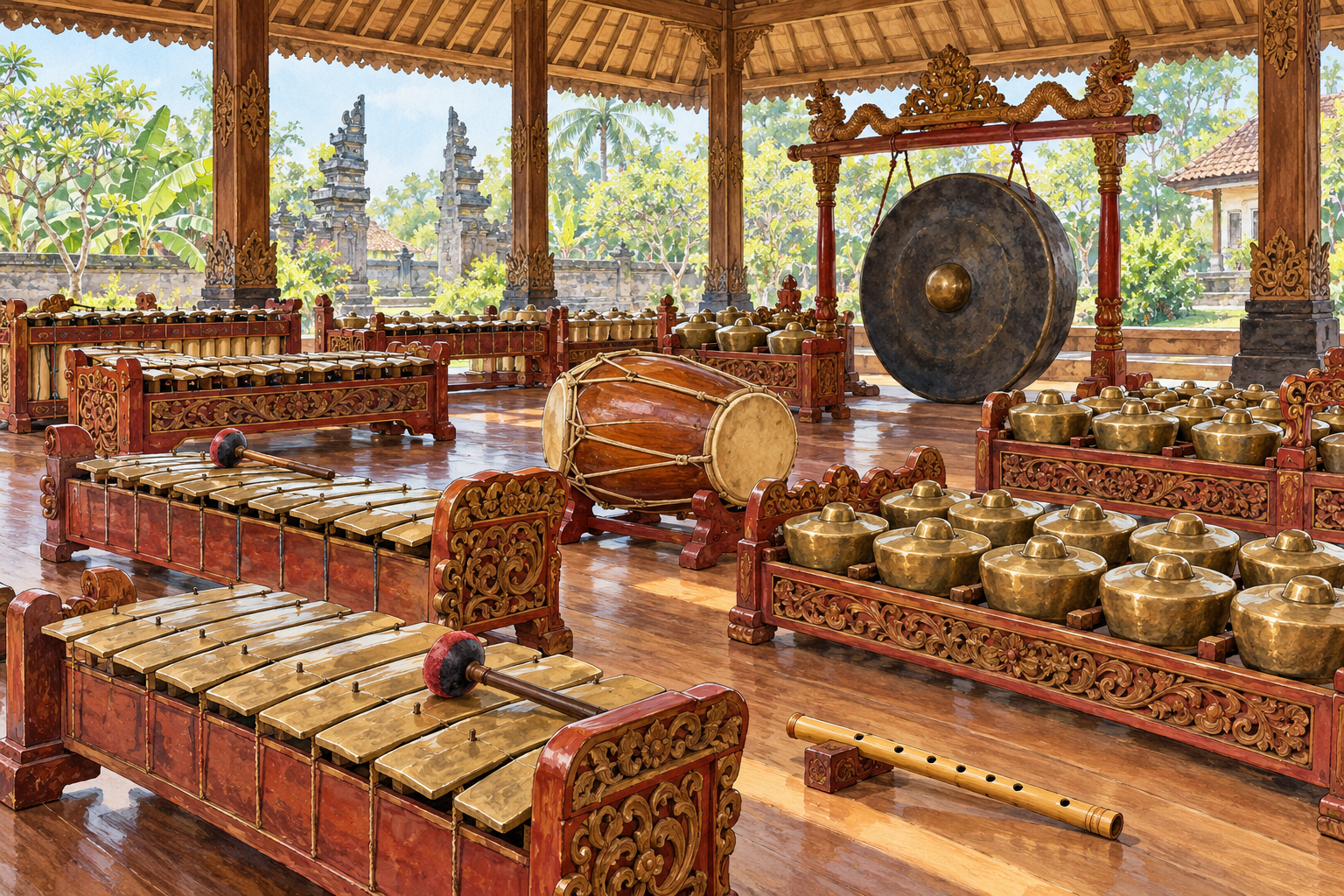
An interpretive gamelan arrangement includes bronze keys, kettle gongs, a hanging gong, drum and flute.
Generated illustration of a generalized gamelan arrangement. It is not a documented ensemble or a diagram of any particular set’s tuning.

The deep resonance of a gong, the clear attack of bronze keys and the movement of many overlapping parts can make a gamelan immediately recognizable. But “gamelan” does not name one instrument, one tuning or one uniform Indonesian musical style. It refers to ensembles and traditions whose details depend on place, purpose and history.

Central Javanese, Sundanese and Balinese practices differ, and there is variation within those broad descriptions. Understanding a particular performance begins with identifying the ensemble and the tradition in which its players are working.

Two tuning categories in a Javanese example

In Central Javanese gamelan, two important tuning categories are sléndro and pélog. Sléndro has five pitch positions per octave, with comparatively even spacing. Pélog has seven, with more conspicuously unequal intervals; particular pieces often emphasize selected groups of pitches.

Those descriptions are starting points. They do not mean every sléndro ensemble shares exactly the same frequencies, or that pélog is simply a Western scale with a different name. Individual gamelan sets can have distinct tunings that contribute to their character.

Central Javanese categoryIntroductory description
SléndroFive pitch positions, comparatively even spacing
PélogSeven pitch positions, unequal intervals and selected pitch groupings

A full ensemble may include separate instruments for the two tunings. Moving an instrument from one set into another is not automatically like swapping two identical piano keys. Its pitches and sound belong to relationships among the ensemble's components.

The music lives between the parts

Gamelan commonly includes metallophones and gongs, but other instruments and voices can be important. Depending on the ensemble, these can include drums, a wooden xylophone, a bowed rebab, plucked strings and a bamboo suling.

Different parts organize musical time in different ways. Some mark larger structural moments, while others articulate a melody or provide more elaborate patterns around it. The listener can move attention between a repeating cycle and the activity unfolding within it.

Learning also involves those relationships. Musician and scholar Sumarsam's introductory Javanese materials emphasize listening, observing and playing with others. Notation can assist learning, but knowing a written sequence does not by itself supply the full experience of how one part fits the ensemble.

The same caution applies to a diagram of a scale. Frequencies alone do not explain phrasing, timing, instrumental color, ensemble interaction or the context of a performance.

Hear a particular ensemble

The Smithsonian's Javanese gamelan concert resource identifies pieces and their tuning and modal settings. Its timed program lets a listener connect actual music with names such as sléndro and pélog, rather than treating them as abstract categories.

Other gamelan traditions need their own explanations. The brilliant interlocking textures of many Balinese ensembles, for example, should not be assumed to follow every detail of a Central Javanese introduction. Even within Bali, there are many ensemble types and purposes.

The useful discovery is that tuning can be part of an ensemble's identity. Musicians make a shared sound with instruments designed and learned in relation to one another. Listening to that collective voice reveals much more than asking which Western notes it resembles.

Sources and further reading: Sumarsam: Introduction to Javanese Gamelan; Smithsonian National Museum of Asian Art: Javanese concert resource; The Met: Sléndro saron panerus.

Explore more creative discoveries at Incoprea.
The Kora: Two Hands, Many Musical Lines

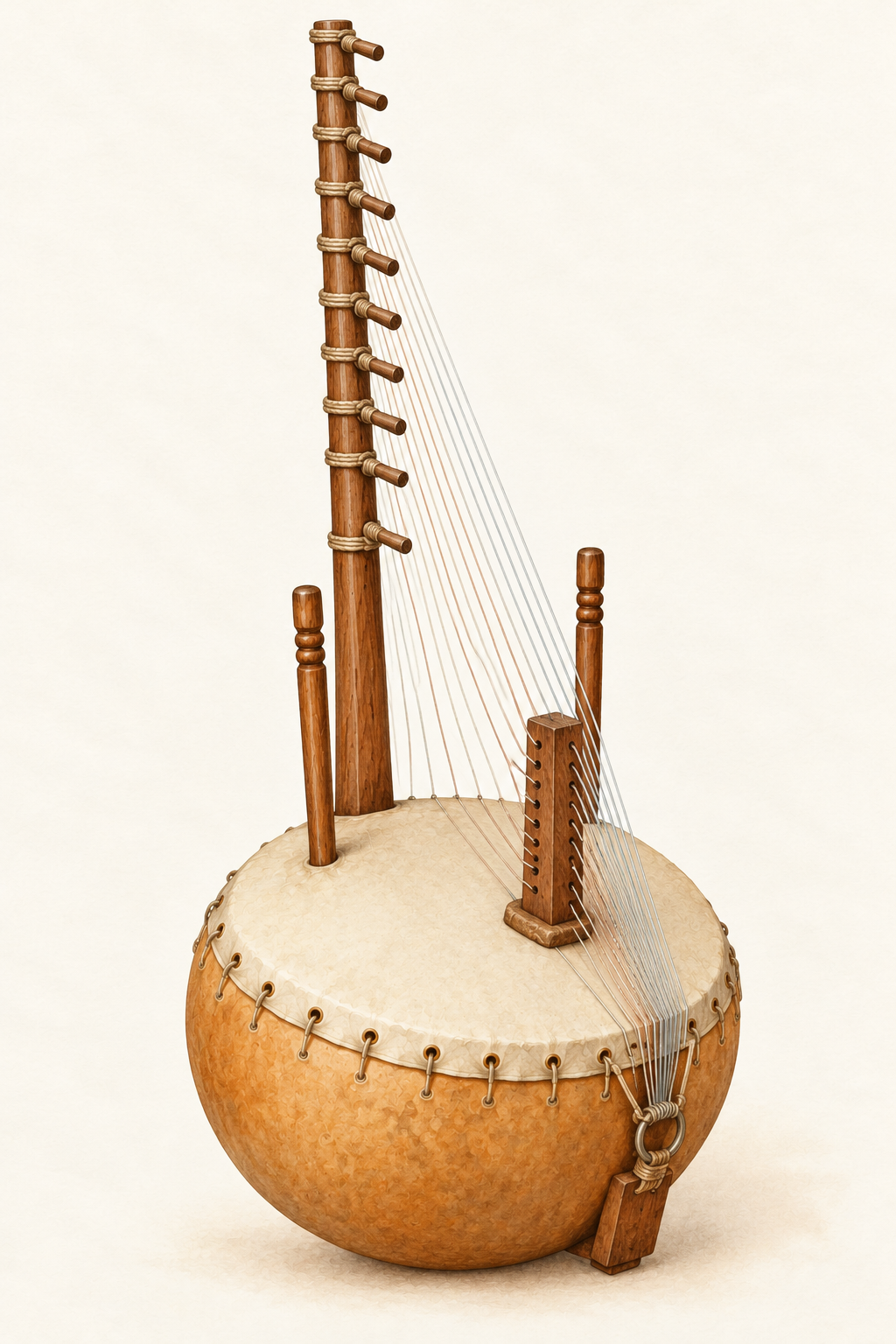
An interpretive kora has a long plain neck, handles, gourd body and a separate upright bridge.
Generated illustration of a generalized kora design. String arrangement and dimensions are stylized; it is not a measured instrument diagram or a specific historical artifact.

A kora's appearance is distinctive: a long wooden neck rises above a hide-covered gourd, with strings passing through a tall bridge. Its sound can seem equally surprising, as repeating patterns and flowing melodies emerge from the same player's hands.

The instrument is strongly associated with the Mandé region of West Africa and with jali or jeli traditions of musicianship, storytelling and social knowledge. Its musical importance extends beyond the sound of plucked strings.

A gourd becomes a resonator

A common kora has 21 strings, arranged in two rows on either side of an upright bridge. The bridge stands on the hide soundboard covering a calabash resonator. The long neck supports the tension of the strings, while handles help the player hold the instrument in position.

The player plucks with the thumbs and index fingers of both hands. Different notes are distributed between the rows, so the arrangement rewards coordinated movement rather than the fingering used on a fretted guitar. The instrument is generally classified as a harp, although “harp-lute” also appears in discussions of its distinctive construction.

Materials and designs have changed. Museum examples preserve older string materials and leather tuning attachments; contemporary makers can use nylon strings and mechanical tuning systems. The 21-string description identifies a common form, not a prohibition on instruments with additional strings.

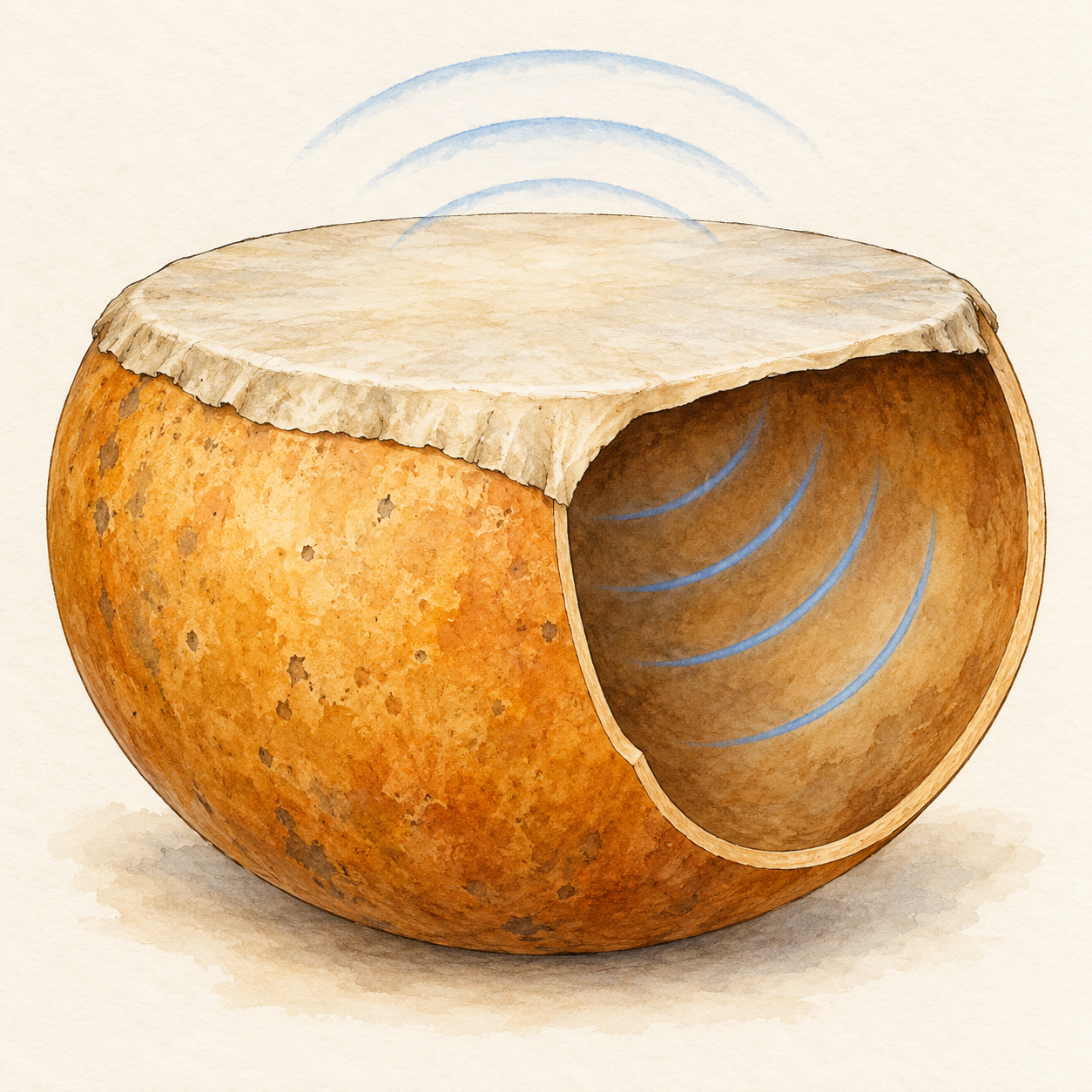
A conceptual cutaway shows a gourd cavity covered with a hide soundboard and abstract sound curves.
Generated conceptual illustration of a kora’s resonating body. The cutaway and blue sound curves are explanatory, not measured acoustic modes or construction instructions.

Patterns interlock

A player can maintain a repeating accompaniment while adding melodic and rhythmic variations. The resulting texture may suggest several musical parts, even though the coordination happens in two hands. Listening closely reveals how repetition gives the changing material a foundation.

The mechanics are only one aspect of the tradition. In the communities where jali or jeli roles are inherited, musicians can also be keepers of histories, praise, family connections and social relationships. Not every modern kora player occupies the same role, and the cultural setting should not be reduced to a generic description of “African music.”

Yacouba Sissoko's Carnegie Hall educational resources provide a specific personal account. Born in Kita, Mali, into a jeli family, he began learning the kora and its associated oral traditions from his grandfather. His later work includes sharing that knowledge with learners and collaborating across musical settings.

Watch the hands, then listen to the whole

Carnegie Hall's materials with Yacouba Sissoko include videos and listening resources. Begin with the hand movements, then follow a repeated pattern underneath a changing phrase. This is a better introduction to the instrument's musical possibilities than counting strings alone.

The accompanying cutaway simplifies the gourd and hide soundboard to explain the resonating body. It leaves out the rest of the instrument rather than pretending to be a maker's technical plan.

A kora performance brings together construction, coordination and knowledge carried between people. Its shimmering texture is an invitation to hear both the player's individual choices and the traditions within which those choices become meaningful.

Sources and further reading: The Met: Kora construction, history and technique; Carnegie Hall: Malian traditions with Yacouba Sissoko; Sierra Leone National Museum: Kora collection record.

Explore more creative discoveries at Incoprea.
Sámi Joik: A Voice That Holds Relationships and Memory

An interpretive singer in contemporary clothing performs beside a microphone.
Generated interpretive illustration of solo vocal performance. It does not depict a named Sámi artist, documented joik performance or traditional costume.

A musical portrait need not describe a person in a sequence of verses. In Sámi joik traditions, a voice can evoke a person, an animal or a place through a distinctive musical expression. The relationship is central: the performance is not simply a tune with an interesting subject attached.

The Sámi Information Centre describes joik as a tradition of memory. People, places and experiences can be brought into shared remembrance through it. That offers a different starting point for listening than asking whether a piece has the familiar structure of a popular song.

More than singing about something

The centre explains a distinction often expressed by practitioners: one joiks something, rather than merely singing about it. This phrasing emphasizes the connection between the performer and what is evoked. A personal joik can express affection and maintain a relationship in memory.

Such explanations should not be turned into a rule that every Sámi person has an identical musical experience. Traditions vary, people have different relationships to them, and historical suppression disrupted their transmission. Living performers and communities are the appropriate guides to their own practices.

The terminology also varies across the Sámi area. The centre discusses South Sámi vuollie, North Sámi luohti and the distinct Skolt Sámi leu'dd tradition. Recognizing those differences is more useful than treating all Sámi vocal music as one standardized sound.

A living practice, not a frozen relic

Joik has faced opposition, including religious condemnation and broader pressures on Sámi culture. It has also continued through families, performers, recordings, teaching and new artistic work. Both the difficulty of transmission and the creativity of present-day musicians belong in its history.

At Nord University, composer and performer Frode Fjellheim presents joik as a form of communication that requires cultural understanding. His teaching encourages attention to language, history and relationships, rather than listening only for an unusual vocal effect.

Contemporary artists may work with ensembles, electronic sound or other musical settings. Innovation does not automatically make a tradition less meaningful. The useful questions are who is creating the work, what they intend and how they situate it within their own experience.

Listen with the performer in view

Smithsonian Folkways' archival joik recording page credits individual performers, including Per Henderak Haetta and Inga Susanne Haetta. Its historical album title uses older terminology; the credits and context help identify the people behind the recordings.

An archive is one encounter with particular performances, not a complete portrait of Sámi music today. Pair it with the Sámi Information Centre's explanation and contemporary practitioners' accounts.

The interest of joik lies in what a voice can carry: identity, recognition, memory and relationship. Careful listening begins by making room for those meanings, rather than reducing the tradition to a sound to imitate.

Sources and further reading: Sámi Information Centre: Joik and memory; Nord University: Frode Fjellheim on joik as communication; Smithsonian Folkways: Archival joik recordings and performer credits.

Explore more creative discoveries at Incoprea.
Inuit Snow Goggles: A Clever Design for an Overwhelmingly Bright World

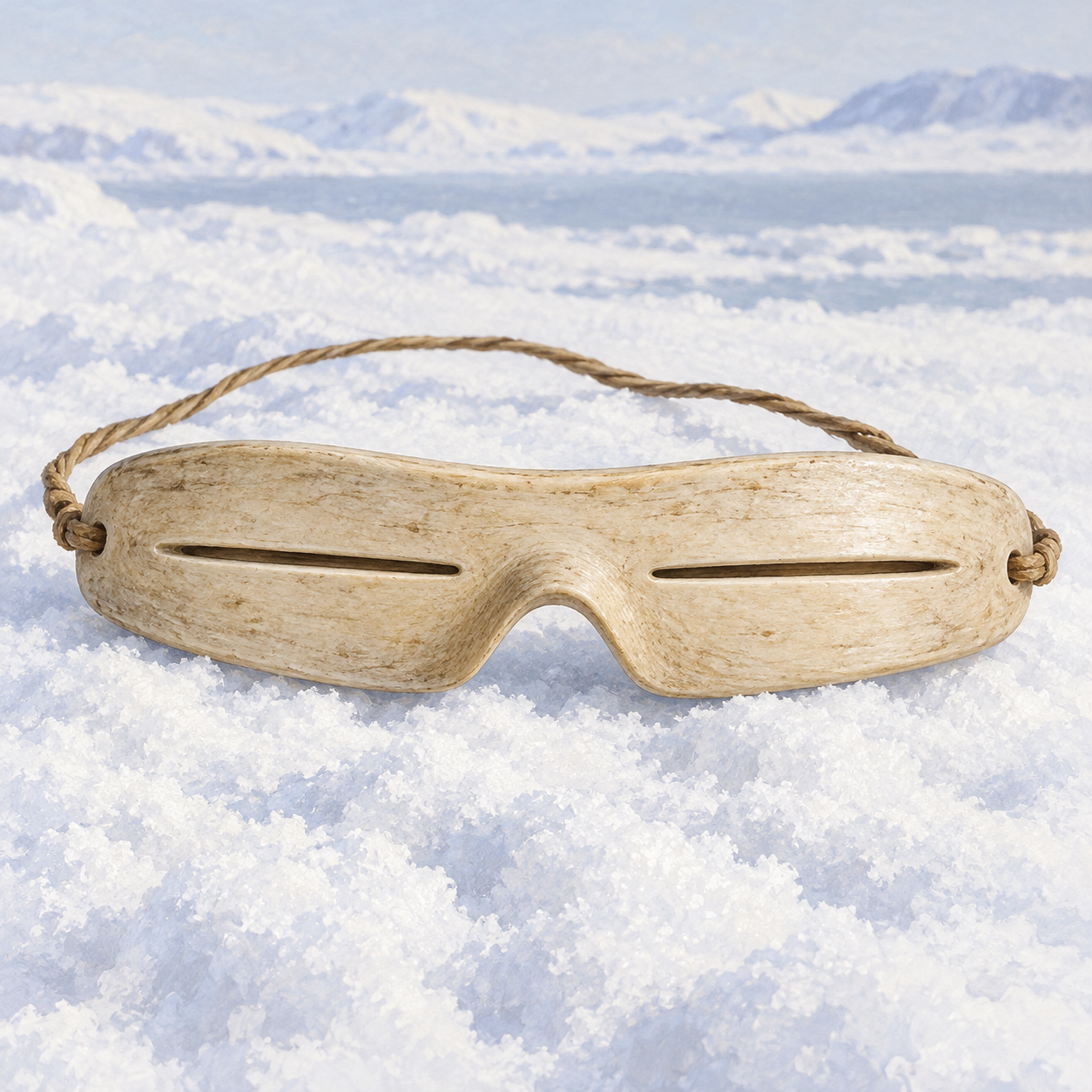
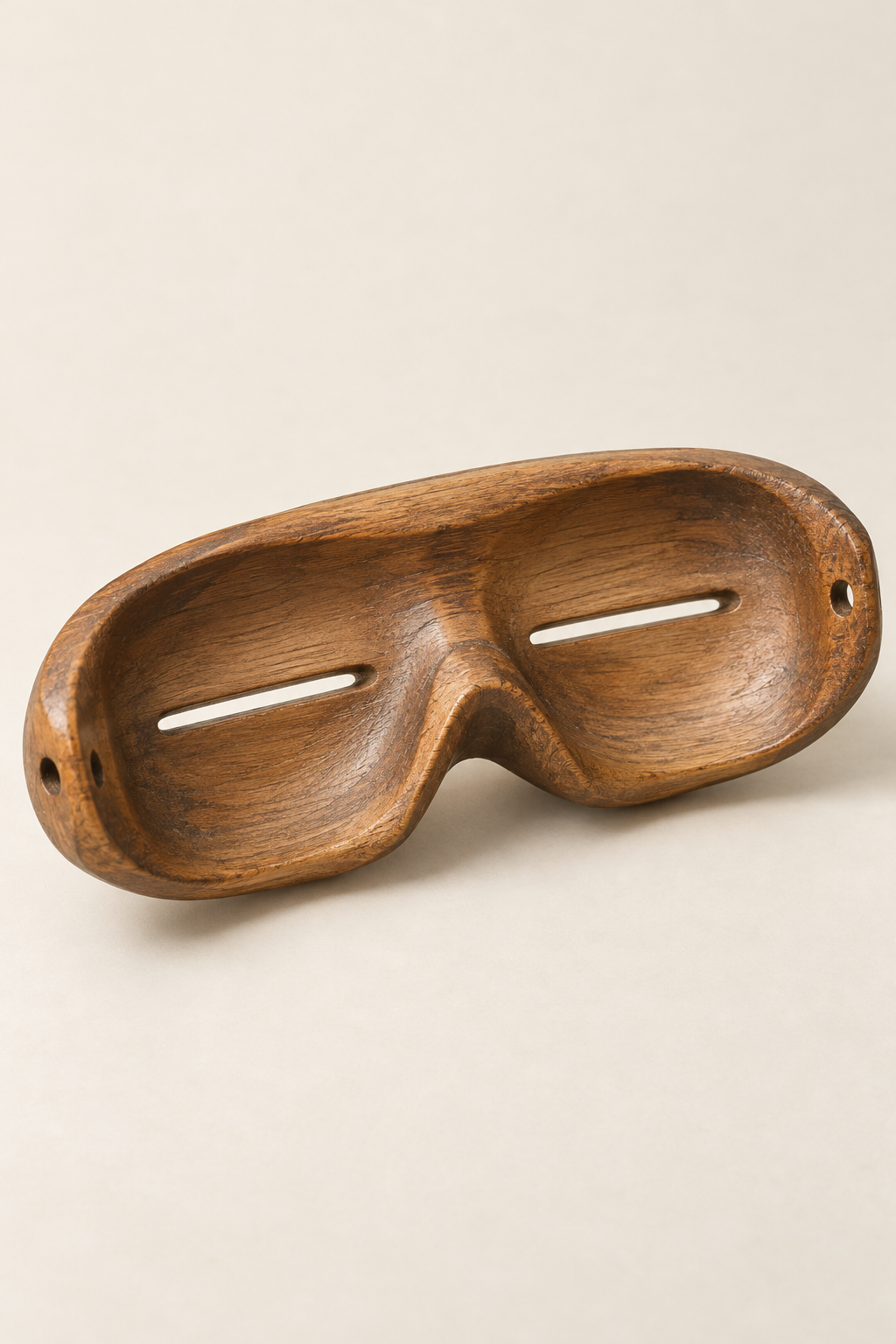
An interpretive pale carved frame has two narrow horizontal slits and a cord against snow.
Generated explanatory illustration of a general snow-goggle design. It is not an authentic artifact, exact replica or attribution to a particular maker or community.

Some of the most striking Arctic eyewear has no glass at all. A carved frame fits close to the face, with narrow slits admitting a restricted view of the landscape. Snow goggles made by Inuit and other Arctic peoples demonstrate how a practical design can emerge from close knowledge of a demanding environment.

Snow and ice can reflect intense light, while wind carries ice particles toward the face. Effective equipment has to work in those conditions using materials, craftsmanship and forms suited to the people who wear it.

Let in a useful view, reduce the glare

The narrow openings restrict the light entering the eyes while allowing the wearer to see ahead. The solid frame shields surrounding parts of the face and helps keep windblown material away. A contoured shape and a cord secure the object in position.

The design does not depend on dark tinted lenses. It reduces exposure through the size and placement of the openings. This makes the silhouette immediately recognizable: a long pale or wooden frame divided by a nose bridge, with openings that look almost impossibly slender.

Actual examples vary. A Smithsonian record describes St. Lawrence Island Yupik goggles with nine narrow horizontal slits, arranged somewhat like blinds to provide a broad field of view. It is a useful reminder that one familiar two-slit image cannot represent every Arctic maker's solution.

An interpretive inner view of plain wooden slit goggles shows their concave carved surfaces.
Generated explanatory illustration of a wooden snow-goggle design and its carved fit. It is not an actual artifact or a replica attributed to a particular community.

Materials and individual choices

Museums preserve goggles made from different materials. The Metropolitan Museum of Art holds an Inuit child's pair from the Hudson Bay region, dated around 1900, made from antler, pigment and sinew. Its scale shows that such equipment was also adapted for children.

The same museum records an older pair from Alaska, attributed to Thule culture and dated approximately 800–1200, carved from walrus ivory. Engraved details give it a distinctive appearance. The museum explains that these designs were significant to its owner or maker; reducing the object to a generic optical gadget would overlook that aspect.

Inuit, Yupik and the historical Thule attribution should not be treated as interchangeable labels. These examples come from particular regions, communities and periods. Their similarities are interesting, and their differences deserve attention.

A sophisticated object can look simple

A pair of goggles contains choices about opening width, the field of view, fit, strength and material. Those choices are informed by use, not merely by abstract geometry. An object with few parts can still embody considerable expertise.

The Met's older goggles record includes detailed images and an audio feature. Comparing it with the Inuit child's pair makes the variation concrete.

The generated illustration here is a general explanatory design, not a replica of either artifact. The museum records provide the actual objects and their provenance. Together, they encourage a better kind of looking: notice both the ingenious response to glare and the people whose craftsmanship made that response usable.

Sources and further reading: Smithsonian: St. Lawrence Island Yupik snow goggles; The Met: Thule snow goggles from Alaska; The Met: Inuit child’s snow goggles.

Explore more creative discoveries at Incoprea.
Songlines: Learning From Knowledge That Connects People and Country

An original landscape illustration shows red desert earth, rocky ridges and a starry dusk sky.
Generated landscape illustration evoking arid Australia. It depicts no named cultural site, songline route, traditional artwork or ancestral narrative.

A route can be described by distances and coordinates. It can also be known through places, stories, relationships and performance. Publicly shared accounts of Aboriginal Australian songlines reveal ways of connecting knowledge with Country that reach far beyond a line drawn on a map.

There is no single songline tradition that can stand for every Aboriginal people. Names, languages, responsibilities and forms of knowledge differ. A useful introduction begins with a specific example shared by its custodians, rather than treating diverse cultures as one anonymous source of information.

A public example: the Seven Sisters exhibition

The National Museum of Australia's Songlines: Tracking the Seven Sisters exhibition was developed with senior custodians from Martu Country, Ngaanyatjarra lands and Anangu Pitjantjatjara Yankunytjatjara lands. It presents sections of five songlines from Australia's Western and Central Deserts through artworks, objects, song, dance and multimedia.

The project began with Elders' concern about preserving knowledge for future generations. Community-nominated senior knowledge holders formed a curatorium that directed the cultural representation in collaboration with the museum. They were not simply advisers asked to approve a finished outside account.

That process is part of what makes the exhibition valuable. The audience encounters knowledge that people have chosen to share, presented with identifiable communities, artists and custodians.

Place, law and memory belong together

In the museum's public explanation, songlines connect ancestral narratives with features of the landscape. They can carry knowledge of significant places, water, food, law and ways of living, while helping pass that knowledge between generations.

Navigation is one aspect of this relationship, but “an ancient GPS” is too narrow a description. A coordinate system does not by itself express responsibility, family connection or the meaning of an ancestral account. The knowledge concerns how people live in relation to Country as well as where they travel.

Performance and art can make these connections present in ways that a short written summary cannot reproduce. The exhibition's paintings, weaving, voices and films should be understood as the work of named people within particular traditions, rather than as interchangeable examples of a decorative style.

Listening through the door that is offered

Public sharing does not erase custodianship or mean every detail is available for unrestricted retelling. Learning from the exhibition also means respecting the context in which its knowledge holders chose to speak. This article stays with that publicly presented context and does not attempt to reproduce restricted teachings.

The museum's audio journey, presented by Alison Page, Duncan Smith and Ursula Yovich, offers a fuller encounter than a diagram could. The museum notes that the journey contains sexual references, and that its site includes voices, images and names of people who have died.

Songlines invite an unfamiliar reader to consider knowledge as a lived relationship among people, place and inherited responsibilities. The respectful next step is to follow the voices and resources that custodians have made public, with attention to who is speaking and which Country they are speaking about.

Sources and further reading: National Museum: About Songlines and community direction; National Museum: Songlines exhibition and films; National Museum: Project origins and publicly shared explanation.

Explore more creative discoveries at Incoprea.
Herculaneum Scrolls: Reading a Library Without Opening Its Pages

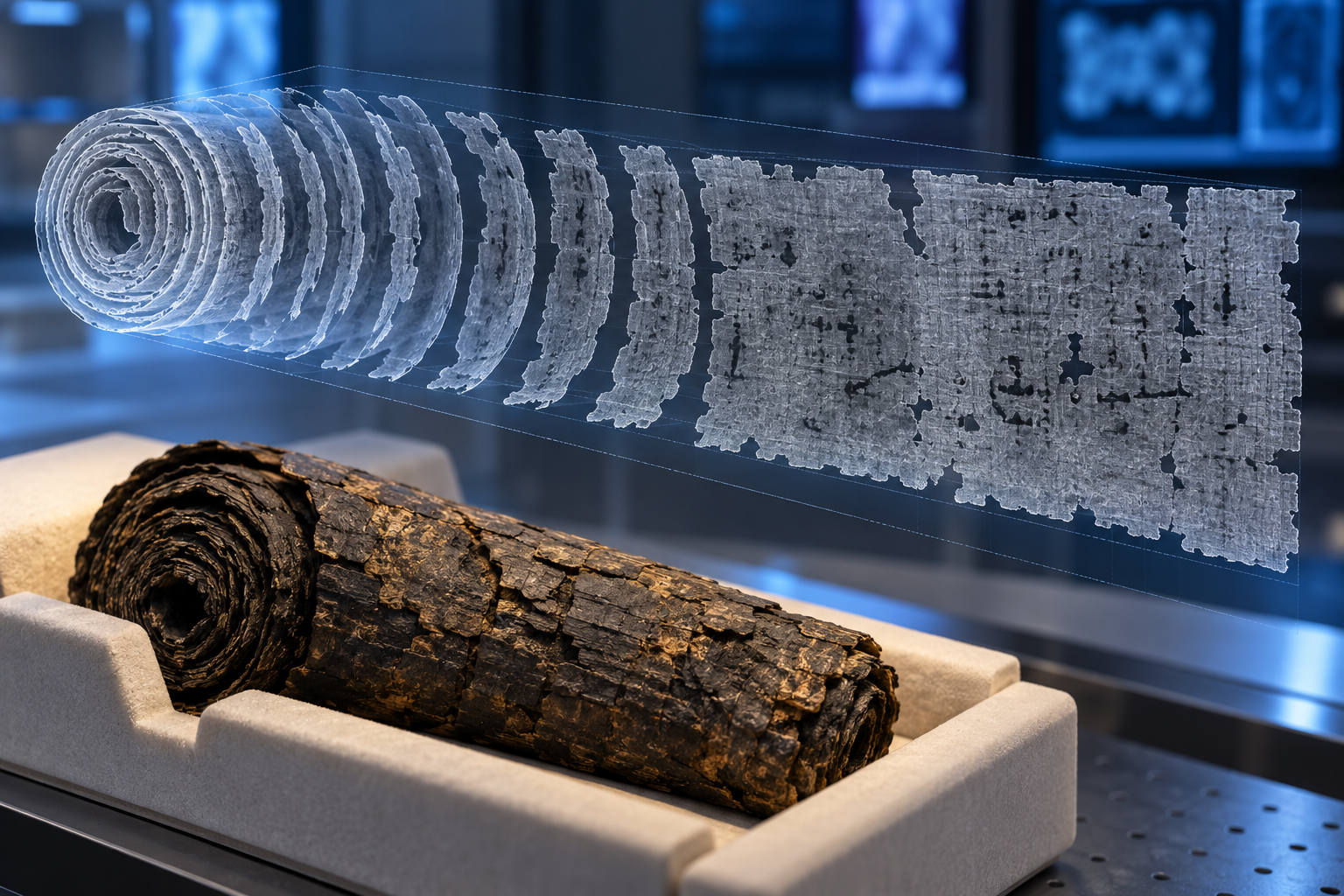
A conceptual carbonized scroll rests in a cradle beneath an abstract visualization of digital layers flattening.
Generated conceptual illustration of virtual unwrapping. The scroll, scan layers and marks are invented visual examples, not actual scan data or recovered text.

At first glance, a carbonized Herculaneum scroll can resemble a lump of charcoal. It is actually a fragile rolled document, transformed by the eruption of Mount Vesuvius in 79 CE. Its text may survive inside, but physically separating the layers can destroy the very evidence a reader hopes to recover.

Virtual unwrapping tackles that contradiction. Researchers scan the object, trace its internal surfaces digitally and produce flattened views of the papyrus. The physical scroll can remain closed while a representation of its pages becomes available for study.

Find the surface before reading the ink

High-resolution X-ray tomography creates a three-dimensional record of internal structure. It is not an ordinary photograph that sees directly through the outer layers. Many projections are combined to reconstruct a volume, within which researchers identify the papyrus surfaces.

Tracing those surfaces is called segmentation. The layers can be compressed, distorted or broken, making it a difficult geometrical problem. Once a surface has been identified, software can flatten its representation. The resulting image needs to preserve the relationship between marks and the actual scanned material.

Ink introduces another challenge. Carbon-based ink on carbonized papyrus can be hard to distinguish. Machine-learning methods help detect subtle evidence associated with ink in the scan data. They are tools for interpreting measured features, not a legitimate way to invent plausible ancient sentences where evidence is missing.

Progress from individual words to sustained text

The Vesuvius Challenge, launched in 2023, accelerated work by sharing scan data and encouraging researchers to improve the methods. Early milestones demonstrated that writing could be detected inside still-rolled Herculaneum material.

A February 2025 Bodleian announcement described successful imaging inside PHerc. 172, one of its scrolls. Further progress was reported by the University of Kentucky in June 2026: the surviving portion of PHerc. 1667 had been virtually unwrapped, yielding nearly 1.5 meters of text across approximately 20 columns. The announcement also reported more than 70 recovered columns from PHerc. 172.

“Surviving portion” is a meaningful qualification. A damaged fragment of a roll is not necessarily a complete ancient book. Likewise, recovering an image, reading letters and establishing the identity of a work are separate stages, each requiring its own evidence.

Some newly recovered material has supplied book titles associated with the Epicurean philosopher Philodemus. Other authorship questions remain open. The 2026 researchers treated a possible Stoic attribution cautiously rather than presenting an attractive candidate as a certainty.

Imaging becomes scholarship

Papyrologists and other specialists assess handwriting, reconstruct damaged words and interpret the results in their historical and philosophical setting. A technological breakthrough makes that scholarship possible; it does not replace it.

At the same time, conservation remains central. A digital representation can let many researchers examine evidence without repeatedly handling a vulnerable artifact. Better methods may also help revisit images whose first readings were incomplete.

Kentucky's 2026 research page includes a film of the virtual unwrapping. Watching the layers become a surface helps explain the process far better than imagining an invisible hand pulling a scroll open.

The achievement is a new relationship between preservation and access. A library that survived physically but was largely unreadable can gradually become legible, one measured surface and carefully interpreted passage at a time.

Sources and further reading: Bodleian: Inside PHerc. 172, February 2025; University of Kentucky: June 2026 recovery announcement; EduceLab: Verifiable recovery methodology.

Explore more creative discoveries at Incoprea.

Linear B: The Administrative Notes That Reopened Bronze Age Greek

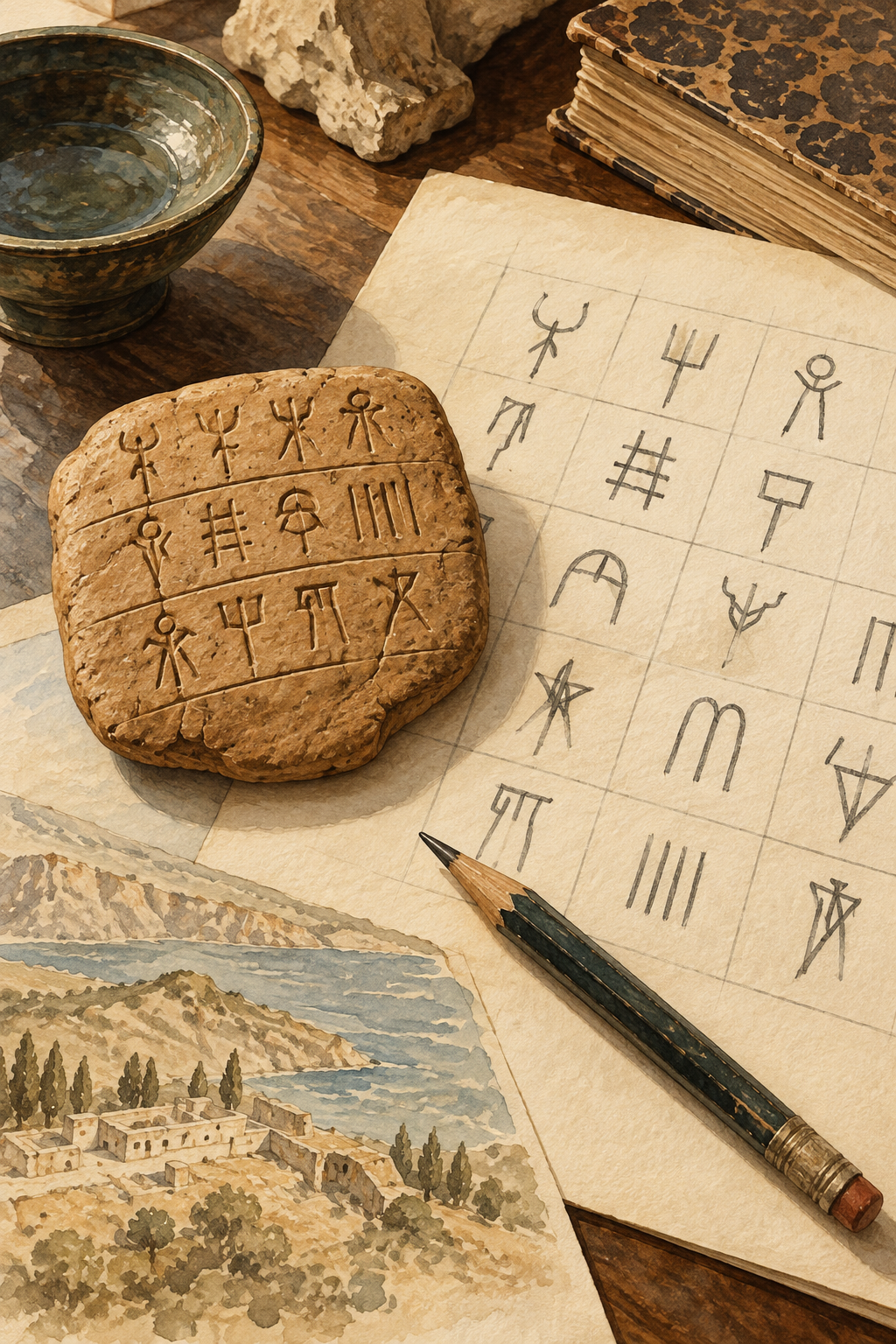
An interpretive clay tablet appears beside a paper grid of abstract signs and a pencil.
Generated illustration of decipherment study. The tablet and sign grid are invented visual examples, not authentic Linear B records or a valid translation key.

The clay tablets were not written to impress future readers. They recorded allocations, goods, livestock and people in Bronze Age palace administrations. Yet the effort to understand their script, Linear B, became one of the twentieth century's most celebrated decipherments.

In 1952, Michael Ventris reached the crucial conclusion that Linear B recorded an early form of Greek. The result changed what scholars could know about the Mycenaean world. It also showed how far careful pattern analysis could go when no straightforward bilingual key was available.

Patterns before a language name

Decipherment requires more than matching a mysterious sign to a familiar letter. Researchers must determine what the signs represent, how words behave and whether proposed readings work consistently across texts. A plausible reading of one short passage can be a coincidence.

Alice Kober's work was fundamental. She studied recurring patterns and related word forms without forcing an early assumption about the underlying language. Her analysis helped establish relationships among signs and endings, providing a disciplined framework on which later work could build.

Ventris organized evidence into grids and tested changing hypotheses. Likely place names supplied useful clues to sound values. The Greek interpretation then had to explain the larger body of evidence, rather than merely make one name look convincing.

ClueWhat it could help reveal
Recurring word endingsGrammatical relationships
Likely place namesPossible sound values
Consistent readings across tabletsA test of the proposed language

A breakthrough strengthened by collaboration

Ventris was an architect with an intense interest in the problem. Once the Greek interpretation emerged, he sought the linguistic expertise of John Chadwick at Cambridge. Their collaboration helped develop, test and publish the decipherment, including a scholarly paper in 1953.

The story is therefore larger than a lone flash of genius. Earlier analysis, access to tablet evidence, repeated testing and expertise in Greek all mattered. The surviving research history makes those contributions visible.

Linear B is a syllabic script with additional signs used in administration, including representations of commodities and numbers. Its spelling conventions do not reproduce every sound distinction in Greek. Reading it requires understanding those conventions as well as recognizing individual signs.

What the tablets actually tell us

The recovered language is Mycenaean Greek, considerably earlier than the Greek of classical literature. The tablets illuminate palace economies, workforces, religious offerings and the organization of goods. Their often mundane subject matter is precisely what makes them valuable evidence for daily institutions.

They do not supply a lost collection of Homeric poems. Nor did solving Linear B automatically solve Linear A, a related but different script whose underlying language remains unresolved. Similar-looking signs do not guarantee the same language or the same sound values.

Cambridge's account of the decipherment follows the people and evidence behind the result. What emerged from rows of administrative signs was not just a readable script, but an earlier chapter in the history of Greek—and a model of how patient scholarship can make a bold conclusion testable.

Sources and further reading: Cambridge Classics: Decipherment of Linear B; Cambridge: The decipherment sixty years on; Gonville & Caius: Kober, Ventris and Chadwick.

Explore more creative discoveries at Incoprea.
Ugaritic: An Alphabet Written With Cuneiform Wedges

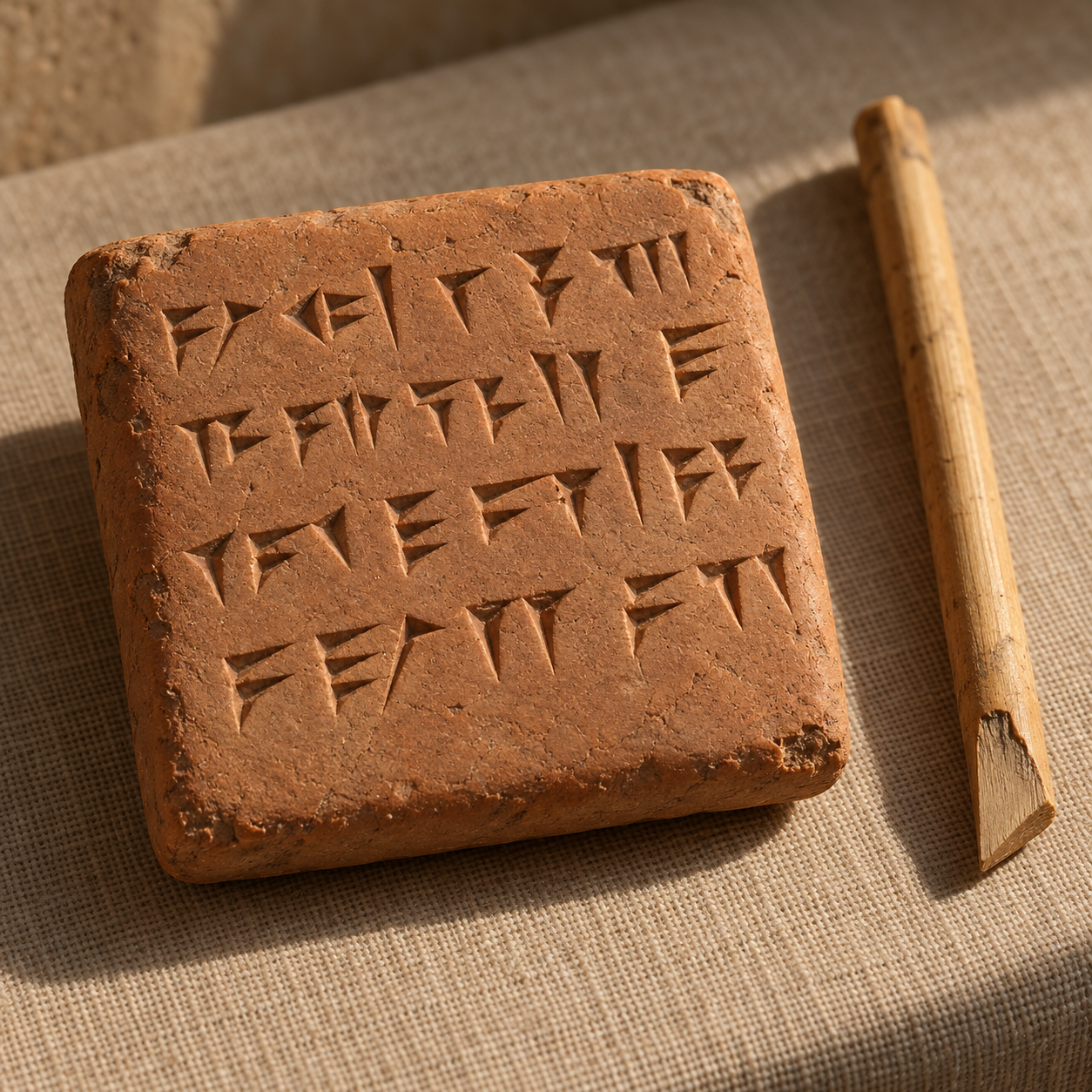
An interpretive clay tablet with wedge-shaped marks rests beside a stylus.
Generated illustration inspired by alphabetic cuneiform. The marks are illustrative, not a transcription, authentic inscription or readable Ugaritic message.

A clay tablet covered with wedge-shaped marks might seem to belong to a single familiar category: cuneiform. But the shape of a mark does not tell you how a writing system works. At ancient Ugarit, scribes used wedges to write an alphabet.

Ugarit stood on the coast of what is now Syria, at the site called Ras Shamra. Its Late Bronze Age texts preserve a world of administration, correspondence and literature. Among them are tablets that show a compact alphabetic system alongside other languages and scripts.

A familiar tool, a different principle

Cuneiform describes writing made from wedge-like impressions. A stylus pressed into clay produces those shapes efficiently. The older Mesopotamian traditions used many signs with word and syllabic values. Ugaritic alphabetic cuneiform applied a different organizing idea to the same writing material and general technique.

The standard long Ugaritic alphabet has 30 signs. It primarily represents consonants, with some special treatment of glottal-stop signs associated with vowels. It is often described more precisely as an abjad. That is different from a syllabary, in which a sign commonly represents an entire syllable.

So two tablets can look broadly similar while encoding language differently. The tool helps explain the visual appearance; the relationship between signs and sounds explains how the text can be read.

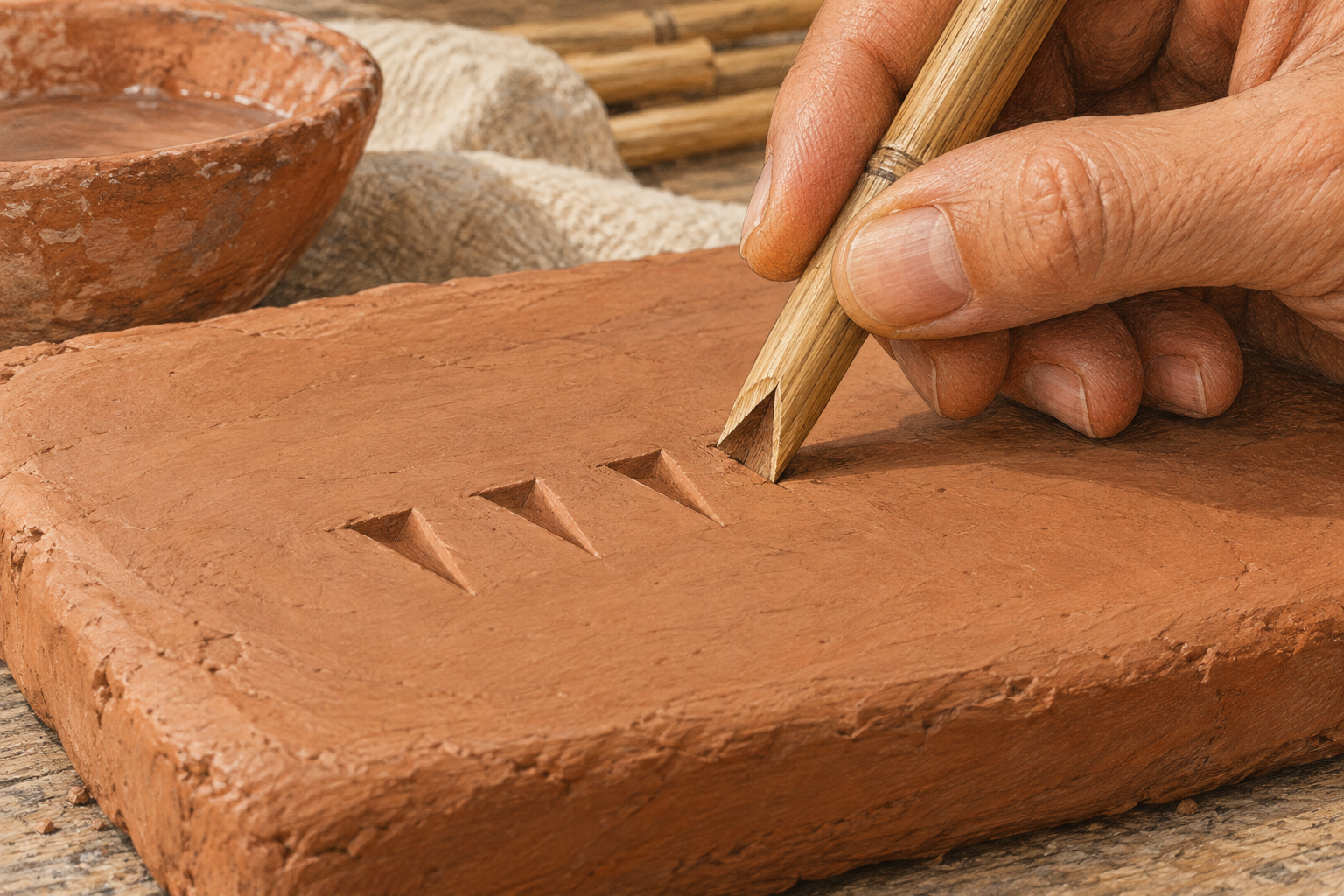
A hand presses a shaped stylus into clay beside a few wedge impressions.
Generated explanatory illustration of making wedge impressions in clay. The marks do not form an authentic inscription, and the hand and tool are interpretive.

School exercises preserve the order

Abecedaries are texts that list alphabetic signs in sequence. Ugaritic examples provide unusually direct evidence for how scribes organized their writing system. A complete standard list contains 30 signs, and the sequence has important relationships with later alphabetic traditions.

The evidence is more varied than one perfect classroom chart. Shorter alphabetic forms and an alternative ordering are also documented. That variation matters when reconstructing how writing circulated and how different scribal communities used it.

Ugarit's multilingual setting is part of the story. Its scribes also used Akkadian cuneiform, including for communication beyond the city. The alphabetic script was not simply a universal replacement for every other writing practice. Different systems served different languages and purposes.

A glimpse of an alternative alphabetic future

Ugaritic texts include lists and contracts as well as literary and religious works. They therefore reveal both the practical work of a city and the stories its scribes preserved. The system was not the world's first alphabet, and the history of alphabetic writing cannot be reduced to one invention in one place.

What makes Ugaritic especially striking is the combination: a small sign inventory expressed through a technique usually associated with much larger inventories. Penn Museum's illustrated discussion compares this route with other paths in alphabetic history.

Modern letters make the alphabet feel inevitable. Ugarit's wedges show that the same broad principle could wear a very different visual form. Written language is both a system of meaning and a technology shaped by hands, tools and materials.

Sources and further reading: Penn Museum: The alphabet’s different histories; Scuola Normale Superiore Mnamon: Ugaritic writing; French Ministry of Culture: Ugaritic abecedary RS 12.033.

Explore more creative discoveries at Incoprea.
Vortex Rings: A Traveling Shape Made Entirely of Motion

A conceptual blue-dyed vortex ring curls through clear water in a dark aquarium.
Conceptual visualization of a dyed vortex ring. Generated illustration, not a photograph or a frame from the research film.

A ring of dye can travel through water while curling around its own circular core. The result looks briefly like a soft doughnut with a life of its own. It is a recognizable pattern made from moving fluid.

A ring is a motion, not a solid object

The Feynman Lectures describe a smoke ring as a torus-shaped bundle of vortex lines. Fluid circulates around the ring's core, and different parts of that circulating flow help carry the structure forward.

Seeing the colored outline is only a beginning. Smoke or dye makes some of the motion visible, while surrounding fluid also participates. The visible tracer should not be mistaken for a rigid boundary enclosing every moving particle.

This is a useful way to look at a familiar effect: a shape can persist because of organized motion. The ring's identity comes from how the fluid moves, rather than from a solid surface holding it together.

Watching order become more complicated

In research reported by Harvard SEAS in 2020, scientists sent differently dyed vortex rings into head-on collisions in a water tank. They combined rapidly scanned imaging with numerical simulations to investigate how the organized structures broke down.

The rings stretched and developed waves. Filaments formed, followed by smaller interacting vortices. The team observed a cascade through three generations of structures, offering a closely examined route toward turbulent flow.

Harvard SEAS research film, Understanding turbulence. Experiment and research context.

The controlled collision does not reproduce every turbulent river or aircraft wake. Its value is that researchers can isolate an interaction, measure it and compare the observations with calculations.

Beautiful pictures can test serious models

Caltech researchers have also modeled underwater bubble rings merging and separating. Their account describes using comparisons with real footage to judge how well simulations captured the evolving geometry.

A bubble ring and a dyed water vortex have different visible ingredients. Both can nevertheless draw attention to curved vortex structures and the difficulty of predicting their interactions. The resemblance encourages questions; it does not make every swirling ring physically identical.

That is part of their appeal. A simple-looking loop gives us something the eye can follow, then reveals stretching, interaction and breakdown that demand much more than a simple picture.

Sources and further reading: Caltech: Feynman Lectures, vortex lines; Harvard SEAS: Unraveling turbulence; Caltech: Bubble rings and ink chandeliers.

Explore more creative work at Incoprea.

Water Hammer: The Invisible Wave Behind a Banging Pipe

A brass shutoff valve with a red wheel joins two copper pipe sections on a pale wall.
A generic pipe and valve, shown calmly because pressure waves inside water are invisible. Generated illustration.

A pipe can make a sharp knock when a valve closes. The sound offers a small clue to an invisible event: moving liquid has been forced to change speed, and a pressure disturbance is traveling through the system.

Water is almost incompressible, not perfectly rigid

A rapidly closing valve interrupts flowing water. Upstream, pressure rises as the liquid decelerates. Water compresses slightly and the pipe wall can expand slightly, allowing energy to be stored elastically rather than making the whole water column stop everywhere at once.

The disturbance propagates along the pipe. Its speed depends on the liquid and the surrounding pipe, including the material and wall properties. It is distinct from the ordinary flow speed: the water need not be racing down a pipe at the speed of the pressure signal.

That distinction is useful in picturing the event. A message about a change in motion can travel through a material much faster than the material itself moves from one end to the other.

The pipe network answers back

Branches, tanks, valves and changes in cross-section can reflect a pressure wave. Several returning disturbances can then combine at the same place. This is why a system's layout matters alongside the initial valve movement.

Surges can also involve falling pressure. If pressure drops sufficiently, vapor-filled regions and separation of the liquid column can occur. The subsequent collapse or reunion of moving columns may create another severe surge. The term water hammer therefore covers more than a single push against a closed tap.

What changesWhy it matters
Flow speedAn abrupt change initiates the pressure disturbance.
Pipe propertiesThey help determine wave propagation and the system's elastic response.
Network geometryReflection points influence where waves return and overlap.

A brief noise can describe a large system

A household knock and a surge in a long pumped pipeline share relevant physics, although their consequences and operating conditions differ. Large installations must account for events such as a sudden pump shutdown as well as normal valve operation.

Engineered controls may change the timing of a flow change or provide somewhere for energy and liquid to go. Their selection depends on the specific installation; the visible valve alone cannot describe the whole response.

The interesting lesson is how much flexibility is hidden inside apparently rigid plumbing. A moving liquid, a slightly yielding wall and a network of reflection points can turn one local action into a traveling event.

Sources and further reading: KSB: Surge pressure; KSB: Why water pipes bang; KSB: Water hammer.

Explore more creative work at Incoprea.

The Theremin: Playing Music in the Space Between Your Hands

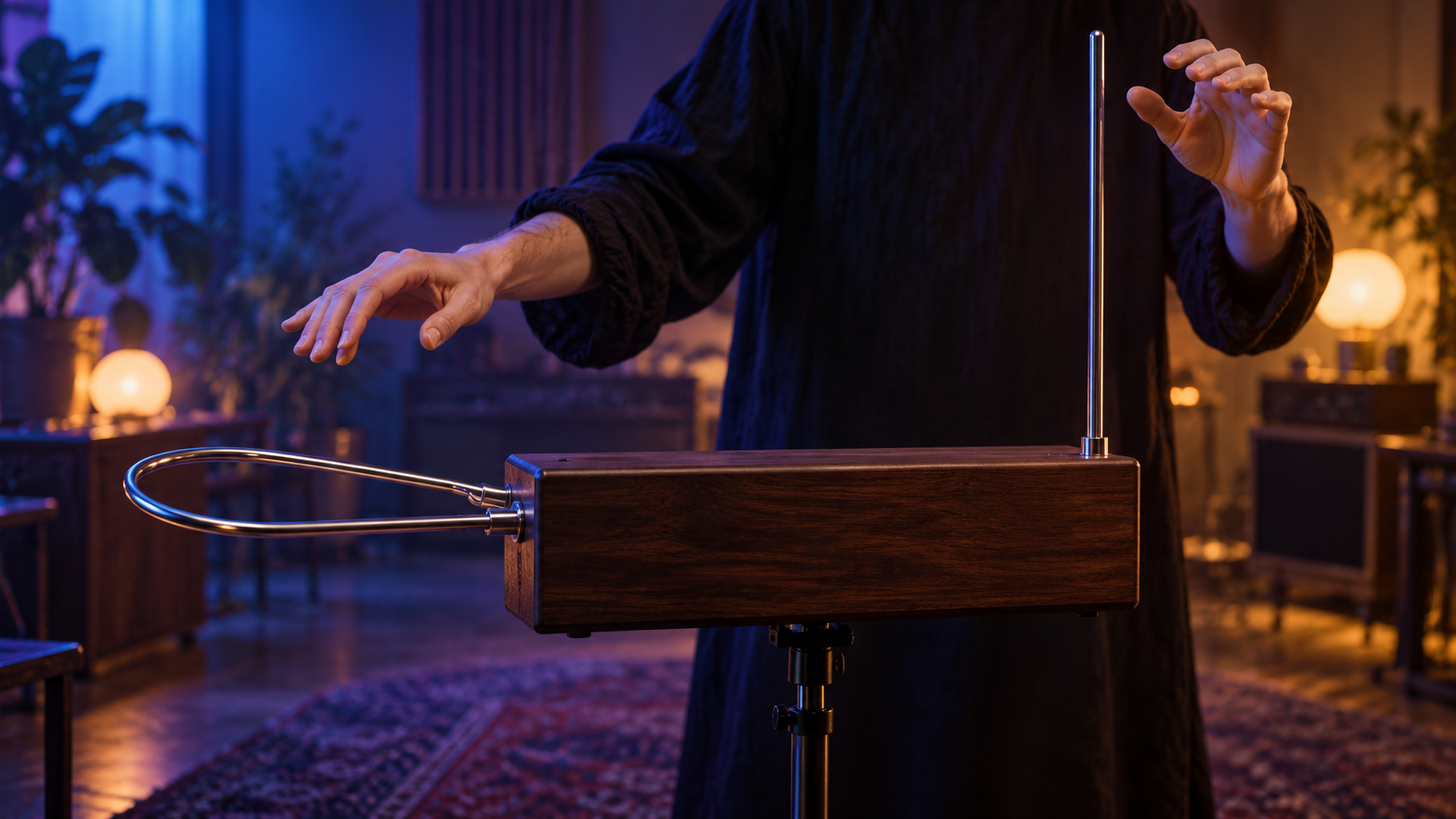
Two hands hover near a theremin with a straight pitch rod and curved volume loop.
An invented performance scene showing the two-antenna arrangement. Generated illustration, not a portrait or a named instrument model.

A musician raises a hand beside a metal rod, and a note slides upward. The hand touches nothing. At the other end of the instrument, another hand shapes the loudness beside a curved loop. The theremin turns the space around its player into a musical interface.

Two gestures, two musical jobs

On the traditional two-antenna arrangement used by Moog's Etherwave, the straight antenna controls pitch and the loop controls volume. That division lets a player shape the height of a note separately from its entrance, sustained strength and ending.

There are no frets or piano keys to provide a physical landing place. A movement between pitches can remain audible as a continuous slide. To make a phrase sound deliberate, the performer must coordinate where the pitch settles with how the sound is articulated.

Moog also explains that the instrument is sensitive to its immediate surroundings. Nearby objects are part of its electrical surroundings, so placement and adjustment matter before a performance begins.

The body participates in an electrical circuit

The antennas respond to changes in capacitance associated with a nearby hand and body. The Bob Moog Foundation describes this as capacitance actuation: a change in the instrument's electrical conditions changes the frequency or amplitude of its sound.

The hand is therefore influencing electronics, rather than vibrating a string or interrupting a visible beam. The graceful appearance can conceal a demanding task: the player continually hears the result and adjusts a gesture in response.

The short sound example below demonstrates a smooth pitch rise and fall. It is an original synthesized tone, not a theremin recording or an imitation of a named musician. Listen for the uninterrupted path between the low and high points.

A concert instrument beyond the eerie effect

Clara Rockmore helped establish the instrument's expressive musical possibilities. The foundation preserves material from Bob Moog's 1993 interview with her and describes the long relationship behind his work repairing the instrument Léon Theremin built for her in the 1930s.

Moog's own connection began with building theremins before his famous modular synthesizers. That history places the instrument within a sustained exchange between musicians and electronics builders.

One familiar recording can confuse the story: the sound on the Beach Boys' Good Vibrations came from an Electro-Theremin with a mechanical pitch control. The foundation distinguishes it from the space-controlled instrument. A similar sliding tone does not necessarily reveal the same playing method.

The distinctive achievement is the combination of electrical sensitivity and practiced human movement. Empty space becomes useful musical territory because the performer learns to navigate it.

Hear a continuous pitch glide

Original eight-second synthesized sine tone demonstrating a smooth rise and fall. This is not a recorded theremin performance or a model of its circuitry.

Sources and further reading: Moog Music support: Tuning the Etherwave; Bob Moog Foundation: Capacitance-actuated instruments; Bob Moog Foundation: Bob Moog interview with Clara Rockmore; Bob Moog Foundation: The theremin and its musical history.

Explore more creative work at Incoprea.

The Phonograph Cylinder: A Voice Stored in a Physical Groove

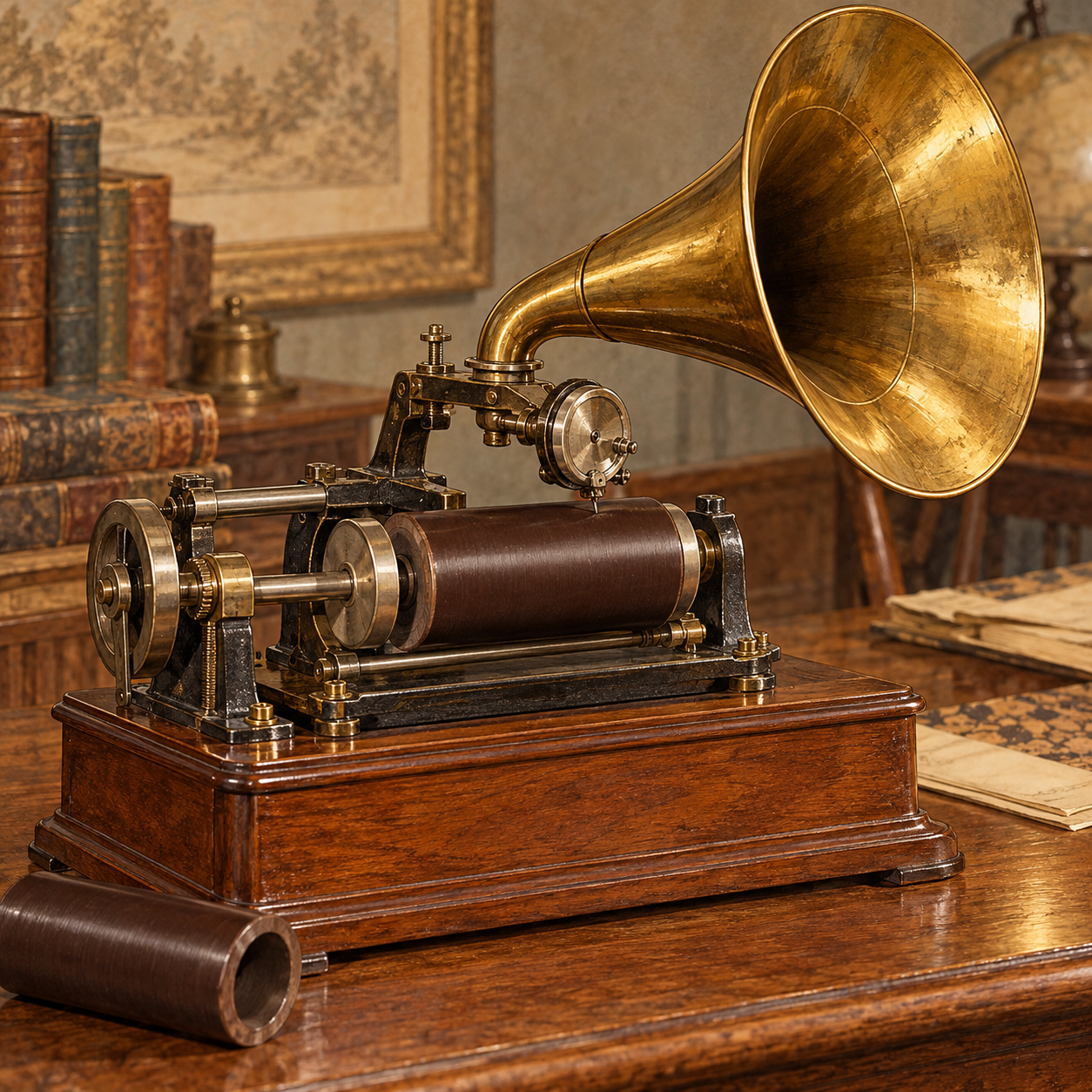
A generalized cylinder phonograph has a horizontal brown record, reproducer and brass acoustic horn on a wooden base.
An invented historical cylinder-phonograph scene. It does not identify the machine or cylinder used for the accompanying 1888 recording. Generated illustration.

A voice can leave a physical path around a cylinder. In early phonographs, a rotating record and a moving stylus converted sound into a groove, then used that groove to make sound again. The recording was a shaped surface that a machine could revisit.

Listening to a surviving cylinder makes the mechanism feel unexpectedly intimate. A brief voice from the nineteenth century is carried through a chain of materials, machines and preservation decisions.

A horn gathered the energy

Acoustical recording used a flared horn to gather sound waves and direct them toward a diaphragm. The diaphragm's movement drove a stylus that marked a rotating recording surface. Playback reversed the process: movement along the groove made a diaphragm vibrate and produce sound.

The Library of Congress describes recording before microphones and electrical amplification, when performers had to work with the horn's limitations. Position mattered. A stronger passage might require moving away, while a quiet sound might call for coming closer.

The process captured a restricted range of frequencies, so different voices and instruments did not emerge equally well. Recording technique influenced what listeners received, long before an engineer could adjust an electronic mixing console.

The cylinder changed as recording developed

Edison's 1877 phonograph used tinfoil on a cylinder. Later work by Chichester Bell and Charles Sumner Tainter, as well as Edison's renewed experiments, helped develop wax-cylinder recording. The familiar cylinder era therefore involved changes in both the machine and its recording medium.

Office dictation was one proposed use, but prerecorded entertainment became an important market. Cylinders carried music, speech and comic performances, making replayable sound part of ordinary listening.

The National Park Service offers an especially direct example: Around the World on the Phonograph, attributed to Thomas Edison and dated approximately late October 1888. The park describes it as the earliest believed surviving recording of his voice, a claim narrower than calling it the first sound recording.

Listen to the preserved 1888 voice recording

National Park Service audio: Thomas Edison, Around the World on the Phonograph, approximately late October 1888, catalog EDIS 566. Context and collection details.

Preservation includes knowing how to listen

Keeping the cylinder is only part of preserving its contents. A transfer requires suitable playback equipment, an appropriate stylus and knowledge of the particular format and condition.

A Library of Congress preservation specialist described using the Archeophone, a modern player designed for historical cylinders. In some damaged examples, playing in reverse could allow the stylus to follow a track that it could not follow normally; software could then restore the direction of the transferred audio.

That example shows why an old recording is not simply waiting for any needle. Physical condition, equipment and expertise influence what can be recovered from the surface.

The resulting sound joins two kinds of survival: a groove remains on an object, and people retain the knowledge needed to interpret it. A short, imperfect voice can become a remarkably powerful connection when that whole chain is preserved.

Sources and further reading: Library of Congress: Making records in the acoustical era; Library of Congress: History of Edison sound recordings; National Park Service: Very early recorded sound; Library of Congress: Preserving audio cylinders.

Explore more creative work at Incoprea.

The Jacquard Card Chain: A Textile Pattern Stored in Holes

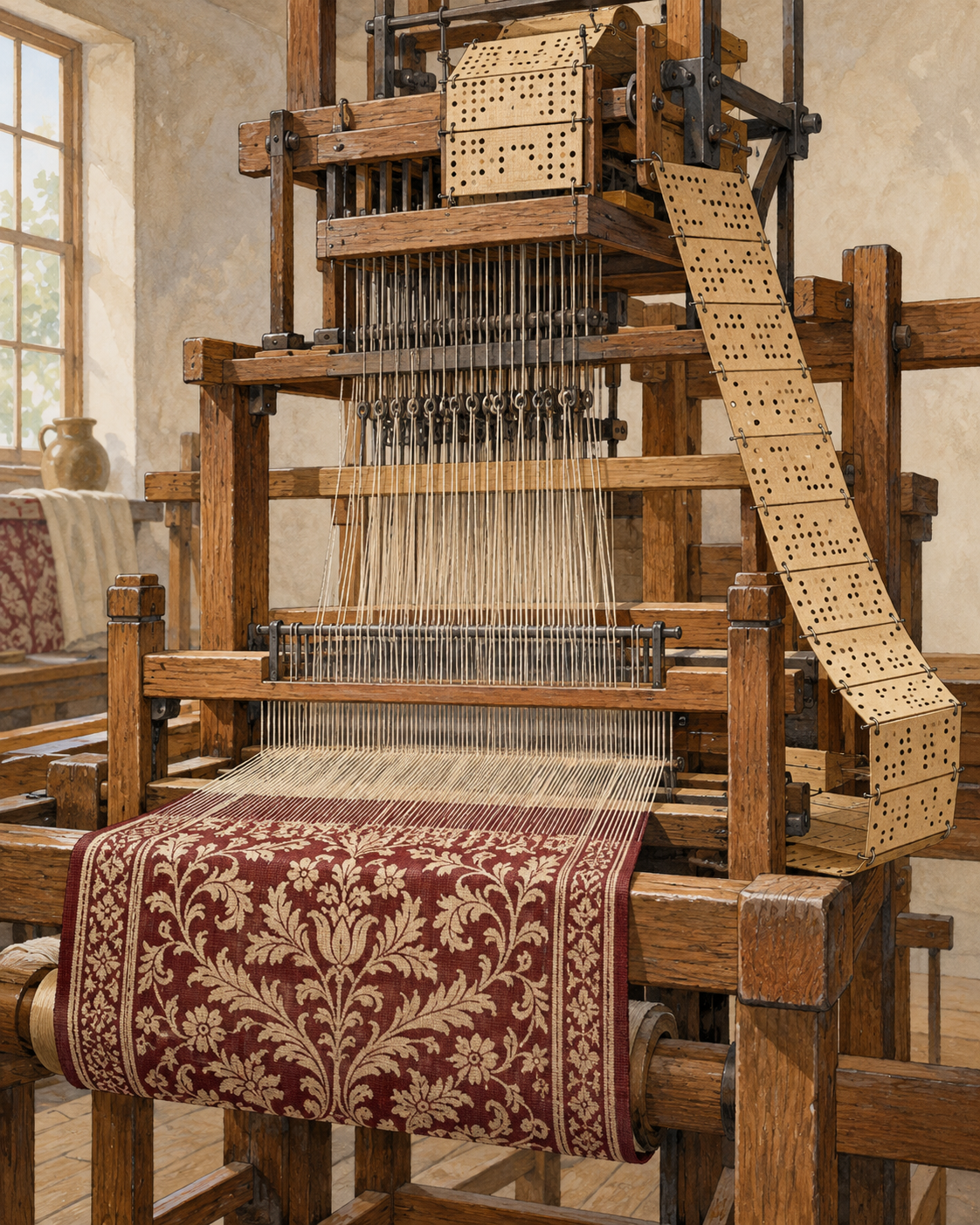
A generalized wooden loom has a hanging punched-card chain and patterned burgundy-and-cream cloth.
An invented historical weaving scene combines a Jacquard-style card chain and cloth. It is not an exact museum machine or a diagram encoding the depicted textile. Generated illustration.

A woven flower can begin as a sequence of holes in stiff cards. In a mechanical Jacquard system, those holes help control which warp threads are raised, turning stored instructions into a pattern that gradually appears in cloth.

The card chain is striking because the design exists in two forms at once: a sequence the machine can read and a textile someone can wear or display. The connection helped inspire later ideas about programmable calculation.

Small decisions accumulate into a pattern

A loom interlaces warp and weft. Producing a complex pattern requires selecting particular warp threads as weaving proceeds. A Jacquard attachment automates that selection through a mechanism responding to punched cards.

The Science Museum Group describes holes controlling a task previously carried out by a weaver's assistant. The pattern is distributed across the card sequence, so the order of the cards matters as much as the arrangement of holes on one card.

The museum also preserves a hand-operated hole punch made for a model Coventry ribbon loom in 1870. That modest tool is a useful reminder that the instructions themselves had to be produced. A machine-readable pattern still depended on preparation and care.

The information can be separated from the cloth

National Museums Scotland's historical handloom has a Jacquard attachment and came from silk weaving in Stonehouse, Lanarkshire. Its account describes thousands of cards laced together for complex designs, with rows of holes corresponding to rows in a textile pattern.

The arrangement lets a pattern be stored outside the woven object. A sequence can guide repeated production, while a different sequence gives the mechanism different selections to make. The physical machine and the instructions are connected, but they are not the same thing.

Part of the processIts role
Pattern designSpecifies the intended arrangement
Punched-card sequenceStores selections the mechanism can read
WeavingTurns those selections into cloth

The textile is therefore evidence of both material skill and organized information. Its flowers and geometric forms are the visible outcome of decisions made earlier.

A loom suggested another kind of machine

Charles Babbage drew on the Jacquard system when developing plans for his Analytical Engine. The Science Museum's discussion of those plans identifies punched-card input alongside calculating and memory mechanisms.

The proposed engine would have handled calculations with mechanical parts such as gears, cams and clutches. The analogy to weaving concerned how instructions could guide a sequence of operations, rather than a loom already performing general-purpose arithmetic.

A museum account of the Jacquard-computing connection shows how a drawn pattern could be transferred to cards and read by the loom head. That passage between representation and action is the especially interesting feature: marks on one medium determine what a machine does in another.

A card can look plain beside the rich fabric it helps create. Yet the holes are part of the beauty's production history. They make a pattern portable, repeatable and available to a mechanism—an early, concrete example of instructions becoming physical results.

See the mechanism: The Science and Industry Museum includes a film explaining the loom-computing connection.

Sources and further reading: Science Museum Group: Jacquard-card hole punch; National Museums Scotland: Jacquard weaving and computing; Science Museum: Babbage's engine plans and punched-card input; Science and Industry Museum: Weaving numbers.

Explore more creative work at Incoprea.

Magnetic Core Memory: The Computer That Restored a Bit After Reading It

An artistic macro view of dark ferrite rings and fine wires within a memory-like metal frame.
A generated artistic detail of ferrite rings and woven wiring. It is not an identified historic artifact or an exact core-plane wiring diagram.

Before memory became a collection of microscopic devices on a silicon chip, a computer could remember with tiny magnetic rings. Viewed close up, a core-memory plane resembles an intricate woven surface: wires threaded through ferrite rings, each carrying a small piece of information.

The construction makes a digital idea unusually tangible. A bit has a place in a physical grid, and changing a magnetic state changes the information stored there.

One ring can represent one bit

A core can be magnetized in two opposite directions, assigned the meanings zero and one. A plane contains many such cores, with wires arranged to select and operate on them. The wire network is essential to the memory, rather than merely a way to fasten its parts together.

The Computer History Museum places core memory in MIT's Whirlwind computer in 1953. It credits Jay Forrester with perfecting the technology while acknowledging that several inventors contributed to its development.

The underlying idea separates a value from its ordinary appearance. A ring need not visibly change color or position when a bit changes. Electronics create and detect the magnetic condition that encodes the value.

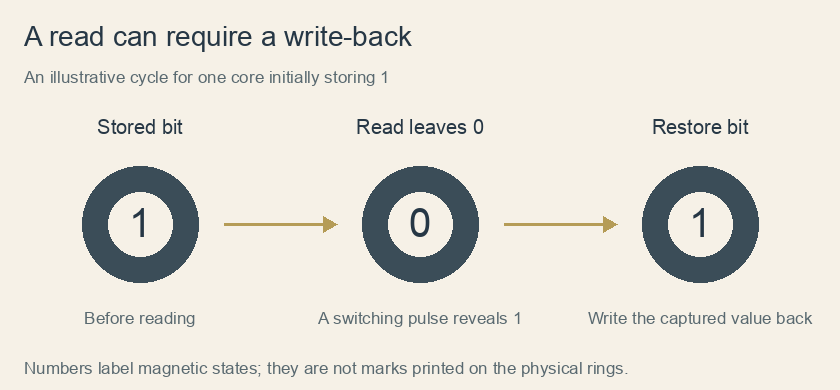
Three stages show a core holding one, a read leaving zero while detecting the former one, and a write-back restoring one.
Original logical schematic of a destructive-read cycle for a core initially storing 1. The displayed digits label magnetic states, not physical markings. The diagram omits circuitry and timing details.

Reading changes what is stored

Ken Shirriff's direct examination of an IBM 1401 core module explains a particularly surprising feature. Selected currents in crossing address wires operate on the chosen core. During a read, the circuitry drives it toward the zero state.

If the core previously held one, switching its magnetization produces a signal in a sense wire. If it already held zero, that switching signal is absent. The electronics can distinguish the former value, but the read has left the core at zero.

The system therefore writes the desired value back. “Destructive read” describes this controlled change of state, rather than physical damage to the ferrite ring. Reading and restoring are cooperating parts of the memory operation.

The process turns measurement into an active event. The circuit learns a value through a change, then uses the captured result to restore the information.

Manufacturing mattered as much as the clever bit

IBM's history of dynamic random-access memory describes magnetic-core storage in the mid-1960s as arrays of hundreds of thousands of ferrite elements laced with thin wires. By then, assembly had become highly automated.

That detail corrects the tempting image of an entire era depending exclusively on people threading every ring by hand. The technology developed along with methods for producing it, while its density, cost and performance still faced practical limits.

Semiconductor approaches offered a route to placing memory elements on chips. Robert Dennard's work on dynamic memory used a different storage arrangement, with charge and an integrated device taking the role previously served by an individually wired magnetic core.

The older grid remains fascinating because it exposes the physical work behind remembering. Its rings show how a computer's abstract zeros and ones can arise from material states, carefully selected currents and a sequence that even includes repairing the information after it has been read.

Sources and further reading: Computer History Museum: Memory and storage timeline; Ken Shirriff: Direct examination of IBM 1401 core memory; IBM: Magnetic-core manufacturing and the development of DRAM.

Explore more creative work at Incoprea.

Tensegrity: The Structure Held Together by What Pulls

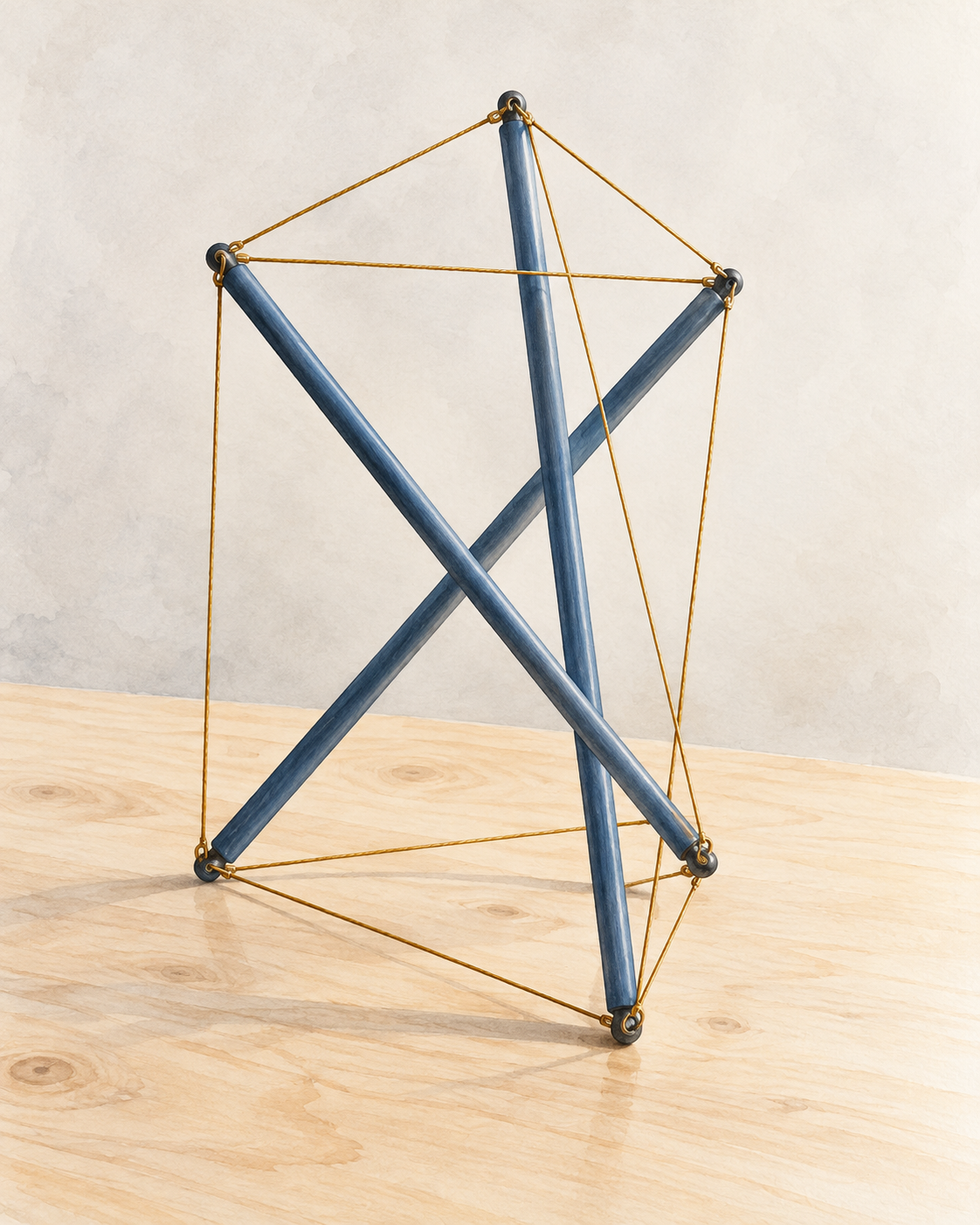
Three blue-gray struts form an open tabletop model held by taut gold cables, with no joined central crossings.
An invented three-strut educational model illustrates the interplay of tension and compression. Generated artwork based on an original geometric reference, rather than a named sculpture.

A skeletal arrangement of rods and cables can look as though its solid pieces ought to fall apart. Follow the cables, and the apparent puzzle becomes a structural system: the parts pulling against one another help keep the whole shape together.

This is the appeal of tensegrity. An open structure can balance tension and compression in a way that produces both striking sculpture and useful engineering questions.

A connected network holds separated pieces

In the familiar Snelson-style form, rigid compression members are separated within a continuous tension network. The rods resist being shortened; the cables pull between their attachment points. The solid members need not stack directly on one another.

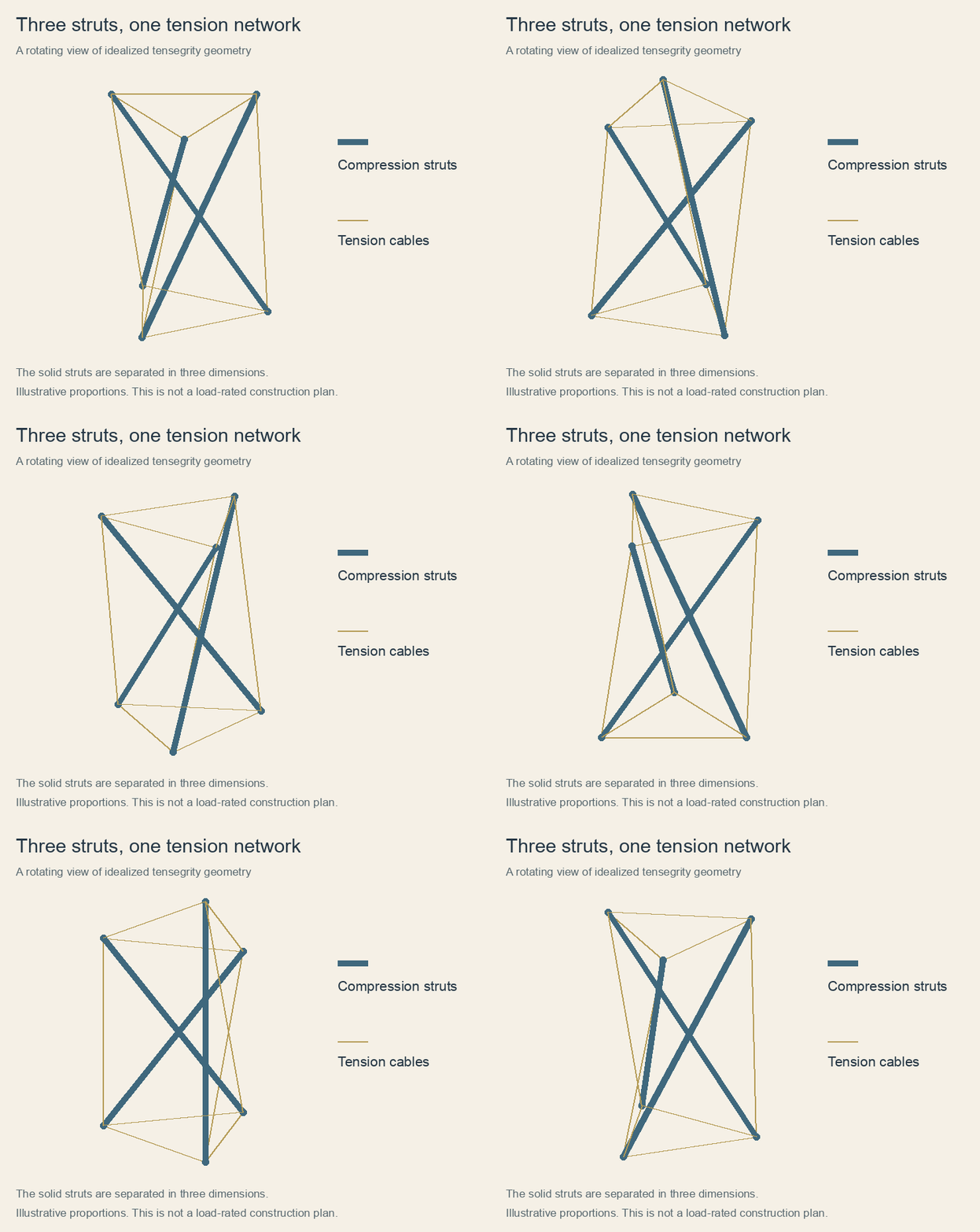
Looking from a single angle can obscure the arrangement. Two rods may cross in a photograph while passing at different depths in space. Moving around a model reveals how the cable network connects the ends and how the struts remain separate.

The tension is part of the structure's condition. A collection of loose strings and rods has the same ingredients, but it does not necessarily have the same stability. Geometry and the forces carried by the members must work together.

A rotating three-strut tensegrity schematic distinguishes blue compression members from a gold tension network.
Original rotating view of an idealized three-strut tensegrity geometry. Blue members represent compression and gold lines represent tension; solid struts are separated in three dimensions. Proportions are illustrative, and this is not a load-rated construction plan.

An artist made the structural puzzle visible

Kenneth Snelson explored such arrangements in sculptures that turned engineering relationships into a visual experience. The Smithsonian's Archives of American Art documents his work, including towers, drawings, project records and patents.

Snelson studied at Black Mountain College during the summers of 1948 and 1949, where his teachers included Buckminster Fuller and Josef Albers. His subsequent career also encompassed photography and early computer art.

The Hirshhorn's collection records Needle Tower, made in 1968 from aluminum and stainless steel. Its listed height is 720 inches, or 60 feet. The open outline lets a viewer notice both the material and the spaces through which the system extends.

A small classroom model and a large sculpture share an interesting question: how can visibly separate rigid pieces participate in one coherent structure? The answer becomes easier to appreciate when the thin connecting elements receive as much attention as the rods.

The network can protect a payload

NASA has investigated tensegrity robots as possible landing and mobility platforms. The Super Ball Bot research considered structures that could absorb impact, protect instruments and change configuration to move.

The proposal's objectives included building rolling hardware and developing controls for navigation and difficult terrain. These were research goals, rather than evidence that a tensegrity robot had already been deployed on another planet.

A 2023 NASA account described a related terrestrial application from Squishy Robotics: sensor-equipped structures that could be dropped into difficult areas to gather information for responders. The account distinguished the company's stationary devices from mobile systems under development.

The structural principle therefore offers more than an illusion of floating bars. Its network can distribute forces around a protected center, while deliberate changes in shape provide another avenue for experimentation. What begins as a visual puzzle becomes a way to think about how a structure can hold, yield and recover.

Sources and further reading: Smithsonian: Kenneth Snelson papers; Hirshhorn: Needle Tower collection record; NASA: Super Ball Bot research proposal; NASA: Tensegrity sensor robots and terrestrial applications.

Explore more creative work at Incoprea.

The Cornstarch Suspension That Builds Resistance as It Moves

A bowl of ivory cornstarch suspension holds a spoon beside a mound of dry starch.
A conceptual cornstarch-suspension still life. Appearance alone does not identify the sample's concentration or response to loading. Generated illustration.

A spoon can move gently through a dense cornstarch suspension, then encounter much greater resistance when the motion becomes forceful. The familiar demonstration is surprising because the material's response depends on how it is being disturbed.

Such behavior belongs to a larger subject: how suspended particles alter flow. The liquid between the grains is only part of the story. Contacts among particles can create structures that make a concentrated suspension resist movement.

A network can form while material moves

Shear thickening means that a material becomes more resistant to shear flow under the relevant loading conditions. A cornstarch mixture is a useful example, but its behavior is more complicated than having a permanent switch labeled “liquid” and “solid.”

Cornell researchers described contact clusters that continually form and reorganize during flow. The collective arrangement of particles helps explain why a suspension can become difficult to stir or push through a narrow opening.

In 2016, the team showed that carefully chosen oscillations perpendicular to the original flow could disrupt those clusters. A motor's flywheel that stalled in a thickened suspension could turn when the additional disturbance was applied.

The direction and timing of the disturbance mattered. Simply adding more vigorous movement in any direction was not the method; the experiment used a controlled combination that broke up the contact structures.

Impact asks a different question

Videos of people moving over a cornstarch-filled pool illustrate another dramatic response: a concentrated suspension can temporarily resist an impact. Researchers study this with defined objects and controlled geometries, rather than relying on a stunt alone.

A 2020 Cornell account described a plate dropped onto a cornstarch suspension. Rotational oscillations applied through the apparatus changed how the material resisted the impact and made the plate sink more readily.

The study connected compression and extension to the earlier work on shear. Different ways of deforming a material can create different contact networks, even when the suspension itself looks unchanged.

ObservationUseful question
Easy slow movementWhat contacts exist under this loading?
Strong resistance to impactHow is stress transmitted through the suspension?
Oscillation changes resistanceDoes the disturbance disrupt the particle network?

The boundary conditions are part of the material's behavior

Concentration, stress and the way a sample is confined help determine what happens. A bowl demonstration, a moving plate and a continuously flowing industrial suspension do not impose identical conditions.

Research on scaling shear-thickening transitions has compared different suspensions, including cornstarch and silica particles in glycerol. It seeks relationships among stress, particle fraction and the approach to rigidity, helping connect particular experiments to broader models.

The practical interest extends beyond the odd sensation at a spoon. A concentrated material may need to pass through equipment, be printed into a shape, or change its resistance during a controlled task. Understanding the particle network helps researchers ask how to manage that response.

The surprise is that a material's apparent stiffness can emerge from interactions happening during movement. The grains are ordinary; their temporary collective arrangement is what makes the suspension unusual.

Watch the research: Cornell's article includes a film of the controlled thickening experiment.

Sources and further reading: Cornell: Controlling shear thickening with crosswise oscillation; Cornell: Tuning impact solidification; Cornell LASSP: Universal scaling of shear-thickening transitions.

Explore more creative work at Incoprea.

Aerogel: The Porous Solid That Caught Dust from Space

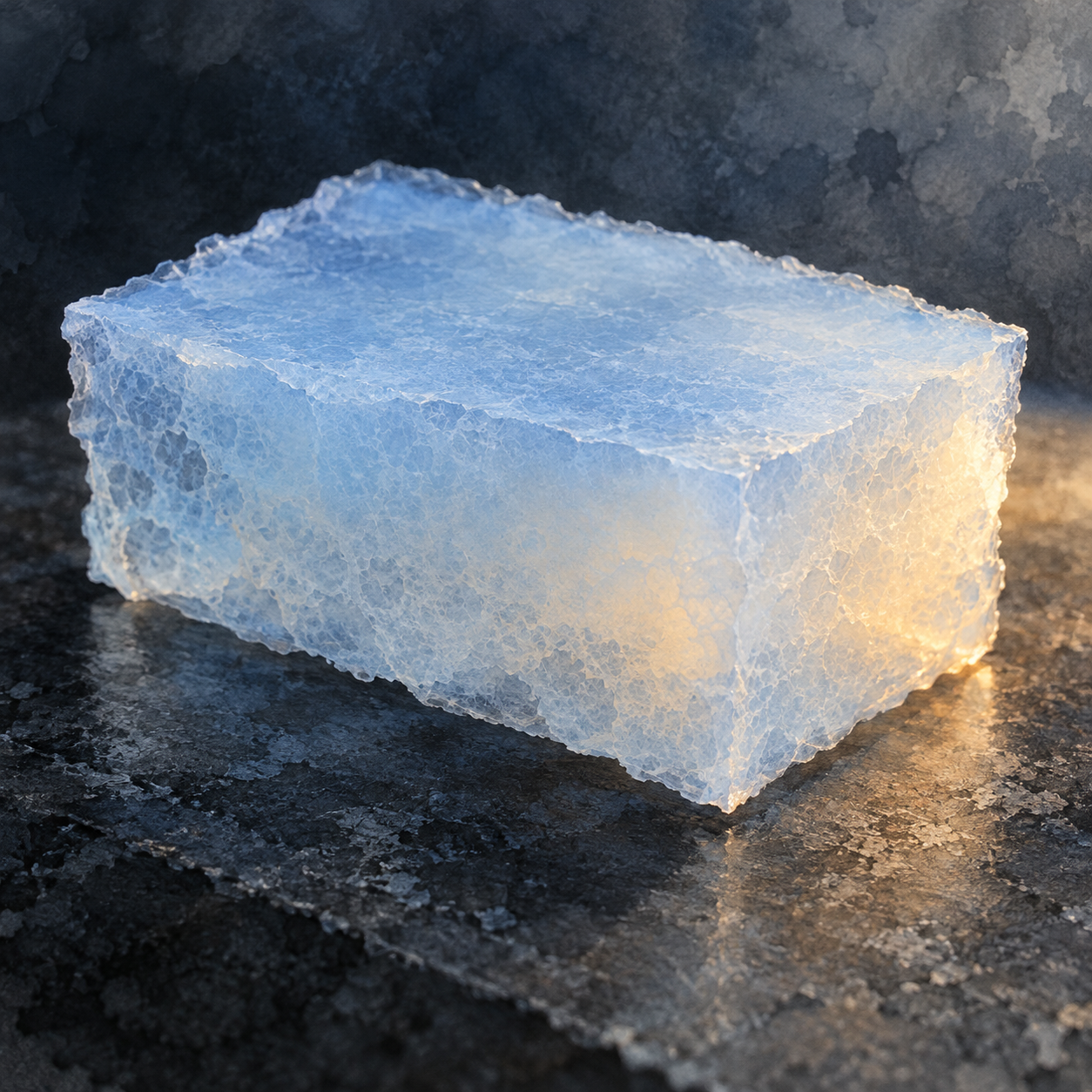
A pale-blue porous solid block with softly lit edges rests on a dark laboratory surface.
A conceptual silica-aerogel monolith, with texture artistically emphasized. Actual nanopores are too small to see at this scale. Generated illustration.

A piece of silica aerogel can resemble a patch of pale blue smoke that has somehow acquired edges. It is a solid, but much of its volume is pore space. The small amount of material forms a framework delicate enough to challenge our usual idea of what a solid should look like.

Aerogel is a family of porous materials, rather than one substance with a single density or strength. Its unusual structure has made it useful for two very different jobs: slowing tiny space particles and slowing the passage of heat.

Remove the liquid, preserve the framework

A gel contains a solid network and liquid. Making an aerogel involves removing that liquid while preserving much of the network, leaving gas-filled pore space in its place. If drying collapses the structure, the desired light, porous material is lost.

NASA's account of silica aerogels describes supercritical extraction as one route. The important result is the surviving framework, with pores far too small to resolve by looking at an ordinary piece on a table.

That scale contributes to useful insulation. Gas in very small pores transfers heat differently from gas in an open space, while the sparse solid framework also provides limited paths for conduction. The details depend on the material and its structure.

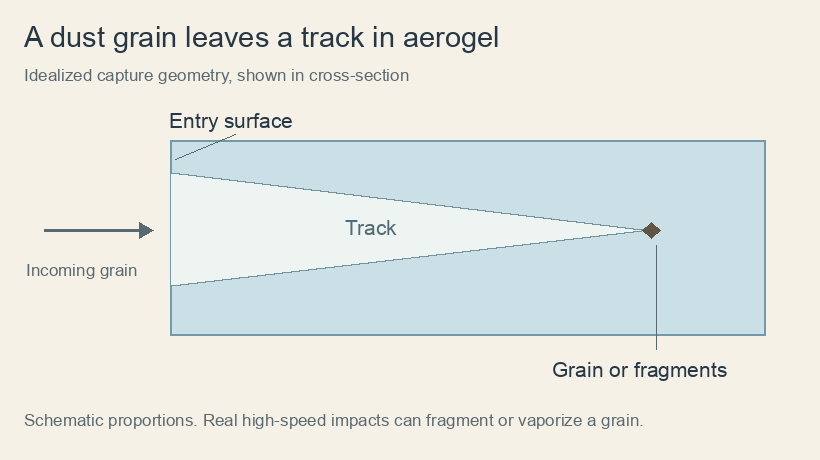
An idealized cross-section shows a dust grain entering aerogel and leaving a broad-to-narrow track.
Original explanatory diagram of an idealized aerogel capture track. Sizes and proportions are illustrative. Actual impacts can fragment or vaporize grains; the drawing is not a reconstruction of a particular Stardust sample.

A gentle catcher for a fast encounter

Stardust used aerogel as part of a collector for cometary and interstellar dust. The spacecraft flew near comet Wild 2 in 2004, and its sample-return capsule reached Earth in 2006.

A collector had to intercept particles moving rapidly relative to the spacecraft. Aerogel offered a low-density medium through which they could penetrate and lose energy, leaving tracks that researchers could investigate after the collector returned.

Those tracks are evidence of an energetic event. A 2014 JPL report showed a 35-micrometer track associated with a tiny particle that probably vaporized on impact. Other candidate interstellar grains arrived more slowly and remained intact.

The collector therefore did more than place perfectly unchanged dust in little compartments. Researchers studied tracks, surviving material and impact effects, then assessed where the particles might have come from. The 2014 report explicitly treated their interstellar origin as a hypothesis requiring further tests.

Fragile blocks and flexible blankets

The familiar translucent silica block can be brittle. That does not mean every aerogel product must behave like a fragile display specimen. NASA researchers investigated polymer reinforcement and other aerogel compositions to improve strength and flexibility.

Aerogel can also be incorporated into composites, including insulating blankets. A NASA account describes the development of practical flexible blankets through work with industry, connecting the porous material to uses beyond spacecraft laboratories.

The contrast is useful: a collector needs a medium suited to particle capture, while a wearable or industrial blanket needs an entire durable product. The word “aerogel” tells us about a structural approach, and the composition and design tell us how a particular example can work.

The smoky-looking solid is compelling because emptiness becomes an engineered feature. Its pores are part of the material's usefulness, helping turn a delicate framework into a tool for handling energy on very different scales.

Sources and further reading: NASA: Aerogel structure and reinforcement; JPL: Stardust mission; JPL: Candidate interstellar particles and impact tracks; NASA: Flexible aerogel blankets.

Explore more creative work at Incoprea.

Nitinol: The Metal That Returns to a Shape It Was Given

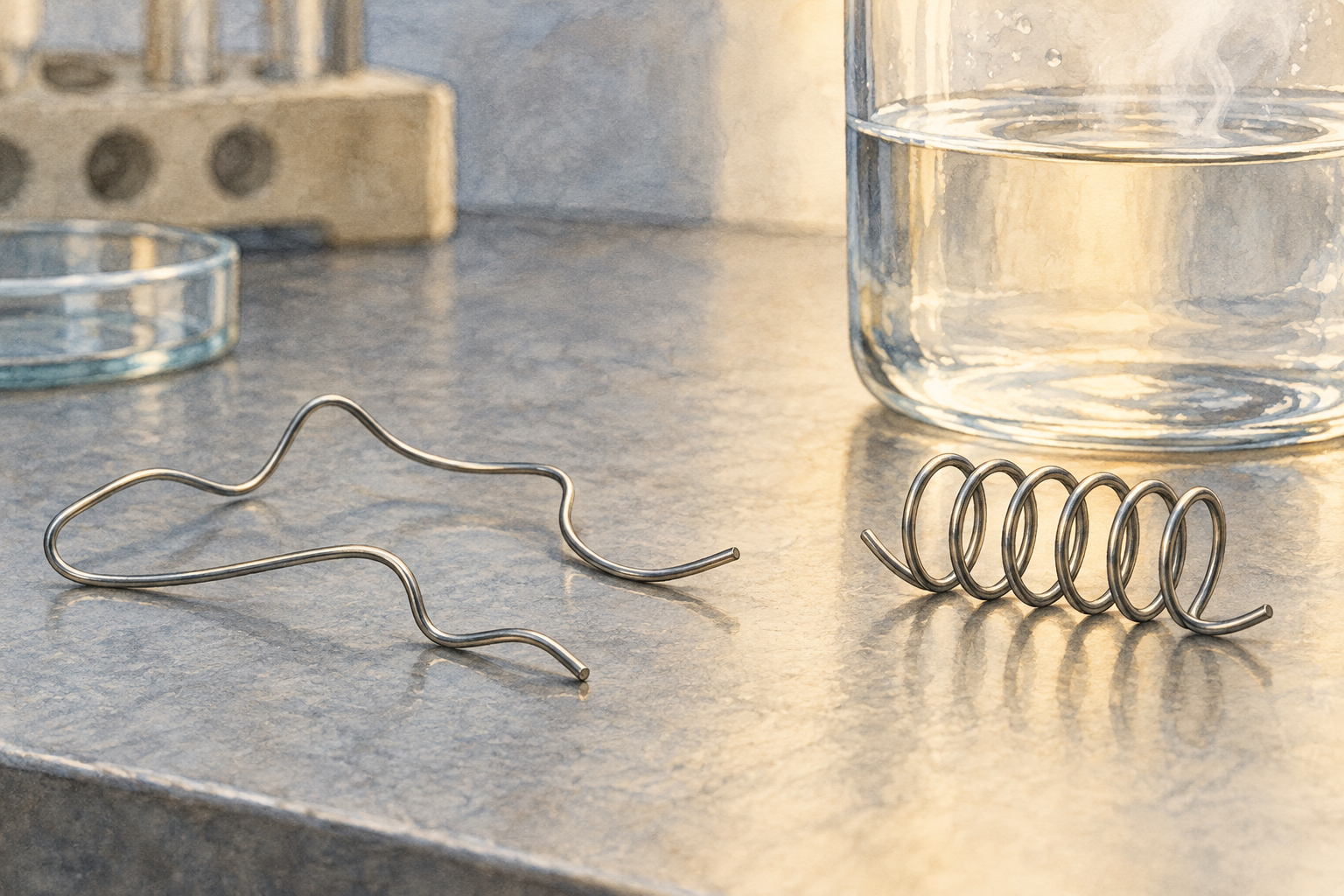
An irregular silvery wire and a neat helical spring illustrate two conceptual states of shape-memory metal on a laboratory bench.
Two conceptual wire shapes illustrate deformation and recovery of a trained form. This generated scene does not depict an exact experiment or alloy specification.

A bent wire usually stays bent. A suitably prepared piece of nitinol can behave differently: warm it through its transformation range, and it recovers a shape established earlier. Watching a crooked strand become a spring makes an ordinary metal seem unexpectedly purposeful.

Nitinol is based on nickel and titanium in roughly equal atomic proportions. Its memorable behavior comes from a change inside the solid, which engineers can use to produce useful movement.

The memory is in the structure

The alloy can adopt different crystal structures called martensite and austenite. In an appropriate lower-temperature condition, deformation can rearrange the martensitic structure. Heating through the reverse transformation restores the austenitic form and allows the previously set shape to return.

This is a solid-state transformation. The wire does not have to melt and be poured into a hidden mold. Its internal organization changes while the component remains a solid object.

Heat treatment helps establish the response, and there is a range over which transformation begins and finishes. “Memory metal” therefore describes a prepared material with particular conditions, rather than a universal promise that any bent nickel-titanium object will repair itself.

A metal can become an actuator

An actuator turns supplied energy into movement. With a shape-memory alloy, a temperature change can make a component bend or twist, transferring that movement to a mechanism.

NASA described an aircraft demonstration in 2018 using a specially developed alloy in wing-folding actuators. A small research aircraft called PTERA changed the angle of its outer wing portions during flight, reaching 70 degrees in the reported tests.

The application connected a materials response to a larger aerodynamic question: could wing geometry adapt to changing flight conditions? The alloy was part of an engineered actuator and control system, rather than the entire wing spontaneously changing shape.

The tested aviation material belongs to the broader shape-memory-alloy family. Its performance should not be assigned automatically to a classroom wire sample. Composition, preparation, loading and thermal conditions matter when a laboratory effect becomes a working component.

The response can be tuned

A second NASA account, published in 2019, described experimental vortex generators: small fins that influence airflow over an aircraft wing. Alloy rods at their hinges responded to temperature changes, moving the fins between upright and stowed positions.

For those devices, researchers tuned the material to relevant environmental temperatures. They also built a test setup that simulated the thermal changes of flight, showing how much work goes into making a response happen at the useful moment.

That is the appealing engineering idea behind the little returning wire. A material can provide both a response to its surroundings and part of the movement a device needs. The striking demonstration becomes more interesting when its apparently simple motion is connected to a deliberately designed internal transformation.

NASA's film of the wing-folding research, using a specially developed alloy and aircraft actuator. Read the experiment's context and credits.

Sources and further reading: Kellogg's Research Labs: Nitinol technical FAQ; NASA: Alloy-actuated wings tested in flight; NASA: Memory metals and experimental vortex generators.

Explore more creative work at Incoprea.

The Small Lobster Nerve Circuit That Helps Explain Big Brains

An illustrated lobster appears beside a small abstract inset of connected neurons.
Generated illustration of a lobster with a conceptual neural inset. The inset does not represent the actual ganglion location, cell count or connection map.

A lobster's digestion involves coordinated movements inside its body: food is chewed, filtered and moved along. Controlling those movements requires rhythmic signals. A small part of the crustacean nervous system has become one of neuroscience's most informative models precisely because researchers can study its components in detail.

The stomatogastric ganglion contains only about 30 neurons in the lobsters and crabs commonly used for this research. That is a particular ganglion, not the animal's entire nervous system. Its manageable size gives scientists a way to connect individual cells with the patterns they collectively produce.

A circuit that generates rhythms

Neural networks known as central pattern generators can produce repeated motor patterns. In the stomatogastric system, interacting circuits organize different aspects of digestive movement. The gastric mill circuit helps coordinate chewing, while the pyloric circuit organizes faster filtering and related movements.

Studied patternDigestive role
Gastric mill rhythmCoordination of chewing movements
Pyloric rhythmCoordination of filtering and pumping-related movements

Researchers can identify neurons, record electrical activity and investigate their connections. Under suitable laboratory conditions, an isolated ganglion can continue producing rhythmic activity. This makes it possible to study how a pattern arises without having to infer everything from the animal's visible behavior.

A rhythm is still influenced by the cell's properties, its connections and incoming modulatory signals. The network is not simply a tiny rigid clock that ticks identically in every circumstance.

The same result can have different ingredients

Work associated with Eve Marder's laboratory has shown why a wiring diagram is not the whole explanation of a neural circuit. Ion channels shape a neuron's electrical behavior, synapses determine interactions, and neuromodulators can alter how the system responds.

Measurements across individual animals reveal variation in these components. A 2009 study of crab pyloric circuits found substantial differences in synaptic strength, a modulator-evoked current and expression of several ion-channel genes. Relationships among the measurements helped explain how circuit output related to the differing ingredients.

This supports a broader lesson: similar useful activity need not require exactly identical values for every underlying parameter. A circuit can have multiple workable configurations. Conversely, changing one component may have different consequences depending on what else is present.

Robust does not mean unchanging

Researchers also use these circuits to investigate temperature. Electrical and chemical processes change with temperature, yet a functional rhythm can persist over a range of conditions. Models and experiments help examine how different properties contribute to that robustness and where it breaks down.

The result is not a direct explanation of every human brain function. A digestive circuit in a crustacean has its own biology. Its value is that general questions about rhythm, variability and compensation can be tested in a system whose cells are unusually accessible.

A few dozen neurons can therefore illuminate a problem faced by much larger nervous systems: how to produce dependable behavior with changing inputs and variable components. The small model makes the complexity visible rather than making it disappear.

Sources and further reading: Brandeis Marder Laboratory: Stomatogastric circuits; Functional consequences of animal-to-animal variation; Temperature compensation in a small rhythmic circuit.

Explore more creative discoveries at Incoprea.