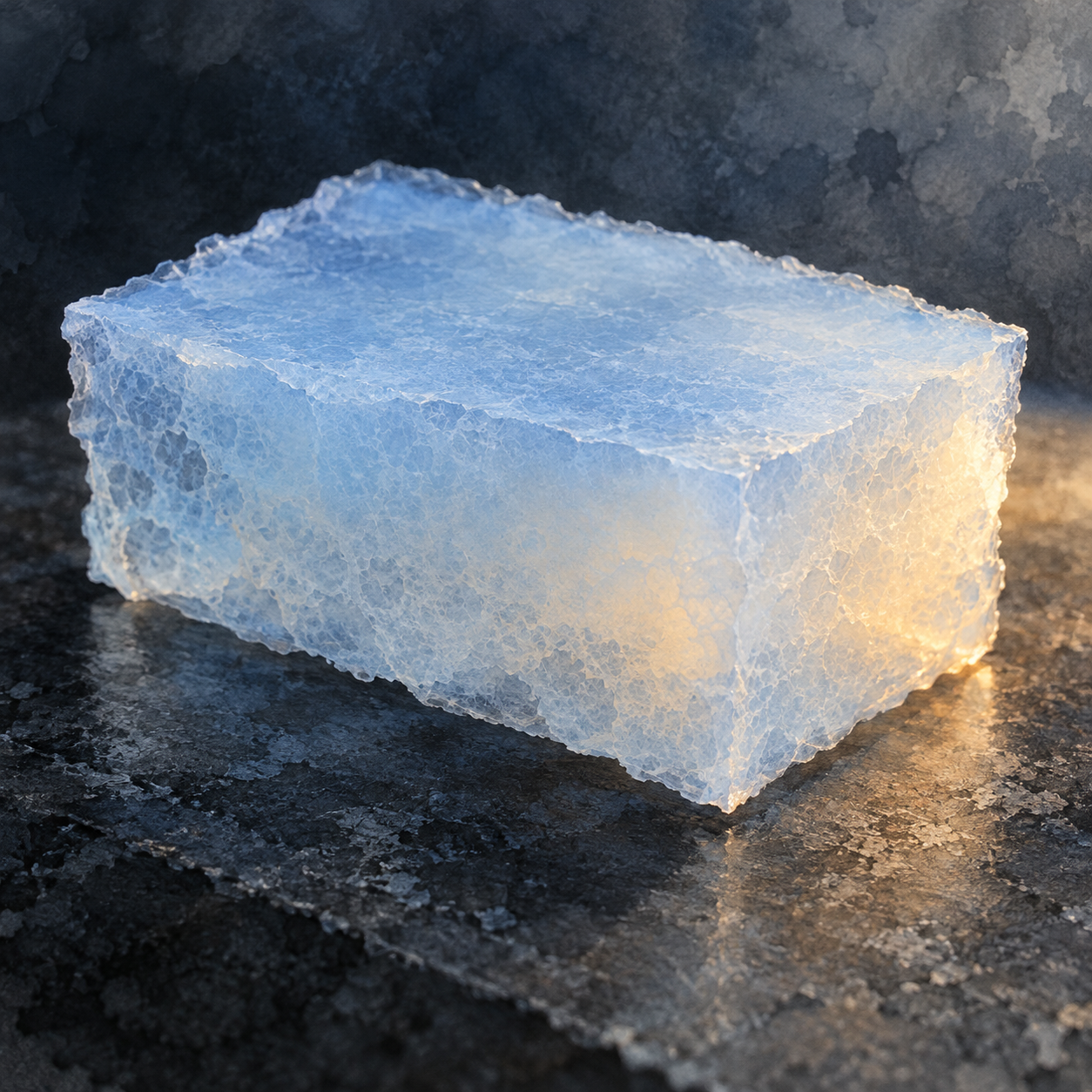
A piece of silica aerogel can resemble a patch of pale blue smoke that has somehow acquired edges. It is a solid, but much of its volume is pore space. The small amount of material forms a framework delicate enough to challenge our usual idea of what a solid should look like.
Aerogel is a family of porous materials, rather than one substance with a single density or strength. Its unusual structure has made it useful for two very different jobs: slowing tiny space particles and slowing the passage of heat.
Remove the liquid, preserve the framework
A gel contains a solid network and liquid. Making an aerogel involves removing that liquid while preserving much of the network, leaving gas-filled pore space in its place. If drying collapses the structure, the desired light, porous material is lost.
NASA's account of silica aerogels describes supercritical extraction as one route. The important result is the surviving framework, with pores far too small to resolve by looking at an ordinary piece on a table.
That scale contributes to useful insulation. Gas in very small pores transfers heat differently from gas in an open space, while the sparse solid framework also provides limited paths for conduction. The details depend on the material and its structure.
A gentle catcher for a fast encounter
Stardust used aerogel as part of a collector for cometary and interstellar dust. The spacecraft flew near comet Wild 2 in 2004, and its sample-return capsule reached Earth in 2006.
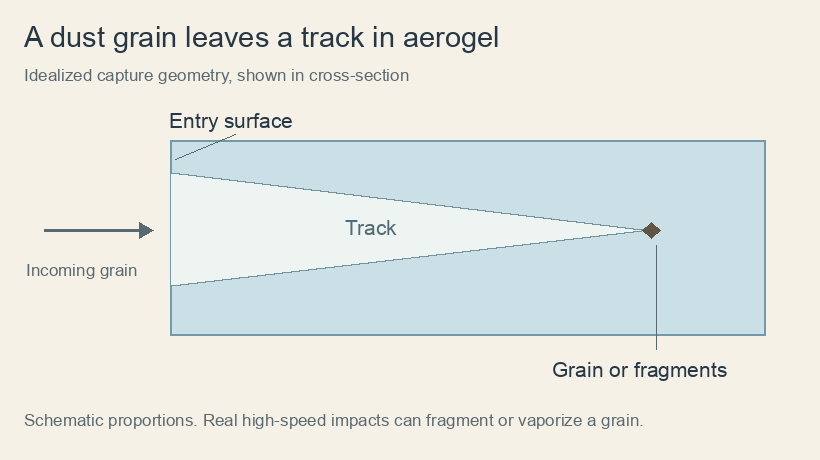
A collector had to intercept particles moving rapidly relative to the spacecraft. Aerogel offered a low-density medium through which they could penetrate and lose energy, leaving tracks that researchers could investigate after the collector returned.
Those tracks are evidence of an energetic event. A 2014 JPL report showed a 35-micrometer track associated with a tiny particle that probably vaporized on impact. Other candidate interstellar grains arrived more slowly and remained intact.
The collector therefore did more than place perfectly unchanged dust in little compartments. Researchers studied tracks, surviving material and impact effects, then assessed where the particles might have come from. The 2014 report explicitly treated their interstellar origin as a hypothesis requiring further tests.
Fragile blocks and flexible blankets
The familiar translucent silica block can be brittle. That does not mean every aerogel product must behave like a fragile display specimen. NASA researchers investigated polymer reinforcement and other aerogel compositions to improve strength and flexibility.
Aerogel can also be incorporated into composites, including insulating blankets. A NASA account describes the development of practical flexible blankets through work with industry, connecting the porous material to uses beyond spacecraft laboratories.
The contrast is useful: a collector needs a medium suited to particle capture, while a wearable or industrial blanket needs an entire durable product. The word “aerogel” tells us about a structural approach, and the composition and design tell us how a particular example can work.
The smoky-looking solid is compelling because emptiness becomes an engineered feature. Its pores are part of the material's usefulness, helping turn a delicate framework into a tool for handling energy on very different scales.
Sources and further reading: NASA: Aerogel structure and reinforcement; JPL: Stardust mission; JPL: Candidate interstellar particles and impact tracks; NASA: Flexible aerogel blankets.
Explore more creative work at Incoprea.