The Unlikely Record · Episode 20 · Twelve stories
Twelve discoveries that required a second look
An unexpected mark, a faint colour or an instrument reading can begin a discovery without explaining it. These twelve histories follow the work after the surprise: checks, competing possibilities, improved equipment and the words researchers chose when they finally announced a result. The surviving records show how an observation became evidence.
Story 01
The Plate Did Not Need the Sunshine
Henri Becquerel began with a question prompted by the newly announced X-rays. Could a substance that glowed after illumination also produce penetrating rays? In Paris in 1896, he placed uranium salts against photographic plates protected from ordinary light, using sunlight in the early experiments to excite the material.
The developed plates showed marks beneath their covering. Objects interposed between the material and the plate could leave silhouettes. At first, this seemed compatible with the question about light and phosphorescence that had brought him to the experiment.
Then cloudy weather interrupted the planned illumination. The photographic effect still appeared strongly. The substance did not require the expected exposure to sunlight to produce it. Continued investigation separated this persistent emission from an ordinary glow caused by earlier lighting.
In his later Nobel lecture, Becquerel described how the photographic observations led towards electrical measurements of the effect on air. Pictures had made the phenomenon visible, but another method could measure it more precisely. The experiment had started by asking whether a familiar response to light could explain a new kind of ray. Its importance emerged when a missing part of the expected procedure failed to stop the result.
Evidence and sources
Becquerel’s lecture describes the experiments; the Nobel historical account supplies the cloudy-weather episode. The exact day and private reactions are not invented.
- On Radioactivity, a New Property of Matter — Henri Becquerel; Nobel Foundation
11 December 1903, printed pages 52–55 - Marie and Pierre Curie and the Discovery of Polonium and Radium — Nobel Foundation
Opening historical section on Röntgen, Becquerel, cloud cover and photographic plates
Story 02
The Clear Patch Was Only the Beginning
Returning to his laboratory at St Mary’s Hospital in 1928, Alexander Fleming noticed something unusual among cultures of staphylococcal bacteria. A contaminating mould had grown on a plate, and a clear area surrounded it. The nearby bacterial colonies had been affected by something the mould produced.
Fleming investigated that substance and published his findings in 1929. The observation became famous, but mould growth did not immediately supply a dependable medicine. He and colleagues struggled to obtain the active material in a sufficiently stable and purified form. A promising effect on a laboratory plate and a treatment that could be produced consistently were different achievements.
A team at Oxford returned to the problem in 1939. Howard Florey, Ernst Chain, Norman Heatley, Edward Abraham and others developed the extraction, purification and testing work. Wartime shortages encouraged inventive use of equipment: the museum’s surviving production history includes household containers adapted for growing cultures and specially made stackable ceramic vessels.
By 1941 the Oxford programme was carrying out clinical trials. The long interval restores the work that disappears when penicillin is remembered only as a lucky contaminated dish. Fleming’s clear patch supplied an important lead. Turning that lead into a usable drug required a further research programme, new apparatus and enough production to support treatment.
Evidence and sources
Institutional histories distinguish Fleming’s observation from the later Oxford work that made concentrated, usable penicillin possible.
- Discovery and Development of Penicillin — American Chemical Society
Fleming’s discovery; development at Oxford - Production: Back from the Dead — History of Science Museum, University of Oxford
Complete production exhibit, culture vessels and purification apparatus
Story 03
A Hidden Hand Became Public News

On 8 November 1895, Wilhelm Conrad Röntgen was investigating a cathode-ray tube in Würzburg when an unexpected glow appeared on a nearby fluorescent screen. Something from the apparatus was reaching it in a way that required further investigation. He called the unfamiliar rays X-rays, giving their uncertain identity a name.
Over the following weeks he tested what the rays could pass through and how their effects could be recorded. A radiograph of his wife Anna Bertha’s hand, made in December, showed bones and the much more opaque rings against the surrounding hand. The image offered a striking demonstration of information that ordinary photography could not reveal.
Röntgen submitted his account to the local physical and medical society on 28 December. Early in January he sent copies and selected images to other scientists. In Vienna, the material reached the newspaper Die Presse through scientific contacts, and a report appeared on 5 January 1896.
The result moved quickly from a laboratory observation to a public image. The hand helped readers understand the consequence of rays they could not see directly. Röntgen did not patent the discovery, and in 1901 he received the first Nobel Prize in Physics. The unexplained glow had become both a new research tool and a powerful way to picture the body.
Evidence and sources
The discovery, circulation of the paper and newspaper response are documented. The December hand radiograph is a later demonstration, not the first November observation.
- X-rays: A Helping Hand from the Media — Joachim Pietzsch; Nobel Foundation
Full discovery, circulation and newspaper account - Wilhelm Conrad Röntgen: The Nobel Prize in Physics 1901 — Speed Read — Nobel Foundation
Complete short account and hand-image caption
Story 04
The Small Mark Returned with the Stars
Jocelyn Bell Burnell was examining long paper records from a new radio telescope when she noticed a small, unusual disturbance. The Cambridge instrument had been built to investigate quasars. Its output demanded close manual attention, and a brief mark on the chart could easily have looked like unwanted interference.
The feature returned at the same position among the stars. That recurrence made it worth pursuing. A surviving chart in the Cambridge archives records an early observation on 6 August 1967, before faster recording exposed the signal’s striking regularity.
On 28 November, the equipment resolved pulses arriving roughly every one and a third seconds. Bell Burnell and her colleagues checked possible explanations, including effects associated with the equipment. Observations with another telescope helped establish that the signal was real. Within a short period, they found further sources producing similar behaviour.
The joking nickname LGM, for little green men, later made the story sound like an announcement about aliens. The investigation was more careful than that label suggests. Repetition, position and independent checks turned a scrap of apparent interference into evidence for a new astronomical phenomenon: pulsars. The surviving paper chart preserves an early stage, when the record was already there but its meaning still had to be established.
Evidence and sources
An archived August chart and Bell Burnell’s institutional interview document the stages of detection and checking. The LGM nickname was not evidence of extraterrestrial intelligence.
- Journeys of Discovery: Jocelyn Bell Burnell and Pulsars — Louise Walsh; University of Cambridge
Full article, chart anomaly, 28 November recording and checks - Discovery of Pulsars: The Miscellaneous Collection — Churchill Archives Centre, University of Cambridge
MISC 109; first chart of 6 August 1967; Craig Mackay letter of 8 January 2019
Story 05
Cleaning the Antenna Did Not Remove the Signal
Arno Penzias and Robert Wilson were preparing a large horn antenna at Bell Laboratories for sensitive radio astronomy when they found more background noise than their equipment and surroundings could explain. The excess persisted as they investigated the atmosphere, the ground and the antenna itself.
Pigeons had been roosting inside the structure. Removing the birds’ contamination was part of the effort to make the instrument’s behaviour understandable. Further cleaning and work on its joints improved matters slightly, but the unexplained signal remained. It was present through changing directions and seasons, resisting explanations tied to an ordinary local disturbance.
In 1965, a connection with researchers at Princeton supplied a different possibility. Robert Dicke’s group was considering radiation left from an early hot universe. The persistent background measured in Holmdel fit that line of inquiry, although the measurement and its interpretation were separate pieces of work.
The two groups published neighbouring papers: one reported the excess antenna temperature, while the other discussed its cosmological meaning. That separation mattered. Penzias and Wilson could state what their apparatus measured without making the measurement depend on accepting every part of an explanation. A signal first treated as a problem in a sensitive instrument became evidence reaching far beyond the antenna that had recorded it.
Evidence and sources
The researchers’ Nobel lectures document the measurement, elimination of possible causes and separate cosmological interpretation.
- The Cosmic Microwave Background Radiation — Robert W. Wilson; Nobel Foundation
8 December 1978; experimental introduction and sections II–IV; complete sections VI–VII, printed pages 474–476 - The Origin of the Elements — Arno A. Penzias; Nobel Foundation
8 December 1978, printed pages 455–456
Story 06
The Library Argument Needed Fallen Stones
Ernst Chladni approached falling stones through reports that many scholars found difficult to accept. After a discussion with the physicist Georg Christoph Lichtenberg in 1793, he gathered descriptions of fireballs and material said to have fallen from the sky. The library offered a way to compare incidents that no single observer could have witnessed.
In 1794 he published an argument that such masses came from beyond Earth. The proposal connected luminous events in the sky with the physical stones and iron left on the ground. Its evidence depended partly on witnesses whose accounts had often been dismissed or separated from the objects they described.
Acceptance required more than a forceful interpretation of old reports. In 1802, Edward Howard and Jacques-Louis de Bournon investigated meteorite materials, finding shared chemical and mineral features. Their work gave the scattered objects a basis for comparison independent of a witness’s credibility.
Then a fall near L’Aigle in 1803 provided Jean-Baptiste Biot with a fresh field investigation. He interviewed witnesses and studied the distribution of the stones. Chladni’s once-unwelcome explanation gained support from chemistry, material evidence and a mapped event. The book had organised a question; later researchers supplied different kinds of observation that made its proposed answer much harder to dismiss.
Evidence and sources
Chladni’s 1794 publication is catalogued by the Smithsonian; the museum history traces the later chemical and field evidence that strengthened its argument.
- Ernst Chladni and the Birth of Meteoritics — American Museum of Natural History
Complete Cosmic Horizons excerpt, 1793–1803 - Über den Ursprung der von Pallas gefundenen und anderer ihr ähnlicher Eisenmassen — Smithsonian Libraries and Archives
Complete record for Chladni’s 1794 book
Story 07
Zero Meant the Instrument Was Overwhelmed
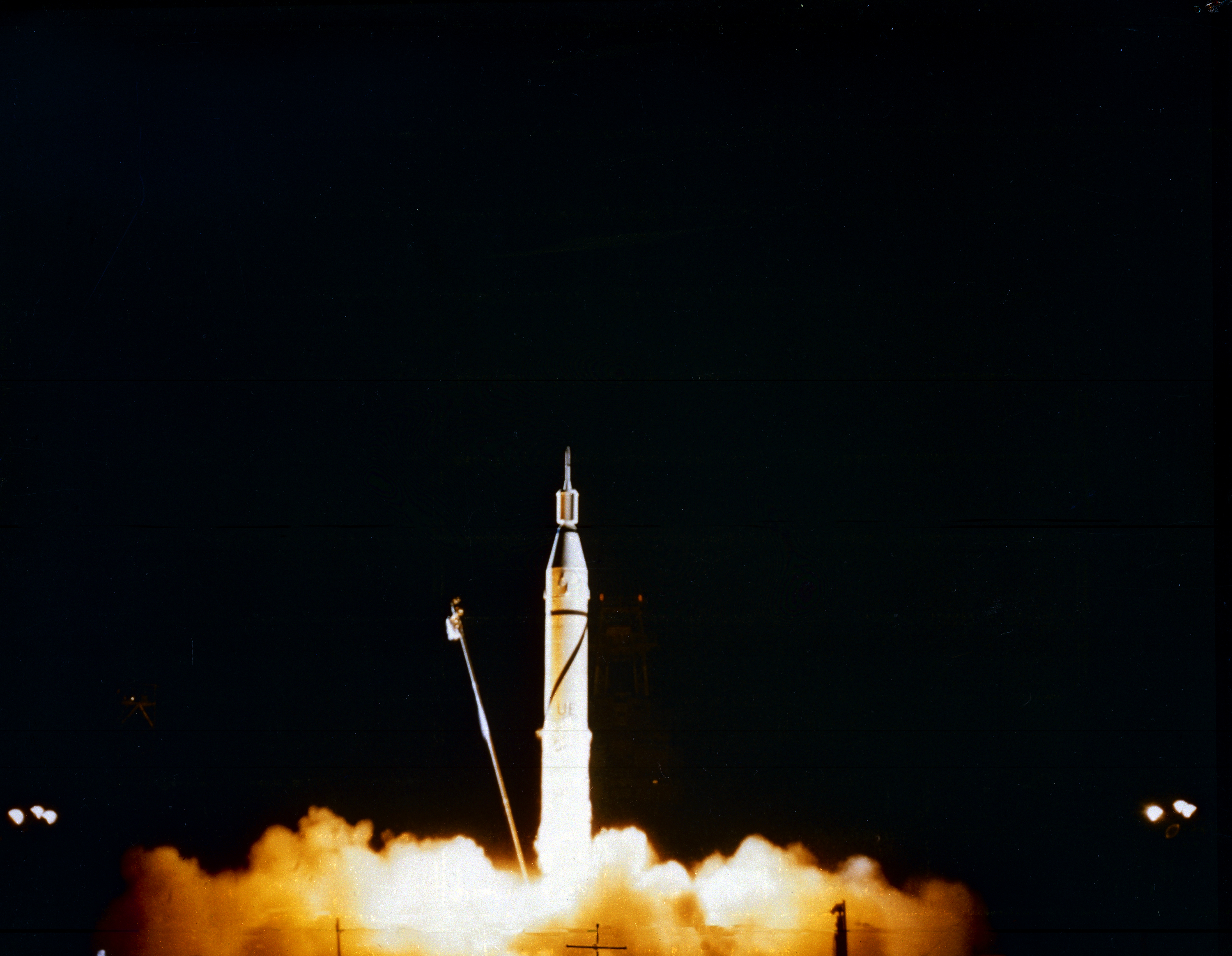
Explorer 1 carried a radiation experiment into orbit on 31 January 1958. Scientists expected its counter to register energetic particles. Some readings behaved as anticipated, but others were unexpectedly blank. A zero could look like an absence of particles or a failure in the instrument.
The first satellite could transmit only when a receiving station was within range. It did not provide a continuous recording of the entire orbit. Those brief glimpses made it difficult to see how the strange readings related to the spacecraft’s changing position.
Explorer 3, launched on 26 March, carried a recorder that preserved the orbital sequence. The readings climbed, reached the upper limit of the transmitted scale and then dropped to zero. Laboratory checks showed how sufficiently intense radiation could overwhelm the counter so that it stopped reporting separate events.
The blank result therefore pointed towards an extreme environment rather than an empty one. James Van Allen’s team used the observations to identify a region of energetic particles trapped around Earth. The later satellite’s recorder helped make the earlier spacecraft’s puzzling messages intelligible. An instrument designed to count particles had encountered conditions in which its apparent silence carried the most consequential part of the discovery.
Evidence and sources
NASA’s detailed account distinguishes Explorer 1’s brief ground-contact readings from Explorer 3’s later orbital recording. Saturation explains the misleading zero counts.
- Studying the Van Allen Belts, 60 Years After America’s First Spacecraft — Mara Johnson-Groh; NASA
Complete historical narrative on Explorer 1 and the radiation discovery - Explorers 1 and 3 — David P. Stern and Mauricio Peredo; NASA Goddard Space Flight Center
Complete satellite count-rate and recording account
Story 08
The Weapons Monitor Found an Astronomical Problem
The Vela satellites were built to help detect nuclear explosions. Their gamma-ray instruments also registered events that did not fit that purpose. One signal, recorded on 2 July 1967, showed a distinctive burst in more than one spacecraft’s data.
Ray Klebesadel and Roy Olson examined the event, but recognising an unusual flash did not immediately establish where it came from. Timing had to be checked carefully, and the early instruments could not yet supply a convincing location. The researchers accumulated evidence while leaving the explanation open.
Later spacecraft provided better opportunities to compare arrival times. By 1972, analysis involving Ian Strong allowed the team to rule out major nearby sources such as Earth and the Sun for a group of events. The results were published in 1973, bringing these brief gamma-ray bursts into astronomical research.
The interval between detection and publication is sometimes made to sound like a story of military suppression. The Los Alamos historical account gives a more specific explanation: the evidence needed to become convincing. The satellites’ original mission had created an unusual observing system, but it took years of instrument checks and comparison to turn its unexplained triggers into a defensible claim about the sky.
Evidence and sources
Los Alamos accounts document the 2 July 1967 event, subsequent localisation work and 1973 publication. The earlier account explicitly rejects secrecy as the explanation for the delay.
- The Weapons Connection — Roger C. Eckhardt; Los Alamos National Laboratory
Los Alamos Science, Summer 1982, printed pages 24–25 - Gamma-ray Bursts: A Los Alamos History of Discovery — Los Alamos National Laboratory
1663, August 2014, printed page 4, full boxed historical account
Story 09
The Failed Medicine Experiment Left a Colour Sample
William Henry Perkin was eighteen when an attempt to make quinine led him towards a different product. Working during the Easter holiday in 1856, the chemistry student obtained material that produced a striking purple colour. The sought-after medicine had not appeared, but the colouring effect offered another direction.
Perkin pursued the possibility of a dye rather than leaving the result as a laboratory curiosity. With financial support from his father, he established a factory at Greenford Green in 1857. Making the colour on a commercial scale required development beyond the original experiment. The accidental observation became the starting point of a manufacturing enterprise.
Fifty years after the discovery, a commemorative page in the Journal of the Society of Dyers and Colourists carried a piece of fabric coloured with Perkin’s mauve. Its printed account explained an easily missed distinction: the surviving dye had been made in 1863 or 1864, and the sample was prepared for the 1906 celebration.
The object therefore preserves both a colour and the effort to remember it accurately. It is not fabric from the first experiment. The dated material, the later dyeing and the accompanying explanation make the history more useful than a simple tale of a lucky spill. A failed synthesis had opened a practical problem that Perkin chose to develop.
Evidence and sources
The original experiment and factory are documented in institutional history. The surviving 1906 printed sample explicitly uses dye made in 1863–1864.
- William Henry Perkin — Science History Institute
Complete biographical article, 1856 experiment and 1857 factory - Perkin’s Mauve — Science History Institute
Journal of the Society of Dyers and Colourists, November 1906, page 330; actual page image and complete catalogue
Story 10
The Air Was Slightly Too Heavy
Lord Rayleigh was making careful measurements of gases when nitrogen refused to behave like a single, dependable standard. Samples prepared from the atmosphere were slightly heavier than samples obtained from chemical compounds. The difference was small, but it persisted when he repeated the work.
A minor discrepancy could have been dismissed as an imperfection in preparation or measurement. Rayleigh tested possible explanations, including whether one sample changed while being stored. The disagreement remained. The question shifted from how to remove an error to whether the supposedly same gas samples actually had different contents.
William Ramsay joined the investigation. By separating known components of air, the researchers isolated a gas that did not respond like nitrogen. Its chemical inactivity and distinct spectrum helped establish that it was a separate element. They announced the new atmospheric constituent in 1894, followed by a fuller presentation in 1895.
The name argon referred to its lack of readiness to react. The discovery had emerged from weighing ordinary air with unusual care, rather than from finding an exotic material in a distant place. A difference of roughly half a percent between nitrogen samples had become an opening into the atmosphere’s composition. Keeping that small disagreement visible allowed the investigators to discover what an apparently routine measurement had concealed.
Evidence and sources
Rayleigh’s lecture describes the density discrepancy and follow-up; the RSC history supplies the joint announcement chronology and elemental interpretation.
- The Density of Gases in the Air and the Discovery of Argon — Lord Rayleigh; Nobel Foundation
12 December 1904, printed pages 90–93 - A Noble Quest — Mike Sutton; Royal Society of Chemistry, Chemistry World
23 August 2016; introduction and complete Mystery Gases section
Story 11
The Faint Colour Survived the Cleaning
During a Mediterranean voyage in 1921, C. V. Raman became interested in the colour of the sea. Back in Calcutta, the question led into a programme studying how light scattered through materials. What followed took years and involved several researchers, rather than a single fortunate glance.
In the early experiments, K. R. Ramanathan noticed a weak component of scattered light with a changed wavelength. Impurities offered a plausible explanation. Yet the effect persisted after purification. K. S. Krishnan examined additional liquids, while other experiments and photographs slowly made the observation harder to set aside.
By 1928 the team could distinguish new spectral features from the original illuminating light. Raman’s later lecture credited work by Krishnan, Ramanathan and S. Venkateswaran, describing the instruments and successive questions through which the result had developed. The change carried information about the interaction of light with the material through which it passed.
Raman and Krishnan’s paper, A New Type of Secondary Radiation, appeared in Nature on 31 March 1928. The faint feature had moved from a possible contaminant to the centre of an experimental claim. Its importance depended on following it through different materials and improved observations. A signal that survived efforts to explain it away became the basis of a new way to investigate matter.
Evidence and sources
Raman’s Nobel lecture traces years of collaborative investigation; the publisher’s public record verifies the 1928 paper’s authors and publication date.
- The Molecular Scattering of Light — C. V. Raman; Nobel Foundation
11 December 1930, printed pages 267–273 - A New Type of Secondary Radiation — C. V. Raman and K. S. Krishnan; Nature
Nature 121, pages 501–502, published 31 March 1928; public metadata and opening preview only
Story 12
The Discovery Announcement Kept a Question Open
On 4 July 2012, the CMS experiment at CERN announced evidence for a new particle. Its measured mass was near the range in which researchers had been searching for the Higgs boson. The result was strong enough to announce a discovery, but the wording preserved an important distinction: finding a particle and establishing all its properties were different tasks.
The analysis combined observations from several ways in which such a particle could decay. Researchers had used checks designed to reduce the influence of expectation, including keeping the most sensitive region hidden until selection procedures were settled. The announcement described a particle consistent with the Higgs expectation while calling for further tests.
By March 2013, the ATLAS and CMS collaborations had studied substantially more data. CERN reported that the emerging picture indicated a Higgs boson. Evidence about its spin and other properties supported that conclusion, although the release still asked whether it matched the Standard Model version or belonged to a broader theoretical possibility.
The successive announcements preserve the discovery’s actual movement. Confidence increased as different properties were investigated. The first celebration did not end the work; it marked the point at which a new object of study had become visible enough to examine. The cautious language recorded what had been established and what the next measurements still needed to decide.
Evidence and sources
The original CMS announcement identified a new particle consistent with the expected Higgs boson; the March 2013 follow-up strengthened the identification while retaining questions about its exact nature.
- Observation of a New Particle with a Mass of 125 GeV — CMS Collaboration, CERN
4 July 2012, complete announcement and technical detail - New Results Indicate That Particle Discovered at CERN Is a Higgs Boson — CERN
14 March 2013, complete press release
The observations in this chapter became useful because people returned to them. They cleaned equipment, compared materials, improved recordings and kept unanswered questions visible. A discovery could begin with an accident, but its meaning depended on work that made the result understandable to someone else.
About the evidence labels
Documented identifies a supported historical event. Disputed marks an account whose explanation or details remain contested. Folklore identifies a recorded tradition; its inclusion does not establish that a supernatural event occurred.


