Showing posts with label The Unlikely Record. Show all posts

Sunday, September 6, 2026

The Unlikely Record 01: Letters That Took the Long Way

The Unlikely Record · Episode 01 · Twelve stories

Twelve postal detours, peculiar parcels and unexpected reversals

Some letters survive because delivery failed. The United States Dead Letter Office tried to identify recipients and senders from difficult addresses, incomplete information and the contents of undeliverable mail. Its clerks could open a packet to recover only the information needed to route it. Surviving albums preserve corrected addresses as records of successful detective work. Other messages remained outside the system for centuries, while some perfectly deliverable objects stretched the definition of a parcel. These twelve stories follow particular letters, journeys and decisions. They distinguish a surviving object from an attractive legend, and a documented accident from an invented explanation.

Watch this episode on YouTube · Narration and English captions

Story 01

A Letter Read Without Being Opened

documented31 July 1697; virtually read in research published 2 March 2021 · The Hague, Netherlands

On 31 July 1697, Jacques Sennacques wrote to his cousin Pierre Le Pers, a merchant in The Hague. His request was practical: he needed a certified copy of a death notice for Daniel Le Pers. The letter did not complete its journey. It survived instead among undelivered correspondence preserved in a postmaster’s trunk, now known as the Brienne Collection.

The sheet was folded and secured so that it formed its own enclosure. For a conservator, simply cutting it open would destroy part of the evidence: the folds, slits and fastening showed how the sender had protected the message. In research published on 2 March 2021, an international team used X-ray microtomography and computational reconstruction to examine the writing while leaving the packet physically closed.

The result was an unusual reversal. A technique developed with help from dental imaging could reveal an ordinary request that seventeenth-century postal delivery had failed to convey. Reading and opening were no longer the same act. The message did not finally reach its intended reader; historians gained access to it centuries after its practical purpose had passed. The small bureaucratic errand survived precisely because its journey had gone wrong.

Evidence and sources

The surviving letter and the published imaging study establish the request and its virtual reading. The reason for the failed delivery and the intended recipient’s response are unknown. The reconstruction was made computationally while the original packet remained closed.

  1. Researchers virtually open and read sealed historic letters — MIT Libraries
  2. Unlocking history through automated virtual unfolding of sealed documents imaged by X-ray microtomography — Nature Communications

Story 02

The War That Kept the Family Mail

documented1757–1758; later archival opening and research · French ports; Portsmouth, England; Admiralty, London; The National Archives, Kew

The letters were meant to follow a ship. During 1757 and 1758, relatives wrote to men serving aboard the French frigate Galatée. Postal officials redirected the correspondence between ports, trying to catch a moving destination. Then war changed the address entirely. British forces captured the vessel in April 1758, and members of its crew became prisoners in England.

The papers followed them across the Channel but did not reach their hands. They entered Admiralty custody and eventually the collection now catalogued as ADM 97/131 at Britain’s National Archives. The surviving bundle contains messages about affection, family obligations and the everyday strains of separation. Historian Renaud Morieux’s research recovered the correspondents as people with complicated relationships, rather than simply names on a captured ship’s list.

The archive also complicates a tempting modern headline. Publicity in 2023 described the messages as newly read after 265 years, but the National Archives catalogue records that many sealed letters were opened in July 2007. That earlier catalogue date belongs in the account alongside the recent research. Family communication, repeatedly redirected in pursuit of its readers, became government evidence and outlived them. The same bureaucracy that interrupted the conversation helped preserve its traces.

Evidence and sources

The National Archives catalogue records an opening in July 2007, earlier than the 2023 publicity might suggest. The bundle contains correspondence with differing routes; some letters may have been posted individually.

  1. French love letters confiscated by Britain finally read after 265 years — University of Cambridge
  2. ADM 97/131: Undelivered letters to and from prisoners of war — The National Archives

Story 03

The Airmail Letter That Waited on the Ground

documentedJuly–November 1919 · East Fortune, Scotland; Nova Scotia, Canada; Mineola, Long Island, United States

R34 landing in New York, reproduced in the New-York Tribune in July 1919.
R34 landing in New York, reproduced in the New-York Tribune in July 1919. New-York Tribune / Library of Congress · Public domain.

Airship R34 left East Fortune on 2 July 1919 and reached Long Island on 6 July. A letter from the airfield’s chaplain to his sister traveled aboard that crossing. The flight offered a dramatic new connection across the Atlantic, but this particular piece of correspondence took a less direct route than the aircraft.

National Museums Scotland preserves both the letter and its envelope. The envelope records that the message was dropped over Nova Scotia, found in November 1919, and then posted onward. Those few annotations give the story its shape: a letter carried by a celebrated aerial journey spent months waiting to rejoin an ordinary postal one.

The objects do not identify every stage of that delay. The finder, exact landing spot and eventual receipt by the sister remain outside the record presented by the museum. The surviving evidence is quieter and more interesting than that. New transport could cross an ocean in days while a single dropped message remained outside the delivery system until someone encountered it. The envelope preserves two different kinds of travel together: the conspicuous achievement of a transatlantic flight, and the much less conspicuous work of forwarding a letter after the spectacle was over.

Evidence and sources

The museum’s interpretation of the letter and annotated envelope supports the crossing and November recovery. The precise drop and recovery dates, the finder’s identity and eventual receipt are not established. The letter’s journey was not a scheduled airmail service.

  1. Stowaways and cats: The first transatlantic flight from Britain to the United States — National Museums Scotland

Story 04

The Child Who Traveled on Postage

documented19 February 1914 · Grangeville, Idaho, United States; Lewiston, Idaho, United States

May Pierstorff in a portrait associated with reports of her 1914 journey.
May Pierstorff in a portrait associated with reports of her 1914 journey. Gerald Snipes / National Postal Museum · Public domain.

On 19 February 1914, five-year-old May Pierstorff traveled from Grangeville to Lewiston, Idaho, to visit her grandparents. Her fare was paid in parcel-post stamps: fifty-three cents attached to her coat. At forty-eight and a half pounds, she came just under the service’s fifty-pound package limit.

That description invites a misleading picture of a child packed into a sack. May actually traveled in the train’s mail compartment with a trusted postal worker. The National Postal Museum identifies the clerk who delivered her as Leonard Mochel and notes that a relative working on the railway mail service accompanied her. Parcel post was still new, having begun in 1913, and people were probing what its low rates would permit.

The strange part was the classification. A journey that would normally require a passenger ticket was processed as the movement of a parcel. Postal workers still had to provide human care; the stamps did not turn May into an unattended object. Her trip became the most familiar example of a brief period when some families used the service to transport children. Told accurately, the story concerns an unexpected use of a new public network, and the responsibility carried by the people operating it.

Evidence and sources

The National Postal Museum documents May’s age, postage and accompaniment by postal workers. She traveled as a passenger under their care. The familiar image of a child enclosed in a crate or mailbag is unsupported.

  1. Very Special Deliveries — Smithsonian National Postal Museum
  2. Precious Packages—America's Parcel Post Service — Smithsonian National Postal Museum

Story 05

A Bank Façade, Fifty Pounds at a Time

documented1916 · Salt Lake City, Utah, United States; Vernal, Utah, United States

The former Bank of Vernal building, photographed in 2010; its façade was built with mailed bricks.
The former Bank of Vernal building, photographed in 2010; its façade was built with mailed bricks. Ntsimp / Wikimedia Commons · Public domain.

A bank needs a dependable delivery service, but William Horace Coltharp applied that idea unusually literally. When the Bank of Vernal needed pressed bricks for its new façade in 1916, he arranged to send the material through parcel post from Salt Lake City. The postal network offered a cheap route to a town beyond the main railway connections.

The National Postal Museum’s catalogue describes bricks wrapped individually and packed ten to a wooden crate so that each package stayed within the fifty-pound limit. One of those façade bricks now belongs to the museum. The shipment turned a rule about individual parcels into a much larger logistical burden: a succession of compliant packages could amount to tens of tons of building material.

The response was to regulate the aggregate shipment. A notice required postmasters to seek instructions before accepting more than two hundred pounds of nonperishable merchandise from one sender to one addressee on the same day. The surviving brick therefore records both a building project and a lesson in writing rules. The postal system had helped make remote construction affordable, then had to confront the scale of what its prices encouraged. The whole bank did not travel intact; the remarkable cargo was material used to build its front.

Evidence and sources

Institutional accounts give conflicting brick totals, shipment weights and policy dates. The museum’s surviving brick establishes that façade material traveled by post. Its current catalogue describes a requirement for prior approval above two hundred pounds, rather than an absolute prohibition.

  1. Precious Packages—America's Parcel Post Service — Smithsonian National Postal Museum
  2. The Bank of Vernal brick, 2022.2007.1 — Smithsonian National Postal Museum

Story 06

The Diamond in Brown Paper

documented8–10 November 1958 · New York City, New York, United States; Washington, D.C., United States

On 8 November 1958, the Hope Diamond left New York by registered first-class mail. Jeweler Harry Winston had donated it to the Smithsonian, and the package carrying the gem looked reassuringly ordinary: brown wrapping paper, postage and postal markings. The total mailing charge was $145.29. Only $2.44 covered postage; most of the charge paid for insurance.

On 10 November, letter carrier James G. Todd collected the package at Washington’s City Post Office and drove it to the Natural History building. He delivered it to Smithsonian Secretary Leonard Carmichael in the Gem Room. A routine professional task had acquired an audience of officials, cameras and reporters.

Registered mail was a familiar method for shipping valuables, and Winston had used it for gems before. Todd’s reported nervousness concerned the attention around his work, rather than a belief that the diamond was beyond the postal system’s care. The jewel became a celebrated museum attraction; its discarded-looking wrapper became a museum object too. Together they preserve the conspicuous gift and the ordinary system trusted to deliver it safely. The package had completed a short journey through established routines before officials presented its contents to the public.

Evidence and sources

The USPS historian and the Natural History Museum agree on delivery on November 10, 1958; the wrapper catalogue gives an inconsistent date. The package traveled by registered mail with substantial insurance.

  1. History of the Hope Diamond — Smithsonian National Museum of Natural History
  2. Hope Diamond Wrapper, 1992.2002.15 — Smithsonian National Postal Museum
  3. Hope Diamond Delivered by Mail — United States Postal Service Historian

Story 07

Letters in a Guided Missile

documented8 June 1959 · USS Barbero, off Florida; Naval station at Mayport, Florida, United States

The Regulus missile and reception party at Mayport on June 8, 1959.
The Regulus missile and reception party at Mayport on June 8, 1959. U.S. Navy / Naval History and Heritage Command · Public domain.

On 8 June 1959, a missile launched from the submarine USS Barbero carried an unexpected cargo: three thousand letters. Its destination was a naval station at Mayport, Florida, roughly one hundred miles away. The postal and defense departments had cooperated in an experiment that made the term airmail seem newly elastic.

Postmaster General Arthur E. Summerfield promoted the possibility of using missiles to accelerate delivery across the United States and overseas. The demonstration reached its target successfully. Yet the successful arrival of a missile did not establish a workable postal service. A device could move a small batch dramatically without carrying enough mail to justify the expense of a routine network.

The National Postal Museum places the experiment within the Cold War as well as postal history. Displaying American missile capability was part of its significance. The cargo consequently had two audiences: the people addressed on the envelopes, and everyone watching what delivered them. The ordinary letter became a prop in a technological announcement. Summerfield’s everyday missile-mail future did not follow, leaving this flight as a record of a different ambition: proving that something could be done before establishing that doing it regularly would make practical sense.

Evidence and sources

The demonstration succeeded, but it did not lead to an operating missile postal network. The distinction between demonstrating a capability and establishing a practical service is this account’s interpretation of the documented outcome.

  1. Missile Mail — Smithsonian National Postal Museum

Story 08

Rocket Post, Returned as Cinders

documented28–31 July 1934 · Scarp, Outer Hebrides, Scotland; Harris, Outer Hebrides, Scotland; Amhuinnsuidh Castle, Scotland

Context: the north coast of Scarp in 2006, not a photograph of the 1934 rocket trial.
Context: the north coast of Scarp in 2006, not a photograph of the 1934 rocket trial. Tony Page / Geograph · CC BY-SA 2.0.

Gerhard Zucker arrived in the Outer Hebrides in July 1934 with a proposal for overcoming difficult crossings: send the mail by rocket. Remote communities had real communication problems. A short flight over the water might appear to offer a direct answer, and special rocket-post labels gave collectors something tangible to purchase in anticipation.

On 28 July, Zucker attempted a launch between Scarp and Harris. The rocket exploded, leaving scorched correspondence instead of a functioning link. A second demonstration on 31 July, moved to the vicinity of Amhuinnsuidh Castle, also failed. The Postal Museum preserves evidence from the trials in archive file POST33/5130, including a burned envelope and contemporary reports.

The irony survives in that damaged paper. The proposed means of protecting a letter’s journey had become the cause of its injury; the failure also produced a collectible souvenir. That does not justify inventing Zucker’s private intentions. Museum accounts discuss both technological ambition and the trade in philatelic curiosities, while the local postmaster raised concrete concerns about safety and cost. Those competing concerns appear together in the surviving records of the failed trials. An experiment can address a genuine need, attract publicity and still fail the basic task it is meant to perform.

Evidence and sources

The two July demonstrations are supported by museum accounts and archive file POST33/5130. The surviving reports establish the failures and practical objections; they do not establish Zucker’s private intentions.

  1. Euro 2024: History for Half Time?—Rocket post — Historic Environment Scotland
  2. Rocket Mail — The Postal Museum

Story 09

The Petitioners Sent as Letters

documented23 February 1909 · 10 Downing Street, London, England

The human-letter protest at 10 Downing Street on February 23, 1909.
The human-letter protest at 10 Downing Street on February 23, 1909. LSE Library / Flickr Commons · No restrictions.

On 23 February 1909, Daisy Solomon and Elspeth McClelland approached 10 Downing Street in the company of a postal messenger. They were taking part in the campaign for women’s voting rights, and their unusual delivery method made the demand for access visible: the women were being sent as human letters.

Historic England’s account records a threepenny charge and the refusal of the delivery, which was returned to the Women’s Social and Political Union’s offices. A photograph preserved by London Museum shows the women carrying notices about a planned deputation to the House of Commons. The image places the protest at an exact doorway on an exact day, rather than leaving it as an amusing story about postal eccentricity.

The activists had turned a delivery arrangement into a question about political access. A messenger could bring them to the address, but payment could not compel the prime minister’s office to receive them. The attempt therefore made its point even through refusal. Solomon and McClelland were active participants using a public system to stage a demand, with their own physical presence making the request impossible to overlook. Their action survives as a carefully directed encounter between postal procedure and the limits placed on women’s political voice.

Evidence and sources

The dated photograph and institutional histories document the protest and refusal. Catalogue captions vary in their spelling of the women’s names. No dialogue at the doorway survives in the sources used here.

  1. The Creativity of Protest — Historic England
  2. Suffragettes Delivering 'Human Letters' to Downing Street, 23rd February 1909 — London Museum

Story 10

The Plane Worth More Upside Down

documented14 May 1918 · New York Avenue post office, Washington, D.C., United States

An Inverted Jenny stamp: the blue aircraft is inverted relative to its red frame.
An Inverted Jenny stamp: the blue aircraft is inverted relative to its red frame. United States Post Office Department · Public domain.

William T. Robey bought a sheet of the new twenty-four-cent airmail stamps on 14 May 1918. The hundred stamps cost twenty-four dollars, but each contained the same conspicuous mistake: the blue airplane was upside down inside its red frame. A printing error had turned a routine postal purchase into a collector’s discovery.

The two-color design required separate impressions, creating an opportunity for the components to be inverted relative to one another. The National Postal Museum preserves two possible explanations for the precise mishap, rather than claiming certainty about which part entered the press upside down. What is clear is that one sheet of one hundred errors escaped inspection and reached the New York Avenue post office in Washington.

Robey sold the sheet to Philadelphia dealer Eugene Klein for fifteen thousand dollars. The image had failed as an accurate representation of an aircraft in level flight and succeeded spectacularly as an object people wanted to own. Its appeal depended on the mistake remaining scarce. The intended function was humble: paying the rate for a new airmail service. The surviving error gained a second function as evidence of a moment when industrial repetition broke down in exactly the same way across a whole sheet.

Evidence and sources

The purchase and sheet are documented. The museum preserves alternative explanations for the mechanical error, so its exact cause remains uncertain. This account concerns the 1918 discovery rather than present market values.

  1. Flying Upside Down — Smithsonian National Postal Museum
  2. U.S. Postal Stamps — Smithsonian National Postal Museum

Story 11

The Error the Postmaster Ordered Again

documented23 October–16 November 1962 · United States postal system; New Jersey, United States

A used Hammarskjöld invert stamp; this image does not identify an original discovery error.
A used Hammarskjöld invert stamp; this image does not identify an original discovery error. United States Post Office Department / scan by Stan Shebs · Public domain.

A stamp honoring United Nations Secretary-General Dag Hammarskjöld was issued on 23 October 1962. New Jersey jeweler Leonard Sherman acquired a pane whose yellow background had been printed upside down. In collecting, a mistake that escapes inspection can become valuable precisely because so few examples exist.

The official response reversed that expectation. Postmaster General J. Edward Day ordered forty million additional stamps reproducing the inversion. They were issued on 16 November. The policy made the apparent error widely available, reducing the scarcity that had excited collectors. Rather than removing a mistake from circulation, the department multiplied it on purpose.

The National Postal Museum’s account records considerable objection from the collecting community. Sherman later donated his discovery pane to the American Philatelic Society in 1987. The episode differs sharply from the earlier Inverted Jenny discovery: this time, postal authority intervened in the conditions that made the accident desirable. The physical design could look much the same while its meaning in the market changed. An unintended production error had become an intentional issue, and a potential windfall had become an argument over what a public postal service owed to collectors. The reversal concerned rarity, not the stamp’s ability to carry a letter.

Evidence and sources

The museum records the discovery and intentional reprint policy. A later reprint is not necessarily one of the original accidental errors, and the sources do not establish Sherman’s precise financial loss.

  1. The 4th Maynard Sundman Lecture — Smithsonian National Postal Museum
  2. U.S. Postal Stamps — Smithsonian National Postal Museum

Story 12

The Postal Dog Sent Around the World

documented19 August–29 December 1895 · Tacoma, Washington, United States; Kobe, Japan; Hong Kong; Shanghai, China; Singapore; Suez; Algiers; New York City

Owney preserved with postal tags at the National Postal Museum, photographed in 2011.
Owney preserved with postal tags at the National Postal Museum, photographed in 2011. Smithsonian National Postal Museum · CC0.

Owney was already familiar to American railway mail clerks when Tacoma promoters arranged a larger journey for him in 1895. The dog had traveled with postal workers and their bags around the country. On 19 August, accompanied by a clerk, he left Tacoma aboard the mail steamer Victoria for a trip around the world.

The National Postal Museum traces his route through Kobe and Hong Kong, then aboard another steamer through Shanghai, Singapore, Suez and Algiers to New York. He returned to Tacoma by train on 29 December. A creature associated with the practical business of transporting letters had become the central attraction in a publicity venture about the reach of modern transport.

Owney did not understand a timetable or organize his own circumnavigation; people arranged and enabled it. That distinction makes the human network more visible. Postal employees had already marked his travels with tags, turning a dog into a moving record of the places where workers welcomed him. The world tour enlarged that custom into civic promotion. Its charm lies in the mismatch between the grand language of global travel and a passenger whose importance came from companionship. Behind the celebrity dog stood ships, railways and the many people who kept both mail and mascot moving.

Evidence and sources

The museum’s route and dates document a journey organized and supported by people. Published duration totals depend on how endpoints are counted. This account follows the 1895 tour.

  1. Owney Stamp — Smithsonian National Postal Museum
  2. Owney Goes Around the World — Smithsonian National Postal Museum

These journeys leave different kinds of evidence: a folded sheet, an annotated envelope, a brick, a wrapper, a stamp, a photograph. Some reveal a delivery completed; others preserve a failure or a refusal. Looking closely at those objects lets us follow the people and decisions behind the surprising headline, while keeping the unknown parts of each journey open.

About the evidence labels

Documented identifies a supported historical event. Disputed marks an account whose explanation or details remain contested. Folklore identifies a recorded tradition; its inclusion does not establish that a supernatural event occurred.

The Unlikely Record 30: The Way Back Had to Be Made

The Unlikely Record · Episode 30 · Twelve stories

Twelve rescues, recoveries and the work of bringing people home

A rescue begins with a difficult question: where is someone, and what would make it possible to reach them? These accounts move from Arctic camps and flooded mines to a spacecraft, a river and the routes taken by refugees. They follow people who made contact, built a passage or kept searching. Some brought everyone out; others saved a few or recovered only what remained. Each outcome belongs to the record.

Story 01

Seven People in the Tent

documented22 June–8 July 1884 · Cape Sabine, Ellesmere Island, Canadian Arctic

The rescue party found seven people alive. Three years earlier, twenty-five had gone north with Adolphus Greely to collect Arctic scientific observations. By June 1884, the expedition had contracted to a tent near Cape Sabine and a dwindling supply of food.

The isolation had grown through successive failures. A relief ship could not break through the ice in 1882; the following year, another was crushed. Greely’s party eventually abandoned its station at Fort Conger and travelled south, expecting supplies near Cape Sabine. The caches they found could not sustain them through the winter. Hunger turned the months of waiting into a succession of deaths.

Winfield Schley’s relief expedition reached the camp on 22 June. The ships Thetis and Bear carried away the survivors, together with the expedition’s records and instruments. Scientific observations had remained worth protecting even while the people who made them were struggling to stay alive.

The rescue did not immediately settle the final count. Joseph Ellison, grievously injured by frostbite, died on 8 July after an amputation during the homeward journey. Six members eventually returned alive. The surviving notebooks preserve measurements from the Arctic; the relief report preserves a different measurement, the narrow interval between finding someone and being able to bring that person home.

Evidence and sources

The relief commander’s report and expedition chronology establish seven people found alive on 22 June; one died during the return voyage.

  1. Report of Winfield S. Schley, commanding Greely Relief Expedition of 1884 — United States Navy / Naval History and Heritage Command
    Report and telegrams on the 22 June rescue, 8 July death and return of records
  2. The Greely Expedition: Timeline — PBS American Experience
    1881 departure; failed 1882–83 relief; retreat; June–July 1884

Story 02

The Survivors Had to Search Again

documented1881–1882 · Lena Delta and northern Siberia, Russian Empire

Reaching land did not mean that the Jeannette expedition was together, or safe. After the ship was crushed in Arctic ice in June 1881, its company hauled boats and supplies toward open water. A storm separated the three boats during their approach to Siberia.

George Melville’s party reached a settlement and received food from local people. George De Long’s party landed elsewhere in the Lena Delta, where hunger and cold progressively reduced its ability to travel. De Long sent two men ahead for assistance. They survived with local help, but a message connecting their whereabouts to Melville had still to cross a landscape whose language and routes the Americans did not know.

When that information arrived, Melville became a rescuer of the companions from whom he had been separated. His search failed to reach De Long in time. A renewed effort the following spring found the dead and recovered their records. The third boat’s company was never found.

An 1885 congressional report considered allegations that the search had been negligently delayed. Its committee rejected blame against Melville and stressed what he had known at the time. It also credited Siberian residents who had shared provisions scarcely sufficient for themselves. The inquiry’s final pages make clear how much survival had depended on people outside the expedition.

Evidence and sources

The ship’s loss, local aid and later search are documented. A congressional committee distinguished accusations of neglect from its findings clearing the surviving officers.

  1. Jeannette I (Steam Bark) — Naval History and Heritage Command
    1879 departure, 1881 loss, Melville’s search and 1882 recovery
  2. The Jeannette Expedition, House Report No. 2602, 48th Congress, 2d session (17 February 1885) — United States House of Representatives / Government Publishing Office
    House Report 2602 (17 February 1885), printed pages 3–5

Story 03

A Room Lowered Through the Sea

documented23–25 May 1939 · Off Portsmouth, New Hampshire, United States

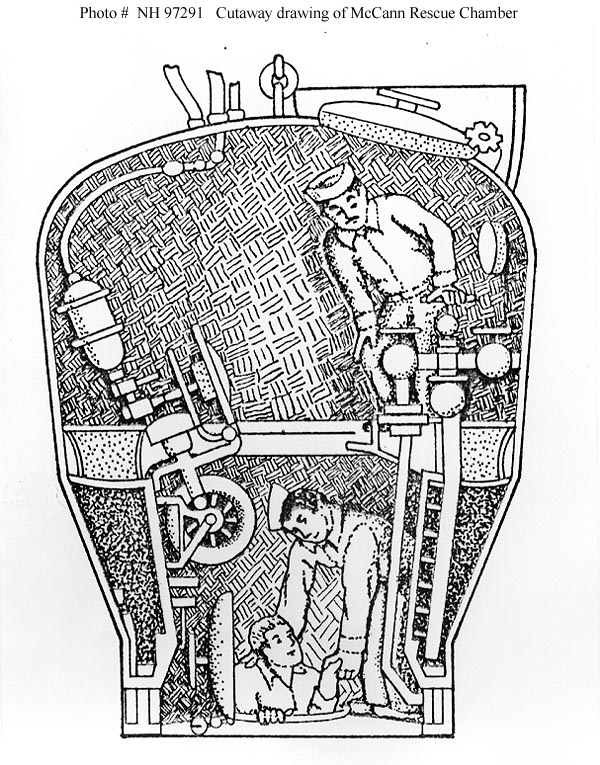
Official Navy cutaway of the chamber used in the Squalus rescue. This is an explanatory drawing, not a view inside the actual operation.
Official Navy cutaway of the chamber used in the Squalus rescue. This is an explanatory drawing, not a view inside the actual operation. Official U.S. Navy drawing / Naval Historical Center, NH 97291; UNC ibiblio mirror · Public domain in the United States: official federal government work.

A rescue chamber had to bring a small room to the people who could not leave their own. When the submarine Squalus sank off New Hampshire on 23 May 1939, thirty-three people remained alive in its forward compartments. Twenty-six others had died in the flooded after part of the vessel.

The submarine lay more than two hundred feet below the surface. Reaching its position was only one part of the problem. The people inside needed a protected passage through the surrounding water. The McCann chamber, developed from Charles Momsen’s earlier work, provided a way of connecting the trapped compartment to a vehicle that could return to the surface.

Momsen directed the rescue, and four descents brought all thirty-three survivors out. The operation required divers working around the sunken submarine as well as crews and equipment above it. Four Navy divers later received the Medal of Honor for their part in the effort.

A surviving Navy cutaway drawing makes the chamber’s purpose unusually clear. It shows the enclosed upper space and the lower connection, with human figures marking the route through the device. The drawing is a diagram, not a view inside the actual rescue. It explains the essential achievement: a temporary doorway where there had been only seawater.

Evidence and sources

The sinking and rescue of thirty-three people are documented. The rescue chamber brought out those alive in forward compartments; twenty-six people in the flooded aft compartments died.

  1. Navy History Matters, 14 May 2024: McCann’s Rescue Chamber Saved 33 Lives — Naval History and Heritage Command
    McCann’s Rescue Chamber Saved 33 Lives
  2. NH 97291: McCann Rescue Chamber — United States Navy / Naval Historical Center; institutional mirror at UNC ibiblio
    NH 97291, catalogue dated 15 June 2000

Story 04

The Submarine Came Back Without Its Crew

documentedSeptember 1925–July 1926 · Off Block Island and New York Harbor, United States

The submarine S-51 came back to a Navy drydock more than nine months after it sank. By then its return meant something very different from the rescue first attempted after its collision with the steamship City of Rome on 25 September 1925.

Only three of the thirty-six people aboard survived. Divers reached the wreck the following day and hammered on its hatches without receiving an answer. Because death had not yet been conclusively established, an attempt was made to lift the stern using floating derricks. The flooded submarine was too heavy for them. The task then became salvage.

The Navy had to restore buoyancy inside the hull and add lifting power outside it. Divers worked with the vessel partly embedded in the seabed, while large pontoons supplied additional lift. Another submarine, S-50, served as a model on which they could rehearse procedures before attempting them underwater. Bringing S-51 up required repeated adjustments to equipment and plans.

Even the tow to New York brought another difficulty: the wreck grounded in the East River, near its destination. It finally entered drydock on 8 July 1926. A technical account measures the undertaking in lifting forces, hoses and working days. Beneath those calculations lies the distinction that defined the whole operation: recovering the submarine could not restore the lives lost with it.

Evidence and sources

Three people survived the collision. Initial rescue attempts gave way to salvage; the later raising of S-51 was recovery of a wreck, not a rescue of living occupants.

  1. S-51 — Naval History and Heritage Command
    Collision and three survivors
  2. Submarine Salvage Manual: Appendix C, Salvage of Submarine S-51 — United States Navy; digitized reproduction at University of North Carolina ibiblio
    Appendix C, C-1–C-3; C-28–C-33

Story 05

The Map Ended Before the Water Did

documented24–28 July 2002 · Quecreek, Somerset County, Pennsylvania, United States

The mine map did not show how far the old workings extended. On 24 July 2002, miners at Quecreek cut into the flooded Harrison No. 2 mine. Water blocked one crew’s escape route. Nine men were trapped underground; nine others managed to leave.

A narrow borehole supplied the first direct connection from the surface. When drilling reached the section the following morning, the trapped miners tapped on the steel and received an answer. Pumps were brought in to lower the water while a larger hole was prepared for a rescue capsule. The two operations had to work together: opening a route downward could be dangerous while the water remained too high.

Damaged drilling equipment delayed the work. Finally, on Saturday night, the rescue hole broke through. Communication confirmed that all nine men were alive. They travelled upward one at a time, the first reaching the surface at 12:55 on Sunday morning and the last at 2:45. Medical teams received them above ground.

Investigators later traced the breakthrough to an incomplete, undated and uncertified map of the abandoned mine. A more extensive historical map turned up at a coal heritage centre after the accident. The rescue had depended on finding the men accurately; the disaster had begun because the record of what lay beside them was wrong.

Evidence and sources

Federal and state investigations document the entrapment, successful rescue and incomplete mapping of the adjacent abandoned mine.

  1. Quecreek No. 1 Mine Inundation Investigation Report — Mine Safety and Health Administration
    Overview and rescue operations, particularly printed pages 2 and 30
  2. Quecreek Investigation Executive Summary — Pennsylvania Department of Environmental Protection
    Executive summary, 22 July 2003

Story 06

Thirty-Three Trips Through One Opening

documented5 August–13 October 2010 · San José Mine, near Copiapó, Chile

The San José mine and surrounding Atacama landscape, photographed by satellite on 16 September 2010, while the miners remained underground.
The San José mine and surrounding Atacama landscape, photographed by satellite on 16 September 2010, while the miners remained underground. NASA Earth Observatory / Jesse Allen and Robert Simmon; NASA EO-1 team data · NASA imagery: editorial and informational reuse under NASA Media Usage Guidelines.

For seventeen days after the San José mine collapsed, rescuers did not know whether the thirty-three men underground were alive. Their discovery changed the task from searching to sustaining people who still had no usable exit. The mine lay in the dry hills north of Copiapó.

Small passages linked the men to the surface. Food, water, medicine and messages could travel through them, but a person could not. Underground, the miners had already rationed supplies and organised work. Above ground, Chilean authorities assembled a rescue effort that also drew on outside expertise, including a small NASA team familiar with isolation and life support.

The final passage required a specially designed capsule. Chilean naval shipyard ASMAR worked with CODELCO technicians on the Fénix design, while naval personnel joined the rescuers at the mine. Rollers helped the capsule move along the shaft; communications and medical monitoring connected its occupant to the teams above. The person inside still had to make the journey alone.

All thirty-three miners were brought to the surface on 13 October, sixty-nine days after the collapse. A satellite image made during their confinement shows the mine as a small mark within a vast desert landscape. Beneath that unremarkable-looking patch, survival had become a carefully maintained connection between people who could see daylight and people who could only wait for it.

Evidence and sources

Chilean institutional records and contemporary NASA reporting document the entrapment and collaborative rescue. The satellite photograph predates the final evacuation.

  1. Bravo Zulú al Grupo de Tarea Naval 33 — Armada de Chile
    20 October 2010 report of the 19 October recognition ceremony
  2. NASA Langley 100: Responding to Emergencies — NASA
    Help on the Ground: Chile, 2010
  3. San Jose Mine, Chile — NASA Earth Observatory
    Image acquired 16 September 2010; article 26 September 2010

Story 07

The Landing Craft Became a Lifeboat

documented13–17 April 1970 · Earth–Moon space and the South Pacific Ocean

The damaged service module after jettison, photographed by the Apollo 13 crew on 17 April 1970. The original supplied frame is preserved.
The damaged service module after jettison, photographed by the Apollo 13 crew on 17 April 1970. The original supplied frame is preserved. Apollo 13 crew / NASA, AS13-59-8500 · NASA imagery: editorial and informational reuse under NASA Media Usage Guidelines.

The part of Apollo 13 meant to land on the Moon became the place where three people waited to return to Earth. After an oxygen tank failed on 13 April 1970, the lunar landing was abandoned. James Lovell, Jack Swigert and Fred Haise had to preserve enough power and life support for the journey home.

The lunar module Aquarius became their lifeboat. Its systems had been intended to support two men during a short visit to the surface; now they had to sustain three for much longer. Ground teams calculated what could be switched off, how the return trajectory could be adjusted and which supplies had to be conserved.

One problem came down to incompatible shapes. Carbon-dioxide-removing canisters from the command module did not fit the lunar module’s system. Controllers devised an adapter using materials already aboard, including plastic bags, cardboard and tape. The crew could then use supplies that would otherwise have been inaccessible to their temporary living space.

Before re-entry, the astronauts discarded the damaged service module and photographed the missing panel that exposed its interior. They also left behind the lunar module that had kept them alive. On 17 April, the command module splashed down in the Pacific, and a helicopter carried the crew to USS Iwo Jima. The rescue had ended with a spacecraft completing only the journey nobody originally wanted it to make.

Evidence and sources

Mission records establish the oxygen-system failure, improvised life support and safe return. The photograph shows the damaged service module after it was jettisoned.

  1. Apollo 13: Mission Details — NASA
    Oxygen-tank failure, lunar-module lifeboat, consumables and carbon-dioxide adapter
  2. NASA’s Apollo 13 Mission Challenged Crew, Launch Team — NASA
    Transfer to lunar module, return maneuvers, April 17 recovery
  3. Damage to Apollo 13 — NASA Astronomy Picture of the Day
    17 April 2010 catalogue entry; image made 17 April 1970

Story 08

A Message Crossed the River

documentedOctober–December 1972 · Andes and Los Maitenes, Chile

The outside world had stopped searching when two of the survivors began the journey that would bring help. After a Uruguayan aircraft crashed in the Andes in October 1972, people remained alive beside the wreck, isolated by the mountains and struggling through cold and hunger.

Fernando Parrado and Roberto Canessa walked westward. In December they encountered the Chilean muleteer Sergio Catalán across a river. Distance and water frustrated ordinary conversation. A written message, carried across with a stone, explained that they had come from an aircraft and that fourteen others were still at the wreck. Contact had finally become something another person could act upon.

News reached the authorities, and Chilean Air Force helicopters went into the mountains. The remaining survivors could not all be carried out at once. Six were evacuated on 22 December, and eight the following morning. Three members of the Andean rescue service stayed overnight with the second group, bringing food, warmth and preparation for the next day’s departure.

Sixteen people survived the disaster in all, including the two who had walked out. The spectacular helicopter ending depended on less conspicuous links: the decision to leave the wreck, a local man responding to strangers and rescuers staying behind for another night. The mountains had made the survivors almost invisible. Their rescue began when a message made their continued existence known.

Evidence and sources

The survivors’ walk, local contact and helicopter evacuation are documented. The scholarly account distinguishes the actual two-stage evacuation from confused early press reports.

  1. A 51 años del rescate de los sobrevivientes de la tragedia de los Andes — Museo Nacional Aeronáutico y del Espacio, DGAC Chile
    20 December 2023 anniversary article
  2. El «milagro de los Andes»: reflexiones sobre el proceso de creación de memorias colectivas, in Seminario Simon Collier 2011 — Gabriela Robles Ramos / Pontificia Universidad Católica de Chile, Instituto de Historia
    Gabriela Robles Ramos, El «milagro de los Andes»: reflexiones sobre el proceso de creación de memorias colectivas, especially pages 156 and 162

Story 09

Most of Them Left by the Breakwater

documented26 May–4 June 1940 · Dunkirk, France, and the English Channel

A narrow breakwater carried much of an army toward home. The small boats at Dunkirk became the familiar image of rescue, but more than two-thirds of the evacuated troops left through the harbour’s eastern mole. That awkward structure became an essential route after the main docks were put out of action.

German advances had trapped Allied forces against the coast. From tunnels beneath Dover Castle, Bertram Ramsay and his staff directed Operation Dynamo, which began on 26 May 1940. At first, evacuation moved painfully slowly. Ships had to reach men under attack and return across the Channel while the pocket around Dunkirk contracted.

The gently shelving beaches kept large vessels far offshore. Smaller craft could approach the waiting soldiers and ferry them out; some carried troops all the way to Britain. Meanwhile, destroyers and other larger ships repeatedly used the harbour route. The rescue depended on these different kinds of vessel doing different jobs, alongside the forces defending the evacuation.

By 4 June, approximately 338,000 troops had been brought away. Many others were captured, and the British force left nearly all its heavy equipment behind. The men who reached Britain were a vital resource for the continuing war. Their arrival could be celebrated without changing what had happened on land: an extraordinary evacuation had followed a devastating military defeat.

Evidence and sources

The evacuation is documented. Institutional histories distinguish embarkation from the mole from the important work of boats along the beaches.

  1. Operation Dynamo: Things you need to know — English Heritage
    Operation Dynamo, mole versus beaches, key numbers and aftermath
  2. Dunkirk: fact sheet and IWM resources — Imperial War Museums
    Fact sheet page 1

Story 10

Safety Was on the Other Shore

documentedAutumn 1943 · Denmark and neutral Sweden

A warning had to travel faster than the arrests. In late September 1943, news of the impending German action against Jews in Denmark passed through political contacts, the Jewish community and informal networks. People left their homes for hiding places and began looking for routes to Sweden.

The rescue involved finding somewhere to wait as well as somewhere to go. Friends, strangers, medical workers and local organisations helped with shelter, food and transport to the coast. Jewish families and organisers participated in their own escape. Across the water, neutral Sweden agreed to receive the refugees.

Fishing boats and other small vessels carried people over, sometimes concealed beneath nets. Some operators charged nothing; others demanded substantial payment. Rescue organisations raised funds and helped people who could not afford passage. The crossing was neither safe nor universally successful. At Gilleleje, German searches caught a large group of fugitives, including people hidden at the church.

Approximately 7,200 Jews and 700 non-Jewish relatives reached Sweden during the wider escape. Nearly five hundred Jews were deported from Denmark to Theresienstadt. Those two outcomes belong in the same account. The boats made a striking final image, but their passengers had reached them through many smaller decisions: a warning passed on, a door opened, money collected and a place kept ready on the other shore.

Evidence and sources

The escape of most Jews in Denmark is documented, alongside arrests, deportations and dangerous or costly crossings. It was a network of actions rather than one uniformly successful operation.

  1. Danish Jews Escape — United States Holocaust Memorial Museum
    Danish Jews Escape, autumn 1943
  2. October 1943: The Rescue of the Danish Jews from Annihilation — National Museum of Denmark / Museum of Danish Resistance
    Therkel Stræde, October 1943, especially pages 15–23

Story 11

The Arrival Was Only the Beginning

documented2 December 1938–January 1939 · Harwich, London and reception camps, England

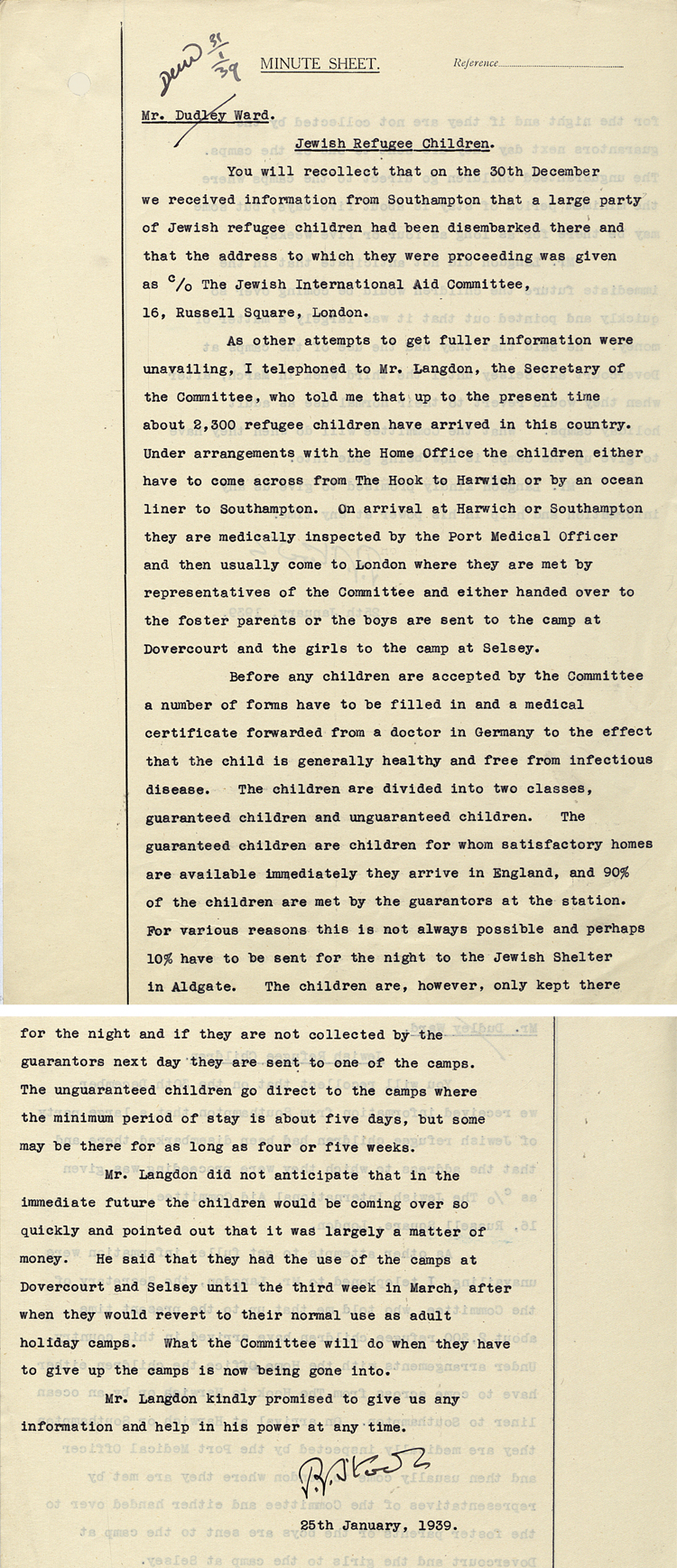
Publisher-supplied composite scan of Stock’s 25 January 1939 memorandum. It describes reception arrangements after the first Kindertransport, not a list of its passengers.
Publisher-supplied composite scan of Stock’s 25 January 1939 memorandum. It describes reception arrangements after the first Kindertransport, not a list of its passengers. The National Archives, MH 55/704. Contains public sector information licensed under the Open Government Licence v3.0. · Open Government Licence v3.0.

About two hundred children arrived at Harwich on 2 December 1938 in the first Kindertransport. They had escaped Nazi persecution through an arrangement that allowed unaccompanied minors into Britain. Their parents could not come with them under the same scheme.

The transports required work on both sides of the journey. Jewish organisations in Germany and elsewhere selected and assembled children, while refugee committees and supporters in Britain arranged guarantees for their care. Finding a seat on a train or ship solved only the immediate problem of departure. A child arriving in a foreign country still needed a home, supervision and continuing support.

A Health Ministry memorandum written several weeks later exposes that less familiar part of the rescue. Dr R. Stock recorded that children with arranged homes were generally collected by their guarantors. Others went to camps. A child whose expected adult failed to arrive might spend a night at the Jewish Shelter in Aldgate before being transferred onward.

The memorandum also identified a deadline. The Dovercourt and Selsey camps were due to return to ordinary holiday use in March, while the refugee organisers were still working out what would replace them. The first landing had been a moment of safety after persecution. Making that safety last required money, rooms and people who remained responsible after the headlines moved on.

Evidence and sources

The first arrival and subsequent reception arrangements are documented. The January memorandum describes continuing accommodation and funding problems, not the first transport’s passenger list.

  1. Kindertransport, 1938–1940 — United States Holocaust Memorial Museum
    First arrival, 2 December 1938; aid organizations and entry conditions
  2. Dr. Stock memorandum to Dudley Ward, 25 January 1939, MH 55/704 — The National Archives, United Kingdom
    MH 55/704, Dr R. Stock to Mr Dudley Ward

Story 12

The Line Came Back for Someone Else

documented13 January 1982 · Potomac River, Washington, D.C., United States

Six people escaped the initial impact into the freezing Potomac. Air Florida Flight 90 had struck Washington’s 14th Street Bridge after taking off in a snowstorm on 13 January 1982. Those still alive in the river clung to wreckage while people on shore watched the rescue develop.

A U.S. Park Police helicopter arrived about twenty minutes after the crash. Its crew worked close to the water, bringing a line to people who could scarcely hold on. Four were pulled to shore. When another woman lost her grip, bystander Lenny Skutnik entered the river and brought her to the bank.

Arland Williams had taken the helicopter’s line and flotation rings and passed them to other people. When the helicopter returned for him, he was gone. Five people ultimately survived the flight. The bridge would later bear Williams’s name, turning a place associated with the crash into a memorial to someone who had helped others during it.

The investigation also followed the decisions made before takeoff. Snow and ice had accumulated, the engine anti-ice system had not been activated, and misleading indications contributed to inadequate thrust. The rescue and the investigation tell different parts of the same event: the first records how people responded after the danger became visible; the second asks how it was allowed to develop.

Evidence and sources

The crash investigation and rescue account distinguish six people who escaped the initial impact from the five who ultimately survived. The rescue aircraft was a U.S. Park Police helicopter.

  1. Remembering Air Florida Flight 90 and the Progress Towards Eliminating Airline Icing Accidents — National Transportation Safety Board, Safety Compass
    Jeff Marcus, 12 January 2022, rescue sequence and icing findings
  2. Boeing 737-200: Air Florida Flight 90, N62AF — Federal Aviation Administration
    Accident Overview and flight-crew icing decisions

A doorway, a message, a boat, a place to sleep: rescue often depends on ordinary things being available at an extraordinary moment. These stories preserve the work behind the arrival, including local knowledge, organised care and the willingness to return. They also preserve the limits. The people who came home and those who did not remain part of the same history.

About the evidence labels

Documented identifies a supported historical event. Disputed marks an account whose explanation or details remain contested. Folklore identifies a recorded tradition; its inclusion does not establish that a supernatural event occurred.

The Unlikely Record 29: Ceremony Had Other Plans

The Unlikely Record · Episode 29 · Twelve stories

Twelve encounters between official ritual and practical reality

A ceremony promises that everyone knows where to stand, what to say and what will happen next. The surviving records often reveal something less settled: a disputed credential, a revised invitation, an accommodation, or a moment remembered differently from the way it occurred. These twelve stories follow the people and decisions behind public ritual, keeping the documented sequence separate from the polished anecdote.

Story 01

One Flag, Two Different Salutes

disputed13 July 1908 · White City Stadium, London, England

At the opening of the London Olympics, Ralph Rose carried the American flag before King Edward VII. The familiar version gives him one defiant action: refusing to lower it. But the ceremony contained two separate opportunities to salute, and treating them as one helped turn a complicated record into a patriotic anecdote.

The teams first stood in formation facing the royal box. Later, they marched past it. Newspaper descriptions did not always distinguish those moments, and reports also confused the man carrying the national nameboard with the flag-bearer. In 1999, Olympic historians Bill Mallon and Ian Buchanan compared the accounts and suggested that Rose might have acted differently at each salute.

Bob Wilcock’s 2011 study supplied photographic evidence for that distinction. During the stationary salute, Rose lowered the flag with the others. During the march-past, he held it upright while American teammates removed their caps. The pictures allow both observations to be true without requiring the ceremony to happen twice.

The accompanying quotation about a flag dipping to no earthly king has a shakier history. Mallon and Buchanan found no 1908 source for Sheridan’s supposed words. The missing American flag among the stadium decorations was a real, separately corrected grievance. Later retelling compressed decoration, gesture, motive and quotation into a single dramatic scene that the surviving evidence does not support.

Evidence and sources

Photographs distinguish two moments often collapsed into a single story. The famous declaration attributed to Martin Sheridan lacks a contemporary source.

  1. To No Earthly King: The United States Flag-Bearing Incident at the 1908 Olympic Games Opening Ceremony — Bill Mallon and Ian Buchanan; Journal of Olympic History 7(3), September 1999
    Printed pp. 21–28; contemporary reports, competing salutes, Sheridan quotation and conclusion
  2. This Flag Dips to No Earthly King: The 1908 Olympic Opening Ceremony: Fresh Evidence — Bob Wilcock; Journal of Olympic History 19(1), March 2011; LA84 Foundation
    Complete article, printed pp. 39–45

Story 02

The Credentials Needed Another Ocean Crossing

documentedMarch–July 1872 · Washington, D.C., United States, and Japan

The Iwakura Mission arrived in Washington carrying a letter from Japan’s emperor and ambitions far larger than a courtesy call. Its members hoped to study foreign institutions and improve the unequal treaties governing Japan’s relations with Western powers. Formal reception did not settle whether they could actually sign a new agreement.

At the first official negotiating meeting on 11 March 1872, the Japanese representatives maintained that they possessed that authority. Secretary of State Hamilton Fish disagreed. They could discuss revision, he said, but lacked the necessary plenary powers to conclude it. The meeting’s practical business became a disagreement about what their credentials permitted.

The mission decided to pursue formal negotiations. Itō Hirobumi and Ōkubo Toshimichi returned to Japan to obtain additional authority, extending what had begun as preliminary discussions into months of waiting. They reached Washington again on 22 July with the new powers. By then, the obstacle was larger than paperwork: the two sides still disagreed about the proposed treaty.

The negotiations ended without an agreement. Emperor Meiji’s introductory letter had spoken of consultation, institutional reform and a future revision after the embassy returned. Washington exposed the distance between those broad purposes and a document authorizing signatures. Crossing the ocean again could repair the credential problem, but it could not compel the other government to surrender privileges.

Evidence and sources

Japanese archival records distinguish diplomatic introduction from authority to sign a revised treaty.

  1. Treaty Revision Negotiations by the Iwakura Mission and Their Legacy — Japan Center for Asian Historical Records, National Archives of Japan
    Complete first essay, through conclusion on treaty revision; later essays on education and students were not used
  2. Letter from Emperor Meiji to President Ulysses S. Grant, on the Iwakura Mission, 1871 — Emperor Meiji; Asia for Educators, Columbia University
    Complete two-page teaching document

Story 03

The Portrait Offered a Diplomatic Compromise

documented14 September 1793 · Garden of Ten Thousand Trees, Chengde, Qing China

A portrait of George III became part of an argument about how far his ambassador should bow. Lord Macartney had brought British gifts to the Qianlong emperor, including scientific instruments and images of the royal family. Their intended message of wealth and standing encountered a different ceremonial understanding of the visit.

Macartney objected to performing the kowtow because he believed it would show greater submission than he offered his own king. The Royal Collection records his proposed compromise: a Chinese official of equivalent rank would perform the same ceremony before George’s portrait. Reciprocity might make a physical gesture acceptable to both courts. The proposal itself does not establish that the bargain was accepted.

Qianlong received the delegation at Chengde on 14 September 1793, and gifts passed in both directions. Britain sought wider commercial access, an offshore trading base and diplomatic representation in Beijing. The emperor’s responses rejected those requests and described the embassy through the language of tribute and imperial favour.

The surviving edicts make the disagreement more substantial than a dispute about etiquette. Each government approached the exchange with assumptions about authority, trade and the proper place of a foreign representative. An ingenious suggestion involving a painted king could address the appearance of respect. It could not, by itself, create agreement about the political relationship that respect was supposed to express.

Evidence and sources

The audience, exchanged gifts and rejected trade demands are documented. The reciprocal bow was a reported proposal, not an established agreement.

  1. George III: Portraits and Protocol in the Macartney Embassy — Royal Collection Trust
  2. Two Edicts from the Qianlong Emperor on the Occasion of Lord Macartney’s Mission, September 1793 — Qianlong Emperor; Asia for Educators, Columbia University
    Introduction and translated excerpts, pp. 1–2
  3. The Macartney Embassy Having an Audience at the Garden of Ten Thousand Trees — National Palace Museum, The Chengde Summer Resort
    Receiving Foreign Dignitaries: Macartney audience and tribute-list sections

Story 04

The Audience Moved Before It Happened

documentedJuly–September 1896 · New York, Washington, D.C., and Vancouver

Li Hongzhang’s American visit depended on meeting a president who was away from Washington. The Chinese statesman carried an autograph letter from his emperor, and presenting it was the central formal purpose of his journey. Waiting indefinitely in the capital would interfere with his return to China before winter disrupted navigation.

In July 1896, Chinese minister Yang Yü explained the problem to the State Department. Li could visit the president at his summer residence or another convenient place. The request made room for an audience outside the customary setting, allowing ceremony to follow the traveller’s timetable rather than force the traveller to wait for the setting.

An August letter fixed the meeting in New York for the thirty-first. It also offered a special train to Washington and onward toward Canada, with an army officer detailed to attend Li. Then, on 25 August, another letter changed the appointment: President Grover Cleveland would receive the party on the twenty-ninth at eleven in the morning, at 2 West Fifty-seventh Street.

The correspondence preserves diplomacy as a practical chain of adjustments: location, date, transport and escort. Before sailing from Vancouver on 13 September, Li sent formal thanks for the welcome and the officers’ attention. The grandeur of an imperial letter still required someone to solve the much smaller problem of getting its bearer and its recipient into the same room.

Evidence and sources

A sequence of diplomatic letters records changes to the audience’s location and date; the farewell telegram records Li’s expressed thanks.

  1. Yang Yü to Richard Olney, July 18, 1896 — Chinese Legation; United States Department of State, FRUS 1896, document 64
  2. William W. Rockhill to Yang Yü, August 12, 1896 — United States Department of State, FRUS 1896, document 67
  3. William W. Rockhill to Yang Yü, August 25, 1896 — United States Department of State, FRUS 1896, document 68
  4. Li Hung Chang to Yang Yü, September 13, 1896 — Li Hongzhang; United States Department of State, FRUS 1896, document 69

Story 05

The Surprise Had Been Negotiated

documented2 December 1804 · Notre-Dame Cathedral, Paris, France

David’s painting shows Napoleon crowning Joséphine. Created after the 1804 ceremony, it also includes Napoleon’s mother, who was absent.
David’s painting shows Napoleon crowning Joséphine. Created after the 1804 ceremony, it also includes Napoleon’s mother, who was absent. Jacques-Louis David, The Coronation of Napoleon, 1805–1807. Musée du Louvre, INV 3699. Public-domain painting and faithful reproduction via Wikimedia Commons. · Public domain: historical painting and faithful two-dimensional reproduction.

Napoleon placing a crown on his own head looks like the perfect unscripted interruption. In popular retelling, the pope is about to crown him when the emperor seizes control. The ceremonial history describes something more deliberate: French and papal negotiators had already worked through the actions and prayers.

The service at Notre-Dame on 2 December 1804 combined elements of French royal coronations, papal imperial rites and newly designed imperial ceremony. Pius VII anointed Napoleon and Joséphine. At the appropriate point, Napoleon took the crown from the altar and placed it on his head. He then crowned Joséphine, who knelt before him.

The political boundaries extended beyond the crowning moment. After the mass, the pope withdrew to the sacristy before Napoleon pronounced the constitutional oath. That oath upheld arrangements, including the civil code and the disposal of former church property, with which papal teaching conflicted. The order of the service made space for those disagreements without requiring their resolution.

Jacques-Louis David’s great painting added another layer of arrangement. It shows Joséphine’s coronation rather than Napoleon’s self-crowning and includes his mother, who had not attended. Neither the painting nor the famous anecdote is a neutral replay. The event’s drama came from carefully negotiated assertions of power, later reorganized into images and stories that looked more immediate than the planning behind them.

Evidence and sources

The self-coronation is documented; its familiar portrayal as a spontaneous affront to a surprised pope is contradicted by the negotiated ritual.

  1. Napoleon’s Consecration and Coronation — Peter Hicks; Fondation Napoléon
    Napoleon crowns himself; surrounding discussion of the hybrid liturgy
  2. The Day of Napoleon’s Coronation and Consecration, 2 December 1804 — Fondation Napoléon
    The ceremony: anointing, crowns, enthronement and constitutional oath
  3. The Sacre or Coronation — Fondation Napoléon

Story 06

The Patron Could Not Choose Every Picture

documented17 February–15 March 1913 · 69th Regiment Armory, New York City, United States

A period poster advertising the New York Armory Show. Its printed February 15 start date differs from the documented public opening on February 17, 1913.
A period poster advertising the New York Armory Show. Its printed February 15 start date differs from the documented public opening on February 17, 1913. Unidentified, Poster from the Armory Show, circa 1913. Smithsonian American Art Museum, Gift of Olga Hirshhorn, 1994.70. CC0. · CC0.

John Quinn helped make the Armory Show possible, but even its powerful patron could not make the selection committee accept everything he wanted. When he gave the opening speech in February 1913, the exhibition already contained the results of arguments, negotiations and refusals that its formal welcome could conceal.

Quinn was a lawyer, collector and honorary member of the Association of American Painters and Sculptors. He incorporated the association, helped secure the exhibition space and contacted people in Europe about loans. He hoped to promote English and Irish artists in particular. Yet his letters list works by several artists that the committee declined, alongside the pictures it accepted.

The show opened at the 69th Regiment Armory on 17 February and ran in New York until 15 March before travelling to Chicago and Boston. Its European experiments became a focus of enthusiastic and hostile commentary. The Smithsonian’s surviving records show that publicity was actively organized, rather than simply arriving as an accidental reward for artistic daring.

Quinn also changed through the exhibition he promoted. He bought works by Paris-based artists and later developed a collection more committed to modern European experiments. His opening role makes him look like the man announcing a settled programme. His correspondence shows a patron working within a committee’s decisions and then discovering that the event could alter his own judgement as well as the audience’s.

Evidence and sources

Quinn’s correspondence documents promotion, rejected loans and changing purchases. The story concerns the opening and its immediate collecting consequences.

  1. John Quinn and the 1913 Armory Show — Tal Nadan, Manuscripts and Archives Division; New York Public Library
  2. About the 1913 Armory Show — Kelly Quinn; Archives of American Art, Smithsonian Institution

Story 07

The Cameras Were Invited Back

documentedOctober 1952–2 June 1953 · London, England

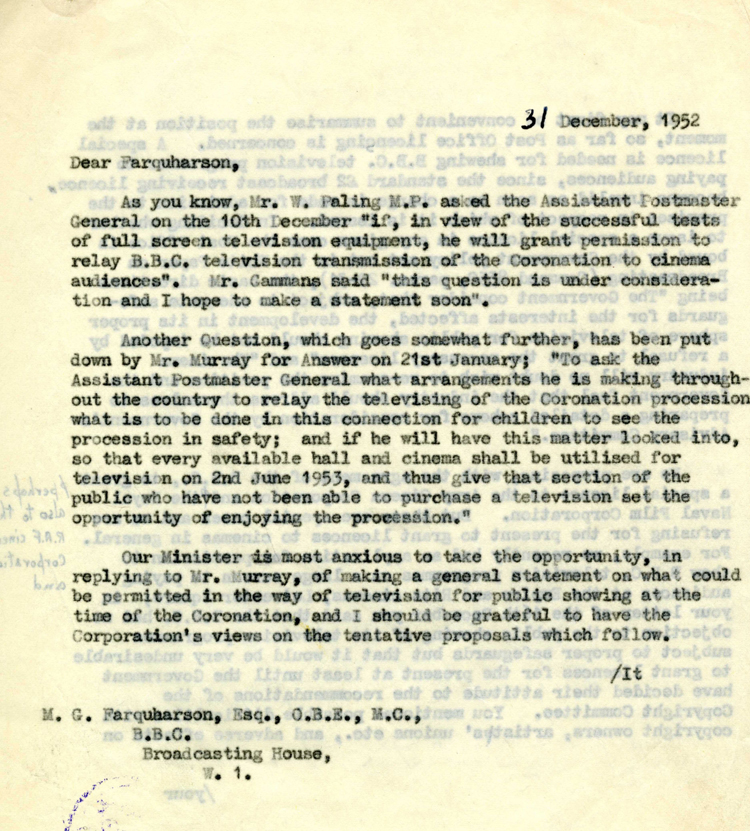
A government letter of 31 December 1952 discusses proposals for coronation television screenings in cinemas and halls. It records planning, rather than proving that every proposed screening took place.
A government letter of 31 December 1952 discusses proposals for coronation television screenings in cinemas and halls. It records planning, rather than proving that every proposed screening took place. The National Archives, HO 256/323. Contains public sector information licensed under the Open Government Licence v3.0. · Open Government Licence v3.0.

The coronation that became a landmark television event was initially going to keep most of its ceremony off the screen. On 20 October 1952, Buckingham Palace announced that television coverage would be restricted to the procession entering and leaving Westminster Abbey. The BBC’s proposal for wider access had encountered resistance over equipment, strain and the sacred character of the service.

The exclusion prompted complaints in newspapers and Parliament. Discussions reopened, and on 8 December the decision to televise the ceremony was announced. The change still had boundaries: the anointing and communion would remain concealed, and camera access was not permission to treat every moment as a close-up spectacle.

Agreement about the cameras created another problem: access to the picture. A government letter to the BBC on 31 December asked about relaying the coronation to cinema audiences. It also quoted a parliamentary question concerning halls, children’s safety and people who could not afford a television set. The audience was being planned alongside the ceremony.

Elizabeth II was crowned on 2 June 1953. The broadcast’s eventual familiarity can make its existence seem inevitable. The retained correspondence shows a succession of decisions instead: whether to transmit, what to conceal, and where people could gather to watch. A ceremony built around controlled admission now required officials to think about participation far beyond the doors of the abbey.

Evidence and sources

Committee records and government correspondence trace a reversal over television access and continuing questions about public screenings.

  1. The Television Broadcast of the 1953 Coronation, The Family Firm, chapter 6 — Edward Owens; University of London Press
    Opening analysis and television negotiations from June to December 1952
  2. Screening the Coronation: Letter to the BBC, December 31, 1952 — Overseas Telecommunications Department; The National Archives, HO 256/323

Story 08

The Cathedral Service Came Down the Steps

documented22 June 1897 · St Paul’s Cathedral, London, England

Gow’s painting represents Victoria’s carriage outside St Paul’s Cathedral. It was completed after the 1897 service and is not a photograph.
Gow’s painting represents Victoria’s carriage outside St Paul’s Cathedral. It was completed after the 1897 service and is not a photograph. Andrew Carrick Gow, Queen Victoria’s Diamond Jubilee Service, 22 June 1897, 1897–1899. Guildhall Art Gallery, City of London Corporation; faithful public-domain reproduction via Art UK and Wikimedia Commons. · Public domain: historical painting and faithful two-dimensional reproduction.

Queen Victoria arrived at St Paul’s Cathedral for her Diamond Jubilee and stayed in the carriage. This was an accommodation built into the ceremony. By 1897, walking was difficult for her, and the cathedral’s stairs presented a practical obstacle to the national service of thanksgiving.

The solution moved the gathering outside. Clergy, choir and dignitaries assembled around the west steps while the queen remained seated below. The Royal Collection’s photograph catalogue explicitly connects that arrangement with her difficulty mounting the stairs. Ceremonial authority did not depend on making her complete a painful climb.

The procession on 22 June brought seventeen carriages through London. Victoria travelled with her daughter Helena and the Princess of Wales, behind eight cream horses. The cathedral records a service lasting about twenty minutes, with music, prayers and a blessing. Afterwards, the queen continued her tour through the city rather than entering the building to complete a second version of the event.

The arrangement joined a vast imperial celebration to a very ordinary human limitation. Crowds, troops and carefully placed seating made the day expansive, but its central ritual was adjusted around one person’s mobility. The records of the outdoor service show how those needs were joined: a monarch travelling through the city, and a ceremony brought to the place where she could take part.

Evidence and sources

The cathedral and Royal Collection record a service arranged outdoors so Victoria could remain in her carriage.

  1. Queen Victoria’s Diamond Jubilee Service in Front of St Paul’s Cathedral, June 22, 1897 — Royal Collection Trust, RCIN 2942076
  2. Royal Jubilees: Queen Victoria’s Diamond Jubilee — St Paul’s Cathedral
    Complete Queen Victoria subsection

Story 09

The Emperor Listened to an Unfinished Invention

documented25 June 1876 · Centennial Exhibition, Philadelphia, Pennsylvania, United States

Before the emperor heard the telephone, Alexander Graham Bell was worried about the demonstration. In a letter of 21 June 1876, he described an invitation to exhibit alongside Elisha Gray on the coming Sunday. Gray had substantial equipment and battery power. Bell felt hurried, poorly assisted and uneasy about the direct comparison.

On 25 June, Emperor Pedro II of Brazil and scientist William Thomson attended the exhibits at Philadelphia’s Centennial Exhibition. Bell’s letter to his parents two days later describes the emperor recognizing him from an earlier introduction in Boston. After Gray’s demonstration, the visitors examined Bell’s apparatus and tried signalling with it.

Bell then offered to transmit the human voice, describing his invention as still developing. He went to another room to sing and speak. His account carefully identifies Willie Hubbard as the source for some of what the listeners did while he was absent. Thomson recognized words, and the emperor expressed surprise that he could hear.

The familiar polished version often supplies a different memorable exclamation for Pedro. Bell’s immediate letter is more useful for the uncertainty it preserves: preparation, rivalry, partial expectations and reports passed between rooms. A royal visitor did not transform a finished consumer product into an attraction. He helped make an experimental demonstration conspicuous at the moment its inventor was still explaining how much he hoped it would do.

Evidence and sources

Bell’s contemporary letters document nervous preparation and success. Some listeners’ reactions reached him through Willie Hubbard.

  1. Alexander Graham Bell to Mabel Hubbard, June 21, 1876 — Library of Congress, Alexander Graham Bell Family Papers
    Complete transcript; planned Sunday demonstration and concerns about competing equipment
  2. Alexander Graham Bell to His Parents, June 27, 1876 — Library of Congress, Alexander Graham Bell Family Papers
    Complete two-page transcript
  3. 1870 to 1879: Alexander Graham Bell Timeline — Library of Congress

Story 10

The Officer’s Task Went to a Sergeant

documented24 October 1921 · Châlons-sur-Marne, France

Four identical caskets stood in a French city hall, and someone had to choose the American Unknown Soldier. The original instructions assigned the task to a commissioned officer. Shortly before the ceremony, the plan changed: the Americans learned that France had given the equivalent honour to an enlisted man.

Major General Harry Rogers authorized a similar choice. Major Robert Harbold selected Sergeant Edward Younger, one of the soldiers attending from the American occupation force in Germany. On 24 October 1921, Younger entered the room at Châlons-sur-Marne and placed white roses on one casket.

The Army had taken precautions against identification. The remains came from four American military cemeteries in France, and the caskets had been rearranged onto different shipping cases. Younger was choosing a representative for the nation’s unidentifiable war dead, not deciding which individual life deserved greater recognition. The selected casket travelled through Le Havre to the United States and ultimately Arlington.

Younger later returned to civilian work in Chicago. When a newspaper found him in 1930, he had not yet been able to afford a visit to the tomb. It paid for the journey, and he again laid roses there. The ceremonial decision had briefly made one sergeant indispensable, then left him living an ordinary life at a distance from the memorial with which his name would remain linked.

Evidence and sources

Official records establish the changed selection protocol and choice by roses. The sergeant’s internal experience is known through later recollections.

  1. A Humble Sergeant: Edward F. Younger and the Unknown Soldier — Tim Frank, historian; Arlington National Cemetery
  2. Tomb of the Unknown Soldier: The World War I Unknown — Arlington National Cemetery
    October 1921 selection and journey to Arlington

Story 11

The Interpreter Recorded a Joke About Interpreters

documented4 June 1961 · Soviet Embassy, Vienna, Austria

At lunch during the Vienna summit, Nikita Khrushchev praised direct conversation between leaders and joked about the disadvantages of love conducted through interpreters. We know the remark through an interpreter’s record. Alexander Akalovsky drafted the American memorandum of the meeting, preserving a joke that playfully diminished the work making the exchange possible.

The luncheon on 4 June 1961 followed difficult discussions with President John F. Kennedy. Khrushchev’s toast acknowledged that the two sides had not reached an understanding. He argued that personal meetings were still preferable to leaving every difficult question to ambassadors and lower officials, even while Berlin remained a source of dangerous disagreement.

Kennedy’s reply also combined courtesy with warning. Modern war, he said, could affect succeeding generations. Near the end, he recalled asking what position Khrushchev had held at forty-four, Kennedy’s own age. Kennedy joked that at sixty-seven he hoped to head Boston’s planning commission. Khrushchev suggested a worldwide version; Kennedy kept the ambition local.

The memorandum records humour without turning it into evidence of agreement. Its provenance matters: Akalovsky drafted it, and the White House approved it later that month. The summit’s toasts could sound companionable while the political positions remained far apart. Behind the apparent ease of a personal encounter stood interpreters, notes and subsequent approval—the machinery through which the conversation became a historical record.

Evidence and sources

An interpreter-drafted memorandum preserves the luncheon toasts. It is an official reconstructed record, not a verbatim sound recording.

  1. Editorial Note on the Vienna Summit, June 3–4, 1961 — United States Department of State, FRUS 1961–1963, Volume V, document 82
  2. Memorandum of Conversation at Lunch, Vienna, June 4, 1961 — Alexander Akalovsky; United States Department of State, FRUS 1961–1963, Volume V, document 88

Story 12

The Toast Reached the Pianist

documented19 July 1945 · Potsdam, Germany

A formal dinner at Potsdam reached the point where Joseph Stalin raised a toast to the pianist. Harry Truman described the evening in a letter to his wife, Bess, on 20 July 1945. The previous night, he had hosted Winston Churchill on his right and Stalin on his left after another difficult day of meetings.

The dinner included a succession of toasts to heads of state, honoured guests and foreign ministers. Music then gave Stalin an additional subject. Truman wrote that the pianist had played Tchaikovsky especially for him, and Stalin responded by saying he would bring a leading Russian pianist to perform for the American president.

The performer was Eugene List, an American soldier and accomplished pianist. Truman praised the range of music he played, including Chopin, Weber and Schubert. A later photograph catalogue records List presenting the president with music from the Potsdam performance in January 1946. It provides a quiet documentary continuation to the evening’s more theatrical exchange of hospitality.

Truman’s letter reports that his guests left in a happy mood; the same letter makes his impatience with the negotiations plain. The music offered a temporary shared experience within a meeting full of incompatible demands. It did not supply a political settlement. In the private account, the formal sequence of honouring leaders briefly expanded to include the enlisted musician whose performance had altered the tone of the room.

Evidence and sources

Truman’s letter the next day records the dinner and Eugene List’s performance. Its description of Stalin’s mood is Truman’s observation.

  1. Harry S. Truman to Bess W. Truman, July 20, 1945 — Harry S. Truman; Truman Presidential Library
    Source 7: complete July 20 letter
  2. President Truman Meets with Staff Sergeant Eugene List, January 4, 1946 — Truman Presidential Library, photograph 64-166

Protocol can make a gathering appear inevitable. Letters, photographs and meeting notes return the choices to view: who was included, what was changed, and which later story displaced the record. The most revealing moment is often the practical decision that the ceremony was designed to make invisible.

About the evidence labels

Documented identifies a supported historical event. Disputed marks an account whose explanation or details remain contested. Folklore identifies a recorded tradition; its inclusion does not establish that a supernatural event occurred.
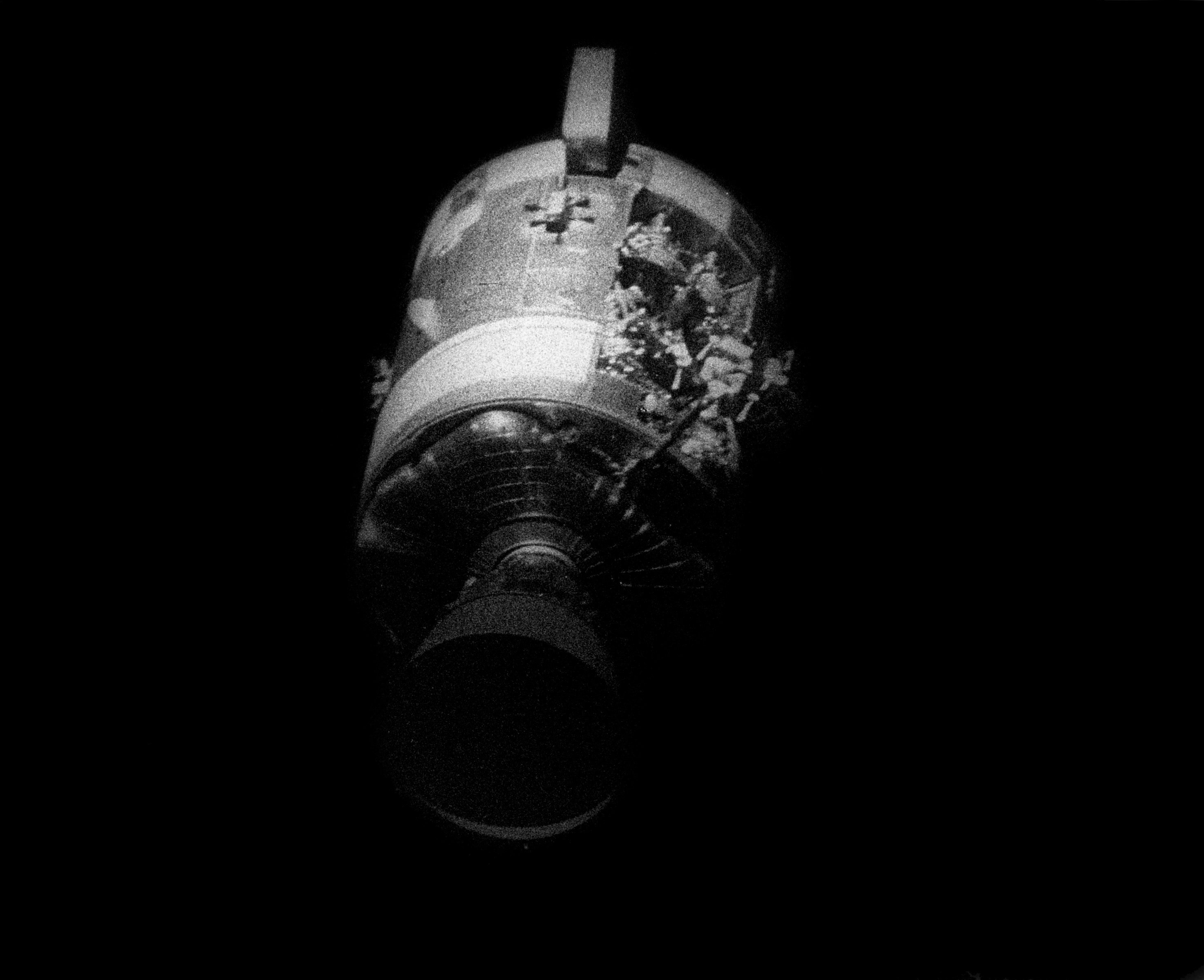
The Unlikely Record 01: Letters That Took the Long Way

The Unlikely Record · Episode 01 · Twelve stories Twelve postal detours, peculiar parcels and unexpected reversals Some letters survive b...