The Unlikely Record · Episode 30 · Twelve stories
Twelve rescues, recoveries and the work of bringing people home
A rescue begins with a difficult question: where is someone, and what would make it possible to reach them? These accounts move from Arctic camps and flooded mines to a spacecraft, a river and the routes taken by refugees. They follow people who made contact, built a passage or kept searching. Some brought everyone out; others saved a few or recovered only what remained. Each outcome belongs to the record.
Story 01
Seven People in the Tent
The rescue party found seven people alive. Three years earlier, twenty-five had gone north with Adolphus Greely to collect Arctic scientific observations. By June 1884, the expedition had contracted to a tent near Cape Sabine and a dwindling supply of food.
The isolation had grown through successive failures. A relief ship could not break through the ice in 1882; the following year, another was crushed. Greely’s party eventually abandoned its station at Fort Conger and travelled south, expecting supplies near Cape Sabine. The caches they found could not sustain them through the winter. Hunger turned the months of waiting into a succession of deaths.
Winfield Schley’s relief expedition reached the camp on 22 June. The ships Thetis and Bear carried away the survivors, together with the expedition’s records and instruments. Scientific observations had remained worth protecting even while the people who made them were struggling to stay alive.
The rescue did not immediately settle the final count. Joseph Ellison, grievously injured by frostbite, died on 8 July after an amputation during the homeward journey. Six members eventually returned alive. The surviving notebooks preserve measurements from the Arctic; the relief report preserves a different measurement, the narrow interval between finding someone and being able to bring that person home.
Evidence and sources
The relief commander’s report and expedition chronology establish seven people found alive on 22 June; one died during the return voyage.
- Report of Winfield S. Schley, commanding Greely Relief Expedition of 1884 — United States Navy / Naval History and Heritage Command
Report and telegrams on the 22 June rescue, 8 July death and return of records - The Greely Expedition: Timeline — PBS American Experience
1881 departure; failed 1882–83 relief; retreat; June–July 1884
Story 02
The Survivors Had to Search Again
Reaching land did not mean that the Jeannette expedition was together, or safe. After the ship was crushed in Arctic ice in June 1881, its company hauled boats and supplies toward open water. A storm separated the three boats during their approach to Siberia.
George Melville’s party reached a settlement and received food from local people. George De Long’s party landed elsewhere in the Lena Delta, where hunger and cold progressively reduced its ability to travel. De Long sent two men ahead for assistance. They survived with local help, but a message connecting their whereabouts to Melville had still to cross a landscape whose language and routes the Americans did not know.
When that information arrived, Melville became a rescuer of the companions from whom he had been separated. His search failed to reach De Long in time. A renewed effort the following spring found the dead and recovered their records. The third boat’s company was never found.
An 1885 congressional report considered allegations that the search had been negligently delayed. Its committee rejected blame against Melville and stressed what he had known at the time. It also credited Siberian residents who had shared provisions scarcely sufficient for themselves. The inquiry’s final pages make clear how much survival had depended on people outside the expedition.
Evidence and sources
The ship’s loss, local aid and later search are documented. A congressional committee distinguished accusations of neglect from its findings clearing the surviving officers.
- Jeannette I (Steam Bark) — Naval History and Heritage Command
1879 departure, 1881 loss, Melville’s search and 1882 recovery - The Jeannette Expedition, House Report No. 2602, 48th Congress, 2d session (17 February 1885) — United States House of Representatives / Government Publishing Office
House Report 2602 (17 February 1885), printed pages 3–5
Story 03
A Room Lowered Through the Sea
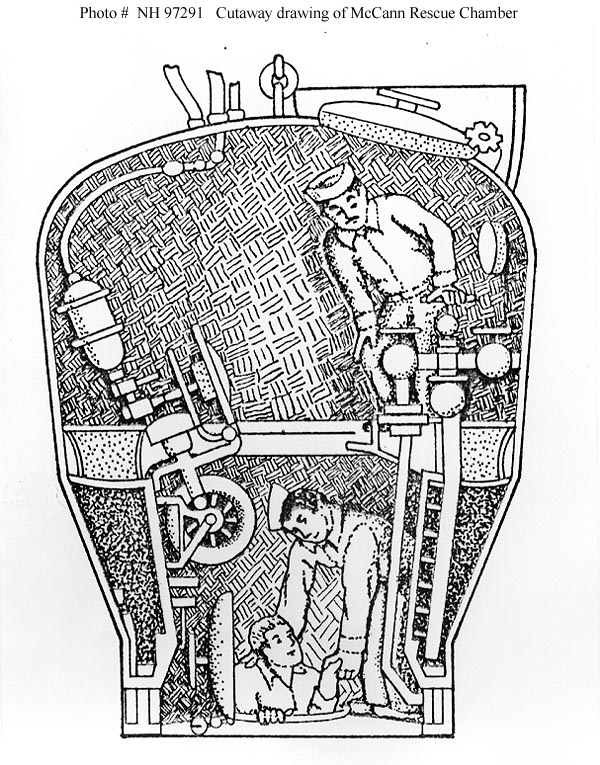
A rescue chamber had to bring a small room to the people who could not leave their own. When the submarine Squalus sank off New Hampshire on 23 May 1939, thirty-three people remained alive in its forward compartments. Twenty-six others had died in the flooded after part of the vessel.
The submarine lay more than two hundred feet below the surface. Reaching its position was only one part of the problem. The people inside needed a protected passage through the surrounding water. The McCann chamber, developed from Charles Momsen’s earlier work, provided a way of connecting the trapped compartment to a vehicle that could return to the surface.
Momsen directed the rescue, and four descents brought all thirty-three survivors out. The operation required divers working around the sunken submarine as well as crews and equipment above it. Four Navy divers later received the Medal of Honor for their part in the effort.
A surviving Navy cutaway drawing makes the chamber’s purpose unusually clear. It shows the enclosed upper space and the lower connection, with human figures marking the route through the device. The drawing is a diagram, not a view inside the actual rescue. It explains the essential achievement: a temporary doorway where there had been only seawater.
Evidence and sources
The sinking and rescue of thirty-three people are documented. The rescue chamber brought out those alive in forward compartments; twenty-six people in the flooded aft compartments died.
- Navy History Matters, 14 May 2024: McCann’s Rescue Chamber Saved 33 Lives — Naval History and Heritage Command
McCann’s Rescue Chamber Saved 33 Lives - NH 97291: McCann Rescue Chamber — United States Navy / Naval Historical Center; institutional mirror at UNC ibiblio
NH 97291, catalogue dated 15 June 2000
Story 04
The Submarine Came Back Without Its Crew
The submarine S-51 came back to a Navy drydock more than nine months after it sank. By then its return meant something very different from the rescue first attempted after its collision with the steamship City of Rome on 25 September 1925.
Only three of the thirty-six people aboard survived. Divers reached the wreck the following day and hammered on its hatches without receiving an answer. Because death had not yet been conclusively established, an attempt was made to lift the stern using floating derricks. The flooded submarine was too heavy for them. The task then became salvage.
The Navy had to restore buoyancy inside the hull and add lifting power outside it. Divers worked with the vessel partly embedded in the seabed, while large pontoons supplied additional lift. Another submarine, S-50, served as a model on which they could rehearse procedures before attempting them underwater. Bringing S-51 up required repeated adjustments to equipment and plans.
Even the tow to New York brought another difficulty: the wreck grounded in the East River, near its destination. It finally entered drydock on 8 July 1926. A technical account measures the undertaking in lifting forces, hoses and working days. Beneath those calculations lies the distinction that defined the whole operation: recovering the submarine could not restore the lives lost with it.
Evidence and sources
Three people survived the collision. Initial rescue attempts gave way to salvage; the later raising of S-51 was recovery of a wreck, not a rescue of living occupants.
- S-51 — Naval History and Heritage Command
Collision and three survivors - Submarine Salvage Manual: Appendix C, Salvage of Submarine S-51 — United States Navy; digitized reproduction at University of North Carolina ibiblio
Appendix C, C-1–C-3; C-28–C-33
Story 05
The Map Ended Before the Water Did
The mine map did not show how far the old workings extended. On 24 July 2002, miners at Quecreek cut into the flooded Harrison No. 2 mine. Water blocked one crew’s escape route. Nine men were trapped underground; nine others managed to leave.
A narrow borehole supplied the first direct connection from the surface. When drilling reached the section the following morning, the trapped miners tapped on the steel and received an answer. Pumps were brought in to lower the water while a larger hole was prepared for a rescue capsule. The two operations had to work together: opening a route downward could be dangerous while the water remained too high.
Damaged drilling equipment delayed the work. Finally, on Saturday night, the rescue hole broke through. Communication confirmed that all nine men were alive. They travelled upward one at a time, the first reaching the surface at 12:55 on Sunday morning and the last at 2:45. Medical teams received them above ground.
Investigators later traced the breakthrough to an incomplete, undated and uncertified map of the abandoned mine. A more extensive historical map turned up at a coal heritage centre after the accident. The rescue had depended on finding the men accurately; the disaster had begun because the record of what lay beside them was wrong.
Evidence and sources
Federal and state investigations document the entrapment, successful rescue and incomplete mapping of the adjacent abandoned mine.
- Quecreek No. 1 Mine Inundation Investigation Report — Mine Safety and Health Administration
Overview and rescue operations, particularly printed pages 2 and 30 - Quecreek Investigation Executive Summary — Pennsylvania Department of Environmental Protection
Executive summary, 22 July 2003
Story 06
Thirty-Three Trips Through One Opening

For seventeen days after the San José mine collapsed, rescuers did not know whether the thirty-three men underground were alive. Their discovery changed the task from searching to sustaining people who still had no usable exit. The mine lay in the dry hills north of Copiapó.
Small passages linked the men to the surface. Food, water, medicine and messages could travel through them, but a person could not. Underground, the miners had already rationed supplies and organised work. Above ground, Chilean authorities assembled a rescue effort that also drew on outside expertise, including a small NASA team familiar with isolation and life support.
The final passage required a specially designed capsule. Chilean naval shipyard ASMAR worked with CODELCO technicians on the Fénix design, while naval personnel joined the rescuers at the mine. Rollers helped the capsule move along the shaft; communications and medical monitoring connected its occupant to the teams above. The person inside still had to make the journey alone.
All thirty-three miners were brought to the surface on 13 October, sixty-nine days after the collapse. A satellite image made during their confinement shows the mine as a small mark within a vast desert landscape. Beneath that unremarkable-looking patch, survival had become a carefully maintained connection between people who could see daylight and people who could only wait for it.
Evidence and sources
Chilean institutional records and contemporary NASA reporting document the entrapment and collaborative rescue. The satellite photograph predates the final evacuation.
- Bravo Zulú al Grupo de Tarea Naval 33 — Armada de Chile
20 October 2010 report of the 19 October recognition ceremony - NASA Langley 100: Responding to Emergencies — NASA
Help on the Ground: Chile, 2010 - San Jose Mine, Chile — NASA Earth Observatory
Image acquired 16 September 2010; article 26 September 2010
Story 07
The Landing Craft Became a Lifeboat
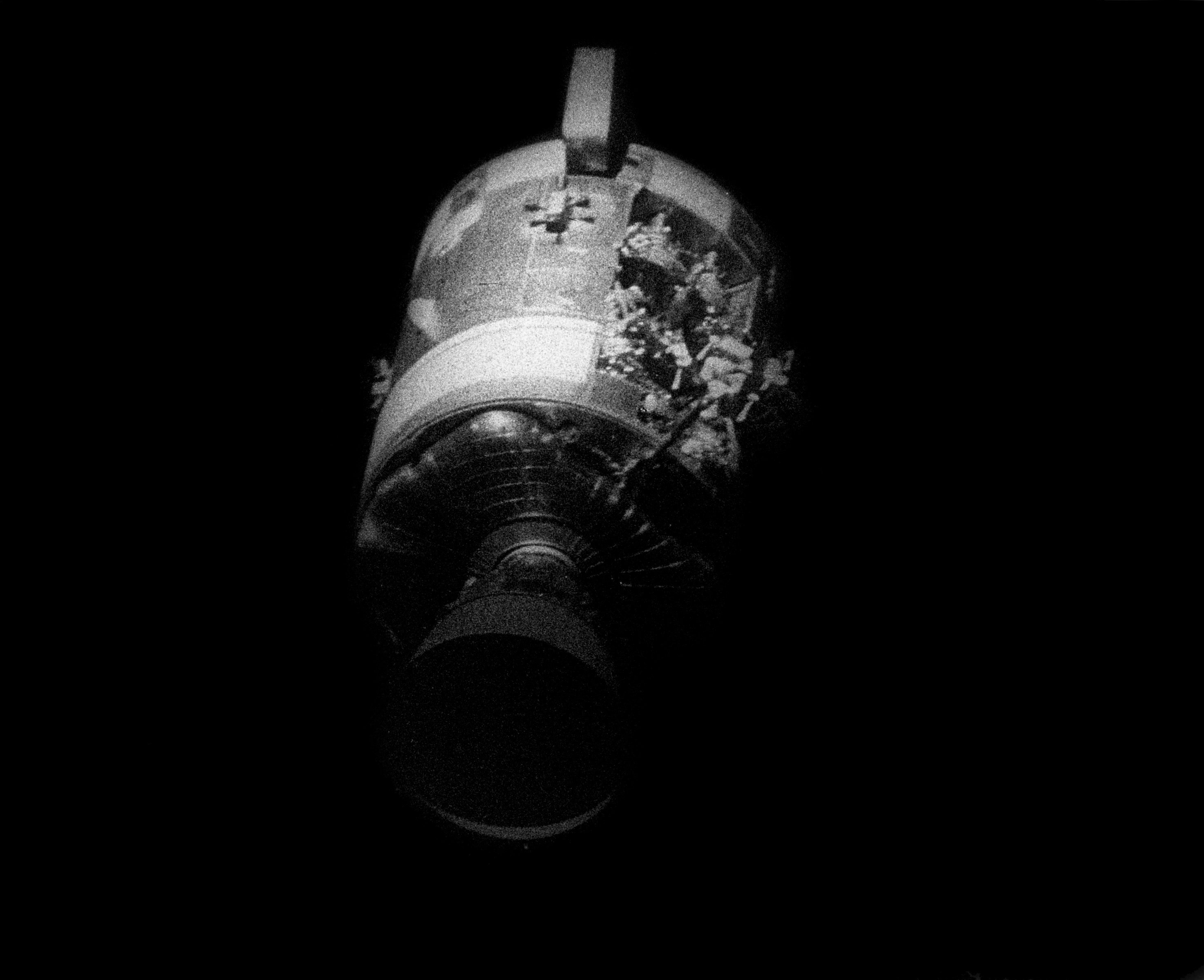
The part of Apollo 13 meant to land on the Moon became the place where three people waited to return to Earth. After an oxygen tank failed on 13 April 1970, the lunar landing was abandoned. James Lovell, Jack Swigert and Fred Haise had to preserve enough power and life support for the journey home.
The lunar module Aquarius became their lifeboat. Its systems had been intended to support two men during a short visit to the surface; now they had to sustain three for much longer. Ground teams calculated what could be switched off, how the return trajectory could be adjusted and which supplies had to be conserved.
One problem came down to incompatible shapes. Carbon-dioxide-removing canisters from the command module did not fit the lunar module’s system. Controllers devised an adapter using materials already aboard, including plastic bags, cardboard and tape. The crew could then use supplies that would otherwise have been inaccessible to their temporary living space.
Before re-entry, the astronauts discarded the damaged service module and photographed the missing panel that exposed its interior. They also left behind the lunar module that had kept them alive. On 17 April, the command module splashed down in the Pacific, and a helicopter carried the crew to USS Iwo Jima. The rescue had ended with a spacecraft completing only the journey nobody originally wanted it to make.
Evidence and sources
Mission records establish the oxygen-system failure, improvised life support and safe return. The photograph shows the damaged service module after it was jettisoned.
- Apollo 13: Mission Details — NASA
Oxygen-tank failure, lunar-module lifeboat, consumables and carbon-dioxide adapter - NASA’s Apollo 13 Mission Challenged Crew, Launch Team — NASA
Transfer to lunar module, return maneuvers, April 17 recovery - Damage to Apollo 13 — NASA Astronomy Picture of the Day
17 April 2010 catalogue entry; image made 17 April 1970
Story 08
A Message Crossed the River
The outside world had stopped searching when two of the survivors began the journey that would bring help. After a Uruguayan aircraft crashed in the Andes in October 1972, people remained alive beside the wreck, isolated by the mountains and struggling through cold and hunger.
Fernando Parrado and Roberto Canessa walked westward. In December they encountered the Chilean muleteer Sergio Catalán across a river. Distance and water frustrated ordinary conversation. A written message, carried across with a stone, explained that they had come from an aircraft and that fourteen others were still at the wreck. Contact had finally become something another person could act upon.
News reached the authorities, and Chilean Air Force helicopters went into the mountains. The remaining survivors could not all be carried out at once. Six were evacuated on 22 December, and eight the following morning. Three members of the Andean rescue service stayed overnight with the second group, bringing food, warmth and preparation for the next day’s departure.
Sixteen people survived the disaster in all, including the two who had walked out. The spectacular helicopter ending depended on less conspicuous links: the decision to leave the wreck, a local man responding to strangers and rescuers staying behind for another night. The mountains had made the survivors almost invisible. Their rescue began when a message made their continued existence known.
Evidence and sources
The survivors’ walk, local contact and helicopter evacuation are documented. The scholarly account distinguishes the actual two-stage evacuation from confused early press reports.
- A 51 años del rescate de los sobrevivientes de la tragedia de los Andes — Museo Nacional Aeronáutico y del Espacio, DGAC Chile
20 December 2023 anniversary article - El «milagro de los Andes»: reflexiones sobre el proceso de creación de memorias colectivas, in Seminario Simon Collier 2011 — Gabriela Robles Ramos / Pontificia Universidad Católica de Chile, Instituto de Historia
Gabriela Robles Ramos, El «milagro de los Andes»: reflexiones sobre el proceso de creación de memorias colectivas, especially pages 156 and 162
Story 09
Most of Them Left by the Breakwater
A narrow breakwater carried much of an army toward home. The small boats at Dunkirk became the familiar image of rescue, but more than two-thirds of the evacuated troops left through the harbour’s eastern mole. That awkward structure became an essential route after the main docks were put out of action.
German advances had trapped Allied forces against the coast. From tunnels beneath Dover Castle, Bertram Ramsay and his staff directed Operation Dynamo, which began on 26 May 1940. At first, evacuation moved painfully slowly. Ships had to reach men under attack and return across the Channel while the pocket around Dunkirk contracted.
The gently shelving beaches kept large vessels far offshore. Smaller craft could approach the waiting soldiers and ferry them out; some carried troops all the way to Britain. Meanwhile, destroyers and other larger ships repeatedly used the harbour route. The rescue depended on these different kinds of vessel doing different jobs, alongside the forces defending the evacuation.
By 4 June, approximately 338,000 troops had been brought away. Many others were captured, and the British force left nearly all its heavy equipment behind. The men who reached Britain were a vital resource for the continuing war. Their arrival could be celebrated without changing what had happened on land: an extraordinary evacuation had followed a devastating military defeat.
Evidence and sources
The evacuation is documented. Institutional histories distinguish embarkation from the mole from the important work of boats along the beaches.
- Operation Dynamo: Things you need to know — English Heritage
Operation Dynamo, mole versus beaches, key numbers and aftermath - Dunkirk: fact sheet and IWM resources — Imperial War Museums
Fact sheet page 1
Story 10
Safety Was on the Other Shore
A warning had to travel faster than the arrests. In late September 1943, news of the impending German action against Jews in Denmark passed through political contacts, the Jewish community and informal networks. People left their homes for hiding places and began looking for routes to Sweden.
The rescue involved finding somewhere to wait as well as somewhere to go. Friends, strangers, medical workers and local organisations helped with shelter, food and transport to the coast. Jewish families and organisers participated in their own escape. Across the water, neutral Sweden agreed to receive the refugees.
Fishing boats and other small vessels carried people over, sometimes concealed beneath nets. Some operators charged nothing; others demanded substantial payment. Rescue organisations raised funds and helped people who could not afford passage. The crossing was neither safe nor universally successful. At Gilleleje, German searches caught a large group of fugitives, including people hidden at the church.
Approximately 7,200 Jews and 700 non-Jewish relatives reached Sweden during the wider escape. Nearly five hundred Jews were deported from Denmark to Theresienstadt. Those two outcomes belong in the same account. The boats made a striking final image, but their passengers had reached them through many smaller decisions: a warning passed on, a door opened, money collected and a place kept ready on the other shore.
Evidence and sources
The escape of most Jews in Denmark is documented, alongside arrests, deportations and dangerous or costly crossings. It was a network of actions rather than one uniformly successful operation.
- Danish Jews Escape — United States Holocaust Memorial Museum
Danish Jews Escape, autumn 1943 - October 1943: The Rescue of the Danish Jews from Annihilation — National Museum of Denmark / Museum of Danish Resistance
Therkel Stræde, October 1943, especially pages 15–23
Story 11
The Arrival Was Only the Beginning
About two hundred children arrived at Harwich on 2 December 1938 in the first Kindertransport. They had escaped Nazi persecution through an arrangement that allowed unaccompanied minors into Britain. Their parents could not come with them under the same scheme.
The transports required work on both sides of the journey. Jewish organisations in Germany and elsewhere selected and assembled children, while refugee committees and supporters in Britain arranged guarantees for their care. Finding a seat on a train or ship solved only the immediate problem of departure. A child arriving in a foreign country still needed a home, supervision and continuing support.
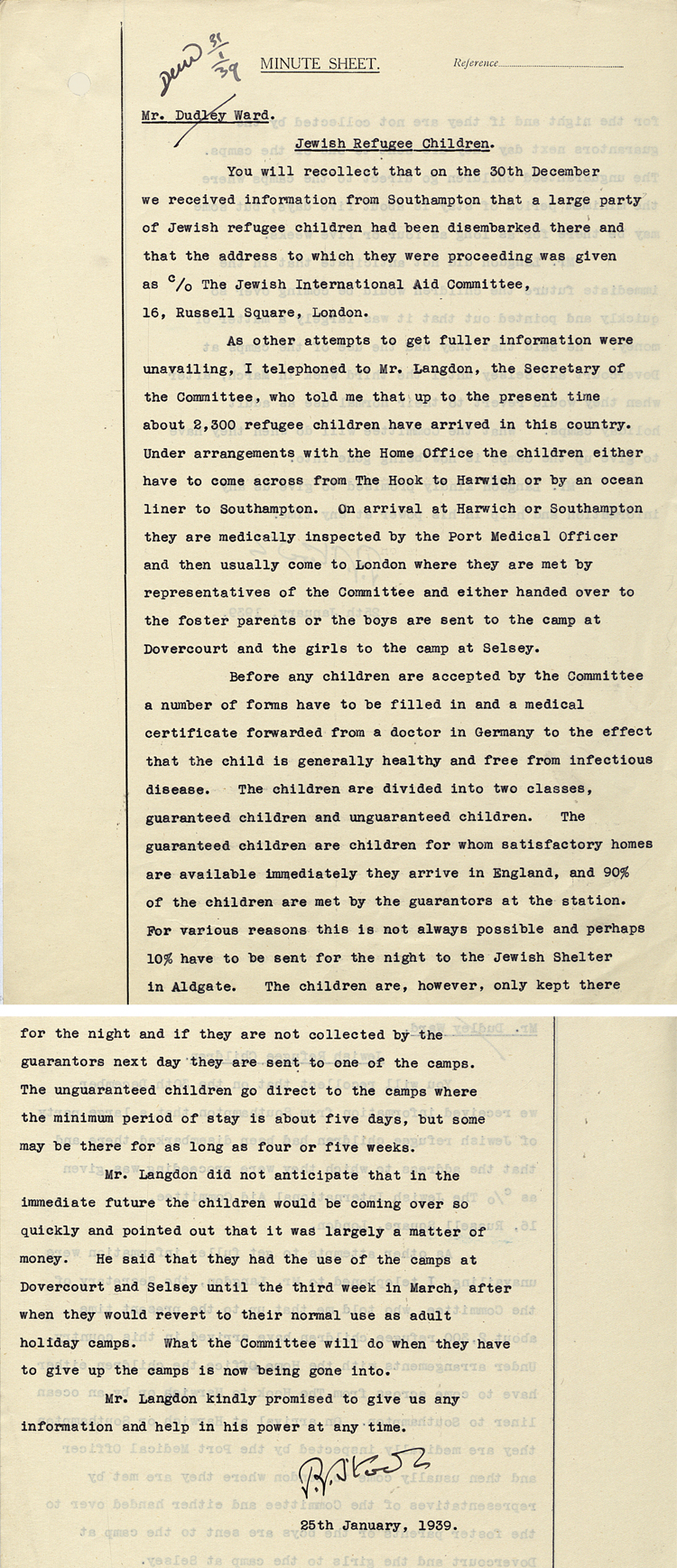
A Health Ministry memorandum written several weeks later exposes that less familiar part of the rescue. Dr R. Stock recorded that children with arranged homes were generally collected by their guarantors. Others went to camps. A child whose expected adult failed to arrive might spend a night at the Jewish Shelter in Aldgate before being transferred onward.
The memorandum also identified a deadline. The Dovercourt and Selsey camps were due to return to ordinary holiday use in March, while the refugee organisers were still working out what would replace them. The first landing had been a moment of safety after persecution. Making that safety last required money, rooms and people who remained responsible after the headlines moved on.
Evidence and sources
The first arrival and subsequent reception arrangements are documented. The January memorandum describes continuing accommodation and funding problems, not the first transport’s passenger list.
- Kindertransport, 1938–1940 — United States Holocaust Memorial Museum
First arrival, 2 December 1938; aid organizations and entry conditions - Dr. Stock memorandum to Dudley Ward, 25 January 1939, MH 55/704 — The National Archives, United Kingdom
MH 55/704, Dr R. Stock to Mr Dudley Ward
Story 12
The Line Came Back for Someone Else
Six people escaped the initial impact into the freezing Potomac. Air Florida Flight 90 had struck Washington’s 14th Street Bridge after taking off in a snowstorm on 13 January 1982. Those still alive in the river clung to wreckage while people on shore watched the rescue develop.
A U.S. Park Police helicopter arrived about twenty minutes after the crash. Its crew worked close to the water, bringing a line to people who could scarcely hold on. Four were pulled to shore. When another woman lost her grip, bystander Lenny Skutnik entered the river and brought her to the bank.
Arland Williams had taken the helicopter’s line and flotation rings and passed them to other people. When the helicopter returned for him, he was gone. Five people ultimately survived the flight. The bridge would later bear Williams’s name, turning a place associated with the crash into a memorial to someone who had helped others during it.
The investigation also followed the decisions made before takeoff. Snow and ice had accumulated, the engine anti-ice system had not been activated, and misleading indications contributed to inadequate thrust. The rescue and the investigation tell different parts of the same event: the first records how people responded after the danger became visible; the second asks how it was allowed to develop.
Evidence and sources
The crash investigation and rescue account distinguish six people who escaped the initial impact from the five who ultimately survived. The rescue aircraft was a U.S. Park Police helicopter.
- Remembering Air Florida Flight 90 and the Progress Towards Eliminating Airline Icing Accidents — National Transportation Safety Board, Safety Compass
Jeff Marcus, 12 January 2022, rescue sequence and icing findings - Boeing 737-200: Air Florida Flight 90, N62AF — Federal Aviation Administration
Accident Overview and flight-crew icing decisions
A doorway, a message, a boat, a place to sleep: rescue often depends on ordinary things being available at an extraordinary moment. These stories preserve the work behind the arrival, including local knowledge, organised care and the willingness to return. They also preserve the limits. The people who came home and those who did not remain part of the same history.
About the evidence labels
Documented identifies a supported historical event. Disputed marks an account whose explanation or details remain contested. Folklore identifies a recorded tradition; its inclusion does not establish that a supernatural event occurred.