Showing posts with label Living Traditions. Show all posts

Wednesday, October 14, 2026

Sámi Joik: A Voice That Holds Relationships and Memory

Suppose you recognize someone before hearing their name. A gesture, a way of entering a room, or the rhythm of a familiar voice brings the person to mind. That experience offers a modest starting point for thinking about joik: a musical expression can hold a relationship without describing it in a sequence of explanatory verses.
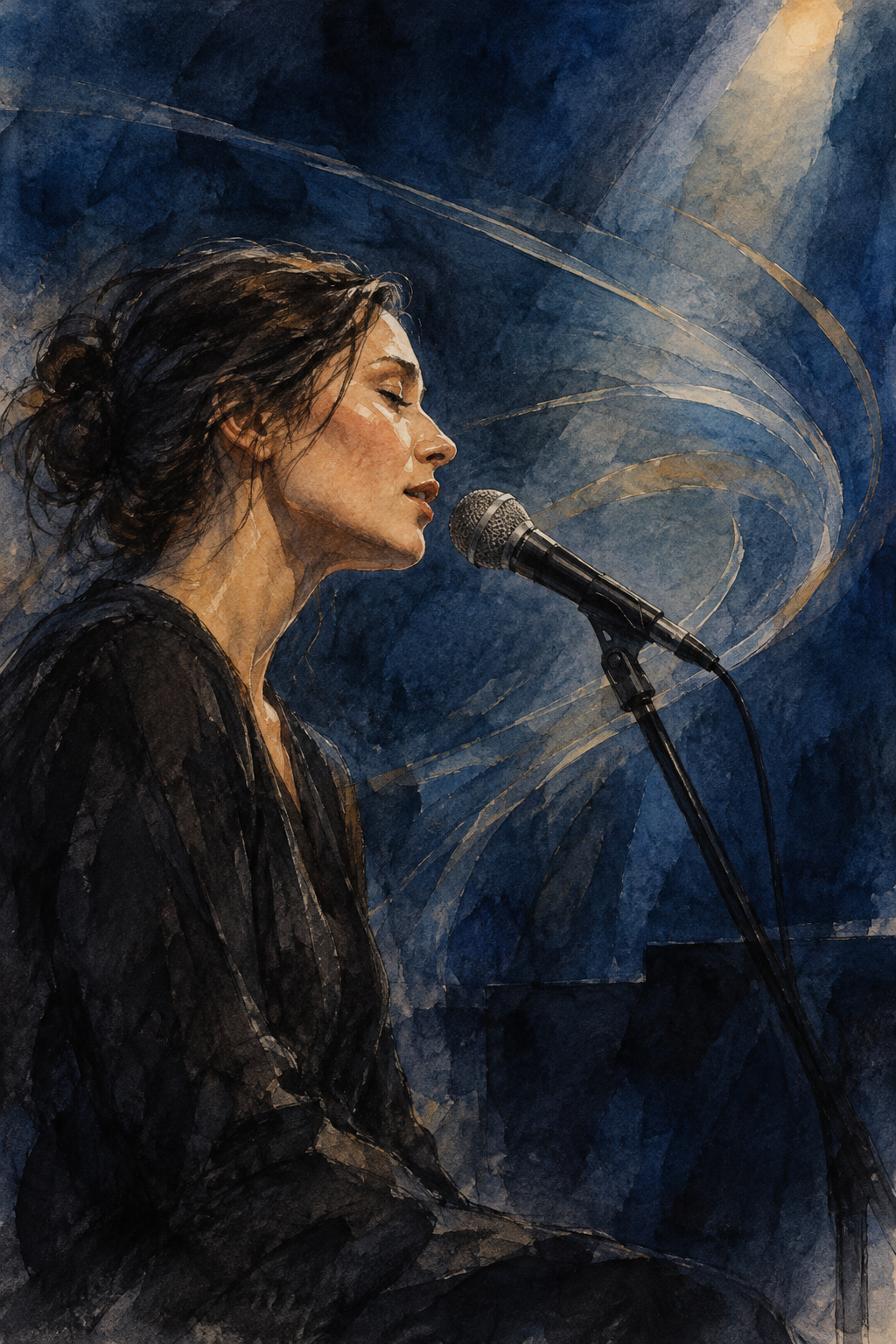
An interpretive singer in contemporary clothing performs beside a microphone.
Interpretive illustration of solo vocal performance. It does not depict a named Sámi artist, documented joik performance or traditional costume.

It is only a starting point. Sámi joik traditions have their own histories, languages, and meanings. The most rewarding introduction follows Sámi explanations and named performers, then gives careful attention to a particular performance. It leaves room for the fact that a listener may hear a returning figure before understanding what it evokes.

What changes when a performance evokes someone?

The Sámi Information Centre’s account describes joik as a tradition of memory. People, animals, places, and experiences can remain present through it. The distinction often expressed is that one joiks someone or something, rather than simply singing about a subject from the outside.

This changes the questions a newcomer brings. Instead of immediately asking for a line-by-line translation, ask whether the performer or accompanying account identifies a person, place, or relationship. A title might name someone, but the significance of that name may require knowledge shared among people who know the joik.

A musical portrait need not provide the sort of information a written biography supplies. Recognition, affection, remembrance, and a description of events are different kinds of work. Understanding that difference makes room for what the performance is doing, rather than treating unfamiliar structure as missing content.

A repeated figure can remain responsive

In an explanation published by Skellefteå Museum, Lena Maria Nilsson and Krister Stoor discuss the return and variation of musical themes. The performance’s character can change with the relationship being expressed and the situation. A recurring melody is therefore not evidence that the performer is merely repeating an unchanging emotional statement.

Listen for a figure’s return before deciding that you have heard all it can offer. Does a note feel sustained differently? Does the voice’s intensity change? Does a repeated passage acquire another emphasis through what surrounds it? You can notice such details without claiming that you know their personal meaning.

The same museum account presents a specific historical case connected with forced labor at the Nasafjäll silver mine. Kristina Mårtensson shared the joik with Karl Tirén in 1912; the museum discusses its later documentation and Lena Maria Nilsson’s interpretation. Those names and records matter. A performance can carry a history of transmission as well as the history it recalls.

One label does not erase regional differences

Terms and traditions differ across Sápmi. The Sámi Information Centre distinguishes South Sámi vuollie, North Sámi luohti, and the distinct Skolt Sámi leu’dd tradition. These are reasons to read an artist’s or archive’s description carefully, not interchangeable tags to attach to any Sámi vocal performance.

When you encounter a recording, keep its language or regional identification beside its title. If the information is absent, leave the gap visible. A broad playlist heading can help you discover work, but a specific credit gives you a better foundation for learning what you have found.

Transmission has also been affected by religious condemnation and wider pressures on Sámi culture. The centre describes how opposition discouraged some people from learning. That history helps explain why continued practice and teaching cannot be taken for granted. It does not mean every Sámi person has the same relationship to joik.

Meet artists in the present tense

Composer and performer Frode Fjellheim, in Nord University’s account of his teaching, places cultural and linguistic understanding at the center of learning. His discussion of joik as communication directs attention beyond an unusual vocal sound. Sound, knowledge, and the relationship being expressed belong together.

The Sámi Information Centre’s video selection provides a useful next encounter. It identifies performances by Jon Henrik Fjällgren, Mari Boine, Jörgen Stenberg, Sofia Jannok, and Ára. The named works and different musical settings allow a listener to meet artists making particular choices, rather than imagine one performance as a complete account of Sámi music.

Choose one credited work that interests you. The presence of instruments or contemporary production is not, on its own, an explanation of the performer’s relationship to tradition. Read what the artist or presenting institution shares, then return to the sound with that account in mind.

A listening notebook with room for what you do not know

Use one of the centre’s selected videos. On the first pass, listen without trying to imitate the voice. Choose a short returning figure that you can recognize. On the next pass, attend to its phrasing and the sounds around it.

Keep three kinds of note separate
Your noteA useful example
Something audibleA short figure returns, with a different emphasis near its end.
Something supplied by the sourceThe performer’s name, work title, and explanation of its context.
Something still unknown to youThe significance of a name or the personal history behind a phrase.

Compare your first description with the source’s explanation. Did you hear a detail that now feels more significant? Did you assume a meaning the explanation does not support? Both discoveries improve listening. You are learning to connect sound with an account of its context, rather than treating an immediate impression as a translation.

You can also compare two performances by different credited artists. Record one musical difference without ranking which is more authentic from its sound alone. An archive, a concert stage, and a contemporary recording are different encounters, each requiring its own context.

An archive preserves an encounter, not a whole people

Smithsonian Folkways’ 1956 release from northern Norway includes individual performer credits and a modern advisory about its historical title. The advisory explains that “Lapp” and “Lappish” were externally imposed terms with negative associations. Read that explanation as part of the record, rather than adopting the old album title as your own description.

Its track list identifies performers including Per Henderak Haetta and Inga Susanne Haetta. Those credits let you retain the people behind an archival sound. The release offers listening options, while full streaming may require membership. The centre’s video selection provides a separate route to public performances.

Joik becomes more compelling when you allow recognition and uncertainty to coexist. A returning figure may become familiar to your ear while its deeper relationships remain something to learn from the people who share it. Patient attention begins there.

Continue with another form of shared memory

Explore Songlines: Learning From Knowledge That Connects People and Country and Nüshu: The Writing That Travelled on Fans and Wedding Books. Each follows a different tradition through the people and relationships that give it meaning.

Explore more art, ideas, and independent projects at Incoprea.

Songlines: Learning From Knowledge That Connects People and Country

In the National Museum of Australia’s Songlines audio journey, the Seven Sisters move between Countries, and their names and stories change along the way. A listener has to keep attending to who is speaking and where the journey has arrived. The movement is not simply a line progressing across an otherwise empty map.

An original landscape illustration shows red desert earth, rocky ridges and a starry dusk sky.
Landscape illustration evoking arid Australia. It depicts no named cultural site, songline route, traditional artwork or ancestral narrative.

That offers a useful way into a large subject. Public accounts of Aboriginal Australian songlines connect places, ancestral narratives, knowledge, relationships, and responsibilities. They do so within particular peoples’ traditions. A close encounter with one community-directed exhibition is more rewarding than collecting a list of broad claims about an undifferentiated Aboriginal culture.

Begin with who directed the telling

Songlines: Tracking the Seven Sisters grew through collaboration involving senior custodians from Martu Country, Ngaanyatjarra lands, and Anangu Pitjantjatjara Yankunytjatjara lands. The museum explains that community-nominated senior knowledge holders formed a curatorium. They directed the cultural representation in collaboration with the institution.

That is a consequential distinction. Custodians were not merely being asked to comment on an account whose main decisions had already been made elsewhere. Their role shaped what visitors could encounter and how it would be presented. The exhibition’s authorship belongs in an introduction alongside its subject.

Read the credits as part of the experience. They identify communities, knowledge holders, artists, art centres, and collaborators whose different kinds of work brought the project into being. A familiar museum name can otherwise eclipse the people whose knowledge makes its presentation possible.

A route holds more than directions

The museum’s account of the original 2017 exhibition describes sections of five songlines from the Western and Central Deserts. It connects ancestral journeys with knowledge of places, water, food, and ways of living. The project began with Elders’ concern to carry knowledge forward and share understanding with a wider public.

Navigation matters within that account, but a comparison with a coordinate system reaches its limit quickly. A point on a map can locate a waterhole without explaining a person’s responsibilities, relationships, or reasons for remembering it. Knowing where something is and knowing how one belongs in relation to it are different achievements.

The audio journey makes that relationship specific. Its public transcript introduces the sisters as Minyipuru in Martu Country, then Kungkarangkalpa in the APY Lands. It points to changes of language and story with Country. Following those changes helps a newcomer resist flattening many local accounts into one standardized narrative.

The transcript also states that the exhibition shares an open story. That is a positive description of the invitation being offered: listeners can learn through this public telling while recognizing that not every kind of knowledge is being presented to every audience.

Artworks are encounters with named makers

The online exhibition selection brings painting, fibre work, photographs, objects, performance, and moving image into view. Its highlights include Minyipuru at Pangkal, credited to Martumili Artists, and the Seven Sisters Tree Women by Tjanpi Desert Weavers. These are particular works with makers and contexts, not interchangeable illustrations of a general visual style.

Different materials ask different things of a viewer. A painting can invite sustained attention across its surface. A group of three-dimensional figures occupies space in another way. A voice introduces timing, emphasis, and a speaker. Moving between them can change what you notice without implying that one medium translates every aspect of another.

Start with the title and credit of one work before reading a general explanation of symbols. Ask what the presenting source actually tells you about this object. If it identifies a maker, art centre, material, or place, retain that detail in your notes. A shape you recognize visually does not automatically give you permission or knowledge to assign it a cultural meaning.

Make a short visit through the audio and transcript

The museum’s 37-minute, 45-second audio journey is presented by Alison Page, Duncan Smith, and Ursula Yovich. It was developed for the exhibition and remains a route through its publicly shared material. The page includes a transcript. The museum notes sexual references in the journey and images, voices, and names of people who have died on its site.

Choose a manageable portion rather than trying to absorb every place name in one sitting. Keep the transcript open, but begin with a short passage of listening. The following sequence gives you a way to return to the material with a more precise question.

  1. Listen for an arrival. Find a moment when the narration identifies a Country, community, or part of the journey. Write the name as the transcript presents it.
  2. Identify the medium. Is the guide discussing a painting, figures, a film, a place, or a performance? Locate the corresponding work in the museum’s online selection when it is available.
  3. Read a small section. Look at the transcript around your chosen moment. Note one relationship or explanation that was difficult to retain from listening alone.
  4. Listen again. Notice emphasis, the exchange of voices, and pacing. What does hearing add to your reading?

A useful notebook has three headings: the work or place named, what its presenters share, and a question you still have. The last heading is not a demand for information the exhibition has not offered. It helps distinguish what you learned from what you merely expected to learn.

Because the journey was written for an exhibition space, some directions refer to rooms and objects. Online, treat those moments as clues to the original encounter. You can pause to examine the credited online works without pretending that the screen reproduces the full physical installation.

Preserving knowledge also means preserving relationships

The museum’s project history describes Elders initiating the work for future generations. It also records research material being returned for an Aboriginal-managed archive. Public display was therefore one part of a wider undertaking, rather than the final destination of everything collected.

This is a useful change of emphasis for anyone who thinks preservation means only recording words before they disappear. Questions about who holds material, who teaches, who decides on access, and how younger people encounter it remain part of the work. A recording can support those relationships; its mere existence does not replace them.

Return to the beginning of the audio journey after exploring one artwork. You may now hear a name as a connection rather than an item in a list. That is a worthwhile first step: more attention to particular people and Country, and less confidence in an easy universal summary.

Continue through other publicly shared accounts

Explore another account of memory and relationship in Sámi Joik: A Voice That Holds Relationships and Memory. Then consider why an object’s interpretation requires social context in A Message Stick Is More Than the Marks a Camera Can See.

Explore more art, ideas, and independent projects at Incoprea.

Famous Last Meals is now in paperback — stories, history and 25 recipes

Famous Last Meals: Stories, History, and Recipes is now available in paperback on Amazon. The illustrated collection brings together 23 his...
