Showing posts with label Birds. Show all posts

Sunday, October 25, 2026

The Air-Sac Circuit That Keeps a Bird's Lungs Supplied

A pigeon lifts from a courtyard and begins the work of flight. Its chest moves as it breathes, but the lungs inside do not operate like a pair of human lungs expanding and emptying.

A bird combines compact lungs with a system of air sacs. One part specializes in gas exchange; another helps move air. That division makes a surprising flow pattern possible: air can pass through the main exchange passages in the same direction during both inhalation and exhalation.

Gray pigeon in flight across an open sunlit courtyard.
A bird’s breathing apparatus includes air sacs that move air and compact lungs where gas exchange occurs.

Keep the pump and the exchanger separate

The lungs contain the intricate surfaces where oxygen enters the blood and carbon dioxide leaves it. They are held against the back of the body and remain relatively rigid during breathing.

The thin-walled air sacs expand and compress with the body's breathing movements, acting as ventilatory bellows. The sacs do not provide the lung's principal exchange surface. Nor should we imagine them as little muscular hearts pumping independently. Movements of the ribs, sternum, and associated structures change their volumes.

The distinction is central to a 2025 review of avian respiratory structure. It explains why adding more “air bags” is not the same as adding more gas-exchange tissue. Volume for moving gas and surface for exchanging it are different resources.

In and out at the entrance, onward through the lung

Air still enters and exits through the trachea. A bird does not inhale through one opening and exhale through another. The unusual pattern occurs deeper in the circuit.

In the main, or palaeopulmonic, parabronchi, flow ordinarily proceeds from the rear toward the front during both respiratory phases. These are small through-passages within the lungs, connected to larger airways and the sac system.

A 2025 review of air sacs and the neopulmo also emphasizes variation. Many birds possess additional neopulmonic exchange passages where airflow is bidirectional. “One-way airflow” describes a major functional arrangement, not every passage in every bird.

Breathing phaseSimplified picture of the main circuit
InhalationFresh air travels toward the posterior sacs; some also enters the lung. Expanding anterior sacs receive air from the lung.
ExhalationPosterior sacs send air through the lung while anterior sacs discharge air toward the trachea.

The important feature is simultaneous movement in several compartments. Oxygen-bearing air can keep reaching the exchange region while air elsewhere is leaving the animal.

The helpful model with an important limitation

A familiar teaching model follows an imagined parcel of air over two breaths: into posterior sacs, through the lung, into anterior sacs, then out. It helps establish the order of the main compartments.

But a real respiratory system is not a queue of sealed balloons passing identical packages on a timer. Air mixes, and some follows faster routes.

In a 2013 study of zebra finches and yellow-headed blackbirds, researchers used small pulses of helium and implanted temperature-sensitive probes to investigate ventilation. Much of the pattern agreed with the established model. Yet some tracer reached anterior sacs during the very inhalation in which it entered the bird.

The researchers also found differences in anterior-sac ventilation during calling and wing flapping. They did not establish whether all of those adjustments were active or passive. Their observations show why the two-breath diagram is an introduction, rather than an exact itinerary for every molecule during every behavior.

Airflow needs direction without little flap valves

Airway geometry and moving air help direct the flow through a process called aerodynamic valving. It is not a set of tiny mechanical doors opening and closing on the diagram's arrows.

The detailed performance depends on the physical system. Flow speed, gas properties, and the compliance of the sacs matter. Reviews distinguish the better-studied routing during inhalation from remaining questions about the corresponding expiratory mechanism. The circuit's broad behavior is well established even while parts of its control remain research problems.

This is a useful engineering lesson. Direction can arise from the interaction of geometry and flow, rather than requiring a moving gate at every junction.

The blood has a route too

Moving air is only part of respiration. Blood must reach the exchange tissue, and oxygen must cross a thin barrier.

The overall relationship between blood delivery and bulk airflow in the parabronchi is called cross-current. A classic experiment in ducks tested models of this arrangement by reversing airflow through the exchange passages. The findings agreed with the cross-current interpretation.

It is worth keeping that geometry distinct from the one-way ventilation story. One describes how air travels through passages; the other describes how the two exchanging media are arranged. Efficient gas exchange depends on several cooperating features, rather than one magical arrow.

The next departing pigeon still looks effortless from the pavement. Under its feathers, breathing is a coordinated circulation through spaces with different jobs, supplying a working animal through both halves of a breath.

Read the research

Keep exploring

Discover more art, ideas, and curious things at Incoprea.

Friday, October 23, 2026

The Honeyguide Listens for a Human Partner’s Call

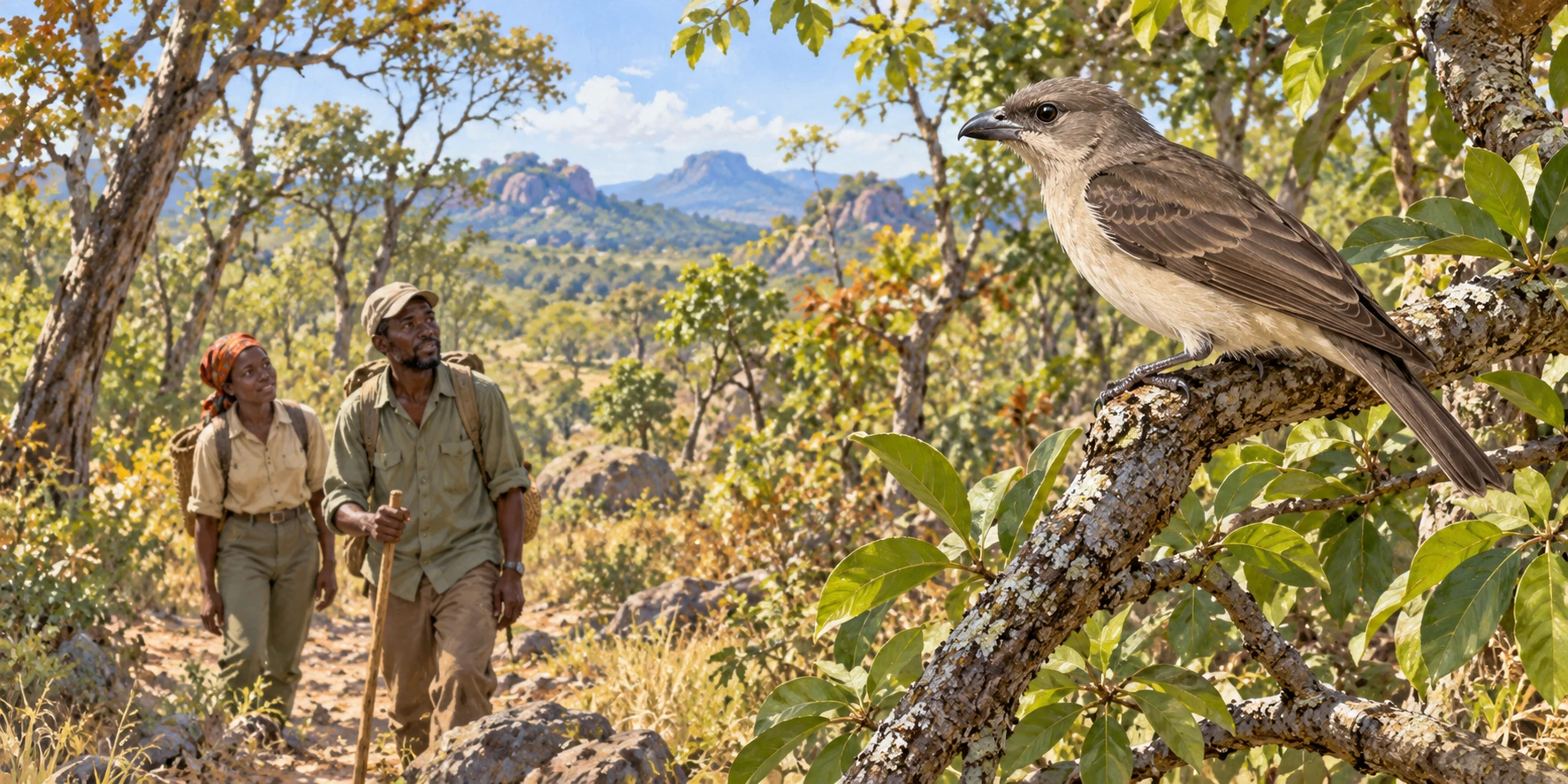
A person calls into woodland. A small bird answers, moves ahead and waits. The person follows. The scene can look like a trained performance until one essential fact becomes clear: the greater honeyguide is a free-living wild bird, and the partnership is part of a living human tradition.

Greater honeyguide perched above a woodland path as two honey-hunters look toward it
The partnership joins a wild bird’s search with human knowledge and locally maintained signals.

Honeyguides lead honey-hunters toward bees' nests. People can open a nest and obtain honey; birds can gain access to beeswax. The partners bring different capabilities, and signals help them coordinate a search. The deeper question is how each recognizes a useful partner among all the sounds in the landscape.

A call tested against alternatives

A 2016 field experiment compared a specialized Mozambican honey-hunting call with other human and animal sounds of similar amplitude. The specialized sound increased the probability of being guided from about 33 to 66 percent. The overall chance of finding a nest through guiding increased from 17 to 54 percent in the reported comparison.

Those are different outcomes. A bird beginning to guide is an intermediate event. Finding a nest is an outcome farther along the cooperative sequence. Reporting both helps avoid turning every response into a completed successful hunt.

The controls mattered too. Without alternative sounds, a response might merely show that a human noise attracted attention. Comparing sounds lets researchers ask whether a particular signal is especially associated with cooperation.

There is no single universal password

Different honey-hunting communities use different calls. In 2023 experiments in Tanzania and Mozambique, honeyguides responded more readily to the calls of local partners than to calls from the other culture. Differences in how sound traveled did not explain the pattern. The results support birds learning local human signals.

This is richer than the idea of one magical sound that summons a species everywhere. A signal can acquire practical meaning through a history of successful interactions. The communities maintaining that history are central participants, rather than background scenery in an animal-cognition story.

Response to a call does not establish that the bird understands human language in the same way people do. It does show discrimination that is useful in an actual cooperative relationship. The behavioral finding is strong enough without adding an untested mental translation.

Dialects within a region

A 2026 study across 13 villages in northern Mozambique examined finer regional variation. Calls varied with geographical and social patterns more consistently than with the measured environmental proxy for sound propagation. People who had moved between villages used calls resembling those of their current community.

The authors distinguish recruitment calls, used to attract a partner, from coordination calls used while following one. They also separate the evidence for regional human dialects from the further hypothesis that birds help maintain those differences. Experiments would be needed to establish how birds respond to the finer neighboring-village variation.

Listen for a function, then a pattern

The study's public research repository includes example anonymized call recordings, as described in its data statement. Start with those selected examples and the accompanying descriptions. The full collection is not public because some recordings contain participants' names.

  1. Notice whether the example is a recruitment or coordination signal.
  2. Listen for rhythm and the sequence of sound types, rather than trying to turn every sound into a word.
  3. Compare examples at a comfortable volume. Recording loudness alone is not a fair comparison of calls in the field.
  4. Return to the experiment: which playback comparison would demonstrate discrimination, rather than merely acoustic difference?

Keep a three-column listening note: the pattern you hear, the function described by the researchers and the receiver response actually tested. An unfamiliar rhythm can be acoustically distinctive without a demonstrated local meaning. Filling the columns separately makes the playback experiment easier to understand, and preserves the human context around the sound.

This is a listening exercise, not an invitation to play calls at wildlife. The scientific value lies in connecting a sound with its use, its community and the evidence for a receiver's response.

The woodland exchange becomes more compelling when its local character is preserved. A wild bird can learn something useful about human culture, while people sustain a tradition that makes the next cooperative encounter possible.

Sources and further reading: Reciprocal signaling in honeyguide-human mutualism (2016); Culturally determined interspecies communication (2023); Cooperative human signals to honeyguides form local dialects (2026).

Explore all 80 new articles · Browse the complete illustrated collection

Explore more art, ideas, and independent projects at Incoprea.

A Bowerbird Builds a View for One Particular Audience

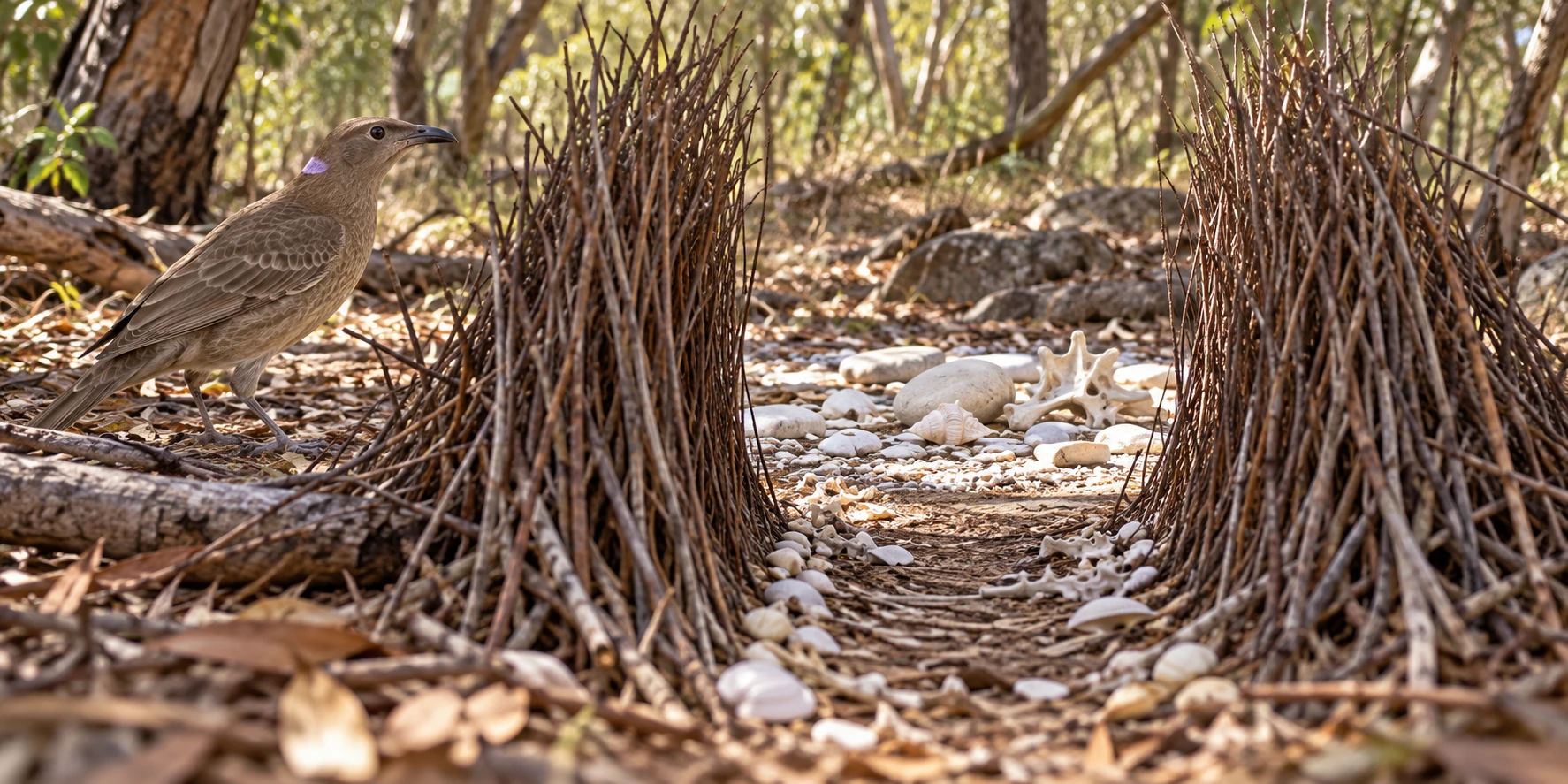
Stand above a great bowerbird's court and you see pale objects on the ground. Lower your viewpoint to the entrance of its stick avenue and you meet a different display. The arrangement has an audience position. That small change in where you look is the key to the story.

Great bowerbird beside a stick avenue and a court of pale objects
The display has a viewing position: object size and distance must be considered together.

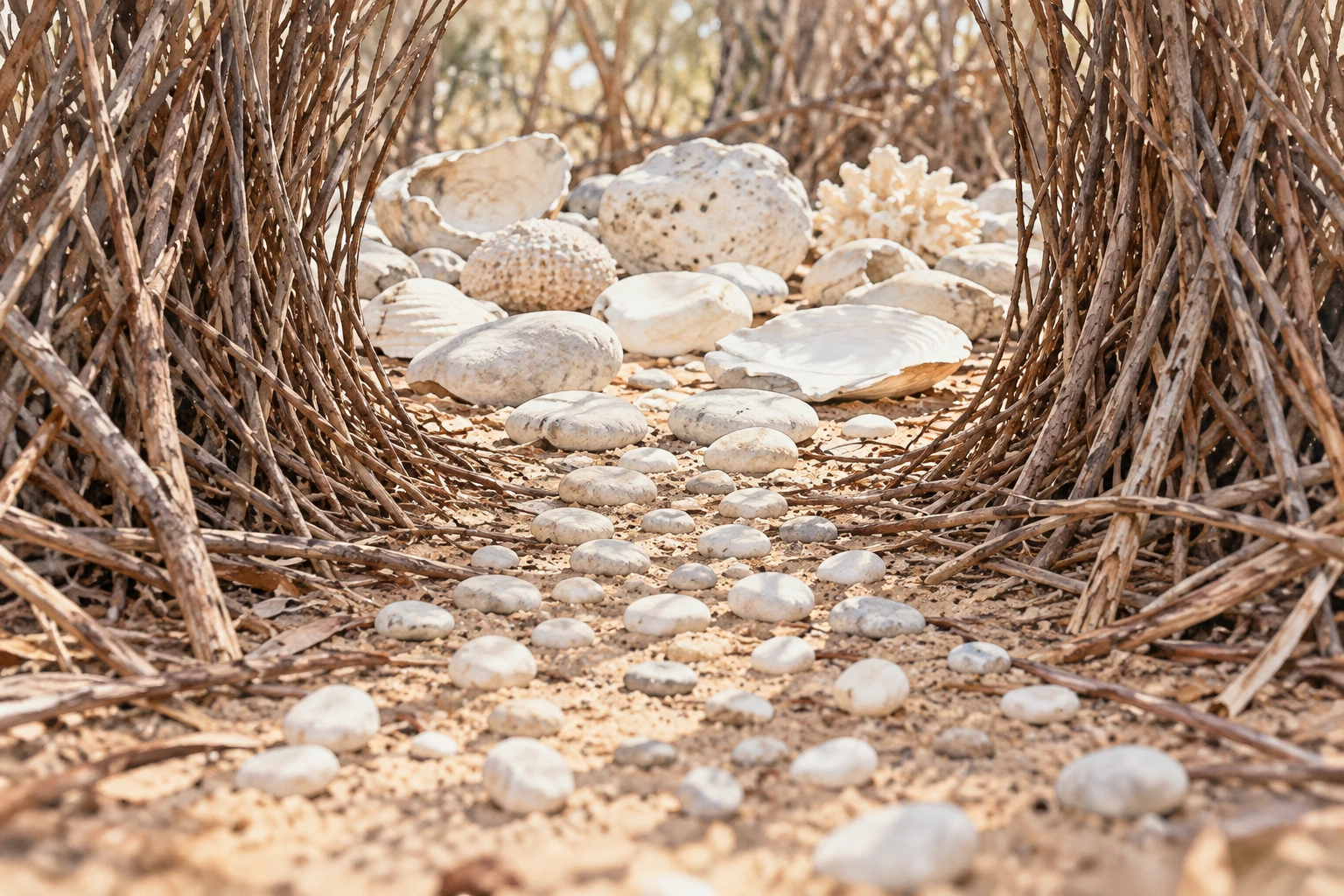
Male great bowerbirds construct an avenue with courts beyond its ends. On those courts, pale stones, shells and other objects can increase in size with distance from the avenue. A larger object farther away can occupy a similar angle in the viewer's field of vision to a smaller nearby object. The result is a more uniform apparent texture from the avenue than an overhead inventory would suggest.

The 2010 study describing this arrangement connected object size, distance and the female's viewing position. Birds also maintained their arrangements after researchers changed them. This is much more informative than simply observing that a male collects attractive objects.

A scene depends on its viewing point

Perspective is easy to experience with a thumb and a distant building. Changing the thumb's distance from your eye changes how much of the building it covers. Nothing about the thumb's physical size has changed. Angular size and physical size answer different questions.

Low view of a bower court with larger pale objects farther away
An interpretive view of the court’s size gradient, rather than a measured bower or a test of a bird’s perception.

The explorer below makes only that geometric comparison. It represents four flat, facing objects. Select equal physical widths, then select widths that increase with distance. Finally move the hypothetical viewer backward. The objects remain in place while the pattern of angular sizes changes.

Change the audience viewpoint

Compare angular sizes for equal-width and size-gradient objects while moving the viewer.

Open change the audience viewpoint in its own window.

At the initial viewing point, widths of 2, 4, 6 and 8 centimeters at distances of 0.5, 1, 1.5 and 2 meters subtend the same angle. That is an invented numerical example, not a measurement of a particular bower. It shows why the relationship between size and distance matters.

The tool cannot tell us what a bird subjectively experiences. Real objects have height, shape, occlusion and lighting. A model of angular size is a useful first step toward a perceptual question, not a substitute for a behavioral test.

The biological interpretation is harder

A 2012 paper reported a relationship between mating success and the geometry of the view available to females. Its central suggestion was that arranging the stage can contribute to a male's display. However, an association among court geometry, behavior and mating does not isolate every causal pathway.

A published technical comment challenged aspects of the statistical support, excluded observations and alternative display traits. It also proposed that keeping larger objects farther away could help leave room for male movements. Those criticisms matter because several features of a complex courtship display can covary.

The measured gradient, its geometrical effect and the explanation for its reproductive importance therefore deserve separate confidence levels. We can calculate angular sizes without knowing whether uniform texture holds attention, changes apparent scale or accompanies some other useful display property. A vivid phrase such as “optical illusion” should open those questions rather than close them.

What happens when a human improves the arrangement?

Another 2012 experiment improved court geometry according to the researchers' measure. Males tended to restore their own earlier arrangements rather than keep the imposed improvement. Individual differences were relatively consistent.

That result interrupts an easy story in which each bird is simply climbing toward the single arrangement a human analyst calls best. The constraints and preferences behind an individual's construction remain relevant. Its behavior cannot be inferred from the model's optimum alone.

For anyone who makes photographs, exhibitions or gardens, this is a useful invitation to inspect a scene twice. First inventory the objects. Then choose a viewer position and examine the relationships among them. Those are distinct descriptions of the same physical place.

A bowerbird's court is especially compelling because the second description may be central to its biological function. The bird does not need to be credited with human geometry lessons for its construction to deserve careful attention. The arrangement, the maintenance and the audience together make the question interesting.

Sources and further reading: Great bowerbirds create theaters with forced perspective (2010); Illusions promote mating success in great bowerbirds (2012); Consistently different individual quality (2012); Comment on Illusions Promote Mating Success (2012).

Explore all 80 new articles · Browse the complete illustrated collection

Explore more art, ideas, and independent projects at Incoprea.

A Hummingbird’s Tongue Does More Than Dip Into Nectar

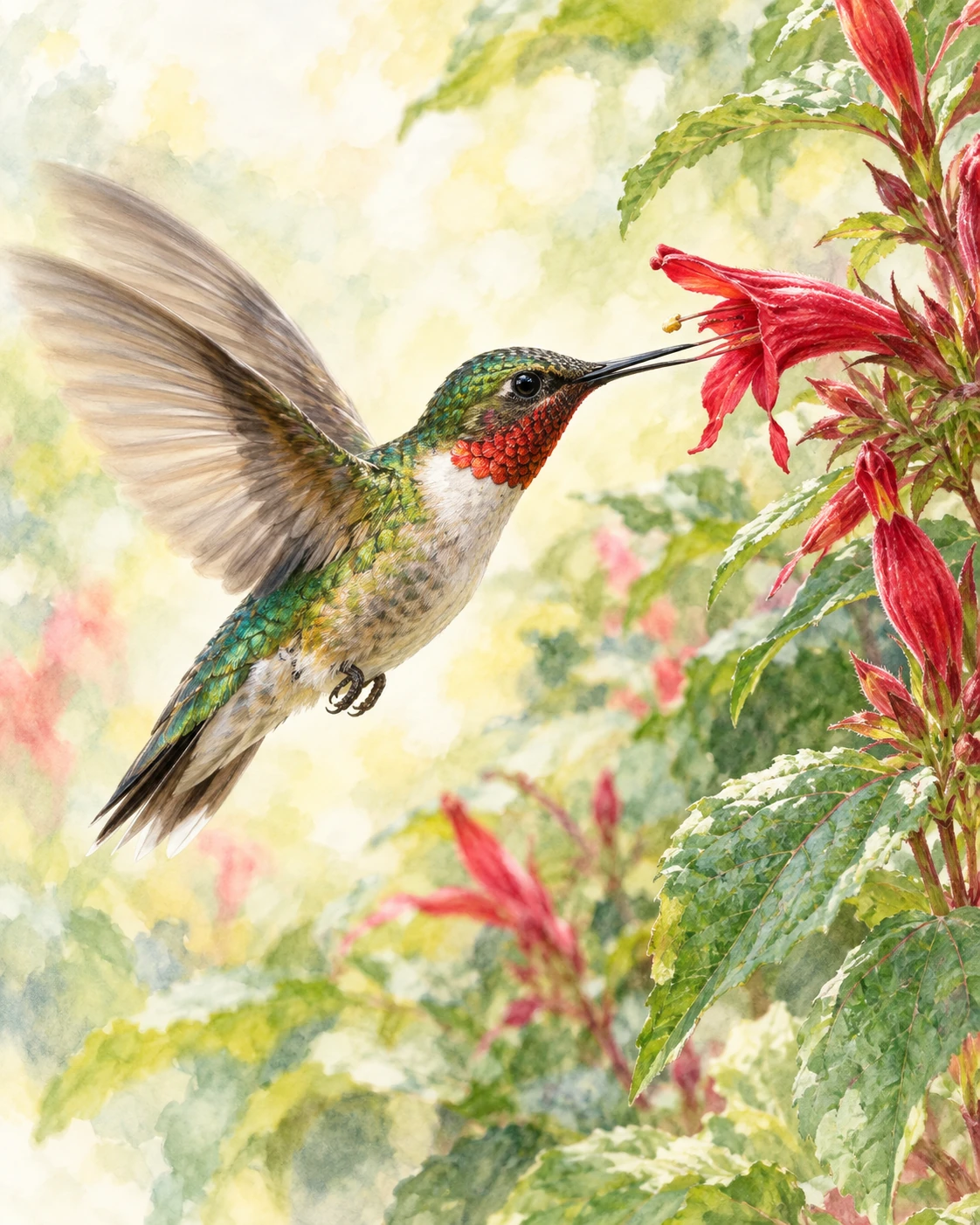
A hummingbird pauses at a flower for so little time that drinking looks like one smooth event. Slow the event down and the familiar picture of a bird using a tiny straw begins to fall apart. Its tongue is a moving, changing structure. The sequence matters as much as the shape.

Hummingbird feeding at a flower in a tall watercolor composition
A flower visit contains several distinct steps, most too fast to separate with the unaided eye.

For a reader watching from a window, this offers an unusually satisfying shift in attention. The hovering wings are spectacular, but the quieter story is happening at the bill tip. Nectar must be collected, brought inside, released from the tongue and moved toward the throat. A successful visit needs the whole chain.

The tongue arrives already prepared

In a 2015 high-speed study, researchers recorded nectar feeding in 18 hummingbird species. The tongue's paired grooves emerged flattened after compression by the bill. They stayed flattened while crossing the air. Once the tips contacted nectar, the grooves expanded and filled. The recovering walls supplied the force for an elastic micropump.

That starting condition changes the explanation. An empty, open tube could admit a rising liquid meniscus. A flattened groove has no comparable empty tube waiting to fill. The recordings did not show the meniscus-led process predicted by the old capillary account during ordinary feeding. This is a conclusion about the observed mechanism, rather than a claim that capillary forces can never exist in biological material.

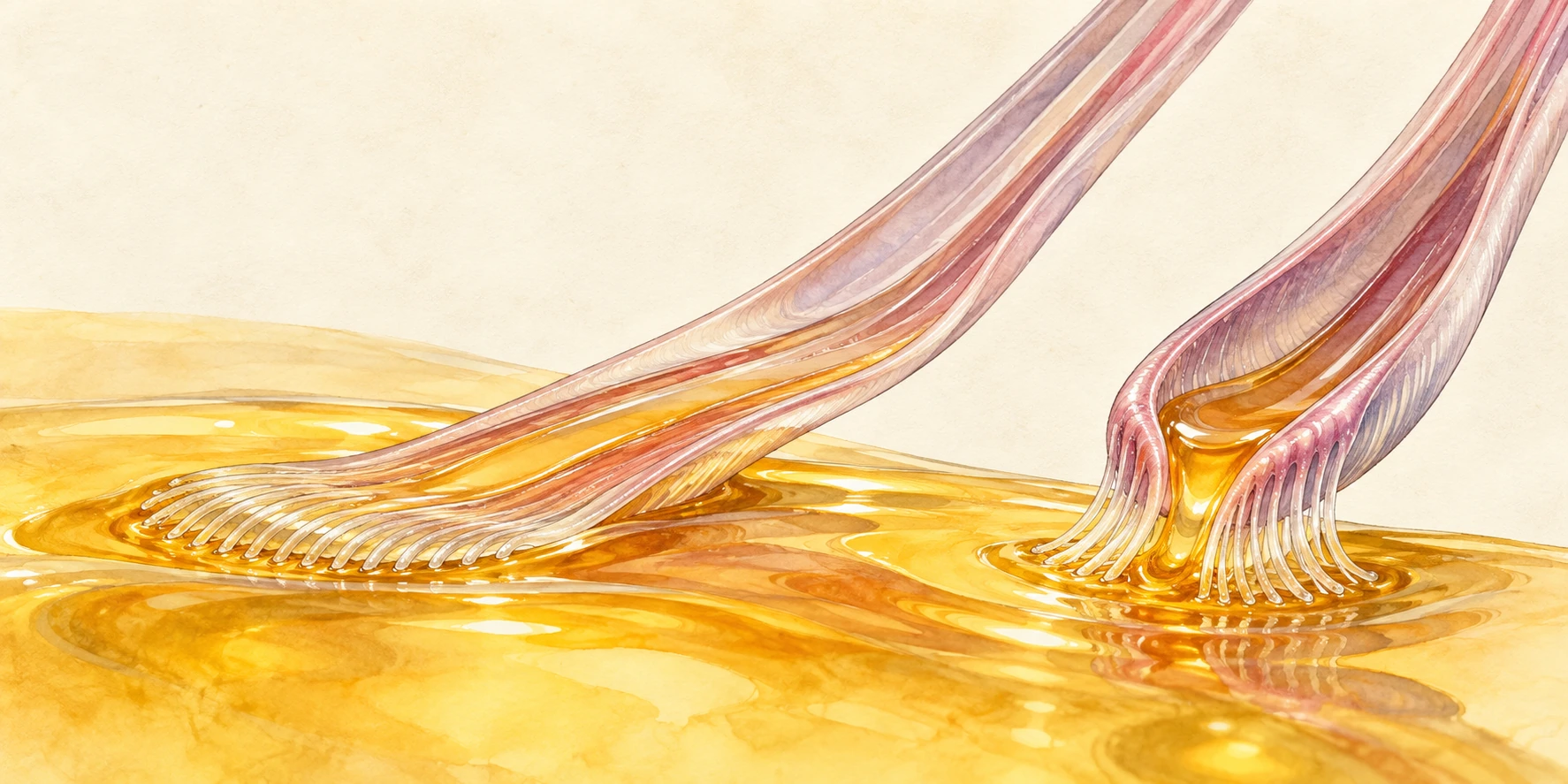
Two flexible grooved ribbons touching golden liquid
A material analogy for a changing tongue tip and grooves; anatomy and motion should be checked against the research recordings.

The illustration above is a material analogy. It emphasizes flexible grooves and a fringed tip; it does not reproduce a microscope image. Its useful question is simple: what changes when a flattened structure can recover its shape only after touching liquid?

Two parts of a tongue can do different jobs

The groove pump builds on a separate result. A 2011 study showed the tongue tips acting as a fluid trap. Their fringed structures spread in nectar and change configuration when withdrawn, retaining liquid. Similar changes occurred in living and dead tongues. That comparison helped show how the material and its interaction with liquid could produce the movement without a muscle operating each fringe.

“Passive” can sound like “unimportant.” Here it means that local shape changes can follow from material properties and contact with fluid. The bird still positions its head, moves its bill and cycles its tongue. An actively controlled journey can contain mechanically automatic steps.

Read a lick as a sequence

  1. Before contact: look at the tongue between bill and nectar. Is the groove open or collapsed?
  2. At contact: separate the spreading tip from the expansion traveling along the grooves.
  3. During withdrawal: ask which structures retain liquid and which portions never entered the nectar pool.
  4. On the next outward movement: look for nectar being squeezed off inside the bill.

This is a viewing guide for the supplementary recordings linked from the 2015 paper. Pause and replay one lick before watching a long sequence. A freeze-frame of an open groove cannot establish how it became open. The before-and-after frames carry the stronger evidence.

Collection is only the beginning

A 2017 investigation used microCT and close high-speed filming to examine bill-tip structures. The authors identified a compressed region with specialized edges, prongs and shallow basins. They proposed that this arrangement works as a wringer, helping release nectar as the tongue moves outward again. The structural observations and the proposed contribution of each feature should be kept distinct.

The broader review makes the next problem clear: released nectar still needs transport inside the mouth before swallowing. A model of collection alone therefore cannot explain the entire meal. Bill length, flower depth, handling and other bill functions also complicate any simple claim that one longer or narrower shape must always be best.

Try sketching a four-box flowchart: collect, withdraw, offload, transport. Place an observation in each box, then mark the transitions you cannot see from an ordinary garden view. This small exercise turns admiration into a testable question. The next hummingbird visit becomes a glimpse of a coordinated process, with much of its most important motion hidden in plain sight.

Sources and further reading: The hummingbird tongue is a fluid trap, not a capillary tube (2011); Hummingbird tongues are elastic micropumps (2015); Functional morphology of hummingbird bill tips (2017); Shifting paradigms in nectar extraction (2019).

Explore all 80 new articles · Browse the complete illustrated collection

Explore more art, ideas, and independent projects at Incoprea.

Thursday, October 22, 2026

A Crow’s Hook Changes More Than the Shape of a Twig

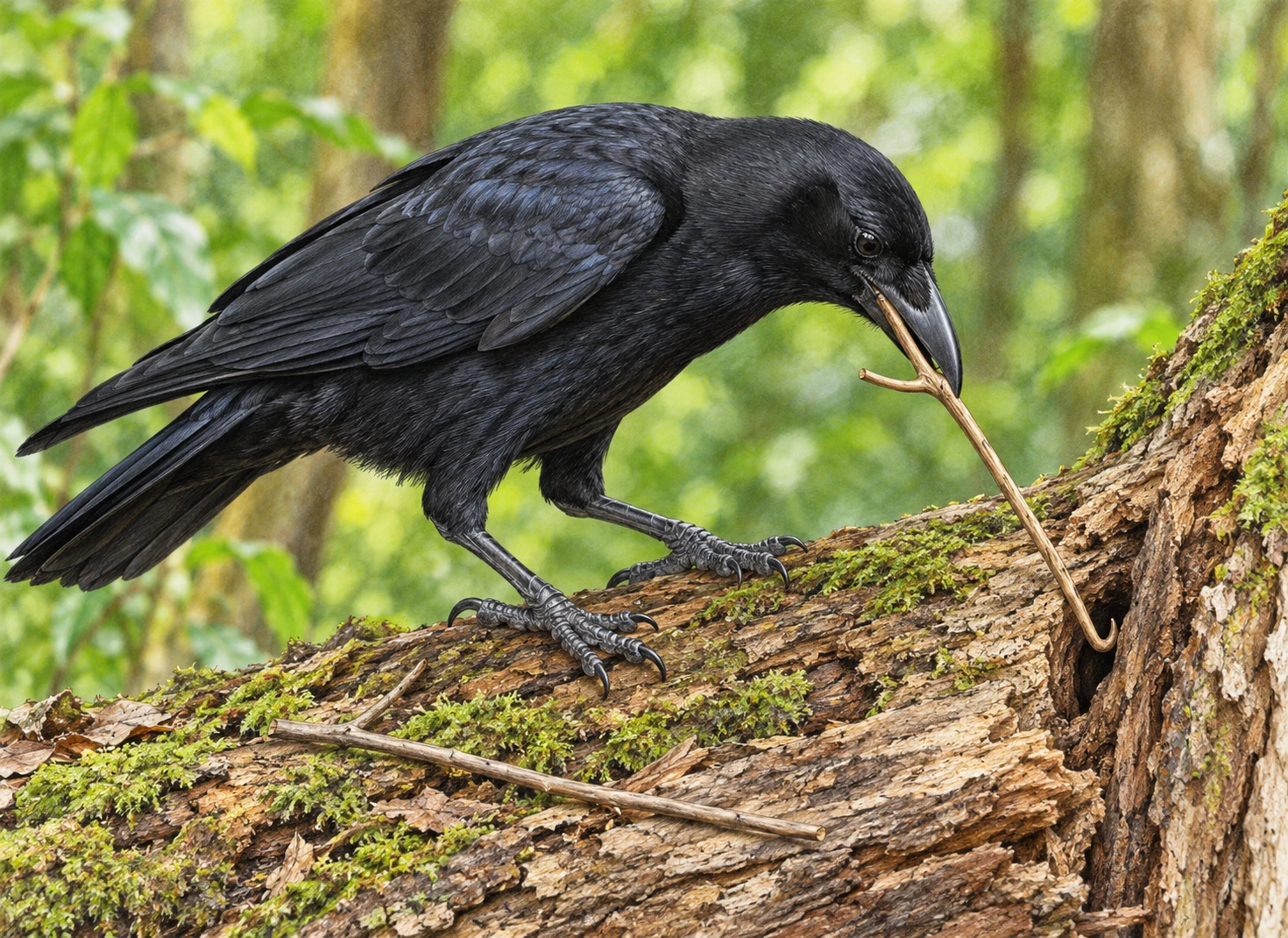
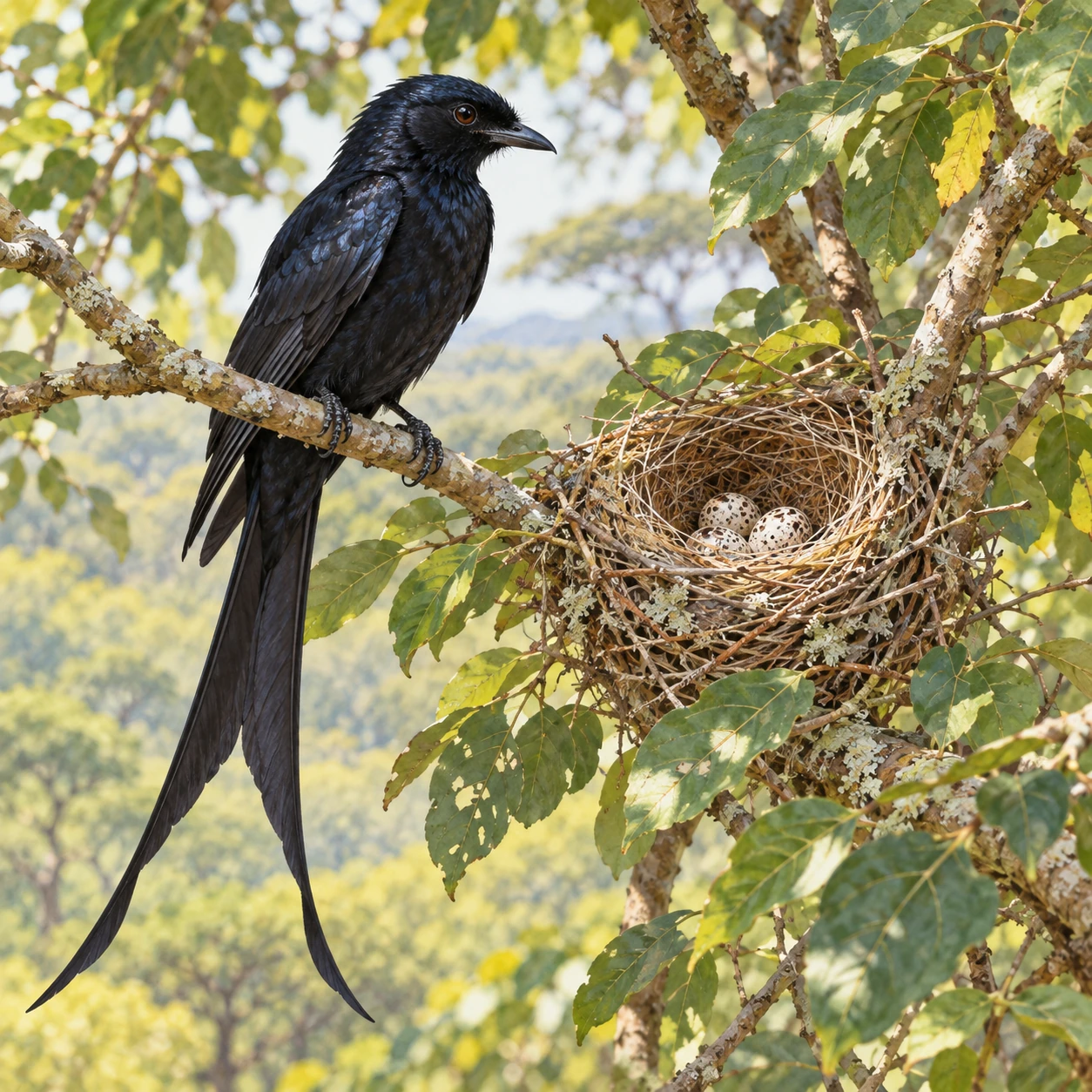
A glossy black crow probes a log cavity using a slender hooked plant stem.
Conceptual illustration of New Caledonian crow tool use; the tool form is interpretive rather than a measured specimen.

A straight twig can reach into a hole. A twig with a small hook can also catch what it reaches. That modest difference helps explain why some New Caledonian crows spend time selecting and shaping a tool before they begin feeding. The bird's investment changes the mechanical possibilities of the task.

The species, Corvus moneduloides, is native to New Caledonia in the southwest Pacific. It is famous for tool use, but the most interesting question goes beyond whether a bird can use a stick. Why make a more elaborate tool when a simpler one is available? And once the bird has made it, does its subsequent behavior reflect the tool's usefulness?

A hook is a small design change with a measurable effect

A 2018 study compared foraging performance using hooked and non-hooked tools in naturalistic extraction tasks. According to the University of St Andrews account, hooked designs produced benefits that varied with the task, allowing food to be obtained between two and ten times more efficiently in the comparisons described. The range matters: there was no single universal multiplier attached to the hook.

A tool can alter contact. A straight tip may push, probe, or disturb prey; a hooked tip can engage an edge or body part and pull. Which action works depends on the cavity and the target. The scientific comparison therefore needs more than an impressive video of one success. It needs repeated tasks in which different tool types can be evaluated.

Efficiency also has more than one clock. A hooked tool can save extraction time while requiring extra time to obtain and manufacture. A complete ecological account must consider that investment and the likelihood of reuse. The experiment measures a substantial performance benefit; interpreting why tool manufacture persists requires connecting that benefit to the bird's wider life.

The tool has to stay in a useful view

A tool tip can be mechanically effective and still difficult to control if the animal cannot see where it is going. For a crow holding a stick in its bill, the eyes and tool move together. That creates a different coordination problem from a person's hand moving independently in front of the face.

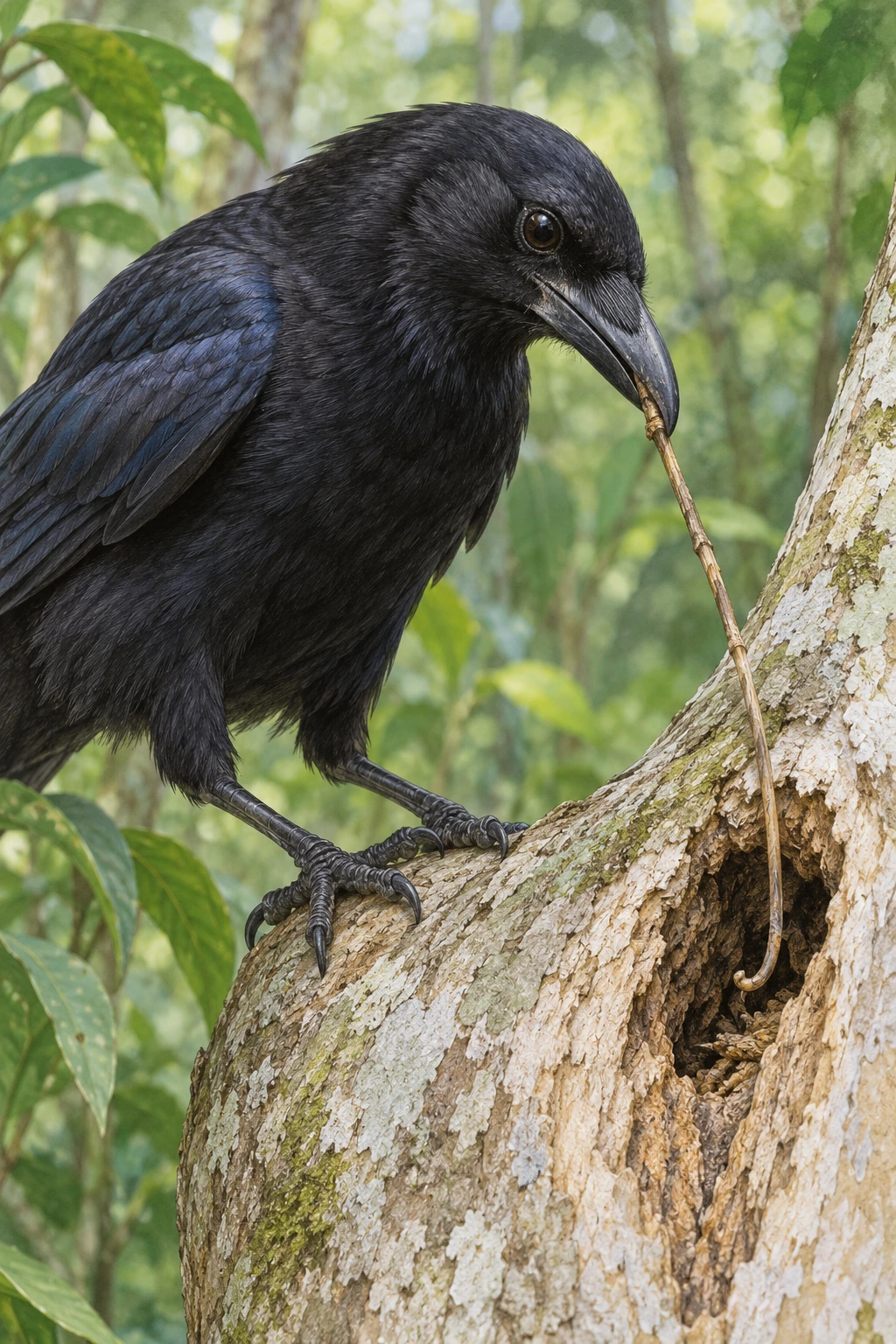
New Caledonian crow holds a hooked twig near its straight bill and eye
The working assembly includes a viewing geometry. This portrait does not map the crow’s visual field.

A 2012 comparison of corvid visual fields and bills found unusually broad binocular overlap in New Caledonian crows, together with a relatively straight bill that helps position a tool. The work made morphology part of the tool-use explanation. Cognitive ability alone is not a description of the physical arrangement through which an action is performed.

A 2014 study sharpened the interpretation. During natural extraction, the diagonally held tool tip could be viewed by the opposite eye. Individual tool-side preferences correlated with eye dominance. The authors argued that the broad visual field need not imply simultaneous binocular viewing of the working tip; it could permit one eye to see far enough across the midline.

That is a useful example of progress through a more specific question. Measuring the region that both eyes can cover is different from establishing which eye actually controls a particular maneuver. The later work changed the interpretation of an impressive anatomical fact without making the earlier measurements disappear.

A diagram-reading exercise

In the published visual-field diagrams, locate the bill axis first. Then locate the projected tool direction. Finally ask whether a line falls within the field of the left eye, the right eye or their overlap. Do not substitute the camera's view of the crow for the crow's view along its tool.

You can illustrate the coordination problem with an ordinary pencil held safely in your hand well below eye level. Move your hand while keeping your head still, then move both together. The exercise only separates two arrangements of movable parts; it does not reproduce crow vision or establish how a bird experiences depth.

The new close view is therefore an invitation to notice the whole working assembly: eye, bill, grip and projecting tip. The hook's shape matters, but so does the body that must guide it. A useful object and a useful way of looking become parts of the same action.

The material is part of the problem

These hooks are not tiny metal fishing hooks. Crows work with plant stems and naturally branching material. A 2015 study of manufacture examined variation in the birds' behavior and the influence of raw-material properties. Selecting a stem and modifying it are not interchangeable steps. The material offers some shapes and resists others.

That is recognizable to anyone who has made something by hand. A successful procedure depends partly on what the material will permit. The comparison should not become a claim that a crow thinks like a human craftsperson; it identifies a useful shared constraint. A tool is made from a particular piece of the world, not from an abstract drawing.

It also helps explain why a single improvised act in a laboratory cannot tell the entire evolutionary story. Wild tool traditions, developmental experience, opportunities to practice, and the properties of local plants all deserve study. An animal's successful behavior can be clear even while the balance of learning and inherited predisposition remains a separate research question.

Making a better tool is one problem; keeping it is another

A crow may need to put its tool down while handling food. On a branch or log, setting it anywhere can mean losing it. The 2021 eLife safekeeping study tested whether birds treated hooked tools differently from simpler non-hooked tools. Wild-caught birds temporarily held for experiments strongly preferred the hooked tools offered in the study and more often kept them safe between uses, including by holding them underfoot or placing them in nearby holes.

The researchers used “value” to interpret this pattern. The operational evidence is preference and protective handling. It does not demonstrate that a crow has a human economic concept, but it does connect the tool's usefulness and acquisition cost with measurable choices about retention.

The distinction becomes clearer if we imagine two tools that differ in both material and performance. A preference might be driven by material, familiarity, shape, expected utility, or some combination. Good experiments work through those possibilities. Reading the methods and comparisons is more informative than deciding in advance that the animal is either an engineer or an unthinking machine.

A useful way to watch the linked research videos is to count the transitions. When does the bird select material? When does it modify a tip? Does it orient the hook before insertion? What happens to the tool when food is obtained? The quiet moment after success can reveal as much as the extraction itself.

The generated image here brings those ideas into one scene: a bird, a cavity, and a shaped twig. Its hook is illustrative. The research photographs and videos provide the evidence for actual tool forms and actions.

The crow's achievement becomes richer when we stop treating a stick as a yes-or-no intelligence test. There is a sequence of practical problems: finding material, producing contact geometry, extracting food, and avoiding the loss of a useful object. Small improvements at several points can change the return from a foraging opportunity. A hook is a tiny shape, but it opens a large set of questions about how an animal makes its world more workable.

Follow the evidence: St Clair and colleagues: hook efficiency study; University of St Andrews: tools and task-dependent benefits; Klump and colleagues: manufacture and raw materials; Klump and colleagues: hooked-tool safekeeping.

More curious connections, art and independent projects at Incoprea.

Cuckoo Eggs: Why a Near-Perfect Forgery Can Still Fail

Suppose a forger can reproduce the average appearance of a banknote perfectly, but every legitimate note has a different private pattern. Matching the average would not guarantee matching the particular note being checked. Something similar happens in the nests of birds that defend their eggs against brood parasites.

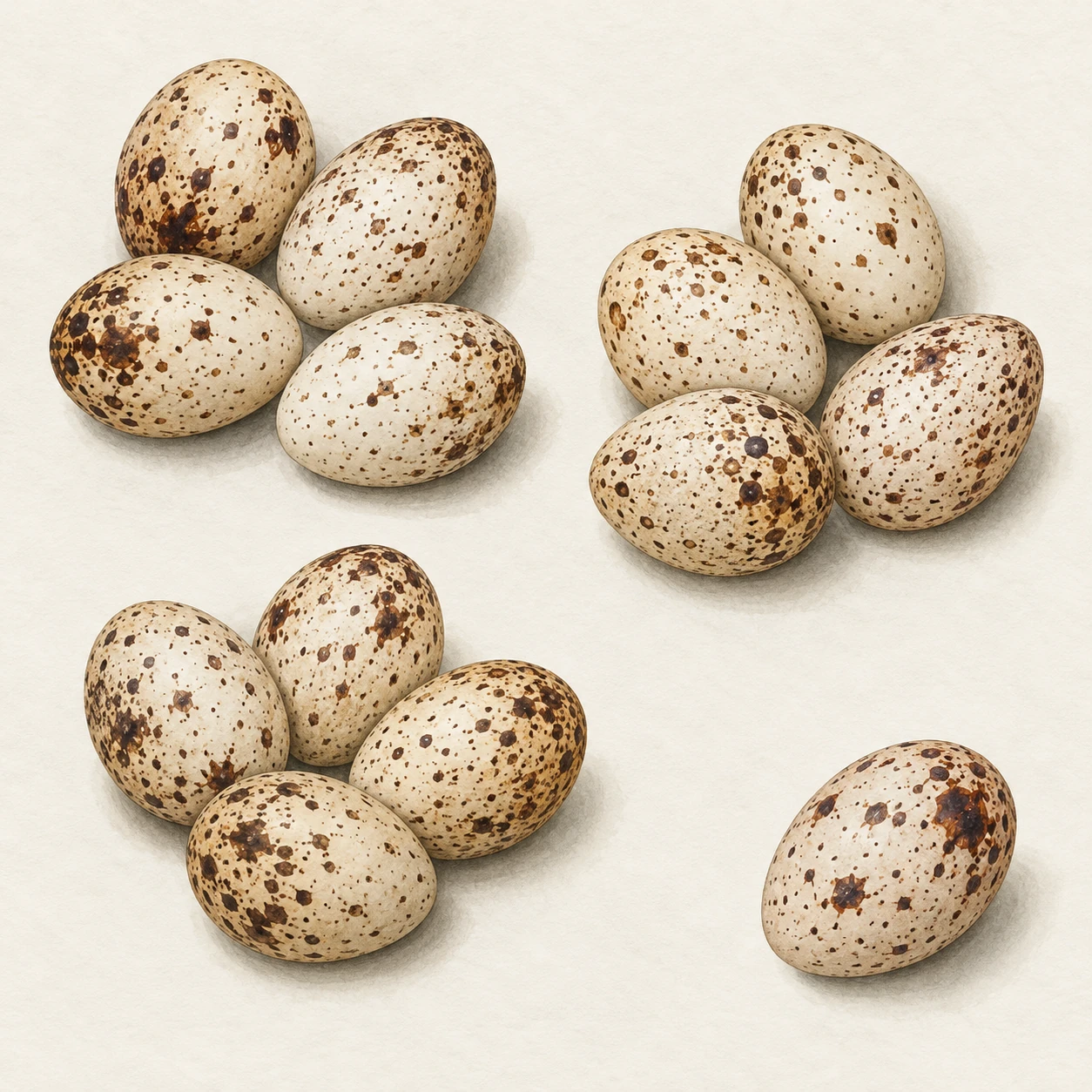
Three conceptual clutches of speckled eggs with different group patterns and a single separate egg.
Conceptual egg-pattern study; the markings are invented illustrations, not species identifiers or research data.

A brood-parasitic bird places an egg in another bird's nest, leaving the host to provide care. Some parasites have evolved eggs that resemble those of their hosts. Hosts, in turn, may reject eggs that do not match their own. The result is often called an evolutionary arms race, but the metaphor becomes more useful when we ask exactly what is being copied and exactly what is being recognized.

Matching a species is different from matching a mother

A 2023 study of African cuckoos and fork-tailed drongos found highly accurate mimicry of host egg colors and patterns on average. Nevertheless, drongos showed fine discrimination against foreign eggs, using pattern differences between a parasite's egg and the eggs in their own clutch. Variation among host females made a close population-level match insufficient.

The researchers combined image analysis, field experiments, and simulations. Their model predicted rejection of 93.7 percent of cuckoo eggs in the studied system. That figure is a modeled prediction built from the measurements, not a claim that researchers watched exactly that fraction of every naturally laid egg being thrown out. The distinction is part of the evidence, not a footnote to it.

A successful defense therefore need not be one universally uncopyable pattern. It can be a population containing many patterns, with each female producing a sufficiently consistent version for her own comparison. A parasite that matches one nest especially well may match another poorly. Diversity itself changes the copying problem.

A pattern must be recognizable to the bird

To human eyes, two speckled eggs may look nearly identical—or obviously different. Neither judgment is an adequate substitute for a host's visual task. A 2010 study of common-cuckoo egg patterns quantified features in relation to avian vision and host defenses. It found better pattern mimicry in host relationships with stronger rejection. The visual match is something to measure in the relevant sensory context.

A 2014 pattern-recognition study investigated whether egg patterns could act as individual signatures. Recognizability matters alongside variation: if every egg differed randomly even within one female's clutch, distinguishing “mine” from “foreign” would become difficult. Variation between females and consistency within a female can work together.

The Cambridge explanation describes this as a defense against increasingly refined mimicry. There is no conscious agreement among host birds to diversify their eggs. The pattern arises through inheritance, variation, and differences in reproductive success over generations.

Recognition has two possible kinds of error

A rejection system can fail by accepting a parasite's egg. It can also fail by rejecting a legitimate egg. Looking only for the first error makes a more aggressive rule seem automatically better, even when the second error is expensive.

A 1999 signal-detection model of egg recognition explored how learning and decision thresholds affect these competing outcomes. A model does not identify the precise neural rule used by a drongo. It supplies a way to ask why the best response can depend on the frequency of parasitism and the costs of mistakes, as well as on visual differences.

Fork-tailed drongo beside an open nest with a small clutch of speckled eggs
Recognition happens in a nest with particular eggs and viewing conditions. The marks here are interpretive and are not diagnostic signatures.

Field experiments add further complications. A yellowhammer study examined responses to introduced eggs and discussed how egg material and removal method affect rejection costs. The authors did not observe recognition errors in their own experiment. A predicted cost, an outcome observed in another system and a result measured in the present sample should remain separate.

Try a fictional decision ledger

Imagine 100 hypothetical eggs assessed over many nests:90 legitimate and 10 foreign. RuleA detects eight foreign eggs but wrongly rejects nine legitimate ones. RuleB detects six foreign eggs and wrongly rejects two legitimate ones. These are invented values for reasoning, not results for either bird species.

Which rule is better?

Detection alone favors A: eight rather than six. If each kind of error has equal cost, A makes 11 errors and B makes six. If accepting a foreign egg is much more costly than losing a legitimate egg, the ranking can change. There is no answer until the costs and encounter frequencies are specified.

Now change only the mixture to a setting with much rarer parasitism. A false-rejection rate applied to many legitimate eggs can outweigh the benefit of detecting a few additional foreign ones. This is why an imperfect-looking response need not be explained simply as poor eyesight.

The original article's individual signature concerns what information distinguishes eggs. The ledger adds what an animal does with uncertain information. A close visual match and a cautious decision rule address different parts of the problem.

When reading a new rejection experiment, keep a small four-cell table: legitimate accepted, legitimate rejected, foreign accepted, foreign rejected. Then look for how each category was actually observed. A successful defense is easier to understand when its possible costs are visible too.

There is more than one kind of egg forger

Different brood-parasitic birds should not be merged into one generic cuckoo. Research on cuckoo finches, summarized in Cambridge's 2022 account, examined maternal inheritance of egg appearance and its consequences for the parasite's evolutionary responses. That concerns a different bird lineage from the African cuckoo–drongo system. Similar-looking conflicts can be built on different genetic arrangements.

Such distinctions keep an attractive story from becoming a universal rule. Not all brood parasites mimic eggs closely, and not every host uses the same rejection strategy. A useful article or documentary should identify the parasite, the host, the location, and the trait being studied before moving to a broad claim about an arms race.

It is also possible for recognition to involve a tradeoff. Rejecting a foreign egg can protect a brood; rejecting an unusual egg of one's own can waste reproduction. Selection acts within those costs. The meaningful question is not why a host fails to reject every imperfect match, but what evidence it can use under the conditions of its own nest.

The generated egg plate here illustrates patterns within and among clutches. It is intentionally not labeled as a specimen chart: its marks cannot identify any species or reproduce the study's measured colors. The original papers provide the calibrated comparisons.

The nest contains a small but demanding recognition problem. It is not solved merely by having better eyesight, or by making a prettier egg. The defense can lie in the relationship between an individual's consistent signature and the diversity of the population around her. A near-perfect forgery can still fail because there is no single original to copy.

Follow the evidence: Lund and colleagues: drongo signatures versus African cuckoo mimicry; Stoddard and colleagues: recognizable egg-pattern signatures; Stoddard and Stevens: egg mimicry through avian vision; Cambridge: egg signatures as host defenses; Cambridge: cuckoo finch inheritance and egg forgery.

More curious connections, art and independent projects at Incoprea.

The Fairy-Wren’s Family Signature Begins Inside the Egg

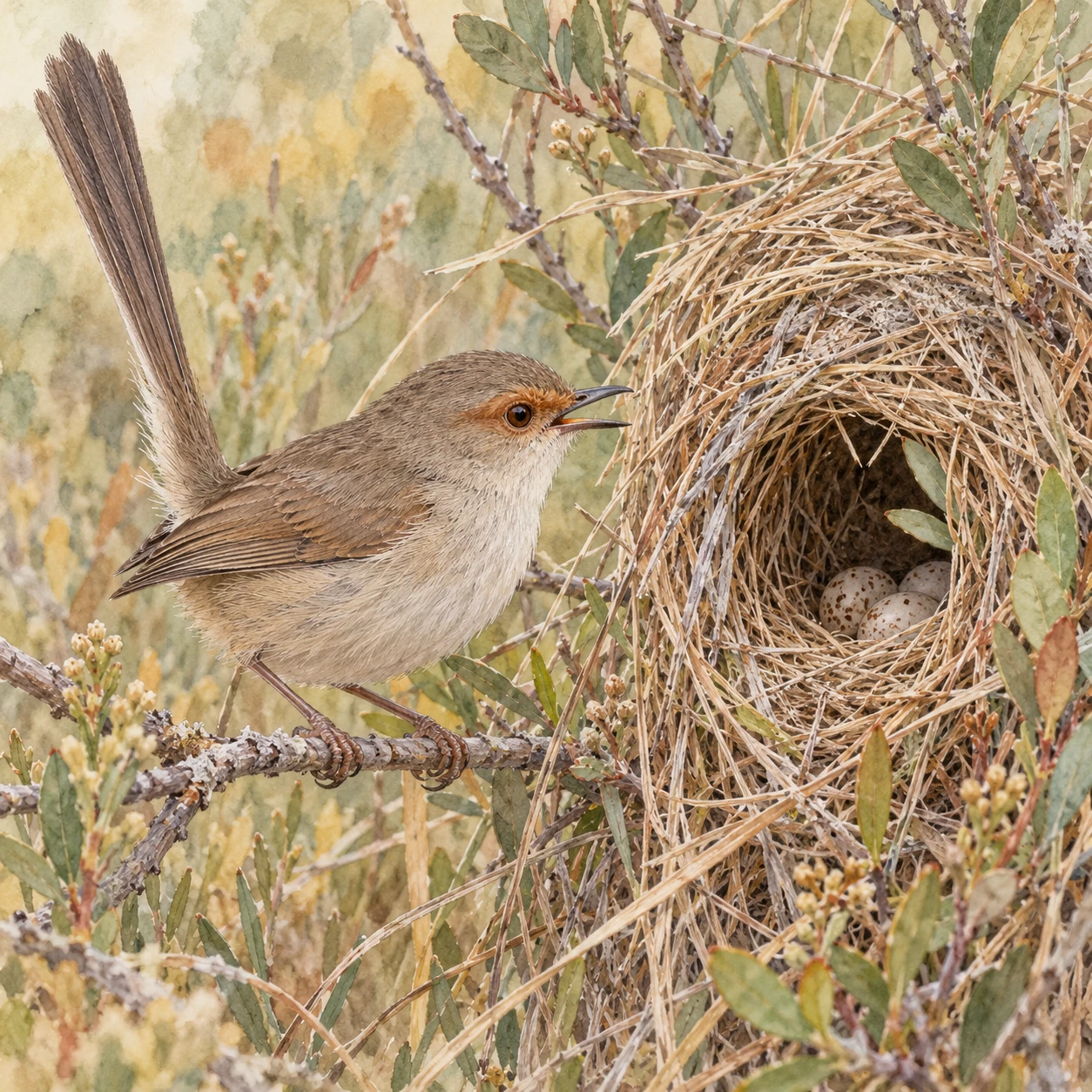
A plain gray-brown female superb fairy-wren calls beside a grass nest with a glimpse of eggs.
Conceptual maternal-calling scene; not an experimental nest or evidence of an embryo’s response.

A bird egg seems like a boundary between an unfinished chick and the social world outside. For superb fairy-wrens, sound crosses that boundary in a consequential way. Mothers call during incubation, and after hatching their chicks can produce begging calls containing elements associated with the mother's call. Part of the family's vocal history begins before the nestling is visible.

The result is often described as a password. It is an effective metaphor for a recognizable feature that can influence parental responses, but it is not a secret word chosen consciously by a bird. The scientific interest lies in how an individual vocal signature can be acquired, compared, and used in a world where a nest may also contain a brood parasite.

Similarity alone would not prove learning

Parents and offspring can resemble one another because of genes, shared surroundings, or learning. A 2012 Current Biology study used cross-fostering and playback experiments to separate some of those explanations. Chicks' calls most closely matched the foster mother whose incubation calls they experienced, rather than simply following genetic parentage.

Adults also responded differently to begging calls from their own nest, other fairy-wren nestlings, and cuckoo nestlings in the experiments. Combining production and response was important. A copied sound feature could exist without having any demonstrated consequence for the listener. Playback helped test whether the acoustic difference mattered to adults.

The relevant parasite was Horsfield's bronze-cuckoo, not the common cuckoo of many European accounts. Different host–parasite systems have different recognition problems. Keeping the species identified prevents an intriguing result from becoming a generic rule about all cuckoos and all songbirds.

The egg is not acoustically empty

Hatching is a dramatic transition for an observer, but sensory development does not necessarily wait for it. A 2021 comparative study measured embryonic heart-rate responses during sound playbacks in several bird lineages. Repeated sounds produced patterns consistent with habituation, a form of non-associative learning, even in species not usually classified as vocal-production learners.

That finding should not be inflated into embryos learning complete adult songs. Detecting sound, becoming familiar with repeated sound, and learning to produce a particular vocal pattern are different capacities. The study broadened the evidence for early auditory learning while preserving those distinctions.

A change in heart rate is also an indirect measure. It can reveal a response that researchers interpret through carefully controlled comparisons, but it does not give an embryo a verbal report of recognition. The method makes an otherwise hidden developmental stage experimentally accessible.

A changed response can reveal a remembered difference

How could a researcher ask an embryo whether two sounds are different? The animal cannot approach a speaker or produce a learned reply on command. A physiological response can offer another route, provided the comparison is designed carefully.

A 2014 study of superb fairy-wren embryos measured heart-rate responses during repeated calls and subsequent changes of caller. Its habituation–dishabituation design distinguished repeated examples from the same individual from calls of a novel individual. The results supported discrimination and a form of non-associative learning. They did not establish that an embryo understood a spoken meaning.

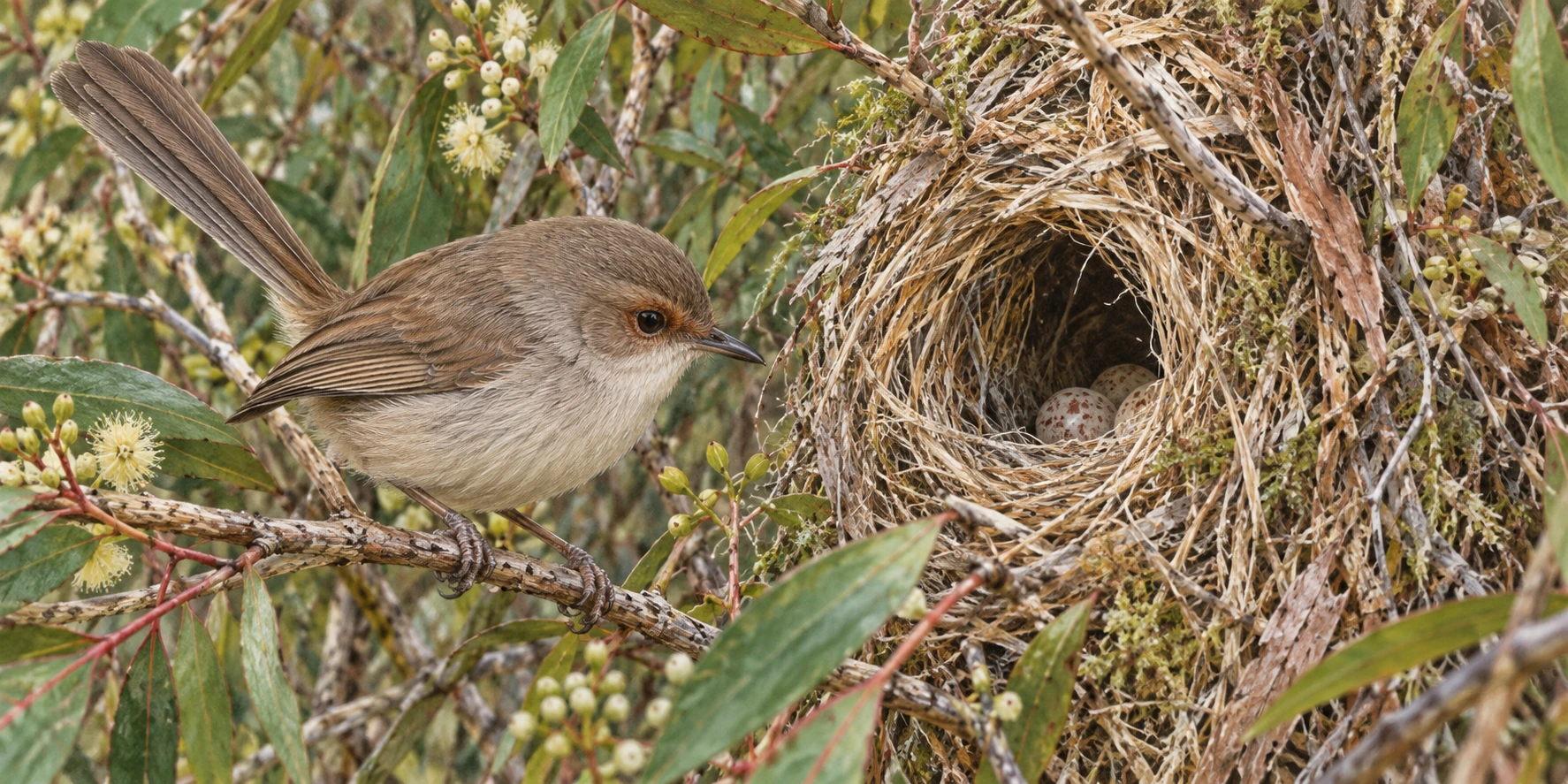
Plain-colored female superb fairy-wren near a woven nest entrance
The early acoustic setting matters, but an exterior nest scene cannot demonstrate an embryo’s response.

The key is the changed relationship between experience and response. A smaller response to a repeated stimulus alone could have several explanations, including fatigue or a changing baseline. Introducing an appropriate novel stimulus helps test whether the animal still responds to a relevant difference.

The optional sound comparison below makes one elementary property easy to follow: order. Pattern A and Pattern B contain the same three synthetic pitches in different sequences. They are invented tones, not fairy-wren calls or an assay of the research finding. A complete transcript makes the comparison available without listening.

Two invented sound patterns

Three low-gain synthetic tones in two orders, user-initiated playback, stop control and complete text transcript.

Open this activity in its own window.

After comparing them, list what stayed the same and what changed. Pitch inventory stayed the same. Sequence changed. In a real study, the relevant features might be measured very differently, and the receiver's ability to distinguish them must be tested rather than assumed.

Spectrograms offer another way to inspect a sound. Time runs along one axis, frequency along the other, and displayed intensity is processed into brightness or color. The Macaulay Library's explanation shows why display transformations matter: a weak sound can become visible under one treatment and hard to see under another. A darker mark is not automatically an independently calibrated difference in field loudness.

For the fairy-wren papers, locate the exact call element the authors compare before looking at the whole picture. Then keep three questions distinct: did the embryo respond, did experience change that response and did the chick later produce a learned feature? The family signature becomes clearer when those steps are connected through evidence, rather than compressed into a single word such as “password.”

How the mother calls can matter too

Later work examined more than whether an incubation call was present. Flinders University's 2023 account describes a study in which slower maternal calling was associated with greater similarity between the mother's signature element and the nestling's begging call. The research paper investigates how the structure of the early experience relates to the outcome.

That is a richer question than “can embryos learn?” If timing affects copying, the information's delivery may shape what is acquired. But an association with call rate does not by itself demonstrate that mothers understand an embryo's knowledge state or consciously slow down to teach. A functional effect and an intentional mental explanation are different claims.

The broader lesson is about developmental context. An animal's first independent actions may already contain the effects of an earlier social environment. A begging call heard after hatching can carry information about what occurred inside the egg.

For a listener exploring bird recordings, distinguish three sounds: the mother's incubation call, the chick's begging call, and the species' familiar adult territorial or courtship song. Calling all of them “the song” conceals the particular comparison that makes this research compelling. Published spectrograms help show which acoustic elements were measured.

The artwork focuses on a plain-colored female near a nest, rather than the striking blue breeding male that often represents the species in photographs. That choice keeps attention on the individual whose incubation behavior is central to these studies. It remains an interpretive scene, not a picture of an experimental nest.

Inside a shell, an embryo is still developing the body that will produce a voice. Yet the world can already contribute to what that voice becomes. The family signature is not simply inherited and not simply invented at hatching. It grows out of a meeting between biology, experience, and a mother calling nearby.

Follow the evidence: Colombelli-Négrel and colleagues: embryonic vocal passwords; Colombelli-Négrel and colleagues: prenatal auditory learning across birds; Flinders University: maternal call rate and learning; Kleindorfer and colleagues: maternal signatures and slow calling.

More curious connections, art and independent projects at Incoprea.

Wednesday, October 14, 2026

The Hoatzin: A Leaf-Eating Bird With a Fermentation Chamber

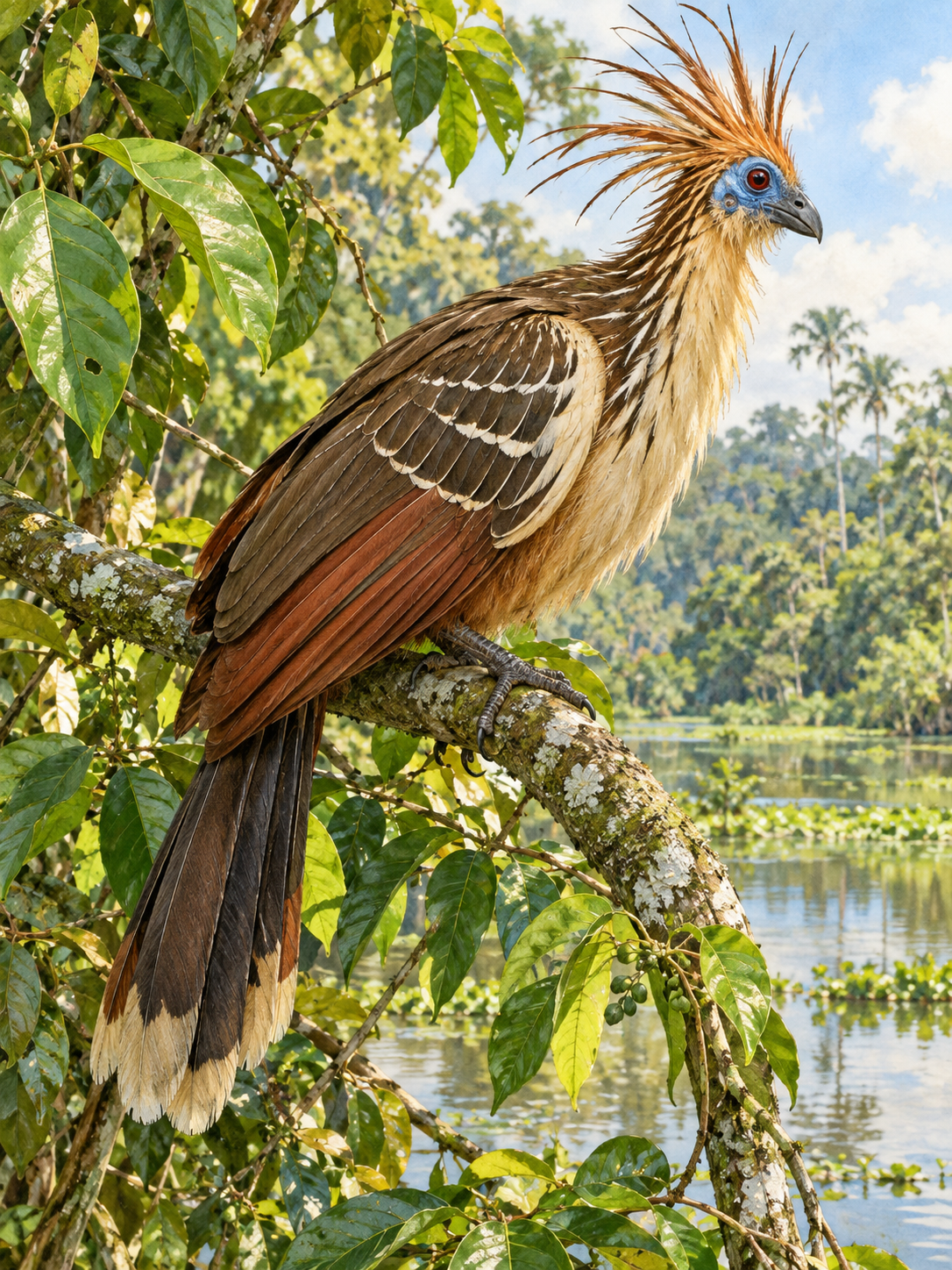
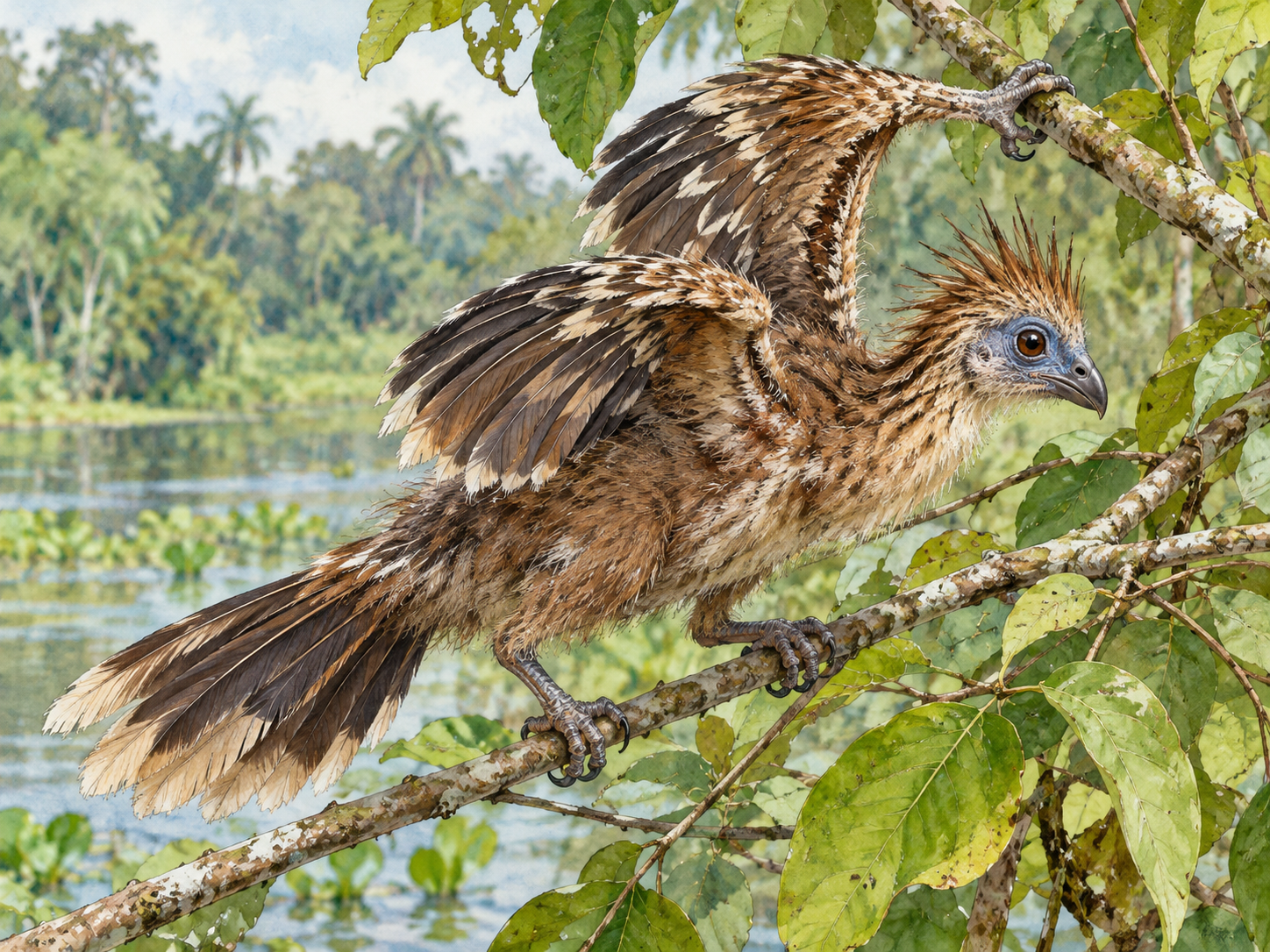
A hoatzin sits above a South American waterway with a loose crest, blue facial skin and red eyes. Its extravagant appearance is easy to notice. The more unusual feature is the processing system beneath those feathers. A leafy bite enters a digestive partnership in which microbes help make difficult plant material useful to a bird.

An adult hoatzin with blue facial skin and a reddish crest perched above a tropical wetland.
An artistic habitat view of an adult hoatzin.

Leaves seem like plentiful food until you consider their construction. Their contents are enclosed by cell walls, and eating the material does not automatically release all its potential nutrients. The hoatzin retains leafy food in an enlarged foregut where microbial fermentation can work on it. Swallowing is the start of a process that takes space and time.

Follow the meal by its jobs

The main fermentation spaces are the enlarged crop and lower esophagus, before the meal reaches the stomach. A crop in another bird can store food temporarily. In the hoatzin, this part of the digestive tract supports an extensive microbial processing system. The location of fermentation makes it a foregut fermenter.

The useful comparison with a cow is the sequence of retaining plant material for microbes before later digestion. It does not make the two animals anatomically interchangeable. The hoatzin has a bird's body and its own arrangement of chambers. Similar biological problems can be approached with comparable principles through different structures.

For a small mental exercise, divide a leafy meal into jobs: collecting food, retaining it, breaking down components, absorbing useful products and passing along the remainder. Now ask which job merely watching a bird eat would reveal. The visible bite tells you relatively little about retention or chemical processing. Those require a different kind of evidence.

Digestion can be measured

Alejandro Grajal tested captive hoatzins with two experimental diets differing in composition and fiber content. The study measured intake and digestibility instead of inferring success from the fact that the birds swallowed leaves. It documented effective digestion of fibrous material, including cellulose and other components. That result puts the feeding specialization on a measurable footing.

A balance trial compares what enters with what leaves, but interpretation still depends on the question and measurements. The presence of food in a gut shows consumption; the amount retained or digested tells a different story. Neither measurement alone identifies every microbe or enzyme responsible. Physiology and microbial ecology supply complementary pieces of the explanation.

This is one reason a familiar phrase such as “the bird eats leaves” can hide so much biology. Diet is a description of material consumed. Feeding success also depends on processing that material and obtaining enough useful resources. The hoatzin's enlarged foregut makes the invisible portion of that story a substantial part of its anatomy.

The chamber is an ecosystem

In a 2008 study, Filipa Godoy-Vitorino and colleagues examined crop bacteria from six wild adult hoatzins using DNA-based methods. They found a diverse community, with many sequences poorly matched to organisms then classified at species level. The results revealed how much microbial diversity could be present within a familiar-looking vertebrate organ.

A sequence survey is not a list of fully understood workers with individually assigned jobs. Relatedness can suggest possibilities, but finding a bacterium does not by itself establish exactly which plant compounds it processes in the bird. The authors emphasized questions about microbial function that remained open. Diversity and demonstrated metabolic activity are related research topics, not equivalent measurements.

The anatomy also imposes tradeoffs. A substantial chamber and its contents must fit within the body of a bird that moves among branches and can fly. Anatomical work describes skeletal modifications associated with accommodating the enlarged crop. The hoatzin makes a good reminder that a specialization is built into a whole animal rather than added without consequences.

The chick solves a different problem

A young hoatzin using its legs and small wing claws while climbing leafy branches.
Conceptual scene of a young hoatzin using wing claws to help climb. The pose and proportions are artistic.

A young hoatzin above water has another immediate challenge: moving to safety before it is an accomplished flyer. Its wing fingers bear functional claws that can grip vegetation. Chicks can escape into water and work their way back toward branches. These claws are useful early-life equipment, rather than the normal climbing tools of the adult.

Anick Abourachid and colleagues investigated nestling movement in a 2019 study. They filmed four chicks climbing an inclined, grippable surface and moving in water. During climbing, the limbs could act in an alternating sequence, with wing claws anchoring and helping pull the body upward. Swimming showed a flexible repertoire of limb coordination.

The small sample and experimental setting are part of the result. They document how the filmed chicks moved under those conditions. They do not describe every escape in the wild or turn a modern nestling into an unchanged prehistoric bird. The practical finding is compelling on its own: wings can participate in a mode of movement very different from synchronized flight.

Watch for a grip, then a pull

The locomotion paper and its supplementary materials let you inspect the movement behind the description. Focus on one wing at a time. Look for contact with the surface, the moment a claw takes hold, and the motion that follows. Then compare that pattern with both wings beating together during ordinary flight.

If a grip fails, do not dismiss the irregularity as an uninteresting interruption. Finding a usable contact point is part of locomotion on a complex surface. A branch-filled world does not supply an evenly spaced ladder. Watching the transition from searching for purchase to pulling upward makes the movement more legible than simply labeling the chick “clawed.”

The adult's fermentation chamber and the chick's climbing behavior belong to different problems and life stages. One concerns extracting resources from foliage; the other concerns moving through a risky waterside nursery. Together they reveal an animal through processes, rather than through nicknames: a leaf meal unfolding inside, and a developing bird negotiating the branches outside.

Explore more creative curiosity at Incoprea.

Famous Last Meals is now in paperback — stories, history and 25 recipes

Famous Last Meals: Stories, History, and Recipes is now available in paperback on Amazon. The illustrated collection brings together 23 his...