Showing posts with label Ancient Technology. Show all posts

Wednesday, October 14, 2026

Egyptian Blue: The Ancient Pigment with an Invisible Signal

A face in a Roman Egyptian portrait can contain blue even where it looks like warm flesh. A marble sculpture can retain pigment too faint to notice in ordinary light. Egyptian blue makes these discoveries possible because its material identity has a second, invisible signature.

When illuminated appropriately, the pigment emits near-infrared light that suitable imaging equipment can record. The resulting image is more than a spectacular effect. It helps researchers move from “this surface once had colour” to questions about where paint was placed and how an artist used it.
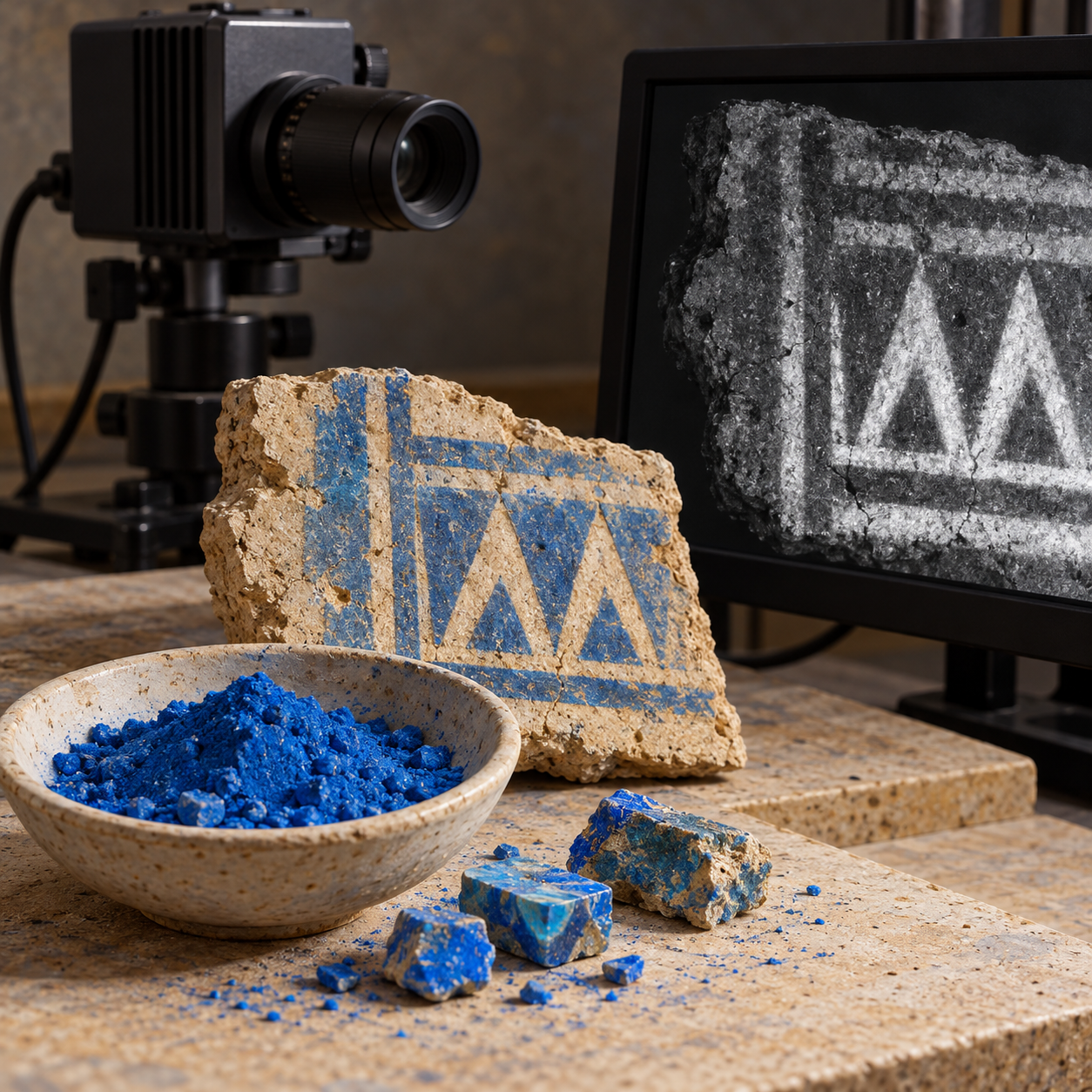
Laboratory-inspired illustration of blue pigment, a painted fragment and imaging equipment.
A conceptual materials study; the screen is illustrative, not measured data.

Blue is an appearance; pigment is a material

Egyptian blue is a manufactured calcium copper silicate pigment, associated with the crystalline compound cuprorivaite. Its preparation required heat and controlled material processing. It is widely described as the earliest known synthetic pigment.

The name does not limit its use to Egypt. It circulated within a wider ancient world, and a modern catalogue can identify it in works from different locations and periods. Nor does finding the material guarantee that the surface looked bright blue. Small particles can be mixed into other colours.

This distinction changes the question a reader asks of an artwork. “Where is the blue?” searches for a visible hue. “Where is Egyptian blue?” asks where a particular material occurs, including places whose overall colour is something else. Scientific imaging can make the second question practical.

How the invisible signal becomes a picture

Visible-induced infrared luminescence imaging, commonly abbreviated VIL, uses illumination to provoke an emission outside ordinary human vision. A camera sensitive to the relevant near-infrared wavelengths records it while filters distinguish that emission from other light.

The resulting bright areas are a way of displaying recorded information. The ancient paint is not glowing blue to the naked eye, and the displayed brightness should not be mistaken for the original appearance of the artwork. It is an analytical view with a particular purpose.

Getty's discussion of the APPEAR portrait project also notes that images made by different teams are not necessarily directly comparable in brightness. Equipment, conditions and processing matter. The useful interpretation begins with the image's method and legend, rather than assuming every pale pixel means the same quantity of pigment.

A blue contribution to a woman's face

Stephanie Spence and John Twilley's study of a portrait at the Nelson-Atkins Museum of Art provides an especially engaging example. Their investigation combined luminescence imaging, elemental mapping and microscopy. The portrait depicts a woman with carefully modelled highlights and shadows.

Egyptian blue was identified in an underdrawing role and in mixtures used to modulate flesh tones. The face does not present obvious blue patches in those areas. Microscopic particles and corresponding analytical responses reveal the material's subtle contribution.
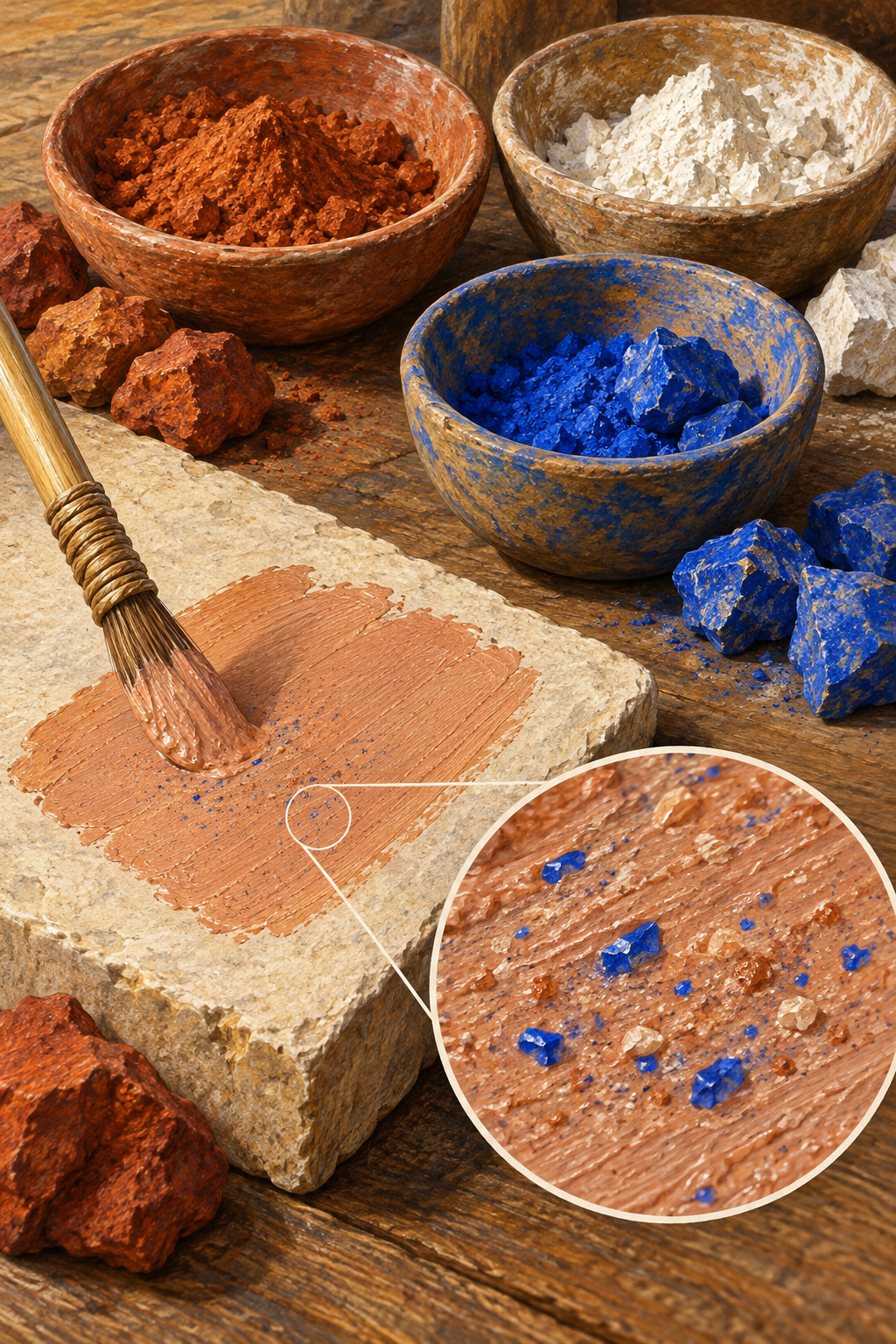
Illustration of blue pigment grains mixed into ochre paint, with an enlarged conceptual inset.
Small pigment additions can alter a paint mixture. The inset is conceptual, not a micrograph.

The conceptual particle illustration encourages a change of scale. In the Getty study, compare the ordinary portrait, the VIL image and the photomicrograph in figure 14.5. The real evidence lies in the relationship among those views, rather than in the explanatory inset here.

For an artist, a pigment can help a mixture achieve an effect without advertising itself as a separate colour. The research therefore recovers a decision about painting, not just an entry in a chemical inventory. A small amount can matter because of where and how it is used.

The surviving trace on marble

Research on the Parthenon sculptures provides a different scale of evidence. A 2023 primary study by Giovanni Verri and colleagues combines close examination of carving with analysis of colour traces, including Egyptian blue. It investigates the relationship between sculpted textiles and painted designs.

That is more specific than simply repainting every marble surface in the imagination. A detected trace can establish the presence of a material at a location. Reconstructing a whole garment's original design requires additional evidence about the distribution, surviving forms and comparison with other works.

Surface texture matters too. The study describes carving that differentiated materials such as skin and fabric. Painting and sculpting were parts of the finished effect. Modern white marble is therefore not a neutral window onto every aspect of the ancient object's appearance.

A three-view investigation

Open the Nelson-Atkins portrait study. Choose one small area, such as the region beneath an eye or part of the neck, and follow it across the published views.

  1. In visible light, describe the colour and modelling without using the material name.
  2. In the VIL image, identify the corresponding location and inspect the response shown there.
  3. Read the microscopy and elemental-map discussion. Which additional observations support the pigment identification?

The sequence keeps observation ahead of conclusion. It also explains why several techniques can be more informative together. An elemental map indicates the distribution of an element; a luminescence response concerns a material's optical behaviour; a microscope can reveal particles and their context.

Now reverse the journey. Return to the visible portrait and look at the same area again. Its appearance may not change, but your account of the artist's choices has. You know that a seemingly straightforward skin tone can contain a carefully judged mixture.

More than hidden colour

Egyptian blue connects making and examining. Ancient craftspeople controlled materials to produce a useful pigment; modern researchers use its properties to find evidence that ordinary viewing misses. Neither achievement requires turning the material into a magical secret.

The most rewarding discovery is often a relationship: blue within flesh, a pigment trace on carved cloth, a particle linked to a brush decision. The signal beyond sight matters because it returns us to the visible work with better questions about the person who made it.

Sources and further reading

Explore more art, stories and discoveries at Incoprea.

The Antikythera Mechanism: A Sky Made of Gears

A corroded lump of bronze is a difficult place to look for the sky. The surviving Antikythera mechanism does not immediately present the neat face of a working instrument. Its teeth, inscriptions, and layered fragments have to be investigated. From those damaged remains, researchers recover evidence of a machine that turned astronomical relationships into motion.

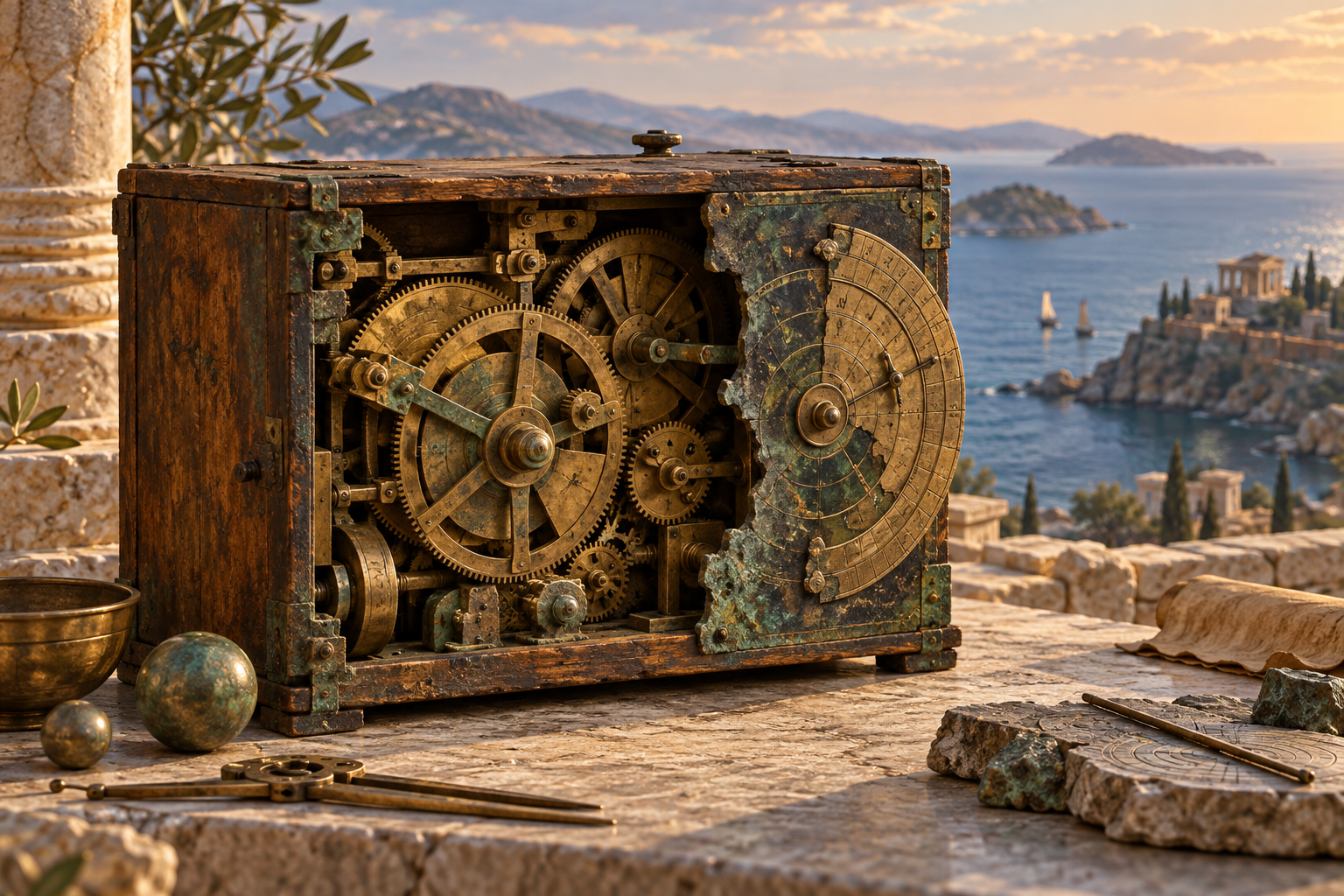
Interpretation of an ancient bronze astronomical calculator in a wooden case beside the Mediterranean.
A visual interpretation of ancient astronomical machinery, rather than an exact reconstruction.

The reward is more interesting than a claim that ancient people somehow possessed a modern computer. Here is a purpose-built instrument made from the knowledge, materials, and craft of its own world. Understanding it means following how observations, numbers, metalwork, and readable displays could be brought into one object.

A calculation can be built into moving parts

The National Archaeological Museum’s research history places the mechanism within ancient traditions of gears, scientific instruments, and models of the heavens. It also follows the changing interpretations of the fragments recovered from the shipwreck near Antikythera around the beginning of the twentieth century.

Calling the mechanism an analogue computer draws attention to calculation through physical relationships. It was not a telescope gathering a fresh measurement of a planet. Its moving parts represented astronomical periods and models that people had already developed through observation and mathematics.

That difference is useful in any model. A device may make a prediction because its parts embody a theory. To assess the prediction, we need to understand what relationship has been built into it and how well that relationship matches the world.

Try a calculation with two imaginary wheels

Imagine two simple external gears meshing without slipping. The first has 20 teeth and the second has 40. These are invented teaching numbers, not a claim about two surviving Antikythera wheels.

If the small wheel makes one full turn, it advances 20 tooth positions through the contact. The large wheel has 40 positions to complete, so it turns halfway. Two turns of the small wheel produce one full turn of the large one. Because the wheels mesh externally, their directions are opposite.

Add a 60-tooth wheel after the 40-tooth wheel. What changes?

Three full turns of the 20-tooth input advance 60 tooth positions. The final 60-tooth wheel therefore turns once. With two external contacts, it turns in the same direction as the input. In this simple chain, the middle wheel changes the direction at each contact but does not change the final 20-to-60 ratio. More elaborate arrangements can do much more.

You have expressed a numerical relationship through movement without a written answer appearing on a screen. Connecting several such relationships is the beginning of a mechanical calculation. The ancient mechanism’s ingenuity lies in the particular relationships chosen and the compact machinery devised to express them.

Teeth and letters constrain each other

The museum’s account of its inscriptions describes densely written astronomical and calendrical text on metal plates, including instructions for using the instrument. A surviving number or word can help explain what a mechanical relationship was intended to represent.

Consider the difference between finding a ratio and identifying its meaning. A ratio alone does not tell you whether a pointer counts a calendar interval, follows a lunar relationship, or serves another purpose. An inscription narrows the possibilities. In turn, the physical room for gears and the surviving components constrain how a proposed reading could become a working display.

This partnership makes the mechanism an unusually rich research problem. Text specialists, historians of astronomy, imaging scientists, and people who understand mechanisms can test different parts of the same explanation. A successful account has to let those kinds of evidence coexist.

New ways of looking changed the questions

According to the museum’s research timeline, photography, X-ray investigation, and later tomography contributed to successive interpretations. The technology mattered because the fragments could not simply be taken apart like a serviceable modern machine.

Surface evidence and internal evidence answer different questions. A photograph may show the edge of a component or a visible inscription. A tomographic view can help distinguish structures buried within corrosion. Neither automatically supplies a complete reconstruction: researchers still have to identify what they are seeing and how one part relates to another.

When you encounter a clear modern model, take a moment to return to a photograph of the actual fragments. The contrast makes the work of interpretation visible. The model is a proposal assembled from evidence, not the object conveniently restored by a camera.

What the 2021 front-display model proposed

In a 2021 Scientific Reports paper, Tony Freeth and colleagues proposed a model for the front of the mechanism. Their study worked with 82 surviving fragments, including 30 corroded gearwheels, and inscriptions describing a display involving the Sun, Moon, and the five planets known in antiquity.

Two planetary periods in the inscriptions, associated with Venus and Saturn, were important constraints. The team combined those textual clues with surviving mechanical features and ancient mathematical methods to design a compact arrangement that could fit the available space.

The UCL account of the research includes an essential distinction: the authors presented a theoretical advance and identified construction using ancient techniques as a further challenge. The proposed nested tubes carrying outputs were one difficulty. Explaining how parts could fit and demonstrating the historical feasibility of making them are connected but different achievements.

Look at a reconstruction in three columns

The 2021 paper’s Figure 4 places photographs, X-ray views, and computer reconstructions together. Open the figure and choose one feature described in its caption. Build a short record before moving to the completed model.

How much of a model is directly visible?
ColumnYour question
Surviving featureWhich photograph or scan shows the evidence being discussed?
InterpretationWhat does the caption say the feature may represent or support?
ReconstructionWhich added arrangement explains how it could function within the model?

You do not need to solve the gearing to benefit from the exercise. Its purpose is to keep the ancient trace and the modern proposal in view at the same time. An elegant animation becomes more informative when you can point to a constraint it has to satisfy.

The achievement does not depend on erasing uncertainty

The mechanism already establishes a remarkable meeting of astronomical knowledge and precision craft. Unresolved details are not evidence that the surviving work must have come from somewhere outside its historical world. They are the remaining questions raised by a damaged object with an extraordinary amount to tell us.

Return to the two imaginary wheels. Their simple ratio was easy to understand. The ancient achievement was turning many relevant relationships into an instrument somebody could operate and read. The fragments preserve enough of that ambition to keep researchers asking better questions about how a sky became a machine.

Follow another investigation through damaged evidence

Explore Palimpsests: The Books Hidden Inside Other Books for another meeting of imaging and scholarly reading. Compare a different kind of unresolved function in The Roman Dodecahedron: Twelve Faces, No Agreed Answer.

Explore more art, ideas, and independent projects at Incoprea.

The Lycurgus Cup: Roman Glass with Two Personalities

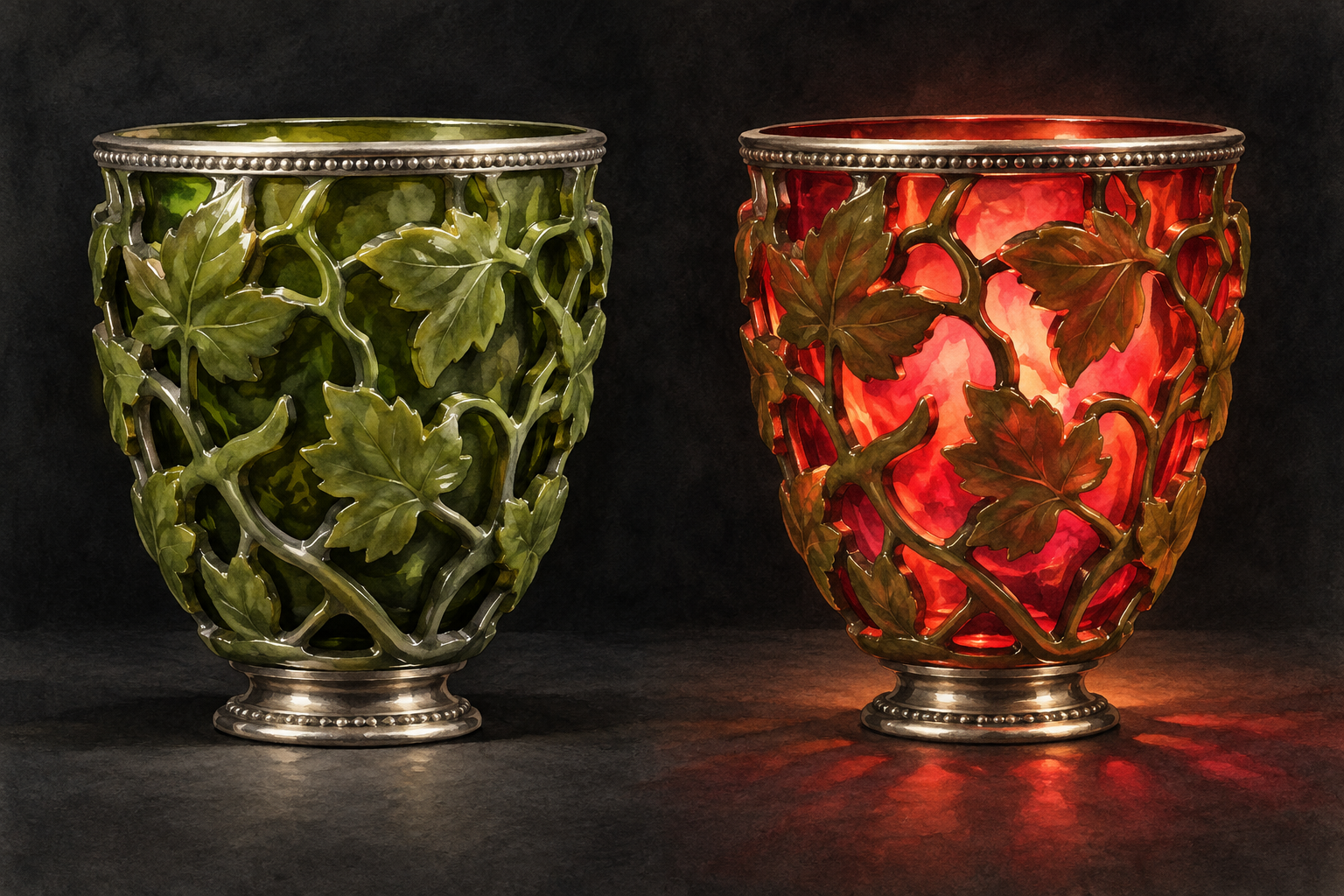
Two photographs can make the Lycurgus Cup look like two different objects. In one, the glass is green and difficult to see through. In another, it is a translucent red. Before looking for a second cup, follow the light. Has it returned toward the camera from the vessel, or traveled through the glass on its way there?

Comparison of green reflected and red transmitted light in a Roman-inspired glass cup.
A simplified comparison inspired by the cup's optical effect; decoration is interpretive.

The fourth-century Roman cup makes color feel less like a possession and more like an event. Glass, illumination, and viewing position work together. Its optical effect is remarkable, but the carved object deserves equal attention: an outer world of figures and vines stands around a fragile vessel.

The light takes two different journeys

The British Museum’s record identifies the Lycurgus Cup as a Late Roman drinking vessel. Its glass appears green in reflected light and red when light passes through it. This behavior is called dichroism.

In a reflected-light view, much of what reaches your eye has been returned from the object. In a transmitted-light view, illumination reaches you after passing through the glass. Those are different selections from the light interacting with the material. Moving a lamp can change the appearance without the object changing its chemical composition on command.

The cup is not producing light by itself. Nor does every colored glass object show this particular green-to-red effect. The useful first question is more concrete: where are the light source, the object, and the observer in this view?

Small particles, large consequences

In their 2007 scientific study, Ian Freestone, Nigel Meeks, Margaret Sax, and Catherine Higgitt discuss the investigation of the glass and its manufacture. Electron microscopy revealed minute metal particles, typically about 50–100 nanometres across. Analysis identified particles containing a silver–gold alloy, with copper also present.

The particles’ interaction with light helps explain the different appearances in reflected and transmitted illumination. Their size and composition matter; the optical behavior is not the same as placing a small lump of ordinary gold behind clear glass. A material’s arrangement can change the way we encounter its ingredients.

This is also a lesson in how explanations develop. Identifying elements in a sample is one kind of evidence. Showing how those elements are distributed, including whether they form tiny particles, answers another question. A list of ingredients does not completely specify a glass’s structure or appearance.

Two kinds of knowledge belong to different histories

The scientific description uses modern concepts and instruments. The surviving cup demonstrates an ancient material and an extraordinary level of working skill. Those facts do not establish that its makers held a modern theory of nanoparticles.

A craftsperson can learn what conditions produce a useful result before a later investigator explains every physical process. Repeated practice, comparison, material judgment, and a successful working sequence are forms of knowledge. Their value does not depend on whether the maker would recognize a modern scientific term.

Smithsonian’s Museum Conservation Institute indexes Robert Brill’s earlier research on the chemistry of the cup, including the relationship between its colors and reproducing that behavior. The record is a reminder that the scientific account has its own history of questions and experiments. Explaining an ancient achievement is continuing work, not a single moment when the object stopped being interesting.

Follow a vine as carefully as a color

The museum-authored account accompanying the cup’s digital image describes a thick glass blank worked by cutting and grinding. Much of the surrounding material was removed until figures stood in high relief, some joined to the vessel through small bridges. This openwork construction gives the object another kind of complexity.

Imagine working backward from the finished surface. The open space around a figure was once occupied by glass. Removing it had to preserve the vessel and the connections supporting the decoration. Looking for those connections makes patient craft visible where a quick glance might register only an elaborate silhouette.

The museum’s gallery guide relates the scene to the myth of Lycurgus, who attacks Dionysus and his followers. Ambrosia becomes a vine that traps him. The figure entangled in vegetation is therefore part of a narrative, not just a decorative reason to fill the surface with leaves.

Examine one connection between a figure, vine, and cup wall in the museum image. How does it serve the picture, and how does it help the fragile structure remain one object? The same detail can do visual and physical work.

Make a record of the light before describing the color

Use the museum’s digital image and the photographs in the scientific paper to explore the object. For each view, record three things: the apparent glass color, the visible direction of illumination if it is supplied, and the feature of the carving you are following.

A photograph is also a viewing arrangement
QuestionWhat to notice
What reached the camera?Does the source identify reflected or transmitted light?
What stays recognizable?Follow the same figure or vine even when its color looks different.
What remains uncertain?Do not infer an exact lamp position or material measurement from a photograph that does not provide it.

The repeated feature anchors your comparison. It keeps a dramatic color difference connected to one physical object. If a caption gives the lighting arrangement, keep that information beside your observation rather than letting the image circulate as an unexplained curiosity.

You can practice the first distinction with an ordinary empty colored drinking glass near a window. Look at the glass with the bright window behind it, then with room light returning from its surface. Notice which reflections and details become easier to see. This does not reproduce the Lycurgus Cup’s special dichroism; it isolates the difference between looking through glass and looking at returned light.

A powerful object can survive its explanation

Knowing about the particles adds a scale of attention the eye cannot reach on its own. Looking at the carving adds a working history that a particle measurement cannot supply. Both enlarge the encounter rather than reducing it to a trick.

Return to the two colors with which you began. The question is no longer simply why a cup changes color. It is how one material can select different light for different viewing paths, and how people turned that material into a demanding piece of sculpture. The ancient object and the modern investigation remain remarkable for different, connected reasons.

Look at another optical material

Explore a biological reflector in A Reindeer’s Reflecting Eyes Change With the Season. For another kind of colored-light encounter, browse Stained Glass: 30 Artists to Discover.

Explore more art, ideas, and independent projects at Incoprea.

The Baghdad Battery: When a Name Gets Ahead of the Evidence

Imagine a demonstration in which a replica jar makes a voltmeter register a signal. The audience has seen something real happen. Then the explanation makes a much larger leap: people in antiquity must have built the original object to produce electricity. The interesting investigation begins in the space between those two statements.

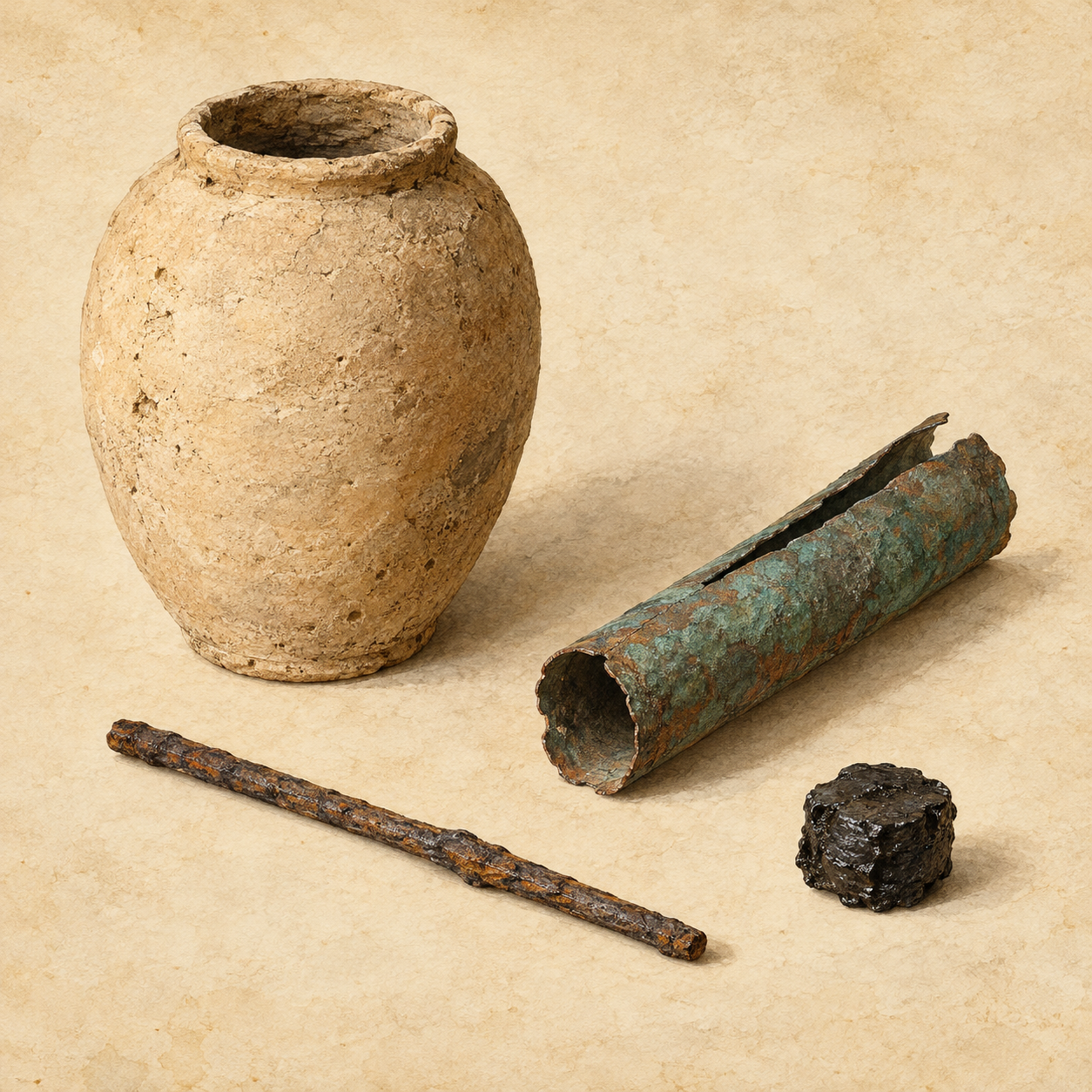
Illustration of a pottery jar and separate copper tube, iron rod and dark plug laid out for study.
A study inspired by the reported components, with no electrical use assumed.

The artifact commonly called the Baghdad Battery is a ceramic vessel associated with copper, iron, and a dark sealing material. Its nickname has become so familiar that it can sound like a settled identification. A more useful approach is to examine what was reported, what a reconstruction adds, and which historical purpose the evidence can support.

Start with the components, not their modern names

D. E. Von Handorf’s 2002 technical discussion revisits the vessel reports associated with Wilhelm König and the debate that followed. Published descriptions include a pottery container, a copper cylinder, an iron element, and asphalt-like material. Their arrangement suggested an electrochemical interpretation to modern observers.

Try describing those parts without using the words battery, electrode, or electrolyte. You still have a physical assemblage. Now restore the electrical vocabulary and notice how quickly each component acquires a role. That change in language is useful when explaining a hypothesis, but it should not silently convert the hypothesis into an observed ancient function.

Descriptions of several related vessels also need to remain separate. A component present in one reported example cannot automatically fill a gap in another. A reconstruction assembled from the most convenient details across several finds may test an ingenious design without representing any one documented original.

What would make the arrangement a cell?

The US Department of Energy’s explanation of batteries distinguishes electrodes, an electrolyte, and an external circuit. Chemical processes and movement of charge have to work together. A pot containing metals is not enough to specify all those conditions.

For a historical reconstruction, the liquid matters, as do the metal surfaces, their separation, and the connections used to draw current. If a demonstrator chooses those details, the choices belong in the experiment’s record. They may be reasonable, but they still need historical support before becoming a description of ancient use.

It also matters what the demonstration measures. A voltage reading is not a complete description of useful electrical performance. A proposed task may require current for a certain time under a particular load. Ask whether the result being displayed answers the same question as the historical claim being made.

Electrical proposals are not all the same proposal

Paul T. Keyser’s 1993 paper is instructive because it argues against electroplating while proposing a different electrical use: local pain relief. He discusses ancient use of electric fish and the cultural setting in which an electrical sensation might have been understood.

Those are arguments within a particular interpretation, not evidence that every proposed electrical function stands or falls together. One can reject electroplating and still propose another use. Equally, finding a weakness in one alternative does not establish the electrical interpretation by elimination.

At the beginning of his medical-purpose discussion, Keyser explicitly says the proposal must remain hypothetical until further confirming evidence appears. His conclusion nevertheless argues that such a purpose was possible and even likely. Reading both parts gives a more accurate account than either presenting his title as proof or dismissing the paper without considering its argument.

Ask what a proposed use should leave behind

A historical explanation becomes stronger when it predicts evidence beyond a working replica. An electroplating interpretation might prompt examination of relevant finished surfaces, workshop materials, and connections. A medical interpretation needs its own contextual support. A container interpretation likewise needs comparisons that explain the whole assemblage, not merely its resemblance to an ordinary jar.

Absence has to be handled carefully. A missing perishable connection does not prove a device never worked, but inventing that connection does not prove it did. The question is how many unsupported additions an explanation requires and whether independent evidence begins to support them.

This is a useful discipline because the most vivid part of an explanation can arrive last. We begin with modest materials, supply a plausible liquid and connections, obtain a modern result, then imagine a workshop or treatment. Each step may feel small. Together they can produce a historical scene whose crucial parts never came from the find.

Separate three claims in a demonstration

What has actually been established?
ClaimEvidence needed
This reconstruction produces an electrical effect.A documented experiment, with materials, connections, measurements, and conditions.
An ancient example could have operated similarly.A close match between the reconstruction’s necessary features and the surviving object or reliable record.
People made the object for that purpose.Historical or archaeological support for intention and use, beyond the modern experiment.

Choose a demonstration or written explanation and place its strongest evidence in one row. Then look at its conclusion. Has the argument moved to another row without supplying another kind of support? This simple check works even when you cannot assess every detail of the chemistry.

Does a successful first row make the last row likely?

It makes the proposed function physically more plausible under the tested conditions. It does not tell us how ancient people used the object. Many objects can perform tasks for which they were never designed; the intended task needs a historical argument of its own.

Read skepticism as carefully as enthusiasm

In a 2012 interview, archaeologist Elizabeth Stone expressed strong skepticism about the battery interpretation. She also made clear that she was recalling the object during a live conversation. Her response is evidence of her assessment in that interview, not a substitute for a published examination of every reported component.

That distinction protects the investigation on both sides. A confident demonstration is not enough to establish ancient use, and a confident dismissal does not by itself identify the original function. Detailed records, material analysis, carefully framed experiments, and comparisons each contribute something different.

The jar remains worth looking at because it exposes how a modern analogy can organize what we see. Once the label has supplied a complete machine in our imagination, it is surprisingly difficult to return to the actual components. Making that return gives us a better question: which parts of the story came from the object, and which came from us?

Keep investigating

Apply another test of proposed functions in The Roman Dodecahedron: Twelve Faces, No Agreed Answer. Then compare scientific explanation of a surviving material in The Lycurgus Cup: Roman Glass with Two Personalities.

Explore more art, ideas, and independent projects at Incoprea.

publications

New this week Two novels in six stories each, from The Night Shift . New — a novel in six documents Small Print A Novel in Six Do...