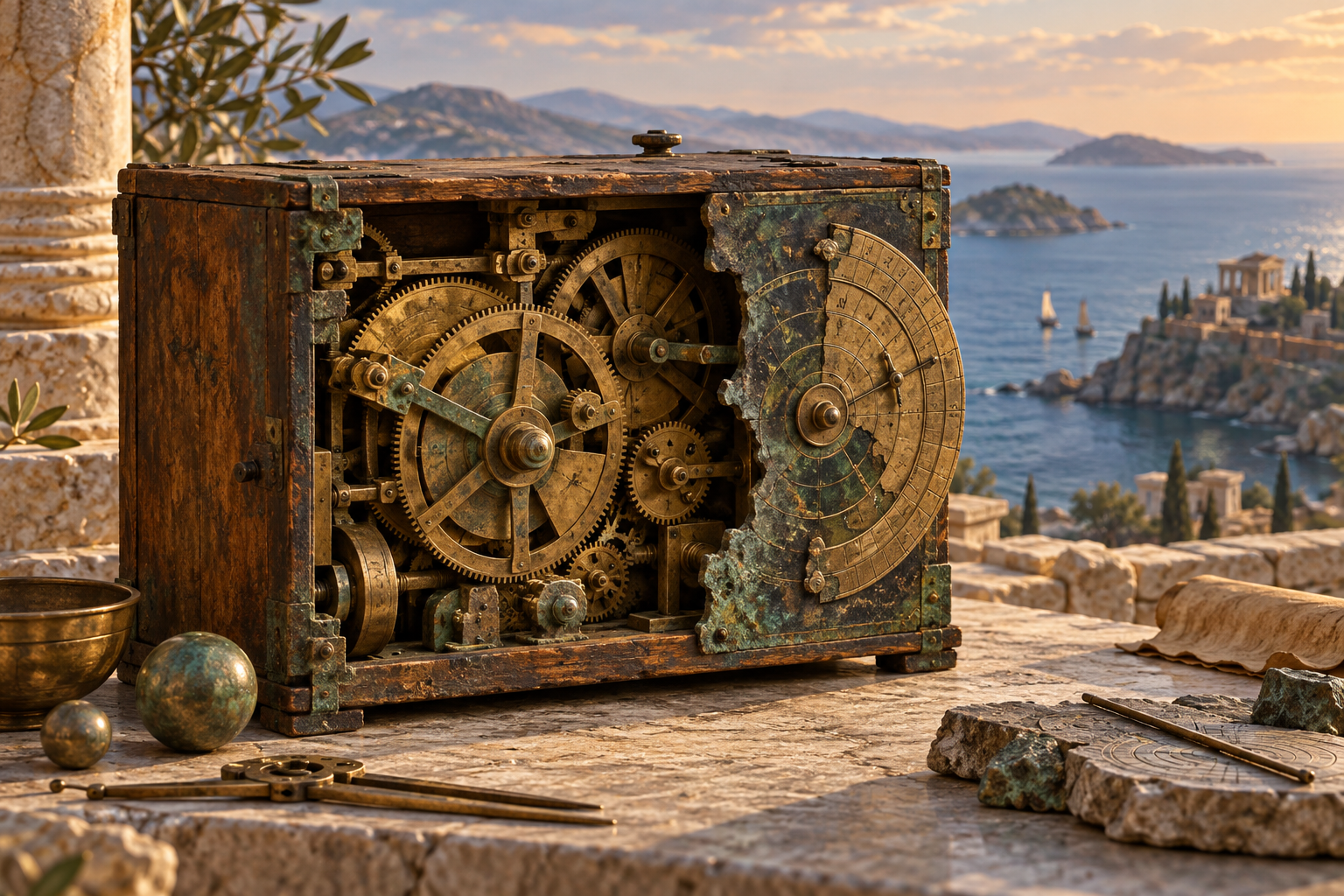
A shipwreck can preserve cargo. Occasionally, it preserves a machine that changes our picture of an entire age. The Antikythera mechanism, recovered near a Greek island in 1901, is a corroded collection of bronze fragments. Inside those fragments are toothed wheels that once translated astronomical cycles into moving displays.
Calculation you could turn by hand
The mechanism was an ancient Greek astronomical calculator. Its surviving gears and inscriptions connect it with calendars, the Moon and eclipse prediction. Calling it an analogue computer is useful if we remember what that means: a purpose-built physical device that represents quantities through mechanical motion, rather than a general-purpose electronic machine.
Think of two interlocking wheels with different numbers of teeth. Turn one, and the other rotates at a related rate. Add more wheels and that simple relationship can express a more complicated cycle. The remarkable achievement here was making several astronomical relationships work together in a small instrument.
This was not a machine watching the sky through a lens. Its predictions embodied astronomical models and periods already understood by its makers. It transformed accumulated observation and mathematics into something a person could operate.
Reading through corrosion
The National Archaeological Museum's history of the research shows how interpretations changed as investigators acquired better ways to inspect the remains. Photography, X-ray examination and computed tomography exposed features hidden inside material that could not simply be pulled apart.
There were also words. Densely written inscriptions on metal plates supplied astronomical information and instructions. Gears might reveal a numerical ratio; an inscription might indicate which astronomical cycle that ratio represented. Each kind of evidence helps constrain the other.
In 2021, a UCL team proposed a model for the missing front display, using surviving fragments, inscriptions and ancient mathematical methods. Their reconstruction included the Sun, Moon and the five planets known in antiquity. It was presented as a solution consistent with the evidence, with practical construction using ancient techniques identified as a further challenge.
A wonder with unfinished details
Only part of the original machine survives. That makes it important to distinguish a surviving gear from a gear introduced by a reconstruction, even when the reconstruction is convincing. A complete modern model necessarily contains decisions that the damaged ancient object cannot directly confirm.
The uncertainty does not shrink the accomplishment. We already have evidence that ancient craftspeople brought precision metalworking and mathematical astronomy together in an extraordinary way. The mechanism encourages a better question than whether ancient people were secretly modern: what could skilled people achieve with the knowledge and materials available to them?
Its answer is there in the bronze. A sky full of recurring motions could become a network of hand-cut wheels. Two thousand years later, those wheels still turn our assumptions.
Sources and further reading: National Archaeological Museum: research history; the mechanism's inscriptions; UCL's 2021 reconstruction.
Explore art, ideas and creative work at Incoprea.