Showing posts with label Investigation. Show all posts

Thursday, October 22, 2026

Seventeen Minutes Between Two Wrong Clocks

Case 29 · investigation · Medium · About 5–8 minutes

A messenger left the harbor when its clock read 10:18 and reached the station when the station clock read 10:41. A verified timer shows that the journey took exactly seventeen real minutes.

Both wall clocks are wrong. Vale needs the messenger’s real arrival time, rather than an answer copied from either face.
Two antique clocks viewed from their open backs on a railway office bench.
Clock faces are not shown; all timing evidence is in the text.

The clockmaker’s guarantees

  • Each clock differs from real time by a constant whole number of minutes during this journey.
  • Each error is at most four minutes in either direction. A clock may be fast, slow, or accurate within that range.
  • Exactly one clock is two minutes fast. The clockmaker does not say which one.
  • Both readings concern the same morning. There are no hour resets, time-zone changes, date changes, or clock adjustments.

A clock that is two minutes fast displays 10:20 when real time is 10:18. A clock four minutes slow displays 10:14 at that same real instant.

Find each clock’s error and the real departure and arrival times. Use the seventeen-minute journey to compare the errors; do not assume that the difference between the displayed times is the real elapsed time.

The illustration shows clock backs as atmosphere. No visible gear or unmarked object determines a time. Every relevant numerical condition appears above.

Hint 1 - reveal when you want a nudge

The displayed times differ by 23 minutes, while real time increased by 17. The station clock’s error must be 6 minutes greater than the harbor clock’s.

Hint 2 - reveal when you want a nudge

If the harbor clock were 2 minutes fast, what error would that require at the station? Compare it with the 4-minute bound.

Reveal the solution and explanation

The harbor clock is four minutes slow. The station clock is two minutes fast. Real departure was 10:22, and real arrival was 10:39.

The displays advance from 10:18 to 10:41, a difference of 23 minutes. The real journey adds only 17 minutes. The extra 6 minutes must come from the station clock’s error being 6 minutes greater than the harbor clock’s.

If the harbor clock were 2 minutes fast, the station clock would need to be 8 minutes fast. That violates the 4-minute bound. Therefore the station is the clock that is 2 minutes fast, and the harbor’s error is 2−6=−4 minutes.

Add 4 minutes to the harbor reading to get 10:22. Subtract 2 minutes from the station reading to get 10:39. Those real times differ by 17 minutes. The bound rules out the only alternative assignment of the known 2-minute-fast clock, proving uniqueness.

Solve another: The Cabinet of Fifty Mysteries · Browse all 50 cases

The Freight Office’s Forged Weight

Case 24 · investigation · Hard · About 6–10 minutes

An empty brass balance and unmarked parcels in a railway freight office.
All weights and parcel identities are specified in the text.

Three sealed museum parcels, A, B, and C, have reached the station freight office. Someone altered exactly one line of the weighing record. The parcels themselves were not changed.

Vale has four recorded totals and a trustworthy ordering note. Determine the false line and recover the three individual weights.

The four recorded lines

  1. A and B together: 9 units.
  2. B and C together: 11 units.
  3. A and C together: 8 units.
  4. A, B, and C together: 15 units.

Verified conditions

  • Each parcel weighs a whole number of units, from 1 through 9 inclusive.
  • A is lighter than B, and B is lighter than C. No two weights are equal.
  • Exactly three recorded lines are correct. The remaining line gives an incorrect total.
  • Every weighing uses the same unit and the same unchanged parcels. No container weight or hidden packing adjustment needs to be added.

Which numbered line was altered? Give A’s, B’s, and C’s weights, then calculate all four totals to check your answer.

You may solve by algebra or systematically test increasing triples. A contradiction among the totals does not tell you which line is false by itself. The trustworthy light-to-heavy ordering is an essential additional constraint.

The illustration is atmospheric. The sizes or number of drawn parcels and the empty balance do not supply measured evidence.

Hint 1 - reveal when you want a nudge

Temporarily suppose the first two pair totals and the grand total are correct. Subtract each pair total from the grand total.

Hint 2 - reveal when you want a nudge

Those three lines give C=15−9 and A=15−11. Use either pair total to find B, then test the remaining line.

Reveal the solution and explanation

Line 3 is false. A weighs 4 units, B weighs 5, and C weighs 6. Their totals are A+B=9, B+C=11, A+C=10, and A+B+C=15.

To prove uniqueness, consider the alternatives. If line 1 were false, the other lines would give A=4, B=7, C=4, violating the strict order. If line 2 were false, they would give A=2, B=7, C=6, again violating the order.

If line 4 were false, adding the three pair totals gives twice the combined weight: 28. The total would be 14, producing A=3, B=6, C=5, which also fails B<C.

Only treating line 3 as false yields an increasing triple in the allowed range and exactly three correct lines. Its recorded 8 should be 10.

Solve another: The Cabinet of Fifty Mysteries · Browse all 50 cases
The Appointment That Never Happened

Case 20 · investigation · Medium · About 5–8 minutes

A courier submits four appointment cards to explain a morning’s movements. Vale knows that exactly one appointment was invented. The other three happened at their stated places and times.

Find the false card without guessing how quickly the courier walks. The case supplies fixed minimum travel times, and appointments take no time beyond the recorded instant.

A folio on a quiet station bench with branching tracks beyond.
All itinerary evidence is in the text.

The four cards

  • A: Harbor, 09:00.
  • B: Museum, 09:05.
  • C: Station, 09:15.
  • D: Gallery, 09:40.

Guaranteed travel limits

The minimum minutes between each pair of places are the same in either direction:

  • Harbor–Museum: 10; Harbor–Station: 12; Harbor–Gallery: 30.
  • Museum–Station: 15; Museum–Gallery: 20.
  • Station–Gallery: 20.

These are complete minimum travel times, already allowing the quickest permitted route. Waiting is allowed. The courier used no other transport or shortcuts. All cards use the same accurate clock. The invented appointment did not happen and imposes no stop on the real route.

Which card is false? Show that the three remaining appointments can form a possible journey. Then explain why deleting any other single card still leaves an impossible pair. You need not identify an exact street route; enough elapsed time between consecutive genuine stops establishes feasibility under these rules.

The illustration supplies atmosphere only. No shadow, rail line, or unmarked paper in it adds evidence.

Hint 1 - reveal when you want a nudge

Look for pairs of cards separated by less time than their stated minimum journey.

Hint 2 - reveal when you want a nudge

There are two impossible pairs, and they share one card.

Reveal the solution and explanation

Card B, Museum at 09:05, is false.

A and B are only five minutes apart, but Harbor–Museum requires ten. B and C are ten minutes apart, but Museum–Station requires fifteen. Both impossible pairs include B.

Remove B and the real journey works: Harbor at 09:00 to Station at 09:15 gives fifteen minutes for a twelve-minute trip. Station at 09:15 to Gallery at 09:40 gives twenty-five minutes for a twenty-minute trip. Spare time can be spent waiting.

Removing A leaves the impossible B–C pair. Removing C leaves A–B. Removing D leaves both. Therefore only B can be the single invented appointment. The argument identifies a false record, not a reason why the courier invented it.

Solve another: The Cabinet of Fifty Mysteries · Browse all 50 cases

Four Keys and a Missing Name

Case 19 · investigation · Medium · About 4–7 minutes

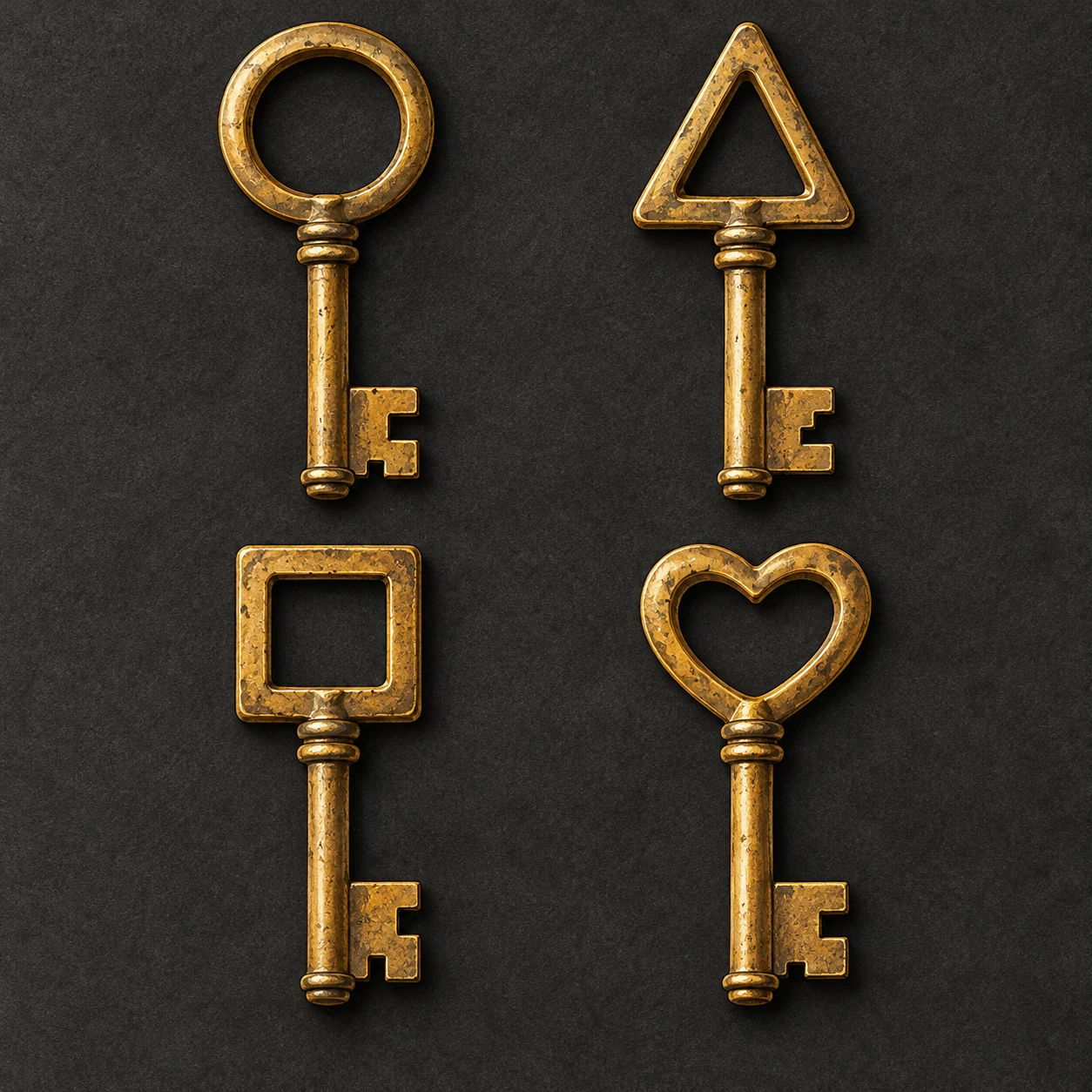
Four brass keys in a grid: circle and triangle above, square and heart below.
Handle shapes and grid positions matter; key teeth do not.

A museum key register has lost its final column. Four staff members returned four different keys, and one return is waiting to be credited. Vale arranges the keys exactly as shown in the evidence picture.

The round-handled key is the one whose return needs a name. Work out its borrower from the surviving register notes.

The rules

Ari, Bea, Cal, and Dev each borrowed exactly one pictured key. No key was shared, and each person returned that same key. The notes describe the present arrangement, not where keys hung earlier.

  1. Ari’s key is in the upper row.
  2. Bea’s key is directly below Ari’s, in the same column.
  3. Dev’s key has the square handle.

Picture evidence

Accessible evidence transcript: There are four keys in a two-by-two arrangement. Upper left: round handle. Upper right: triangular handle. Lower left: square handle. Lower right: heart-shaped handle.

The handles identify the keys; tiny teeth, color differences, and decorative wear do not matter. A handle described as square is the lower-left key, even though its corners are slightly softened by the drawing style.

Who borrowed the round-handled key? Recover all four assignments. You may sketch the four positions and place the names. Do not assume that a key’s handle reveals its actual lock: this fictional register supplies every relationship needed.

Hint 1 - reveal when you want a nudge

Ari and Bea must occupy one complete vertical column, with Ari above Bea.

Hint 2 - reveal when you want a nudge

The left-column possibility would give Bea the same key already assigned to Dev.

Reveal the solution and explanation

Cal borrowed the round-handled key. Ari had the triangle, Bea the heart, Cal the circle, and Dev the square.

Ari has only two upper-row choices. If Ari had the upper-left round key, Bea would have the lower-left square key. But Dev already has the square, and the one-key-per-person rule forbids that double assignment.

Ari must therefore have the upper-right triangle. Bea, directly below Ari, has the heart. Dev keeps the square specified in the note. The unused round key belongs to Cal.

The rejected left-column branch and the successful right-column branch exhaust Ari’s choices. With the four people and four distinct keys, no further assignment is possible. The remaining name is established by exclusion, not by a guess about which handle a person would prefer.

Solve another: The Cabinet of Fifty Mysteries · Browse all 50 cases
The Harbor Gate’s Even Cargo

Case 18 · investigation · Easy · About 3–6 minutes

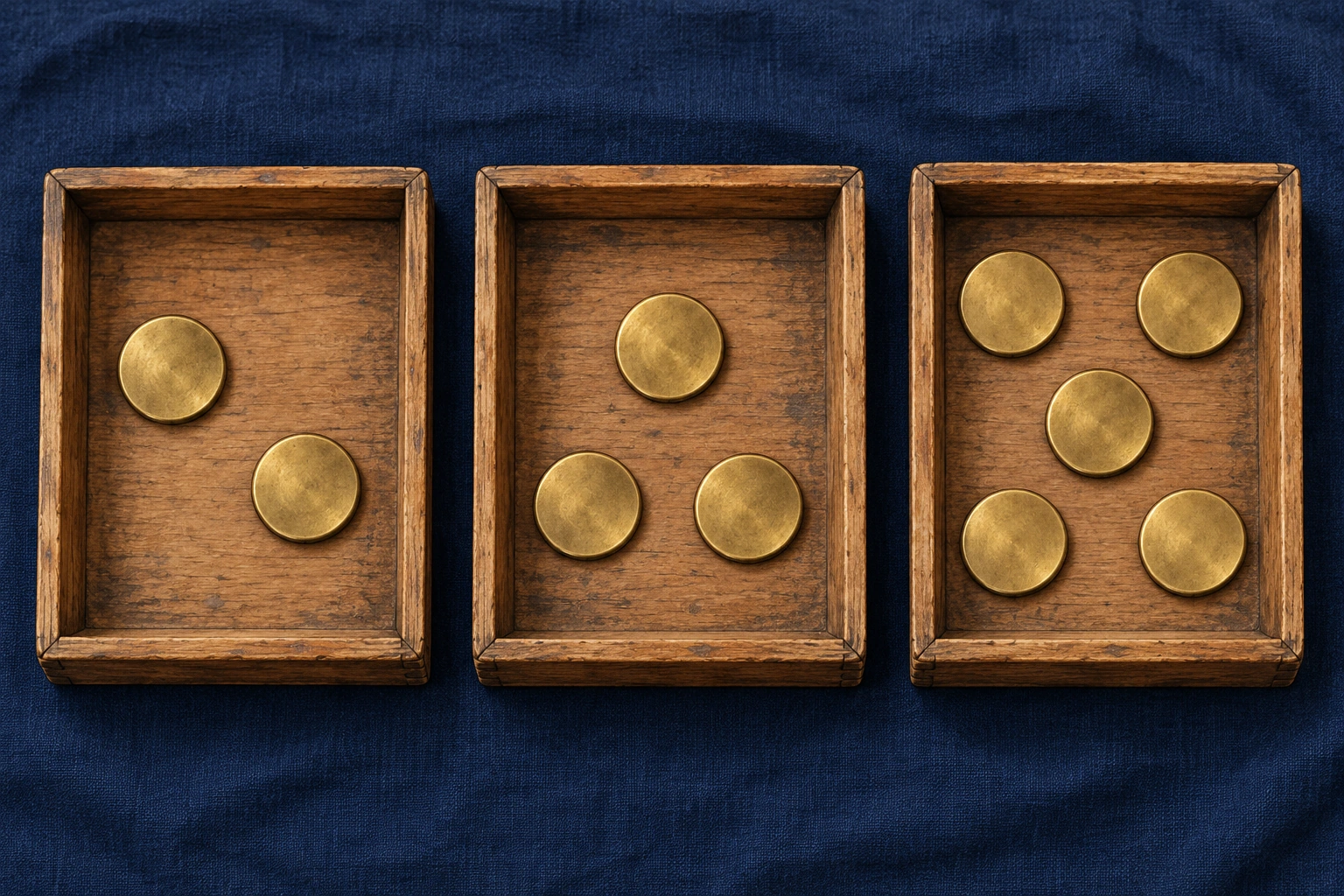
Three wooden trays contain, from left to right, two, three, and five brass counters.
Counter counts and tray order are the complete visual clues.

A torn release slip has halted the last cargo launch at Bell Quay. Three boats are ready, and the dock office has represented their loads with brass counters. The picture is the complete tally at the moment the slip was issued.

Vale must recover which boats the slip authorized. Choosing the biggest load is not enough: the harbor’s temporary release rule has two separate conditions.

The release rule

  • Each counter represents one sealed cargo unit.
  • The left tray records Boat A, the middle tray Boat B, and the right tray Boat C.
  • The slip released exactly two different boats. Their loads could not be divided, transferred, or left partly ashore.
  • Together, the released boats had to carry at least six units but no more than eight.
  • Their combined number of units had to be even.

Picture evidence

Count the separate counters, not the trays or marks in the wood.

Accessible evidence transcript: Boat A’s left tray contains two counters. Boat B’s middle tray contains three counters. Boat C’s right tray contains five counters. No counters overlap, and none lie outside the trays.

Which two boats were released, and how many units remained on the dock? List every possible pair to show why there is exactly one legal answer. The rule concerns cargo units only; it makes no claim about weight, safe loading, weather, or actual harbor regulations.

Hint 1 - reveal when you want a nudge

There are only three pairs: A with B, A with C, and B with C.

Hint 2 - reveal when you want a nudge

A pair can satisfy the six-to-eight range yet still fail the even-number condition.

Reveal the solution and explanation

Boats B and C were released, carrying eight units together. Two units remained with Boat A.

The complete pair check is: A+B gives 2+3=5, below the minimum. A+C gives 2+5=7, within the range but odd. B+C gives 3+5=8, within the range and even.

Thus each condition does useful work. The range excludes the five-unit pair; the parity rule excludes the seven-unit pair. The eight-unit pair is the only survivor. The tally contains ten units altogether, so releasing eight leaves two.

No boat has been accused of carrying a false load. The mystery is the lost authorization, and the closed rule plus the visible tally recovers it without needing an unseen document.

Solve another: The Cabinet of Fifty Mysteries · Browse all 50 cases
Three Parcels, Every Label Wrong

Case 16 · investigation · Medium · About 4–7 minutes

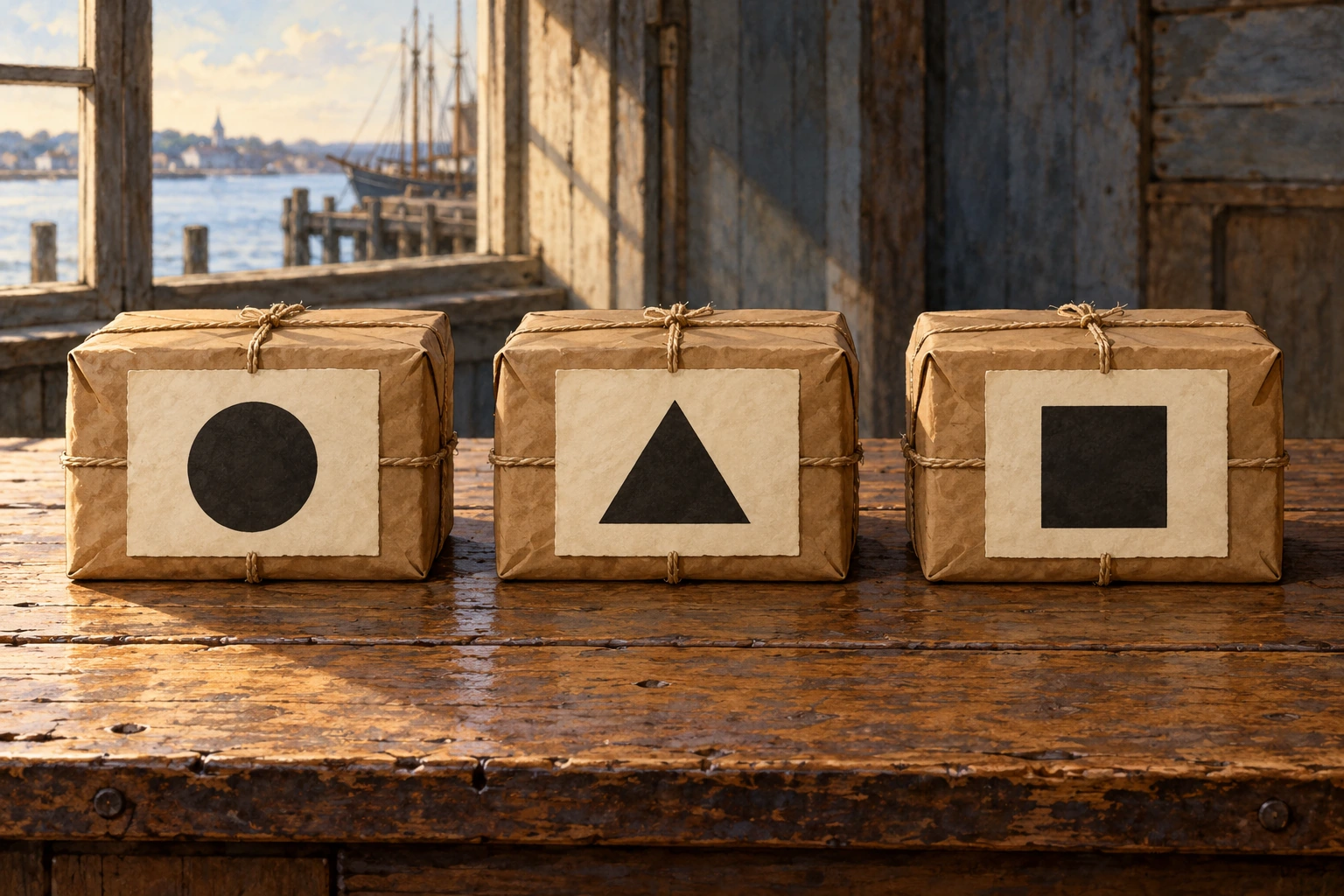
Three labeled parcels in a row on a harbor receiving desk; symbols are circle, triangle, square.
The three parcel symbols and their order are clues; background details are decorative.

At Bell Quay, Inspector Vale finds three parcels waiting for the museum launch. One contains a small clock, one an atlas, and one a ceramic bowl. The contents are intact, but someone has replaced all three identifying labels.

The dispatcher wants the clock before the boat leaves. You may use the picture and the verified statements below. You do not need to open a parcel.

The dispatch rules

  • Each parcel contains exactly one of the three objects. Every object appears once.
  • In the correct labeling system, a circle means clock, a triangle means bowl, and a square means atlas.
  • Every label now on the desk is wrong. No parcel bears its correct symbol.
  • A reliable witness saw the contents before packing and confirms that the clock is farther to the right than the bowl.
  • The parcels have not changed positions since that observation.

Picture evidence

Read the three large labels from left to right. Ignore the boats, window, twine, and apparent parcel size; they supply no clues.

Accessible evidence transcript: The left parcel bears a circle. The middle parcel bears a triangle. The right parcel bears a square.

Which parcel contains the clock? Give the complete contents of the row to demonstrate that your answer satisfies every condition. “Farther right” means a greater position in this three-parcel row; it does not require the objects to be adjacent.

Hint 1 - reveal when you want a nudge

Translate each symbol into the content it forbids, because all three labels are wrong.

Hint 2 - reveal when you want a nudge

There are only two ways to mislabel all three parcels. Compare the clock and bowl positions in those two arrangements.

Reveal the solution and explanation

The right-hand parcel, bearing the square, contains the clock. From left to right, the contents are bowl, atlas, clock.

There are six possible arrangements of three different objects. Requiring all three labels to be wrong leaves only two: bowl–atlas–clock, and atlas–clock–bowl. In the first, the clock is to the right of the bowl. In the second, it is to the left. Only the first passes the witness’s condition.

Check the result against the labels: the circle parcel has no clock, the triangle parcel has no bowl, and the square parcel has no atlas. Nothing about the illustration establishes who switched the labels, so that separate question remains unanswered.

Solve another: The Cabinet of Fifty Mysteries · Browse all 50 cases
The Elevator With Three Working Buttons

Case 50 · shortest-path challenge · Hard · About 10-15 minutes The archive elevator has a peculiar test mode. Its floor display works, but o...