Showing posts with label Writing Systems. Show all posts

Friday, October 23, 2026

The Edge of the Stone Is Part of the Writing

At first, an ogham stone may look almost undecorated. There is no broad panel of letters facing the viewer. The writing gathers around a corner, where groups of strokes meet the edge. To follow it, your attention has to move around the object.
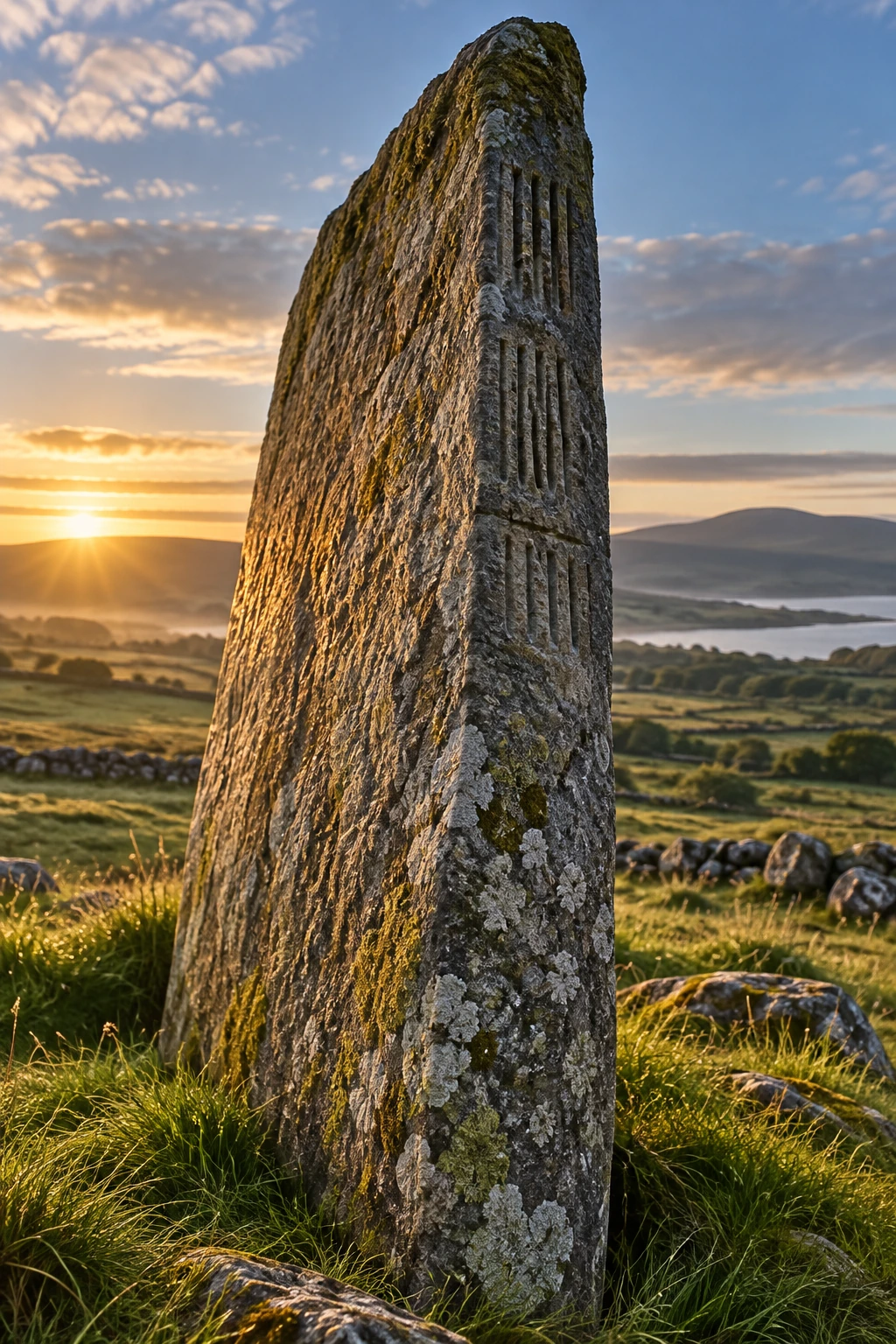
A weathered stone edge with grouped incisions stands in grass under low sunlight.
The corner offers a route for the eye. This reconstructed stone is illustrative; use the museum guide for a documented inscription.

The National Museum of Ireland's introduction shows a stone from Colbinstown, County Kildare. Its corner acts as the central line around which the signs are arranged. That makes the stone's geometry part of the writing surface rather than background scenery.

Find the line before the letters

In a printed alphabet chart, the central line is drawn on the page. On a stone, an actual edge can perform that job. Groups differ by the number and placement of strokes in relation to it. A photograph taken squarely at one face may make some of those relationships difficult to see.

Open the museum's guide and compare its pictured stone with its alphabet exercise. First identify the edge. Then identify individual groups. Only then use the key. This order prevents a common mistake: counting every visible scratch before deciding which scratches belong together.

The guide describes a usual reading route that begins low on the left, continues upward and may pass around the top. The word “usual” matters when moving from a teaching example to a real monument. Damage, reuse and individual inscriptions can make the route less straightforward.

A name can occupy a monument

Many surviving early ogham inscriptions commemorate people through personal names and relationships. The museum's short account places many stones in the fourth to sixth centuries. That is a broad historical setting, not a date obtained by measuring how old the rock is.

Consider the difference between carving “a person existed” and carving a name with a family connection. The second statement places a person among other people. Even when the inscription is short, the social information can be substantial.

For a safe paper exercise, write an invented name and “child of” followed by another invented name in your ordinary alphabet. Count how much of the inscription identifies a relationship rather than a physical feature. There is no need to translate that sentence into ogham to appreciate what the monument is doing.

Turn a digital stone slowly

The researchers behind Ogham in 3D describe their recording process: investigation of stones and sites combined with three-dimensional scanning. A model can preserve information about the corner that a single frontal image compresses.

In a linked digital model, look for a group that is clearer after rotation. Ask what changed. You did not uncover a new carving; you changed the relation between a surface, a light and a viewpoint. The distinction makes a model useful as a tool for examination rather than just an impressive object to spin.

At the same time, a scan is a record made by instruments and processed by people. It does not guarantee that every shallow groove has been identified correctly. Compare the model with the project's transcription and commentary instead of treating every small depression as a letter.

Stone evidence and later learned traditions

Jost Gippert's university-hosted introduction to ogham inscriptions brings photographs, readings and scholarly references together. It makes the difficulty of reading actual stones visible. A neat modern font cannot reproduce all the decisions an epigrapher faces.

Ogham also has later manuscript traditions and interpretations of letter names. Those are interesting subjects in their own right. They should not automatically be substituted for the reading of an early stone inscription. A tree association in a later explanation does not turn every stroke group on a monument into a message about that tree.

Try a three-pass observation

First describe only the stone: its shape, edge and visible damage. Second describe the marks without assigning letters. Third compare a published reading and note where it depends on an uncertain or missing section. Each pass asks a different question, so a difficulty in one need not erase what the others establish.

Leave real monuments untouched. Rubbing, chalking or wetting a surface can affect it, and an enthusiastic attempt to improve contrast may destroy information that a different technique could record. Public photographs and research models offer plenty of room for close looking.

The attraction of ogham is not simply that ordinary words have been disguised as strokes. It is that writing has adapted itself to an edge. Once you notice the corner, a nearly blank stone becomes a route that the reader's eyes can follow.

Sources and further exploration: National Museum of Ireland: ogham guide; Ogham in3D researchers: recording the stones; Jost Gippert: introduction to ogham inscriptions.

Explore all 50 new articles · Browse the complete illustrated collection

Explore more art, ideas, and independent projects at Incoprea.

Your Screen Can Draw One Letter in Several Different Ways

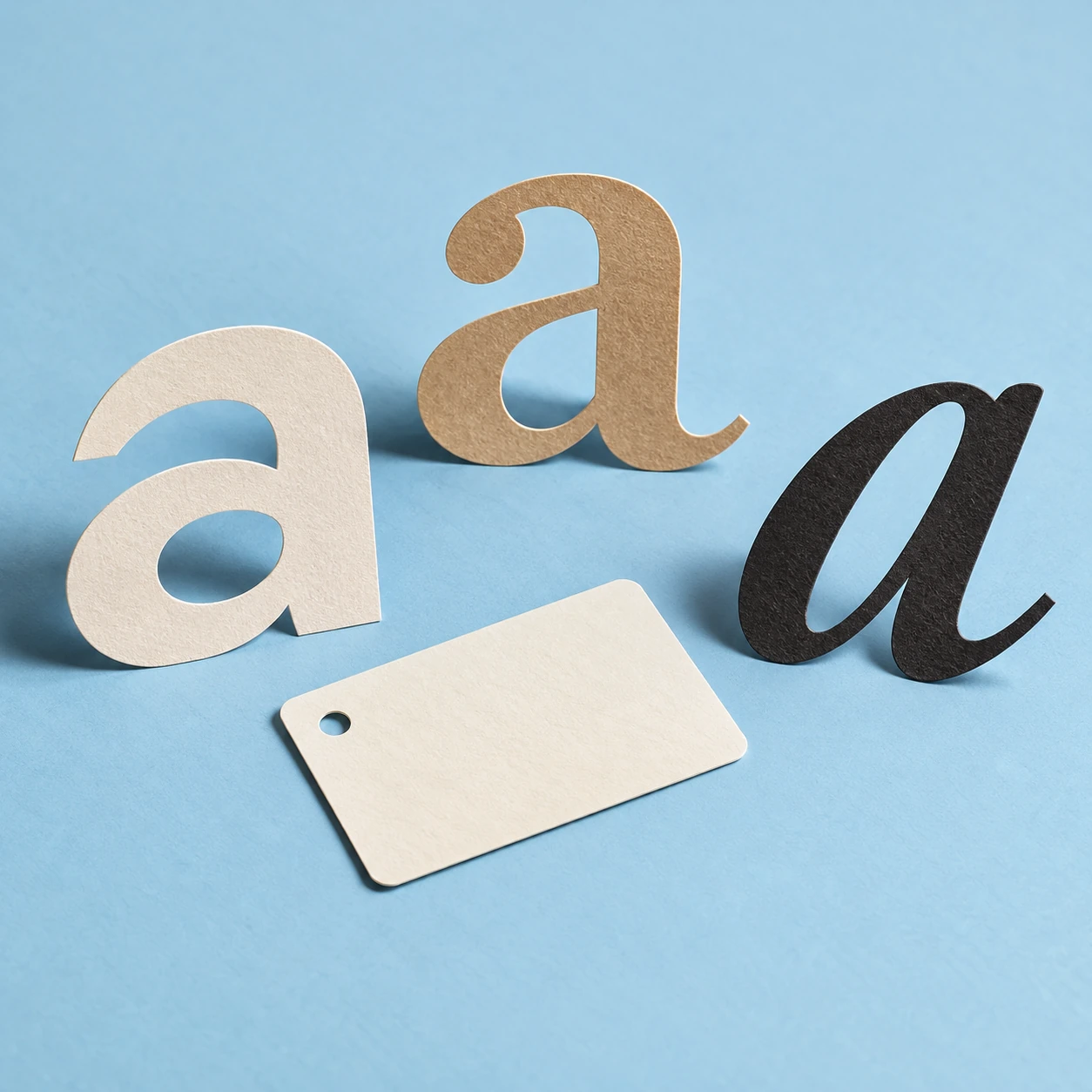
Type a lowercase a. Now change the font. The letter may grow a second storey, lose it again or lean into an unfamiliar curve. You still recognize the letter. A computer also needs a way to preserve that identity while letting the visible shape change.

Three sculptural lowercase a forms in different type designs stand on a pale blue table.
The drawn form changes while the letter remains recognizable. The explorer below separates visible design from encoded text.

This is the useful distinction between a character and a glyph. A character belongs to the encoded text. A glyph is a drawn form used when the text is displayed. They are closely related, but counting the shapes on a screen does not always tell you how the text is stored.

A font change that leaves the message intact

The Unicode Standard's discussion of characters and glyphs describes their relationship explicitly. A single character can have different drawn forms. Rendering also depends on context and typography, so the connection is not always one character to one visible shape.

Try the explorer below with the same short text in three font families. The actual system fonts available on your device determine what you see. That variation is part of the lesson: the stored text does not need to change when the display design changes.

Inspect characters beneath their glyphs

Compare local fonts, code points and canonical normalization without sending text anywhere.

Open inspect characters beneath their glyphs in its own window.

The tool also shows the Unicode code points in your entry. These are identifiers for encoded units, not measurements of ink. They should not be confused with a count of perceived letters, keyboard presses or bytes in a file. Those counts answer different questions.

Two pieces can behave like one familiar letter

Consider an accented e. It can be represented by a precomposed character or by an e followed by a combining acute accent. A suitable rendering system can make those sequences look the same. In the explorer, choose the comparison example and inspect the code points before changing anything.

The Unicode normalization specification defines processes for bringing equivalent representations into particular standardized forms. The explorer's NFC button uses the browser's built-in normalization. For the supplied e-acute example, you can watch two code points become one without asking the visible letter to become a different letter.

That result does not justify removing every accent or replacing unfamiliar characters with familiar ones. Normalization is a defined transformation with specific rules. A spelling choice, a language distinction and a font preference are not all the same kind of difference.

One shape can also serve several characters

The Unicode character-encoding model uses the example of an f followed by an i displayed as a ligature. A font can join their drawn forms. Whether your current font does so depends on the font and the rendering settings, so do not treat a missing ligature as a broken standard.

Think of a handwritten word in which two pen strokes join. The connection on paper does not necessarily turn two letters into a new spelling unit. Typography offers more systematic versions of that flexibility. The reader sees an intentional form, while the encoded text can preserve the underlying sequence.

This matters when searching a document or copying a quotation. A visually convincing screenshot can conceal differences in the stored text. Conversely, two strings with different internal representations may be equivalent under a defined normalization process. Appearance is evidence, but it is not the entire text.

A careful test for a missing square

If an unfamiliar character appears as an empty box, several explanations are possible. The chosen font may lack a glyph. A fallback font may not be available. An application may have mishandled the encoding. The box alone does not prove that the character does not exist.

Use a small diagnostic sequence: preserve the original text, inspect its code points, try another font and compare it with a trusted source. Avoid “repairing” a person's name by replacing a letter with a lookalike before you understand the problem. The replacement may make the screen prettier while changing the name.

What the explorer deliberately does not decide

It does not identify a language, verify spelling, judge whether a name is correct or count every user-perceived character. It exposes code points and a chosen normalization step. Complex writing systems need richer analysis than a row of identifiers.

The pleasure of the character–glyph distinction is that it makes everyday text stranger and clearer at the same time. A letter can survive a new costume. Several encoded pieces can share a visible form. What looks like one tiny mark can be the result of a careful agreement among text, font and software.

Sources and further exploration: Unicode Standard: characters and glyphs; Unicode Standard Annex15: normalization forms; Unicode Technical Report17: encoding model.

Explore all 50 new articles · Browse the complete illustrated collection

Explore more art, ideas, and independent projects at Incoprea.
Nüshu: The Writing That Travelled on Fans and Wedding Books

A narrow, threadlike script on a fan can stop a visitor in front of a museum case. The temptation is to ask for an alphabet chart immediately. What does this mark mean? How can I copy it? With Nüshu, a more rewarding beginning is to ask who made the object, who received it and what happened when its words were read or sung.

A cloth-bound book, folded fan and stitched cloth rest on a study table.
A contextual still life brings book, fan and textile together. It does not reproduce a Nüshu inscription or a named historical object.

Nüshu is associated with women in Jiangyong county and neighboring areas of Hunan, China. The UNESCO account describes correspondence, songs and gifts connected to women's relationships. A script is involved, but an account limited to letter shapes would miss much of the practice.

Script, language and occasion

A script is a system for representing language in visible marks. It is not automatically a separate spoken language. The Unicode Standard's Nüshu section connects the script to the local speech of Jiangyong. Calling it a mysterious language can blur the difference between a way of writing and the speech being represented.

That distinction gives us better questions. Was a particular text composed for a friend? Was it copied, embroidered, exchanged or performed? Does the catalogue identify the maker and reader, or only the location in which the object was collected? Each answer changes what we can responsibly say about the item.

UNESCO illustrates a sanzhaoshu, a book associated with a bride and the days after a wedding. The important detail is the social occasion. A book can hold words while also carrying an act of friendship, separation or encouragement. Translation of the words is essential, but it is not the whole object biography.

Fine lines, folded surfaces and a voice

UNESCO describes elongated characters built from dots and several kinds of fine strokes. Writing could appear on fans and paper, or be embroidered on handkerchiefs, belts and clothing. Mothers taught daughters; friends gathered to sew and sing. Many recorded works used seven-character poetic lines. The script belonged to acts of making and performing as well as to reading.

Pause at the fan. Its surface opens and closes, its ribs divide the field, and the person holding it can choose how much to reveal at once. A written fan is therefore a different reading object from a flat modern page. The words occupy something that moves in a hand.

Now imagine a small wedding book passing from friends to a bride. Its significance includes the occasion of giving and the relationship between people who may be separated afterward. You do not need to romanticize every message to recognize the practical value of a portable object that can be kept and revisited.

Compare the photograph on the UNESCO page with the Online Nushu Dictionary, whose resources identify the reference works behind its character mappings. Find one visible difference between a photographed handwritten form and a standardized digital presentation. Do not guess a translation. Notice how stroke thickness, spacing and the support's shape contribute to the experience of reading.

The danger of a perfect origin story

Stories about writing traditions often acquire a single inventor, a precise birthday or a dramatic claim that nobody outside the group could ever understand them. Such stories are memorable because they are tidy. The surviving evidence is often less tidy: dated objects, memories, collected texts and later descriptions do not all answer the same historical question.

This article does not assign Nüshu an exact invention date or claim that every user had the same experience. Even the phrase “women's writing” should lead us toward particular women and documented practices, rather than an imaginary uniform community stretching unchanged across centuries.

A five-minute reading exercise

Choose one factual sentence about Nüshu from a museum or institutional page. Underline its subject: an object, a named practitioner, a particular place, or the whole tradition. Then check whether your own retelling quietly widens the subject. “This book was a wedding gift” does not automatically become “every Nüshu book was a wedding gift.”

Preservation is more than keeping the shapes

Digital encoding helps people store and exchange text. Collections help preserve fragile objects. Teaching and performance can sustain forms of knowledge that a photograph cannot hold. These activities complement one another, but none is a complete substitute for the others.

Think about a handwritten note from someone you know. A typed transcription preserves its words. A scan preserves visible corrections and spacing. A recording might preserve the writer's voice. A story about when it was given preserves another kind of meaning. That familiar comparison is not an equivalence between cultures. It is a way to notice how many forms of evidence any meaningful message can carry.

The most engaging encounter with Nüshu need not end with a copied symbol. It can end with a better question about an actual book, an identified practitioner or a living teaching project. Paying attention to those relationships makes the writing less like an isolated curiosity and more like the human achievement it is.

Sources and further exploration: UNESCO: Nüshu, from tears to sunshine; Unicode Standard: Nüshu; Online Nushu Dictionary: resources and references.

Explore all 50 new articles · Browse the complete illustrated collection

Explore more art, ideas, and independent projects at Incoprea.

Wednesday, October 14, 2026

Linear B: The Administrative Notes That Reopened Bronze Age Greek

A list of sheep can change the history of a language. So can a record of oil, a worker's name or a notation about a vessel. Linear B mattered because these modest documents revealed that Greek was being written in the Bronze Age, centuries before the alphabet familiar from later Greek inscriptions.

The achievement is easy to turn into a detective story with one triumphant moment. The more interesting version includes patient sign lists, grammatical patterns, disagreements and tests against documents that a proposed reading had not been designed to explain. It also asks what we hear when an archive opens—and whose voices remain outside it.

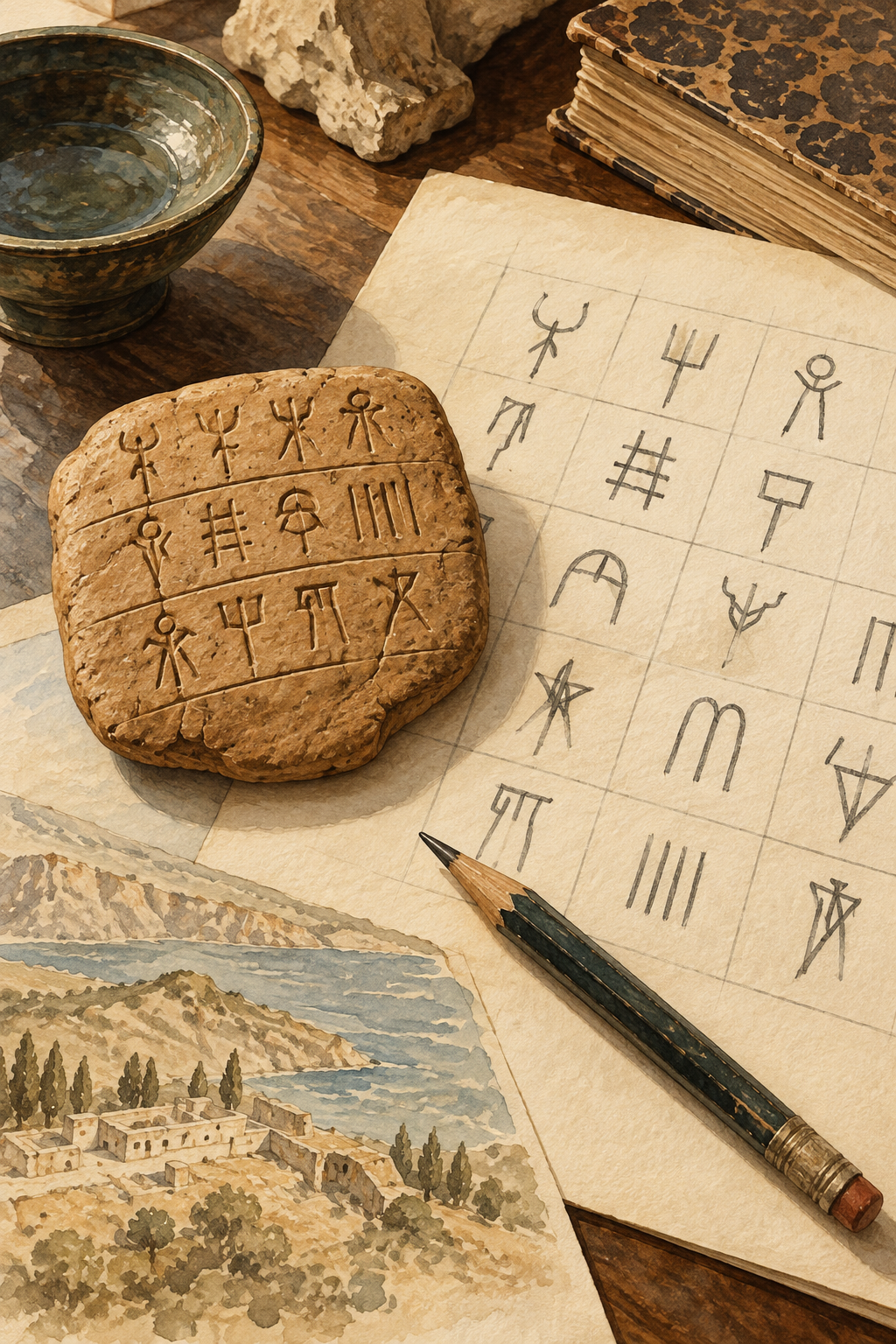
An interpretive clay tablet appears beside a paper grid of abstract signs and a pencil.
Illustration of decipherment study. The tablet and sign grid are invented visual examples, not authentic Linear B records or a valid translation key.

First recognise the kind of page

Linear B occurs on clay tablets and other administrative objects from palatial settings on Crete and the Greek mainland. The script combines signs used for syllables with signs for commodities, quantities and measures. A record can therefore present several kinds of information together, much as a modern stock sheet combines names, product symbols and numbers.

Scuola Normale Superiore's Mnamon guide describes page-shaped tablets as final registrations and narrower leaf-shaped tablets as preliminary ones. Labels and sealings belong to the same administrative world. The object is part of a filing system, not simply a mysterious sentence detached from its setting.

This matters before decipherment even begins. Repeated signs beside quantities can suggest a list. A recognisable animal sign can narrow the subject. Neither observation supplies all the spoken words, but both constrain what a successful reading must explain. The documents were already communicating some of their organisation before scholars could read their language.

Patterns before a preferred answer

Alice Kober examined recurring groups and changes at the ends of words. Those relationships suggested a language with grammatical inflection. Her work helped establish a framework in which signs could be related without immediately deciding what every sign sounded like. Emmett L. Bennett Jr.'s systematic classification helped provide a dependable sign inventory.

These are different jobs. One asks which marks count as the same sign. Another asks how signs behave in words. A third assigns sound values and tests a language. Confusing them makes decipherment look like inspired guessing, when much of its force comes from keeping the questions separate.

Michael Ventris reached the decisive Greek reading in 1952. Cambridge's account records that John Chadwick joined the work within weeks, bringing expertise in the history of Greek. Their first scholarly publication appeared in 1953, followed by further collaboration. The date of a breakthrough is useful; the network of work behind it explains why the breakthrough could hold.

A proposed reading had to produce more than a few attractive names. The same sign values needed to make sense across many groups and records. A theory that requires a new exception whenever it meets an inconvenient tablet has not earned the same confidence as one that keeps generating coherent results.

Why syllables make a difference

A syllabary does not work like the English alphabet. In Linear B, many phonetic signs represent a vowel or a consonant-plus-vowel combination. Writing Greek with that toolkit involves spelling conventions; the written form is not a complete sound recording. A transliteration can therefore look unexpectedly different from a familiar later Greek word.

When you encounter a scholarly transliteration, hyphens commonly separate the signs' syllabic values. They do not mean that the ancient speaker paused between each printed segment. Numbers and commodity signs may be represented separately. The modern presentation is an analytical aid layered over the clay surface.

This distinction is useful beyond Linear B. A photograph shows marks. A transliteration identifies and renders them according to conventions. A translation proposes their meaning in another language. Move among those layers deliberately and it becomes easier to see where damage, uncertainty or interpretation enters a reading.

Try reading the document before reading the language

Cambridge's CaLiBRA photographic archive provides a direct encounter with Linear B tablets from Pylos. Its search accepts identifiers with site or series prefixes. Choose a tablet image rather than a decorative rendering, enlarge it, and begin with its layout.

  1. Count visible lines and note where a line is interrupted by damage.
  2. Look for groups that seem to recur. Mark your observation in words rather than assigning sounds.
  3. Separate what looks like a quantity from what looks like a longer sign group.
  4. Check the catalogue or an accompanying scholarly reading. Which of your visual distinctions survived the comparison?

You are not trying to repeat the decipherment in five minutes. The useful experience is discovering how much can be observed without translation, and how much remains inaccessible without trained comparison. An isolated resemblance is weak evidence. A repeated distribution across a corpus is a different kind of clue.

A question to take into the archive

Suppose a tablet lists a person beside a quantity. Does that mean the person owns the goods, receives them, owes them, supervises them, or is counted with them? Layout alone may not settle the relationship. The question explains why grammar, parallels and archaeological context must accompany a sign chart.

What the reopened archive lets us hear

The tablets illuminate administration: goods, personnel, allocations and the interests of institutions. They make the Bronze Age more specific, populated with recorded names and obligations rather than only palaces and impressive objects. Their ordinary subject matter is part of their historical power.

They also present an uneven view. An administrative record describes people in the categories the institution needed. It rarely gives the account those people might have chosen to tell about themselves. Treating every entry as a transparent portrait would make the palace's paperwork stand for the whole society.

Nor does the decipherment automatically solve Linear A. Related-looking scripts can serve different languages, and a sound value transferred from one system does not guarantee a meaningful reading in another. Linear B's success is most compelling when its limits remain visible: a substantial archive became readable through a method that could be checked, argued over and extended.

Sources and further reading

Explore more art, stories and discoveries at Incoprea.

Ugaritic: An Alphabet Written With Cuneiform Wedges

A tablet covered in wedges can make us expect a writing system with hundreds of signs. At Ugarit, some of those wedges do a different job. A compact set of signs records the local language alphabetically, while other scribes in the same city use the older, more elaborate traditions of Akkadian cuneiform.

The surprise is a useful one: a writing tool does not dictate a single way of representing speech. Pressing a stylus into clay can serve several languages and several systems. Once those distinctions are visible, an ancient tablet becomes more than an example of something called cuneiform.

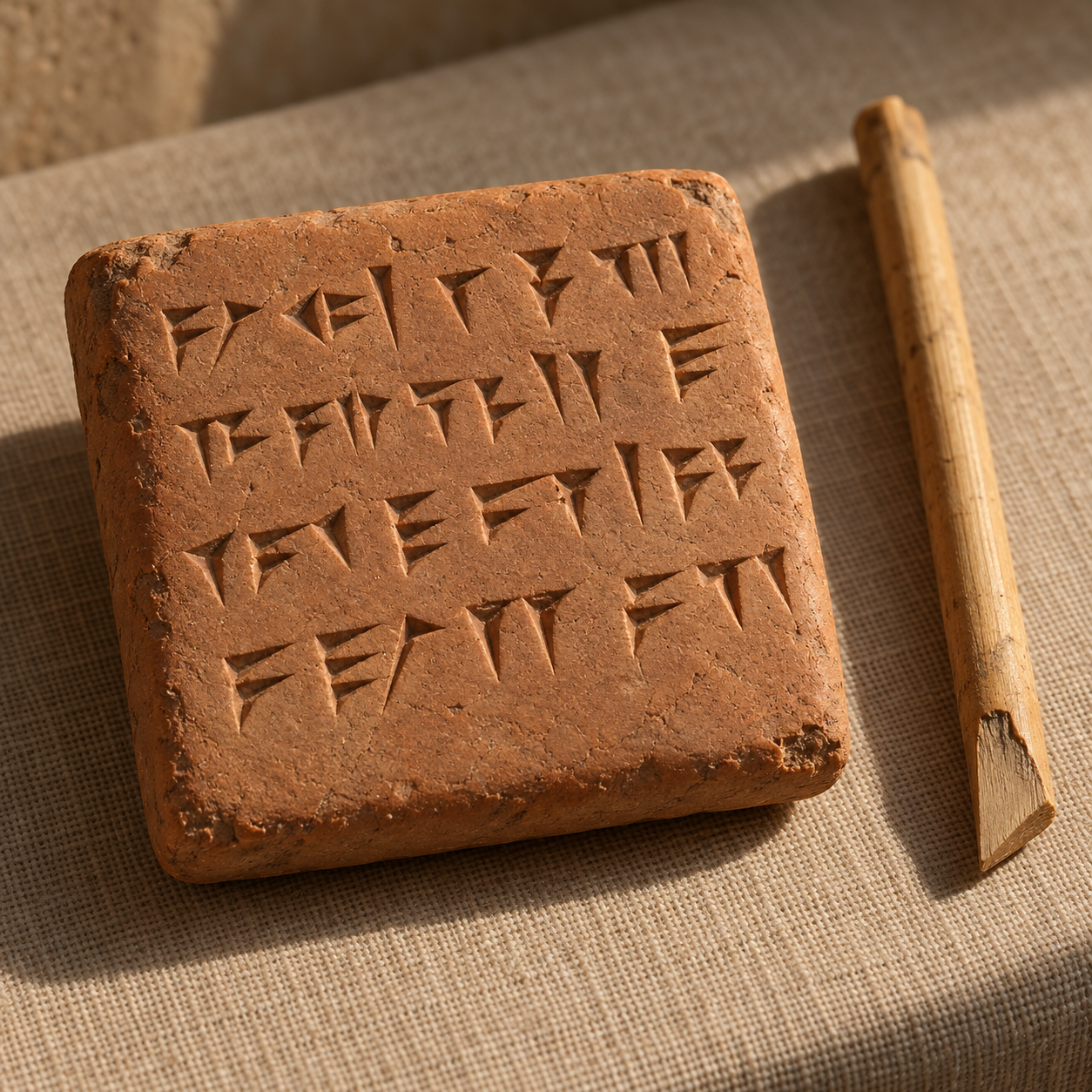
An interpretive clay tablet with wedge-shaped marks rests beside a stylus.
Illustration inspired by alphabetic cuneiform. The marks are illustrative, not a transcription, authentic inscription or readable Ugaritic message.

Three questions hidden in one label

Ask separately about the material, the script and the language. Clay is the writing surface. Cuneiform describes the wedge-shaped impressions. Ugaritic is both the name given to the local language and, in a related use, to its alphabetic writing. These labels answer different questions.

The distinction is familiar in modern life. English and Spanish can use the same letter shapes without becoming the same language. A language can also be written in different scripts. The Ugaritic case adds a further possibility: a similar-looking technique can support systems organised at different levels of sound.

Ugarit, at modern Ras Shamra on Syria's Mediterranean coast, belonged to a multilingual Late Bronze Age world. Its documents include administration, correspondence, legal material, literature and scribal exercises. The city is valuable for studying what writing did in practice: record, communicate, teach and preserve texts within a particular society.

What the thirty signs represent

The standard long Ugaritic alphabet has thirty signs. Specialists often call it an abjad, or a chiefly consonantal alphabet. This wording avoids suggesting that vowels are represented in the same regular way as in English. Three signs associated with the glottal stop introduce additional vowel-related distinctions, so the simple slogan “no vowels” also needs care.

By contrast, the Akkadian cuneiform tradition combines signs with syllabic and word-sign functions. The difference lies in what a sign represents, not in whether its wedges look horizontal or vertical. Similar materials and tools can conceal very different relationships between mark and speech.

Mnamon, the scholarly guide maintained by Scuola Normale Superiore, also describes rarer alphabetic forms at Ugarit: a shorter set and an alphabet with another ordering tradition. The thirty-sign system is the central reference point, but it should not erase all variation. Even a letter list has a history.

A school exercise that became evidence

An abecedary is a sequence of letters in order. The French Ministry of Culture's account identifies tablet RS 12.033 as the first complete Ugaritic abecedary discovered, found during Royal Palace excavations in 1948. Other examples have supplied comparisons. Their repeated sequences helped confirm which marks belonged to the alphabet and how they were ordered.

The small educational object thus works at two scales. For an ancient learner, an ordered sequence could support practice and recall. For modern researchers, comparison across sequences can help distinguish a letter from a damaged shape or a variant. Repetition makes the tablet informative without turning it into a bilingual dictionary.

The ministry's discussion places such exercises within scribal learning and notes examples from palace and private archives. An alphabet was teachable, but a short inventory by itself does not establish how many people could read. Access to teaching, the uses of texts and the organisation of a community matter too.

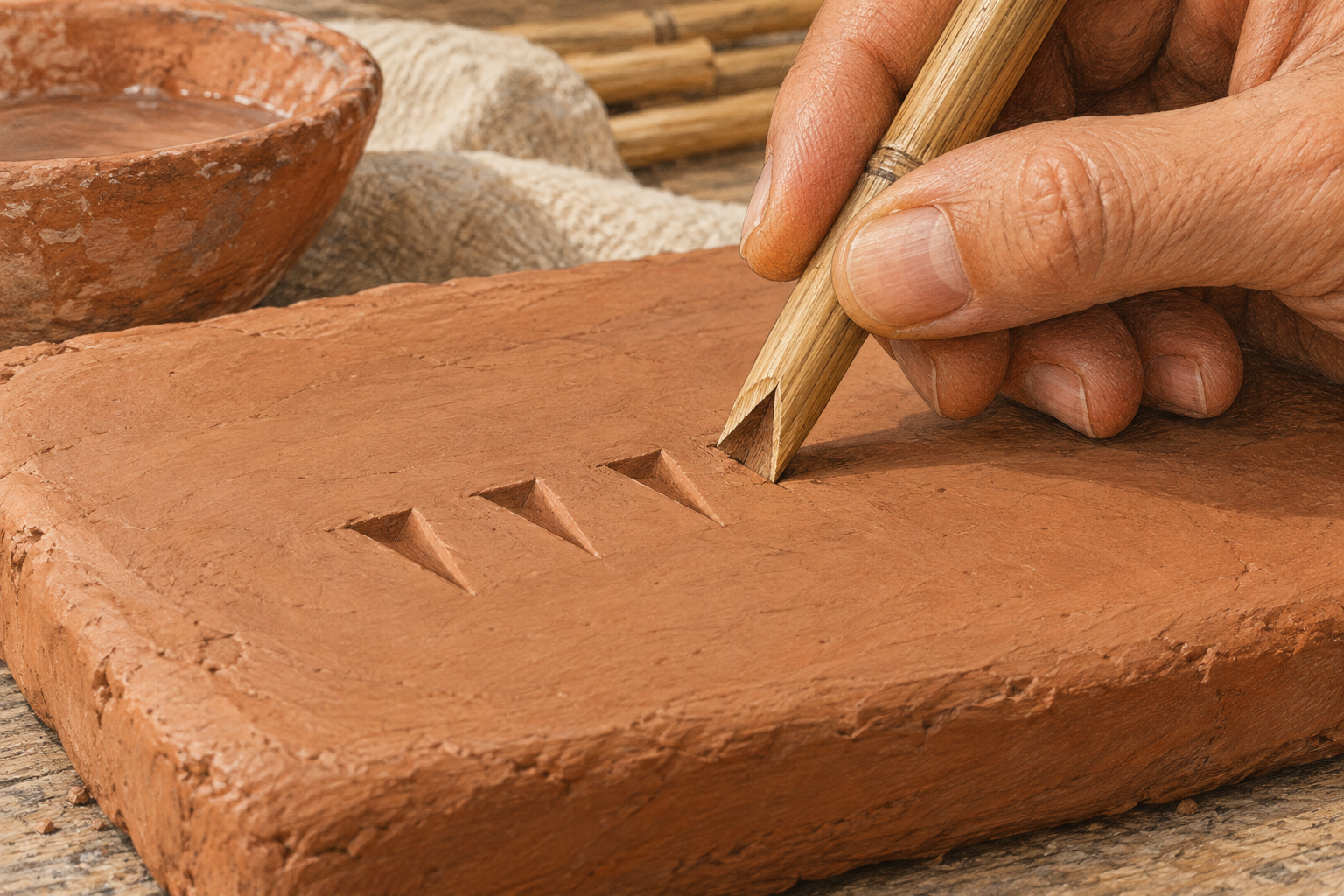
A hand presses a shaped stylus into clay beside a few wedge impressions.
Explanatory illustration of making wedge impressions in clay. The marks do not form an authentic inscription, and the hand and tool are interpretive.

A wedge is made by an action. Angle, pressure and spacing turn a tool into an impression. In an authentic tablet, those features may help a specialist recognise a sign or a hand. The explanatory image above isolates that physical process; its marks are not a passage to translate.

Look at an alphabet without pretending to read it

Open the Ministry of Culture's RS 12.033 feature. The page is in French, but the named tablet and discussion provide a precise starting point. Use the catalogue identifier when following links: an incomplete abecedary is not interchangeable with this complete example.

Begin with three observations. Notice the division into lines. Choose one cluster and count the impressions you can actually distinguish. Then look for a cluster elsewhere whose arrangement differs. Do this before consulting a sign chart, so that a modern label does not decide in advance what you think you see.

Keep the evidence layers separate
LayerWhat it can establish
PhotographVisible impressions, damage, spacing and layout.
Sign identificationWhich impressions form a letter and which variants count together.
Ordered comparisonWhere a letter belongs in an attested sequence.
Language analysisSound values, grammatical relationships and meanings in texts.

The steps build on one another. A photograph does not supply pronunciation by itself. Equally, the inability to pronounce a sign does not prevent a careful observation about its position. That is a useful antidote to the idea that an unread ancient object offers only mystery.

An important alphabet without a race for first place

The alphabet has a complicated early history. Penn Museum's discussion of that history emphasises scattered evidence, changing interpretations and the difficulty of tracing continuity. Giving Ugarit the title “the first alphabet” would flatten that wider story and obscure what makes its evidence distinctive.

Its achievement is interesting on its own terms. Alphabetic writing was adapted to a clay-and-stylus environment and used alongside other established systems. An abecedary lets us see the organisation being taught, while other documents show writing doing work beyond the classroom.

Return to the opening tablet and the wedges look different. Their shape no longer tells you the entire story. The better questions are what the signs encode, which language a writer chose, who learned to make them, and what the finished object was expected to accomplish.

Sources and further reading

Explore more art, stories and discoveries at Incoprea.

Famous Last Meals is now in paperback — stories, history and 25 recipes

Famous Last Meals: Stories, History, and Recipes is now available in paperback on Amazon. The illustrated collection brings together 23 his...