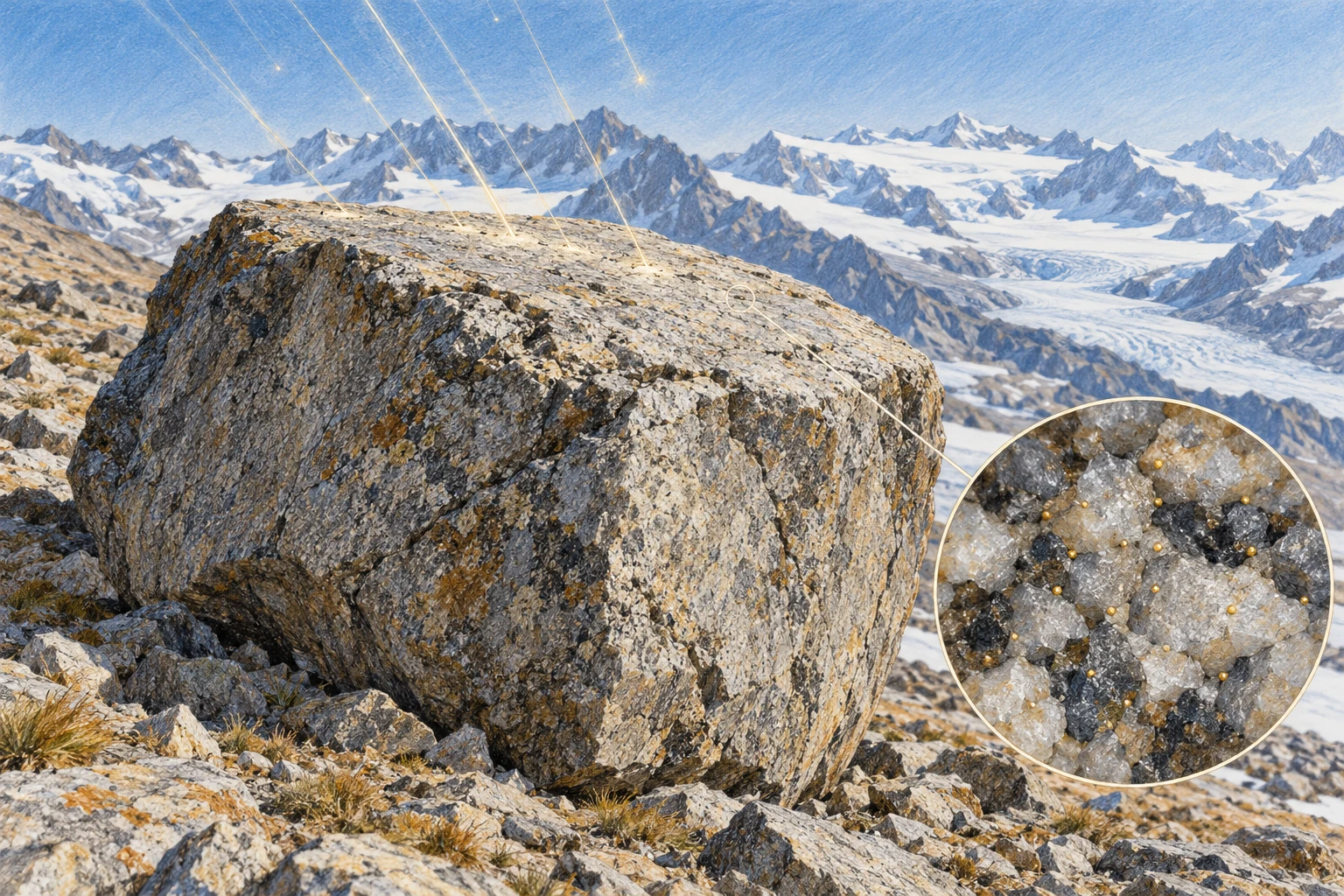
A glacier leaves a boulder on a ridge and retreats. The boulder’s exposed surface begins accumulating rare isotopes made by cosmic-ray interactions. Much later, a small rock sample can help estimate how long that surface has faced the sky.
Cosmogenic exposure dating is not the age of the boulder’s original rock. It is an interpretation of its near-surface history. A granite block can be hundreds of millions of years old while its present exposed face records only the most recent part of that story.
Space makes a small inventory in stone
High-energy cosmic particles generate secondary particles in the atmosphere and near-surface material. Nuclear interactions produce rare nuclides in minerals. Commonly used examples include beryllium-10 and aluminum-26 in quartz, though several other systems are available.
A USGS review of cosmogenic dating explains how measured concentrations, production rates, and decay behavior become tools for dating landforms and estimating erosion. The production is small, requiring sensitive chemical preparation and measurement.
The signal is strongest near the surface and changes with depth. It also depends on altitude, geomagnetic conditions, shielding, and the target mineral. A universal “atoms per year” value cannot be pasted onto every rock on Earth.
The simplest clock is a useful first model
If a stable nuclide accumulates at a constant rate P, begins with no inherited inventory, and is neither eroded nor shielded, its concentration N grows asP multiplied by time. Dividing N by P gives the exposure duration in that deliberately simple model.
For a radioactive nuclide, decay must also be included, and production and erosion can change. The point of the simple model is to expose the assumptions. Each term omitted from it becomes a possible reason the apparent exposure age differs from the landform event.
National Park Service research in the western Alaska Range connects the method with glacial deposits. A moraine’s chronology depends on selecting surfaces whose exposure is plausibly tied to the glacier’s retreat or the deposit’s stabilization.
Three ways the surface history can mislead
Inheritance: a rock already exposed before deposition can carry nuclides into its new setting. Interpreting the full inventory as newly accumulated can produce an apparent age older than the intended event.
Shielding: snow, sediment, water, surrounding topography, or temporary burial can reduce production. Treating an intermittently covered surface as continuously open can make the inferred duration too short.
Erosion or rotation: removing the nuclide-rich outer layer or turning a different face upward can reset part of the observable history. The rock is not a sealed counter that always keeps every event.
USGS work on Yosemite rock-fall deposits explicitly discusses inheritance, erosion, boulder rotation, fire-related spalling, and shielding. The complications are not objections discovered after the method was invented; they are central parts of sampling and interpretation.
A numerical thought experiment
Imagine a hypothetical nuclide produced at 10 atoms per gram per year under fixed conditions, with decay ignored over the example’s timescale. A concentration of 100,000 atoms per gram would imply 10,000 years in the simplest model.
If 20,000 atoms per gram were inherited before the target event, only 80,000 belong to the new exposure, implying 8,000 years under the same assumptions. If shielding reduced production during part of the history, a different correction would be needed. The same measured number can support different durations when the history changes.
These invented values illustrate the accounting, not the actual production rate for a specified mineral, latitude, or altitude. A real calculation uses calibrated scaling and propagates uncertainty rather than choosing round numbers.
Why field photographs matter to a laboratory date
Researchers record the boulder’s setting, stability, surface shape, sample thickness, surrounding horizon, and evidence for erosion or burial. A large stable top surface may be preferable to a loose edge that could have rotated recently.
A Yosemite account of investigating the El Capitan rock avalanche shows how carefully chosen boulders link a landscape question with laboratory analysis. The field interpretation determines what event the measurement can plausibly date.
An accelerator mass spectrometer can count a rare isotope with remarkable sensitivity. It cannot reconstruct an unrecorded snowbank or a boulder’s unnoticed overturning by itself. Better instruments do not make geological context optional.
Consider two neighbors on the same ridge: a stable boulder and one that overturned recently. Their underlying rock can have the same formation age, while their upward-facing surfaces carry very different recent exposure histories. Photographing only their present positions does not reveal the overturning date. Look instead for physical evidence of stability, weathering contrasts, and the relationship with surrounding sediment. This thought experiment shows why several samples from a landform are valuable without assuming that their mean must be the correct answer. Replication helps test a geological story; it does not remove the need to choose that story carefully.
More than one nuclide can reveal burial
Different nuclides have different production relationships and decay behavior. Measuring more than one can constrain exposure and burial histories that a single concentration leaves ambiguous. This is especially valuable when material has alternated between surface and shielded conditions.
Lamont-Doherty’s cosmogenic laboratory guide outlines several systems and applications. Its broader program shows that the same physical process can address glacier history, landscape erosion, and sediment transport, provided the model matches the question.
Read the age population before the headline
If several boulders on one moraine yield different apparent ages, do not immediately average them into one confident date. Ask whether the scatter reflects measurement uncertainty, inherited exposure, delayed stabilization, erosion, or more than one landform episode.
A useful paper exercise is to draw five boulders and assign each a different complication. Decide what extra field evidence would help distinguish it. The goal is not to reject inconvenient data, but to make the geological explanation testable.
The exposure clock is remarkable because it reads a surface’s relationship with the sky. Its strongest results come from combining an extremely small isotope inventory with an unusually careful history of an ordinary-looking rock.
Sources and a next step
- USGS: dating by cosmogenic nuclides
- NPS: glacial deposits in the western Alaska Range
- USGS: Yosemite rock-fall exposure dating and complications
- NPS: investigating the El Capitan rock avalanche
- Lamont-Doherty: cosmogenic nuclide techniques
Continue exploring art, ideas, and unexpected connections at Incoprea.