Showing posts with label Rainforests. Show all posts

Wednesday, October 14, 2026

Strangler Figs: A Tree That Can Begin Above the Ground

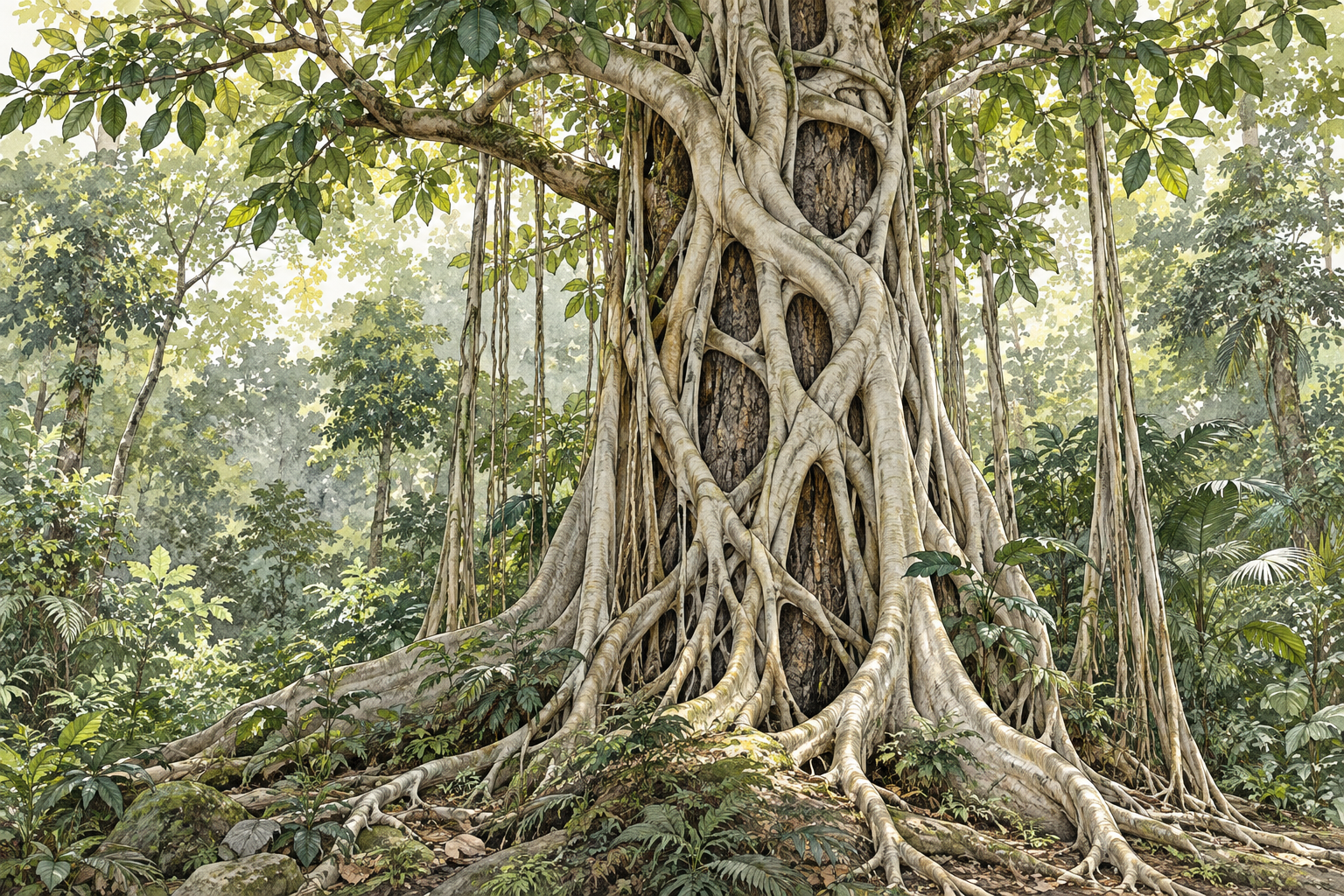
Illustration of a fig's pale interlacing roots around a darker host-tree trunk.
The contrasting structures help show how a fig can surround its support tree. This is an interpretive scene, not a documented specimen.

Look at the trunk in the illustration and try to decide where one tree ends and the other begins. The lighter framework appears to wrap around a darker central support. That puzzle is a useful entrance to the story of strangler figs: a tree can begin high in another tree, send roots downwards, and eventually become a substantial structure of its own.

“Strangler fig” describes a growth habit found in several fig species. It does not name a single species with one timetable and one inevitable outcome. Following the stages of a particular tree is more rewarding than treating every enclosing lattice as the same dramatic event.

A seed begins with an unusual address

Many seeds arrive in places where they will never establish. A fig seed deposited by an animal in a suitable fork or crevice may instead find an elevated foothold. The young plant can begin as an epiphyte, growing on another plant rather than germinating directly in the ground below it.

The Florida Museum describes this canopy-starting route for Ficus aurea. It also notes that the species can grow from buried seeds. A characteristic life history is not an exclusive rule. Even a well-known strangler can have more than one starting point.

An elevated position changes access to light, but it does not remove the need for water and nutrients. The seedling must establish and maintain itself at the place where the seed landed. It has gained a location, not a guarantee of success.

This is also why the word “parasite” should be used carefully. A plant growing on another plant is not necessarily extracting food directly from the host’s tissues. An epiphyte can use physical support while making its own organic food through photosynthesis. Harm can develop later through competition and surrounding growth without that being the original feeding relationship.
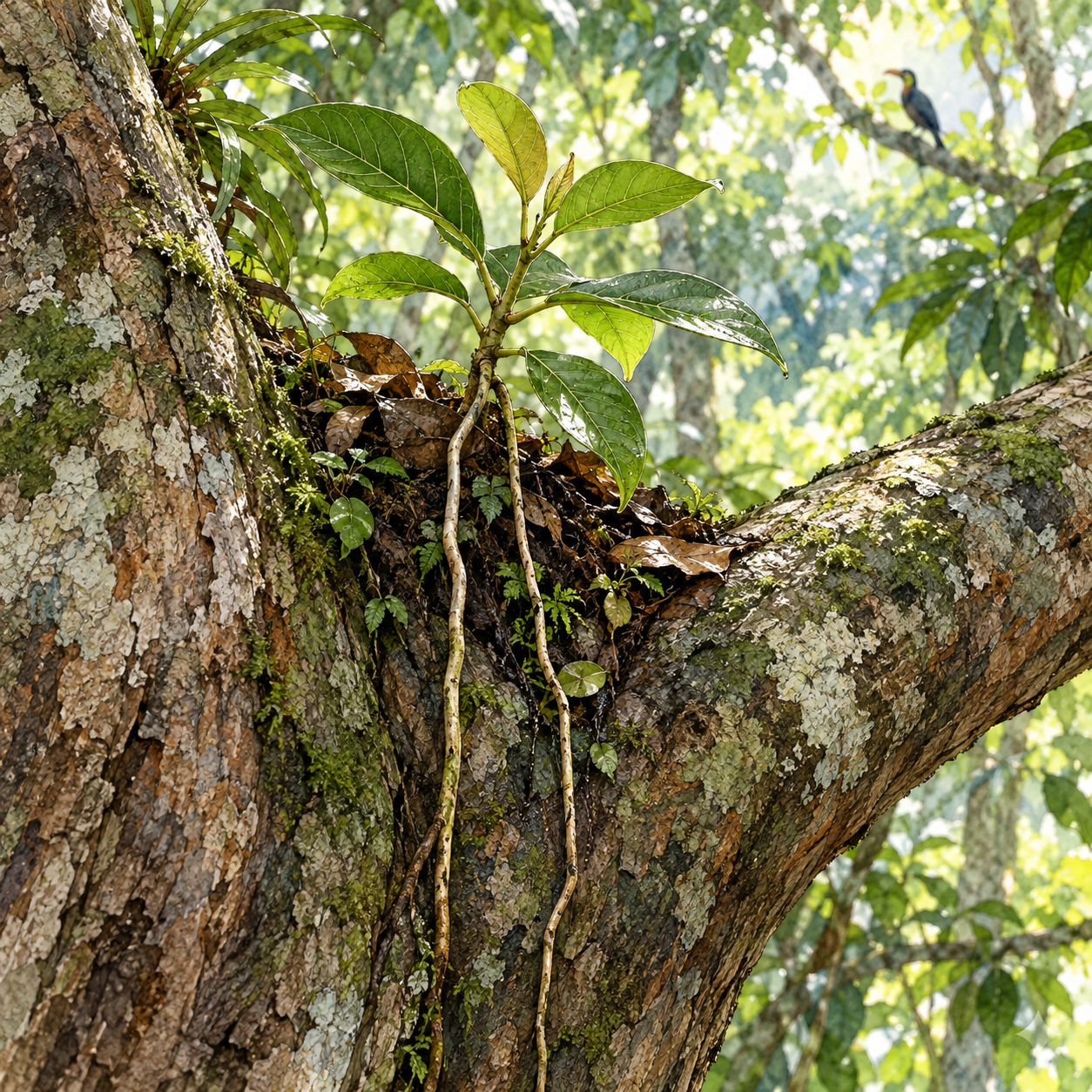
Illustration of a young fig established in a tree fork with slender descending aerial roots.
An early canopy foothold looks very different from a mature enclosing lattice. The scene is an imagined example.

The first long journey is a root’s journey

Descending aerial roots connect the elevated plant with the soil. As they reach the ground and thicken, the balance changes: the fig develops a more extensive resource supply and a supporting framework. University of Florida’s account of F. aurea describes this transition from a vine-like early form to a self-supporting tree.

What looks like a single mature trunk can therefore record a history of many roots. Some remain narrow and hanging; others have reached soil and become substantial supports. A lattice makes that history visible in a way an ordinary smooth trunk rarely does.

The original host may eventually die while the fig remains. But a hollow central space in a mature framework is not enough to reconstruct every detail of the host’s death. Competition for resources, shading, structural enclosure, and other events can matter. A vivid name should not stand in for observations of the particular relationship.

Read the roots in three directions

Use the photographs on the University of Florida page, or an accessible labelled specimen in a botanical collection. Begin at a visible hanging root and follow it downward. Can you see whether it reaches soil? If the lower end disappears behind vegetation or outside the picture, record that part as unknown.

Next follow a thick support upwards. Does it connect to a spreading fig branch or remain obscured? Finally, inspect the central trunk or opening. Distinguish the original support where it is clearly visible from the enclosing framework. Bark colour may help in a particular image, but colour alone does not identify every piece of a living structure.

Compare the young-seedling illustration with the mature view. The thin descending roots and thick framework are stages of a process, not different inventions. A photograph freezes one stage. Observing another stage helps explain how the first one could change without pretending that you watched decades pass.

A fig is also a meeting place for animals

The roots draw attention, but the fruits connect the tree with a much wider community. Smithsonian Gardens emphasizes the importance of figs as food for tropical animals. A tree competing strongly with one host can simultaneously provide resources for many fruit-eaters. Ecology does not require each species to fit a single role as either helper or harm-doer.

Singapore’s NParks profile of Ficus drupacea gives a concrete example. It describes an aerial-rooted strangler whose fruits are eaten and dispersed by birds and small mammals. The same tree’s reproductive biology also involves fig wasps. Dispersal and pollination are two different animal relationships, with different participants and consequences.

That distinction closes the circle without making it too neat. A pollinator contributes to reproduction. A fruit-eater may move seeds. A suitable tree fork can provide the next starting place. Each link has conditions; eating a fruit does not guarantee that a seed reaches a successful canopy site.

The name covers a changing relationship

Consider how the roles alter through time. Early on, another tree supplies a place to establish. Later, the fig’s roots reach the ground and its branches spread. The two plants may then compete while remaining physically interwoven. Eventually, the fig may survive independently. A single word, “strangling,” compresses those different stages into one action.

The comparison with other plants helps make the story precise. A ghost pipe’s fungal dependence concerns nutrition. A strangler fig’s epiphytic beginning concerns location and support. A mangrove seedling’s early development concerns another set of establishment conditions. Unusual starting points do not imply identical biological strategies.

The most interesting view of a mature strangler fig is therefore both structural and historical. Its framework shows routes from canopy to soil, while its fruits connect it with animals moving through the landscape. Looking closely reveals more than one tree surrounding another. It reveals a life history built from changing relationships.

Explore more creative curiosity at Incoprea.

The Walking Palm: Remarkable Roots, With the Story Kept Straight

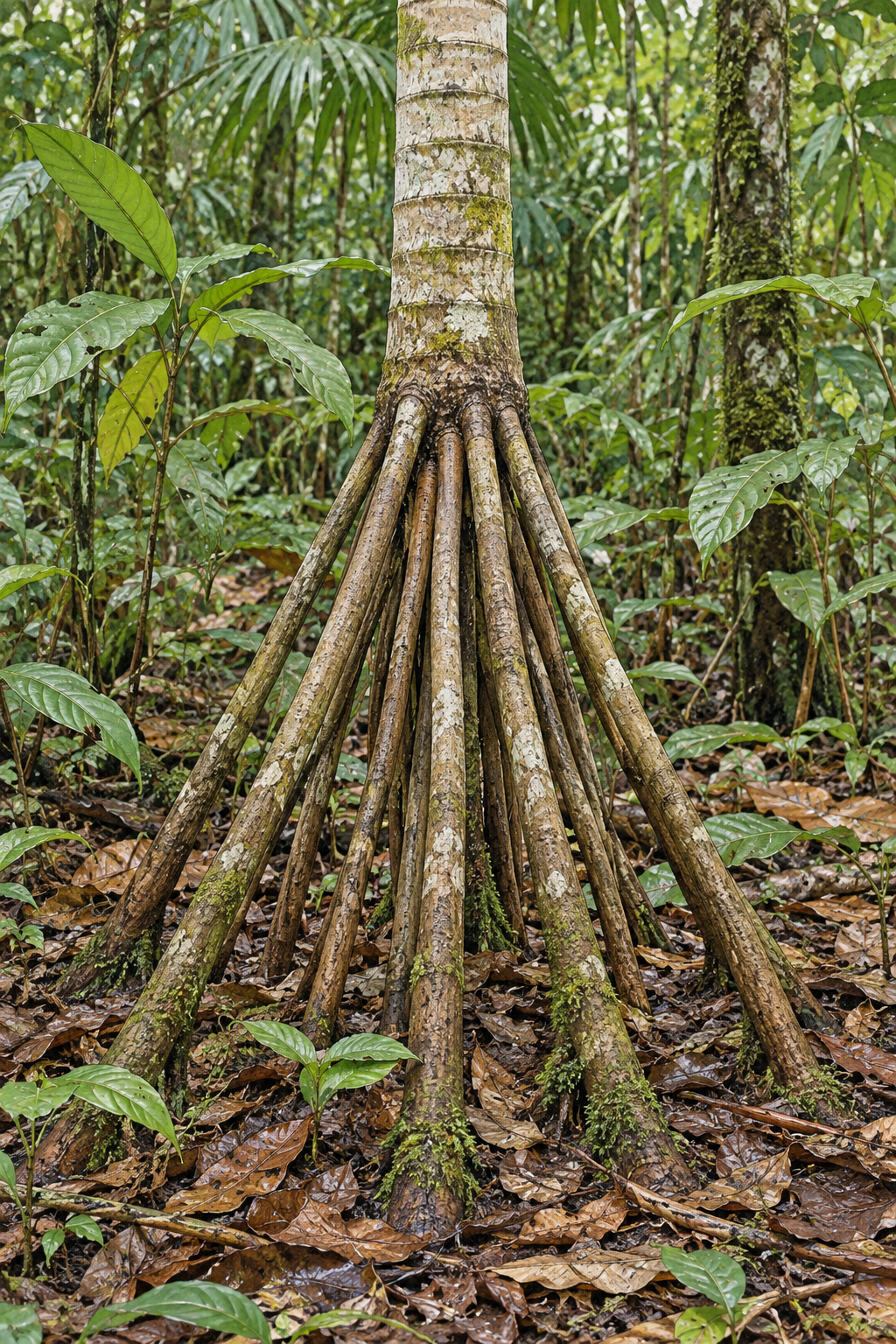
At the foot of a walking palm, the forest seems to have left a piece of scaffolding exposed. Slanting roots descend from the trunk into the ground, enclosing a space that looks surprisingly empty. Before asking whether the tree can walk, pause over a question you can actually see: how does a tall living column stand on this arrangement?

Illustration of an upright palm supported by rooted stilt roots in rainforest leaf litter.
The cone of stilt roots is striking on its own. All roots shown are anchored; the illustration depicts no walking motion.

Socratea exorrhiza is a tropical American palm with stilt roots. Its silhouette invites an explanation, and several have been proposed: support, rapid upward growth, recovery after damage, and advantages in difficult ground. Those possibilities concern different parts of a plant's life. Treating them as one spectacular trick makes the roots harder to understand.

Read the structure from the ground upward

Start with the places where roots enter the soil. Then follow them upward to their junctions with the stem. The visible structure has both height and spread. A wide footprint and a high attachment are different features, even when they appear together. Looking only at the most dramatic root can hide the geometry of the whole support system.

This is a useful way to look at unfamiliar organisms: separate a description from an explanation. “Several roots attach above ground” describes a structure. “They evolved to cope with steep slopes” proposes a function. The second statement needs comparisons that the first does not. A convincing photograph can establish the appearance without settling the proposed reason for it.

For a quiet observation exercise, use a documented photograph with a clear ground line. Identify the highest visible root attachment, the widest visible pair of ground contacts, and anything obscured by vegetation. Do not measure biological proportions from the illustration here. Its purpose is to make the form easier to notice; an actual specimen photograph supplies the observational evidence.

A slope is an appealing explanation. Does it fit?

In a 2005 study, Gerardo Avalos and colleagues measured 31 Iriartea palms and 36 Socratea palms at two Costa Rican sites. They compared root-cone dimensions with palm size and ground slope. Larger palms had larger, taller cones. In that sample, palm size explained the architecture better than slope did.

The comparison matters because a single palm on a hillside cannot tell us which feature explains its roots. A large tree might have a large cone because it is large, because the ground slopes, or because those circumstances coincide. Measuring many trees allows those explanations to be compared rather than selected by visual appeal.

Notice what this finding leaves open. Roots still provide support on sloping ground. The result challenges a simple prediction that slope alone should determine the cone's shape. A structure can function on a hillside without having an architecture chiefly determined by the hillside. That distinction turns an attractive just-so story into a question researchers can investigate.

Growing upward without making everything thicker

Gregory Goldsmith and Rakan Zahawi investigated 80 Socratea trees at two tropical sites. They likewise found no clear differences in several root-cone characteristics between their flat and sloping locations. They did find relationships between the architecture of the stilts and allocation to vertical growth.

Their interpretation was that stilt roots can help a palm gain height while maintaining stability, without simultaneously investing as much in a thicker stem and underground support. That is a growth strategy, rather than a claim that roots remove all mechanical constraints. In a forest, reaching light is useful, but the construction supporting that height has a cost.

Imagine two possible budgets for a growing plant. One spends heavily on broadening a column before extending it; another builds additional supports around a relatively slender column. Neither imaginary budget is a literal account of every palm. The comparison simply makes the research question tangible: how is material divided among height, leaves, stem and roots?

What the famous name compresses

The 2024 Smithsonian chapter by Cecilia Williamson and Helene Muller-Landau revisits the walking story. An often-cited 1980 account concerned seedlings and saplings that had fallen and then rerooted and resprouted. The replacement upright growth could stand away from the original rooting point. Recovery following a fall is a real and interesting change in position.

That account does not establish a mature upright palm deliberately advancing across the forest by growing roots on one side and abandoning the other. The Smithsonian authors describe claims of that mature walking as unsubstantiated. Keeping the life stage in the story preserves the observed biology instead of asking it to support a larger claim.

What would a convincing record look like?

Try designing an observation before choosing its outcome. You would need a fixed reference outside the palm, a consistently defined point on its trunk, dates, repeated measurements and photographs from reproducible positions. You would also record leaning, damage, soil movement and replacement growth. A changing shadow or a new root would not by itself establish displacement of the trunk.

This thought exercise requires no marking, digging or interference with a tree. It is about making the word “move” precise. Does it mean the stem leaned, a fallen juvenile produced a new upright shoot, or the same mature stem shifted horizontally? Each possibility asks for a different record and suggests a different biological process.

There are also questions beyond the nickname. The Smithsonian review reports a steep decline in this palm's abundance on Barro Colorado Island over recent decades and calls for further investigation. A palm can be visually familiar while its population changes remain poorly understood. Its exposed roots offer an entrance into a much larger story about growth, survival and the value of returning to the same forest over time.

Explore more creative curiosity at Incoprea.

Famous Last Meals is now in paperback — stories, history and 25 recipes

Famous Last Meals: Stories, History, and Recipes is now available in paperback on Amazon. The illustrated collection brings together 23 his...