Showing posts with label Research. Show all posts

Thursday, October 22, 2026

Glassfrogs Hide Their Blood While They Sleep

A sleeping glassfrog on a leaf is not simply painted to match the leaf. Part of the background can pass visually through it. Even more surprisingly, its transparency changes with its state: the quiet daytime animal can become harder to see than the active frog. To explain that change, researchers had to follow something normally expected to remain conspicuous—red blood cells.

Glassfrogs have translucent tissues, especially visible from below, but blood poses a problem for a transparent vertebrate. Red blood cells contain hemoglobin, which interacts strongly with light. A body full of circulating red cells is difficult to make optically unobtrusive merely by removing pigment from the skin. Transparency is therefore a whole-body problem, not just a skin color.
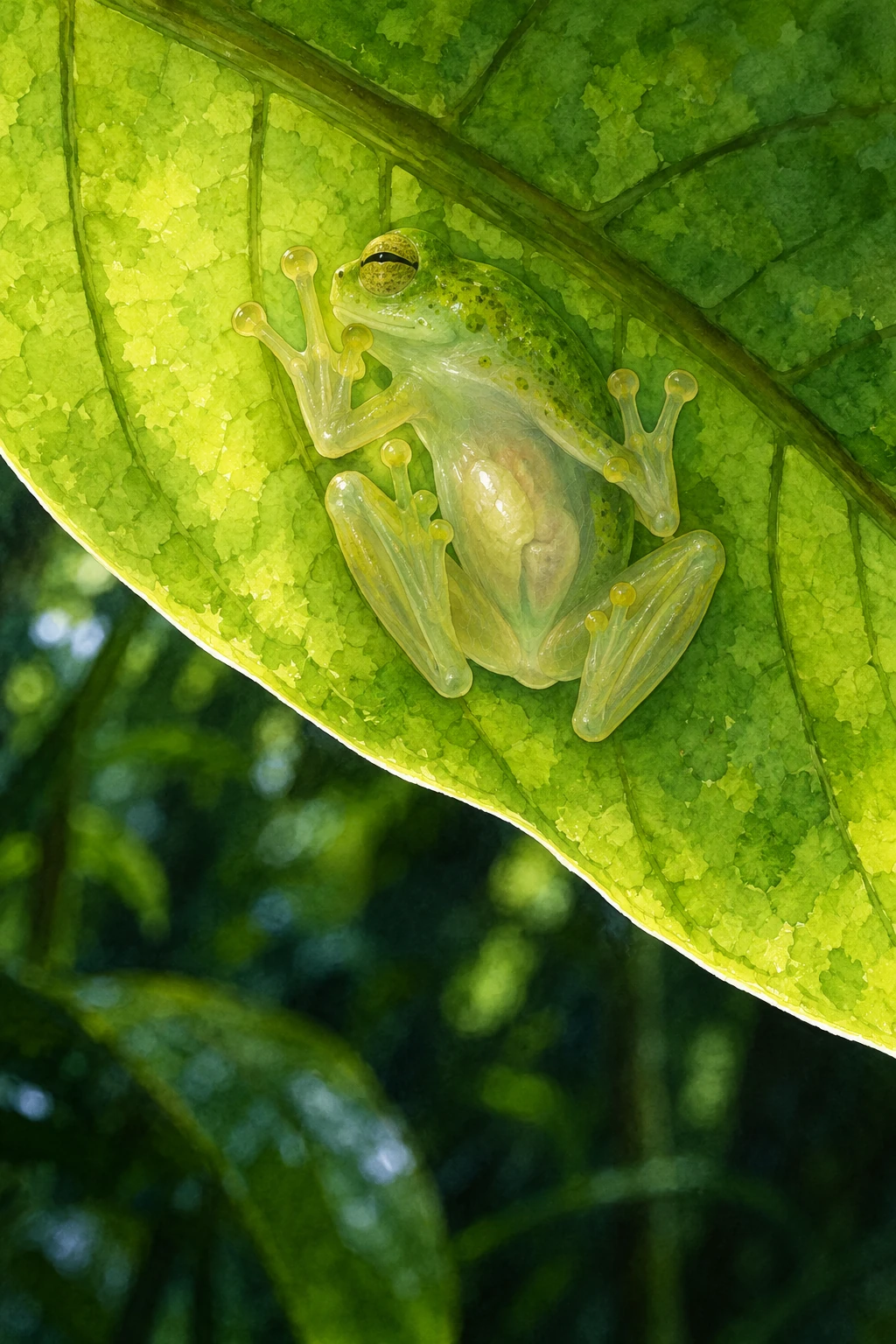
A small translucent green glassfrog rests on the underside of a broad green leaf.
Conceptual natural-history illustration; visible internal forms are artistic interpretation, not anatomical evidence.

The blood was hidden, not removed from existence

A 2022 study in Science investigated Fleischmann's glassfrog, Hyalinobatrachium fleischmanni. In the resting state, frogs sequestered a large fraction of their red blood cells in the liver. When active, more cells returned to circulation. This reversible redistribution helps explain how a frog can retain the blood cells needed for activity while reducing their optical effect during rest.

The American Museum of Natural History's account reports that resting frogs increased transparency roughly two- to threefold while removing nearly 90 percent of red cells from circulation. Those numbers belong to the studied animals and measurements; they are not a guarantee for every frog called a glassfrog, every tissue, or every lighting condition. The liver's reflective covering helps conceal the concentrated cells.

This is a rearrangement of visibility. Concentrating a strongly light-interacting material in a concealed compartment can reduce how widely it reveals the body. Think of the difference between spreading dark beads through a clear container and gathering them behind an opaque patch. The analogy explains the optical logic, although it does not explain how a living frog regulates circulation or maintains its tissues.

How do you find blood without making the frog stop being transparent?

An ordinary photograph records appearance, but it cannot directly establish where the blood went. Researchers used photoacoustic imaging among their methods. Absorbed light produces a small acoustic signal that can be detected and used to localize absorbers such as hemoglobin. The Duke research summary connects the imaging work with the biological discovery.

The measurement problem matters because the state being measured is fragile. Handling, anesthesia, or activity could change a physiological condition. If the interesting phenomenon belongs to a resting animal, an invasive measurement that changes rest could obscure it. A good technique must therefore do more than produce a sharp image; it must preserve enough of the relevant state for the image to answer the question.

The study also raises unresolved physiology. Packing so many blood cells together without the usual harmful consequences is remarkable. But observing the natural outcome does not by itself identify every mechanism that prevents problems, and it does not establish a treatment for human blood clotting. A useful research question can be motivated by the frog without assuming that its solution transfers directly to another animal.

Transparency is not the same as invisibility

An earlier 2020 study of glassfrog camouflage examined imperfect transparency and a proposed effect called edge diffusion. Translucent legs can take on the brightness of the background more readily than the body, reducing the abruptness of the animal's outline. That is different from the later discovery of changing red-cell distribution. One concerns how partial transparency can conceal shape; the other identifies a physiological way of changing transparency.

A transparent animal can still reflect light, cast a shadow, distort a background, or retain opaque organs. For a predator, the relevant question is not whether the frog has vanished from physics. It is whether the visual information is sufficient to detect and recognize prey under real viewing conditions.

The generated image here is similarly limited. It evokes a frog beneath a leaf and the delicacy of translucent limbs. Its internal hints are artistic interpretation. For the actual distribution of blood cells, follow the paper's measurements and figures rather than reading anatomy from generated artwork.

Once those distinctions are clear, the sleeping frog becomes more impressive. It is not a passive green ornament that happens to be see-through. Its apparent stillness includes a substantial reversible physiological change. Resting on the same kind of leaf, an animal can alter the way its interior contributes to the view from outside. The camouflage is partly a matter of where the body puts its blood.

Follow the evidence: Taboada and colleagues: blood concealment in glassfrogs; American Museum of Natural History: transparent camouflage; Duke: discovering the transparency mechanism; Barnett and colleagues: imperfect transparency and edge diffusion.

More curious connections, art and independent projects at Incoprea.

The Ice Plant’s Glittering Bladders Have a More Complicated Job

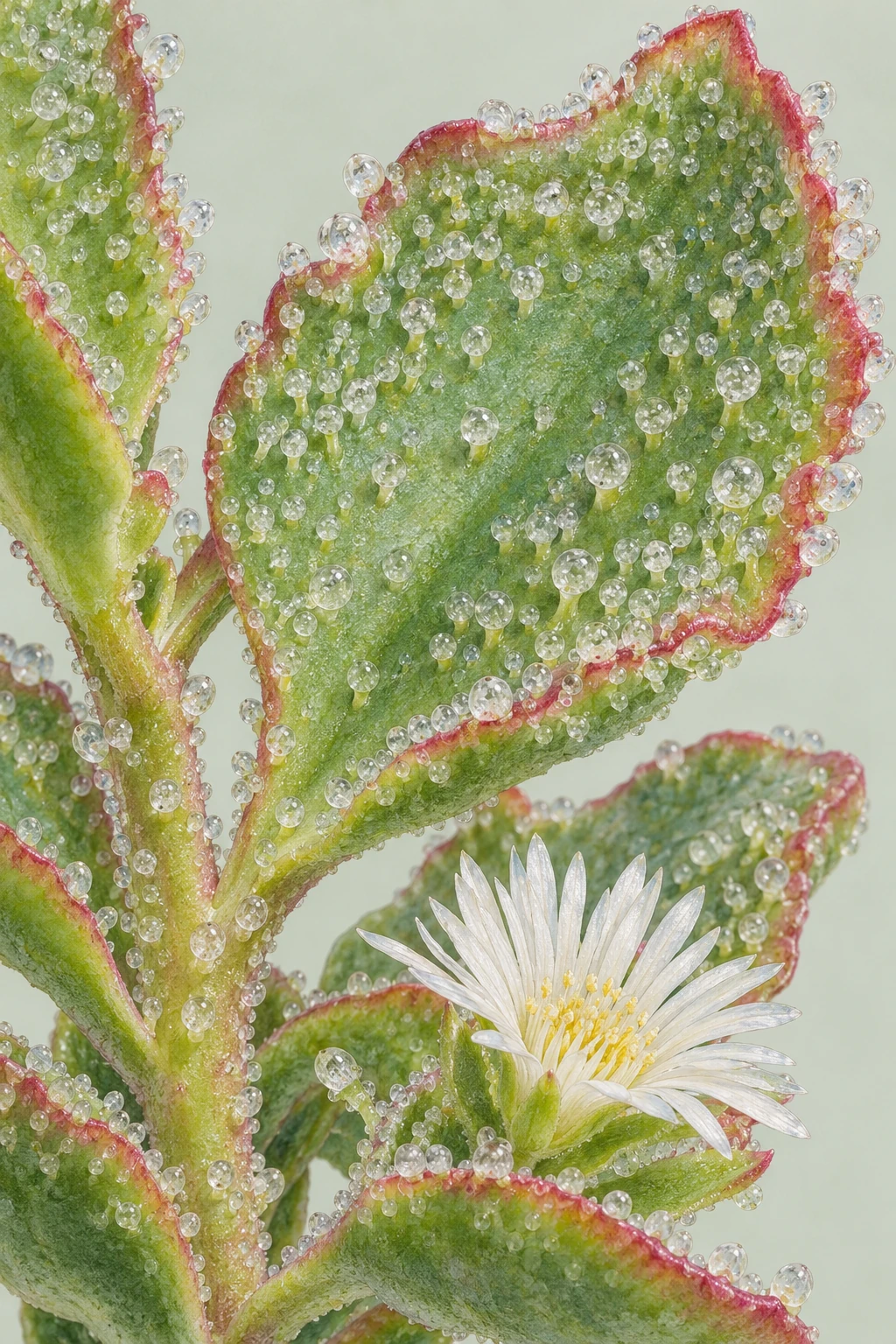
A succulent common iceplant leaf covered with beadlike living cells beside a small white flower.
AI-generated botanical interpretation of epidermal bladder cells; the sparkling structures are conceptual, not microscopy or salt crystals.

The common ice plant looks as though someone has scattered tiny glass beads over its leaves. The sparkling surface is not a crust of ice. Many of those beadlike structures are living epidermal bladder cells: enlarged surface outgrowths that make an ordinary leaf boundary unexpectedly three-dimensional.

A familiar explanation says the bladders store water or salt and therefore explain the plant's tolerance of difficult conditions. That is plausible enough to be repeated easily. Recent research makes the better story more demanding. What is inside a cell, what the cell can do, and what the whole plant actually needs it for are different questions.

First identify the plant, then the structure

“Ice plant” is used for more than one succulent. This article concerns Mesembryanthemum crystallinum, the species identified in the RHS profile, and compares relevant research on quinoa, Chenopodium quinoa. Similar surface structures in different plants create useful comparisons, but they do not guarantee identical function.

Epidermal bladder cells are modified trichomes, a broad category of plant surface outgrowths. Their swollen appearance invites the image of storage tanks. Yet a shape is not a function. A balloonlike cell could affect water relations, chemistry, the movement of small herbivores, or several processes at once.

A plausible explanation meets a perturbation

A 2023 Current Biology study investigated bladder cells as a defense against herbivores. Researchers used plants with reduced or absent bladder-cell development and compared performance and susceptibility. The work challenged a simple assumption that the structures are necessarily the key to salt and drought tolerance.

The Copenhagen account describes particularly clear quinoa results: bladder-deficient plants remained tolerant under tested abiotic conditions but were more vulnerable to small pests. Dense bladders could obstruct access to underlying tissues, while their contents contributed a chemical barrier. The article includes videos contrasting thrips encountering covered and uncovered shoots.

That is a stronger functional test than noting that salt-tolerant plants have shiny cells. If the proposed protective structure is missing and tolerance persists, the explanation needs revision. But the experiment's particular genotype, species, treatment, and outcome still matter. A result in quinoa cannot be silently expanded into every succulent called an ice plant.

The next study complicates the correction

A paper published in December 2024 examined water retention in quinoa leaves. Its authors noted that mutations affecting bladder-cell development can also change other aspects of plant growth. They used virus-induced gene silencing to reduce relevant gene activity in multiple quinoa lines while limiting obvious growth effects.

Leaves with reduced bladder-cell numbers lost water more rapidly after detachment in that study. The result supports a contribution to leaf water retention under those conditions. It does not erase the herbivore-defense findings, nor does it prove a universal whole-plant drought mechanism. It shows why the most useful correction is often more specific than “the old theory is entirely wrong.”

The contrast is an excellent example of experimental refinement. A mutation can change more than one trait. A different intervention can help separate those effects. Detached-leaf water loss is a defined measurement, while survival of an intact plant under drought is another. Both can be informative without being identical.

The ice plant's chemistry is also worth measuring directly

A 2024 metabolomic study analyzed common iceplant bladder cells under salt stress and reported changes across many detected metabolites. Such work treats the bladders as biologically active compartments with a chemical response, rather than inert bags that can be fully described by one common name.

It also illustrates a limit: a catalog of changing metabolites generates mechanistic questions, but does not on its own establish which changes cause tolerance or defense. That next step may require interventions, flux measurements, or performance comparisons. A long chemical list is evidence of complexity, not an automatic explanation.

For a reader with access to a correctly identified cultivated specimen, a magnifier can reveal how the surface differs from a smooth leaf. Look without scraping the cells away. The Copenhagen videos provide the more revealing comparison: the leaf surface as terrain encountered by an insect much smaller than we are.

The generated illustration emphasizes living beads rather than salt crystals. It is a visual introduction, not microscopy. Its sparkle should invite a question about function rather than supply the answer.

The deeper curiosity is how a beautiful surface becomes a scientific argument. A storage-like shape suggested one role; experiments revealed defense; another design recovered evidence for water retention under specified conditions. The leaf did not become less interesting when the simple story broke. It became a place where several plausible functions could finally be distinguished.

Follow the evidence: Moog and colleagues: epidermal bladders and herbivore defense; University of Copenhagen: testing the old bladder-cell explanation; Kobayashi and Fujita: water retention in quinoa leaves; Hainan University: iceplant bladder-cell metabolites under salt stress; RHS: Mesembryanthemum crystallinum identity.

More curious connections, art and independent projects at Incoprea.
The Elevator With Three Working Buttons

Case 50 · shortest-path challenge · Hard · About 10-15 minutes The archive elevator has a peculiar test mode. Its floor display works, but o...