Showing posts with label Life Cycles. Show all posts

Thursday, October 22, 2026

Aphids Can Carry Daughters Already Carrying Daughters

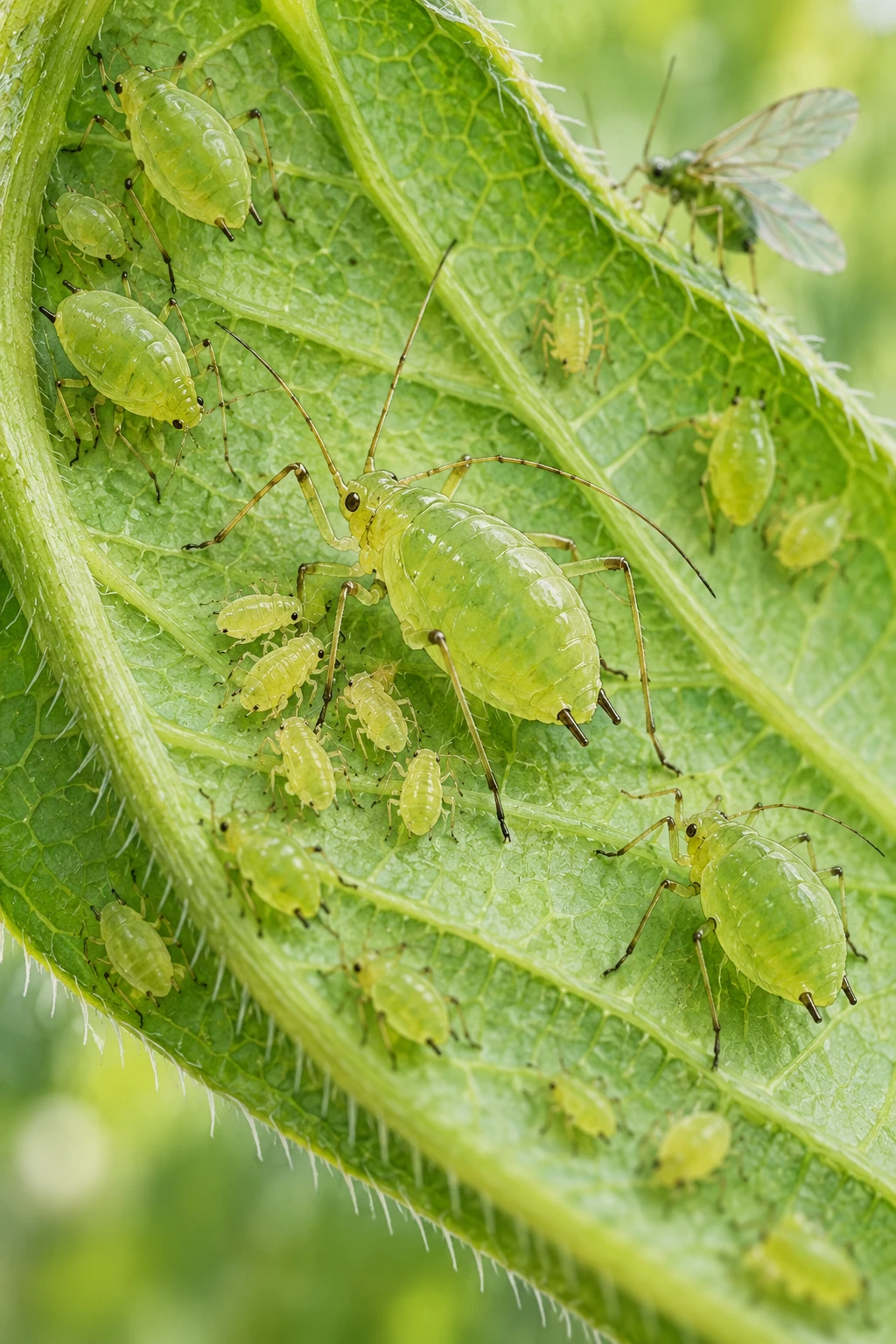
Green aphid adults and smaller nymphs cluster on the underside of a leaf, with one winged form behind them.
Conceptual aphid colony; visible sizes illustrate overlapping ages, not a census or an anatomical view of embryos.

A leaf can hold a family whose generations overlap in a way our ordinary family tree does not show. In the live-bearing, asexual phase of many aphids, daughters develop inside a mother while the beginnings of another generation can already be developing inside those daughters. A grandmother can contain parts of two succeeding generations at once.

The phenomenon is called telescoping generations. It is not an infinite sequence of fully formed insects nested like toys. Developmental stages overlap, and that overlap shortens the delay between one generation and the next. The small crowd under a leaf has a history that began before some of its visible members were born.

Two reproductive features work together

Parthenogenesis means development without fertilization. Viviparity means giving birth to live young. They are different features: an animal can have one without the other. In aphids, their combination during certain life-cycle phases makes telescoping development possible.

The University of Maryland guide explains that aphid reproduction varies with species and season. Females may give birth to live young or produce eggs, and populations can include adults and nymphs of several ages together. A sentence beginning “all aphids always” is therefore likely to need qualification.

Many temperate species alternate a series of asexual generations with a sexual phase that produces overwintering eggs. Other life histories differ. The review of aphid evolutionary and genetic biology places those cycles in a wider context. Telescoping is a specific reproductive arrangement, not a claim that mating has disappeared from the whole group.

The mother is also a developmental environment

A review of embryo nutrition examines how developing aphids receive resources through the maternal system. The ovariole sheath forms a selective interface between maternal fluids and embryo tissues. This is living provisioning, not merely a collection of eggs stored in an empty abdominal space.

That nutritional connection helps explain why maternal conditions can matter. Food quality, physiology, and the timing of development can affect more than one visible generation. The grandmother's body may be the immediate environment in which both a daughter and an early granddaughter stage are developing.

Such direct exposure is important when reading claims about inherited environmental effects. If multiple generations are physically present during an exposure, an effect in a later generation is not automatically evidence of a mysterious memory passed beyond all contact. The reproductive anatomy must be considered before deciding what “transgenerational” means in the experiment.

A daughter also receives a microbial partnership

The developing family includes more than aphid cells. In pea aphids, Acyrthosiphon pisum, the bacterial symbiont Buchnera is transmitted from the mother to her offspring. A lineage's continuity therefore includes an organized passage of microbes into the next developing body.

A 2003 microscopy study used specific labeling to follow Buchnera during transmission to parthenogenetic embryos. It showed bacteria associated with maternal specialized cells and entering developing embryos. The images suggested a possible membranous conduit, an interpretation that later work could test more closely.
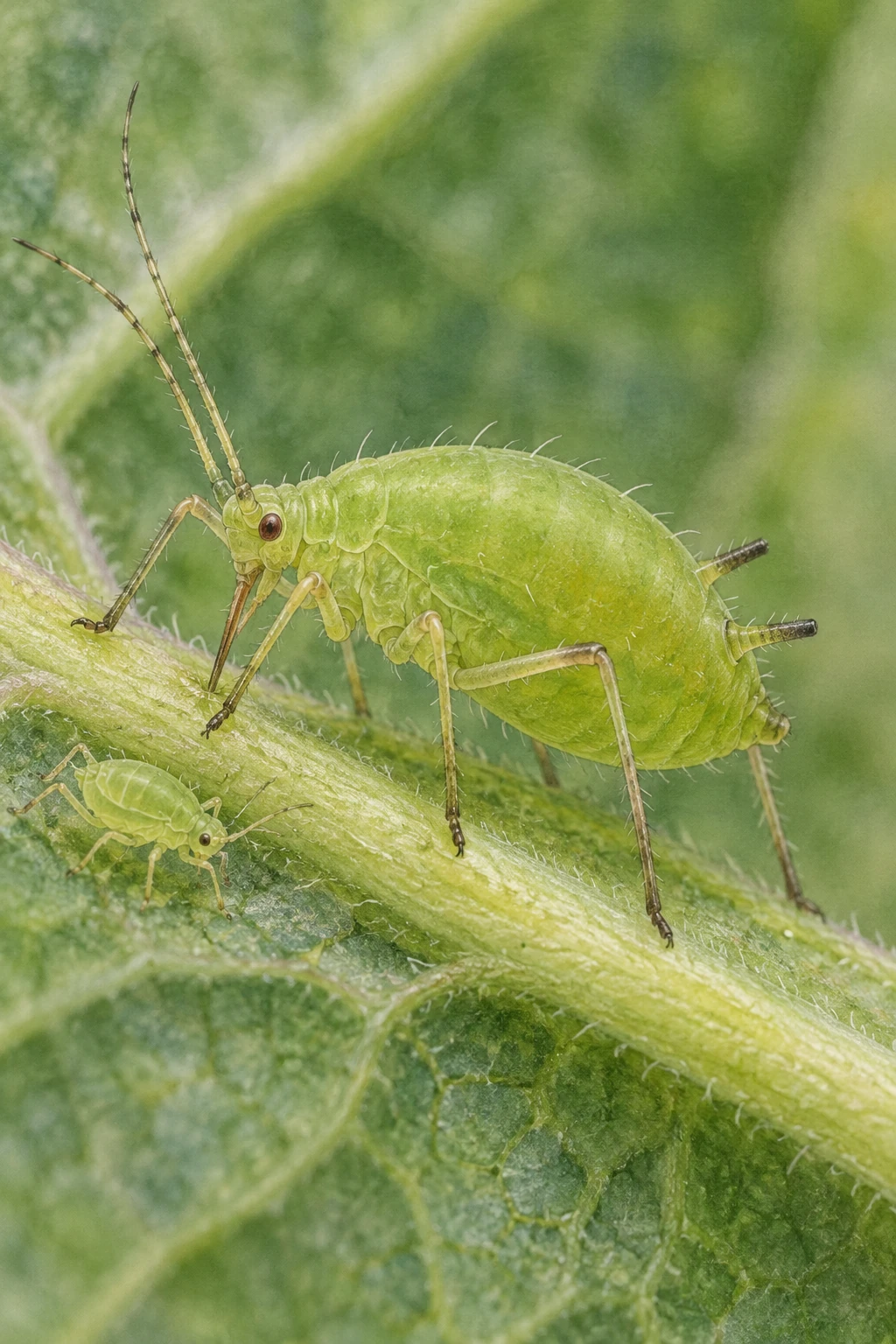
Green pea aphid feeds along a leaf vein beside a smaller nymph
The surface view cannot show embryo stages or bacterial transmission. Those routes require developmental and cellular evidence.

A 2012 study of the bacteriocyte–embryo interface used electron microscopy and manipulated symbiont associations to investigate the route. It supported release of bacteria from the maternal cell, a temporary extracellular passage and uptake by the embryo. The resolved membrane structures argued against a continuous conduit at the observed transmission center.

The mechanism also had a selective component. The maternal-cell release step treated Buchnera differently from the facultative symbiont examined in the experiment. “Bacteria enter the embryo” is therefore only the beginning of the question. Which bacteria, through which cellular step, and with what evidence are the useful details.

Follow ancestry and transmission on separate lines

The worksheet puts the aphid family and the microbial route in two rows. The first records the overlapping mother, daughter and early granddaughter stages. The second records how a symbiotic population reaches an embryo. Both involve inheritance, but they should not be confused with the claim that a bacterial cell is part of the aphid's nuclear genome.

Two inheritances through one mother

A two-route reading ledger contrasts aphid ancestry with symbiont transfer and revisits a mechanism across microscopy methods.

Open this activity in its own window.

For a rewarding comparison, read the 2003 interpretation before the 2012 membrane evidence. Notice how a plausible shape at one resolution can invite a mechanism that a later method revises. That is a more precise story than declaring the earlier picture meaningless or treating every old hypothesis as settled fact.

The feeding aphid's external form conceals both kinds of continuity. One developing generation overlaps another, while a microbial partnership is passed across a cellular interface. The future on the leaf is not only a larger number of aphids. It is the repeated construction of living bodies already connected to other lives.

The environment can influence which kind of offspring develops

Ogawa and Miura's 2014 review discusses aphid polyphenisms: different forms produced from similar genetic backgrounds in response to conditions. Depending on the species and context, maternal information can contribute to developmental switches such as winged versus wingless offspring or reproductive mode.

The pathway is not simply a leaf becoming crowded and every insect instantly growing wings. The mother perceives conditions, signals are integrated and transmitted, and developing offspring respond during sensitive stages. Which generation shows the changed form and how long the effect lasts are empirical questions.

This is why researchers often rear aphid lines under stable conditions across generations before testing a cue. A colony's recent history can influence the outcome. Without that preparation, a result attributed to today's treatment might partly reflect conditions experienced by a mother or grandmother.

Rapid population growth still has limits

Overlapping development and reproduction without a search for mates can help a population build quickly when conditions are favorable. But a reproductive capacity is not a forecast of unlimited increase. Predators, parasitoids, weather, plant quality, disease, and movement alter what happens on a real leaf.

A count on one day is therefore only a snapshot. If observing a small colony on a plant you already own, photograph the same leaf without moving insects and note adults, smaller nymphs, winged forms, and empty shed skins separately. Shed skins are evidence of growth, not additional living aphids. Repeated observations can show births, disappearance, and changes in the visible age mix without revealing every cause.

For a garden-management decision, use the local extension guide's identification and plant-condition advice rather than assuming that any aphid presence requires immediate intervention. The life-history story helps explain the speed of change; it does not establish a universal action threshold.

The generated artwork shows adults and nymphs together, not a transparent anatomical cutaway. The remarkable nesting of developmental stages comes from the research, and it occurs inside bodies too small for an ordinary garden glance to resolve.

An aphid colony can look like a sudden arrival. In part, it is a release of development already underway. The next generation did not wait politely for the previous one to finish. The leaf holds a crowded present, and inside some of its inhabitants a portion of the near future is already growing.

Follow the evidence: Ogawa and Miura: aphid polyphenisms and telescoping development; Bermingham and Wilkinson: embryo nutrition in viviparous aphids; University of Maryland Extension: aphid reproduction and observation; Evolutionary and genetic aspects of aphid biology.

More curious connections, art and independent projects at Incoprea.

Periodical Cicadas: The Long Appointment Beneath the Trees

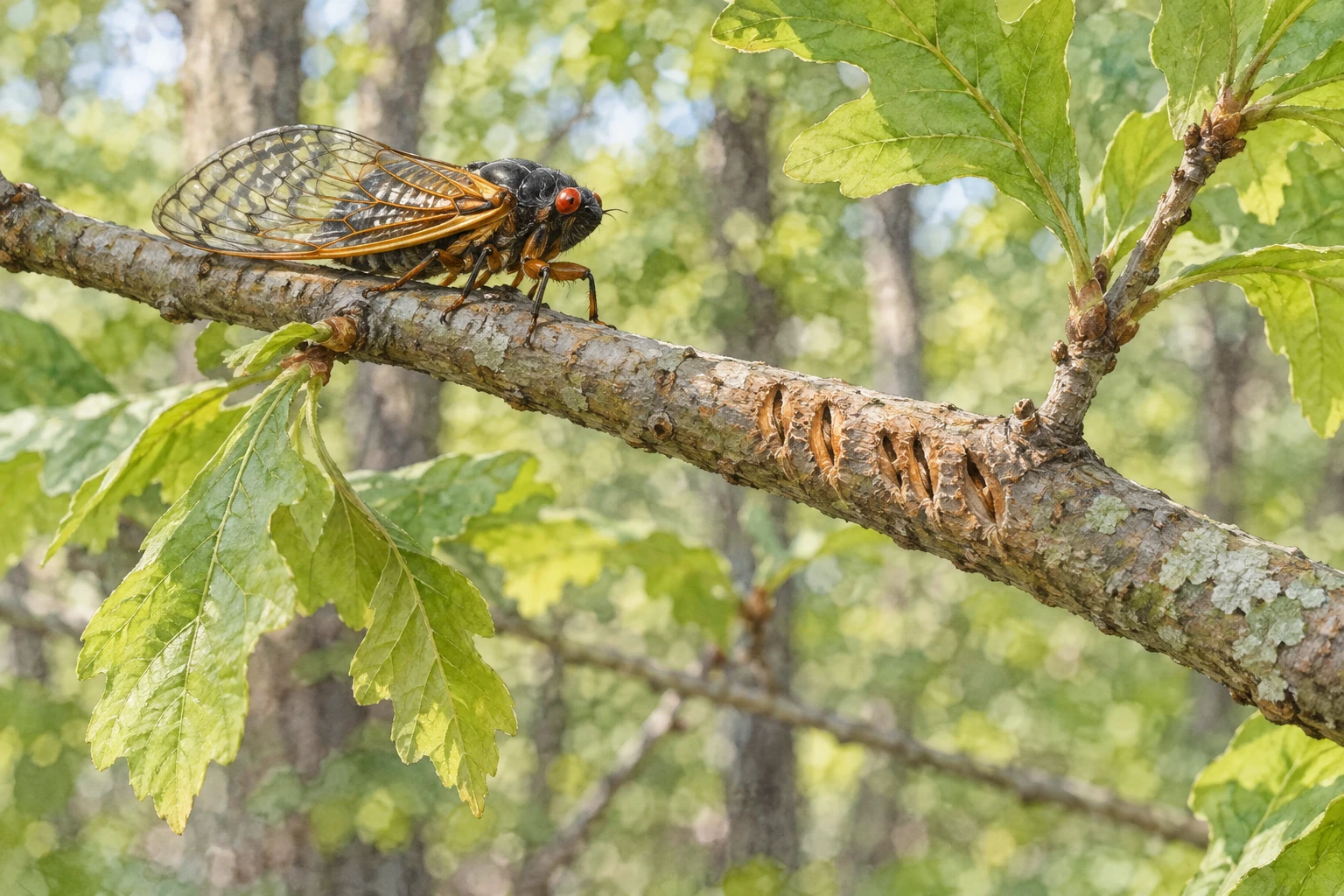
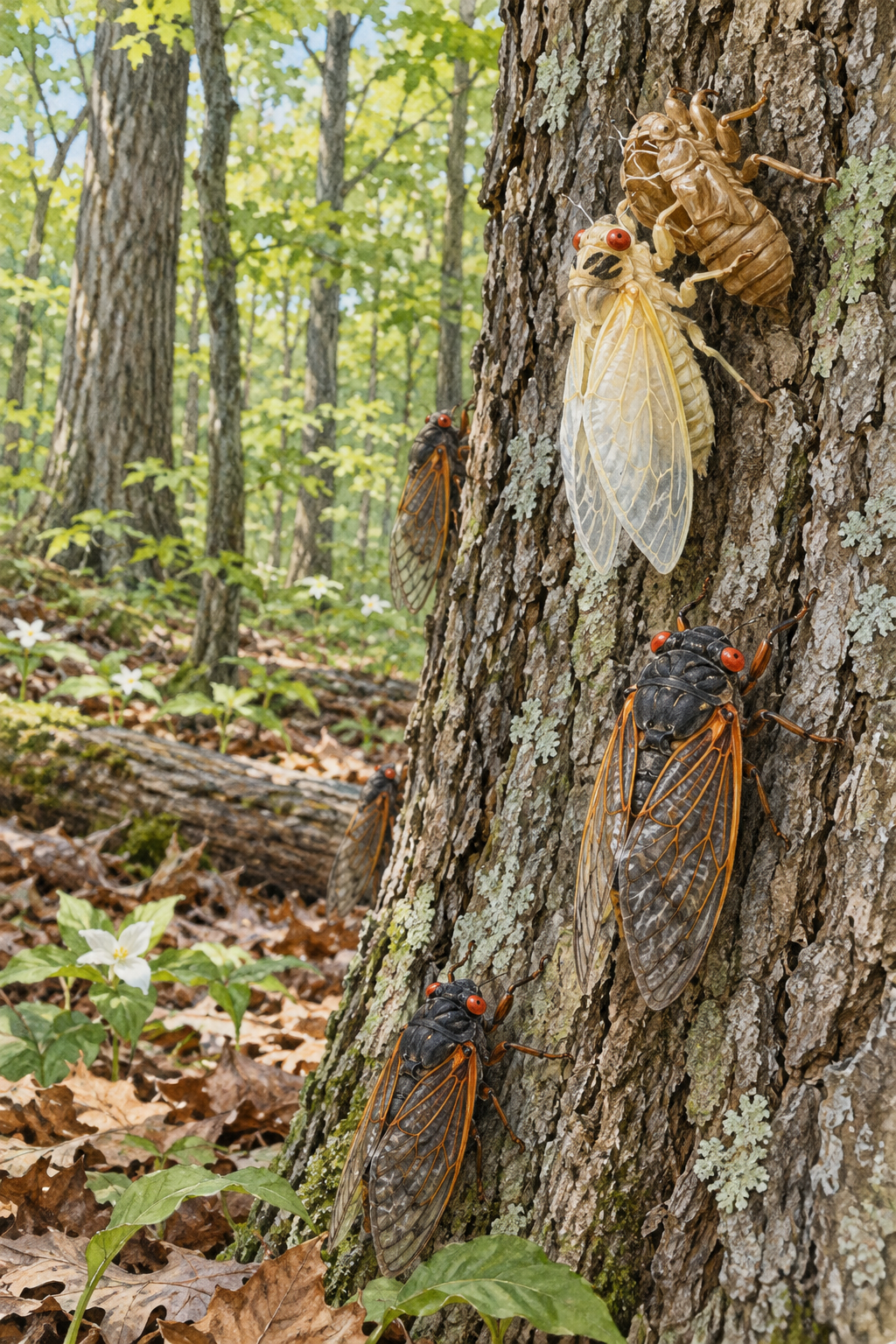
Red-eyed cicadas and a pale newly emerged adult on a woodland trunk beside an empty nymph shell.
Natural-history illustration of a periodical cicada emergence; an interpretive scene, not a field photograph.

Imagine keeping an appointment arranged before a child was born. The landscape has changed, trees have grown, and the child can now drive. Yet, beneath the same neighborhood, a generation of insects is approaching the surface together. The extraordinary feature of periodical cicadas is not simply that they wait. It is that so many arrive on a shared schedule.

That distinction changes the story. A cicada appearing each summer need not have lived for only one year. Many so-called annual cicadas also develop underground for several years; different age groups overlap. In periodical cicadas of the genus Magicicada, adult appearances are concentrated into particular years, separated by thirteen or seventeen years of underground development. A brood is a geographical year-class, not a single species. Several species can share its calendar. Penn State's illustrated account separates those easily confused categories.

The long part happens where we cannot watch

A periodical cicada does not spend all those years asleep. Nymphs feed on fluids from tree roots and grow through juvenile stages. Near emergence, they prepare exit tunnels. On a suitable spring evening, a nymph leaves the soil, climbs vegetation, and splits its old outer skeleton. A pale adult unfolds from it. The abandoned shell remains gripping the bark: a useful trace of an event that may have happened while the observer was indoors.

The visible adult period occupies weeks rather than years. Males produce calls with specialized vibrating structures, and females place eggs in slits in living twigs. Newly hatched nymphs later drop and enter the ground. The Smithsonian's life-cycle resources put those stages side by side. Looking at the sequence restores proportion: the spectacle is the brief reproductive opening of a much longer animal life.

Safety through a temporary excess

A slow, conspicuous insect sounds like an easy meal. In a mass emergence it often is. The survival advantage lies at population scale: predators cannot necessarily consume a matching fraction of an enormous, short-lived food pulse. This is called predator satiation. The National Park Service explanation describes how sufficient survivors can reproduce despite heavy feeding by birds and other animals.

A toy example makes the logic visible without pretending to measure a real forest. Suppose a group of predators eats 900 insects during an observation interval. If 1,000 insects emerge, only 100 remain. If 10,000 emerge and predator consumption rises to 1,800, 8,200 remain. More insects are eaten in the second case, but the proportion lost falls from 90 percent to 18 percent. Real predators, timescales, and densities complicate the calculation; the important distinction is between the number eaten and the risk faced by each insect.

This also explains why a few insects appearing off schedule might face a different situation. They do not automatically receive the protection associated with a dense emergence. A 2024 mathematical study explores how predation can help shape the geographical separation of broods. Its modeled outcomes are tests of a proposed mechanism, not proof that one force alone created the whole life history.

The quieter beneficiaries may be caterpillars

Not every beneficiary of a cicada emergence eats a cicada. A caterpillar can gain an advantage when a bird turns its attention elsewhere. That adds an indirect route from the underground appointment to the leaves above it.

A 2023 study of the Brood X emergence documented more than 80 bird species adding cicadas to their diets. At the studied forest sites, caterpillar densities and accumulated oak herbivory approximately doubled. The result concerned measured changes during that emergence; it is not a prediction that every oak in every brood region will lose the same amount of leaf area.

Cicada beside a twig bearing a short row of small egg-laying scars
A twig can record egg laying. That injury should be distinguished from leaf chewing by other insects during an emergence.

The research team's university account explains the complementary methods. Observers recorded bird feeding. Clay caterpillar decoys helped register bird attacks. Live caterpillars were counted, and leaf damage was measured. Together these observations connected a change in foraging with consequences elsewhere in the food web.

A clay caterpillar is especially useful to think about. It cannot hide, grow or move away. An attack mark measures an encounter with that model under its deployment conditions. It does not supply a complete census of caterpillar survival. The stronger account joins this indicator with independent observations, rather than asking one artificial prey item to stand in for an entire forest.

Follow two kinds of damage without mixing them

The twig detail shown here belongs to a separate part of the story: egg laying can leave small cuts in living twigs. Chewed leaf edges concern a different interaction. A tree could show both signs during an emergence, but pooling them as “cicada damage” would conceal who did what.

A food pulse travels through a forest

Printable evidence ledger separating three food-web links and their measurements.

Open this activity in its own window.

Use the reading sheet to build a three-link ledger: cicadas to birds, birds to caterpillars, caterpillars to leaves. For each link, name the observation and its limitation. Then imagine that only the final leaf measurements had been available. Could you identify the route from that endpoint alone? You would have several plausible explanations and much less leverage to choose among them.

This is a satisfying reason to look beyond the loudest animal. A brief abundance can reorganize attention. The event's ecological footprint may be visible in an insect that nobody watched eating a cicada, and in a leaf that no cicada chewed.

Thirteen and seventeen are clues, not a complete answer

Both intervals are prime numbers. That invites a memorable story about insects defeating predators through arithmetic. But a memorable calculation is not itself an evolutionary history. The University of Connecticut's research guide stresses the unusual combination of long development, periodicity, and synchronized abundance. It also discusses gaps in explanations based solely on predation or past glaciation. Many insects face predators and climatic shifts without evolving this schedule.

We can know that a pattern exists, demonstrate that a mechanism could favor it, and still lack a complete account of its origin. Keeping those levels separate makes the cicadas more interesting. There is room for field measurements, comparisons among species, and experiments about timing, rather than only a clever anecdote about primes.

The same caution helps with maps. A broad brood map identifies an expected region, not a promise for every yard. Changes in vegetation and land use can alter a very local experience. For practical tree protection, consult the extension guide's discussion of young trees and egg-laying injury rather than treating the emergence as a crop-devouring locust invasion. Cicadas and locusts are different insects.

When the chorus subsides, the neighborhood can seem to have returned to normal. A better description is that the visible phase has ended. The next generation has begun a long relationship with the ground and its roots. An empty shell on a fence is therefore more than the remains of an insect costume. It marks a meeting between two timescales: a few weeks loud enough to dominate a summer memory, and years of life that passed beneath notice.

Follow the evidence: University of Connecticut: periodical cicada biology; Smithsonian: life cycle and educational films; National Park Service: emerging cicadas; Penn State Extension: species, broods and tree care; Predation-driven geographical isolation of broods: a mathematical model.

More curious connections, art and independent projects at Incoprea.
Wednesday, October 14, 2026

The Immortal Jellyfish's Remarkable Reset Has Limits

The familiar jellyfish body is a medusa: a swimming bell with tentacles. In Turritopsis dohrnii, that body can enter a developmental route that seems to run the wrong way. It contracts, loses the familiar outline and passes through a cyst-like stage before producing the attached polyp form. The remarkable event is a reorganization, not simply a large jelly becoming a smaller jelly.

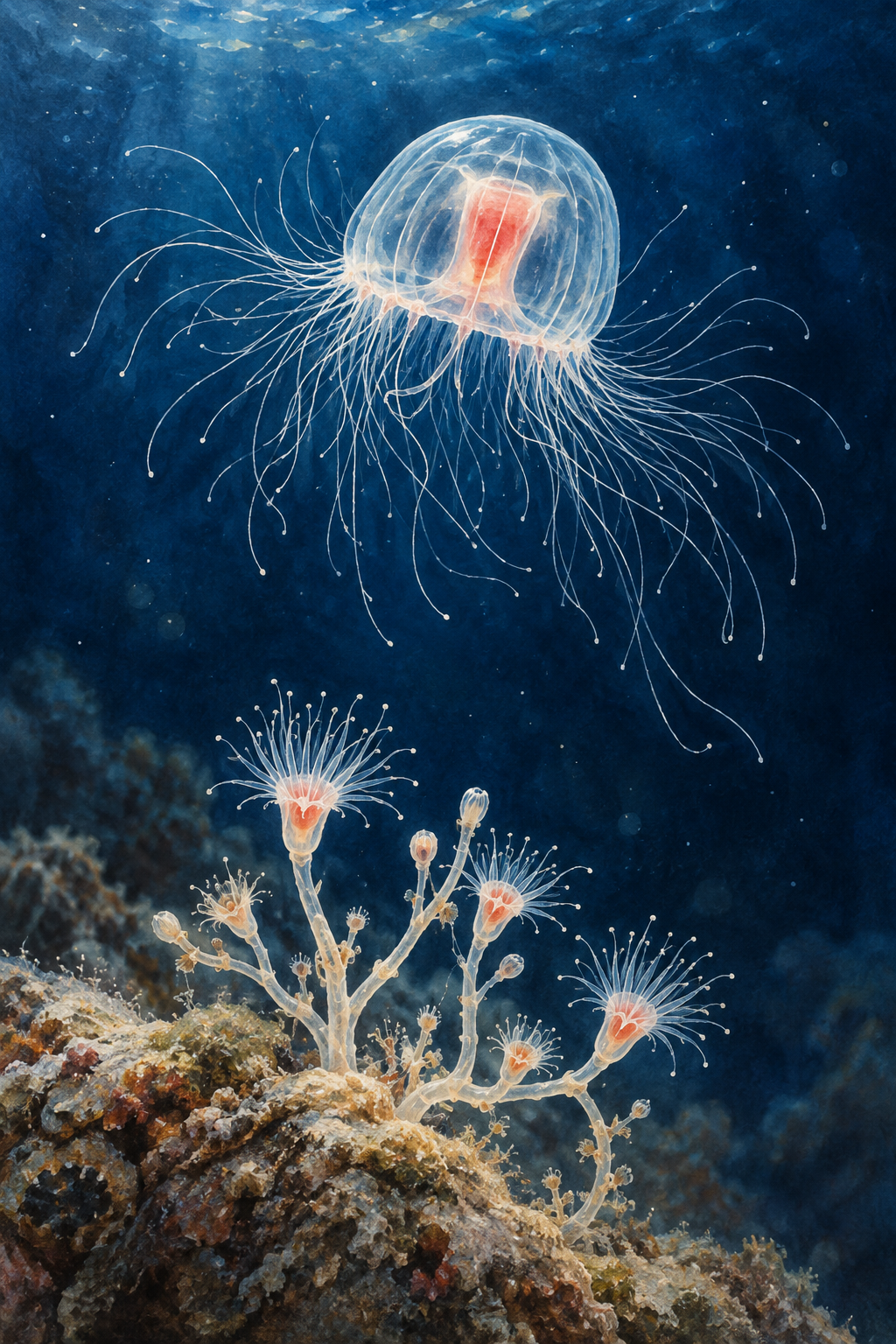
A transparent bell-shaped jellyfish floats above a small attached colony of polyps.
Medusa and polyp forms shown in an artistic life-cycle comparison with illustrative proportions.

The nickname “immortal jellyfish” points toward this capacity for repeated reversal. It does not describe an animal protected from predators, infection or lethal damage. Keeping that distinction clear lets the biology become the attraction. A mature form can produce an earlier body plan, and researchers can investigate how that transition is accomplished.

Two shapes belong to one life cycle

In the ordinary hydrozoan sequence, sexual reproduction produces larvae that settle and develop into polyps. Polyps are attached forms that can grow into colonies and produce medusae by budding. A bell in the water and a small polyp on a surface can therefore belong to connected stages of the same species.

The alternative route begins with a medusa and returns to a polyp without following that ordinary sexual sequence. The cyst is an intermediate state, rather than an overlooked miniature bell. Its tissues are changing as the earlier organization is rebuilt. Thinking in stages prevents the word “younger” from hiding how different the resulting animal looks and lives.

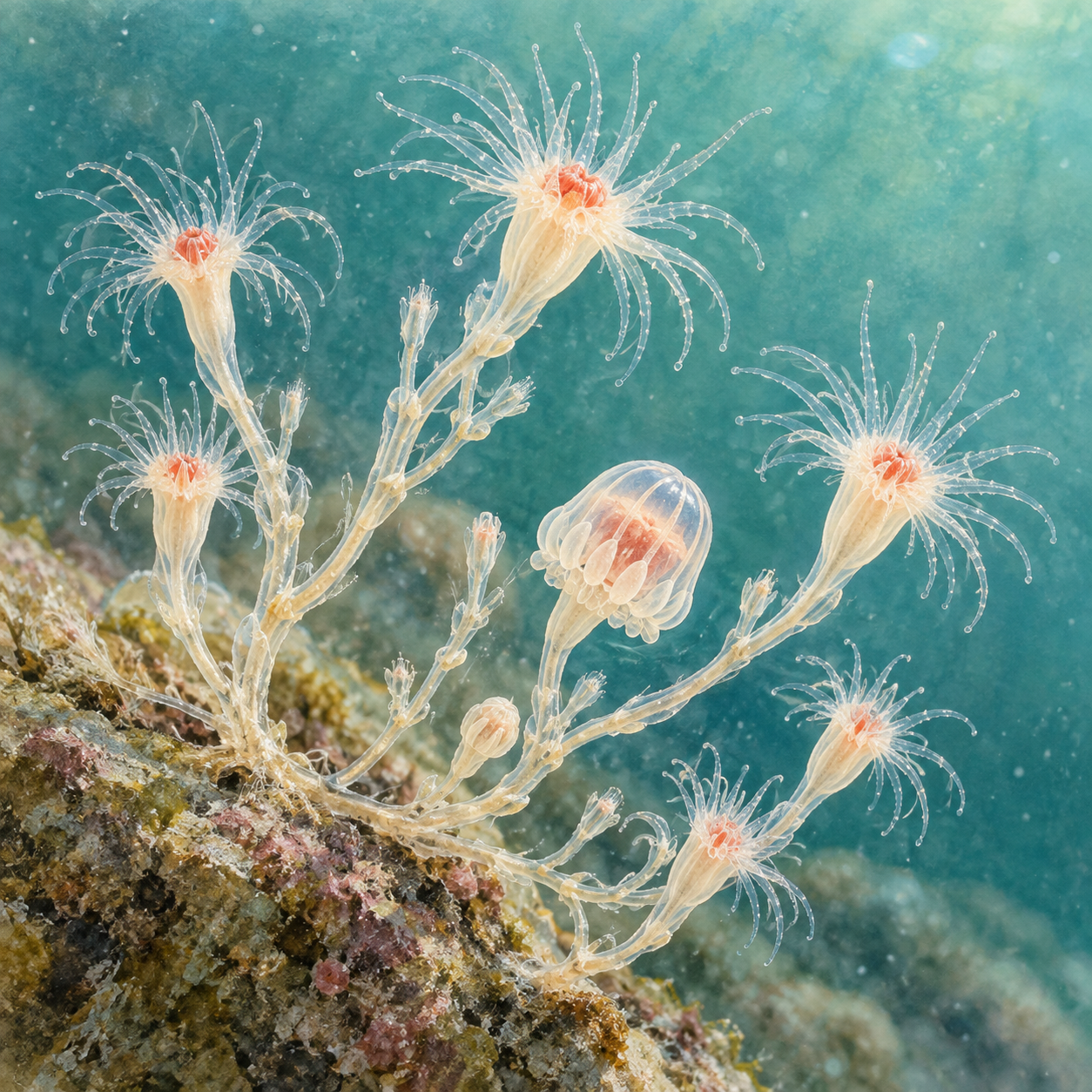
An enlarged artistic polyp colony includes tentacled heads and a small medusa-like bud.
Conceptual enlarged polyp and budding-medusa forms, illustrating the ordinary forward stage of a hydrozoan life cycle. Proportions are simplified.

Try reconstructing the two routes in words. For the ordinary route, begin with gametes and end with a new medusa. For the reversed route, begin with a medusa already present and include the cyst before returning to the polyp stage. Which route contains fertilization and a larva? Which represents reorganization of existing tissue? That difference is central to the phenomenon.

A body plan is more than its outline

Medusae and polyps differ in cell types, structures and ways of living. Reversal therefore requires more than changing size. Researchers investigate cellular plasticity, including changes in the specialization of cells, as the animal produces a different organization. Transdifferentiation is the term often used for a change from one specialized cell identity to another.

The exact cellular sequence remains a research problem. Different processes, including changes in cell state, proliferation and tissue loss, can participate in rebuilding. A photograph of the beginning and end cannot identify how every cell made the journey. The intermediate stages are where an impressive life-history observation becomes a set of questions about development.

Imagine inspecting two buildings with the same materials but different floor plans. Knowing the inventory would not tell you how one arrangement became the other. The comparison is imperfect because tissues are living and can change during the transition. It nevertheless clarifies why recording the final polyp is only one part of understanding the transformation.

Watch gene activity change with the stage

In 2019, Yui Matsumoto and colleagues compared transcriptomes from medusa, cyst and polyp stages. A transcriptome records RNA associated with gene activity in sampled material. Their analysis identified biological processes expressed differently during the cyst stage, including candidates associated with genome maintenance and changes in cellular organization. It supplied leads into the transition rather than a complete causal account.

The samples also came from different collections and were processed with differences the authors described. Such details matter when comparing stages: some measured differences could reflect more than developmental state alone. The useful response is to design follow-up work that separates those possibilities. A first molecular view can be valuable while still needing a more controlled comparison.

Compare this with a genome, which records inherited sequence information. The genome supplies an inventory of possible components; a transcriptome helps show which parts are being used in a particular sample. Neither measurement is a direct movie of cells changing identity. Combining them with observations of tissues can connect molecular candidates to actual developmental events.

Comparing relatives narrows the search

A 2022 study led by Maria Pascual-Torner compared T. dohrnii with the related Turritopsis rubra. The team identified differences involving processes such as DNA replication and repair, telomere maintenance and cellular reprogramming. These are plausible places to investigate a capacity that depends on maintaining and reorganizing living tissue.

A difference between species is not automatically the cause of their different abilities. Relatives differ in many ways, and several changes may act together. A strong next question is whether changing a candidate component alters a specific part of the reversal process. That asks for functional evidence beyond noticing that a sequence or expression pattern differs.

Yoshinori Hasegawa and colleagues provided another genome and transcriptomic resource in work published in 2023. They emphasized the difficulty of reaching definitive conclusions about the relationship between gene functions and the jellyfish's characteristics. Resources like these make further experiments possible, especially for a small animal that is demanding to maintain and sample.

A repeatable escape route still has an outside world

The Natural History Museum describes repeated laboratory reversals, but a repeated process is not a directly observed infinite lifespan. A medusa must survive the transition; a polyp must establish and persist; the resulting colony still encounters ecological hazards. The ability changes one developmental possibility while leaving many ordinary causes of death in place.

The most productive question is therefore specific: how can existing living tissue reorganize into an earlier stage with a different body plan? Following the cyst, measuring changing gene activity and testing proposed mechanisms each illuminate part of the answer. The nickname opens the door. The actual sequence of transformations gives the animal its lasting scientific interest.

Explore more creative curiosity at Incoprea.

Famous Last Meals is now in paperback — stories, history and 25 recipes

Famous Last Meals: Stories, History, and Recipes is now available in paperback on Amazon. The illustrated collection brings together 23 his...