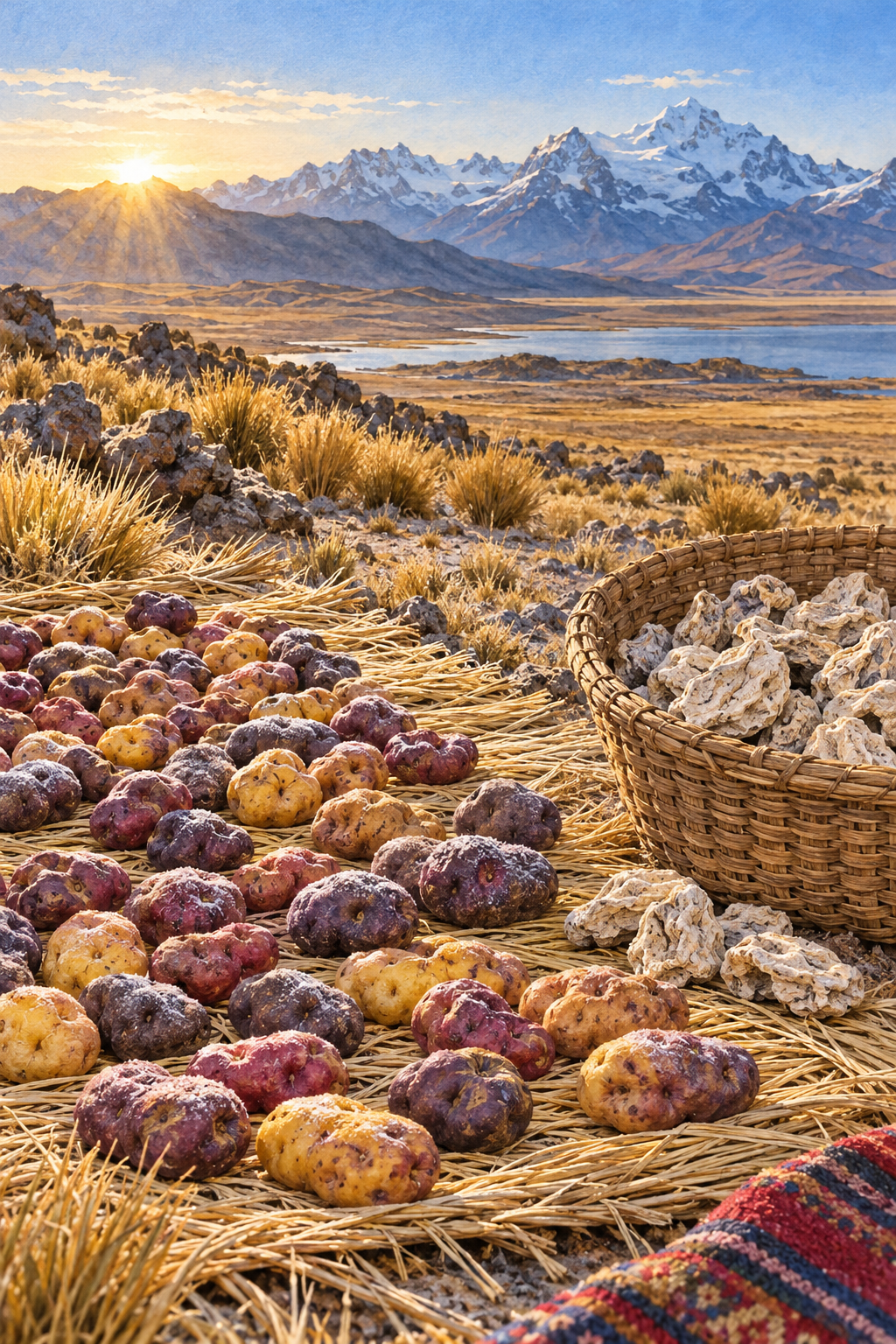
A potato harvested today and a meal needed months from now are separated by more than time. Fresh tubers are perishable. A family also has to think about storage space, the next growing season, and what happens if a harvest disappoints. Chuño is an Andean response to that longer problem: change the potato so that part of a harvest remains useful well beyond the moment it leaves the soil.
The process brings freezing nights, daytime conditions, water where appropriate, and skilled labour into one system. Its ingenuity is often summarized as “the weather freeze-dries potatoes.” That description leaves out the people whose decisions make the conditions useful. Knowing a place well enough to work with it is part of the technology.
The potato changes; the work does not happen by itself
The Food and Agriculture Organization’s account of root and tuber storage explains why transformation matters. Freshly stored tubers continue to respire and lose moisture. Drying and other processing methods can turn a perishable crop into a more durable product, although the result depends on the crop and its environment. Preserving a supply is therefore a different task from keeping every harvested potato in its original condition. Read FAO’s discussion of storage and transformation.
In chuño production, freezing and thawing alter the tuber’s cellular structure, making it possible for producers to remove water through pressure. Drying removes further moisture. FAO’s account of traditional potato processing describes these linked physical changes. This is a description of the principles, not a processing schedule: the choice of material and the management of the whole sequence matter.
“Freeze-dried” is a useful familiar label, but it can make us picture one sealed machine performing one operation. Traditional chuño production includes several forms of work and several changes of condition. The tubers are selected, tended, handled, and judged. A night’s frost is one contribution to the system. It does not inspect the product, organize labour, or decide whether the next stage is ready.
Black and white are processes, not just colours
Black chuño and white chuño are connected traditions with different processing histories. Stef de Haan and colleagues documented regional methods in Peru, including variants from Puno and Huancavelica. White chuño generally included prolonged water exposure; black chuño followed a less elaborate sequence without that stage. The study emphasized variation in the order, repetition, and duration of operations. Read the farmer-managed processing study.
The paper also compared four potato cultivars processed in different ways. That design is worth noticing. Researchers were not testing an abstract “traditional potato” against a universal method. They were comparing named biological materials and documented local practices. Cultivar, environment, tradition, and the intended market could all influence the finished product. A photograph of white and dark tubers cannot tell you that whole history.
Names have local contexts too. White chuño is known as tunta or moraya in different linguistic and regional settings. It would be misleading to flatten every method and name into one timeless recipe. The variations are evidence of practiced knowledge responding to local materials, resources, and expectations.
Meet a producer, rather than an anonymous tradition
The International Potato Center tells the story of Aymara farmer Luzmila Jinez from Yaurima in Peru’s Puno region. Its report follows her journey to Lima to sell tunta at a culinary festival and seek better markets for her association. Her goal was practical: more reliable, better-paying sales that could support families and their children’s education. The account is a documented episode, rather than a claim about today’s prices. Read Jinez’s story at CIP.
The same report describes work with producers on processing quality and hygiene. This is an important part of a living tradition. Knowledge can persist while people improve practices, organize associations, and make decisions about selling their food. Calling a technique ancient should not force its practitioners into the role of preserving an unchangeable museum display.
FAO’s profile of EcoYary offers another specific example. It describes a family enterprise in Peru’s central highlands in which women manage chuño production, with local sales forming part of the business. The account stresses the skill involved in a long, repetitive process. These are people producing a valued food, with labour and quality decisions that deserve to be visible alongside the picturesque highland setting. Explore the producer profile.
Read the weather as a set of dependencies
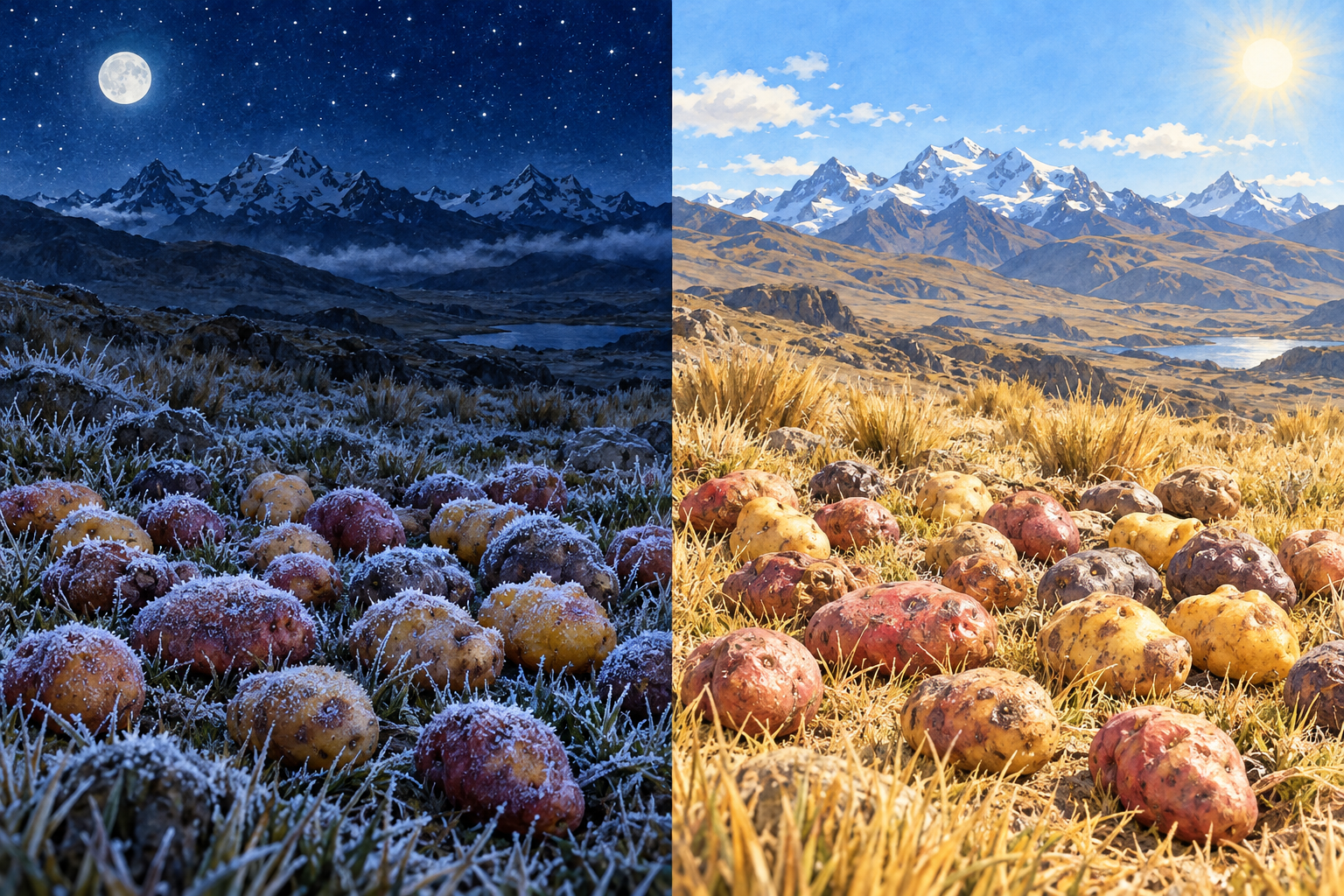
Try looking at the night-and-day illustration again. Instead of treating it as a sequence to imitate, ask what each part of the environment contributes. The following table is a way to think about dependencies. It does not specify safe processing conditions, times, or temperatures.
| Contribution | Question to investigate |
|---|---|
| Freezing conditions | Does the season provide the conditions the documented local method requires? |
| Conditions for drying | How does moisture leave the material after earlier processing? |
| Water access for relevant methods | Which product and local process are being discussed? |
| Skilled labour | Who selects, handles, monitors, and judges the product? |
| Storage and markets | What happens after processing, and who benefits from the sale? |
Now imagine that only one part changes. There is a suitable harvest and skilled labour, but the expected freezing conditions do not arrive. Or the weather is suitable, but a producer cannot obtain the water needed for a particular white-chuño method. Would adding more of a different input automatically solve the problem? The exercise shows why a technique adapted to a place cannot be understood from its equipment alone.
It also suggests better questions for an account of changing climate. Which part of the seasonal pattern is changing? What have local producers observed? What adaptations are being tried, and what trade-offs follow? A general statement that “tradition is threatened” tells us less than evidence attached to a particular practice and community.
Keeping a harvest also means keeping knowledge
FAO’s account of agricultural heritage places chuño within a much broader Andean farming system. It connects crop diversity, Indigenous knowledge, and food kept for periods when fresh supplies are limited. It also identifies the loss of knowledge associated with migration of younger people as a concern. Preservation therefore has two meanings here: keeping food available and sustaining the people and practices that make that possible. Read FAO’s potato heritage account.
The dried tuber is the visible result, but the achievement extends beyond it. It includes knowing which materials work, reading a season, coordinating effort, and deciding what quality means for the intended use. Chuño becomes more interesting when the landscape and the producers remain in the same picture. The weather contributes to the process; generations of Andean knowledge turn that contribution into a food system.




