A cathedral invites you to look up. A misericord asks you to look under a seat. The small carved ledge beneath a hinged choir-stall seat offers a different scale of encounter: close to a body, shaped by use, and often filled with faces, foliage, animals, or scenes that reward patient attention.
The practical part matters as much as the carving. When the seat is raised, the projecting underside can offer support during long periods of standing. A sculpted image and a bodily accommodation occupy the same piece of wood.
Understand the hinge before decoding the image
Ripon Cathedral’s guide describes its choir stalls, made between 1489 and 1494, and explains the small ledges offered by the upturned seats. The name misericord is connected with mercy. A modern visitor seeing a carved panel detached from its furniture can easily miss this mechanical and bodily relationship.
Picture two positions. With the seat down, a person sits on its upper surface. With it up, the underside faces outward and a small support becomes available. The carving’s visibility changes with the movement. It was not simply designed as a picture on a wall.
A good looking exercise begins by tracing the outline of the seat, locating the hinge, and finding the weight-bearing ledge. Only then ask how the figures or leaves fit below it. This order prevents a symbolic explanation from replacing an understanding of what the object does.
Every set belongs to a particular building history
Chester Cathedral dates its quire stalls probably to around 1380 and associates their construction with a team led by William and Hugh Herland. It also notes later woodwork added during the Victorian restoration. A medieval interior is often a layered result, rather than a room completed once and left untouched.
Winchester Cathedral’s collection description identifies its fourteenth-century misericords among the furnishings of the choir. Compare photographs from different cathedrals and the family resemblance is obvious, but a shared type does not mean a shared date, workshop, or iconographic program.
The Historic England listing for Ripon records the choir stalls and misericords as important late fifteenth-century furnishings. Building records provide a different kind of account from a visitor’s anecdote. Reading the two together helps distinguish an established date from a memorable story attached later.
Funny does not automatically mean subversive
A strange animal or an unflattering human figure can seem to offer a direct glimpse of medieval humor. It may do that, but a modern reaction is only the beginning of interpretation. A scene might draw on a fable, a proverb, a moral warning, a familiar activity, a visual joke, or a combination that no longer seems obvious.
It is especially tempting to call every earthy image a rebellion against the sacred setting. The fact that a carving appears within church furniture should make us more careful, not less. We need evidence for who commissioned it, what sources informed it, and how contemporaries might have recognized the subject. A modern caption can make an amusing object much more certain than the historical evidence allows.
Ripon’s own visitor material discusses the possible fascination of its carvings for the young Lewis Carroll, whose father was a canon there. Such a connection is a reason to look closely. It should not turn visual resemblance into a fully documented chain of literary inspiration.
A three-minute looking game
Use a cathedral’s official photograph if you cannot visit. The aim is to describe before solving.
- Thirty seconds: name only visible forms. Count heads, limbs, leaves, tools, and repeated shapes. Avoid words such as “evil,” “lazy,” or “comic,” which already interpret the scene.
- One minute: follow the composition. Does a central image have smaller supporters on either side? Where do bodies curl to fit the available space? Which cuts make a shadow carry the outline?
- One minute: consider the physical object. Where is the ledge? Which areas project? Is a detail worn, broken, darkened, or restored?
- Thirty seconds: write the question. Choose the one missing piece of information that would most improve your interpretation.
The exercise can be done with a child, but there is no need to invent a story to reward every answer. “I can see it, but I do not know what it means yet” is an excellent observation.
Compare the central carving with the small forms on either side. Do the flanking shapes repeat it, answer it, or simply fit another patch of available wood? An isolated close-up may omit those relationships. Seek a wider view before treating a cropped figure as an independent image with a self-contained meaning.
What a carving can say about a working hand
Even without identifying a narrative, you can examine how a maker used the wood. A narrow field invites compression. A limb can become a curve that leads the eye into a leaf. A deep recess can make a small head readable in dim light. These are visual observations and prompts for comparison, not claims that we can reconstruct an individual carver’s thoughts.
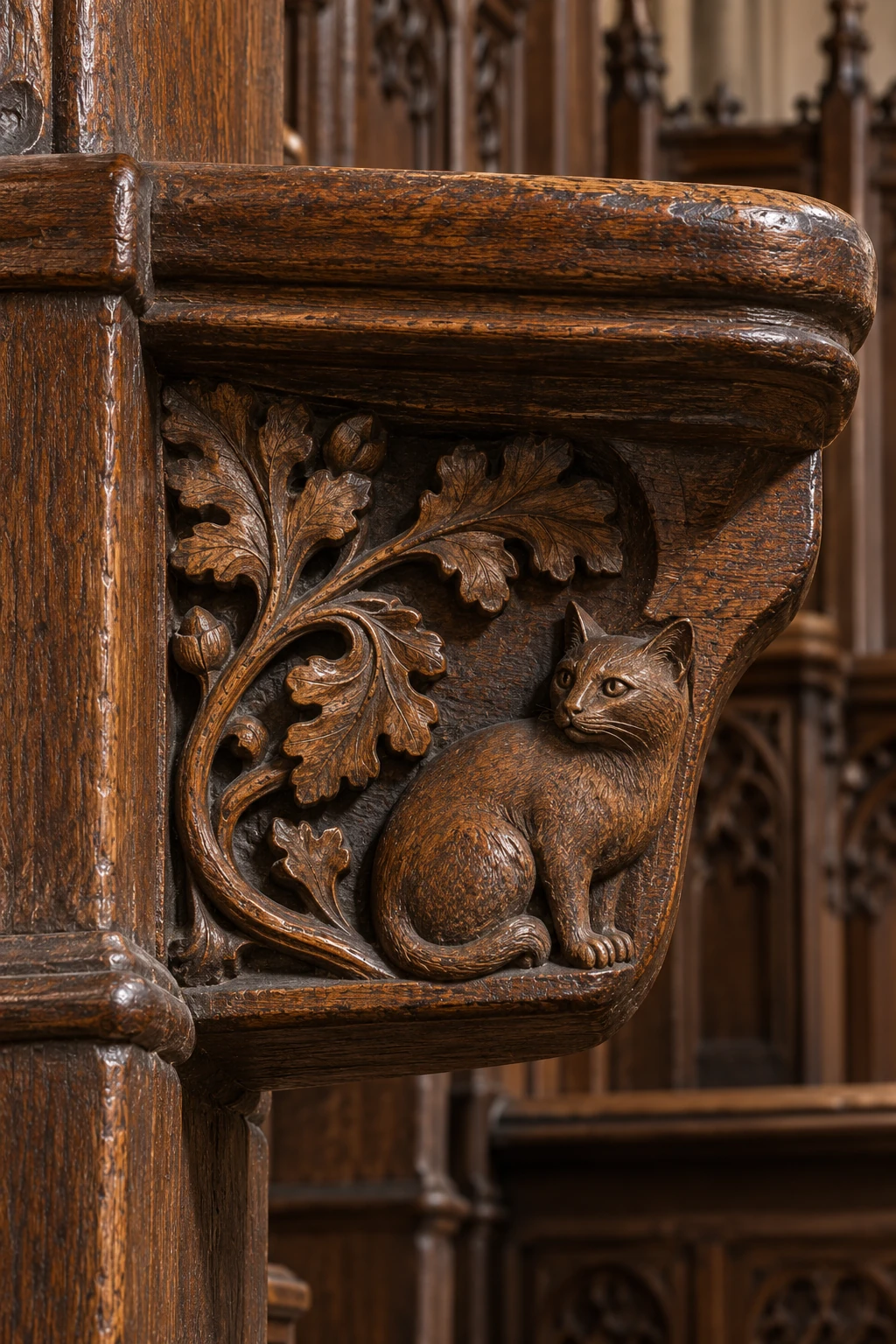
For a paper exercise, draw a broad horizontal ledge with a shallow space below it. Try fitting a cat, a leaf, or a face into that awkward area without changing the boundary. Then make a second drawing that uses the edge itself as part of the design. The constraint helps explain why furniture carving develops forms that would look unusual in a free-standing statue.
When visiting a living cathedral, follow its guidance about access and handling; do not raise old seats simply to get a photograph unless staff permit it. The furniture continues to occupy a working religious space as well as a heritage setting.
Misericords make an unusually intimate history of design visible. They join a tired body, a moving seat, a block of timber, and a carved world in a few inches of space. Looking down can reveal a part of the building that looking up alone would miss.
Sources and a closer look
Ripon Cathedral: quire and misericords; Chester Cathedral: quire history; Winchester Cathedral: collection artifacts; Historic England: Ripon Minster listing.
Find more art, ideas, and unexpected connections at Incoprea.