At the end of a five-metre printed scroll, a short note changes the history of the whole object. It identifies a sponsor, an intention, and a date equivalent to 11 May 868. The final lines let us make a much more precise claim than the appearance of old paper alone would allow.
The Diamond Sutra in the British Library is often introduced as the world’s oldest printed book. The careful wording is more interesting: it is the earliest surviving complete printed text with a date. Earlier printing exists. This scroll’s special power comes from the particular evidence that survives with it.
The last line is part of the work
The International Dunhuang Programme’s guide explains that the copy was sponsored by Wang Jie and woodblock printed onto seven joined sheets. The colophon records the date and dedicates the production to his parents, for distribution. It is a Buddhist act as well as an achievement of printing.
That distinction prevents a common substitution. The sponsor is not automatically the block-cutter, printer, translator, or author of the ancient teaching. A single surviving name can tempt a modern account to assign all the work to one person. The object itself supports a more limited, and more socially interesting, attribution.
The scroll format matters too. A “book” need not consist of leaves turning around a spine. Here, text and image unfold horizontally. The reader’s sequence of encounter differs from flipping through a modern bound volume, even if both objects carry a sustained text.
Printing multiplies a surface; it does not remove labor
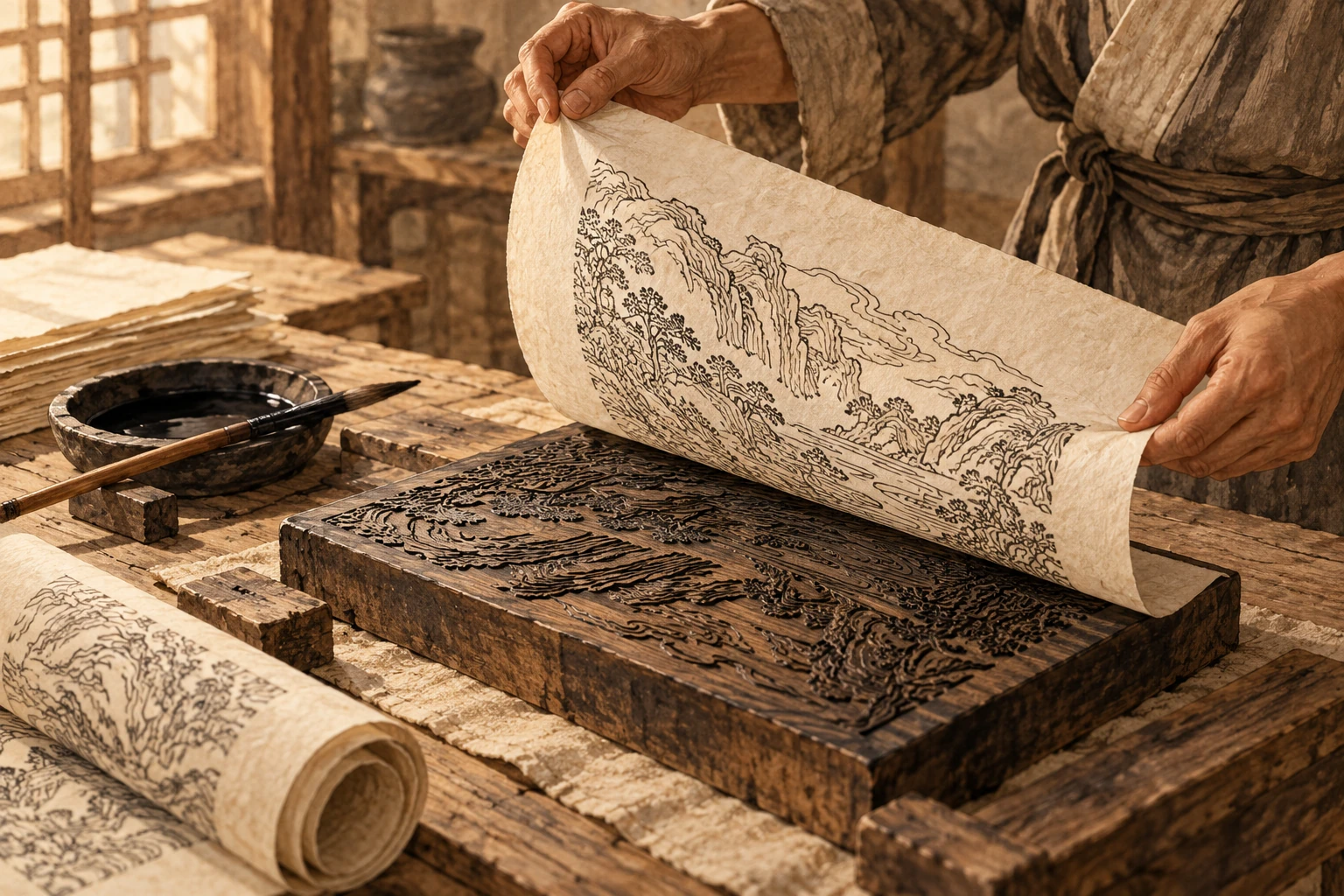
In woodblock printing, a prepared relief surface carries the design that transfers to paper. The IDP account identifies the scroll’s separate printed sections and the joining that made the long format. Once a block exists, repeated impressions become possible; preparing it still requires skilled work.
Think about the difference between writing a message once and making a tool that can reproduce it. The second task can be worthwhile because of the copies it permits. It also requires decisions about layout, line width, ink, paper, and handling. A printing history focused only on the first surviving date can miss those practical choices.
The University of Oxford’s object resource emphasizes the colophon’s devotional purpose. This is a useful corrective to treating the scroll as if it were produced solely to mark a stage on a modern technological timeline. Its makers and sponsor had reasons that belonged to their own religious world.
A text people used, not only an object people display
An IDP newsletter devoted to the Diamond Sutra discusses the text’s place within Mahayana Buddhism and its transmission, alongside research into the scroll’s paper and conservation. The connection is important: the printed object carried a teaching that could be read, copied, recited, and understood within a living practice.
An introductory article cannot replace that tradition’s interpretation. It can avoid turning the sutra into an exotic prop. If you follow the text further, choose a clearly identified translation and commentary and distinguish a religious explanation from a simplified museum label.
The printed frontispiece adds another form of encounter before the main text. Rather than treating it as an optional illustration, ask how an image prepares the reader for what follows. Where are the figures looking? What arrangement makes the act of teaching visible? The answers begin with the picture, while identifying every figure requires the accompanying scholarship.
Conservation changes what access means
The IDP’s film resources connect the scroll’s story with science and conservation. Its later conservation and digitization newsletter explains that the scroll remained in separate panels after extensive treatment, enabling the panels to be displayed in turn. A digitized long view can therefore give an impression of continuous access that differs from the object’s physical conservation arrangement.
A British Library collection-care paper by Helen Shenton discusses virtual reunification and preservation through dispersed collections, including Dunhuang material. Digital access can reunite information for study without undoing the physical histories of collection, dispersal, and treatment.
This is a useful distinction for any online museum visit. Ask whether you are seeing one photograph, several images joined digitally, a reconstruction, or a moving view of the physical object. Each can be helpful; each makes different things visible.
Compare the first and last portions of the scroll as distinct encounters. The opening can invite attention through an image; the ending supplies a dated statement. Between them lies the physical labor of reading a long format. An online image that puts everything on one screen changes that sequence, so try examining the sections individually before viewing the whole.
Read the evidence in reverse order
Try a five-minute visit to the institutional images. Start at the end, where the colophon appears. Then move to the joins between sheets, the main text, and finally the frontispiece. This reverses the dramatic museum habit of beginning with the most beautiful picture.
- Write down what the dated note actually establishes.
- Find one material feature that a transcription of the words would omit.
- Identify one person or task that must have existed but is not individually named in the surviving note.
- Write a caption that preserves the word “dated” in the claim about early printing.
For an optional paper model, join several ordinary scrap sheets end to end and lay them on a table. Put a short original dedication at the end. Roll and unroll the strip gently. Notice how the dedication becomes information encountered after a physical journey through the object. This models format, not Buddhist practice or historical printing.
The Diamond Sutra’s date is a remarkable anchor, but the scroll is richer than a world-record label. It joins devotion, sponsorship, repeated images and words, delicate paper, and centuries of preservation. A small final note opens that larger world because it tells us exactly enough—and leaves the unnamed work around it available for thoughtful attention.
Sources and a closer look
IDP: Diamond Sutra learning guide; Oxford Cabinet: earliest dated printed book; IDP News 38: text, paper and conservation; IDP: Diamond Sutra film resources; IDP News 43: conservation and digitization; Helen Shenton: virtual reunification and conservation.
Find more art, ideas, and unexpected connections at Incoprea.