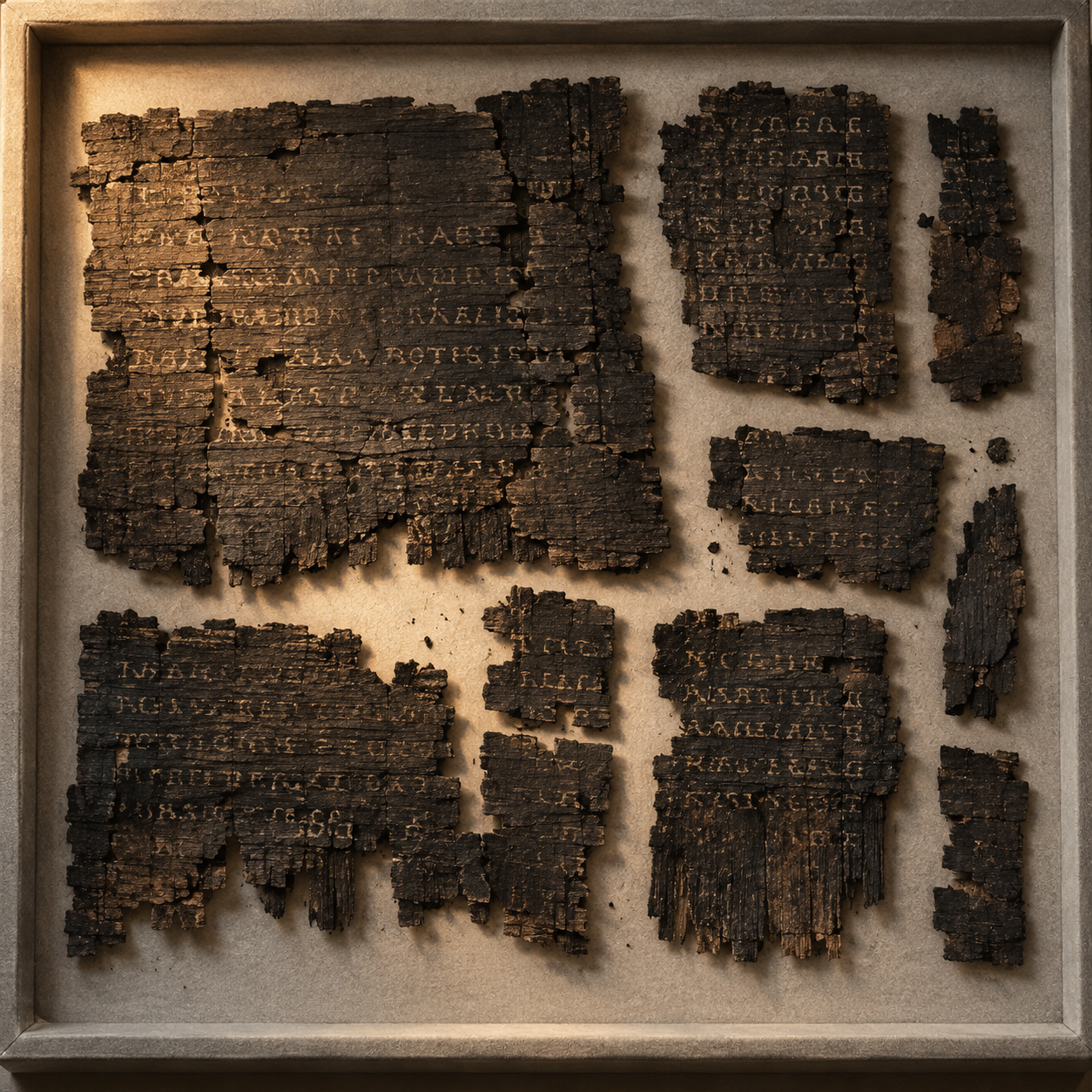
Fire usually belongs in the story of a lost book. At Derveni, near Thessaloniki in Greece, carbonized fragments helped a papyrus survive long enough to be found. Excavated in 1962 among the remains of a funeral pyre, the damaged roll preserves an extraordinary combination of religious instruction and interpretation.
The Archaeological Museum of Thessaloniki dates the surviving writing to approximately 340–320 BCE. The work it copies is considered older. Already, two histories overlap: the age of the physical manuscript and the age of the text transmitted on it.
Reading what the fire left
The roll did not survive intact. Its lower portions were lost, and scholars had to separate layers and arrange fragments. Twenty-six columns of text have been restored, with missing areas that remain part of every responsible reading.
This is why an edition is more than a neatly typed ancient sentence. Editors distinguish surviving letters from uncertain readings and proposed restorations. A translation can make the result look smoother than the underlying object actually is.
UNESCO recognizes the papyrus for its significance to the history of Greek religion and philosophy. Its importance does not depend on removing the gaps. Sometimes a damaged witness is valuable precisely because it preserves a kind of text scarcely represented by physical manuscripts of the period.
A reader interpreting a poem
The text includes ritual material and an allegorical commentary on a poem attributed to Orpheus. The commentator does not merely repeat a story about gods. He treats poetic language as requiring explanation, relating it to a philosophical account of the world.
The Center for Hellenic Studies describes affinities with early Greek philosophical traditions. This meeting of ritual, verse and interpretation complicates the modern habit of separating religion, literature and natural philosophy into independent shelves.
Attribution also needs care. A poem ascribed to Orpheus is not proof that a historically identifiable Orpheus wrote it. The commentator's own identity is disputed. Proposed names belong to scholarly arguments rather than an established author's signature.
| Layer of the evidence | Question to ask |
|---|---|
| The surviving roll | What letters and surfaces remain? |
| The copied work | When was this text composed? |
| The poem within the commentary | How is an earlier tradition being interpreted? |
A reconstruction that can be compared
The Harvard Center for Hellenic Studies project explains its editions and points to digital versions that let readers compare reconstructed texts. Such comparison makes scholarly disagreement visible rather than hiding it behind a single polished page.
That is especially useful for readers unfamiliar with papyrology. A bracket or dotted letter is not decorative clutter. It records the distance between material evidence and editorial judgment.
Derveni's surprise is therefore twofold. A book partly damaged by fire became a rare survivor, and the survivor shows an ancient reader working through another text. We are not only reading words from the past. We are watching interpretation happen twice: first in the commentator's explanation, then in the modern effort to recover what he wrote.
Sources: Archaeological Museum of Thessaloniki: Derveni Papyrus · UNESCO: Derveni Papyrus · Harvard Center for Hellenic Studies: Derveni research project
Explore more creative curiosities at Incoprea.




