Showing posts with label Trees. Show all posts

Thursday, October 22, 2026

Mast Years: Why a Forest’s Seed Schedule Matters

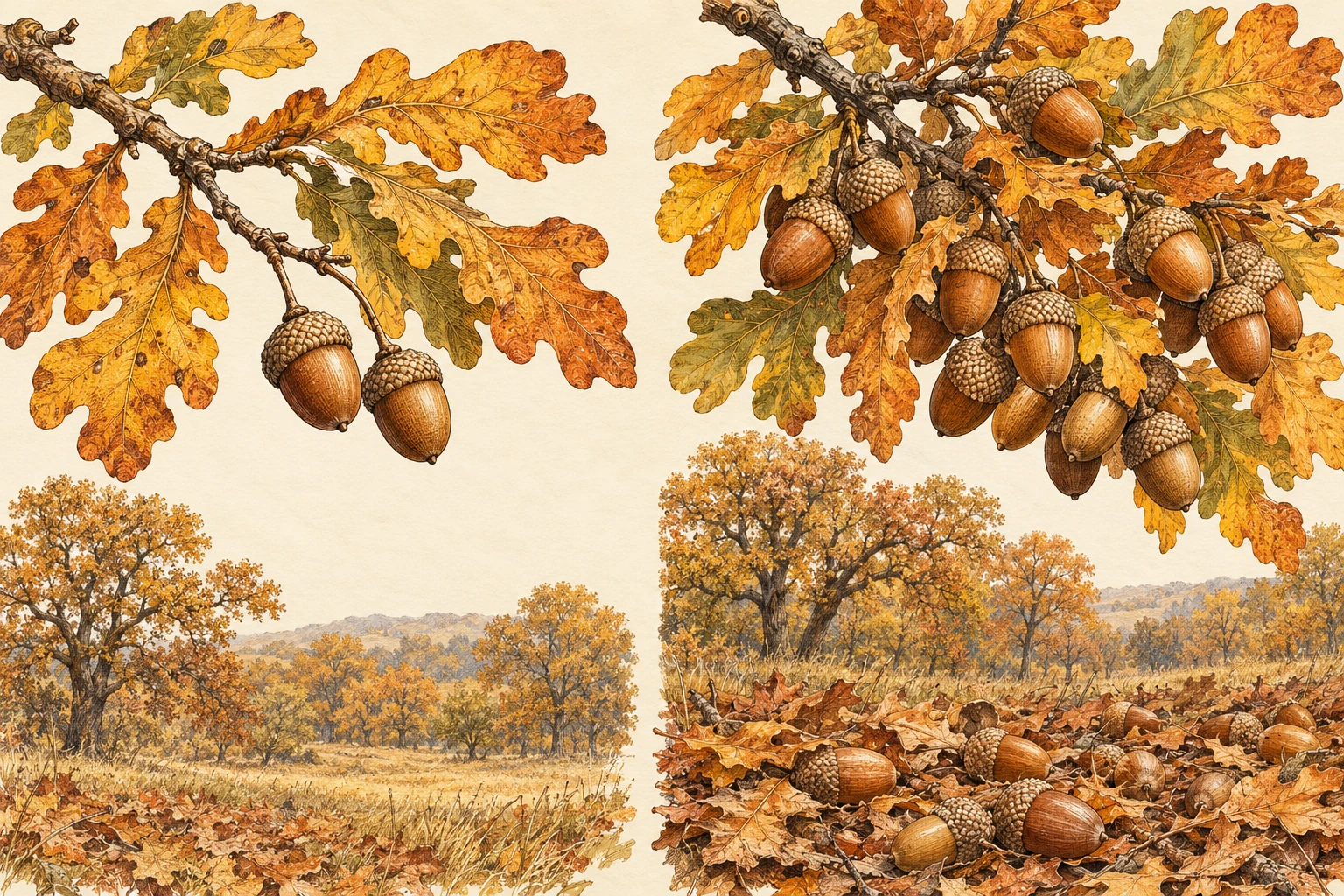
Conceptual comparison of an oak branch with few acorns and a heavily fruiting branch above autumn woodland.
AI-generated conceptual comparison of sparse and heavy seed production; not observations from two measured years.

One autumn the ground beneath an oak seems paved with acorns. Another year, the same walk yields only a few. Extend the view beyond one tree and the puzzle becomes larger: many trees can produce heavy crops together, then share lean years. The forest's reproductive effort has a rhythm, but it is not usually a simple clockwork alternation.

This highly variable, synchronized production is called mast seeding, or masting. It occurs in many perennial plants, with different patterns and mechanisms. Calling every unusually productive individual tree a mast event misses the population component. The interesting signal includes how much crops vary through time and how closely individuals vary together.

Why make seeds in pulses?

The review by Kelly and Sork separates several explanations. A large synchronized crop can overwhelm some seed consumers, leaving a greater proportion uneaten. Synchronized flowering can also improve pollination, particularly in wind-pollinated systems. These are possible benefits of concentrating reproductive effort, not identical mechanisms.

The relevant calculation is often a proportion. A heavy crop can feed more animals while still leaving more surviving seeds per seed produced. Likewise, producing flowers simultaneously can improve opportunities for pollen exchange even when total flower production over many years is held conceptually constant.

But an advantage does not by itself explain how trees achieve the pattern. A plant has resource constraints; flower development unfolds over time; and weather can influence both cues and the success of reproduction. “It saves up and floods the market” is a vivid summary, but not an adequate model for every masting species.

How can distant trees share a year?

Individuals need not communicate directly to respond similarly to a shared environmental signal. Weather patterns can cover large regions. A 2017 analysis combined long-term tree-reproduction records with atmospheric circulation indices to investigate broad synchronization in European beech and Norway spruce. Shared climatic variation can help coordinate organisms separated by distances far beyond neighboring roots.

A 2024 study of European beech investigated another part of the timing problem: responses associated with summer temperature and the solstice. The findings supported a role for a seasonal timing window in coordinating responses across a large range. This is not a discovery that all trees drop seeds on the longest day. The cue can concern the development of a later reproductive event.

That temporal distinction is crucial. Weather during flowering, weather while seeds develop, and a cue influencing the following year's flowering can all matter differently. A correlation between this autumn's crop and last summer's temperature should not be rephrased as this autumn's weather causing every stage of the crop.

More seeds can still mean weaker reproductive efficiency

A 2020 study of European beech in England examined records from 1980 to 2018. Warming was associated with changes in variability and synchrony that weakened benefits linked to mast seeding. The lesson is counterintuitive: increasing average seed production need not compensate for losing the timing pattern that helps seeds avoid consumers or become fertilized efficiently.

Imagine two hypothetical forests with the same ten-year total of seeds. One produces a very large crop in a few shared years and almost none in others. The second produces a steady moderate crop every year. A consumer population may respond differently to those schedules. Equal totals do not guarantee equal outcomes because other organisms respond through time too.

The example does not prove which schedule is best. It isolates the reason a mean alone is insufficient. A serious comparison needs the timing, consumer response, pollination conditions, and actual seedling establishment. A 2024 synthesis of masting brings resource budgets, environmental cues, and evolutionary benefits into a combined framework.

This also helps interpret a neighborhood saying that “lots of acorns predict a hard winter.” A present crop reflects a history of reproduction and environmental conditions; it is not evidence that the tree has forecast the coming season. To test a prediction, one would need defined records and comparisons across many years, rather than remembering the striking autumn before one difficult winter.

The generated comparison above is a conceptual sparse-year and heavy-year illustration, not a dataset. Real trees do not politely arrange their output into two labeled categories, and a good study preserves the variation between extremes.

Masting makes a forest audible and tangible: seeds striking roofs, shells underfoot, animals collecting the pulse. Beneath that abundance lies a relationship among timing, resources, and other lives. The forest has not simply made more. Many individuals have made more together, and that “together” can change what reproduction achieves.

Follow the evidence: Kelly and Sork: mast seeding mechanisms and evolutionary explanations; Journé and colleagues: summer-solstice synchronization in beech; Bogdziewicz and colleagues: warming and masting benefits; Ascoli and colleagues: continental-scale climate synchronization; Evolutionary ecology of masting: mechanisms and climate change.

More curious connections, art and independent projects at Incoprea.

Pando: Where Does One Tree End?

Stand among the white trunks of an aspen grove and the ordinary counting rule seems obvious: one trunk, one tree. Pando, the large quaking-aspen clone in Utah, makes that rule inadequate. Many visible stems belong to a lineage that began from one seed and spread vegetatively. The forest-like scene asks us to distinguish a trunk from a genetic individual.

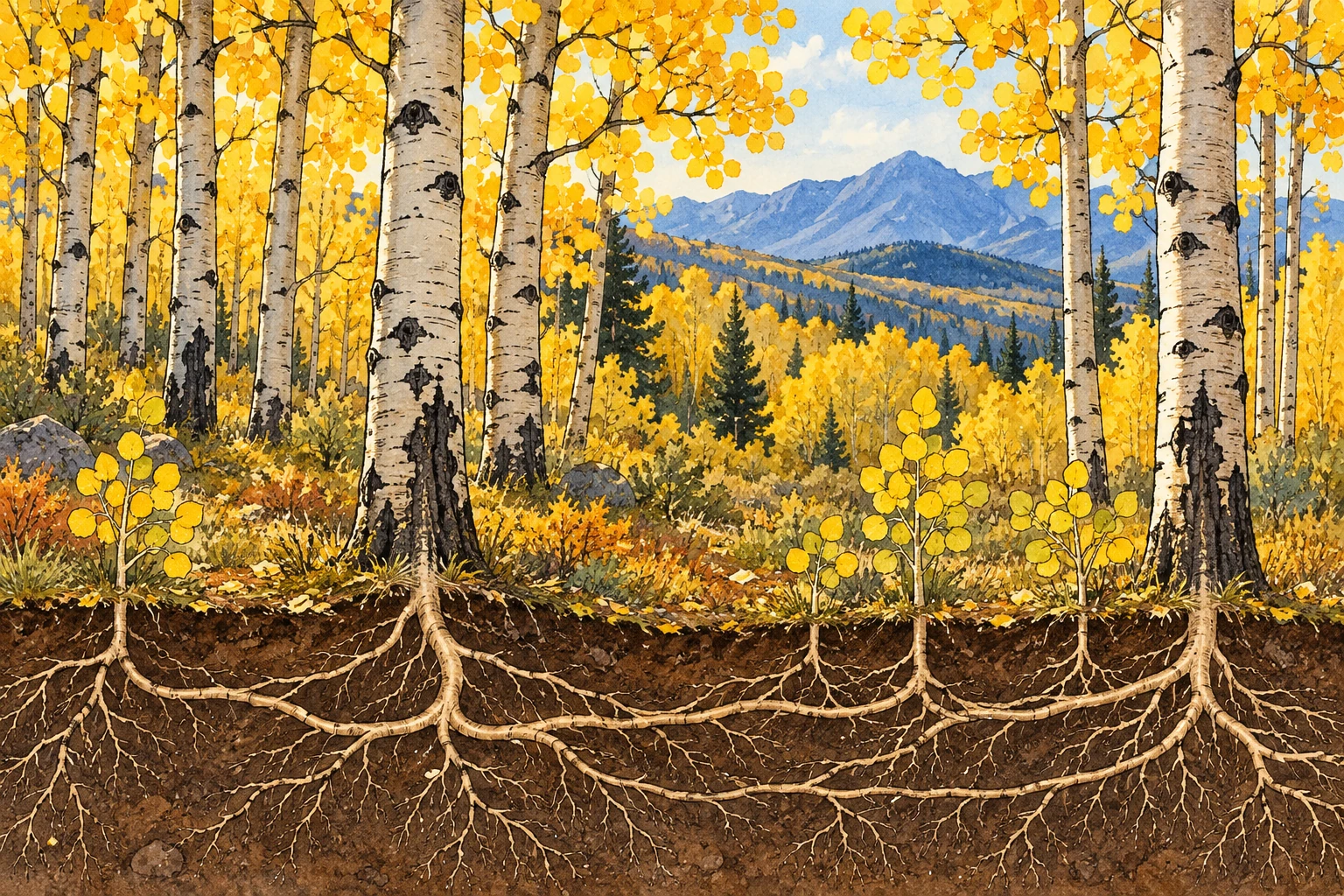
An autumn aspen grove with a schematic soil cutaway showing roots and young suckers.
AI-generated conceptual aspen cutaway; root connections are schematic, not a map or reconstruction of Pando.

The distinction is not mystical. A ramet is a module produced through clonal growth; a genet is the genetic individual originating from a seed or other founding reproductive event. Multiple ramets can belong to one genet. The terms help describe a plant whose body is assembled and renewed across space.

How can we know that the stems belong together?

The Western Aspen Alliance's genetics account describes DNA-fingerprinting work that confirmed Pando's clonal identity in 2008. It also notes other, smaller clones within the broader aspen stand. A grove's visual boundary and a clone's genetic boundary are not automatically the same line.

This is a good example of evidence changing an everyday category. Similar leaf shape or simultaneous autumn color can suggest a connection, but genetic markers can test whether sampled stems share clonal identity. Conversely, a genetically identified clone does not give us a photograph of every living root connection at every moment.

The US Forest Service account of quaking aspen explains how root suckering contributes to regeneration. New stems can arise from an existing root system. A stem can die while clonal growth continues elsewhere. The longevity of a lineage therefore need not mean that one ancient trunk or one unchanged piece of original tissue remains alive.

Which age are we asking about?

Counting rings in a trunk estimates the age of that stem. Estimating the time since the clone's founding seed requires a different method. Neither the number of stems nor the width of the grove supplies a direct clock unless assumptions about past growth are added.

A 2026 eLife reviewed preprint analyzed somatic mutations across more than 500 samples, including different tissues and neighboring clones. Its authors used phylogenetic analyses to estimate a clone age of roughly 12,000–37,000 years. Crucially, the accompanying editorial assessment judged evidence for several central conclusions, including age, incomplete because the genomic data were relatively low-coverage and sampled only part of the genome.

The right way to report that result is as a model-based estimate with explicit evidential limits. It is not a certified birthday. Older articles and earlier preprint versions can give different ranges; that movement is a reason to identify the version and method rather than selecting the most dramatic number.

The practical problem is the next generation of stems

Whatever the precise age, persistence depends on replacement. A 2018 study by Rogers and McAvoy examined 65 monitoring plots under different management regimes. It measured mature trees, regeneration, browsing, and signs of ungulate presence, and used historical aerial photographs to examine change. Successful recruitment of young stems was central to assessing condition.

The study linked mule-deer browsing with poor regeneration and found stronger recruitment under effective protective treatments. A fence that animals could penetrate did not provide the same protection as an effective barrier. That detail matters: the presence of a management structure on a map is not evidence that it achieved its ecological function.

A stand full of large trunks can therefore conceal a demographic problem. If old stems continue to die while few young stems escape browsing and reach maturity, the current canopy does not guarantee a future canopy. Looking only upward can miss the process that determines whether the clone persists.

The Friends of Pando–Forest Service partnership describes a framework for research, public education, and stewardship. Such work turns a record-breaking organism into a place with ongoing practical needs. The relevant conservation outcome is not preserving a headline about size; it is sustaining the living processes that replace tissue and maintain a functioning community.

If visiting an aspen grove, look for several sizes of stems, including young suckers and saplings, from established routes. Do not dig to expose connections or move through protected regeneration areas. The contrast between a mature canopy and the smallest stems can be more informative than another photograph of impressive trunks.

The generated cutaway above is schematic. Its roots explain the possibility of clonal growth; they are not a mapped reconstruction of Pando's underground body. The genetic and monitoring studies are the evidence.

Pando expands the meaning of a tree without erasing the usefulness of individual stems. Each trunk has a history; the lineage has another. Its future depends on renewal at the scale of small shoots. A very old organism can be sustained by tissue that is young, and an apparently full forest can need help making what comes next.

Follow the evidence: Utah State Western Aspen Alliance: genetic identity; US Forest Service: quaking-aspen biology; Rogers and McAvoy: regeneration and browsing at Pando; Pineau and colleagues: 2026 reviewed preprint and assessment; Friends of Pando: stewardship partnership with Forest Service.

More curious connections, art and independent projects at Incoprea.
The Elevator With Three Working Buttons

Case 50 · shortest-path challenge · Hard · About 10-15 minutes The archive elevator has a peculiar test mode. Its floor display works, but o...