Showing posts with label Hidden Wonders. Show all posts

Wednesday, October 14, 2026

Prince Rupert’s Drops: Strong Glass with a Vulnerable Tail

Illustration of two intact glass drops with long curved tails, one showing colorful polarized-light-style stress patterns.
Intact drops with an artistic representation of polarized-light stress fringes; colors are not an ordinary naked-eye appearance.

A Prince Rupert's drop resembles a glass tadpole: a rounded head leads into a long, thin tail. Its contradictory behavior has fascinated investigators for centuries. The head can resist substantial compression, yet damage to the tail can cause the whole drop to disintegrate rapidly.

The puzzle is not solved by calling the glass either strong or fragile. Both descriptions apply under different conditions. The important feature is a pattern of stresses locked into the material as it cools.

A quiet object storing an uneven balance

The drops form through rapid cooling of hot glass. The exterior cools before the interior, and the changing material cannot shrink everywhere in the same way at the same time. The finished object retains compressive stress near its surface and compensating tensile stress inside.

Compression helps keep surface cracks from opening and growing. That gives the bulbous head impressive resistance to certain impacts and applied loads. It does not make the object indestructible or imply that it performs equally well under every kind of force.

The interior tells the other half of the story. Tensile stress favors crack growth once a fracture can enter that region. The drop's strength therefore depends on the relationship between its protective outer stress and its vulnerable stressed interior.
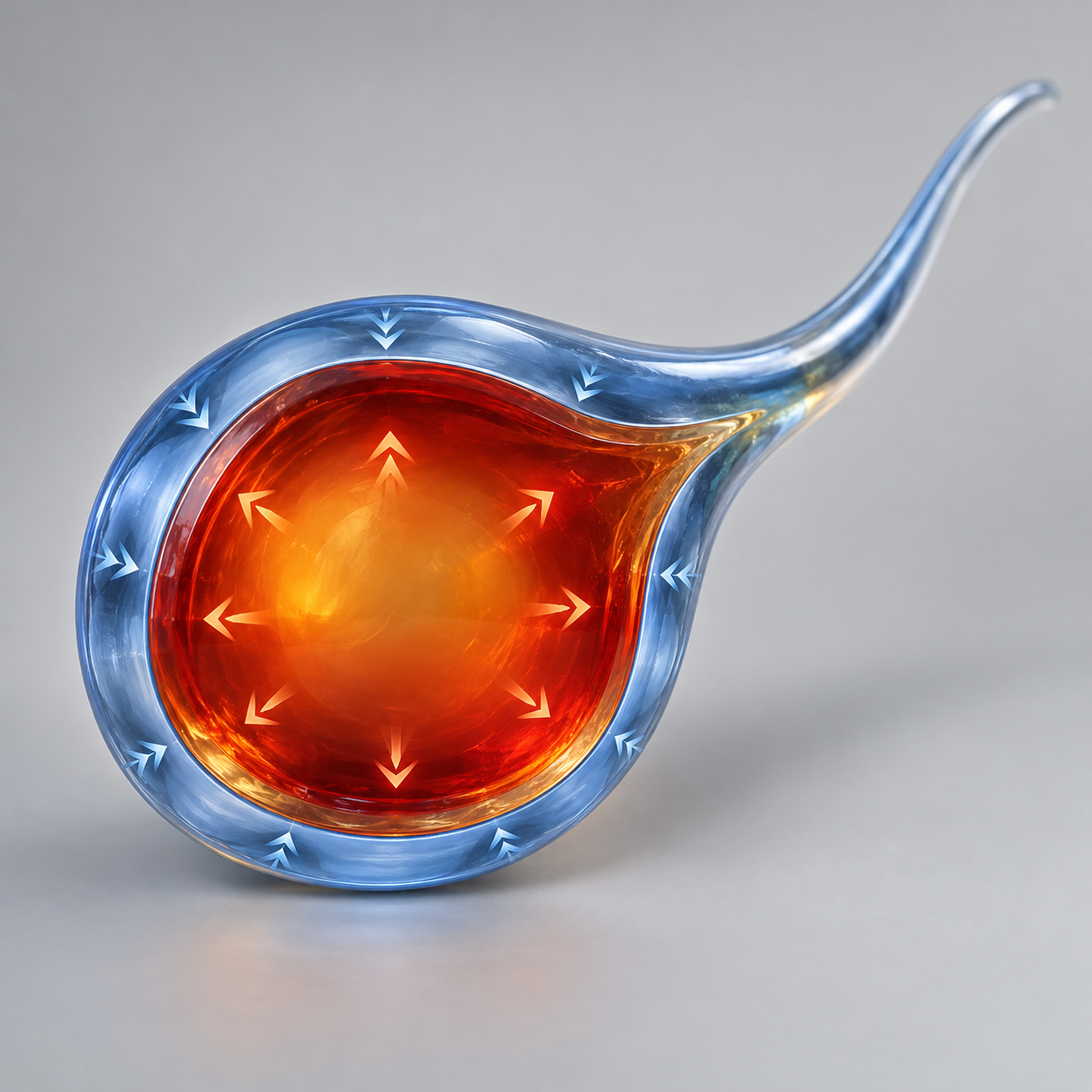
Conceptual blue surface layer and red interior illustrate contrasting residual stresses in a glass drop.
Compression near the surface and tension inside, shown with explanatory colors and arrows rather than a measured stress map.

Strength needs a location and a kind of load

Consider two questions that sound almost identical: how hard is it to start a crack at the head's surface, and what happens after a crack reaches the interior? The first concerns resisting damage under a particular loading arrangement. The second concerns the propagation of damage through an already stressed object. The answers can differ dramatically without contradiction.

Surface compression makes opening a crack more difficult because the surrounding material tends to close it. Inside, stored tensile stress favors separation once an accessible crack can grow. A small initiating disturbance can therefore release energy that was already stored during manufacture. The breaking tool does not have to provide all the energy visible in the final disintegration.

This is a useful distinction when reading a headline comparing the drops with steel. A reported compressive stress or survival under a particular test does not make the glass interchangeable with a steel component. Strength depends on geometry, flaws, the direction of loading and the test being performed. The word becomes informative only when those conditions come with it.

The tail opens a path to failure

The thin tail offers a route for damage to reach the tensile region. Once a crack begins to propagate through the stressed glass, stored elastic energy can drive a very rapid breakup.

High-speed photographic work reported by Srinivasan Chandrasekar and Munawar Chaudhri in 1994 examined that disintegration. Later research concentrated on the head's resistance, measuring how compressive stress helps suppress particular crack patterns.

Watch two different experiments in the laboratory account

Begin with the high-speed breakup sequence. Ask where failure starts and how it travels. A normal-speed clip compresses the event into a sudden disappearance; high-speed imaging spreads it across time so that a propagating process becomes visible. The 1994 investigation addressed this fast sequence, rather than inferring its entire course from the fragments left afterward.

Then compare the polarized-light images. These answer a different question about the intact drop: how stress is distributed before it breaks. Purdue's 2017 account describes mathematical reconstruction from the optical patterns. A colored fringe is part of a measurement method; it is not a direct photograph of a particular number written inside the glass.

Keep a simple ledger while viewing. Under “during failure,” note the moving fracture. Under “before failure,” note the optical stress evidence. Under “interpretation,” place the explanation connecting stored stresses with resistance at the head and rapid propagation from the tail. Each column contributes something the others cannot supply alone.

The comparison also explains why the illustration uses qualifications. Its colored pattern helps distinguish regions, but an artistic fringe cannot establish the measured value at a real point. To learn a number, consult the experiment's calibrated method and reconstruction. The transparent object offers a rare opportunity to connect visible shape, invisible residual stress and a process too fast for ordinary vision, provided those three forms of evidence remain distinct.

Color makes hidden stress readable

Researchers used photoelastic methods to investigate stress distribution. Under suitable polarized-light conditions, stressed transparent material produces patterns that can be analyzed mathematically. Colorful bands become evidence about internal mechanical conditions rather than decoration.

The principle connects this curiosity with broader materials engineering. The performance of glass depends not only on its chemical ingredients but also on cooling history, surface condition and stress. Similar attention to controlled surface compression helps explain the value of toughened glass.

The experimental drama is best understood through documented laboratory observations. This is a materials-science story, not an invitation to prepare or break stressed glass at home.

See the laboratory investigation: Purdue’s research video shows the drops and the analysis behind their unusual behavior.

Sources and further reading: Purdue University: Strength and internal stress of glass drops · Aben et al.: Extraordinary strength of Prince Rupert’s drops · Chandrasekar and Chaudhri: Explosive disintegration study

Lodestones: The Rocks That Arrive Already Magnetic

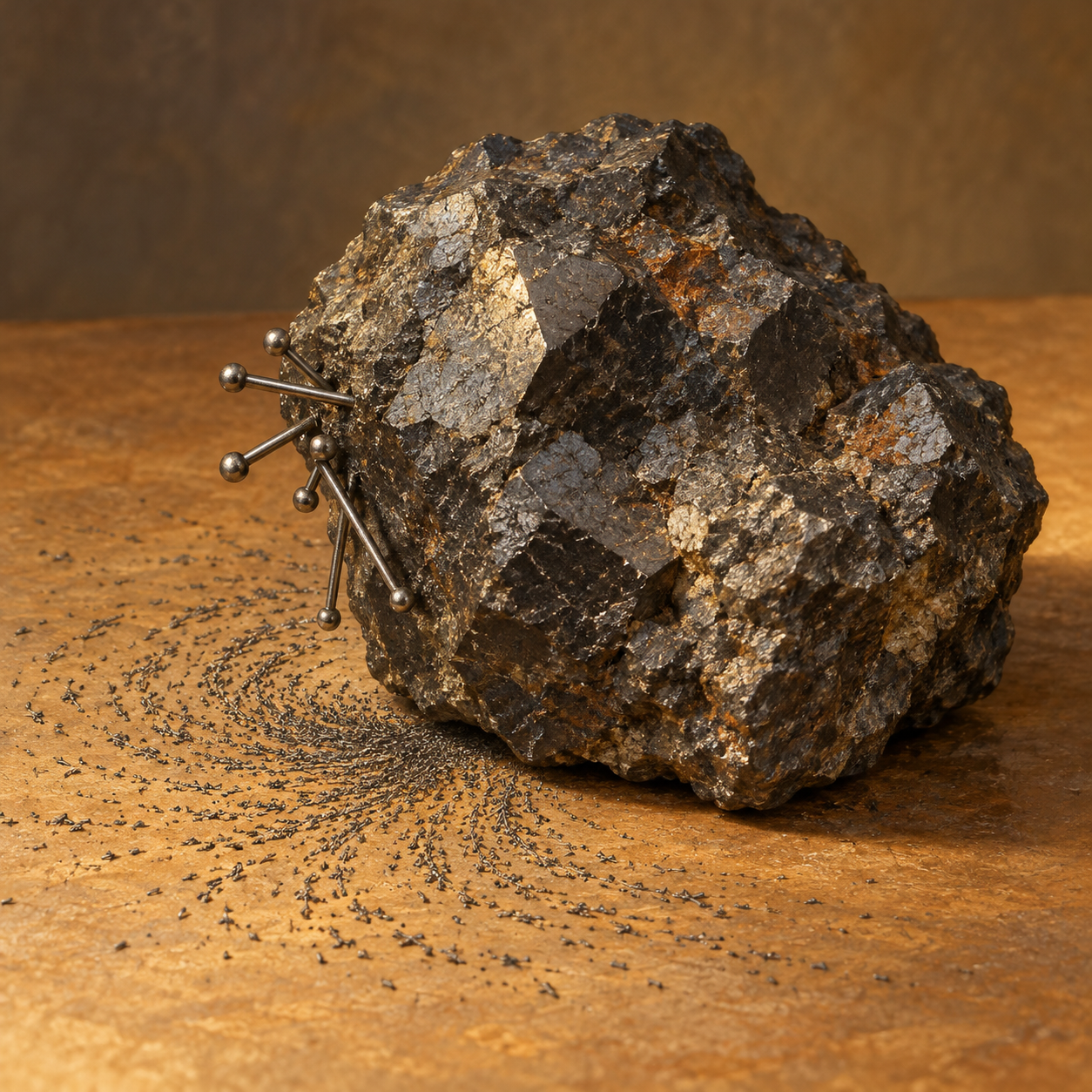
Illustration of a dark lodestone with small steel pins clinging to its side.
A lodestone’s attraction is shown with small steel pins and sparse filings.

A rough dark stone picks up a steel pin. There is no wire, battery or hidden manufactured magnet inside it. A lodestone is a naturally magnetized piece of magnetite, an iron oxide mineral, and its ability to attract certain metals connects a simple tabletop curiosity with the history of navigation.

It is useful to distinguish the mineral from the magnetic specimen. Magnetite is relatively common. A piece that retains a substantial natural magnetization is a more specific thing: the lodestone.

The stone has a direction

Like a manufactured magnet, a lodestone has identifiable magnetic poles. A suitably supported specimen can orient in Earth's magnetic field, and its interaction with another magnet can reveal attraction and repulsion. That behavior explains why naturally magnetic materials could help people discover directional instruments.

The stone does not attract every metal equally. Iron and many steels respond strongly, while materials such as copper do not behave like the pins clinging to a classroom specimen. Magnetism is a property of particular materials and structures, not a universal metallic stickiness.

The irregular surface can disguise that organization. A rock need not look symmetrical, pointy or arrow-shaped to carry a persistent magnetic field. Its useful direction belongs to the physical state of the material rather than its visible outline.

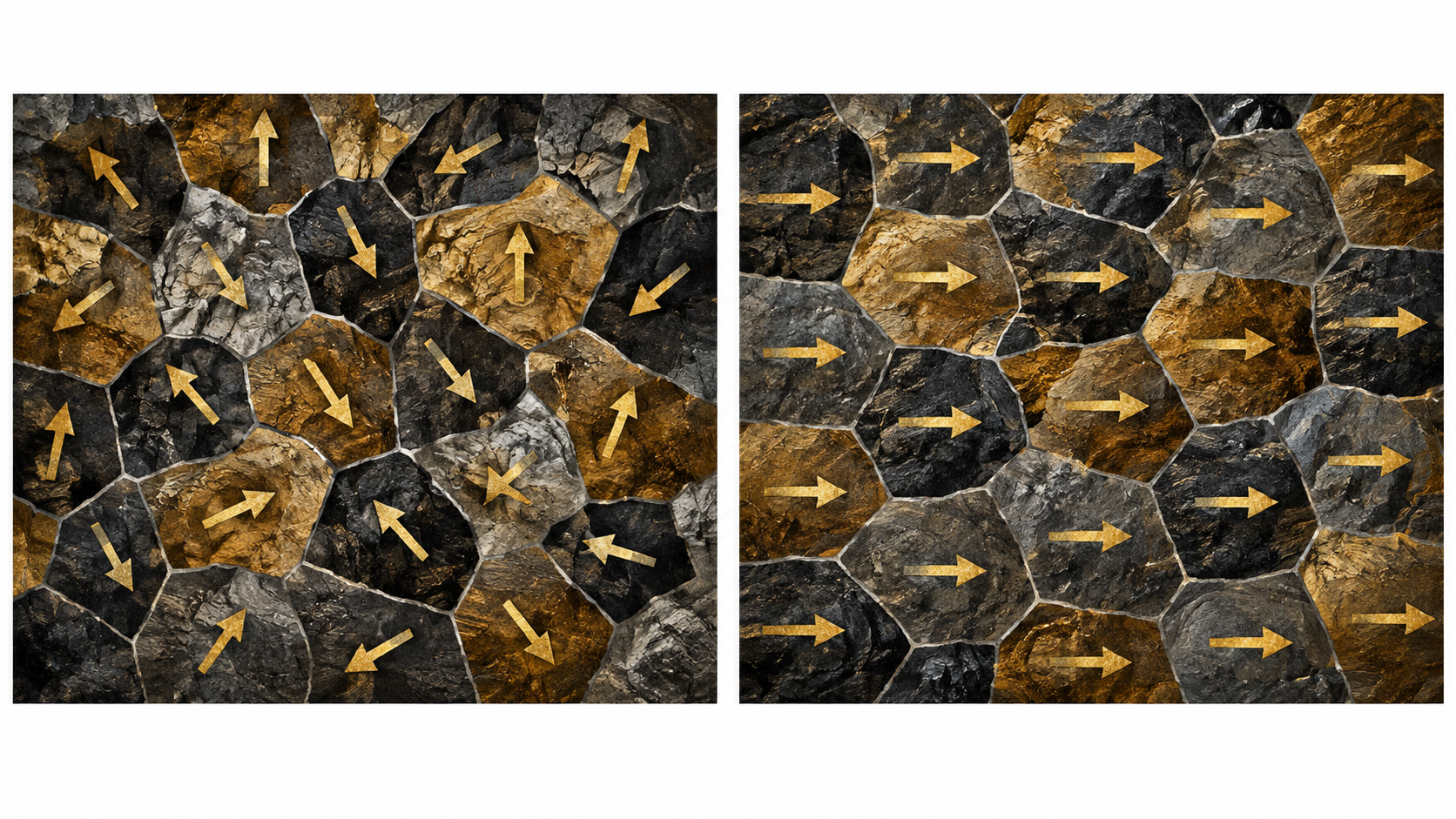
Two conceptual panels contrast varied and more aligned magnetic-domain orientations.
A visual model of less aligned and more aligned magnetic organization; arrows and boundaries are explanatory, not a measured mineral image.

A stone, a steel clip and a test of direction

If you have a classroom lodestone and an ordinary steel paper clip, first note where on the stone the clip is most strongly attracted. Try several positions without assuming that the longest visible axis must be the magnetic one. A rock's irregular silhouette gives no reliable map of its poles.

Next consider a more discriminating observation: attraction alone does not tell you that both objects began as permanent magnets. A magnet can attract suitable unmagnetized iron by inducing a magnetic response in it. Repulsion between identified like poles offers different evidence. This is why a pin hanging from a stone is an engaging demonstration of a field's effects, but an incomplete account of both objects' magnetic history.

Keep nearby manufactured magnets away while examining the specimen's original behavior. Otherwise the observation and the intervention become mixed. A strong applied field can change the state that you were trying to investigate. Record the arrangement before altering it, much as a geologist would record the position and context of a sample before moving it.

A freely turning compass can add a directional comparison. Its needle responds to the combined field in its location, including Earth's field and any nearby magnetic material. A changed direction near the stone does not mean north itself moved. It means the local magnetic environment changed. Move the compass away again and compare rather than treating one reading as an isolated fact.

How did the rock become a magnet?

Researchers have investigated whether lightning can produce strong magnetization in suitable magnetite. A lightning current generates an intense, brief magnetic field. Experiments associated with NASA researcher Peter Wasilewski showed that appropriate mineral samples could become strongly magnetized after exposure to lightning.

That supports a mechanism for producing lodestones, while leaving the history of any particular found specimen to be established. A dark magnetic rock is not, on its own, a timestamped record of a specific strike.

Composition and crystal structure also matter. Different samples can respond differently, and simply resting in Earth's comparatively weak field is not equivalent to receiving a strong magnetic pulse.

What the domain drawing leaves out

The arrow diagram represents organization within a magnetic material. It is useful for separating microscopic magnetic behavior from the shape of the whole rock. It should not suggest that a real specimen consists of a few evenly sized boxes, or that we can count its magnetic regions by looking at a broken surface.

Mineral composition and structure affect the ability to acquire and retain magnetization. An intense event can supply a magnetizing field, but the mineral must also respond in a way that persists afterward. The archived NASA discussion makes this material requirement part of its lightning explanation, rather than proposing that every rock touched by lightning becomes a useful magnet.

That leaves two investigations which should not be merged: establishing a mechanism experimentally and reconstructing the life of a found specimen. An experiment can show that suitable magnetite becomes strongly magnetized in a lightning field. To claim that a particular rock experienced a particular strike would require additional evidence. The satisfying feature of a lodestone is that its present behavior can be clear even while parts of its past remain unknown.

A small clue to invisible fields

That is also a lesson in the difference between a material and its history. Two similar-looking pieces of mineral may carry different magnetic states. An object's behavior can depend on what happened to it, not merely on its ingredients.

The stone's surface tells one story about mineral formation. Its magnetic field adds another story that cannot be read by color and shape alone.

Sources and further reading: University of Colorado Boulder: Lodestone demonstration · NASA Goddard archive: Lodestones and lightning research

The Desert Stones That Travel on Sails of Ice

Illustration of a stone and its curved track beside thin ice on a desert playa.
A conceptual view of a sailing stone and the temporary icy conditions that help create its track.

A rock rests on a cracked desert lakebed. Behind it stretches a long groove, sometimes straight, sometimes turning as if the stone had changed its mind. There are no footprints and no obvious hill. At Racetrack Playa in Death Valley National Park, the scenery seems to have misplaced one of the basic rules of geology: rocks are supposed to stay where you leave them.

The stones really do move. The interesting part is that their journeys depend on conditions almost opposite to the blazing heat most people associate with Death Valley. A rare winter arrangement of water, ice and modest wind can turn an apparently motionless desert into a slow conveyor.

A desert with a temporary winter skin

In December 2013, researchers Richard and James Norris witnessed rocks moving across a shallow pond on the playa. Their experiment used weather instruments, time-lapse cameras and stones fitted with GPS equipment. The research, published in 2014, replaced a collection of plausible stories with direct measurements.

First, rain must leave water deep enough for floating ice to form, yet shallow enough for stones to protrude above the surface. A cold night freezes a thin sheet. Sunshine then weakens and fractures that sheet into broad panels. Wind pushes the floating panels, which can press against rocks and slide them through the soft mud.

The ice was only a few millimeters thick. The observed winds were roughly 3–5 meters per second, a breeze rather than a hurricane. A large panel spreads that gentle push over a substantial area. It need not lift a stone or wrap it in a thick icy jacket to help move it.

The ice panel is the sail

The word “sailing” can lead us toward the wrong picture. A stone does not need to float like a boat, and the wind does not need to push only against the rock's exposed face. A broad floating ice panel intercepts the wind across a larger area and transfers a push where it contacts the stone. The rock moves through soft mud while the panel moves on water.

Several requirements have to coincide. Too little water cannot support the needed floating sheet. A deep covering could leave a different arrangement around a submerged stone. Ice must form, then break into mobile panels rather than remain a single immovable surface. The ground must permit sliding. The rarity comes from the combination, not from one extraordinary ingredient.

Try a counterfactual for each requirement. Suppose the cold night produces ice but the following day never loosens it. Suppose a breeze arrives after the water has disappeared. Each ingredient sounds promising by itself, yet the sequence matters. The desert's usual dry appearance hides the short-lived conditions that make the mechanism work.

This also explains why a forceful-sounding explanation is not automatically better. Earlier proposals could focus on extreme winds because a large rock seems to demand a violent event. Measuring thin ice and modest winds showed how distributing a small force across an appropriate structure can produce an unexpected result.

A journey too slow to notice

During the recorded events, rocks typically traveled at only a few meters per minute. Some movement episodes lasted seconds; others continued for several minutes. Several stones could move together, leaving roughly parallel tracks, while changing ice conditions could produce turns and differences in direction.

That creates an unusual problem for an observer: the evidence can be obvious afterward, while the event itself is easy to overlook. If surrounding rocks are also moving, there may be little visual reference for judging the motion. A dramatic-looking trail can record an undramatic afternoon.

Can you reconstruct a journey from its trail?

Look at photographs in the research paper and select two neighboring tracks. Do their directions agree for part of their length? Do both turn? Such similarities can suggest a shared episode of motion, but tracks alone do not supply a full time sequence. A later crossing can be superimposed on an earlier one, and the mud records only the portions of contact that left a readable mark.

The instrumented study added what the trails lacked: observations of the event while it happened. Position records could be compared with weather and images. A mechanism became testable through the timing of several measurements rather than through a single spectacular photograph of an abandoned path.

Keep that distinction when considering a particular stone. The study documents a mechanism operating under observed conditions; it does not assign a verified date and complete itinerary to every trail a visitor sees. Even a convincing general explanation leaves individual histories to be reconstructed. The undisturbed tracks are therefore still evidence worth protecting, not disposable props after a mystery has been “solved.”

The tracks deserve to stay mysterious-looking

The playa is also fragile. Footprints and vehicle marks can persist, and moving stones erases the very evidence visitors come to see. The best encounter is a patient one: look at the trail, imagine the vanished pond and ice, and let the rock keep its place until the next brief winter journey.

Sources and further reading: National Park Service: The Racetrack · Norris et al., PLOS ONE: First observation of rocks in motion

Brinicles: The Hollow Icicles Growing Beneath the Sea

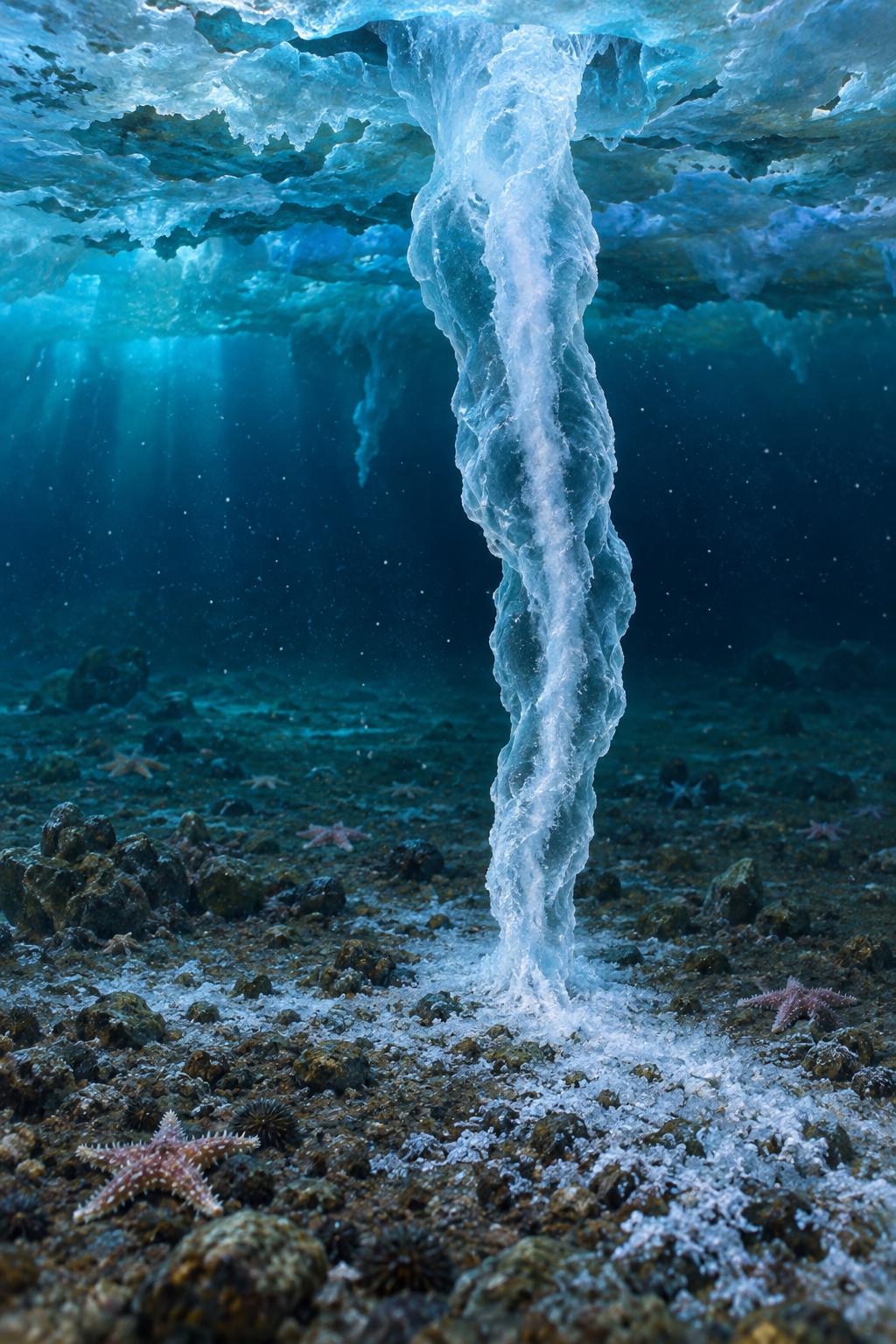
Illustration of a long translucent ice tube hanging beneath polar sea ice toward the seafloor.
A brinicle grows around sinking, concentrated brine beneath sea ice.

Imagine an icicle growing underwater. It hangs from the underside of sea ice and reaches down into seawater, forming a pale tube around an invisible descending stream. This structure is a brinicle, and it is one of the stranger architectural tricks that salt and cold can perform together.

Its familiar nickname, an underwater “ice finger,” captures the shape. More dramatic names can make it sound like a creature hunting the seabed. The real process is physical rather than purposeful: water freezes around concentrated brine draining from the ice overhead.

Freezing makes a salty problem

As seawater freezes, the developing ice excludes much of its salt. The remaining liquid becomes a concentrated brine threaded through channels and pockets in the ice. That brine can be colder than the surrounding seawater while remaining liquid, because dissolved salt lowers its freezing temperature.

It is also denser, so when it escapes from the underside of the sea ice it sinks. The extremely cold plume can freeze the less salty seawater touching it. An icy sleeve develops around the flow, extending downward as more brine passes through. The result is a hollow tube, not a solid spear falling through the ocean.

A thin translucent ice tube hangs beneath sea ice, with its hollow lower opening visible against dark blue surrounding water.
An illustrative underwater close-up emphasizes the hollow ice sleeve and open seawater around it. The brine flowing inside would not appear as a glowing or colored jet.

Why colder liquid can remain liquid

The brinicle's apparent contradiction comes from comparing two different solutions as though their freezing conditions were identical. Concentrated brine can remain liquid at a temperature where less salty surrounding water can freeze. The cold stream therefore need not freeze first merely because it is colder.

As the two meet, heat flows from the relatively warmer seawater toward the colder brine. Under suitable conditions, surrounding water freezes into a wall. The brine continues through the channel it helps produce. A hollow tube is the visible record of this heat exchange and of the continuing supply from above.

Imagine interrupting that supply. The existing tube does not contain a secret engine that must keep lengthening. Its growth depends on the thermal and flow conditions at the advancing end and along its walls. The structure is better understood as an evolving boundary around a flow than as an ordinary icicle that happens to point down underwater.

Salinity, temperature and flow have different roles in this explanation. Salt changes freezing behavior and contributes to the brine's density; the temperature difference makes freezing of surrounding water possible; the flow carries the cold solution through the structure. Removing any one from the description can make the remaining process sound mysterious again.

A garden growing upside down

Researchers have compared this process with “chemical gardens,” laboratory structures in which mineral tubes build themselves around flowing solutions. Ordinary chemical gardens often grow upward because the internal solution is lighter than the surrounding liquid. In a brinicle, dense brine goes downward and the wall is ice, making it an inverted cousin of that phenomenon.

The comparison is useful because it connects a striking polar scene with broader questions about self-organization. Nature can build a narrow channel without a designer, mold or excavator. A difference in composition and temperature provides the machinery.

Watch a laboratory analogue with the variables in view

The 2024 experimental paper includes video material and compares several ways of growing analogous tubes. Before watching, make a short list of what the experiment can control: the solutions supplied, their temperatures, the point where a flow enters and its rate. In the field, these conditions can vary beneath an irregular ice sheet and are harder to measure continuously.

Choose one feature to follow, such as the position of the lower tip. Then notice whether the wall stays continuous and whether branching or irregular growth appears. A time-lapse can make a slow process look decisive, so check the accompanying timing before inferring how fast the natural structure would develop.

An analogue is valuable because it lets researchers test relationships repeatedly. It is not a complete polar ocean reduced to a glass container. Differences in scale, boundaries and supply conditions remain part of the interpretation. Compare the stated experimental method with the natural mechanism rather than judging realism only from a similar silhouette.

The same discipline applies when the discussion moves to icy moons. An Earth experiment can show how a particular brine and temperature arrangement builds a membrane. Extending it to another world requires information about that world's ice, ocean composition and conditions. A plausible chemical setting can motivate a search without establishing that the structure or a living community is actually present there.

An earthly clue for distant oceans

A brine flow that reaches the seafloor can freeze water along its path, affecting small animals unable to move away quickly. That local impact is real, but it does not turn every brinicle into a sweeping underwater catastrophe. Its scale and fate depend on the surrounding environment.

Brinicles have also attracted researchers studying icy moons. Scientists have considered whether comparable ice membranes could form where an ice shell meets a salty ocean, and whether their chemical gradients might matter for possible habitats. Those are hypotheses, not evidence that brinicles or life have been discovered on Europa or Enceladus.

Sources and further reading: Cartwright et al.: Brinicles as inverse chemical gardens · Vance et al.: Brinicle properties and icy ocean worlds · Testón-Martínez et al.: Experimental modelling of brinicle growth

When a Sand Dune Becomes a Musical Instrument

Illustration of a thin avalanche of golden sand flowing down the sloping face of a desert dune.
Flowing sand can produce a deep drone on suitable dry dunes.

A desert can sound quiet until the ground begins to sing. On certain dunes, an avalanche of dry sand produces a low, sustained drone, somewhere between a distant engine and a bowed musical note. The sound comes from the sand itself, and it can be surprisingly clear.

These “booming dunes” are not just wind whistling over a ridge. Their song is linked to grains moving down a slope. That distinction transforms an eerie desert noise into an unusual question: how can a crowd of tiny collisions organize into a recognizable tone?

Millions of grains find a rhythm

Individual sand grains make tiny disturbances as they slide and rearrange. If their movements were completely uncoordinated, we would expect a broad rustle. Research points instead to synchronization among moving grains, allowing many small motions to reinforce one another.

Experiments comparing field avalanches with laboratory flows have connected the sound frequency to the relative movement of the grains. The size distribution matters. Sand made of similarly sized grains can produce a more distinct note, while mixtures with different size groups can generate several frequencies.

This does not mean every handful of sand is a ready-made instrument. Its surface properties, dryness and flow conditions matter. A dune with the right sand can remain silent under unsuitable circumstances. The performer is not simply the dune's shape; it is the material and its motion.

Pitch and loudness ask different questions

A clear note has a repeating pattern in time. A loud noise can contain many patterns without one dominating. For the dune, the striking question is therefore not only how millions of grains make enough disturbance to be heard, but how their motions produce a relatively distinct repetition.

A useful analogy is a roomful of people clapping. Uncoordinated claps make a broad wash of sound; coordinated claps create a recognizable pulse. No listener needs to assign intention to the grains for their motions to become synchronized. The analogy describes collective timing, not the precise mechanics of contacts in a granular layer.

Now separate that timing from amplification. A guitar string supplies a repeating motion, while the body helps radiate sound into the air. This comparison motivates questions about the dune's role without proving that every singing dune must behave like a guitar. A landscape's internal layers and a moving surface layer are different candidate parts of the explanation.

The distinction matters when reading the apparently competing research accounts. A laboratory flow that produces a tone without a full dune rules out the claim that the full dune is always necessary for producing that tone. It does not establish that every large landscape contributes nothing to the sound heard in the field. Necessity, contribution and dominance are different claims.

Does the dune need a sounding box?

Researchers have explored how the dune beneath an avalanche might amplify or sustain sound. Caltech scientists compared internal sand layers with the resonant body of an instrument: an avalanche supplies energy, and the surrounding structure helps determine what an observer hears.

Other experiments demonstrated singing sand flowing down a laboratory incline without a full dune beneath it. A 2012 study reproduced sounds using shallow layers of sand collected in Morocco and Oman. Sorting a mixed sample narrowed the range of notes, supporting a strong role for grain size and local movement.

Listen to the grain-size experiment

The 2012 paper links supporting recordings of singing avalanches. If the publisher's audio is available in your browser, compare a relatively clear note with a broader or rougher sound before reading the sample description. Try describing the difference as “one prominent pitch” or “several overlapping components,” rather than only “louder” and “quieter.”

Then look at what sieving changed. Researchers separated a mixed sand sample into a narrower size range and examined the resulting sound. This intervention is stronger evidence about grain size than merely noticing that two distant dunes have different voices. A single sand source can be compared before and after its size distribution is altered.

It remains a particular experiment on suitable singing sand. Sieving arbitrary beach sand does not guarantee that it will suddenly boom. Surface condition, moisture and the way grains flow still matter. The study's value comes from isolating a variable within a functioning system, not from offering a universal recipe for musical sand.

You can use the same listening questions with the next natural drone you encounter in a recording: is the sound steady, how narrow is its pitch, and what physical motion supplies the energy? For the dune, listening closely leads back to collisions and gravity. The musical impression becomes a way of noticing organization in matter that appears, grain by grain, thoroughly ordinary.

A desert song with scientific value

Listening to a dune offers a window into granular materials: substances that behave differently depending on how they are packed, shaken or allowed to flow. Sand is familiar enough to slip through our fingers, yet a moving layer can act as a coordinated system.

The comparison with music is useful without being literal. There is no composer, melody or intention. Gravity supplies the energy, the grains establish a rhythm, and air carries the result to a listener.

Sources and further reading: Douady et al.: The song of dunes as a self-synchronized instrument · Dagois-Bohy et al.: Singing-sand avalanches without dunes · Caltech: Booming sand dunes

Red Sprites: The Brief Electrical Forests Above Thunderstorms

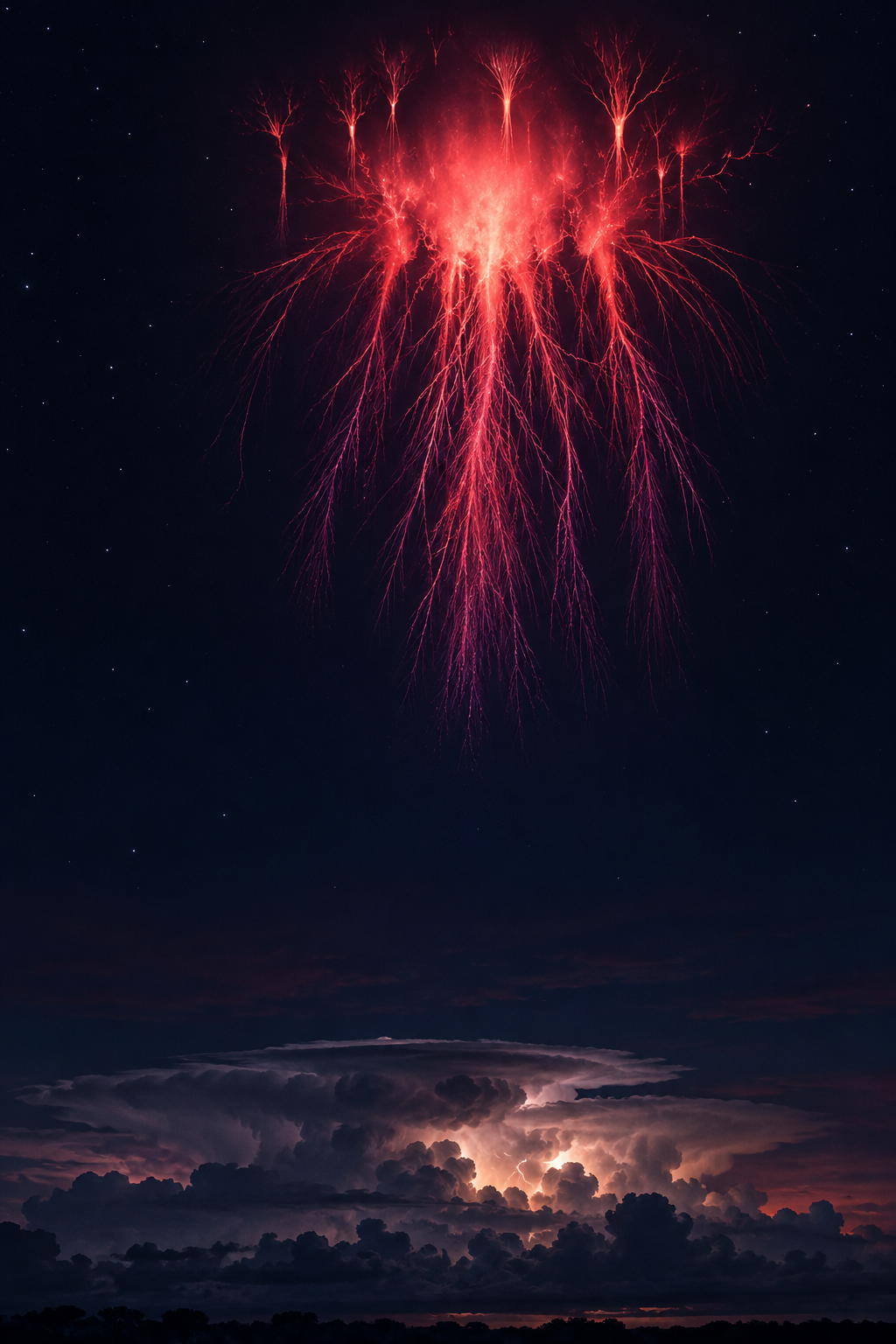
Illustration of a branching red sprite high above a distant nighttime thunderstorm.
A conceptual red sprite above a storm; brightness and scale are emphasized for visibility.

Most of us look downward for lightning: a bright branch reaches from cloud toward land, followed by thunder. But some storms also trigger an electrical display far above their cloud tops. For a few milliseconds, red tendrils appear high in the atmosphere, resembling a luminous jellyfish or an upside-down forest.

These events are called sprites. The playful name fits something so elusive that eyewitness reports long preceded convincing images. They are real physical phenomena, although a photograph can make their duration and visibility seem much greater than a person would experience.

The storm reaches beyond the clouds

Sprites belong to a family called transient luminous events: brief atmospheric glows associated with thunderstorm electrical activity. They form high above ordinary weather, often around 80 kilometers in altitude, after lightning changes the electric conditions below.

The reddish light is associated with nitrogen in Earth's upper atmosphere. Sprites can include diffuse bright regions and fine branching structures extending downward and upward. They are not solid objects, and their jellyfish-like appearance does not imply an animal-shaped cloud hovering over a storm.

Related phenomena have different forms. ELVES can appear as rapidly expanding luminous disks, while jets extend upward from storm regions. The family resemblance is electrical, but these names do not all describe the same event.

The bright cloud and the red structure occupy different layers

A storm photograph can compress enormous vertical distances into one frame. The ordinary cloud top and the sprite above it may appear to touch even when they occupy very different atmospheric regions. Before interpreting a picture, find the horizon and the storm's position. The dark gap between the weather and the upper display can be part of the important geometry.

The trigger and the glowing region need not be in the same place. A lightning discharge changes the electric conditions associated with the storm. The upper atmosphere can respond to that change. This is why “lightning above the cloud” is a useful first description but not a complete account of the connection.

The reddish light also belongs to a physical process, rather than to a red substance injected into the sky. Atmospheric molecules emit light after electrical excitation. Composition and density affect the response, which is one reason an Earth photograph cannot simply be recolored and treated as a measured image of a similar event on another planet.

Separate the sprite from the exposure that made it visible. A sensitive camera may record a faint structure that was difficult for an observer to see, and a selected frame can hold a millisecond event indefinitely. Neither fact makes the event unreal. Both affect how the image should be compared with an eyewitness's experience.

A discovery helped by looking sideways

In 1989, University of Minnesota researchers testing a low-light camera accidentally captured the first credible video evidence of sprites. That lucky recording helped launch a field of research into displays that are difficult to observe routinely.

Sprites are brief, and cloud cover can hide the view from below. Their association with storms does not mean the best vantage point is underneath one. A distant view over a storm can expose the clear sky above it. Images from aircraft and orbit have supplied additional perspectives.

NASA's Spritacular citizen-science project was developed to connect photographers' observations with researchers. Accurate times and locations help scientists compare an image with lightning records and other atmospheric information. An attractive photograph becomes more useful when its circumstances are recorded carefully.

Turn a photograph into an observation record

A useful sprite record needs more than a striking shape. Note the camera's location, the viewing direction and the exposure time. Preserve the time information as accurately as possible. Researchers can then compare the image with records of lightning in the relevant storm rather than associating it with whichever flash looked most dramatic from the photographer's position.

If a sequence exists, inspect the frames immediately before and after the apparent event. A single frame can obscure duration, and an artifact fixed relative to the camera may behave differently from a structure tied to the distant sky. Check whether the image shows a cloud-illuminating flash, a higher diffuse glow or a distinctly branching form. Identification rests on context as well as resemblance.

The linked Spritacular article explains why citizen observations can matter: many capable cameras are already watching storms, but scientific comparison benefits from consistent records. This is a project for observing from an appropriate distant vantage point or reviewing existing footage, not an invitation to stand underneath severe weather for a better picture.

The rewarding viewing question is therefore very specific: what happened above this storm, at this time, from this direction? That narrower question is more useful than assuming that every unusual red mark belongs to the same class of event.

Familiar air, unfamiliar questions

Scientists still investigate why sprites take particular shapes, how often they occur and how they interact with the broader atmosphere. Their connection to a lightning event is the beginning of an explanation, not the end of every question.

There are also hints of related events on other worlds. Juno observations at Jupiter were interpreted as evidence consistent with sprites or ELVES. A different atmospheric composition can change the expected color, reminding us that the same broad electrical process need not look identical everywhere.

Sources and further reading: NASA: Spritacular and the science of sprites · NASA: Sprites and ELVES, on Earth and at Jupiter

Rogue Planets: Worlds That Travel Without a Sun

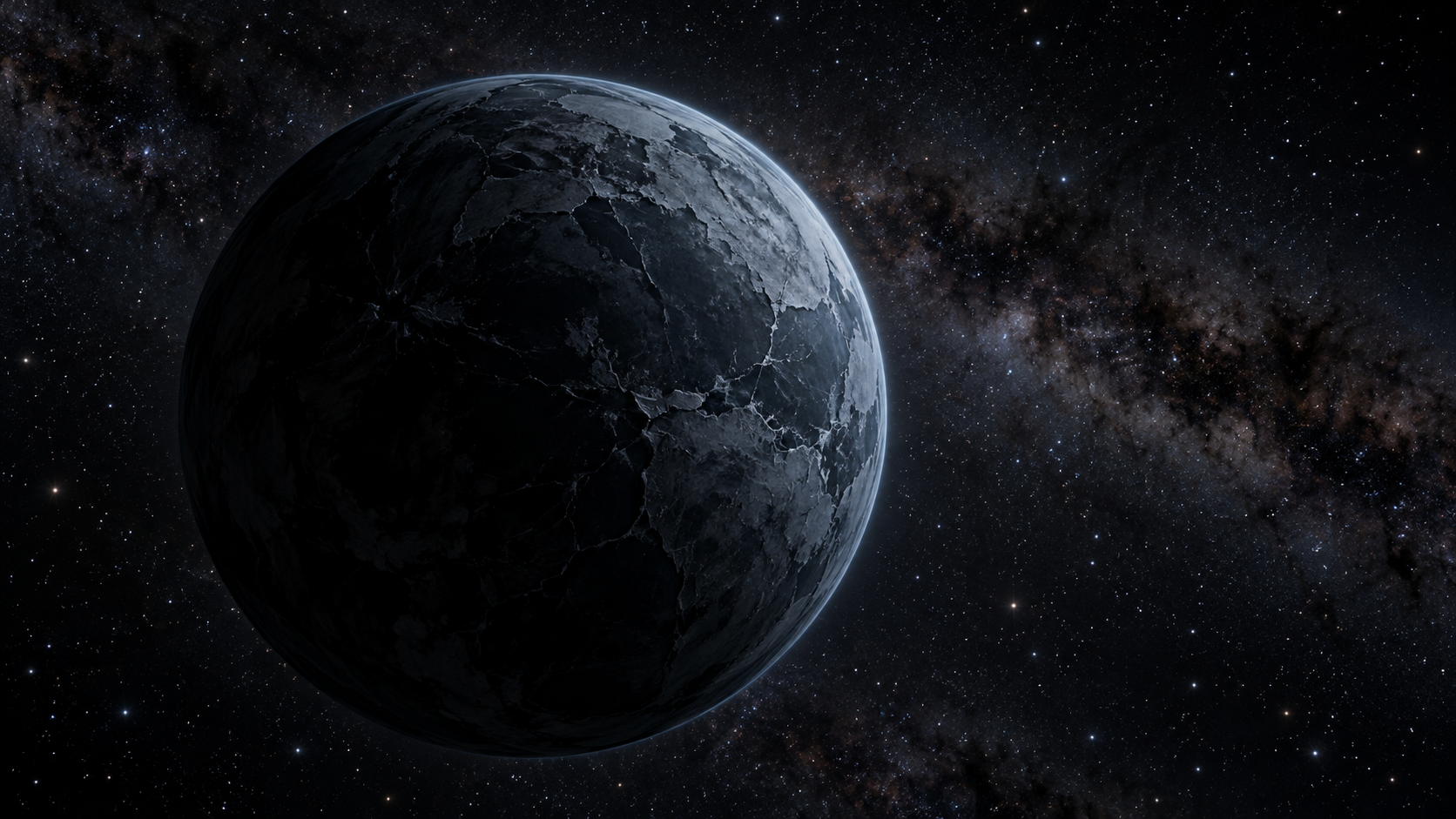
Artist concept of a dark icy planet against a distant starfield, without a nearby sun.
An imagined ice-covered world traveling without a host star; its surface is speculative.

We tend to imagine a planet as a world circling a star. Our own solar system has taught us that arrangement so thoroughly that a planet without a sun sounds unfinished. Yet astronomers study planetary-mass objects that drift through the galaxy without a nearby host star.

These are often called rogue or free-floating planets. The name sounds adventurous, but it describes an orbital circumstance rather than a personality. Their importance lies in what they reveal about the making, disruption and variety of worlds.

How a world can lose its star

Planet formation is not always a peaceful process. Young systems contain bodies that collide and gravitationally disturb one another. A sufficiently strong encounter can eject a planet, allowing it to escape the system in which it formed.

Some isolated planetary-mass objects may have a different history. A small cloud of gas could collapse directly into a body too low in mass to become a star. Similar-looking lonely worlds therefore need not share the same origin, and the boundary between categories can depend on how an object formed.

Without a nearby star, the usual supply of sunlight disappears. An artist can imagine an icy landscape under an unfamiliar sky, but observations do not establish the surface details of most such objects. An Earth-like mass should never be mistaken for evidence of an Earth-like climate or living environment.

Finding something that barely shines

A cold isolated planet can be very difficult to see directly. Astronomers can instead detect its gravity through microlensing. When an unseen object passes close to the line of sight between us and a more distant star, it bends the background star's light.

That alignment briefly changes the star's apparent brightness. The shape and duration of the event provide clues to the intervening object's mass. A small planetary lens may announce itself for only hours or days, then move out of alignment.

There is an important uncertainty: a brief event does not always prove the lens is completely alone. A planet orbiting far from a host star can sometimes produce a signal resembling that of a free-floating object. Researchers must test how strongly the data exclude a stellar companion.

Why a brief brightening does not give one exact mass

Microlensing depends on geometry as well as the lens itself. The lens and background source move relative to each other, and their distances matter. A short event can therefore constrain a planetary interpretation without acting like a balance that displays a unique mass independent of every other quantity.

The 2018 study makes this concrete. For one very short event, the authors considered an Earth-mass object in the Galactic disk or a Neptune-mass object in the more distant bulge. Those alternatives did not describe two separately photographed worlds. They were interpretations of one event under different locations for the intervening lens.

This is a useful exercise in reading uncertainty. Write the measured light change on one line and the inferred object on another. Then list which additional quantities the inference needs. An estimate expressed as a range or a set of alternatives may be a faithful account of the data rather than a weakness to be edited out of a headline.

The missing-host question has a similar structure. The same paper ruled out stellar companions within stated separation limits for its events. That is a specific observational constraint, not proof that a star is absent at every possible distance. “Free-floating or wide-orbit” preserves a distinction that the colorful word “rogue” can erase.

A missing part of the planetary census

Microlensing surveys have produced candidates and estimates of how common these worlds may be. Those estimates depend on observations, statistical models and assumptions; they are not a completed inventory of every dark planet in the galaxy.

NASA's Roman Space Telescope survey is designed to help investigate this hidden population. Measuring the distribution of masses can distinguish between different formation and ejection scenarios. The question is not simply how many lonely planets exist, but which processes create them.

Count detections and populations separately

Imagine a survey that watches many stars but can recognize only brightening events lasting longer than a particular interval. Very short events will be undercounted even if the underlying objects are common. A different observing cadence changes which signals are easiest to catch. The number detected is therefore not automatically the number present per star in the galaxy.

Population studies must account for detection efficiency and the regions surveyed. They also need models linking event properties with the distribution of masses and distances. Improving those models and obtaining more events can narrow the allowed population without converting a statistical estimate into a literal list of individually identified planets.

The same distinction helps with claims about habitability. Mass, orbital isolation and surface conditions are separate questions. Microlensing can provide evidence about a dark object's gravitational influence while telling us little directly about an ocean, atmosphere or landscape. The icy scene accompanying this article is a possibility for the imagination, not a recovered surface photograph.

When you encounter a new rogue-planet result, ask three questions in order: what signal was measured, what alternatives were excluded, and what population was inferred from the survey? That sequence leaves room for the discovery to be extraordinary while keeping the dark spaces in our knowledge visible.

Sources and further reading: NASA: Unveiling rogue planets with Roman · Mróz et al.: Free-floating or wide-orbit microlensing planets · NASA: Research on low-mass rogue planets

The Bacteria That Carry Tiny Magnetic Compasses

Cutaway illustration of a bacterium containing a chain of dark magnetic crystals.
Magnetosomes form a magnetic crystal chain inside a bacterium; internal structures are enlarged for clarity.

Imagine navigating with a compass small enough to fit inside a single cell. Certain aquatic bacteria do something close to that: they manufacture magnetic mineral crystals, arrange them internally and use Earth's magnetic field to help orient their swimming.

These magnetotactic bacteria turn a planetary-scale field into a local biological advantage. Their destination is not a distant continent or the North Pole. It is a suitable patch of water or sediment, often where oxygen conditions fit their needs.

A compass built from crystals

The magnetic particles are housed in structures called magnetosomes. Each contains a tiny crystal, commonly magnetite or greigite, surrounded by a membrane. In many species, magnetosomes form an orderly chain running through the cell.

That arrangement gives the bacterium a magnetic moment, allowing it to align with a magnetic field much as a compass needle does. The field supplies orientation; the bacterium's own swimming machinery supplies motion. Magnetism is not dragging the cell around the planet.

Separate the compass, the motor and the decision

A compass needle gives an orientation but does not propel a boat. The same distinction helps with the bacterium. Its magnetic crystals contribute a directional response, its swimming apparatus supplies movement, and its chemical responses help determine whether the local conditions are suitable.

Imagine a swimmer aligned along a line passing through zones with different oxygen levels. Alignment reduces the directions available for a search, but the line alone does not identify the best point to stop or reverse. Chemical information remains necessary. A magnetic field is not a map of nutrient concentrations or a guarantee that whichever way the cell initially points will lead to a favorable location.

The vertical component of Earth's field can be useful in that search, although it varies with location and the organisms' behavior is diverse. Avoid replacing the ecological problem with a story about a cell simply swimming north. North on a horizontal map is not the same as locating a particular chemical layer in sediment or water.

The distinction also changes how to read a laboratory demonstration. Reorienting a field can test whether swimming direction responds magnetically. It does not, by itself, reveal the organism's preferred oxygen concentration or explain every turn it makes. A controlled change answers the question attached to that change.

Direction helps solve an oxygen problem

Many of these bacteria inhabit regions where oxygen-rich water meets oxygen-poor conditions. Chemical sensing and magnetic alignment can work together as they seek an environment suited to their metabolism.

Magnetic field lines often have a vertical component, offering a directional guide through the water or sediment. Alignment can simplify the search, while responses to oxygen and other conditions help determine whether to continue or reverse swimming. The behavior differs among organisms and environments.

A striking early observation illustrates the mechanism. In work reported by Richard Blakemore in 1975, bacteria in droplets moved consistently toward one side. Changing the magnetic field changed their direction, helping show that light from a nearby window was not the guiding cue.

Building the compass is a separate biological achievement

The minerals are inorganic, but the arrangement is produced within a living system. Membranes create compartments; proteins contribute to mineral formation and organization; the chain gives the cell a coordinated magnetic moment. Describing only a cell full of iron misses the importance of controlling what forms and where it goes.

A chain is especially informative because the particles must act as an organized assembly. In research on magnetosome formation, altered cells can contain particles or membrane compartments without the usual orderly chain. Such comparisons help separate the machinery that makes a mineral from the machinery that positions it. One finished-looking component does not establish that the entire navigational arrangement is functional.

The fossil question requires another separation. Finding a magnetic particle establishes a material observation. Arguing that it originated in a bacterial magnetosome requires evidence about its properties, organization and geological setting. Finding a plausible magnetofossil does not recover the full behavior of the cell that made it.

When looking at a microscope image, ask which of these claims the image supports: a cell is present, crystals are present, a chain is organized, or a particular magnetic response has been measured. The illustration gathers these ideas into a clear picture, but actual research earns the connections between them through different methods. The tiny compass is fascinating because biology must build and use a physical instrument, not because the word “magnetic” explains everything at once.

A tiny organism with a long afterlife

Magnetotactic bacteria are a diverse ecological group rather than one unusually gifted species. Researchers find them across many aquatic settings and study both their biology and their role in environmental processes.

Their mineral crystals can sometimes survive after the cells are gone. Such magnetofossils interest geologists because preserved magnetic particles can contribute information about ancient environments. Identifying a biological origin, however, requires evidence; a magnetic mineral alone is not automatically a bacterial fossil.

Researchers also investigate magnetosomes as potential tools in biotechnology. Their controlled size and organization are appealing, although a promising laboratory material is different from a proven product or treatment.

Sources and further reading: Blakemore: Magnetotactic bacteria, 1975 · Komeili: Magnetosome formation and organization · Lefèvre and Bazylinski: Ecology and diversity of magnetotactic bacteria · Review: Magnetotactic bacteria and magnetofossils

Famous Last Meals is now in paperback — stories, history and 25 recipes

Famous Last Meals: Stories, History, and Recipes is now available in paperback on Amazon. The illustrated collection brings together 23 his...