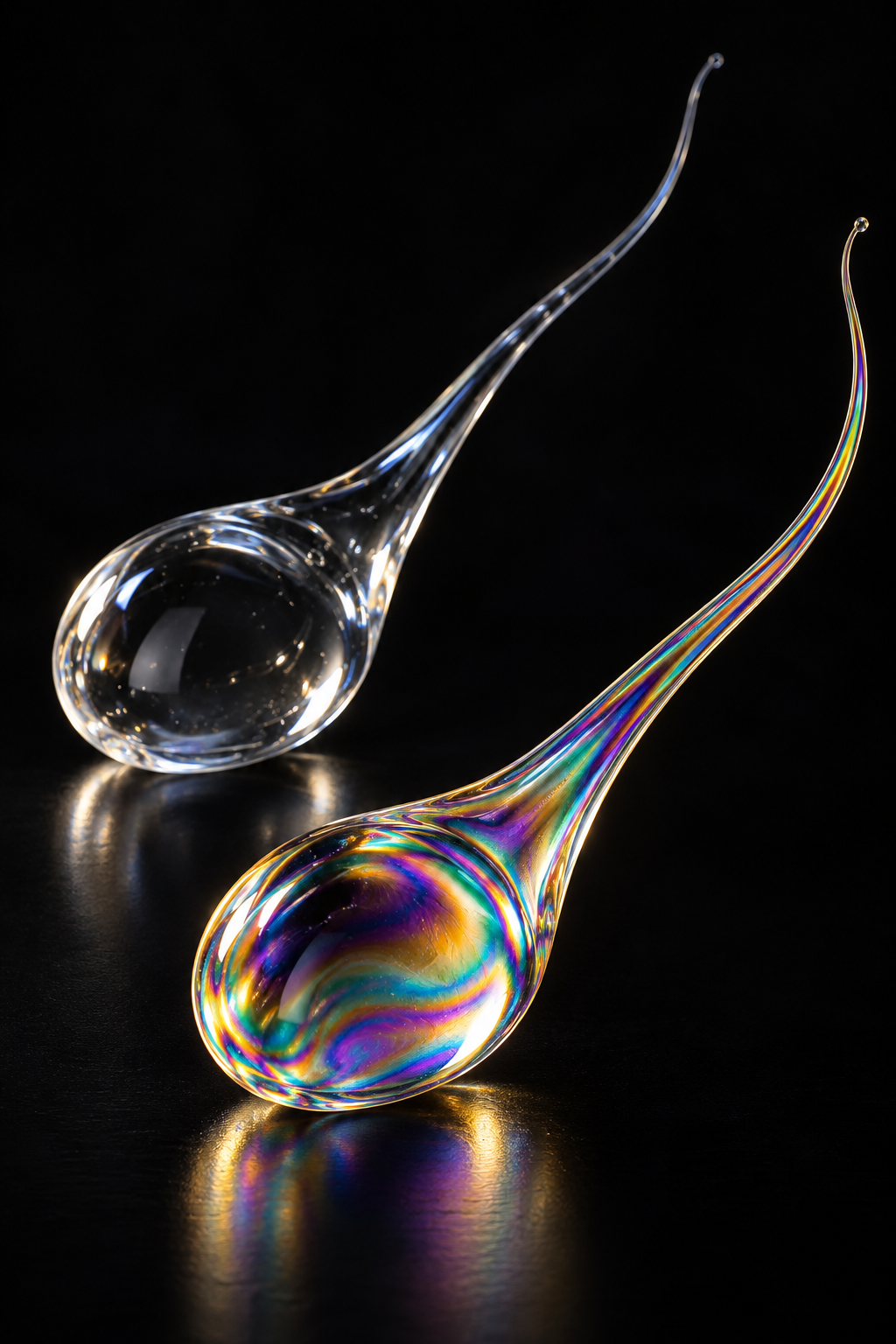
A Prince Rupert's drop resembles a glass tadpole: a rounded head leads into a long, thin tail. Its contradictory behavior has fascinated investigators for centuries. The head can resist substantial compression, yet damage to the tail can cause the whole drop to disintegrate rapidly.
The puzzle is not solved by calling the glass either strong or fragile. Both descriptions apply under different conditions. The important feature is a pattern of stresses locked into the material as it cools.
A quiet object storing an uneven balance
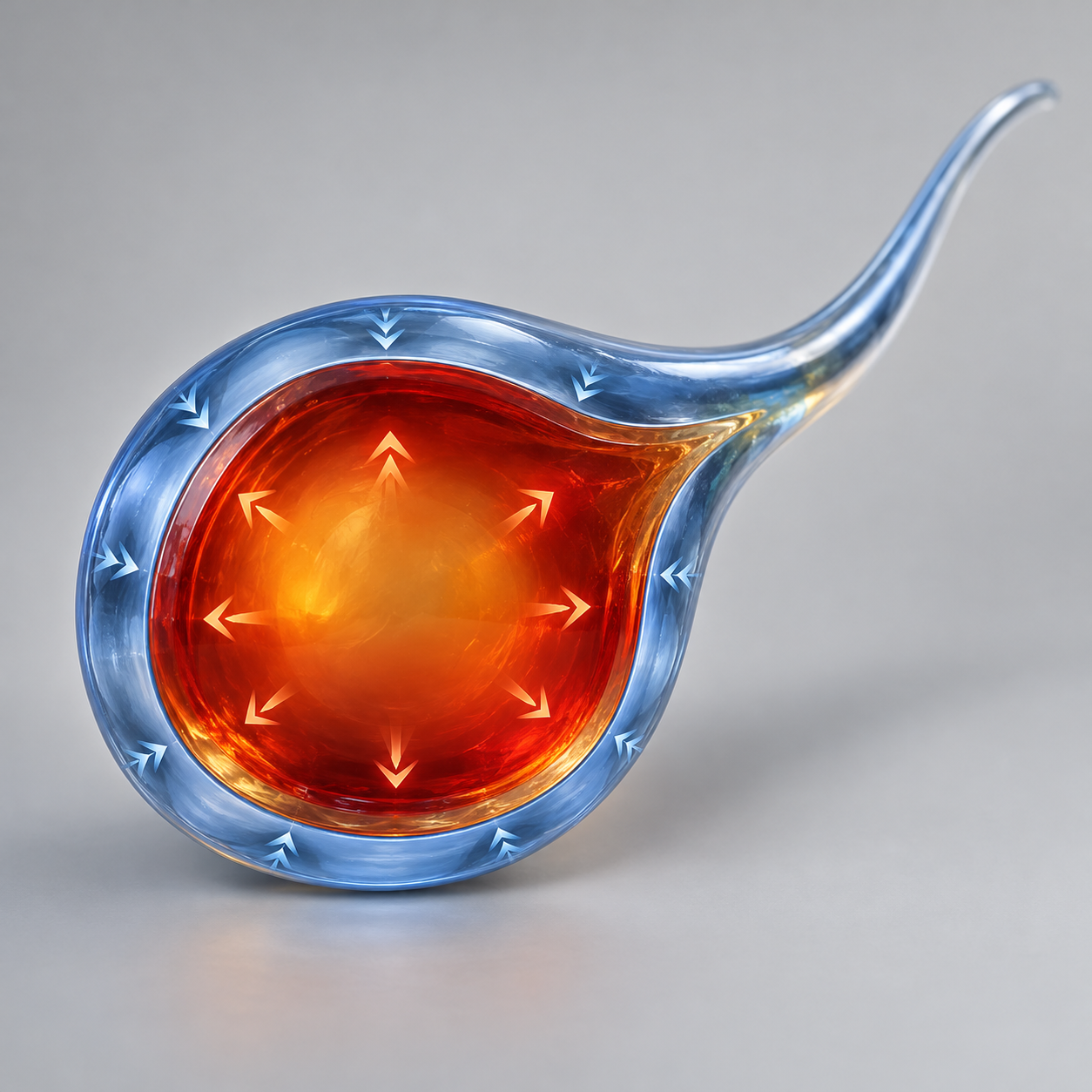
The drops form through rapid cooling of hot glass. The exterior cools before the interior, and the changing material cannot shrink everywhere in the same way at the same time. The finished object retains compressive stress near its surface and compensating tensile stress inside.
Compression helps keep surface cracks from opening and growing. That gives the bulbous head impressive resistance to certain impacts and applied loads. It does not make the object indestructible or imply that it performs equally well under every kind of force.
The interior tells the other half of the story. Tensile stress favors crack growth once a fracture can enter that region. The drop's strength therefore depends on the relationship between its protective outer stress and its vulnerable stressed interior.
The tail opens a path to failure
The thin tail offers a route for damage to reach the tensile region. Once a crack begins to propagate through the stressed glass, stored elastic energy can drive a very rapid breakup.
High-speed photographic work reported by Srinivasan Chandrasekar and Munawar Chaudhri in 1994 examined that disintegration. Later research concentrated on the head's resistance, measuring how compressive stress helps suppress particular crack patterns.
The studies answer related but distinct questions: why the head can resist a load, and why a small failure elsewhere can destroy the whole structure. A single demonstration of survival or breakup cannot fully describe both.
Color makes hidden stress readable
Researchers used photoelastic methods to investigate stress distribution. Under suitable polarized-light conditions, stressed transparent material produces patterns that can be analyzed mathematically. Colorful bands become evidence about internal mechanical conditions rather than decoration.
The principle connects this curiosity with broader materials engineering. The performance of glass depends not only on its chemical ingredients but also on cooling history, surface condition and stress. Similar attention to controlled surface compression helps explain the value of toughened glass.
The experimental drama is best understood through documented laboratory observations. This is a materials-science story, not an invitation to prepare or break stressed glass at home.
A transparent drop can look empty and still hold a complex mechanical history. Its unusual behavior teaches a useful habit: when a material seems to contradict itself, ask where the force is applied, how damage begins and what hidden structure carries the load. The answer can be inside something we thought we could already see through.
See the laboratory investigation: Purdue’s research video shows the drops and the analysis behind their unusual behavior.
Sources and further reading: Purdue University: Strength and internal stress of glass drops; Aben et al.: Extraordinary strength of Prince Rupert’s drops; Chandrasekar and Chaudhri: Explosive disintegration study.
Explore more creative curiosity at Incoprea.