Showing posts with label Cultural History. Show all posts

Friday, October 23, 2026

Nüshu: The Writing That Travelled on Fans and Wedding Books

A narrow, threadlike script on a fan can stop a visitor in front of a museum case. The temptation is to ask for an alphabet chart immediately. What does this mark mean? How can I copy it? With Nüshu, a more rewarding beginning is to ask who made the object, who received it and what happened when its words were read or sung.
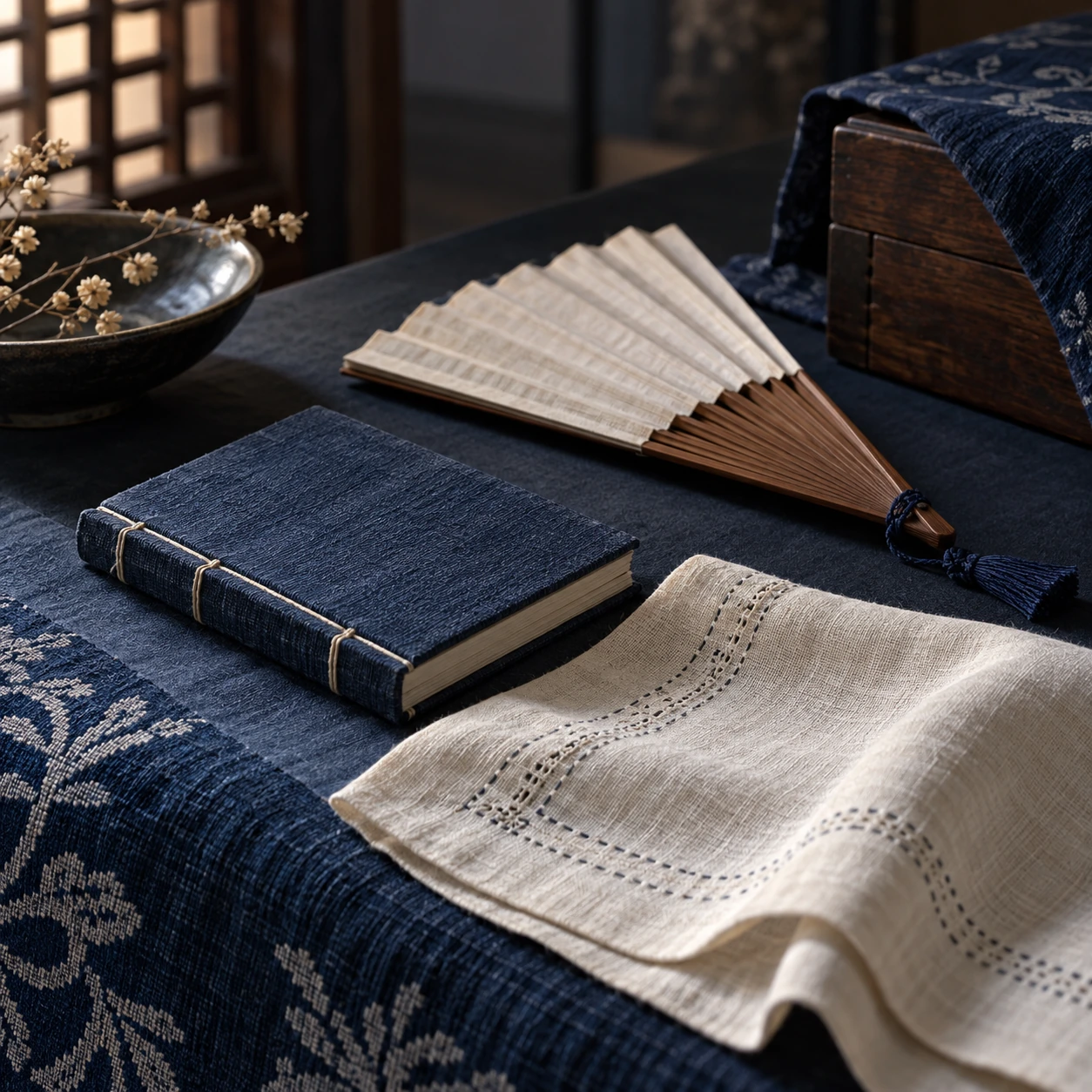
A cloth-bound book, folded fan and stitched cloth rest on a study table.
A contextual still life brings book, fan and textile together. It does not reproduce a Nüshu inscription or a named historical object.

Nüshu is associated with women in Jiangyong county and neighboring areas of Hunan, China. The UNESCO account describes correspondence, songs and gifts connected to women's relationships. A script is involved, but an account limited to letter shapes would miss much of the practice.

Script, language and occasion

A script is a system for representing language in visible marks. It is not automatically a separate spoken language. The Unicode Standard's Nüshu section connects the script to the local speech of Jiangyong. Calling it a mysterious language can blur the difference between a way of writing and the speech being represented.

That distinction gives us better questions. Was a particular text composed for a friend? Was it copied, embroidered, exchanged or performed? Does the catalogue identify the maker and reader, or only the location in which the object was collected? Each answer changes what we can responsibly say about the item.

UNESCO illustrates a sanzhaoshu, a book associated with a bride and the days after a wedding. The important detail is the social occasion. A book can hold words while also carrying an act of friendship, separation or encouragement. Translation of the words is essential, but it is not the whole object biography.

Fine lines, folded surfaces and a voice

UNESCO describes elongated characters built from dots and several kinds of fine strokes. Writing could appear on fans and paper, or be embroidered on handkerchiefs, belts and clothing. Mothers taught daughters; friends gathered to sew and sing. Many recorded works used seven-character poetic lines. The script belonged to acts of making and performing as well as to reading.

Pause at the fan. Its surface opens and closes, its ribs divide the field, and the person holding it can choose how much to reveal at once. A written fan is therefore a different reading object from a flat modern page. The words occupy something that moves in a hand.

Now imagine a small wedding book passing from friends to a bride. Its significance includes the occasion of giving and the relationship between people who may be separated afterward. You do not need to romanticize every message to recognize the practical value of a portable object that can be kept and revisited.

Compare the photograph on the UNESCO page with the Online Nushu Dictionary, whose resources identify the reference works behind its character mappings. Find one visible difference between a photographed handwritten form and a standardized digital presentation. Do not guess a translation. Notice how stroke thickness, spacing and the support's shape contribute to the experience of reading.

The danger of a perfect origin story

Stories about writing traditions often acquire a single inventor, a precise birthday or a dramatic claim that nobody outside the group could ever understand them. Such stories are memorable because they are tidy. The surviving evidence is often less tidy: dated objects, memories, collected texts and later descriptions do not all answer the same historical question.

This article does not assign Nüshu an exact invention date or claim that every user had the same experience. Even the phrase “women's writing” should lead us toward particular women and documented practices, rather than an imaginary uniform community stretching unchanged across centuries.

A five-minute reading exercise

Choose one factual sentence about Nüshu from a museum or institutional page. Underline its subject: an object, a named practitioner, a particular place, or the whole tradition. Then check whether your own retelling quietly widens the subject. “This book was a wedding gift” does not automatically become “every Nüshu book was a wedding gift.”

Preservation is more than keeping the shapes

Digital encoding helps people store and exchange text. Collections help preserve fragile objects. Teaching and performance can sustain forms of knowledge that a photograph cannot hold. These activities complement one another, but none is a complete substitute for the others.

Think about a handwritten note from someone you know. A typed transcription preserves its words. A scan preserves visible corrections and spacing. A recording might preserve the writer's voice. A story about when it was given preserves another kind of meaning. That familiar comparison is not an equivalence between cultures. It is a way to notice how many forms of evidence any meaningful message can carry.

The most engaging encounter with Nüshu need not end with a copied symbol. It can end with a better question about an actual book, an identified practitioner or a living teaching project. Paying attention to those relationships makes the writing less like an isolated curiosity and more like the human achievement it is.

Sources and further exploration: UNESCO: Nüshu, from tears to sunshine; Unicode Standard: Nüshu; Online Nushu Dictionary: resources and references.

Explore all 50 new articles · Browse the complete illustrated collection

Explore more art, ideas, and independent projects at Incoprea.

Wednesday, October 14, 2026

Silbo Gomero: A Sentence Whistled Across a Valley

Two people can be close enough to see each other and still be separated by a difficult walk. On La Gomera, a steep ravine turns that ordinary fact into a communication problem. A shouted sentence loses clarity across the gap. A practiced whistler sends another kind of sentence through the air.

Two people communicate across a deep green ravine in a Canary Islands landscape.
A conceptual scene of whistled communication across La Gomera's terrain, with unnamed figures.

Silbo Gomero is compelling because the whistle is not merely a prearranged signal for “come here.” It represents spoken language. The listener’s knowledge helps turn a narrow, carrying stream of sound into a message. Terrain, acoustic form, and shared understanding all take part in the exchange.

The sentence changes carrier

UNESCO’s account describes Silbo Gomero as a whistled representation of the islanders’ Castilian Spanish. Distinctions of pitch and continuity stand in for distinctions made in speech. Someone is using knowledge of language and a learned whistling system, rather than translating a sentence into an unrelated set of secret words.

That distinction matters even if you cannot understand Spanish. A whistle used to attract attention has a conventional purpose, but it does not necessarily encode the structure of a sentence. Silbo offers speakers a way to send messages whose contents can change. Recognizing the difference is more useful than asking only how loud a person can whistle.

The University of La Laguna’s Silbo Gomero chair situates the practice in the island’s difficult terrain and long history of transmission. It describes both informal learning across generations and more formal teaching. An acoustic technique becomes a communication practice because other people know how to interpret it.

What the listener adds

Whistled speech preserves less acoustic detail than an ordinary spoken sentence. In Ramón Trujillo’s phonological account, the reduced system makes context central to interpretation. Several distinctions present in speech converge in the whistled form, so a message cannot be understood as if every sound retained a separate, perfectly labeled channel.

Linguist Marcial Morera and master whistler Rogelio Botanz give a memorable example in their public explanation: a whistled form can correspond to the Spanish words for a chicken or a whale. Shared circumstances help listeners decide which is intended. The point is not that people routinely confuse farmyards with oceans; it is that the signal and the situation work together.

Ordinary speech also relies on that partnership. If a person says “put it there,” the sentence is clear only when you share enough context to know what “it” and “there” mean. Silbo makes another kind of dependence especially visible: an economical sound system places more responsibility on what communicators already know.

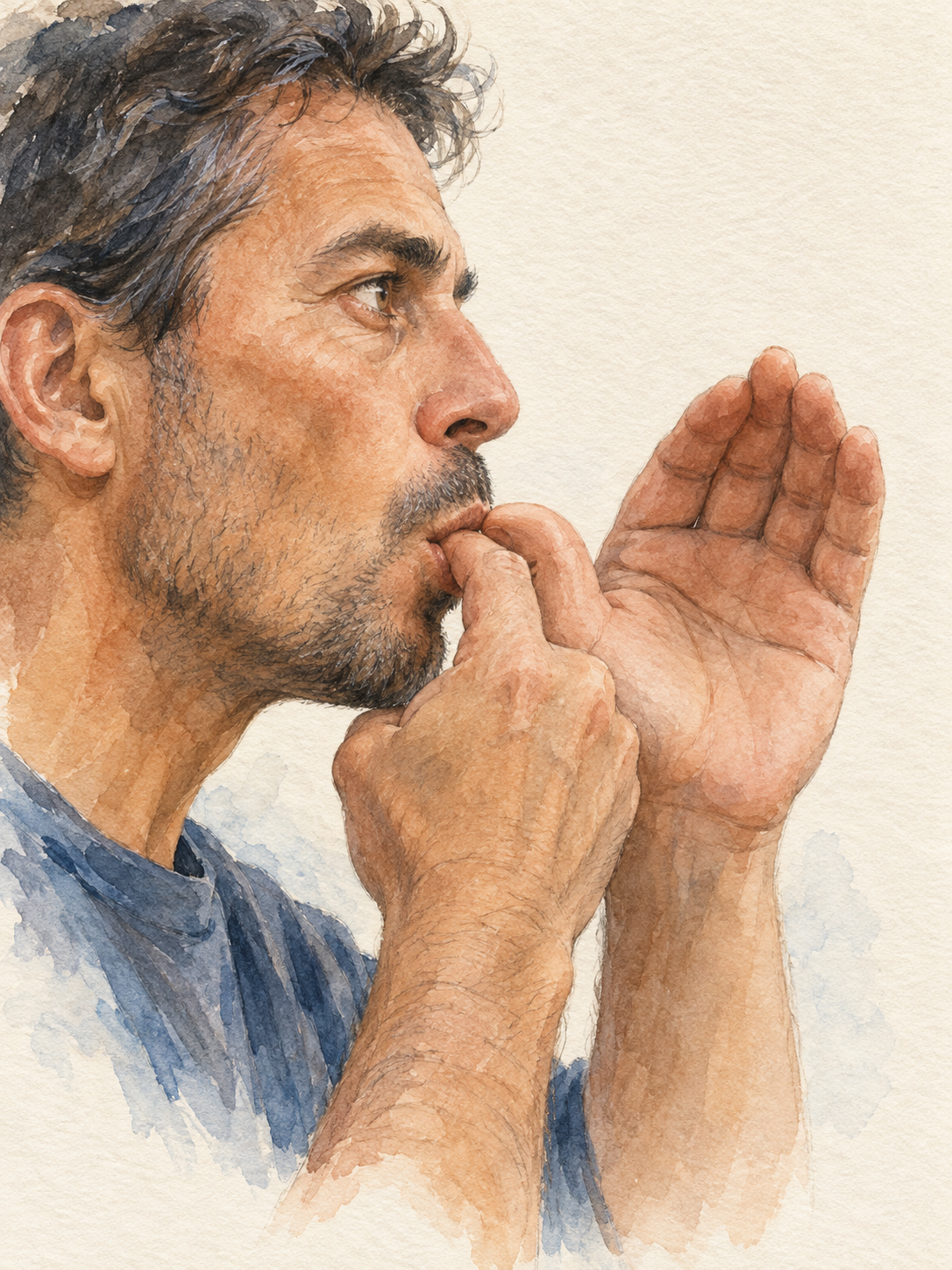
A close artistic study of a whistler's lips and hands.
A conceptual study of a whistling gesture, rather than an exact technique guide or named person's portrait.

Looking at the whistling gesture can reveal physical skill, but a close view of lips and fingers cannot show fluency by itself. Producing a strong tone and understanding an unfamiliar sentence are different accomplishments. To appreciate the second, watch what the receiver does.

Watch the receiver as carefully as the whistler

UNESCO’s Silbo Gomero film provides a credited introduction. Its heritage record credits Juan Ramón Hernandez and David Baute and the Government of the Canary Islands. Watch a short sequence twice: once for the sender, then for the listener and the setting.

A three-part observation record
Watch forAsk
The physical signalCan you hear changes in pitch, duration, or interruption?
The responseWhat shows that another person has received or understood something?
The shared situationWhat place, task, explanation, or subtitle helps you interpret the exchange?

Record only what the film lets you establish. A subtitle can supply meaning that your ear has not learned to recover. A visible answer or action can show an exchange occurring without teaching you how every sound represents speech. You can appreciate both facts without pretending that a few minutes of watching make you a Silbo speaker.

On your second viewing, notice how much attention the film gives to terrain, people, and teaching. A recording of the whistle alone would preserve sound but leave out much of the reason for the practice and the work needed to sustain it.

A learned listener hears another kind of information

A 2005 study by Manuel Carreiras and colleagues asked how proficient users processed Silbo Gomero. Listening activated brain regions normally associated with spoken-language function in the proficient whistlers, while the control participants did not show the same response.

The result gives a scientific counterpart to the listening problem. An inexperienced listener and a practiced one receive an acoustic signal, but they do not necessarily extract the same information. Learning changes what the signal affords the listener.

This finding concerns the participants and conditions studied. It does not establish that any sound becomes language through repetition, or that a brain image can translate an unknown whistle for us. The communication system remains something people acquire through practice with others.

The route from ravines to classrooms is still developing

The Canary Islands’ teaching resources explain the incorporation of Silbo into schools from 1999 and the development of materials for teaching it. Recognition on UNESCO’s heritage list followed in 2009. Transmission involves more than placing an old recording in an archive: new learners need teachers, methods, and opportunities to communicate.

The story has continued. In a March 2026 announcement, the Canary Islands government reported approval of a decree intended to consolidate teaching in primary and compulsory secondary education. It also described a route for schools on other islands to request the teaching under specified conditions. The announcement highlights teacher preparation and organization as part of sustaining the practice.

A classroom is a different setting from a message sent across a rural valley. That difference creates interesting questions rather than automatically making learning less meaningful. Which skills does a beginner need first? How does a teacher know a pupil has understood a message rather than memorized a demonstration? How can learners use the practice beyond a single lesson?

Return to the exchange

After watching, describe Silbo in one sentence that includes the receiver. Then compare it with your first impression of an unusual noise traveling over a ravine. The most important addition may be the person listening: someone who shares a language, recognizes a system, and uses context to make a message arrive.

That is the lasting surprise. Language does not depend on the familiar sound of a speaking voice alone. People can learn to find structure in a different carrier, while their landscape and relationships help shape how the exchange works.

Follow another message

Compare learned signals within a different partnership in The Honeyguide Listens for a Human Partner’s Call. For a different way a message travels, explore Your Message Can Arrive in Pieces Before It Becomes a Sentence.

Explore more art, ideas, and independent projects at Incoprea.

The Persian Qanat: Water Engineering Hidden Under the Desert

From above, a qanat can look like a dotted line crossing dry ground. The dots are access shafts. The line that matters lies underneath: a tunnel graded to carry groundwater towards a lower outlet. A landscape with little visible water can contain a carefully organised flow below its surface.

The achievement brings together three things that are easy to study separately: an aquifer, a geometry and an agreement among users. Water has to be found, conducted and shared. A functioning tunnel solves only part of that combined problem.

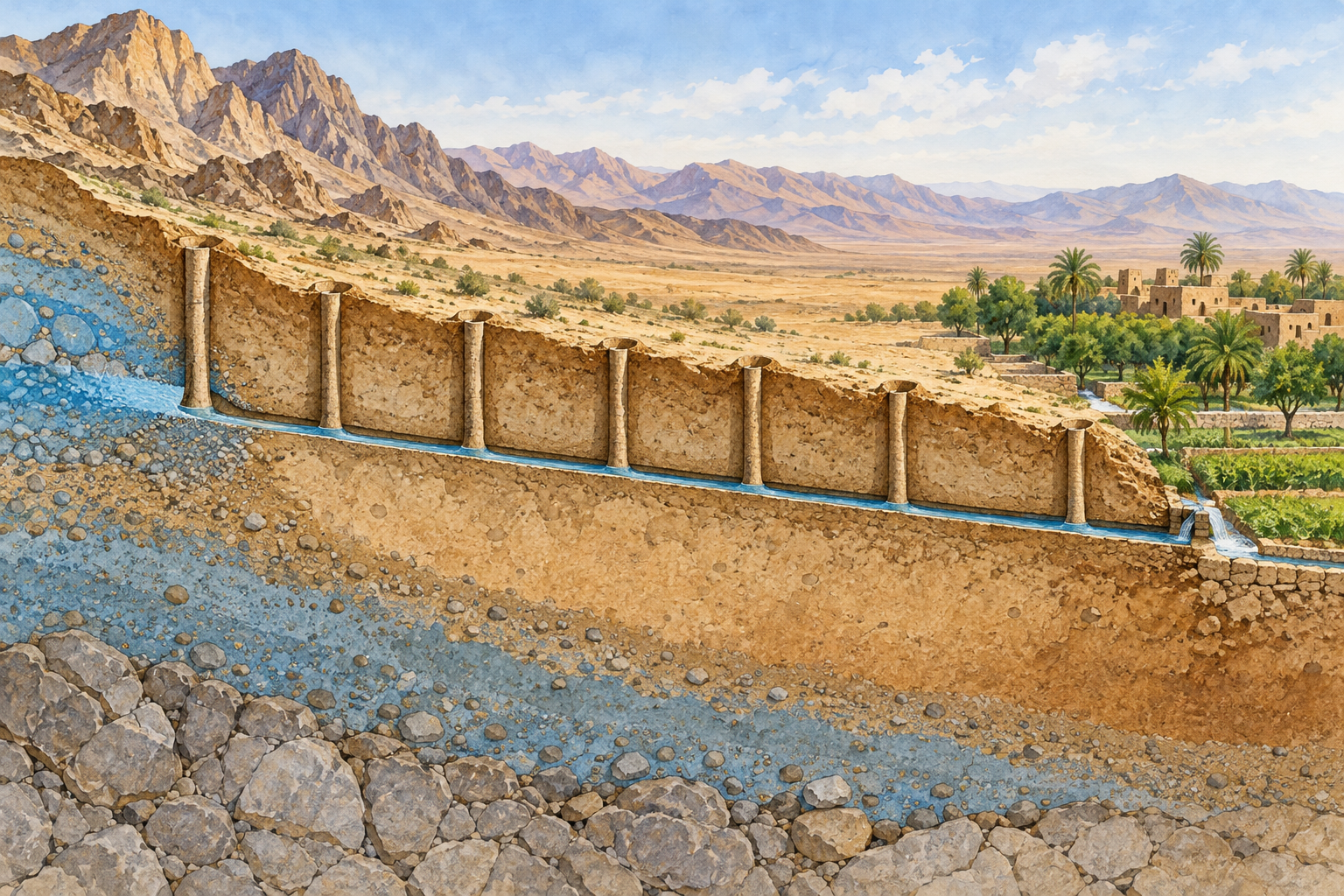
A conceptual underground qanat tunnel and vertical access shafts carry water from high ground to a village garden.
A conceptual qanat cutaway with simplified geology and proportions, rather than an exact site reconstruction.

Let the land supply the fall

The Persian Qanat World Heritage property comprises eleven examples of a much wider tradition. UNESCO describes systems tapping alluvial aquifers near valley heads and conveying water underground by gravity, sometimes for many kilometres. The tunnel links a source in higher ground with an outlet where its water can serve a settlement and fields.

A mother well helps establish access to the source. A chain of shafts allows material to be removed during excavation and provides access and ventilation. The shafts are therefore part of the construction and maintenance system, not a row of independent wells supplying separate streams.

Gravity makes the flow possible only when the route is appropriate. The tunnel has to descend in the required direction while remaining related to the water-bearing ground. The land above can slope differently from the channel below. A row of openings marks the route, but cannot by itself reveal the tunnel's gradient.

Try a small level problem

Imagine a source whose water level is twenty metres above a proposed outlet, with four kilometres between them. A total fall of twenty metres over that distance corresponds to an average of five metres per kilometre, or half a percent. This is an invented calculation, not a recommended qanat design.

Now move the outlet ten metres higher without moving the source. The available fall is halved. Move it higher still, above the source water level, and gravity cannot deliver water to it along the same simple open-flow arrangement. The lesson is that the outlet is a design decision constrained by the source and terrain.

A real qanat requires far more than this arithmetic. Ground conditions, water availability, excavation, erosion and structural stability matter. The simple exercise makes the invisible relationship intelligible without suggesting that digging a tunnel is a straightforward do-it-yourself task.

One tradition, different engineering responses

The ICOMOS evaluation records striking differences among the listed systems. Zarch extends over a long route with branches. Moon at Ardestan includes two levels associated with local ground conditions. Vazvan has an underground barrier that can be used for seasonal storage.

These examples prevent a diagram from becoming a universal template. A drawing of one mother well and one unbroken tunnel is a useful introduction; actual systems adapt to geology, route and use. Comparing particular examples reveals the accumulated knowledge concealed by the general word qanat.

The same evaluation lists related structures such as reservoirs, mills and resting places for workers. Water collection belongs to a larger built environment. Once the flow reaches useful locations, it can support several activities, each introducing further decisions about access and timing.

The water has to arrive at the right time

UNESCO recognises traditional communal management as part of the heritage. Users and responsible institutions coordinate sharing and maintenance. A tunnel carrying water correctly does not automatically settle whose fields receive it or when work on the system must be done.

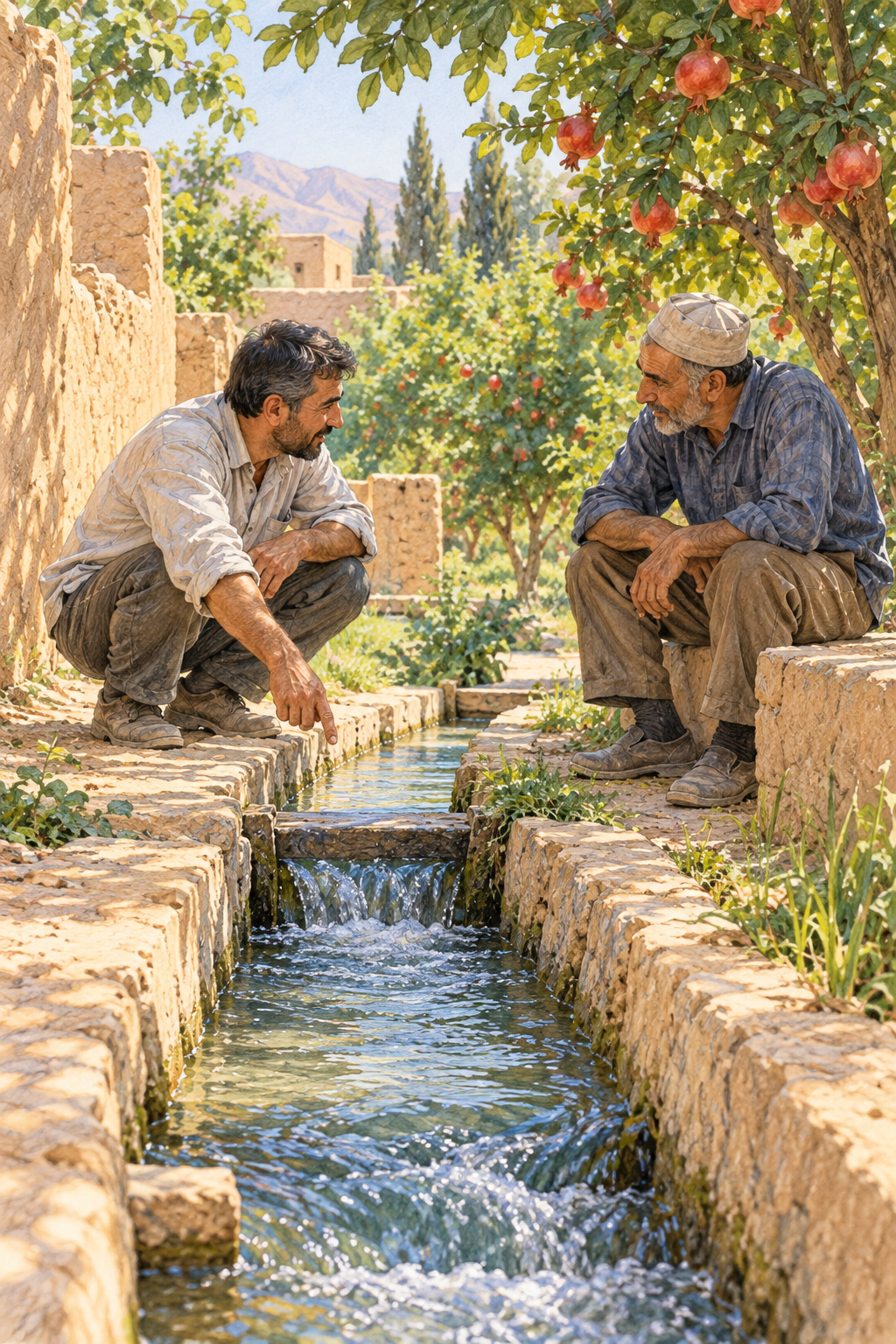
Two farmers discuss water beside an irrigation channel in a pomegranate garden.
An imagined everyday scene of discussion around shared irrigation water, illustrating the social side of qanats.

The everyday scene is an interpretation of that social dimension. For documented local arrangements, turn to the site records. Rules can vary, and no single conversation or generic illustration represents the entire tradition.

FAO's account of qanat-irrigated agriculture around Kashan connects water with farms, livelihoods, crops and biodiversity. Its description includes land allocated across cultivation seasons and uncultivated intervals. Water management influences the pattern of work above ground as well as the flow beneath it.

It helps to imagine the system as a sequence of commitments. Someone must maintain access, someone must inspect and repair, users must recognise allocations, and the catchment must continue supplying water. A beautifully graded tunnel can become ineffective if those relationships break down.

Trace a drop through three kinds of landscape

Use the UNESCO property photographs and the FAO Kashan feature for a short viewing task. First find an image of the dry surface and shafts. Next look for an outlet or distribution space. Finally examine a cultivated landscape associated with the water.

For each view, ask what it leaves outside the frame. The shaft image conceals the tunnel. The outlet conceals the source. The field conceals the work and agreements that make irrigation possible. Put the views together and the system becomes easier to describe.

If you open the ICOMOS evaluation, choose one named qanat and list its branches, related structures and special features. Compare it with the introductory illustration. Which details required the simplified picture to become more complicated? That is the moment when a general principle becomes a particular place.

An enduring system with continuing conditions

Underground conveyance limits exposure to the evaporation that affects open channels, while gravity reduces the need to lift water along the route. These qualities help explain the tradition's endurance. They do not create water independently of the aquifer.

The source, catchment, tunnel condition and maintenance all remain consequential. Protecting visible shafts while neglecting the water-bearing landscape would preserve the outline of a system while putting its function at risk. The same is true of celebrating ancient ingenuity while overlooking the people who keep it working.

Return to the dotted line in the desert. Each opening now belongs to an extended relationship: water-bearing ground, surveyed route, working access, distribution and cultivation. The qanat's quiet movement is the visible outcome of knowledge organised across all of them.

Sources and further reading

Explore more art, stories and discoveries at Incoprea.

Marshallese Stick Charts: Learning the Shape of the Sea

A Marshallese stick chart can look like an abstract arrangement of narrow strips, curves and shells. The resemblance to a modern map is only partial. Some of the relationships it represents concern moving water: how swell patterns change around islands and what a trained navigator can learn from them.

The object becomes more interesting when it is placed back within teaching and voyaging. It does not navigate on behalf of its user. It supports knowledge a person learns to recognise in an ocean that is moving beneath and around a canoe.

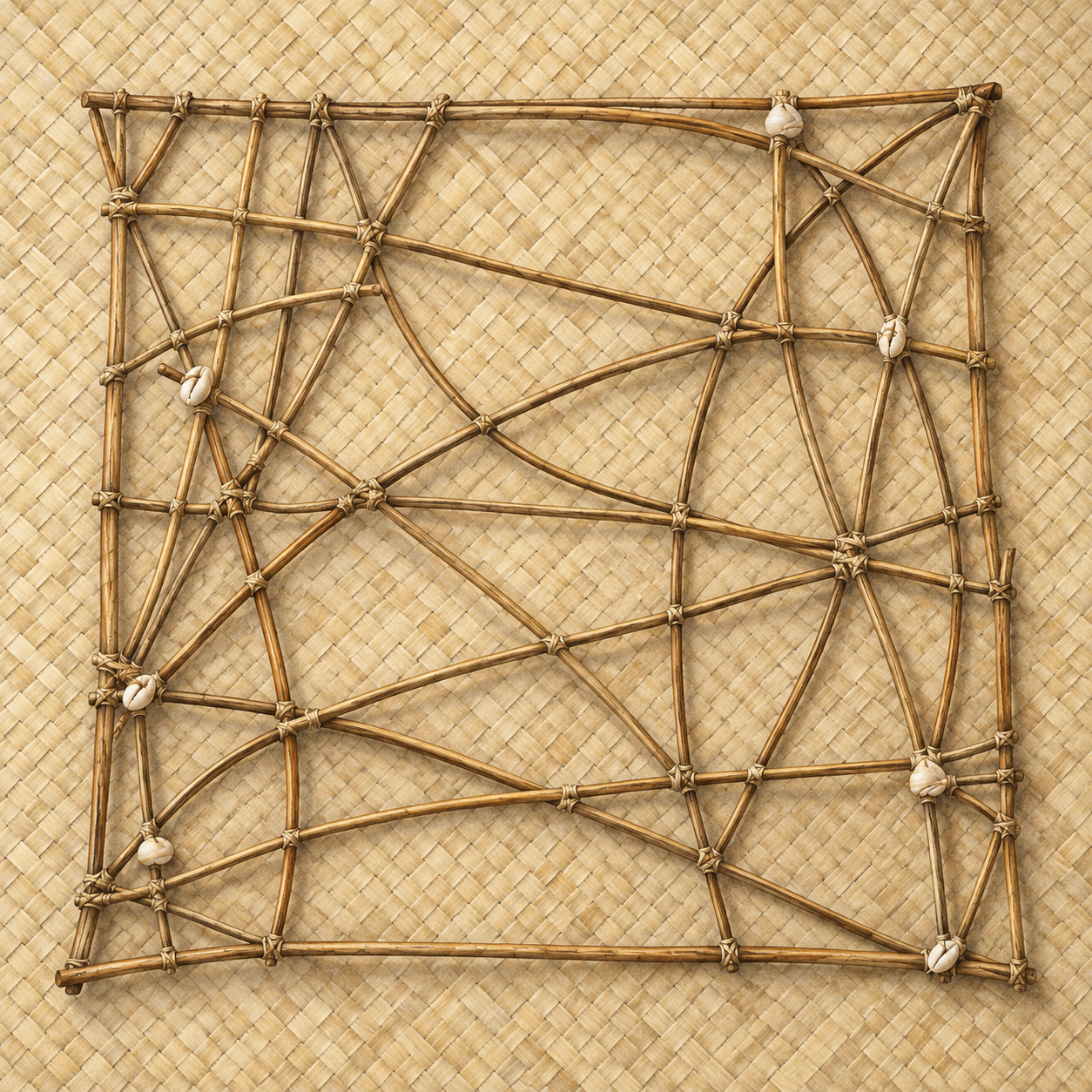
A handmade lattice of curved and straight plant strips with tied shells rests on a woven mat.
An artistic interpretation of a Marshallese stick chart, not a copy of a particular museum object.

A chart built around a task

These charts belong specifically to the Marshall Islands in Micronesia. Calling them generic Polynesian maps loses both the location and the particular expertise involved. Materials can include palm or coconut strips, bindings and shells; their significance depends on the chart and the conventions known to its maker and learners.

The Smithsonian's introduction distinguishes charts closer to geographical instruction from mattang, which model general wave relationships. Shells can mark islands or atolls. Curved strips can express relationships in swell patterns. Other pieces support the physical structure, so it is unwise to assume that every stick is an independent route.

A uniform scale is not the main criterion of usefulness. A diagram can be selective and still be exact about the relationship it is designed to teach. Consider a musical score or a transport schematic: neither looks like the experience it helps organise. The chart's purpose tells us what kind of accuracy to seek.

Why an island changes the sea around it

Ocean swells do not simply continue unchanged through every setting. Interaction with islands and changes in depth can alter their directions and relationships. A navigator can learn to recognise patterns associated with land before the island itself is visible.

Long ocean swells curve around a low coral atoll while a small canoe crosses the foreground.
A simplified atoll-and-swell scene, illustrating relationships rather than providing navigational measurements.

The conceptual sea view highlights this idea without supplying navigational measurements. It cannot reproduce the full conditions of a real passage. At sea, several swell systems, winds and local effects can overlap, and recognising a meaningful pattern takes more than knowing a diagram's labels.

Reflection and refraction provide useful physical terms for some wave transformations. Yet translating a navigator's concepts into oceanographic vocabulary is not always straightforward. Different knowledge traditions can attend to different relationships, including features that a simplified model does not capture.

Learn on land, recognise on water

Museum accounts describe charts as teaching and memory aids studied before voyages, rather than carried as charts to consult aboard a canoe. The distinction shifts attention from the object's surface to the navigator's training.

Knowledge had to be internalised and connected to perception. A learner could discuss a model, then encounter the relevant movement in a setting where the water was constantly changing. The chart served within an instructional relationship, and its conventions might not be obvious to another person holding it in a museum.

That is why preservation of the material object is important but incomplete. Strips and shells can survive while explanations, demonstrations and the opportunity to practise become harder to sustain. A catalogue needs to acknowledge the people who made the object intelligible.

A research voyage with two kinds of instruments

A primary study by Joseph Genz, Jerome Aucan, Mark Merrifield, Ben Finney, Korent Joel and Alson Kelen combined fieldwork with navigators and oceanographic investigation. It used interviews and demonstrations at sea alongside buoy measurements, satellite imagery and modelling.

The study is valuable because Marshallese experts appear as contributors to knowledge, not merely as colourful subjects beside a scientific explanation. Their observations helped frame the questions. Some wave concepts could be related to measured transformations; others did not translate neatly into the available oceanographic models.

The unresolved parts are productive. A failure to obtain a straightforward model match does not establish that a navigator's perception is imaginary. Equally, a striking account should lead to a carefully framed investigation. The interesting work lies in relating observation, experience and measurement without forcing them into one vocabulary too quickly.

A looking exercise about what a chart leaves out

Open the Smithsonian introduction and compare its chart photographs. Choose one object and describe its construction before assigning meaning. Where do strips curve? Where are they bound? Where are shells attached?

Then use the source's explanation to identify one relationship it discusses. Keep that interpretation attached to its source rather than transferring every detail to a different chart. Charts vary, and a maker's conventions matter.

Finally ask three questions that the object alone cannot settle: what would this relationship feel like at sea, under which conditions would it be useful, and what instruction would connect the model to that experience? These questions do not ask you to imitate a navigator. They reveal how much expertise sits beyond the lattice.

A useful comparison with a familiar map

Think of a route you know by the feel of turns, changes in sound or a landmark you notice in motion. A flat map may show its geometry while leaving out those recognisable experiences. The comparison is modest, but it helps explain why useful spatial knowledge need not be reducible to coordinates on paper.

The moving sea as a learned landscape

The charts broaden the idea of a navigable landscape. Land can be low and distant while its effects on the surrounding water remain available to a skilled observer. The traveller learns relationships unfolding through time, not simply points fixed on a surface.

Look once more at a curved strip. Its elegance now belongs to a task: helping someone think about a pattern that has to be encountered in motion. The object links a material model, a teacher, a learner and the sea. That relationship is the achievement worth carrying away from the museum.

Sources and further reading

Explore more art, stories and discoveries at Incoprea.

Famous Last Meals is now in paperback — stories, history and 25 recipes

Famous Last Meals: Stories, History, and Recipes is now available in paperback on Amazon. The illustrated collection brings together 23 his...