Showing posts with label Musical Instruments. Show all posts

Friday, October 23, 2026

The Glass Armonica Moves the Instrument Under Your Fingers

A row of drinking glasses makes a charming instrument until a melody asks for a leap, a chord, and another leap in quick succession. Benjamin Franklin's glass armonica changes the arrangement. Graduated bowls nest on a turning spindle, bringing their rims into a compact sweep beneath the player's hands.
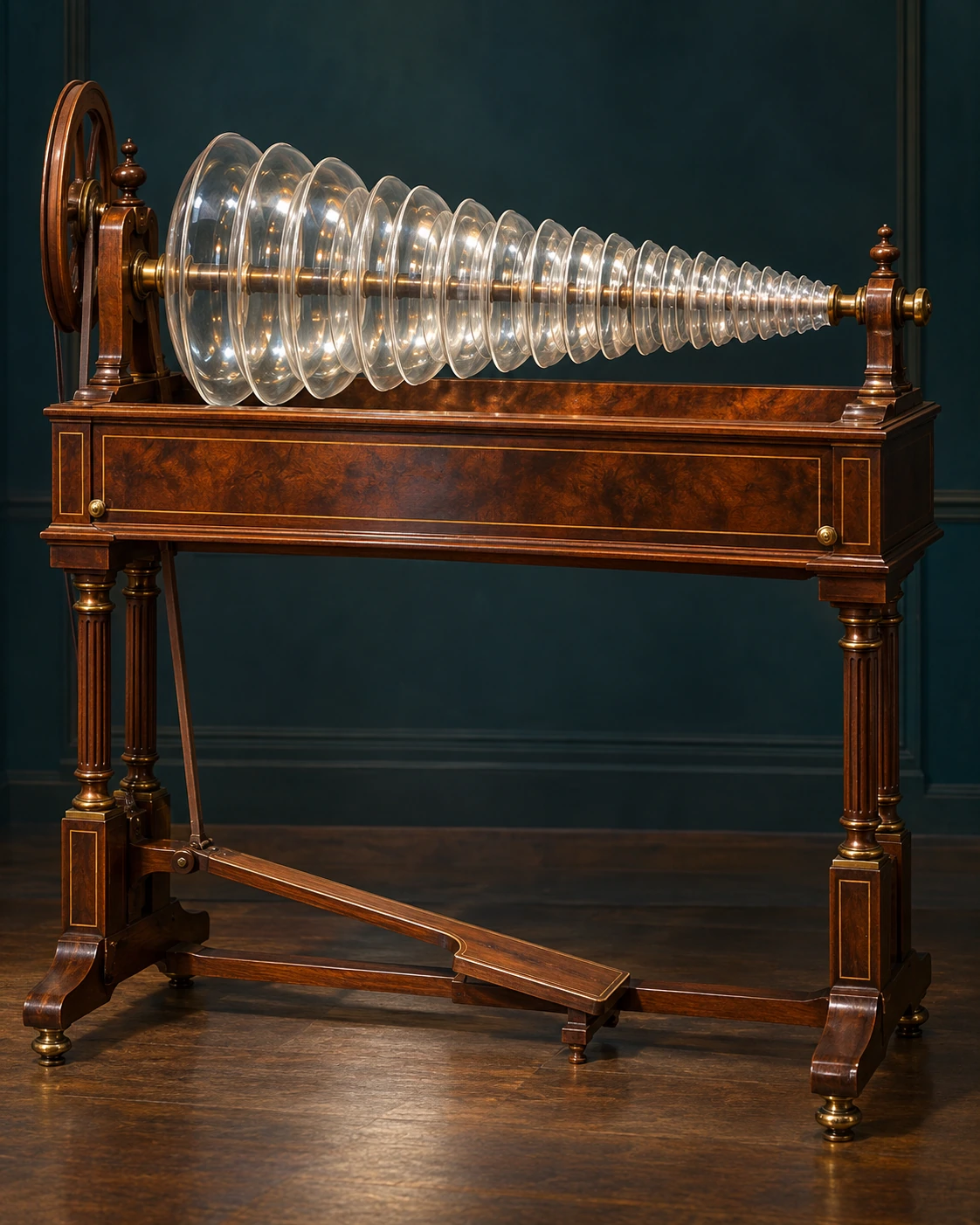
Graduated glass bowls share a horizontal spindle above a wooden treadle stand.
Nesting the bowls brings their exposed rims into a compact playing area. An interpretive instrument, not a dated collection specimen.

The idea is more revealing than a story about an eccentric invention. The sounding material is still glass, but the player's work has been redistributed. Feet can supply the continuous rotation. Fingers can concentrate on choosing rims and shaping contact. A design can transform an activity by moving the object rather than asking the user to move farther.

Where the note lives

The Franklin Institute's instrument account describes bowls made to different sizes and thicknesses so that each sounds its intended note without being filled with tuning water. A pedal rotates their shared rod. Moistened fingers touch the rims to produce sound.

Separate two roles that are easy to mix together. Water in a familiar musical glass can help determine its vibrating behavior. Moisture on a player's finger helps the frictional interaction at a rim. “It uses water” is therefore too vague to explain how a particular instrument is tuned or played.

For a paper exercise, sketch six separate circles across a table, then imagine reaching three nonadjacent rims at once. Redraw the circles as six nested arcs with exposed edges. You have changed the reach problem even though the number of notes is unchanged. The sketch is a design comparison; it is not a fabrication plan, and the real instrument depends on carefully made glass.

The surviving object may have more than one date

The Corning Museum of Glass's armonica has bowls dated 1818–1830 and a wooden case possibly made in the 1930s. Its record names non-lead glass among the materials. A single museum object can therefore carry the history of making, repair, and later support rather than one simple birthday.

Look at a historic instrument as an assembly. Which parts make sound? Which parts hold those sounding parts? Which parts let a player reach them? If two components have different dates, the object may tell two different stories. The museum record helps prevent a beautifully coherent display from hiding that complexity.
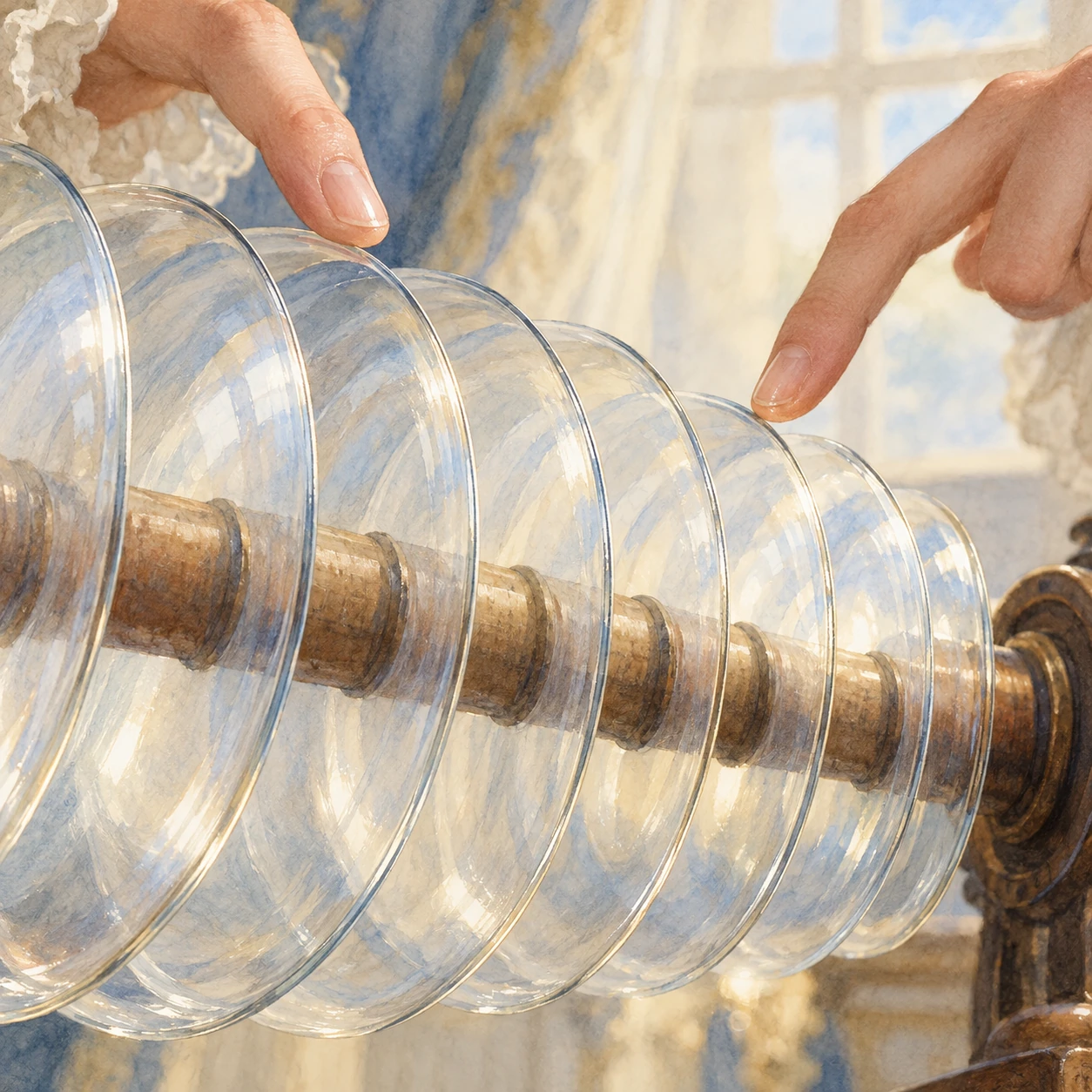
Two fingertips approach neighboring exposed rims of nested glass bowls.
The compact line of exposed rims changes the reach problem. Bowl dimensions and pitch cannot be measured from this interpretive detail.

In the detail illustration, the visible rims and gaps are the important features. Their appearance suggests how fingers might choose neighboring notes. The image cannot tell you a bowl's pitch, glass composition, or date; those require a physical object or a documented collection record.

A foot pedal is one answer, not the definition

The National Music Museum's glass armonica uses a crank rather than a treadle to rotate the spindle. That difference makes a good comparison question: how does the source of rotation affect a player's available hands, a helper's role, or the continuity of a phrase?

Do not infer the complete performance practice from the crank alone. Instead, treat it as evidence that the instrument family supports variations. A label that says “glass armonica” does not erase the maker's choices about how movement reaches the bowls.

Visit the three collection records as a design detective

Make three columns headed sounding glass, rotation, and support. Add only features explicitly visible or stated in each record. Use a question mark where the angle hides something. Then choose one difference worth investigating. This gives you a stronger comparison than assuming that the oldest-looking example must represent every later version.

Listen for a beginning

If a museum or performer provides a demonstration, follow one sustained note from its first audible moment to its release. Listen for whether the sound begins abruptly or grows into place. Next listen to a change between notes. Is the continuity mainly in the tone, in overlapping notes, or in your attention?

Those are useful listening categories even when the instrument's texture makes the answers uncertain. You need not identify a famous composition or know how to read music. Your task is to hear the contact becoming a phrase.

Notice which rim a fingertip can reach without crossing another hand. A compact arrangement offers opportunities, but it can also create decisions about fingering. Imagine holding one note while reaching its neighbor. The design question has moved from finding room on a tabletop to navigating a closely spaced set of edges.

The armonica is often surrounded by dramatic historical rumors. The objects themselves offer a better starting point: glass carefully shaped, a spindle kept in motion, and a hand negotiating a luminous set of edges. The remarkable part is the small practical rearrangement that makes a much larger musical possibility available.

Sources and further exploration: Franklin Institute: the glass armonica; Corning Museum: a composite surviving instrument; National Music Museum: a crank-driven example.

Explore all 50 new articles · Browse the complete illustrated collection

Explore more art, ideas, and independent projects at Incoprea.

Wednesday, October 14, 2026

The Kora: Two Hands, Many Musical Lines

Watch a kora player’s thumbs and index fingers for a moment, then close your eyes. The sound may seem to widen. A low figure returns, higher notes move across it, and a phrase appears to answer another phrase. Open your eyes again: the flowing texture is still being made by one person, using four plucking fingers.

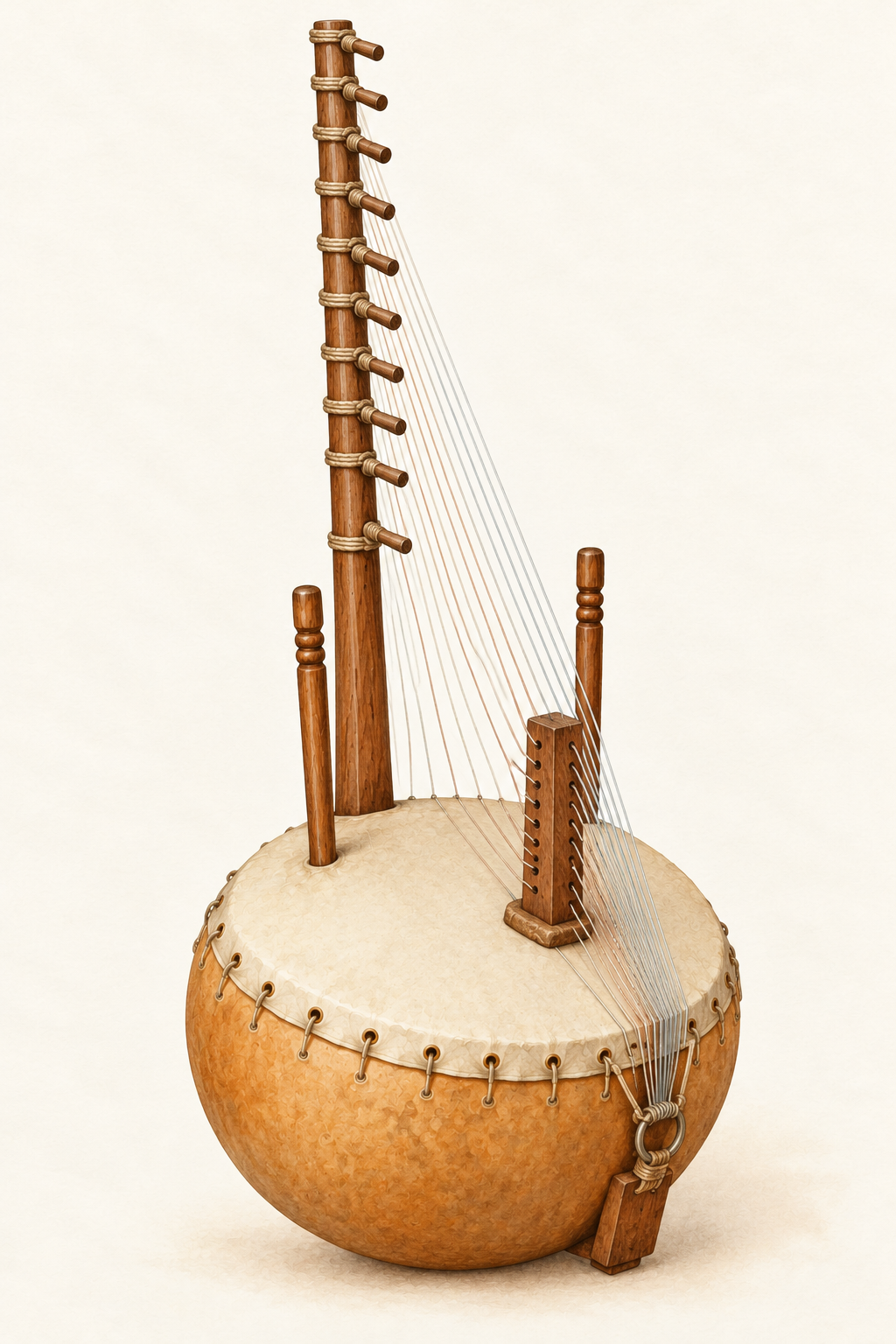
An interpretive kora has a long plain neck, handles, gourd body and a separate upright bridge.
Illustration of a generalized kora design. String arrangement and dimensions are stylized; it is not a measured instrument diagram or a specific historical artifact.

The instrument invites a useful change in listening. Instead of asking how many notes the player can fit into a second, ask which notes give the music somewhere to return. Repetition becomes an active musical choice, and a changing phrase gains meaning through its relationship with that dependable pattern.

Begin with the bridge, not the string count

A common kora has 21 strings distributed along two sides of a tall bridge. Its calabash body is covered by a skin soundboard. A long neck carries string tension, while two handholds steady the instrument. The Metropolitan Museum of Art’s nineteenth-century Mandinka kora offers a detailed record of that construction and identifies the object as a harp.

The bridge is crucial to understanding the arrangement. The strings do not form a guitar-like surface that the player presses against frets. They present separate pitches to fingers working on either side. Watching the hands therefore means watching how notes are distributed across a physical space. The apparent independence of musical lines grows from learned relationships among those positions.

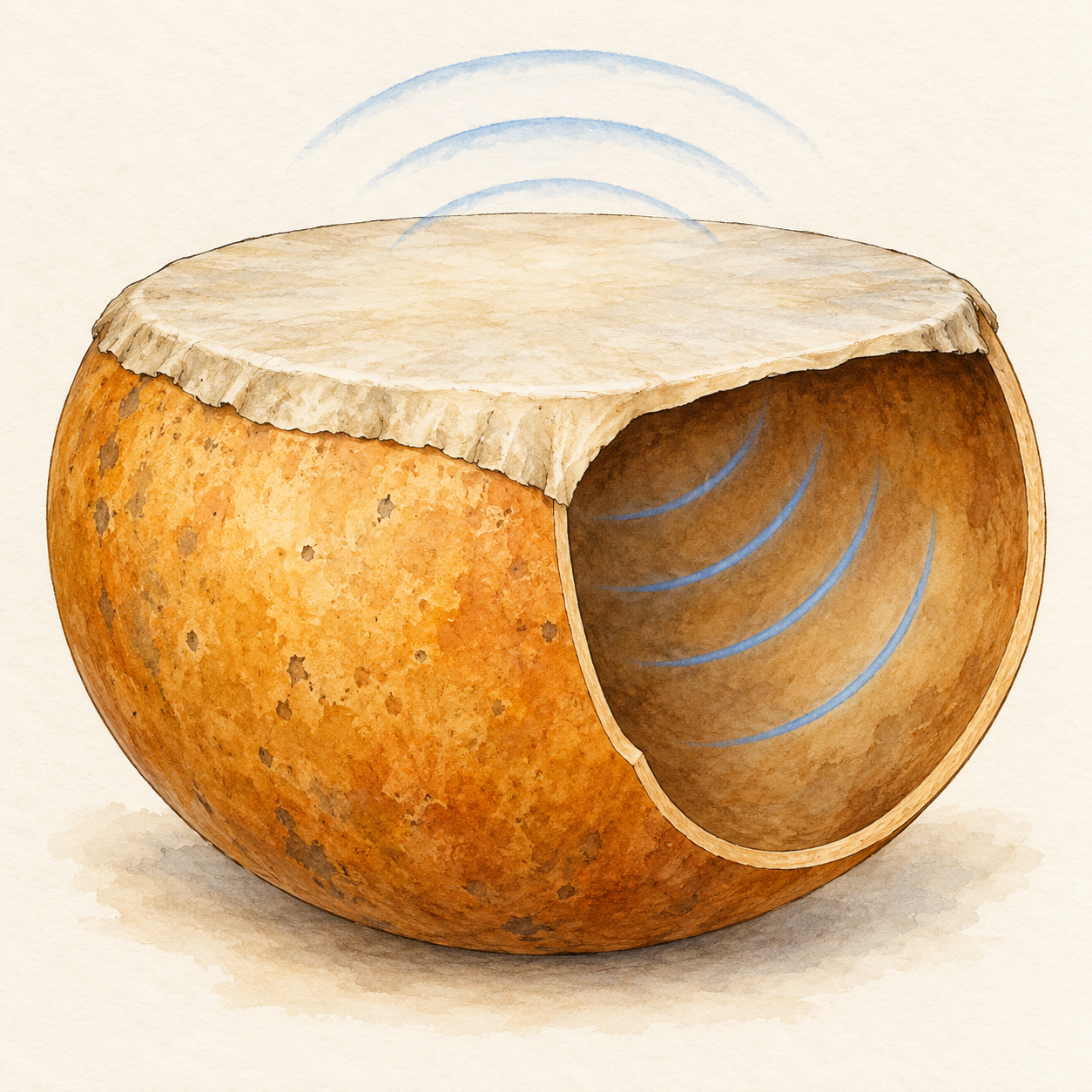
Follow a plucked string toward the bridge, then the bridge toward the soundboard. That route helps connect a small finger movement with a resonating body. The gourd is more than the instrument’s striking silhouette: construction, strings, and the player’s touch contribute to the sound you hear.

A conceptual cutaway shows a gourd cavity covered with a hide soundboard and abstract sound curves.
Conceptual illustration of a kora’s resonating body. The cutaway and blue sound curves are explanatory, not measured acoustic modes or construction instructions.

The illustration above isolates the resonating body so that you can look at those relationships separately. For an actual historical instrument, return to the museum’s photographs and measurements. A simplified cutaway and a surviving object answer different looking questions.

One museum object has traveled with musicians

The Sierra Leone National Museum’s kora record makes the instrument’s working life unusually tangible. The museum acquired this example in 1977 from a member of Bongi Makeba’s touring band. Its record also notes a significant absence: the bridge is now missing.

That detail changes how you look. A photograph of a museum instrument may show an object that cannot currently make its intended sound. If you cannot see a bridge, do not immediately invent an alternative construction principle. Check the record for loss, repair, replacement, and collection history. A musical instrument is both a designed sounding system and a material object that has passed through time.

Compare that example with the Met’s instrument. Identify one feature both records describe and one feature whose present condition differs. You are comparing particular objects, not choosing one museum specimen as the universal form of every kora.

What stays, and what moves?

The Met’s account describes kumbengo, a recurring pattern that helps establish a piece, alongside melodic and rhythmic lines. Grinnell College’s instrument collection similarly distinguishes recurring patterns from more ornate passages, using the term birimintingo for the latter. These names direct attention toward musical activity rather than treating the performance as a continuous cascade of interchangeable notes.

For a listener, a repeated part is like a place recognized on successive walks. Its return lets you notice what has changed around it. A phrase can become busier without losing that point of reference, or briefly pull attention away before the pattern becomes easy to hear again.

Avoid assigning every low sound to one hand and every high sound to the other just because that would make a neat diagram. The instrument’s physical distribution and the player’s coordination deserve to be observed. When a camera angle hides a finger, mark the movement as uncertain instead of filling the gap from the sound alone.

The musical knowledge belongs to people

Kora traditions are strongly associated with the Mandé region of West Africa and with jali or jeli musicians. The terms appear with different spellings across languages and sources; “griot” is also widely used. Their work can connect music with historical knowledge, praise, relationships, and public life. A description limited to the instrument’s engineering would leave that social knowledge unheard.

In Carnegie Hall’s introduction, Malian musician Yacouba Sissoko describes a specific path through that tradition. Born into a jeli family in Kita, he began learning the kora and associated oral traditions from his grandfather at nine. His later training, touring, and work in the United States belong to the same life. An inherited practice can support individual development and collaboration across settings.

Listening to a named musician also gives you a better starting point than searching for a single sound that represents an entire continent. Keep the performer, piece, recording, and context together in your notes. Those details make your next musical discovery more informed.

Hear an accompaniment grow

Carnegie Hall’s “Kelefaba” lesson with Yacouba supplies a particularly clear comparison. It includes a simple two-note accompaniment, a fuller accompaniment, and a sung performance. The song’s teaching context also connects music with the jeli’s role in peacemaking.

  1. Start with the simple accompaniment. Follow the return of its two notes. Tap a comfortable pulse only if that helps you hear the pattern.
  2. Listen to the fuller accompaniment. Notice what has entered between the points you already recognize. Describe a change in density, register, or movement rather than merely calling the second version better.
  3. Add the voice. Decide when your attention follows the singer and when it returns to the instrumental pattern. Can you hear both without losing the point of return?
  4. Watch once more. Choose one visible thumb or finger and follow a few movements. Then widen your attention to the two hands together.

Make a short note after each pass before replaying. Your first impression is worth retaining: a detail that becomes obvious on the fourth hearing was not necessarily obvious on the first. Repeated listening lets the texture become legible without demanding that you understand all of its musical vocabulary immediately.

A living instrument can change its materials

The Met contrasts older string and tuning arrangements with nylon strings and mechanical tuning systems used on contemporary koras. Such changes help explain why two instruments with a recognizable family resemblance may look different at the neck. “Traditional” need not mean that every material and fitting has remained fixed.

Return finally to the opening impression of several musical lines. The wonder has not disappeared now that you can name a pattern or trace a bridge. You have more ways to hear the player’s decisions. The kora’s richness lies in the meeting of a resonating object, coordinated hands, a particular musical voice, and knowledge shared between people.

Follow another musical thread

Listen for coordination across many performers in Kecak: The Balinese Chorus With a Modern Performance History. For a different meeting of hands, mechanism, and expression, explore The Ondes Martenot Puts a Singing Voice Between Two Hands.

Explore more art, ideas, and independent projects at Incoprea.
Famous Last Meals is now in paperback — stories, history and 25 recipes

Famous Last Meals: Stories, History, and Recipes is now available in paperback on Amazon. The illustrated collection brings together 23 his...