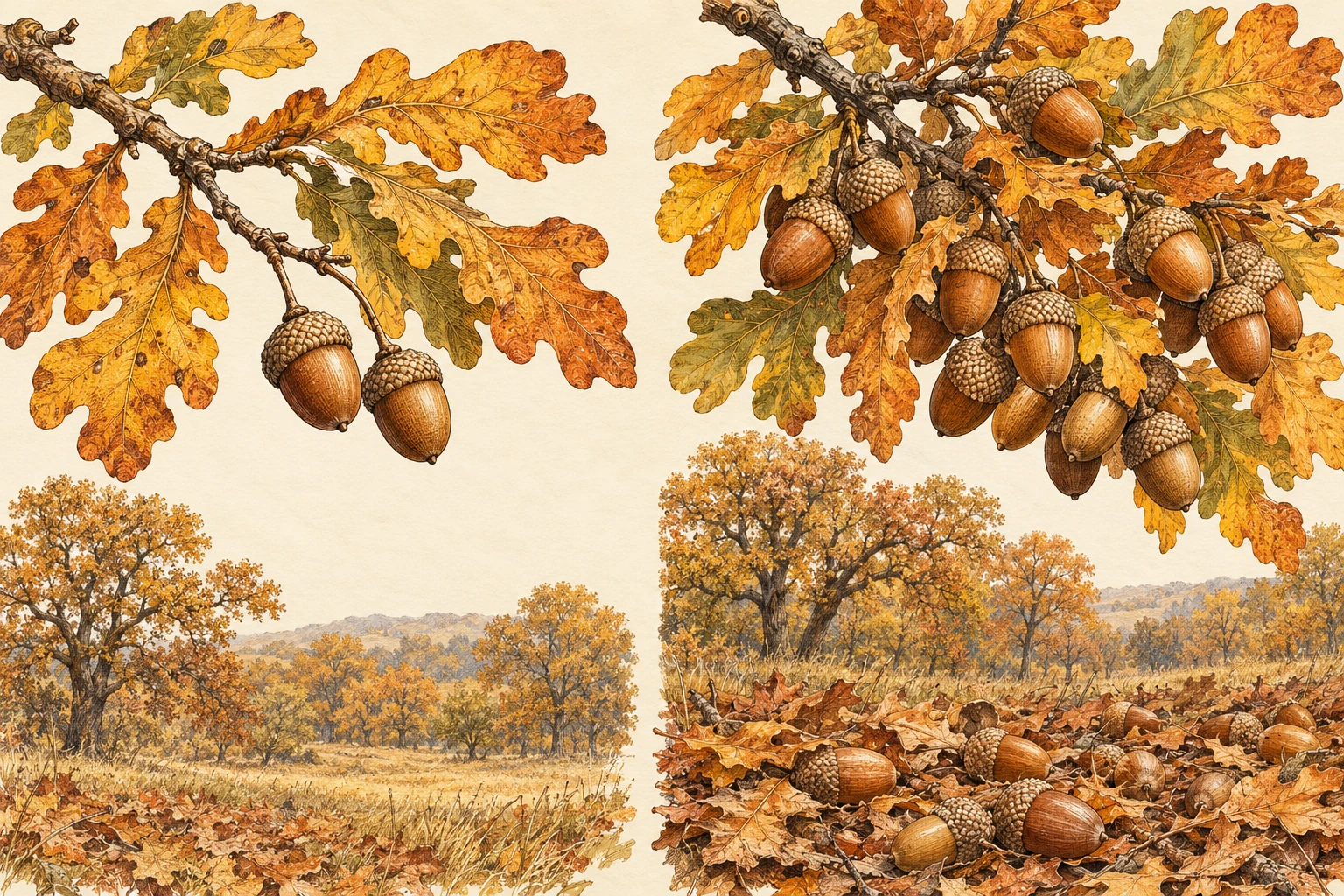
One autumn the ground beneath an oak seems paved with acorns. Another year, the same walk yields only a few. Extend the view beyond one tree and the puzzle becomes larger: many trees can produce heavy crops together, then share lean years. The forest's reproductive effort has a rhythm, but it is not usually a simple clockwork alternation.
This highly variable, synchronized production is called mast seeding, or masting. It occurs in many perennial plants, with different patterns and mechanisms. Calling every unusually productive individual tree a mast event misses the population component. The interesting signal includes how much crops vary through time and how closely individuals vary together.
Why make seeds in pulses?
The review by Kelly and Sork separates several explanations. A large synchronized crop can overwhelm some seed consumers, leaving a greater proportion uneaten. Synchronized flowering can also improve pollination, particularly in wind-pollinated systems. These are possible benefits of concentrating reproductive effort, not identical mechanisms.
The relevant calculation is often a proportion. A heavy crop can feed more animals while still leaving more surviving seeds per seed produced. Likewise, producing flowers simultaneously can improve opportunities for pollen exchange even when total flower production over many years is held conceptually constant.
But an advantage does not by itself explain how trees achieve the pattern. A plant has resource constraints; flower development unfolds over time; and weather can influence both cues and the success of reproduction. “It saves up and floods the market” is a vivid summary, but not an adequate model for every masting species.
How can distant trees share a year?
Individuals need not communicate directly to respond similarly to a shared environmental signal. Weather patterns can cover large regions. A 2017 analysis combined long-term tree-reproduction records with atmospheric circulation indices to investigate broad synchronization in European beech and Norway spruce. Shared climatic variation can help coordinate organisms separated by distances far beyond neighboring roots.
A 2024 study of European beech investigated another part of the timing problem: responses associated with summer temperature and the solstice. The findings supported a role for a seasonal timing window in coordinating responses across a large range. This is not a discovery that all trees drop seeds on the longest day. The cue can concern the development of a later reproductive event.
That temporal distinction is crucial. Weather during flowering, weather while seeds develop, and a cue influencing the following year's flowering can all matter differently. A correlation between this autumn's crop and last summer's temperature should not be rephrased as this autumn's weather causing every stage of the crop.
More seeds can still mean weaker reproductive efficiency
A 2020 study of European beech in England examined records from 1980 to 2018. Warming was associated with changes in variability and synchrony that weakened benefits linked to mast seeding. The lesson is counterintuitive: increasing average seed production need not compensate for losing the timing pattern that helps seeds avoid consumers or become fertilized efficiently.
Imagine two hypothetical forests with the same ten-year total of seeds. One produces a very large crop in a few shared years and almost none in others. The second produces a steady moderate crop every year. A consumer population may respond differently to those schedules. Equal totals do not guarantee equal outcomes because other organisms respond through time too.
The example does not prove which schedule is best. It isolates the reason a mean alone is insufficient. A serious comparison needs the timing, consumer response, pollination conditions, and actual seedling establishment. A 2024 synthesis of masting brings resource budgets, environmental cues, and evolutionary benefits into a combined framework.
This also helps interpret a neighborhood saying that “lots of acorns predict a hard winter.” A present crop reflects a history of reproduction and environmental conditions; it is not evidence that the tree has forecast the coming season. To test a prediction, one would need defined records and comparisons across many years, rather than remembering the striking autumn before one difficult winter.
The generated comparison above is a conceptual sparse-year and heavy-year illustration, not a dataset. Real trees do not politely arrange their output into two labeled categories, and a good study preserves the variation between extremes.
Masting makes a forest audible and tangible: seeds striking roofs, shells underfoot, animals collecting the pulse. Beneath that abundance lies a relationship among timing, resources, and other lives. The forest has not simply made more. Many individuals have made more together, and that “together” can change what reproduction achieves.
Follow the evidence: Kelly and Sork: mast seeding mechanisms and evolutionary explanations; Journé and colleagues: summer-solstice synchronization in beech; Bogdziewicz and colleagues: warming and masting benefits; Ascoli and colleagues: continental-scale climate synchronization; Evolutionary ecology of masting: mechanisms and climate change.
More curious connections, art and independent projects at Incoprea.