Showing posts with label Botany. Show all posts

Sunday, October 25, 2026

The Hidden Work Inside a Tree That Straightens Itself

A tree leans across a woodland opening. Lower down, its trunk points sideways. Higher up, the living crown curves toward the sky. The shape can look like a single gesture, as if a wooden pole has decided to stand straighter.

But a tree is adding material while it supports itself. New wood can generate forces during its formation. To understand the curve, we need to follow the construction, rather than imagine an old trunk stretching like a young shoot.

Leaning woodland tree with upper growth curving toward an upright position.
The outside curve is visible; the forces generated by new wood have to be investigated within the growing stem.

Growing wood can do mechanical work

A woody stem gains thickness through the activity of the vascular cambium, the growing tissue that produces new wood toward the inside. Once mature, the structural wood is not lengthening in the same manner as soft, actively extending shoot tissue.

Andrew Groover's review of tree gravitropism and reaction wood explains how trees use specialized wood to maintain or recover posture. The responses can help an inclined trunk reorient, preserve a branch's position, or support a replacement leader after damage.

Vertical is therefore not the target for every piece of a tree. A side branch has a useful place in a crown. The broader problem is keeping the growing plant's parts appropriately positioned as weight, light conditions, and surroundings change.

Two ways to influence a lean

Many broadleaf trees produce tension wood on the upper side of an inclined stem. It develops unusually strong tensile stress as it matures. Conifers commonly produce compression wood on the lower side, where compressive stress supplies a different means of reorientation.

“Pull from above” and “push from below” are useful first sketches of those two arrangements. They describe forces within growing wood, rather than muscles operating on a finished skeleton. There are botanical exceptions, so the broadleaf–conifer comparison is a guide, not a rule that identifies every unusual sample.

The shared result is a turning force generated by the stem’s own growth. Where the new wood forms, and how it develops stress as it matures, help determine the direction of bending. The cellular route differs between these two kinds of reaction wood.

The wall matters as much as the amount

The difference is not simply that one side grows a thicker ring. Wood's mechanical behavior also depends on the organization and composition of its cell walls.

A critical review of maturation stress describes the role of cellulose microfibrils and the surrounding wall material. Many forms of tension wood contain fibers with a distinctive cellulose-rich gelatinous layer, often called a G-layer. Compression wood has a different wall organization, including larger microfibril angles and altered composition.

These are routes to changing how a new layer behaves along the stem. The same review cautions against treating all tension wood as one uniform tissue. Some forms have layers that become lignified, and an obvious G-layer is not a universal visual badge.

The hidden details matter because a tree's structural material is also part of its movement system. During formation it can supply force. Later, the stiff mature tissue supports the shape that growth has produced.

A passing bend leaves a different question

A permanently tilted stem and one briefly bent by wind do not receive the same disturbance. A 2018 experiment with young hybrid poplars applied repeated, controlled bends and examined the wood formed in different regions of the stems.

The stems became more oval in cross-section. Some tissue changes were similar in stretched and compressed regions; others differed, including G-layer formation and aspects of fiber organization. The authors distinguished wood responding to repeated flexing from the tension wood associated with a sustained lean.

The comparison is a reminder to ask what force a tree experienced, how often, and for how long before giving all unusual wood the same explanation.

Force develops against a restraint

Imagine a new layer trying to change its preferred length while already attached to older, resistant material. Much of that change cannot happen freely. Mechanical stress develops instead.

This is one way to understand maturation stress. When its distribution differs around a stem, the resulting turning effect can influence posture. Seeing a curved trunk does not reveal which microscopic process generated each part of its history, but the curve is compatible with a structure built under changing forces.

The distinction between growth and released movement also matters to woodworkers. The review Tree growth stress and related problems describes stresses in living wood and consequences when a log is cut or processed. Removing a restraint can allow stored stresses to express themselves as deformation or cracking. Subsequent drying adds another set of material changes.

What helped a living stem maintain its position can therefore complicate its later use as lumber. A board's history began before the sawmill.

The history is inside as well as outside

Researchers can examine wood anatomy, growth-ring patterns, and mechanical measurements to investigate a response more closely. Groover's review also discusses how reaction wood can contribute evidence about past disturbance. The tissue becomes part of a tree's physical history.

A lean by itself is not a diagnosis of a tree's stability. It is an invitation to notice that support in a living organism is an ongoing activity. The tree keeps adding structure, and that structure can quietly change the direction in which the next part grows.

Read the research

Keep exploring

Discover more art, ideas, and curious things at Incoprea.

Friday, October 23, 2026

Read the Blue Around the Plant

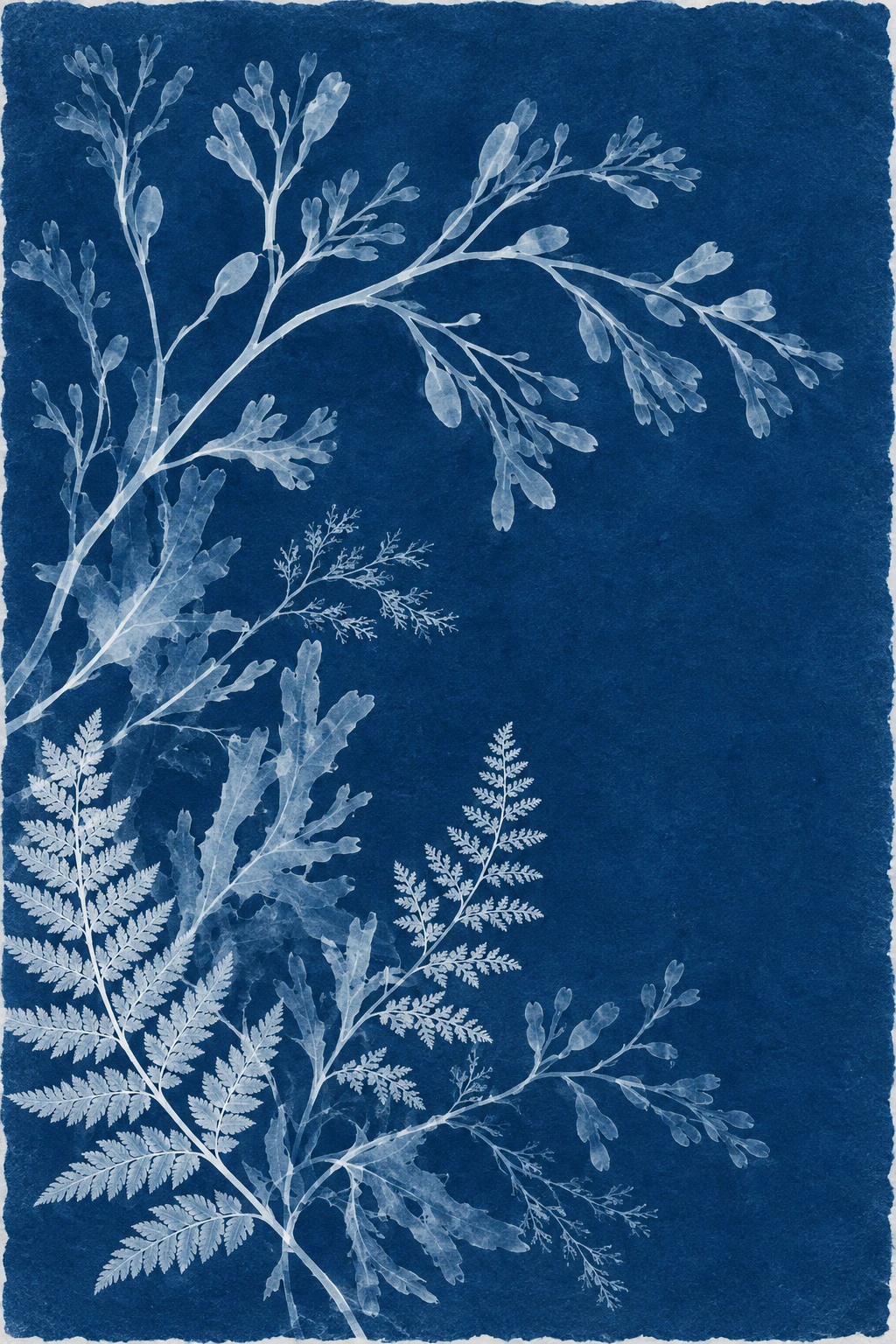
The plant is pale. The surrounding paper is deep blue. A delicate branch seems to have left its shadow behind, yet the image preserves details too fine to dismiss as a simple silhouette. A cyanotype asks you to read the space around an object as carefully as the object itself.

Pale seaweed and fern silhouettes spread across textured Prussian-blue paper.
A modern botanical composition inspired by contact printing. It is not an Anna Atkins original or a measured botanical record.

Anna Atkins made that reversal into an extraordinary way of presenting botanical specimens. Her pages belong to the history of photography, but they also reward the attention we give to a herbarium sheet, a carefully arranged drawing or a handwritten gift.

A specimen on a light-sensitive surface

The Victoria and Albert Museum's account of cameraless photography explains that Atkins used cyanotype paper and placed botanical material in contact with it. Light affected exposed regions, and washing developed the characteristic blue image. No camera lens was required to draw the plant's outline.

Opaque parts blocked more light. Translucent parts allowed some through. That difference can produce tonal information within the outline, rather than a uniform white cutout. Contact and the specimen's physical structure both contribute to the result.

Start with the reproduction of a real Atkins print on the museum page. Choose a thin part and a dense part of the specimen. Does one show more tonal variation? Before guessing why, note whether overlapping material, different thickness or an image reproduction might also affect what you see.

Making a book one contact at a time

The New York Public Library's record of Photographs of British Algae describes a self-published work issued in parts, beginning in October 1843. Atkins arranged, exposed and developed photograms of a large body of specimens. Her work joined a photographic process to the problem of communicating botanical form.

A contact process also makes the page's arrangement a physical event. The specimen must occupy a position during exposure. A branch that crosses another branch can hide information; a crowded page can make comparison harder. Composition is therefore both an aesthetic choice and a decision about what another person will be able to inspect.

Imagine arranging three leaves for someone who has never seen their plant. Would you overlap them to create an elegant shape, or separate them to make every edge available? There is no need to pick one aim forever. The interesting question is which aim your particular page serves.

One process, more than one purpose

The V&A's discussion of Atkins's gift to Anne Dixon focuses on later botanical images associated with friendship. The collection includes fescue grasses, dandelion and poppy studies. These pages invite us to see the work as a material exchange between people as well as a record of plants.

That dual role is familiar. A photograph can document a specimen and also be a carefully chosen gift. The presence of scientific information does not cancel composition, and a beautiful arrangement does not make the plant irrelevant. Atkins's cyanotypes are compelling because those purposes can coexist on one blue sheet.

A close-looking exercise without chemicals

Place a translucent leaf or a small piece of thin fabric on white paper near a window. Observe the object itself, then its shadow under ordinary room light. You are not making a cyanotype. You are separating two questions: what shape does the object occupy, and how does it transmit or block light?

Now look again at an Atkins reproduction. Identify one feature that seems connected to an outer contour and one that seems connected to transparency. Keep the comparison modest. A shadow on your desk is not a chemical print, but it can train attention to the properties the print records.

If you choose to try cyanotype later, use a prepared kit and its instructions. Exposure and washing conditions depend on the material. This article's illustration is a modern composition inspired by the process, not a recipe, an authenticated Atkins page or a botanical identification aid.

Three things the blue cannot tell you by itself

A blue background does not establish a plant's original color, its complete three-dimensional structure or its scientific identity. Labels and specimen knowledge add information the image alone cannot supply. Ask what has been recorded and what has been intentionally transformed.

Leave the page open for a little longer than a quick scroll would allow. Follow a branch into an overlap. Notice the way empty blue spaces hold the specimen apart. The process has replaced natural color with a striking constraint, and within that constraint an individual arrangement becomes wonderfully clear.

Atkins's achievement was not merely making plants look blue. It was finding a repeatable encounter among light, paper and a specimen, then using that encounter to make pages worth studying and sharing.

Sources and further exploration: V&A: cameraless photography; NYPL: Photographs of British Algae; V&A: cyanotypes for Anne Dixon.

Explore all 50 new articles · Browse the complete illustrated collection

Explore more art, ideas, and independent projects at Incoprea.

Thursday, October 22, 2026

Fig Wasps: A Nursery Hidden Inside a Fruit

A fig looks like a sealed parcel. A bee cannot simply land on its surface and brush against an exposed flower. Yet inside that parcel is a whole inward-facing flowering structure, and for many wild figs the pollinator must enter through a narrow doorway. The result is one of the most intimate plant–insect partnerships on Earth: a nursery that is also a pollination chamber.

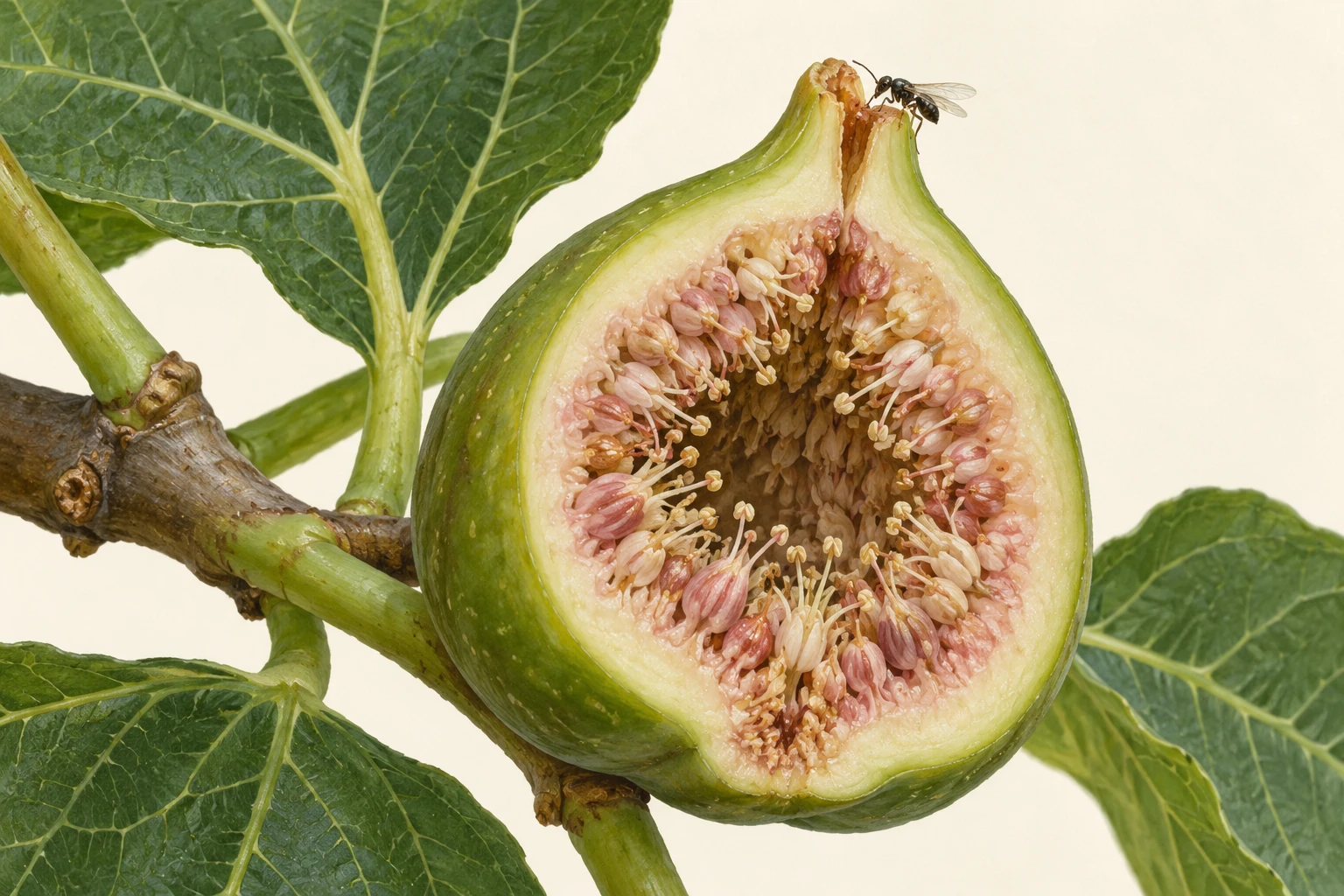
Conceptual cutaway of a green fig showing small inward-facing flowers and a tiny wasp at its opening.
Conceptual botanical cutaway; the wasp and internal structures are illustrative, not a species-identification diagram.

Cutting a ripe fig in half gives a useful first clue, although it does not reveal the whole life cycle. The little structures that seem like seeds belong to numerous tiny individual fruits. The surrounding fleshy structure encloses the flowers from which they develop. Botanists call that enclosed inflorescence a syconium. Kew's common-fig profile explains the arrangement. A fig is therefore not one oversized flower with its petals missing; it is a different way of organizing many flowers.

Finding an entrance to a hidden garden

Female pollinating fig wasps leave the fig in which they developed and search for receptive figs. According to the specialist FigWeb account, host-specific airborne chemicals help guide them. Their target has to be the right kind of fig at the right stage. Finding any green sphere on any tree is not enough.

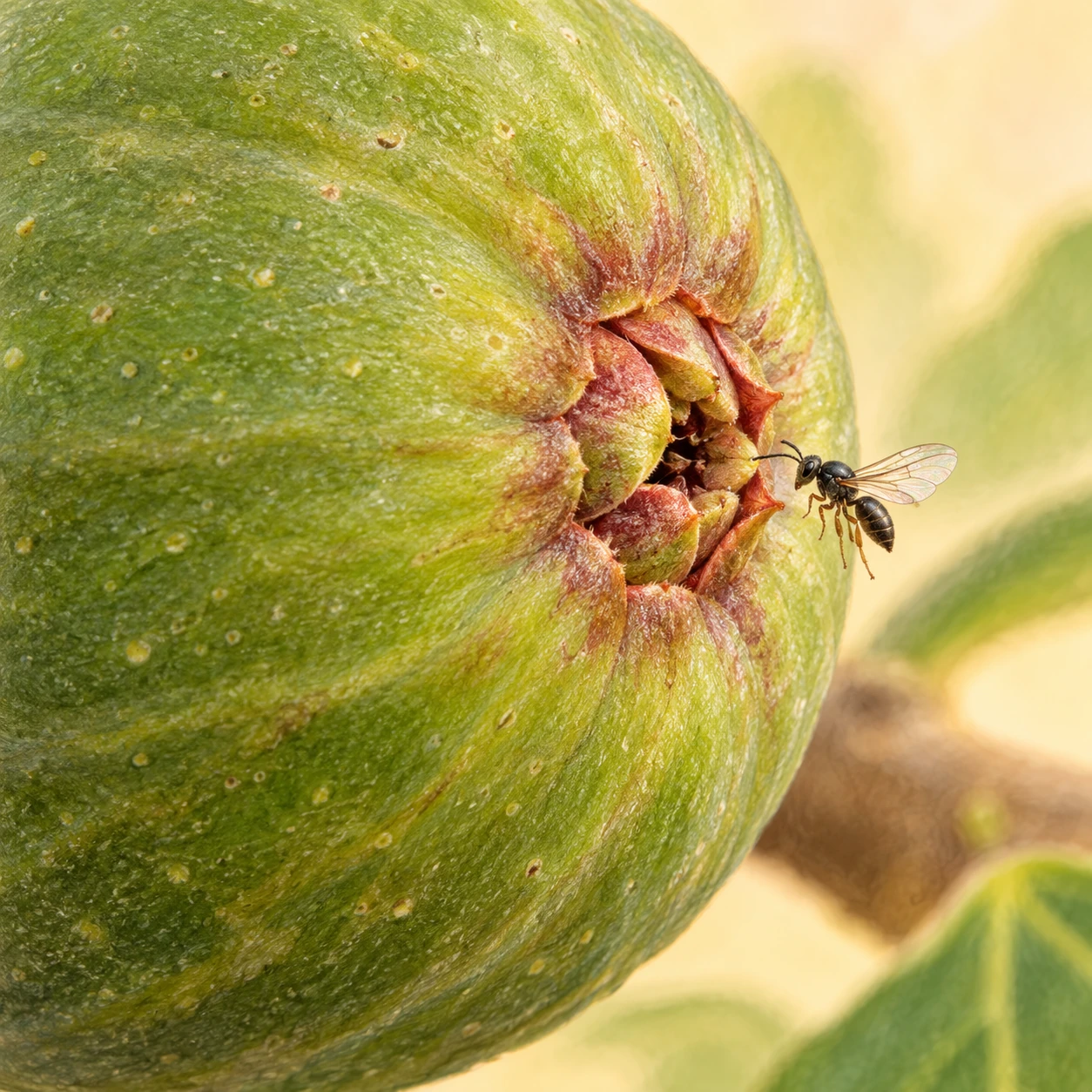
The entry passage, the ostiole, is lined with tightly overlapping bracts. A female's flattened head and thorax help her negotiate it. Once inside, she can pollinate flowers and place eggs in suitable floral structures. This is an awkward place for our usual language of visitors: the insect is not casually stopping for nectar and flying away. Her reproductive future becomes bound to the developing fig, while the tree's reproductive future depends on pollen reaching its hidden flowers.

That dependency should not be flattened into the claim that every fig species has exactly one wasp species, forever paired with it. A comparative study of New World fig-wasp communities examines host specificity and the evolutionary relationships of pollinating and nonpollinating wasps. The system includes variation, multiple interacting lineages, and other wasps using the same resource. A famous mutualism is still an ecological community.

Two ways to move pollen through the doorway

Getting inside a fig does not tell us exactly how pollen arrives at its flowers. Pollinating wasps include active and passive systems. In an active system, a female collects pollen, carries it in specialized structures and deliberately deposits it during her work inside a receptive fig. In a passive system, pollen carried on the body can reach flowers without that same sequence of collecting and placing.

Close botanical view of a fig ostiole with overlapping bracts and a tiny approaching wasp
The narrow entrance is only one stage of the job. Pollen transport and deposition can follow different routines in different fig–wasp systems.

A comparative study based on direct observations in 88 wasp species examined which traits predicted those modes. Coxal combs, structures associated with handling pollen, were informative. Pollen pockets alone were not a reliable diagnosis across the comparison. A structure can remain even when its present behavioral role differs from the one a viewer expects.

That is a useful complication to the familiar image of a pollinator dusted with pollen. Dust on the body and a managed pollen load are different transport arrangements. The difference also changes the plant's investment: how many pollen-producing flowers are needed depends partly on how efficiently the available pollen gets delivered.

A study of eight related fig species and their Eupristina pollinators investigated that relationship among pollination mode, floral investment and other wasps using the interior. It found that the same enclosed architecture can accommodate a more varied set of participants than the famous pair alone suggests. The additional wasps should not all be assigned the pollinator's role merely because they developed in a fig.

A close-view challenge: what would establish active pollination?

A photograph of a wasp near an anther establishes proximity. A pollen pocket establishes a possible carrying structure. To document the behavior, follow collecting, loading, transport and deposition, with the individual actions actually visible. A pocket without that sequence cannot settle the mode by itself.

When watching a research film, pause before the animal enters. Ask what it is carrying. Pause inside and ask what action brings pollen to the flowers. Finally compare those actions with egg laying. The two may occur in the same visit, but their products differ. This small separation lets you see cooperation as work performed through particular motions, rather than as a label attached to two species.

The ostiole is therefore a gateway to more than a protected room. It connects two phases of a transport job. Understanding the cargo and its handling deepens the story hidden behind that tiny external opening.

A partnership with an internal conflict

The tree needs seeds. A pollinator needs surviving offspring. A flower used for a wasp larva cannot also provide the same reproductive outcome as a flower that becomes a seed. The partners benefit from the relationship, but their interests are not identical. That is why figs are useful for studying cooperation without assuming either kindness or conscious agreement.

In experiments on four Panamanian fig species, researchers manipulated pollination and measured developing figs and wasp offspring. Unpollinated figs had less dry mass in their walls and in offspring, and fewer initiated galls produced live wasps. Jandér and Herre's 2016 study found selective resource allocation a more economical explanation of the combined results than the alternatives they evaluated. Better-pollinated figs received more resources; poor pollination could leave wasps with a poorer nursery.

The word “sanction” is used for consequences that reduce the success of an uncooperative partner. It does not mean a tree recognizes a villain. Resource allocation can produce an evolutionary incentive without a nervous system, a plan, or moral judgment. Describing the mechanism precisely makes the partnership more remarkable than imagining a miniature courtroom inside the fruit.

Does this mean every fig you eat contains a wasp?

No single answer applies to every common-fig cultivar or crop. The University of Florida extension explanation distinguishes common, Smyrna, and San Pedro types. Some familiar cultivated figs develop without pollination; other types or crops require it. A statement about a wild pollination partnership is not automatically a statement about a particular supermarket fig.

This is a helpful check on a viral fact. Start by asking whether the claim concerns the genus Ficus, the common fig Ficus carica, a named cultivar, or one particular harvest. Then ask whether it concerns pollen, seeds, larval development, or the remains of a pollinator. Those are related questions with different evidence. The sensational sentence often gains its certainty by sliding between them.

The deeper surprise is not a hidden ingredient in a snack. It is the organization of an exchange. A tree builds flowers in a protected chamber; an insect can reach that chamber and reproduce there; the consequences of successful or unsuccessful pollination affect the next generation. Neither participant needs to understand the system. The partnership persists through the reproductive results of what each does.

A fig therefore offers two kinds of hidden interior. One is anatomical: the garden folded inward. The other is evolutionary: competing interests held in a relationship that can benefit both sides. Looking beyond the sealed surface reveals both, and gives us better questions to ask about every other biological partnership described as perfectly harmonious.

Follow the evidence: Kew: edible fig anatomy; FigWeb: how fig wasps pollinate; Jandér and Herre: resource allocation and sanctions; University of Florida: common fig types; Host-specificity and coevolution among New World fig wasps.

More curious connections, art and independent projects at Incoprea.

Buzz Pollination: A Flower That Has to Be Shaken

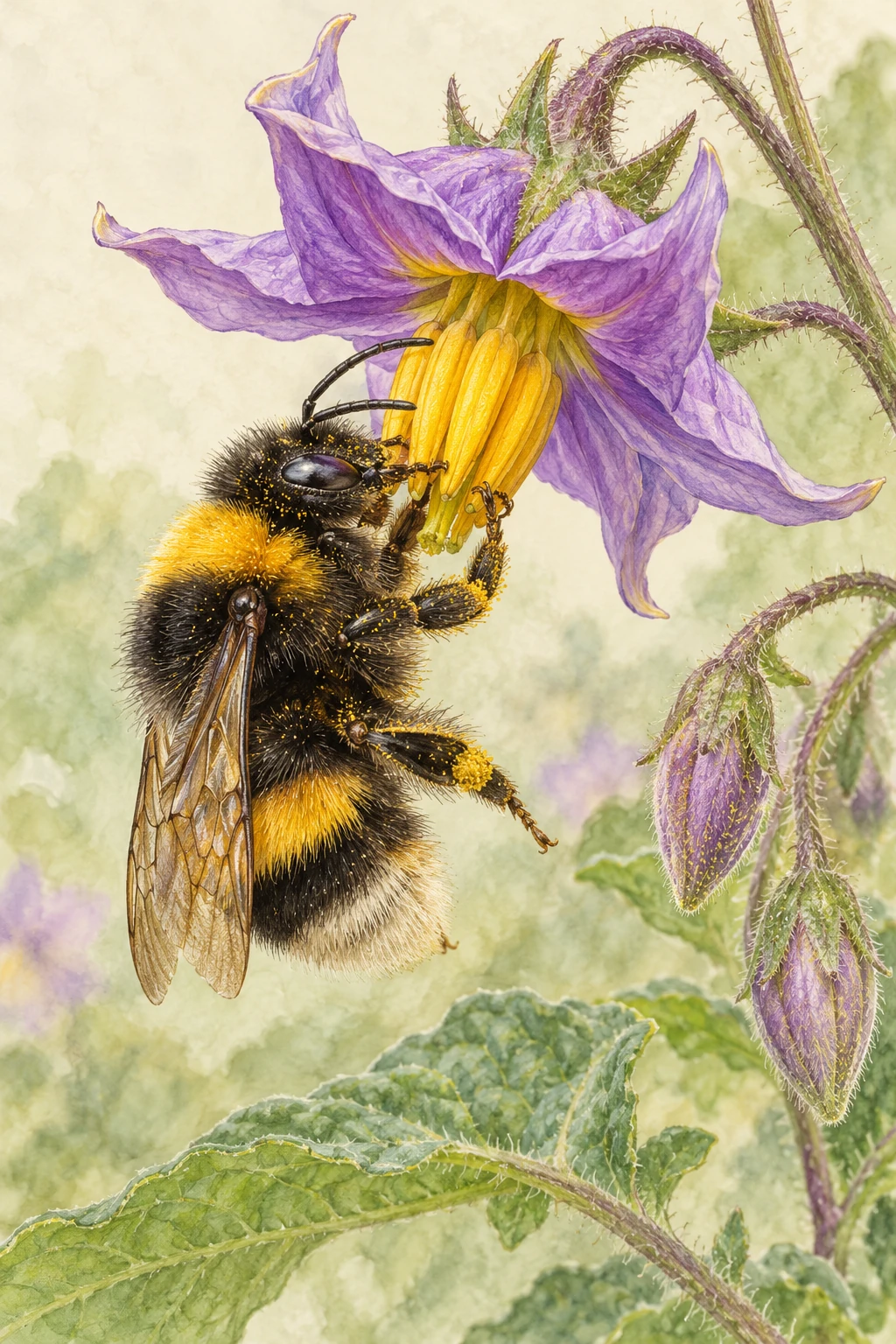
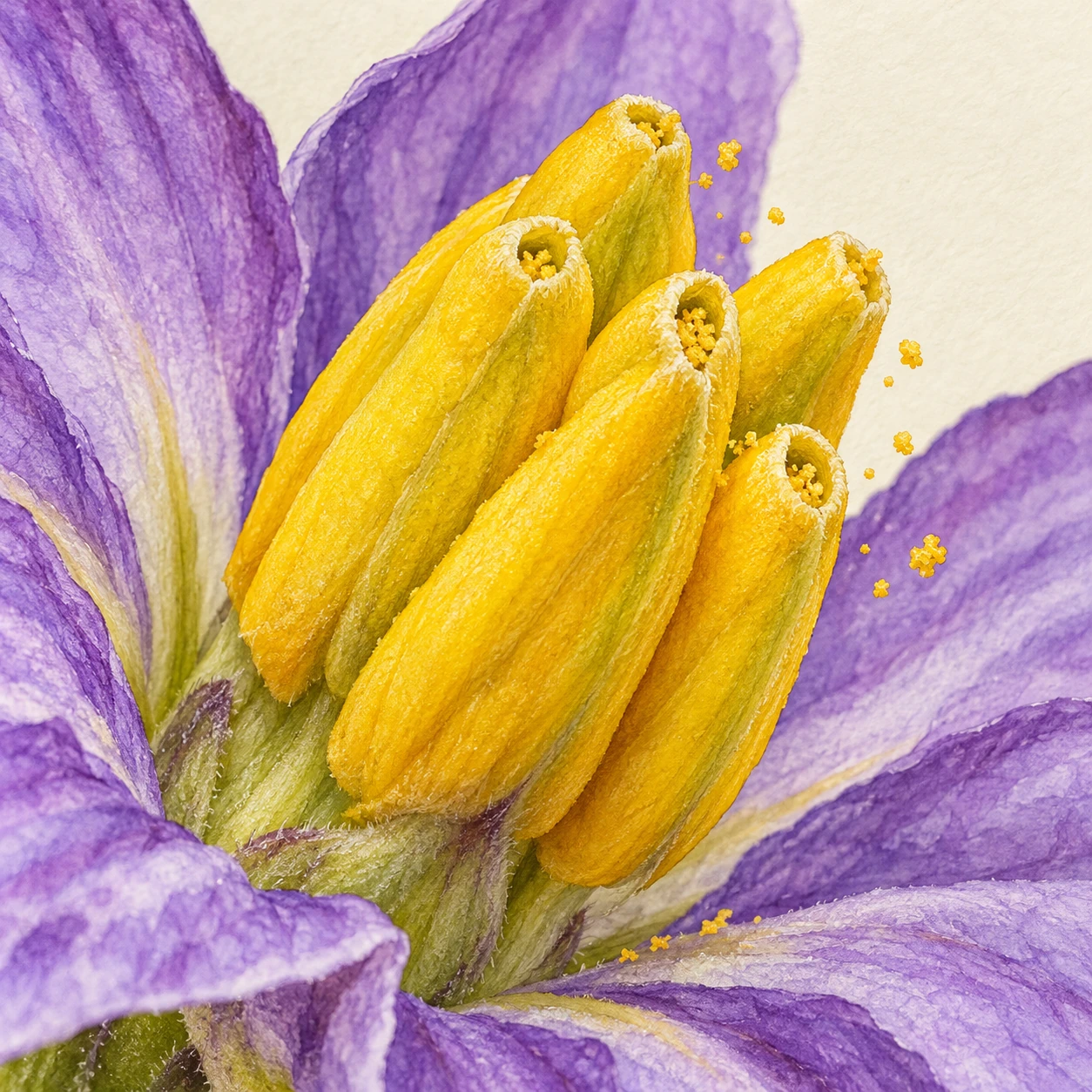
A bumblebee grips the yellow anther cone of a purple Solanum flower with pollen dusting its body.
Conceptual botanical illustration of floral buzzing; not a measured vibration or a diagnostic species plate.

Watch a bumblebee at a suitable flower and the sound can change. The insect lands, grips the pollen-bearing structures, and produces a concentrated buzz with its wings no longer doing the work of flight. The flower is being shaken. Its pollen is not simply waiting on an exposed surface for a visitor to brush past.

This is buzz pollination, or floral sonication. In many flowers adapted to the interaction, pollen is enclosed in anthers and leaves through small openings. Vibrations applied by a bee move through the flower and help eject the grains. The bee is collecting food; some of the pollen it carries can later reach another flower. A practical feeding action becomes part of plant reproduction.

The flower is a mechanical structure

The pepper-pot analogy is useful: shaking can make particles leave a restricted opening. But a real flower is not a rigid kitchen container. Its anthers, petals, connections, and orientation influence how a vibration travels. The relevant motion is not captured by the audible note alone.

Nevard and colleagues' research dataset describes how bees often grasp one or more anthers with their mandibles and transmit thoracic vibrations through floral tissues. Different flower architectures can alter the transmission to neighboring anthers. A bee's grip is therefore part of the contact through which the mechanical signal enters the plant.

In a study of Solanum rostratum flower biomechanics, researchers used contactless laser vibrometry to measure movement in three spatial axes. The study found that dominant vibration frequency was conserved through the flower while other aspects of vibration transmission differed. The direction and magnitude of movement can matter even when the main frequency remains similar.

That is why “the bee hits the flower's magic note” is an incomplete explanation. Frequency tells us how often a motion repeats. Amplitude describes how large the movement is; velocity and acceleration describe other aspects of it. Two vibrations with the same audible pitch need not shake pollen loose equally well.

One shaken anther can lend motion to its neighbors

A bee need not grip every pollen-bearing structure at once. The connection between anthers can make one contact affect several parts of a flower. That gives the arrangement of the anthers a job beyond displaying pollen to a visitor.

Close botanical view of yellow Solanum anthers and their terminal pores
Anther contact can transmit a vibration beyond the bee’s grip. This botanical study is not a measurement of movement or pollen release.

A 2022 study experimentally joined anthers in three Solanum species and compared their response with unjoined arrangements. Applied bee-like vibrations reached neighboring anthers at higher amplitudes in the joined treatment. Pollen release increased in two species with naturally loose arrangements, but not in the species whose anthers were already closely packed.

The exception is useful. A treatment can produce a measurable mechanical difference without increasing the final output in every species. Contact geometry, existing transmission and the amount of pollen available all belong in a complete explanation. The result is more informative than a universal claim that a tighter flower always releases more.

An earlier experiment with synthetic pollination buzzes varied frequency, amplitude and duration separately. Greater amplitude and longer duration released more pollen in the tested system; frequency contributed much less strongly over the investigated range. The work helps explain why a recording's pitch is an incomplete description of the mechanical input.

Read a mechanical experiment in two stages

Make two boxes on paper. Label the first “motion reaching another anther” and the second “pollen released.” Put the measurement in its proper box. Then ask what would connect them. This prevents a larger vibration from quietly becoming a measured reproductive benefit without evidence of the intervening steps.

What should a controlled comparison keep the same?

If the question concerns anther connections, apply the same selected input to both arrangements and measure their different responses. If the question concerns buzz duration, keep the flower arrangement and other input properties comparable. Changing both together would make the cause of a difference harder to identify.

The flower's close view now contains an experiment you can imagine clearly: one entry point, several linked structures and a particulate output. Its small pores are not a demand for one magic note. They are part of a living mechanism whose performance depends on how motion arrives, travels and continues through time.

The bee can change its performance

Research reported by Stirling in 2016 followed inexperienced bumblebees on their first encounters with flowers requiring vibration. Bees began buzzing without needing to watch an expert, but their handling and vibrations changed with experience. They increasingly focused on the pollen-bearing parts rather than the petals. An evolved ability and learned refinement were both present.

Another study comparing buzzing tasks found stronger flower buzzes than those associated with defense or flight under the tested conditions. One insect can use the same general muscular apparatus in different ways. Treating every bee sound as the same motor behavior would miss that flexibility.

There is also an important distinction between a flower visit and effective pollination. An insect might reach nectar, collect exposed pollen, remove pollen through another route, or contact the stigma poorly. A photograph of a bee on a flower cannot establish all the steps. To evaluate a pollination relationship, researchers need to measure what the bee does and what happens to pollen.

Separating bee choices from flower responses

A live bee changes its grip, effort, posture, and visit duration. That flexibility makes natural behavior fascinating and controlled mechanical tests difficult. A research project described by Stirling in 2022 proposed small robotic devices to reproduce aspects of buzzing at a more useful scale. Such tools let researchers vary mechanical inputs systematically rather than depending entirely on what a bee chooses to do next.

A robot is not a complete replacement for a bee. It can isolate a physical relationship, while live-animal observations reveal how an organism actually exploits that relationship. The strongest explanation joins both: the flower's transmission properties and the bee's changing behavior.

This also gives a more precise meaning to pollinator diversity. Flowers do not all present the same task, and insects do not all perform the same actions. Maintaining a collection of visitors is not automatically equivalent to maintaining every specialized function. Which flowers need which behaviors is a question of biological compatibility, not only insect abundance.

The next time a bumblebee stops flying but keeps buzzing, listen for work rather than background noise. A small animal is applying a controlled mechanical action to a living structure. The flower filters and transmits that motion, pollen moves, and both participants' reproductive stories may change. The encounter is audible, but its essential exchange passes through contact.

Follow the evidence: University of Stirling: floral buzzing and experience; Pritchard and colleagues: task-specific bee buzzes; Nevard and colleagues: vibration transmission dataset; Brito and colleagues: flower biomechanics, data and code; University of Stirling: robotics for testing floral vibration.

More curious connections, art and independent projects at Incoprea.

Dodder Finds a Host in the Chemistry of the Air

An orange thread curls through the air beside a green stem. It has no eyes, no nose, and no legs, yet its direction can be influenced by chemicals released from another plant. Dodder makes the space around vegetation look different: apparently empty air can contain useful information about a potential host.

Dodders belong to the parasitic plant genus Cuscuta. Their thin stems can coil around hosts and form specialized connections called haustoria. Through those interfaces, a parasite obtains resources from the host. The obvious tangle is only the visible outcome. Before it can exploit a plant, a young dodder must reach one.

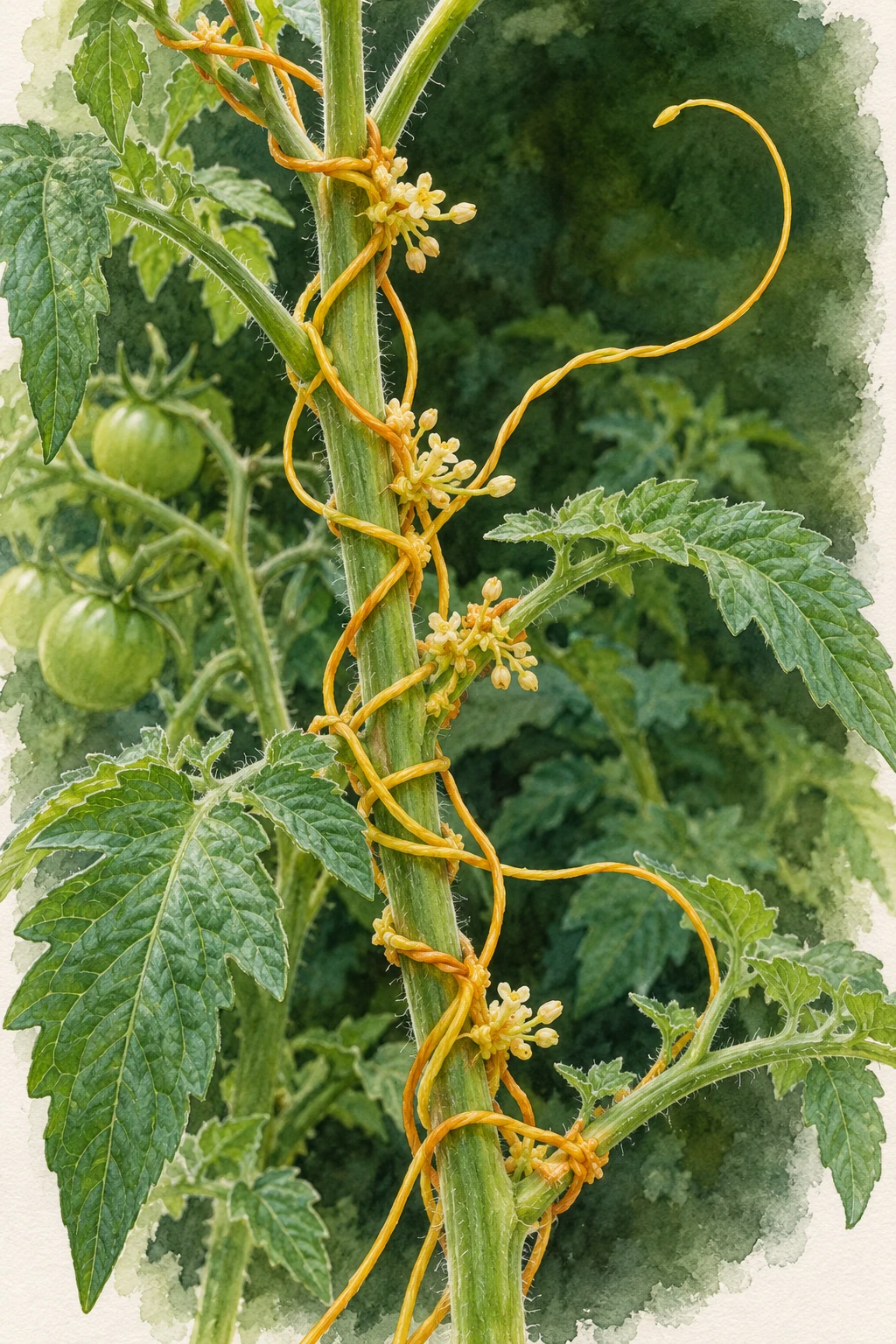
Fine yellow-orange dodder stems coil around a green tomato plant while one searching tip curves into the air.
Conceptual botanical illustration of dodder and a tomato host; attachment structures and growth direction are interpretive.

How to distinguish a smell from a silhouette

In experiments published in 2006, Cuscuta pentagona seedlings grew toward nearby tomato plants and toward extracted tomato volatiles presented without the whole plant. They also responded to other plants, but preferred tomato over wheat volatile cues in the comparison. Certain individual compounds attracted growth, while one wheat compound was repellent.

The important step was separating possible cues. A whole tomato plant supplies light, shade, humidity, contact opportunities, and chemicals. A seedling curving toward it cannot tell us which of those mattered. The Penn State account describes tests with artificial visual stand-ins and extracted chemical cues. The researchers did not infer a chemical response solely because the growth looked purposeful.

“Smelling” is an accessible shorthand for detecting airborne chemicals. It should not imply a nose, a mammal's sensory experience, or a plant consciously choosing lunch. The directly supported description is that chemical information changed directional growth under the tested conditions. That statement is already surprising enough.

Growth can be a way of moving toward information

We tend to imagine behavior as an animal changing position rapidly. A plant can instead alter where its next tissue is added. Over time, differential growth changes a stem's direction and the contacts it is likely to make. A time-lapse reveals the result much more readily than a glance at a garden bed.

That difference in timescale can make plants seem passive when they are not, or tempt a viewer to give them animal intentions when the film is sped up. Both shortcuts lose the mechanism. The useful questions concern the cue, the growth response, and whether that response improves access to a host.

A controlled result in one dodder species also does not establish the same cue hierarchy for every Cuscuta species in every habitat. Wind, the mixture of neighboring plants, distance, and the stage of development can change what information is available. The experiment identifies a capacity and a mechanism worth studying, rather than a universal rule for every orange vine.

One parasite can connect more than one host

Once a dodder stem reaches a second plant, the story is no longer only a parasite drawing resources from one host. The vine can form a living bridge between hosts. A bridge creates possible routes for material and signals, while still imposing the costs of parasitism.

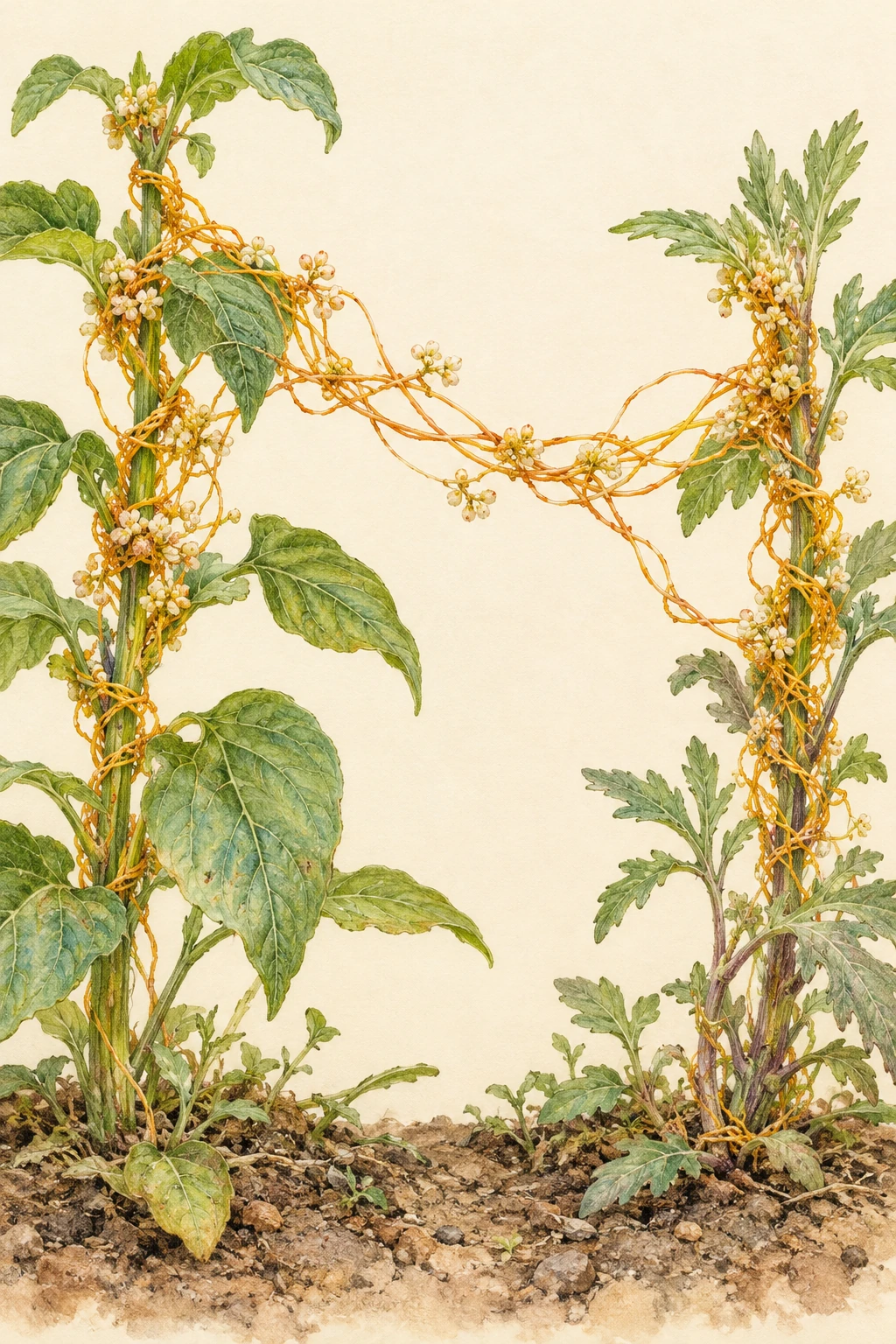
Orange dodder vines bridge two separate green host stems
A dodder bridge can create a signal route while remaining a parasitic connection. The depicted plants are a conceptual arrangement.

A 2017 study of Cuscuta australis connected host plants through the parasite and induced herbivory on one host. Unattacked connected plants changed gene expression and developed stronger defense-related responses. Further tests linked that preparation with increased resistance to insects. The work connected a signal route to a consequence, rather than stopping at the detection of a molecule.

A later experiment with cucumber hosts investigated salt-induced signals. Treating one connected host could prime another for subsequent salt stress, with changes in physiology and gene expression. Published online in 2019 and in a 2020 issue, it concerned a particular controlled host–parasite arrangement, not a universal benefit of dodder in crops.

The two studies ask related but distinct questions. Herbivore damage and salt exposure are different inputs. A response to one does not establish that every kind of information crosses the bridge, or that a recipient receives an identical response in every setting.

Compare three routes before naming a message

On paper, place two host plants in separate boxes. Draw the dodder connection between them. Add a second possible route through shared air and a third through shared growing conditions. A response in both boxes is not enough to identify which route carried the effect. The experiment needs controls that distinguish the alternatives.

What would severing a bridge complicate?

It would remove a proposed route, but it could also wound the parasite or alter its resource demands. A useful design must consider those extra changes. The question is not merely whether a connection is visible; it is whether the observed response depends on that connection under an appropriate comparison.

This changes the meaning of the orange tangle without turning it into a benevolent communication service. A parasite can transmit a useful cue and still reduce host performance overall. The net outcome requires costs, benefits and conditions to be measured together.

The empty air helps a young dodder find a plant. Later, the plant's own connection to the parasite can become part of a network. The article's two stages now meet: locating a host creates an interface that changes what can pass between living bodies.

The connection moves more than water and sugar

Once dodder attaches, the interface is biologically intimate. Genomic work described in a 2014 Virginia Tech thesis examined messenger-RNA movement between parasite and hosts. By sequencing tissues from the parasite, attachment region, and nearby host, researchers could distinguish transcripts associated with the different plants. The work documented extensive cross-species RNA traffic.

Finding a molecule on the other side of a connection is not automatically proof that it has a particular function there. That is a separate experimental question. Messenger RNA normally carries information used in making proteins; detecting its movement opens possibilities, but each claimed consequence needs evidence.

Later research supplied a more specific example of functional influence. A 2018 study summarized by Penn State showed dodder-derived microRNAs associated with reduced expression of targeted host genes, including genes relevant to defense. MicroRNAs are short regulatory molecules, distinct from messenger RNAs. The Axtell Lab overview explains their role as sequence-specific regulators of gene expression.

The sequence of discoveries is useful: a plant can be located through airborne information; attachment creates a resource connection; molecules crossing that interface can also affect regulation. These are different mechanisms operating at different stages. Combining them into “plants talk” would be less informative than keeping the stages separate.

For agriculture, dodder is not merely a botanical curiosity. A parasite connected to a crop creates a difficult management problem because host and parasite are physically and physiologically linked. Understanding that link can suggest research directions for resistance, but a mechanistic discovery is not the same as an immediately available control method. Gardeners should use local extension guidance rather than cultivating the parasite for an experiment.

The orange thread is therefore an entry point into a layered relationship. Airborne chemistry guides growth before contact. A specialized organ then links two plants. Across that link, the interaction can reach the level of gene regulation. What looks like a tangle on a stem is also a meeting of detection, development, and molecular exchange.

Follow the evidence: Runyon, Mescher and De Moraes: volatile-cue experiments; Penn State: the host-location experimental design; Kim: cross-species messenger-RNA movement; Penn State: dodder microRNAs regulate host genes; Axtell Lab: plant microRNA biology.

More curious connections, art and independent projects at Incoprea.

Smoke Signals: The Chemical Clue That Can Wake a Seed

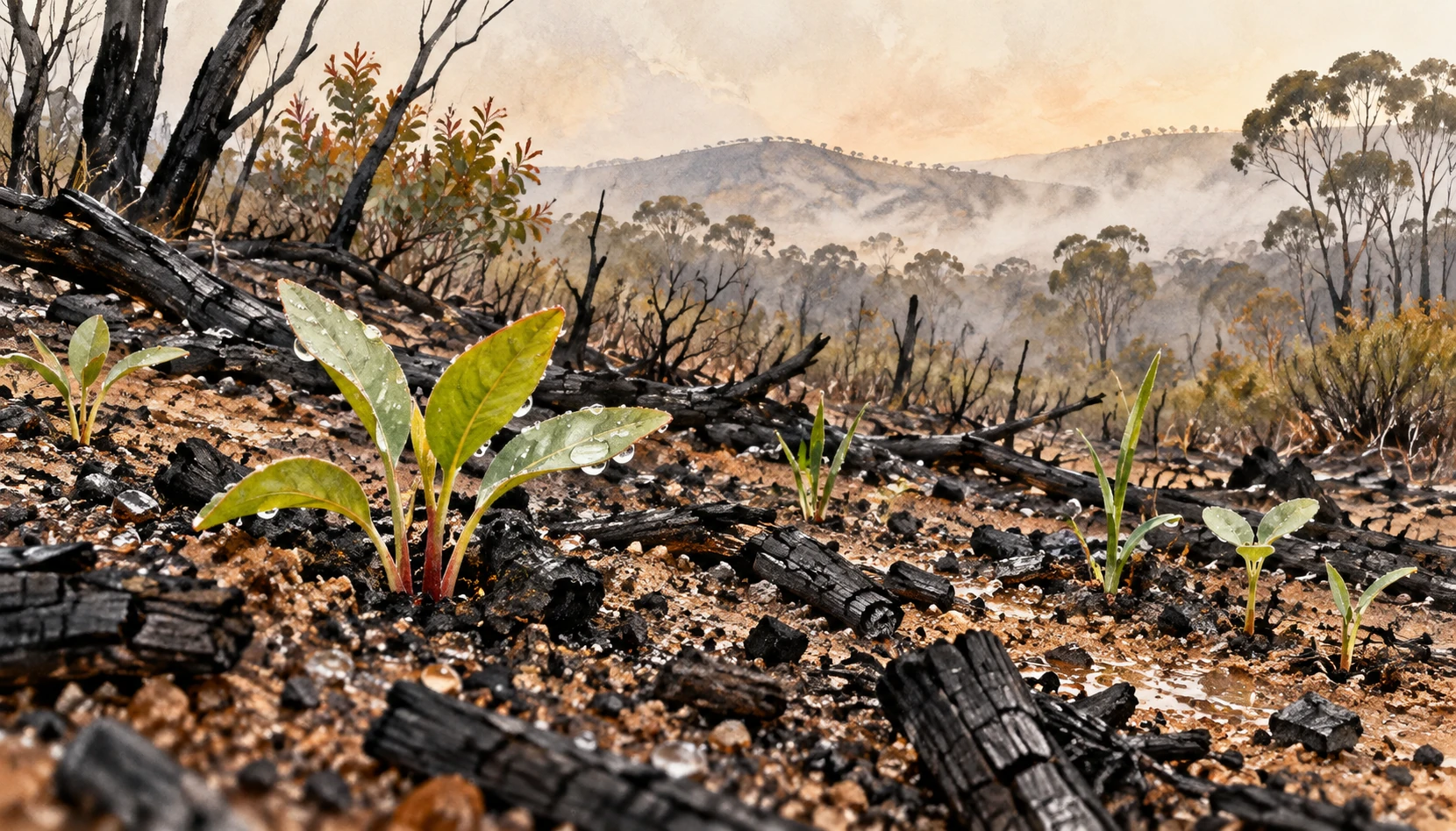
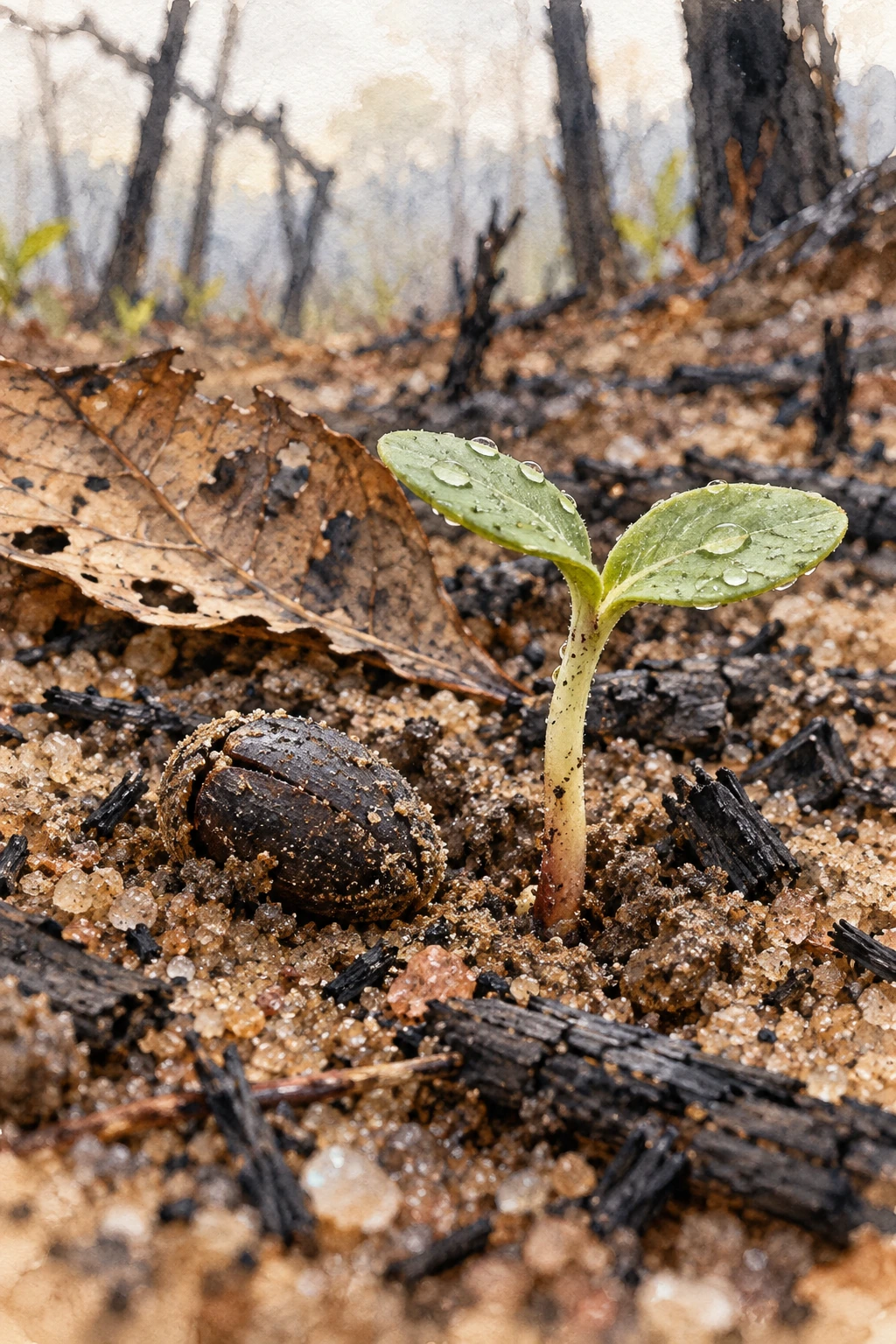
Tender seedlings emerge among charcoal fragments and raindrops in a burned shrubland soil.
Conceptual postfire scene; no species or smoke-response mechanism can be identified from this illustration.

A seed in the soil cannot look across a burned hillside and inspect the space left by vanished vegetation. Yet some seeds can respond to a chemical trace of fire. Compounds produced when plant material burns can help release dormancy or alter early growth. The smoke is not food; it can be information about a changed world.

That distinction makes postfire germination more than a scene of green returning to black ground. A seed may have waited through unsuitable conditions. Germinating at the wrong time can spend its limited reserves without establishing a plant. A useful cue connects the decision to grow with circumstances that have historically offered a better chance.

The chemical clue is specific

Karrikins are a family of small compounds identified in plant-derived smoke. Their name comes from the Noongar word karrik, meaning smoke. A study in the model plant Arabidopsis thaliana showed germination responses that depended on light and the plant's own hormone-related processes. The smoke compound enters an existing biological control system rather than simply forcing every seed to sprout.

The University of Western Australia's 2010 account also describes increased seedling responsiveness to light. Germination and the growth that follows are related but separate stages. A chemical can affect how a seedling responds to its environment as well as whether a dormant seed begins development.

Heat and smoke must not be treated as interchangeable. Some seeds respond to a heat treatment that changes a physical barrier; others respond to smoke chemicals; some depend on combinations of cues. Even among smoke-responsive plants, karrikins do not explain every response. “Fire makes seeds grow” is too broad to tell us which mechanism is operating.

Smoke can contain a brake as well as an invitation

A complex mixture does not have to act like its best-known ingredient. That is especially useful to remember when moving from a purified germination stimulant to the smoke from which it was discovered.

2012 work on lettuce achenes investigated opposing effects of smoke-derived butenolides. Alongside germination-promoting karrikins, smoke contains compounds that can inhibit germination. The study examined the interaction at the level of germination and associated molecular responses. “Smoke response” can therefore hide several inputs with different effects.

A small seedling emerges beside a seed and charcoal flecks in moist soil
Visible recovery does not identify the cue. Smoke-derived mixtures can contain compounds with opposing effects.

A study of five South African weed species likewise compared smoke water, karrikinolide and the inhibitor trimethylbutenolide. Under the tested conditions, the stimulant treatments and inhibitor did not produce equivalent outcomes. The inhibitor also reduced measured amylase activity. These are species- and treatment-specific results, not a recipe for treating unknown seeds.

This complicates a familiar temptation: if a little of a cue helps, more of the original mixture must help more. The mixture can contain other active materials, and a biological response can depend on the balance among them. A response to one purified compound does not fully characterize an environmental exposure.

Read four comparisons without combining them

Draw four empty columns labeled untreated, stimulant, inhibitor and combination. Before looking at a figure, write the question each comparison answers. Untreated versus stimulant addresses an effect of the stimulant. Untreated versus inhibitor addresses a different effect. The combination asks whether one changes the response to the other.

Why does the combination need its own observation?

The effects might reinforce, offset or otherwise alter one another. Adding two separately measured effects is an assumption unless the combined treatment has been tested under comparable conditions. The response can also depend on light, seed condition and the time at which germination is counted.

This is a reading exercise rather than a suggestion to make smoke or mix laboratory compounds. Its reward is a better question for every striking plant response: are we discussing a defined signal, a mixture or the final environment in which growth must succeed?

A seedling beside charcoal is a compelling image. The chemistry behind its beginning becomes more interesting when the aftermath of fire is allowed to contain both opportunities and constraints.

A receptor connects ecology with molecular structure

Work on the protein KARRIKIN INSENSITIVE 2, or KAI2, helped connect a natural cue with a signaling pathway. A 2020 review describes both progress and unresolved questions about perception. The pathway is involved in more than a narrow response to wildfire smoke, and researchers have sought the identity and role of naturally produced internal signals associated with it.

This is an instructive reversal. A molecule discovered because it changes a seed's response to smoke can reveal a control system used more broadly in development. The original ecological observation becomes a route into biology that is not restricted to plants living after fires.

A 2023 review of karrikin perception and signaling emphasizes that relationship between smoke-derived compounds and an endogenous signaling system. It also keeps the unknowns visible. Knowing a receptor participates in a response does not mean every molecular interaction and natural ligand has been established.

Not every rapid return is the same kind of recovery

A 2020 UWA study investigated enhanced sensitivity in some plants. Wild turnip, Brassica tournefortii, had multiple KAI2 receptor forms, and changes in one were associated with stronger karrikin sensing. The researchers also compared related receptor variation more broadly. Altered sensitivity can affect which plants exploit the postfire opportunity first.

That adds a complication to the comforting picture of regeneration. A site becoming green does not by itself show that its former community is returning. Native and introduced species can respond differently to the same cue, and a successful germination pulse can be followed by failure if weather or other conditions are unsuitable.

Restoration therefore needs species-specific knowledge rather than a universal bottle of “growth signal.” A treatment useful for one seed lot under nursery conditions may be ineffective or undesirable elsewhere. Germination is also only the first measurable step toward establishing a reproducing population.

The illustration here shows seedlings emerging among charcoal after rain. It does not identify their species or imply that every visible seedling required karrikins. A real postfire survey would need to distinguish germination from resprouting, identify plants, and follow their survival.

The deeper story is one of conditional beginnings. A seed's potential is held back until information, internal state, and environmental conditions align. Fire can leave a chemical trace that helps some plants recognize an opening. But the response is filtered through a living signaling system with its own history, variation, and unfinished scientific questions. The smoke has faded; a molecular consequence can remain.

Follow the evidence: Nelson and colleagues: smoke-derived karrikins and germination; UWA: karrikins and light response; UWA: evolution of enhanced karrikin sensitivity; Waters and colleagues: perception remains a continuing enigma; Karrikin perception and signalling: 2023 review.

More curious connections, art and independent projects at Incoprea.

The Squirting Cucumber Prepares Its Launch Before It Lets Go

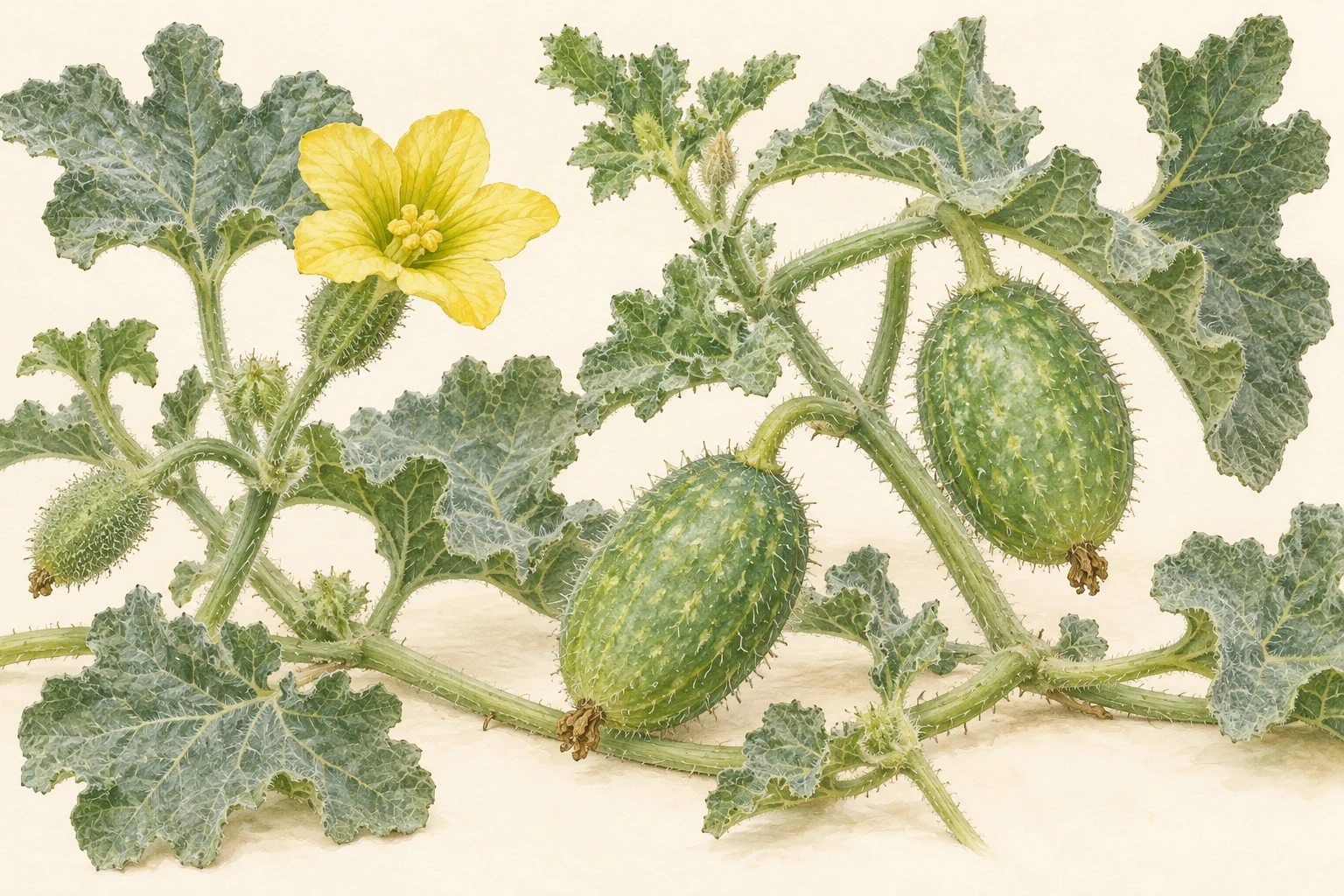
Hairy oval squirting-cucumber fruits and a yellow flower on a low leafy stem.
Still botanical interpretation of Ecballium elaterium; it does not depict or measure seed ejection.

The fruit looks uneventful: a small hairy green oval on a sprawling plant. Then it separates from its stalk and ejects seeds in a brief stream of mucilage. The squirting cucumber, Ecballium elaterium, makes seed dispersal look like a sudden prank. The more interesting discovery is how much preparation takes place before that visible instant.

A launch needs stored energy, an opening, and a useful orientation. It also needs to distribute offspring rather than simply drop them into one pile. Studying the fruit as a whole mechanism reveals how slow changes in fluid and stem structure help set up an event too fast to follow with an unaided eye.

Days of preparation, milliseconds of release

A 2024 PNAS study combined high-speed recording, imaging, experiments, and mathematical modeling. The Oxford research account describes a multistage system. The ripening fruit accumulates pressurized fluid. In the days before dispersal, fluid redistribution changes the stem's dimensions and stiffness, altering the fruit's position. When the attachment gives way, the opening releases the seed-bearing jet.

That sequence means pressure alone is not the full explanation. A pressurized container aimed at the ground and one oriented into open space can release the same kind of jet with very different consequences. The support structure is part of the dispersal system, not merely a convenient place to hang the fruit.

The researchers also considered motion during the release. As the fruit changes orientation, seeds do not all leave under an identical set of conditions. The changing launch can spread seeds over an area. A plant's dispersal performance depends on the distribution of trajectories, not only the furthest seed.

Slow motion is evidence, not merely spectacle

Oxford's account reports an ejection lasting about 30 milliseconds, with seed speeds around 20 meters per second in the described observations. At an ordinary 30 frames per second, one frame interval is roughly 33 milliseconds. The entire fast event can therefore occur in about the time between two ordinary frames.

That comparison explains why high-speed recording changes the question we can answer. A normal video can show that a fruit was attached and then released material. A sequence with many observations during the release can help track where the opening points and when seeds leave it. Better temporal resolution can expose structure in what first looked instantaneous.

The angle question is useful only with its assumptions

A seed's launch direction and its initial speed are different parts of the starting condition. The familiar statement that 45 degrees gives the longest flight belongs to an ideal equal-height projectile with no air resistance. It is not a universal instruction that every real plant should point its fruit at 45 degrees.

NASA's ballistic-flight explanation separates constant horizontal motion from vertical acceleration under gravity. In that simplified setting, a steeper trajectory trades horizontal speed for more time aloft. The mathematical model below lets you inspect that trade without handling a fruit or firing a seed.

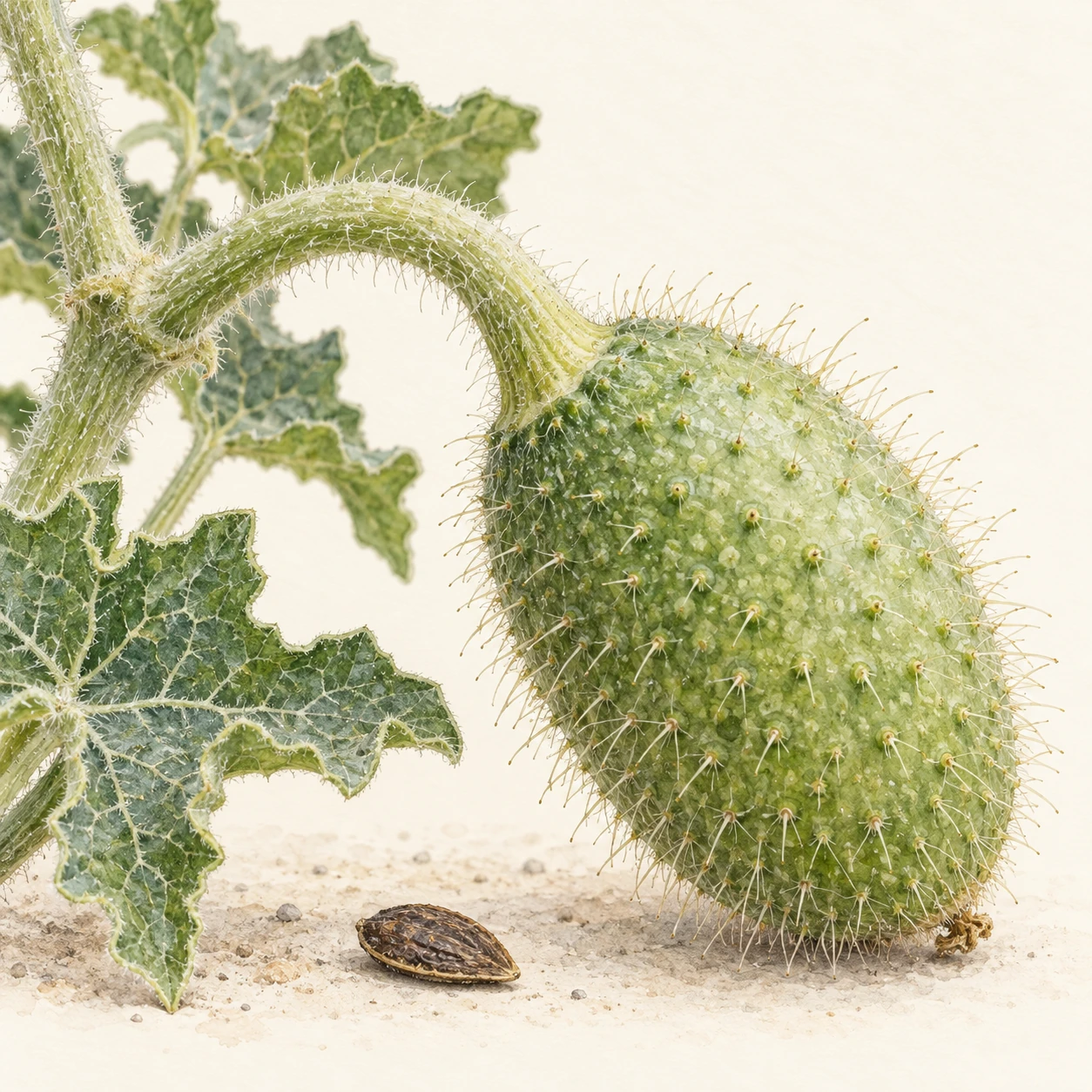
Close botanical view of an intact squirting-cucumber fruit and curved stalk
The attachment prepares the starting conditions. The calculator begins after release and does not model the fruit’s fluid or stem.

Choose an invented initial speed of 5 meters per second. At 30 degrees, the ideal range is about 2.21 meters. At 60 degrees it is the same, even though the peak is higher and the flight lasts longer. At 45 degrees the ideal range rises to about 2.55 meters. None of these values is a measurement of Ecballium.

A launch angle in an ideal world

Responsive mathematical trajectory with fixed axes, angle/speed sliders, reset and explicit no-drag assumptions.

Open this activity in its own window.

The repeated range at complementary angles follows from the equation's symmetry. It does not tell us where the seed will land once drag, launch height, shape and moving air matter. NASA's separate treatment of drag shows why the force law changes the calculation. Naming an omitted force is the beginning of a better model, rather than a reason to abandon modeling altogether.

Why does doubling speed matter so much here?

At a fixed angle, the ideal range is proportional to the square of initial speed. Doubling speed therefore quadruples range within this model. That result is conditional on the same assumptions, including no drag and equal launch/landing height.

Now return to the research footage. The plant does not launch every seed from one perfectly fixed apparatus. The stem, opening and fruit motion create a changing set of conditions. The calculator isolates one relationship after release; the biological study explains how the organism prepares and varies those starting conditions.

This division makes the video more informative. Instead of asking only which seed travels farthest, ask whether successive seeds depart at different angles or speeds. A broad landing distribution can arise from a sequence of launches, while the later life of each seed remains another question.

What counts as a successful dispersal?

A long flight may reduce competition with the parent or nearby siblings, but distance alone cannot establish eventual reproductive success. A seed must land in a suitable place, remain viable, germinate under useful conditions, survive, and eventually reproduce. A mechanical study can show how the launch shapes the starting distribution without measuring every later stage.

The paper's modeling compared the observed system with altered scenarios to investigate the contribution of its parts. Such comparisons are stronger than merely declaring the plant “perfectly designed.” They ask how performance changes when orientation, pressure-related conditions, or other features differ within a specified model.

A near-optimal result within that model does not prove that no alternative organism could disperse farther, or that every real fruit achieves the same range. It tells us that the arrangement can make mechanical sense under the assumptions and conditions evaluated. The limits make the conclusion more useful, because they show what was tested.

For plant identity, the Kew profile provides a botanical starting point. Despite its common name, this is not an invitation to treat the plant as an edible garden cucumber. The RHS profile includes hazard information. Watch the research footage rather than handling or triggering unfamiliar fruits near the face.

The mechanism also offers a good antidote to the idea that plants move only slowly. Growth and fluid redistribution can prepare stored energy over a long interval; release can then be rapid. The visible speed does not imply a hidden muscle. It reflects a change in how previously stored energy is constrained.

Seen this way, the little fruit contains a coordinated history. The stem changes before the fruit lets go. The opening directs a jet. Motion during the jet helps shape where successive seeds travel. A brief squirt is the readable end of several interacting processes—and the beginning of many uncertain journeys across the ground.

Follow the evidence: Box and colleagues: mechanics of seed ejection; Oxford: experiments, videos and the launch sequence; Kew: squirting cucumber plant profile; Royal Horticultural Society: plant identification and hazards.

More curious connections, art and independent projects at Incoprea.

The Ice Plant’s Glittering Bladders Have a More Complicated Job

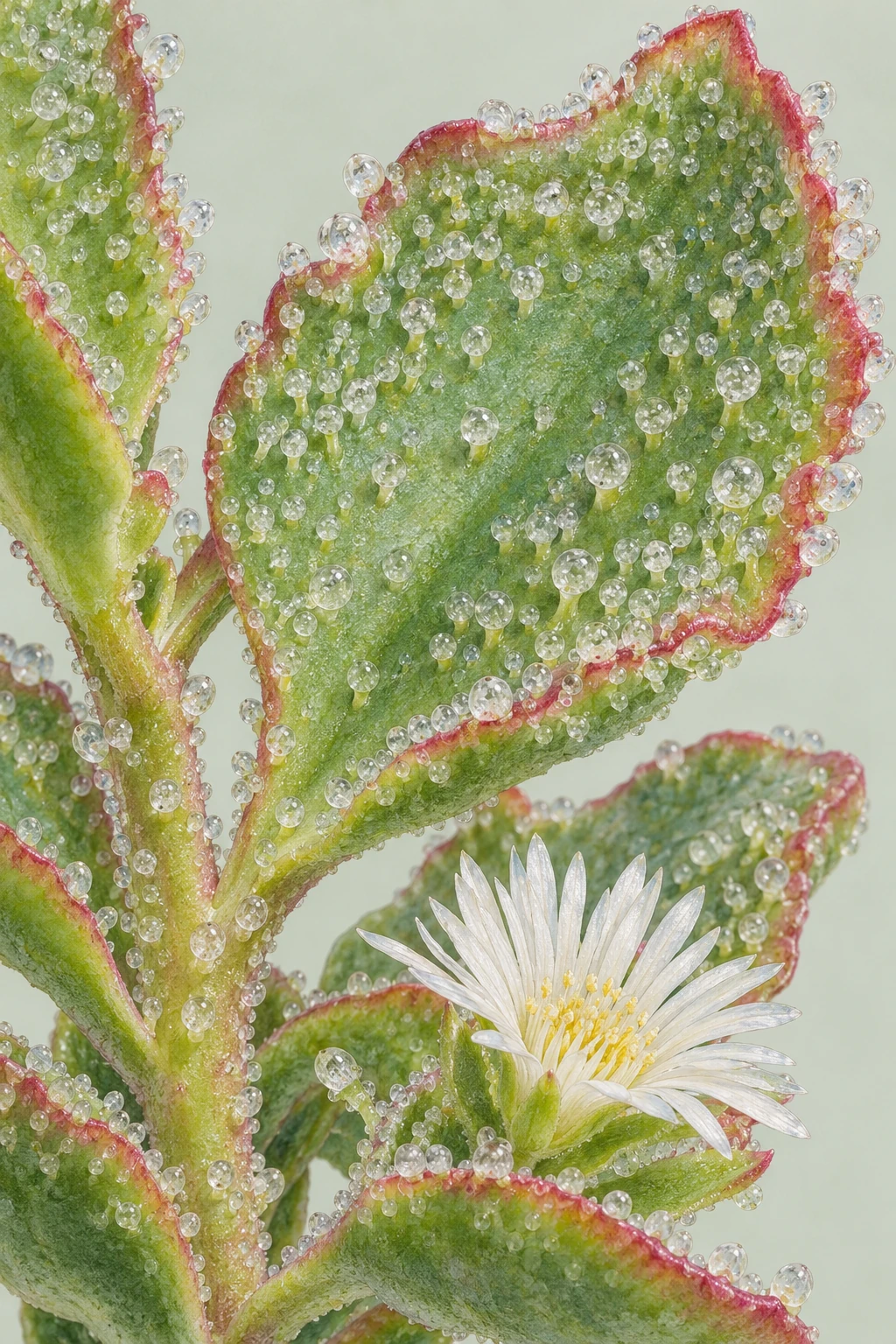
A succulent common iceplant leaf covered with beadlike living cells beside a small white flower.
Botanical interpretation of epidermal bladder cells; the sparkling structures are conceptual, not microscopy or salt crystals.

The common ice plant looks as though someone has scattered tiny glass beads over its leaves. The sparkling surface is not a crust of ice. Many of those beadlike structures are living epidermal bladder cells: enlarged surface outgrowths that make an ordinary leaf boundary unexpectedly three-dimensional.

A familiar explanation says the bladders store water or salt and therefore explain the plant's tolerance of difficult conditions. That is plausible enough to be repeated easily. Recent research makes the better story more demanding. What is inside a cell, what the cell can do, and what the whole plant actually needs it for are different questions.

First identify the plant, then the structure

“Ice plant” is used for more than one succulent. This article concerns Mesembryanthemum crystallinum, the species identified in the RHS profile, and compares relevant research on quinoa, Chenopodium quinoa. Similar surface structures in different plants create useful comparisons, but they do not guarantee identical function.

Epidermal bladder cells are modified trichomes, a broad category of plant surface outgrowths. Their swollen appearance invites the image of storage tanks. Yet a shape is not a function. A balloonlike cell could affect water relations, chemistry, the movement of small herbivores, or several processes at once.

A plausible explanation meets a perturbation

A 2023 Current Biology study investigated bladder cells as a defense against herbivores. Researchers used plants with reduced or absent bladder-cell development and compared performance and susceptibility. The work challenged a simple assumption that the structures are necessarily the key to salt and drought tolerance.

The Copenhagen account describes particularly clear quinoa results: bladder-deficient plants remained tolerant under tested abiotic conditions but were more vulnerable to small pests. Dense bladders could obstruct access to underlying tissues, while their contents contributed a chemical barrier. The article includes videos contrasting thrips encountering covered and uncovered shoots.

That is a stronger functional test than noting that salt-tolerant plants have shiny cells. If the proposed protective structure is missing and tolerance persists, the explanation needs revision. But the experiment's particular genotype, species, treatment, and outcome still matter. A result in quinoa cannot be silently expanded into every succulent called an ice plant.

The next study complicates the correction

A paper published in December 2024 examined water retention in quinoa leaves. Its authors noted that mutations affecting bladder-cell development can also change other aspects of plant growth. They used virus-induced gene silencing to reduce relevant gene activity in multiple quinoa lines while limiting obvious growth effects.

Leaves with reduced bladder-cell numbers lost water more rapidly after detachment in that study. The result supports a contribution to leaf water retention under those conditions. It does not erase the herbivore-defense findings, nor does it prove a universal whole-plant drought mechanism. It shows why the most useful correction is often more specific than “the old theory is entirely wrong.”

The contrast is an excellent example of experimental refinement. A mutation can change more than one trait. A different intervention can help separate those effects. Detached-leaf water loss is a defined measurement, while survival of an intact plant under drought is another. Both can be informative without being identical.

The leaf also changes when it collects carbon

The shining surface is only one part of the ice plant's response to its environment. Mesembryanthemum crystallinum can also shift its photosynthetic schedule. That provides a useful independent example of why stress tolerance cannot be assigned to the most conspicuous structure alone.

In crassulacean acid metabolism, usually shortened to CAM, atmospheric carbon dioxide can be fixed into organic acids at night and released internally for use during the day. Separating those stages can help conserve water by changing when stomata, the leaf's gas-exchange pores, are open. This is a pathway inside living tissue, not a job established merely by finding salt in a bladder cell.

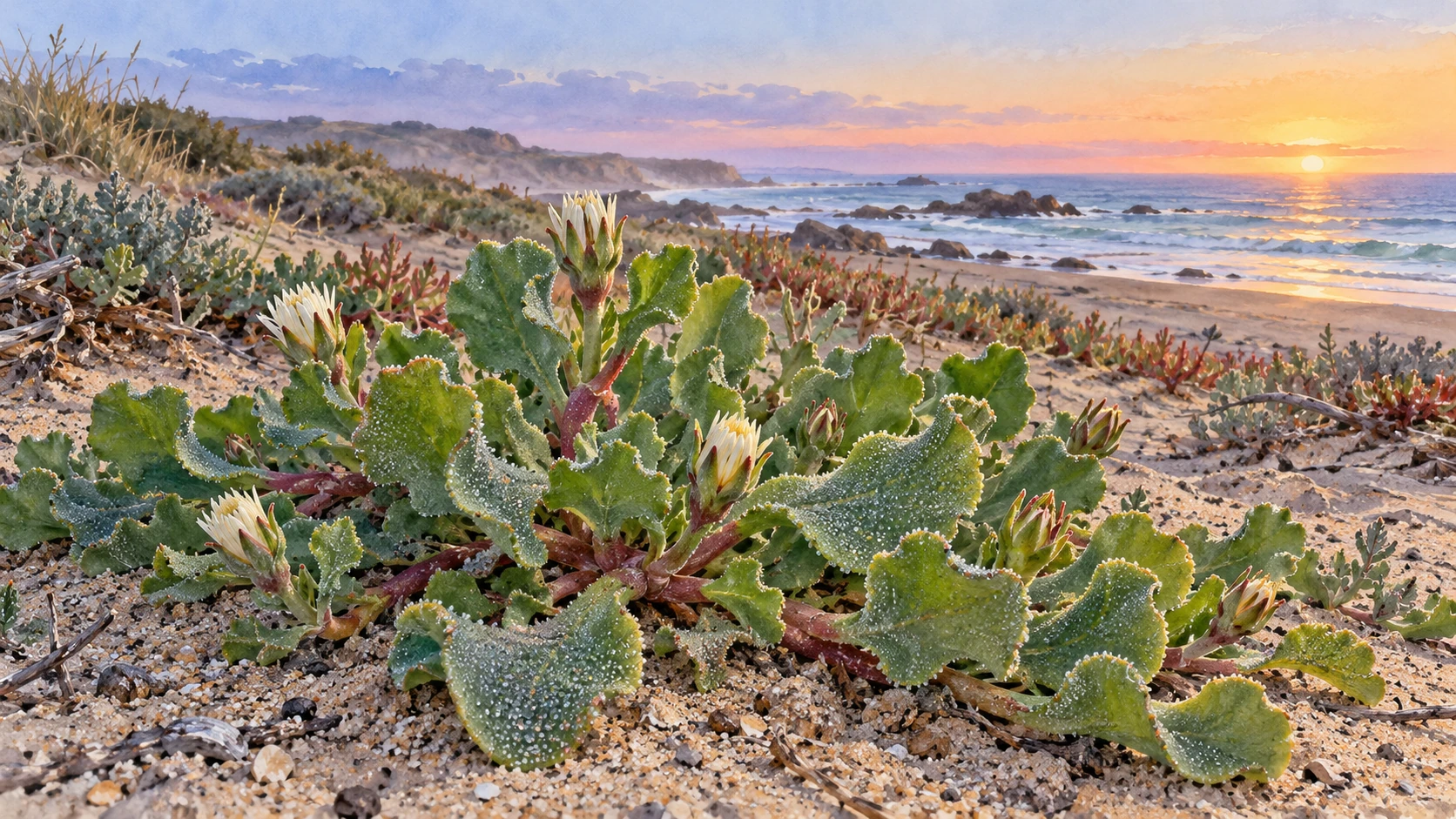
Common ice plant grows in sandy coastal soil in early dawn light
The plant’s daily carbon schedule requires physiological measurements. A view at dawn cannot establish whether a particular leaf is performing CAM.

A 2020 salt-treatment study followed the transition with gas exchange, stomatal behavior and other physiological measurements. The changes unfolded through time. The reported timing belonged to the study's plants and conditions; it was not a universal countdown for every plant called an ice plant.

Earlier research on chloroplast metabolism measured daytime changes in photosynthetic performance alongside evidence of CAM induction. The leaves were not simply switching photosynthesis off in daylight. Carbon handling and the daily operation of the photosynthetic machinery had to be interpreted together.

Two questions for the same leaf

Put a surface photograph beside a day-and-night gas-exchange record from the paper. The photograph can document appearance and bladder distribution. The time series can address when net carbon exchange occurs. Neither should silently become a measurement of the other.

Would removing bladders prove that CAM has stopped?

Not by appearance alone. You would need the relevant physiological measurements under comparable conditions. Likewise, evidence for a metabolic shift does not isolate the contribution of bladder cells. These are connected traits with separately testable roles.

For a figure-reading activity, mark the light and dark periods before comparing peaks. Then identify whether the vertical axis shows carbon exchange, an organic-acid measurement or a photosystem efficiency. These quantities are related through a biological process; they are not different labels for one number.

The leaf becomes more interesting when its visible beads are set beside its invisible schedule. Its response includes structure, transport and timing. The task is to discover which part contributes to which outcome, rather than give one attractive surface feature credit for the whole plant.

The ice plant's chemistry is also worth measuring directly

A 2024 metabolomic study analyzed common iceplant bladder cells under salt stress and reported changes across many detected metabolites. Such work treats the bladders as biologically active compartments with a chemical response, rather than inert bags that can be fully described by one common name.

It also illustrates a limit: a catalog of changing metabolites generates mechanistic questions, but does not on its own establish which changes cause tolerance or defense. That next step may require interventions, flux measurements, or performance comparisons. A long chemical list is evidence of complexity, not an automatic explanation.

For a reader with access to a correctly identified cultivated specimen, a magnifier can reveal how the surface differs from a smooth leaf. Look without scraping the cells away. The Copenhagen videos provide the more revealing comparison: the leaf surface as terrain encountered by an insect much smaller than we are.

The generated illustration emphasizes living beads rather than salt crystals. It is a visual introduction, not microscopy. Its sparkle should invite a question about function rather than supply the answer.

The deeper curiosity is how a beautiful surface becomes a scientific argument. A storage-like shape suggested one role; experiments revealed defense; another design recovered evidence for water retention under specified conditions. The leaf did not become less interesting when the simple story broke. It became a place where several plausible functions could finally be distinguished.

Follow the evidence: Moog and colleagues: epidermal bladders and herbivore defense; University of Copenhagen: testing the old bladder-cell explanation; Kobayashi and Fujita: water retention in quinoa leaves; Hainan University: iceplant bladder-cell metabolites under salt stress; RHS: Mesembryanthemum crystallinum identity.

More curious connections, art and independent projects at Incoprea.

Wednesday, October 14, 2026

Lithops: The Pebbles That Have Windows

Look at a gravelly patch of ground and decide where the plants are. You probably search for stems, leaves held above the surface, or a clear patch of green. A Lithops plant defeats those expectations. Its exposed top can resemble another pebble, while much of the living body sits below the level your eyes are searching.

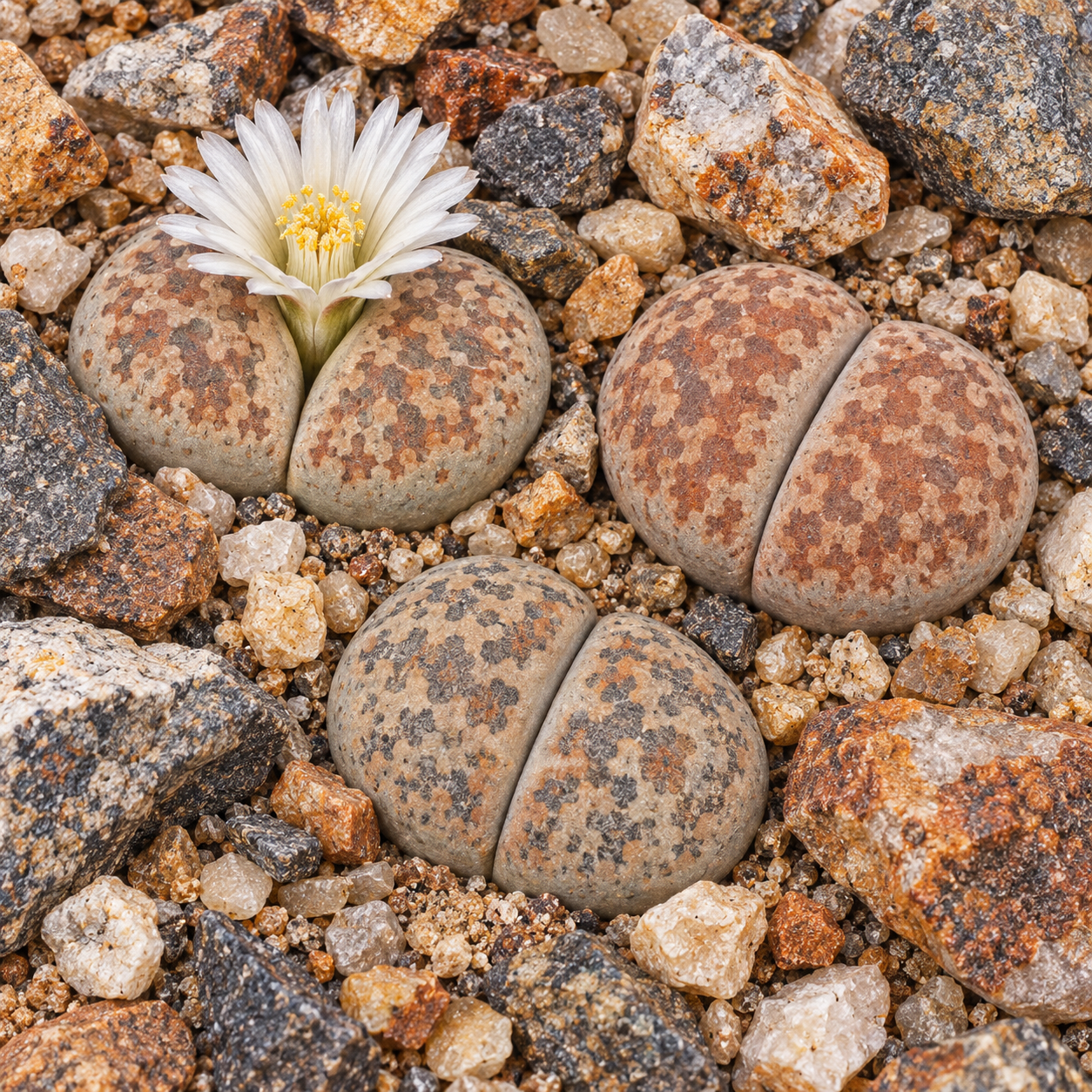
Illustration of low paired Lithops leaves blending with gravel, with one white flower.
Paired fleshy leaves can resemble surrounding stones, while a flower makes the living plant easier to recognize.

The resemblance is the beginning of the story, rather than the whole adaptation. These southern African succulents also face a physical problem: keeping a low profile and storing water can leave much of their photosynthetic tissue shaded underground. Their translucent leaf windows help light reach the interior. Letting light in, however, also changes the heat entering a small water-filled body.

Two leaves make an unexpectedly substantial plant

A typical body consists of a pair of thick leaves joined at the base, with a fissure between their upper faces. The part that looks like a stone is therefore living leaf tissue. A compact form stores water while exposing relatively little surface. It is quite different from a thin garden leaf spreading into the air.

Science and Plants for Schools highlights the combination of spongy water-storage tissue, reduced surface area and translucency. Think of it as several demands sharing one structure. The leaves must retain water, receive useful light and remain functional under demanding conditions. Their shape is interesting because those jobs can pull in different directions.

Try a visual search using the habitat photographs in the University of Wisconsin Extension article. Look first without enlarging the picture, then zoom in. Which cue finally reveals a plant: a fissure, a rounded edge, a repeated pattern, or a difference in texture? Compare that cue with a nearby stone rather than relying on greenness alone.

This is a perception exercise, not a test of whether every animal sees the same way you do. A photograph also freezes the lighting and hides scale. Still, noticing which features mislead your search makes “camouflage” more concrete. The plant is not simply brown; its visible form is difficult to separate from a particular background.

A leaf window is an entrance, not a free supply of energy

Light entering at the top can penetrate to photosynthetic tissue within the leaf. That arrangement lets a partly buried plant use sunlight without spreading a broad sheet above the ground. Yet the interior does not become uniformly illuminated. Light is absorbed and scattered along the way, so different regions experience different conditions.

In a 2013 study of Lithops aucampiae, Katie Field and colleagues found differences in pigments and light-related physiology between upper and lower leaf regions. The buried portions showed features suited to dimmer conditions, while exposed regions had adaptations to stronger light. One leaf can contain contrasting light environments, with corresponding differences in how its tissues use and manage incoming energy.

The researchers also described CAM, a mode of photosynthesis in which carbon dioxide can be taken up at night and stored for later use. Separating that uptake from daytime light use can reduce water loss. Leaf shape, light handling and the timing of gas exchange therefore work together; the window alone cannot explain the plant's way of living.

How would you test a window?

Craig E. Martin, Emily Brandmeyer and R. D. Ross investigated leaf windows experimentally. Plants with windows covered by reflective tape had lower leaf temperatures than plants whose windows were covered with transparent tape. The result draws attention to the heat associated with incoming radiation, alongside the potential benefit of light reaching deeper tissue.

Why use transparent tape as well? Before reading on, think of a possible problem with comparing a taped plant only with an untouched one. Covering a surface can change more than its illumination. A comparison in which both groups receive tape helps separate the intended change in light entry from effects associated with covering the surface.

You do not need to tape or cut a plant to explore the reasoning. Write down the proposed cause, the measured outcome and the comparison group. Then ask what remained different between the treatments. This habit is useful whenever an appealing anatomical feature is assigned a function: the design of the comparison determines how confidently the explanation can be assessed.

The same study compared window sizes with habitat conditions. Its results were consistent with smaller windows in brighter, drier settings and larger windows in cloudier, wetter ones. This supports a tradeoff rather than a universal “bigger is better” rule. Useful light and unwanted heating arrive together, and the balance can differ among habitats.

The pebble changes, even when it seems still

A living stone also makes more sense when viewed across time. As a new leaf pair develops, the old pair is reabsorbed and eventually dries to a papery remnant. A plant may divide into more than one pair. What looks like a static ornament can therefore reveal a sequence of resource transfer, growth and replacement.

The Wisconsin Extension photographs show this transition clearly, along with flowers emerging between the leaves. Rather than assigning every plant an identical calendar, follow the sequence: old leaves, developing replacement, flower and fruit. Species and growing conditions matter. A single snapshot cannot identify every stage, and a shrinking old leaf is not the same observation as a plant simply running out of water.

Even seed release responds to conditions. The fruiting capsule opens when moistened, allowing rain to help disperse seeds, then closes again as it dries. The miniature landscape thus contains more movement than its stony appearance suggests. Water is stored, light is admitted selectively, leaves are replaced, and a dry capsule waits for an appropriate change outside.

Explore more creative curiosity at Incoprea.

publications

New this week Two novels in six stories each, from The Night Shift . New — a novel in six documents Small Print A Novel in Six Do...