A seed in the soil cannot look across a burned hillside and inspect the space left by vanished vegetation. Yet some seeds can respond to a chemical trace of fire. Compounds produced when plant material burns can help release dormancy or alter early growth. The smoke is not food; it can be information about a changed world.
That distinction makes postfire germination more than a scene of green returning to black ground. A seed may have waited through unsuitable conditions. Germinating at the wrong time can spend its limited reserves without establishing a plant. A useful cue connects the decision to grow with circumstances that have historically offered a better chance.
The chemical clue is specific
Karrikins are a family of small compounds identified in plant-derived smoke. Their name comes from the Noongar word karrik, meaning smoke. A study in the model plant Arabidopsis thaliana showed germination responses that depended on light and the plant's own hormone-related processes. The smoke compound enters an existing biological control system rather than simply forcing every seed to sprout.
The University of Western Australia's 2010 account also describes increased seedling responsiveness to light. Germination and the growth that follows are related but separate stages. A chemical can affect how a seedling responds to its environment as well as whether a dormant seed begins development.
Heat and smoke must not be treated as interchangeable. Some seeds respond to a heat treatment that changes a physical barrier; others respond to smoke chemicals; some depend on combinations of cues. Even among smoke-responsive plants, karrikins do not explain every response. “Fire makes seeds grow” is too broad to tell us which mechanism is operating.
Smoke can contain a brake as well as an invitation
A complex mixture does not have to act like its best-known ingredient. That is especially useful to remember when moving from a purified germination stimulant to the smoke from which it was discovered.
2012 work on lettuce achenes investigated opposing effects of smoke-derived butenolides. Alongside germination-promoting karrikins, smoke contains compounds that can inhibit germination. The study examined the interaction at the level of germination and associated molecular responses. “Smoke response” can therefore hide several inputs with different effects.
A study of five South African weed species likewise compared smoke water, karrikinolide and the inhibitor trimethylbutenolide. Under the tested conditions, the stimulant treatments and inhibitor did not produce equivalent outcomes. The inhibitor also reduced measured amylase activity. These are species- and treatment-specific results, not a recipe for treating unknown seeds.
This complicates a familiar temptation: if a little of a cue helps, more of the original mixture must help more. The mixture can contain other active materials, and a biological response can depend on the balance among them. A response to one purified compound does not fully characterize an environmental exposure.
Read four comparisons without combining them
Draw four empty columns labeled untreated, stimulant, inhibitor and combination. Before looking at a figure, write the question each comparison answers. Untreated versus stimulant addresses an effect of the stimulant. Untreated versus inhibitor addresses a different effect. The combination asks whether one changes the response to the other.
Why does the combination need its own observation?
The effects might reinforce, offset or otherwise alter one another. Adding two separately measured effects is an assumption unless the combined treatment has been tested under comparable conditions. The response can also depend on light, seed condition and the time at which germination is counted.
This is a reading exercise rather than a suggestion to make smoke or mix laboratory compounds. Its reward is a better question for every striking plant response: are we discussing a defined signal, a mixture or the final environment in which growth must succeed?
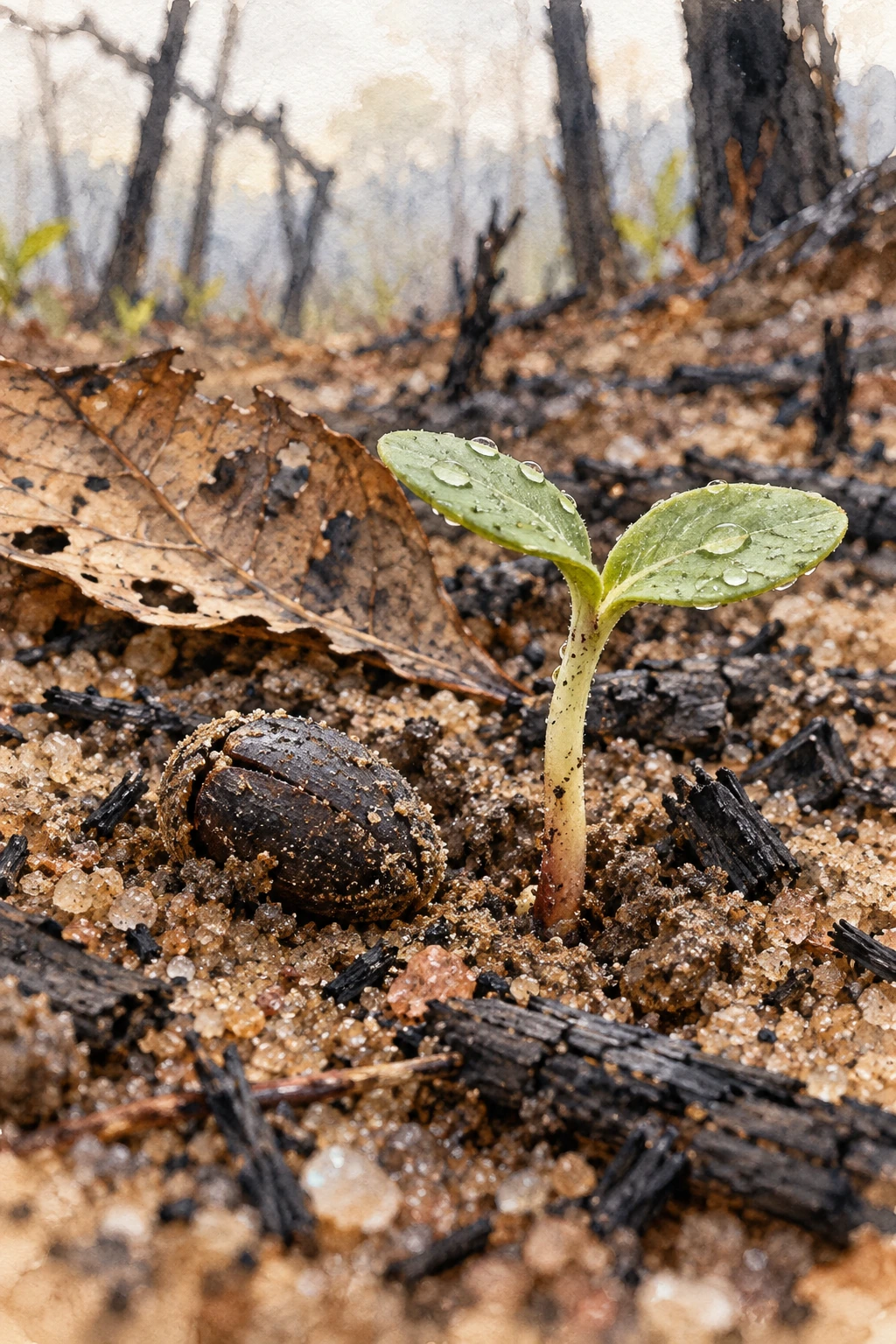
A seedling beside charcoal is a compelling image. The chemistry behind its beginning becomes more interesting when the aftermath of fire is allowed to contain both opportunities and constraints.
A receptor connects ecology with molecular structure
Work on the protein KARRIKIN INSENSITIVE 2, or KAI2, helped connect a natural cue with a signaling pathway. A 2020 review describes both progress and unresolved questions about perception. The pathway is involved in more than a narrow response to wildfire smoke, and researchers have sought the identity and role of naturally produced internal signals associated with it.
This is an instructive reversal. A molecule discovered because it changes a seed's response to smoke can reveal a control system used more broadly in development. The original ecological observation becomes a route into biology that is not restricted to plants living after fires.
A 2023 review of karrikin perception and signaling emphasizes that relationship between smoke-derived compounds and an endogenous signaling system. It also keeps the unknowns visible. Knowing a receptor participates in a response does not mean every molecular interaction and natural ligand has been established.
Not every rapid return is the same kind of recovery
A 2020 UWA study investigated enhanced sensitivity in some plants. Wild turnip, Brassica tournefortii, had multiple KAI2 receptor forms, and changes in one were associated with stronger karrikin sensing. The researchers also compared related receptor variation more broadly. Altered sensitivity can affect which plants exploit the postfire opportunity first.
That adds a complication to the comforting picture of regeneration. A site becoming green does not by itself show that its former community is returning. Native and introduced species can respond differently to the same cue, and a successful germination pulse can be followed by failure if weather or other conditions are unsuitable.
Restoration therefore needs species-specific knowledge rather than a universal bottle of “growth signal.” A treatment useful for one seed lot under nursery conditions may be ineffective or undesirable elsewhere. Germination is also only the first measurable step toward establishing a reproducing population.
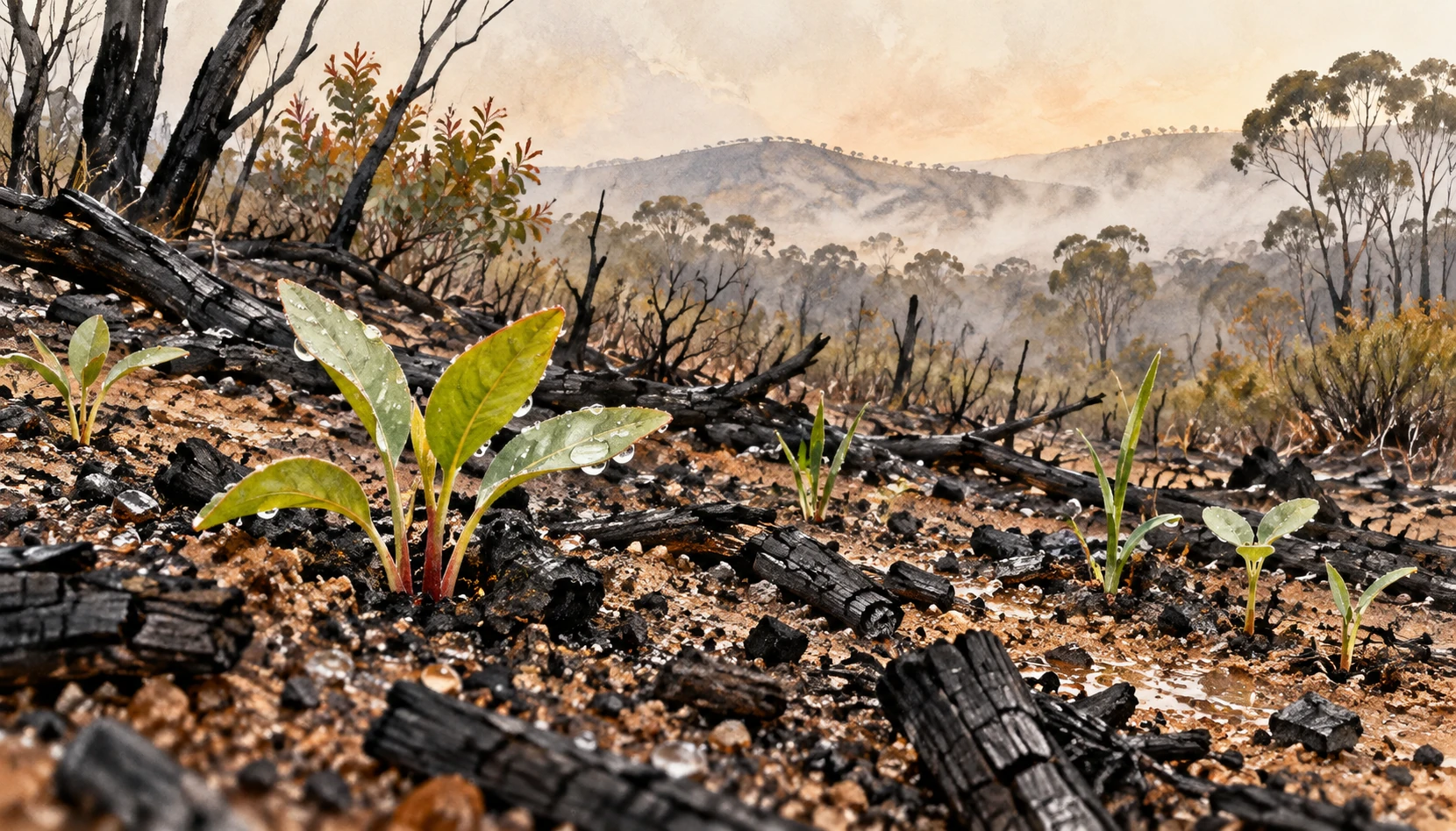
The illustration here shows seedlings emerging among charcoal after rain. It does not identify their species or imply that every visible seedling required karrikins. A real postfire survey would need to distinguish germination from resprouting, identify plants, and follow their survival.
The deeper story is one of conditional beginnings. A seed's potential is held back until information, internal state, and environmental conditions align. Fire can leave a chemical trace that helps some plants recognize an opening. But the response is filtered through a living signaling system with its own history, variation, and unfinished scientific questions. The smoke has faded; a molecular consequence can remain.
Follow the evidence: Nelson and colleagues: smoke-derived karrikins and germination; UWA: karrikins and light response; UWA: evolution of enhanced karrikin sensitivity; Waters and colleagues: perception remains a continuing enigma; Karrikin perception and signalling: 2023 review.
More curious connections, art and independent projects at Incoprea.




