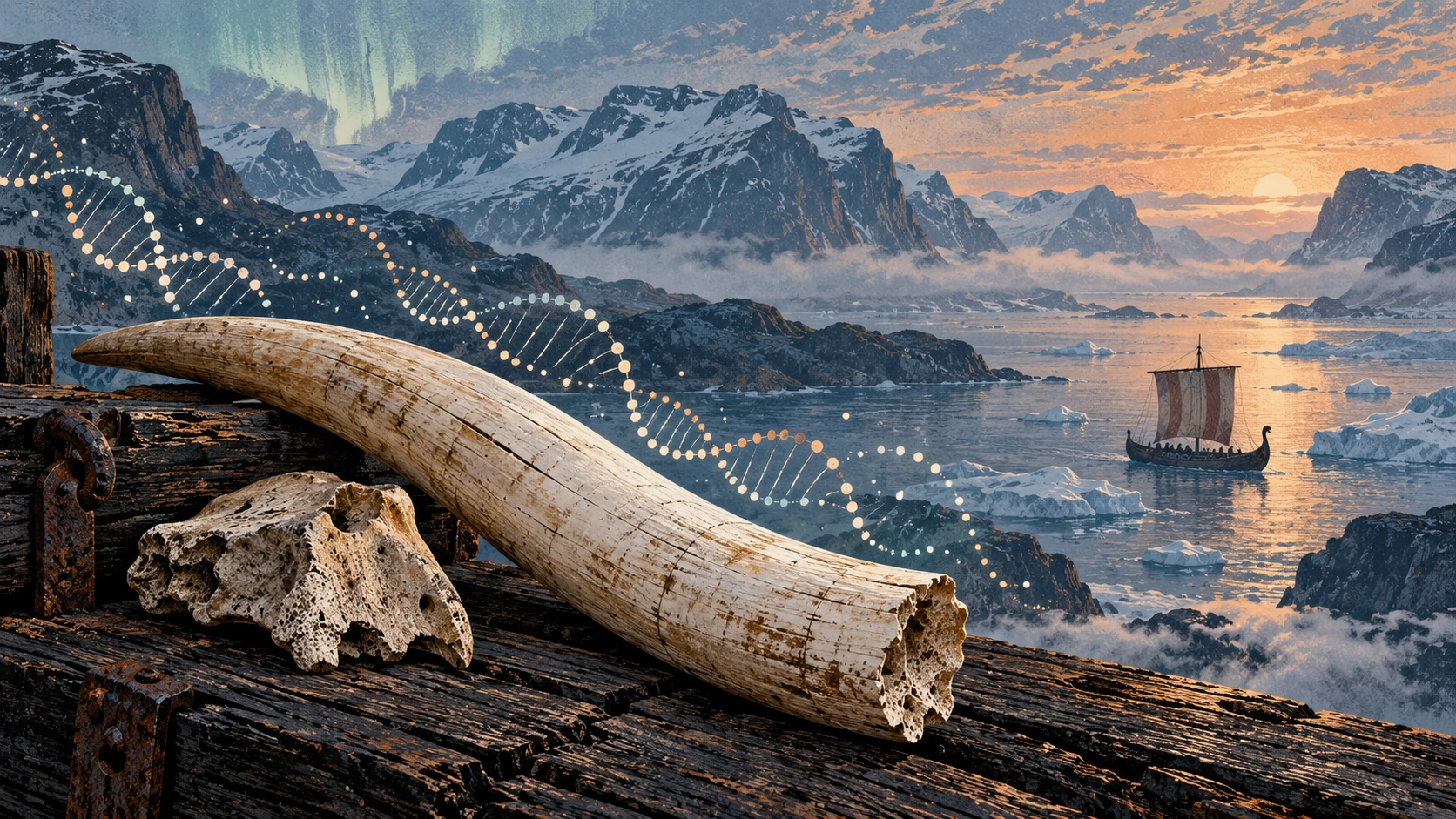
A medieval ivory carving has at least two histories. One begins with a craftsperson deciding what to make from a tusk. The other begins long before that decision, with the animal that grew the material. Ancient DNA can sometimes recover part of the second history from fragments that look far less impressive than a finished sculpture.
That possibility has changed the study of walrus ivory associated with Norse Greenland. A worked object may have lost the shape that identifies a tusk. Waste or skull fragments may preserve biological evidence alongside the archaeological context of trade. The challenge is to connect those records without pretending they tell us every step of a journey.
Start at the destination, then step back
The British Museum’s Lewis chessman 1831,1101.81 is cataloged as walrus ivory: a seated king with carved details extending onto the throne. It offers a clear example of the material’s transformation into a prestigious European object. It is not being presented here as a specimen genetically tested in the studies below.
That sentence is a necessary boundary. A genetic finding about an archaeological sample cannot simply be attached to the most famous ivory carving in a museum. To make an object-specific origin claim, we need evidence about that object, or a carefully justified connection to the material assemblage to which it belongs.
Still, putting the carving beside an undecorated fragment changes what we value. The finished piece preserves decisions about image and use. A discarded rostrum—the part of the skull associated with the tusks—can preserve information about supply. Archaeological importance need not follow artistic finish.
The broad shift seen in 2018
A 2018 study by Bastiaan Star and colleagues analyzed mitochondrial genomes from thirty-seven archaeological walrus specimens. It identified two major maternal lineages and used their geographic distribution to investigate twenty-three specimens found in Europe. Across the medieval period, the researchers found a shift toward material associated with Greenland’s western Atlantic walrus populations.
The result linked Greenland more firmly to the ivory supplied to European markets. It did not require a surviving merchant’s label saying where a particular animal had been hunted. Biological inheritance supplied a different form of evidence, interpreted through comparative samples and archaeological dating.
Notice the scale of the conclusion: a change across a set of specimens and periods. “Every medieval European walrus ivory came from Greenland” would be a stronger statement than the evidence supports. Geographic sourcing depends on which populations can be distinguished and how well the reference material represents them.
A finer map in 2024
The 2024 study Greenland Norse walrus exploitation deep into the Arctic used higher-resolution genetic sourcing to investigate more specific stocks. Its results indicate increasing reliance in the later period on distant northern hunting grounds, especially the North Water Polynya, or Pikialasorsuaq, between northwest Greenland and northeast Canada.
The paper considers both direct Norse hunting and exchange with Arctic Indigenous people as ways such ivory could have reached Norse networks. Biological origin alone does not decide between those social routes. The authors also call for more directly dated artifacts and further archaeological work, including a less exclusively European-centered understanding of Indigenous mobility and interaction.
The associated Dryad data record makes part of the study’s evidence trail available for inspection. It describes the comparative mitogenome material used in the analysis. Data access does not make interpretation automatic, but it allows qualified researchers to examine how results were produced and to extend the comparison.
Four links that must not be collapsed
| Question | Evidence that may help |
|---|---|
| Where did the animal’s population live? | Genetic comparison with geographically informative samples. |
| When was the animal killed? | Appropriate dating evidence, with its uncertainty and calibration. |
| Who obtained or exchanged the tusks? | Archaeological context, historical evidence, and evidence of contact. |
| Where was the final object carved? | Workshop evidence, technical and stylistic comparison, and documented context. |