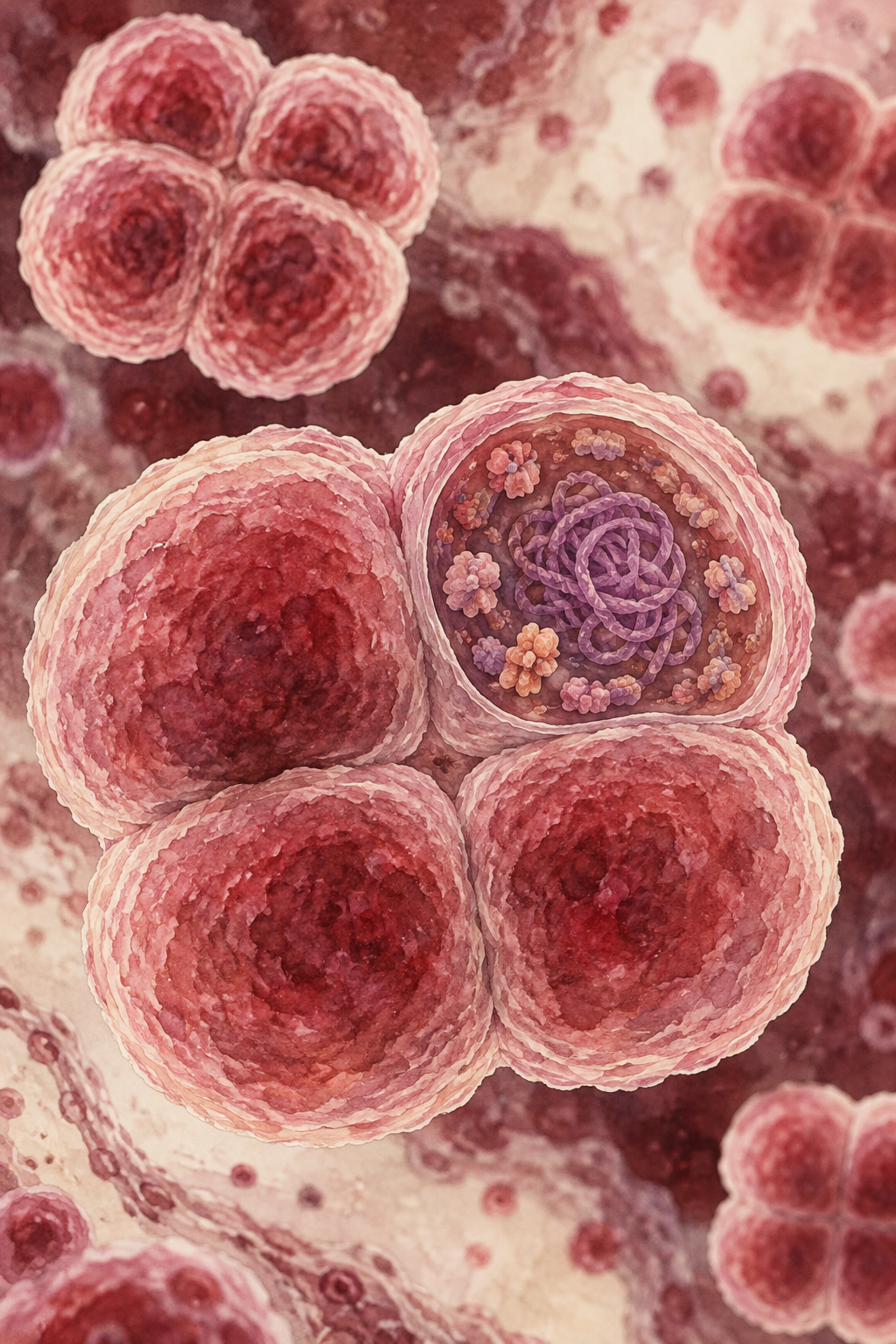
The most revealing image of Deinococcus radiodurans is not a bacterium refusing to break. It is a bacterium rebuilding after something has broken. Radiation can fragment its DNA, yet surviving cells can reconstruct functional chromosomes and resume growth. The scientific puzzle is how enough information and working machinery remain available to make recovery possible.
The pinkish cells, often grouped in fours, have become icons of toughness. But “tough” can hide several different achievements: avoiding damage, limiting damage, repairing what was damaged, and reproducing afterwards. Separating those steps makes the organism more impressive, because we can ask how each one works.
The repair crew needs protection too
Ionizing radiation can damage molecules directly and produce reactive chemicals that attack them. DNA is a conspicuous target, but proteins include the enzymes needed to repair DNA. If those enzymes lose their function, an organism cannot recover merely by retaining fragments of the right instructions.
Michael Daly and colleagues investigated this overlooked side of resistance. Their2007 study connected manganese-related protection with reduced protein oxidation. Conditions that interfered with manganese accumulation or its protective chemistry made the bacterium more sensitive. This was more informative than simply finding an unusual element in a resistant cell: changing relevant conditions also changed the outcome.
A later study examined protective small molecules in cell extracts and reconstituted mixtures. Such experiments can isolate chemical effects on enzyme activity. They do not establish that adding one ingredient would make an unrelated organism radiation-resistant. A living cell has compartments, metabolism, and repair processes that an isolated mixture does not reproduce.
Think of a damaged workshop. Saving the plans matters, but so does keeping enough tools and workers available to use them. The analogy is deliberately incomplete: proteins are not conscious workers, and cells do not organize a reconstruction meeting. It captures why preserving information and preserving the means to act on it are complementary problems.
How fragments can still contain a recoverable history
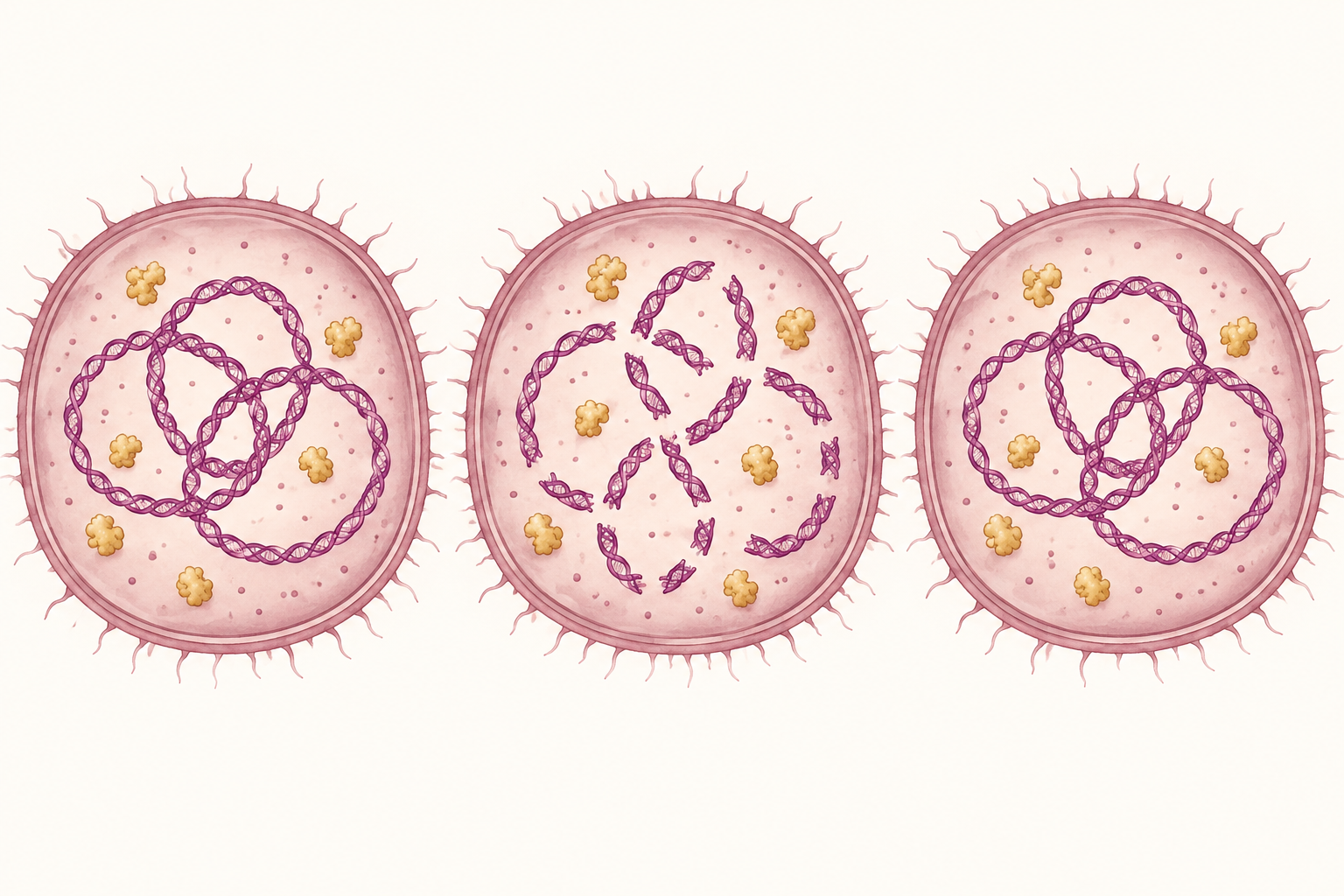
D. radiodurans carries multiple copies of its genetic information. After breakage, surviving overlaps can help provide the information needed to rebuild longer DNA. In 2006, Ksenija Zahradka and colleagues described a two-stage process involving extensive DNA synthesis and fragment assembly, followed by recombination that completes functional chromosomes.
The technical name for the first mechanism is extended synthesis-dependent strand annealing, often shortened to ESDSA. You do not need to memorize the label to appreciate the central distinction. The chromosome is not simply a shattered object whose original pieces have to be glued together by their visible edges. DNA synthesis helps reconstruct missing stretches using surviving information.
Try the information problem on paper
Write the same short sentence twice on separate strips of paper. Cover different portions of each copy, leaving some words visible in both. Ask whether the overlaps let you infer the complete original sentence. Then cover the same word in both copies. What information has become unavailable?
This exercise illustrates redundancy, not the actual chemistry of DNA repair. A person can use vocabulary, meaning, and guesswork. A cell uses molecular recognition, enzymes, and compatible sequences. A guessed sentence can sound plausible while being wrong; biological recovery also raises the crucial issue of accuracy.
Now imagine that the paper remains readable but your ability to copy any part of it has disappeared. That returns us to protein protection. Multiple copies supply information, yet reconstruction still requires functioning machinery. Neither ingredient alone explains the entire achievement.
What does “survived” mean in the experiment?
A measurement of intact DNA immediately after exposure answers a different question from a measurement of colony formation later. A cell might initially contain severe damage and still recover. Another might retain recognizable structures but never divide again. The experimental endpoint belongs beside any striking survival claim.
Researchers also have to specify the radiation, dose, delivery conditions, and recovery environment. A single large number with those details removed can suggest a universal limit that the experiment never tested. Resistance can vary with physiological state and conditions; it does not amount to unlimited protection.
There is a useful three-way comparison here. An isolated enzyme can remain active. A cell can restore a damaged genome. A population can produce descendants after treatment. Those outcomes can support one another in an explanation, but they should never be treated as interchangeable measurements.
Why would such a capability matter outside a radiation laboratory?
Drying provides an important clue. Mattimore and Battista tested radiation-sensitive strains in a 1996 study and found that they were also much less able to survive prolonged desiccation than the ordinary resistant strain. Drying was associated with accumulating DNA damage. The result supported a connection between coping with dehydration and the organism’s unusual radiation tolerance.
This offers an ecological hypothesis rather than a filmed evolutionary history. A defence useful against a recurring stress can also confer resistance to a rarer laboratory challenge. We should distinguish the experimental link between traits from the larger claim about why they evolved.
The bacterium’s value as a research subject lies in this combination of protection and recovery. It does not show that damage is harmless. It shows that a cell can preserve enough functioning chemistry and overlapping information for some apparently disastrous damage to remain recoverable. That is a deeper achievement than the idea of an unbreakable organism, and a much more useful one to investigate.




