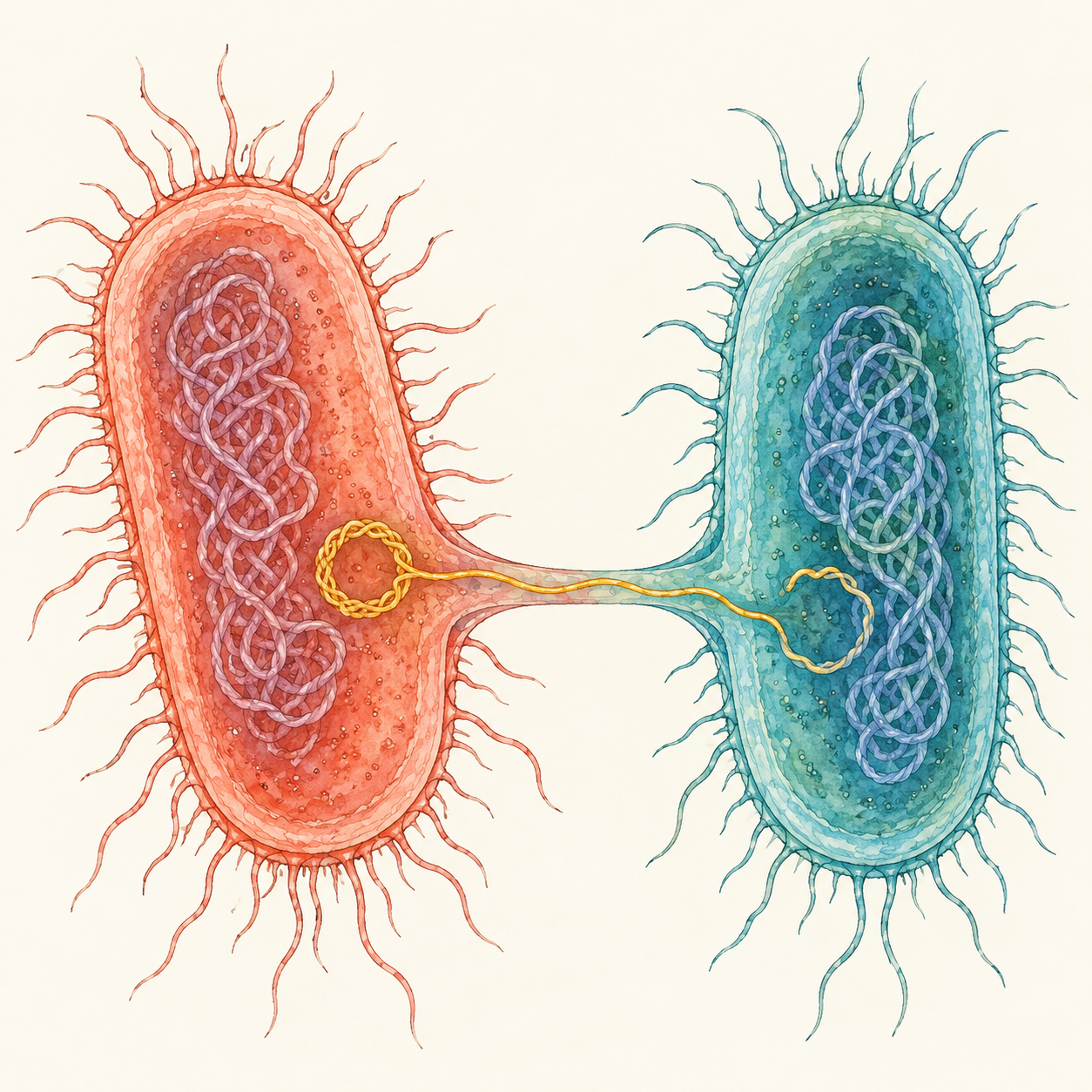
We usually picture inheritance as a family tree: parents pass genes to offspring, and branches divide over generations. In the microbial world, another route can cross those branches. Horizontal gene transfer moves genetic material between organisms outside ordinary parent-to-offspring inheritance.
A bacterium may acquire useful DNA from another cell or from material in its surroundings. This does not make every species freely interchangeable. It does mean that the history of a particular gene can differ from the history of the organism carrying it.
Three routes through the microbial world
In transformation, a cell takes up DNA from its environment. Some bacteria become competent to do this under suitable conditions. DNA released by dead organisms can therefore remain biologically relevant after the organisms themselves are gone.
In conjugation, DNA is transferred through direct contact between cells using specialized molecular machinery. Plasmids, separate DNA elements that can replicate in a host, are important participants. Some other mobile elements can integrate into a chromosome and also transfer between cells.
In transduction, a bacteriophage participates in moving bacterial DNA to another cell. The details depend on the phage and the transfer mechanism. Viruses can thus be involved in genetic exchange as well as in infections that kill their hosts.
| Route | How DNA travels |
|---|---|
| Transformation | Uptake of environmental DNA |
| Conjugation | Transfer through cell contact |
| Transduction | Transfer associated with a phage |
Arrival is only the beginning
For acquired DNA to have a lasting effect, it must persist and function. It may need to replicate as a plasmid or become incorporated into existing genetic material. A recipient's defenses, compatible sequences and cellular machinery influence whether that happens.
The added material can also impose costs. A gene useful in one environment may be unnecessary or disadvantageous in another. Selection then affects whether cells carrying it multiply successfully. Horizontal transfer provides variation; it does not guarantee that every transferred sequence becomes an adaptation.
These constraints make the process scientifically interesting. Researchers can investigate not just whether a gene is present, but how it arrived, whether it is active and what ecological conditions favor its retention. Similar sequences alone do not settle every possible history.
New abilities can cross lineage boundaries
Horizontal transfer can spread genes for using particular nutrients, resisting environmental stresses or interacting with other organisms. Antibiotic-resistance genes are an especially consequential example. Their movement helps explain why a capability can appear in different bacterial lineages rather than remaining confined to descendants of one original cell.
Researchers continue to uncover more complex transfer mechanisms, including forms of phage-associated movement that can carry large stretches of bacterial chromosomes. The three introductory categories are a starting map, not the final inventory of every route.
A family tree still matters, but for microbes it may be crossed by connections between branches. Evolution is shaped by reproduction, mutation and selection, while some genetic information also travels sideways. Following those connections reveals a dynamic community behind what might look like separate, isolated cells.
Sources and further reading: NCBI Bookshelf: Bacterial genetics; ASM: The gut resistome and gene transfer; Bacterial chromosomal mobility via lateral transduction.
Explore more creative discoveries at Incoprea.




