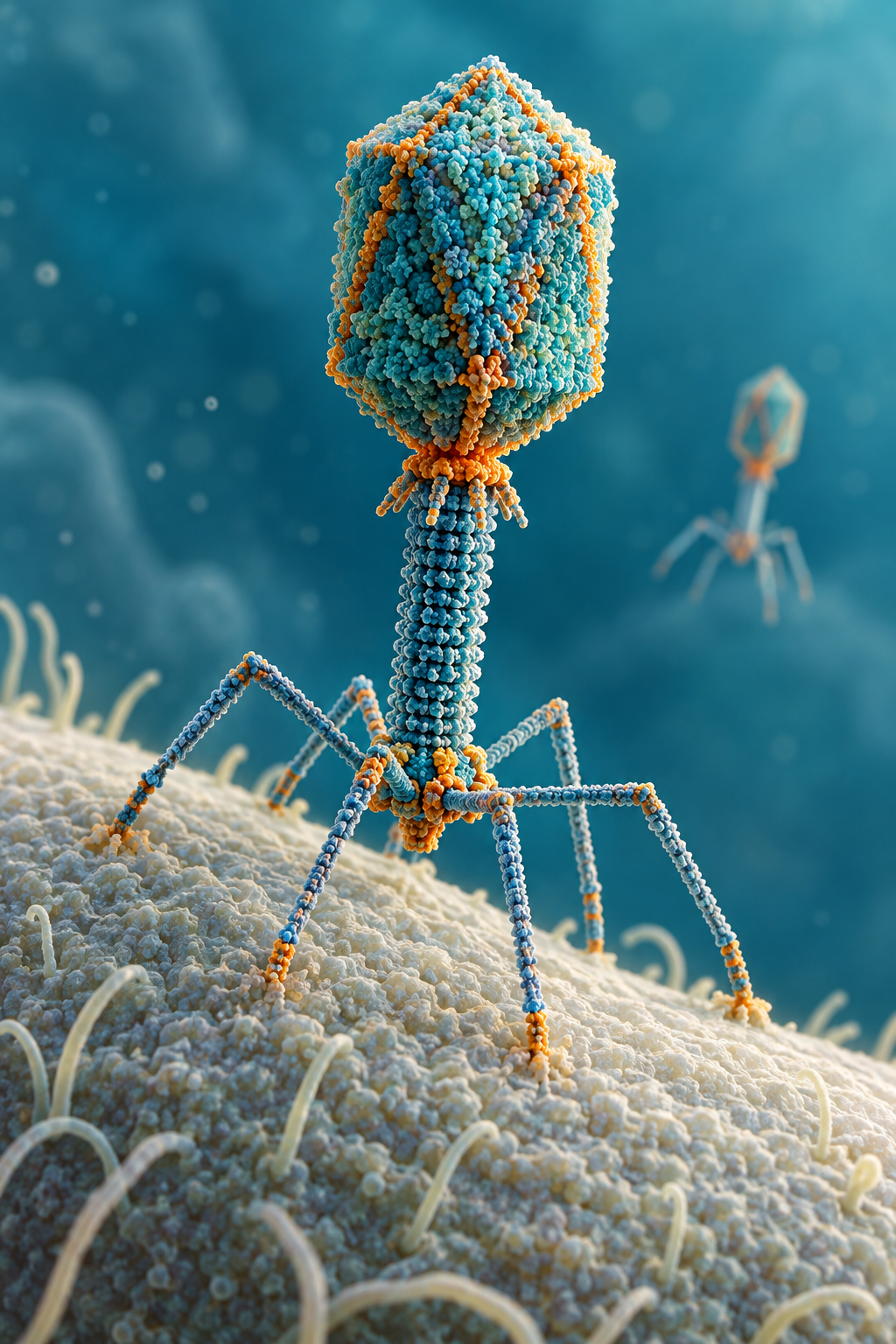
The familiar drawing of a bacteriophage looks almost mechanical: a faceted head, a tail and spindly fibers resting on a bacterial surface. It is tempting to see a miniature landing craft. In reality, those parts are molecular structures that recognize a host and help deliver viral genetic material.
A bacteriophage, usually shortened to phage, is a virus that infects bacteria. Phages occur wherever their hosts live, including seawater, soil and animal-associated microbial communities. Their interactions with bacteria help shape environments that appear quiet at human scale.
Recognition before infection
A phage must encounter a susceptible host. Molecules on the bacterial surface can serve as recognition points, and matching the host matters. A virus capable of infecting one bacterial strain may fail against another. Surface changes and bacterial defense systems help make these relationships highly specific.
Many well-studied phages have tails, but the classic shape is not universal. The small phage phiX174, for example, has a very different architecture from a long-tailed virus such as T4. Comparing structures reveals how evolution has produced different solutions to entering and exploiting a bacterial cell.
The virus relies on the host's molecular machinery to make new viral components. It is not a tiny animal feeding on a bacterium, and its visible shell is not the whole infection process. Much of the consequential activity happens after the genome has entered the cell.
Two important paths
In a lytic infection, new phage particles are produced and the host cell is ultimately broken open. The released particles can encounter further hosts. Temperate phages can also establish a persistent association in which their genetic material is maintained within the bacterial lineage, often integrated into the chromosome.
| Path | Central feature |
|---|---|
| Lytic infection | Production and release of new particles with host-cell lysis |
| Lysogeny | Viral genetic material persists with the host and can later become active |
These are useful introductory distinctions, not a complete catalogue of viral lifestyles. A bacterium carrying a persistent phage genome may acquire new properties, and phages can participate in gene movement between bacterial cells. The relationship is therefore more complex than immediate destruction in every encounter.
An ecological influence
When infected marine bacteria lyse, their contents become available to other organisms. This redirects material through microbial food webs and affects the cycling of nutrients and carbon. Phages can also change the metabolism of infected hosts while an infection proceeds.
Specificity makes phages interesting for research into ways of targeting bacterial infections. It also creates practical challenges: choosing the right phage, understanding resistance and checking safety are essential. Their existence is not evidence that any environmental virus is an interchangeable medicine.
RCSB PDB's illustrated phage resource provides structural examples and an interactive molecular view. A close look replaces the landing-craft analogy with something more interesting: remarkably elaborate molecular machinery, operating in ecological relationships that continually change both viruses and bacteria.
Sources and further reading: RCSB PDB: Therapeutic phage structures; RCSB PDB: Bacteriophage phiX174; Marine phages and microbial ecology.
Explore more creative discoveries at Incoprea.




