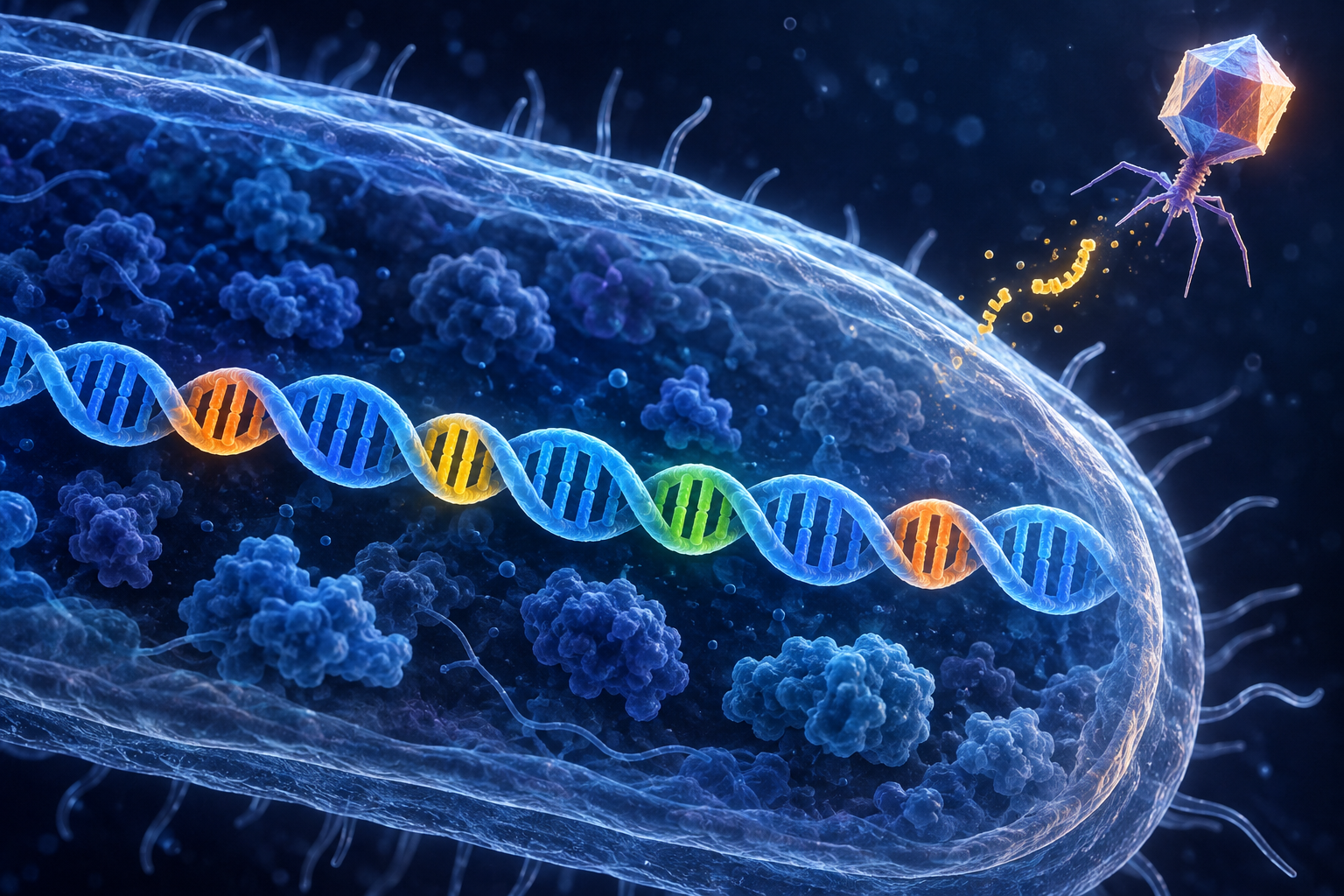
CRISPR is widely associated with editing genes, but its story begins in the ongoing struggle between microbes and the viruses that infect them. Certain bacteria and archaea keep short sequences of foreign genetic material in their own genomes. Those sequences can help them recognize a later encounter.
This is a molecular form of acquired defense. The organism is not consciously remembering an event. Instead, a record in DNA can provide the sequence information needed to direct protective machinery toward an invading target.
Repeated sequences with meaningful gaps
CRISPR stands for clustered regularly interspaced short palindromic repeats. A CRISPR array contains repeated stretches separated by sequences called spacers. Researchers noticed that some spacers matched genetic material from viruses and other foreign elements.
That match was a clue, but an explanation needed experiments. In 2007, researchers working with Streptococcus thermophilus showed that bacteria challenged by phages acquired new spacers derived from the viral genomes. Adding or removing particular spacers changed resistance to the corresponding phages.
The result linked a specific sequence record to a specific protective effect. It helped establish that CRISPR arrays and associated genes could provide acquired resistance. Not every bacterium has such a system, and bacteria possess many other defenses as well.
A sequence becomes a guide
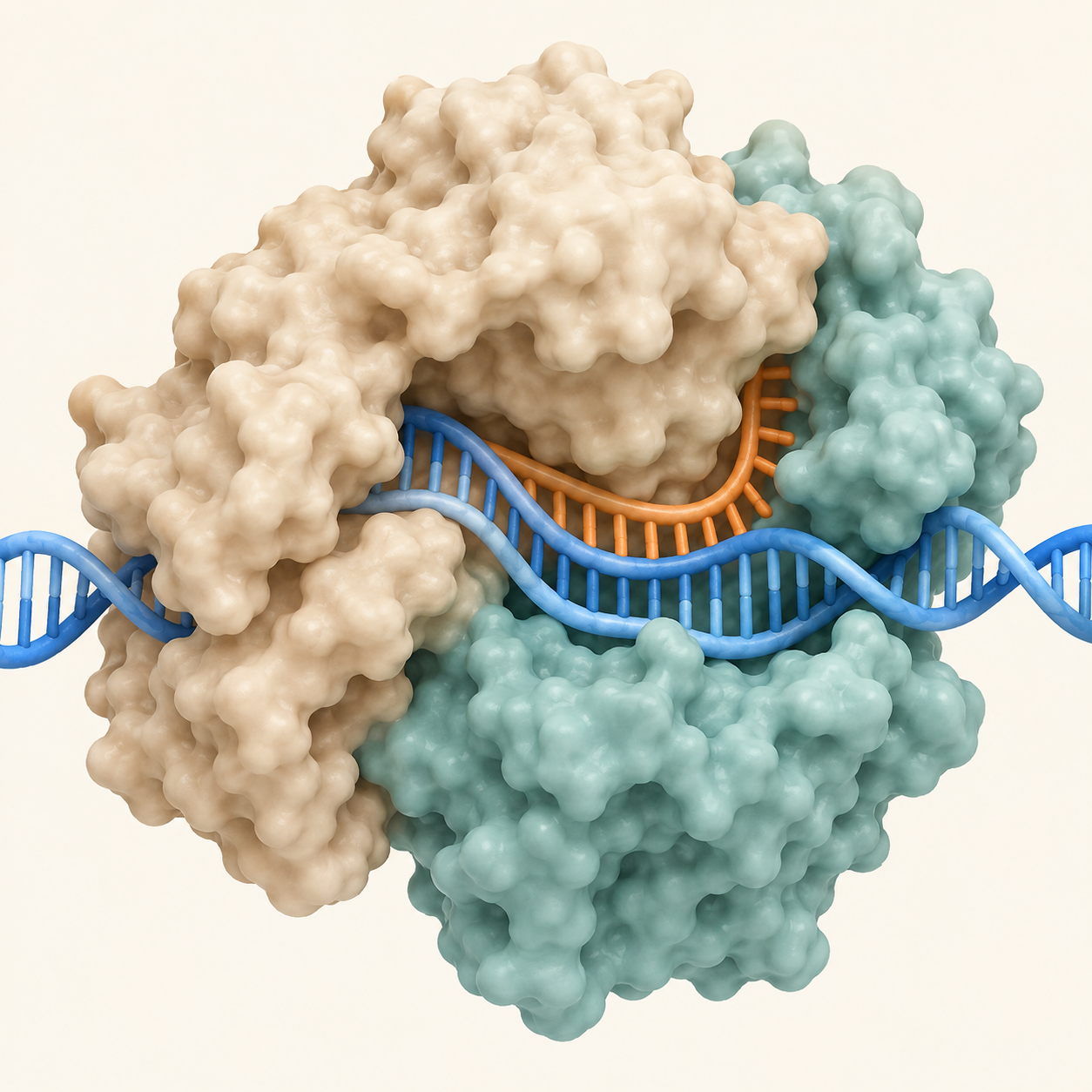
CRISPR-associated proteins are called Cas proteins. In many systems, the stored sequence information is transcribed and processed into RNA guides. A guide can direct a protein or protein complex toward complementary foreign genetic material. The details differ among CRISPR system types.
Cas9 is one famous example of an RNA-guided enzyme that can cut DNA. Other systems use different proteins, and some target RNA. It would therefore be misleading to describe all natural CRISPR defense as the same pair of molecular scissors.
Successful recognition is also more demanding than simply finding a short matching string somewhere in a cell. The system must distinguish an appropriate target and operate in its molecular context. Viruses can change, and some have evolved mechanisms that interfere with CRISPR defenses. The interaction remains an evolutionary contest.
From natural defense to a laboratory tool
In 2012, researchers demonstrated how Cas9 could be programmed with RNA to cut a chosen DNA sequence in a laboratory system. Combining the naturally involved RNAs into a useful guide design made the mechanism adaptable. Subsequent work brought such tools into genome editing in cells.
A cut does not by itself specify every final change. Editing outcomes depend on the cell's repair processes and on the experimental design. That distinction separates the ability to target DNA from the wider task of achieving a particular reliable edit.
The origins remain as interesting as the applications. A biological system shaped by viral encounters became a research tool because scientists asked what its unusual DNA pattern was doing. CRISPR's history shows how careful work on microbial life can uncover mechanisms with uses that were never apparent from the first observation.
Sources and further reading: Barrangou and colleagues: Acquired phage resistance; Jinek and colleagues: Programmable dual-RNA-guided endonuclease; Innovative Genomics Institute: What is CRISPR?.
Explore more creative discoveries at Incoprea.




