Showing posts with label Korea. Show all posts

Sunday, October 25, 2026

Bojagi: The Wrapping Cloth That Changes When Light Passes Through

Place a pale patchwork cloth against a wall and its seams may look like a network of lines. Lift it into window light and the same seams become darker bands. Fold it around a box and the composition changes again. A Korean bojagi can be understood through all three states: as a surface, as a translucent construction and as something designed to wrap.

Illustration of translucent Korean patchwork wrapping cloth with seams visible in window light.
Light makes the seams and layers of a wrapping cloth visible.

A family of cloths, with patchwork inside it

Bojagi is the broad name for Korean wrapping cloths. Jogakbo refers to patchwork examples assembled from smaller pieces. The distinction prevents a beautiful subtype from standing in for the entire tradition. As LACMA curator Virginia Moon explains, bojagi served many purposes, including transport, storage, protection and covering food. They could be embroidered, patterned or pieced, and made from different fibres.

Moon also separates a long history of use from the dates of surviving objects. Written records reach further back than most extant examples, which largely belong to the Joseon period. A nineteenth-century cloth can therefore participate in an older practice without itself being ancient. This is a useful distinction whenever a museum label places an everyday object within a long cultural history.

The V&A’s account of jogakbo describes cloth remnants joined into larger squares or rectangles. It names silk, cotton, ramie, hemp and even paper among possible materials. Individual examples are often organized around one type of fabric. Patchwork could make use of pieces left after other sewing, but the finished cloth still required many decisions about arrangement, scale and joining.

Why the seams become part of the picture

In the V&A’s examples, a careful enclosed seam gives the patchwork its characteristic gridded appearance. A translucent fabric makes that construction especially visible. Where fabric is folded or layered at a join, less light passes through. The seam can become a dark outline even when the thread and cloth are close in colour. Construction supplies part of the visual pattern.

This suggests a way to look that does not begin with resemblance to a painting. Follow a single join. See where it meets another join, changes direction or stops. Then notice whether the adjacent pieces are equal or unequal. The maker has to produce a usable whole from parts whose shapes may not already agree. An apparent simplicity can contain a complex sequence of accommodations.

Translucency is one possibility, rather than a definition of bojagi. A heavier cotton wrapper offers another experience. The Smithsonian’s late-nineteenth-century example, collected in Seoul, has bands attached at its corners for tying. Its printed designs include characters associated with long life and blessings. This large wrapper invites attention to carrying and securing bulky belongings, not only to light passing through delicate fabric.

Wrapping can carry a relationship

The Met’s twentieth-century silk cloth has gold-leaf decoration and was probably used for a wedding gift. Its motifs include paired phoenixes, double happiness and characters expressing a wish for many sons. The museum’s cautious “likely” is important: interpretation is based on the object’s features, rather than a complete surviving account of one documented ceremony.

Those motifs also locate the cloth in a social world with particular expectations about marriage and family. We can describe those expectations without treating them as universal or endorsing them. Wrapping was not necessarily an insignificant stage before the “real” gift appeared. The chosen covering could communicate care, status and a wish for the recipient’s future.

Nor should patchwork automatically be read as evidence of poverty. Reusing pieces can reflect thrift, available material and established household practice, while fine silk and skilled labour may also be involved. The material, workmanship and intended use of a particular cloth deserve attention before a viewer assigns it a single economic story.

A continuing practice, with named makers

The Philadelphia Museum of Art’s Cover, made by Kim Hyeon-hui in 2001, introduces a named contemporary artist. Its muted colours and deliberate piecing show that bojagi is not confined to anonymous objects in a closed past. The museum describes both functional associations and the visual relationships formed by small pieces. Historical tradition and present artistic authorship can coexist.

It can be tempting to call every East Asian cloth made from remnants a version of Japanese boro. That shortcut loses distinctions. Bojagi belongs to Korean wrapping practices; jogakbo names a way of constructing some of those cloths. Boro is associated with Japanese repair and layered textiles. A shared interest in retaining useful fabric does not make the two traditions interchangeable.

Three ways to inspect one cloth
  • Flat: follow the sizes, colours and seam intersections.
  • Against light: distinguish single fabric from layered seam allowances.
  • Wrapped: notice which corners, ties and colours remain visible.

Use the V&A or Philadelphia collection photographs for the first view. If an image viewer fails, the material descriptions still let you compare a fine pieced cover with the Smithsonian’s large cotton wrapper. A photograph cannot supply the full feel of a cloth, but it can help you ask more exact questions about what it was made to do.

The most rewarding thing about bojagi may be its capacity to alter a relationship between objects. A flat cloth becomes a container; a covering becomes a gesture; a seam becomes a line of shadow. The design is not finished when the last stitch is made. It becomes legible through the changing ways the cloth is handled, used and seen.

Explore more art, ideas and independent projects at Incoprea.

Wednesday, October 14, 2026

Jikji: The Korean Book That Changes the Printing Timeline

Open a history of printing at Jikji and the usual sequence changes. This Buddhist book was printed with movable metal type in Korea in 1377, decades before the Gutenberg Bible. Its importance is not only that it makes a familiar timeline longer. It lets us ask how a particular community turned a teaching into a reproducible book.

The surviving metal-type edition is incomplete: the second volume is held by the Bibliothèque nationale de France, while its first leaf is missing. That is enough to preserve a remarkable witness to production, and enough to encourage a closer look at the people and processes behind it.

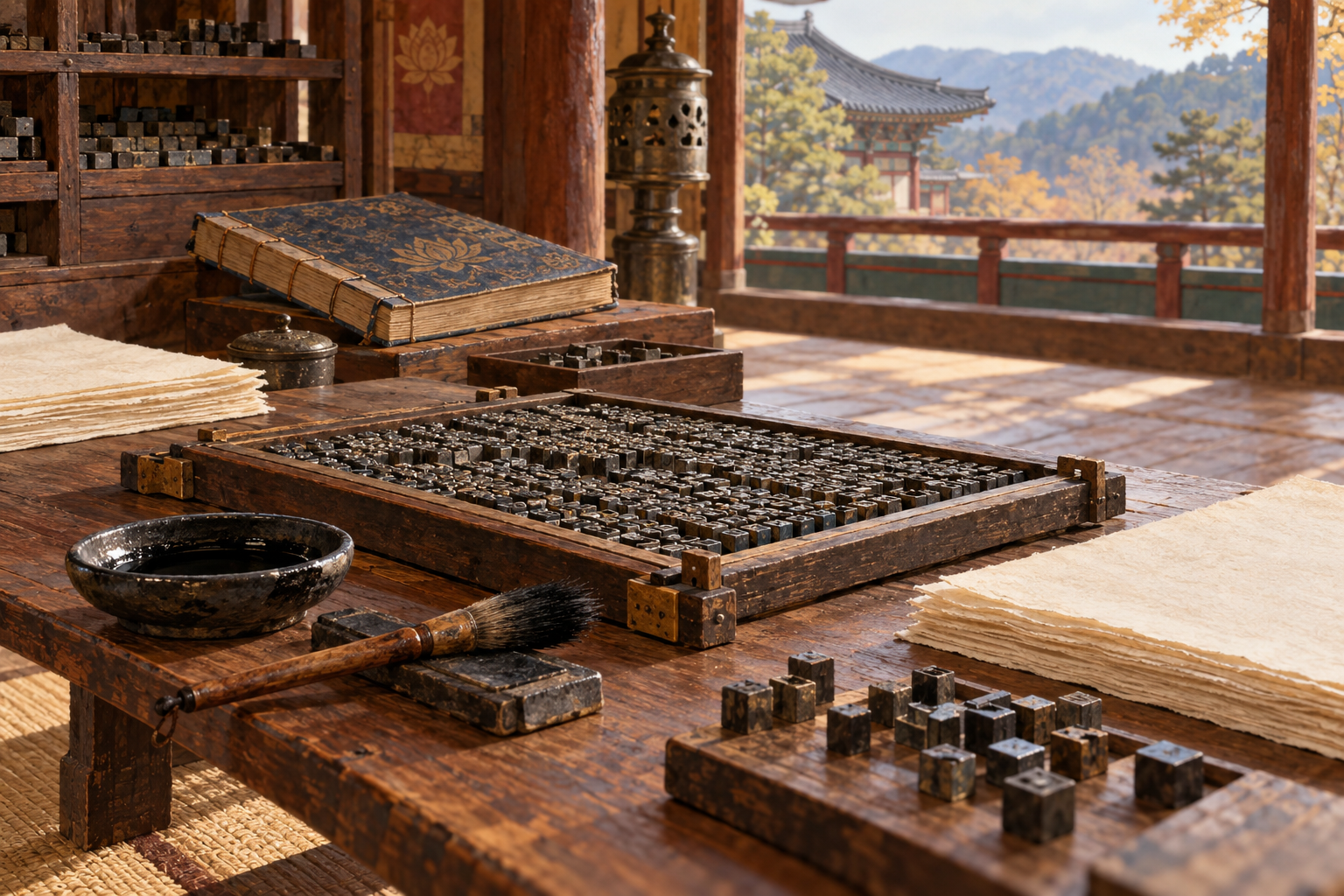
Illustration of an imagined Korean temple workspace with movable metal type and paper.
An imagined printing workspace suggests the materials behind a metal-type book; it is not a reconstruction of a documented workshop.

A book intended to be used

Jikji brings together Buddhist teachings compiled by the monk Baegun. The BnF describes its educational purpose in the tradition known in Korea as Seon. Its makers were preparing a religious text for readers and students, rather than an exhibit demonstrating a step towards a future European press.

The publication took place at Heungdeok-sa temple in Cheongju. The Republic of Korea's UNESCO nomination names the monks Seokcan and Daldam in connection with the work, and records a donation by the Buddhist nun Myodeok. Production required more than an inventor's idea: compilation, support, skilled making and an intended audience had to come together.

Those names also change the scale of the story. A book called the oldest of its kind can seem to belong mainly to a global competition. A book compiled, funded and printed by particular people belongs to a network of teaching and commitment. Both histories matter, but the latter explains why a book was made at all.

What movable type makes possible

Movable type separates the reusable character from the finished page. Individual pieces are arranged to form text, ink is applied and an impression is transferred to paper. The pieces can then be rearranged. A woodblock instead carries an entire carved page that can be retained for further impressions.

The difference creates practical choices. Type offers reuse across different pages, but a printer needs a stock of characters, a way to find them and an arrangement that prints consistently. A block requires the page to be carved, but can preserve that page for later reprinting. The better choice depends on the book, the workshop and the expected use.

Jikji itself makes coexistence visible. The BnF notes a woodblock edition of the complete text dated to 1378, surviving in Korea. Metal type did not arrive and immediately make every other method pointless. Different printing arrangements could serve the circulation of the same teaching.

Choose a printing method for a real task

Imagine that you run a small historical workshop. You have three commissions: a short text that will never change and needs repeated reprints, many different new pages, and a revised edition with frequent corrections. There is no single correct answer without knowing costs, tools and labour, but the comparison makes the tradeoffs easier to see.

Questions a workshop has to answer
NeedWoodblock questionMovable-type question
Repeat an unchanged pageCan its block be stored and used again?Should the setting stay assembled, or be reset later?
Prepare many different pagesHow much carving does each new page require?Are the needed characters available and easy to select?
Correct a passageCan the block be altered, or must it be replaced?Which pieces and spacing need to change?

Notice that storage belongs on both sides. Reusable pieces have to be organised, while retained blocks take space. A technique's advantage is meaningful only when it is connected to a particular production problem.

Look at the surviving pages

The BnF's Jikji feature links to the digitised book in Gallica and includes a video introduction. Begin with a whole spread or page. Follow the columns and the relation between text and margin before concentrating on a single character.

Next choose a character shape that appears more than once. Compare the impressions without assuming that every difference must come from a different piece of type. Ink, paper, pressure, wear and image quality can all affect what is visible. The useful first step is a description of the difference, rather than a diagnosis.

Finally examine the publication information discussed in the catalogue. It connects the object to a place, a date and a method. The historical argument grows stronger when those details remain attached to an identifiable copy rather than circulating as a claim beside a generic printing image.

What the earlier date establishes

The BnF calls Jikji the oldest currently known surviving book printed with movable metal type. The wording leaves room for the earlier Korean printing recorded in written sources. The oldest surviving witness and the first use of a technique are different questions.

Jikji precedes the Gutenberg Bible by roughly eight decades. That comparison corrects a narrow history, but does not by itself prove a direct path of transmission from Korea to Gutenberg. The University of Utah's “From Jikji to Gutenberg” project studies early printed material and the technical questions behind it. Comparison can be valuable without presupposing its conclusion.

Return to the book's purpose after considering the machinery. Movable pieces mattered because they helped make a text available in repeatable form. Jikji is a technological landmark, and it is also a religious book produced by people who wanted readers to encounter its teachings. Seeing both makes the timeline more human and the achievement more complete.

Sources and further reading

Explore more art, stories and discoveries at Incoprea.

publications

New this week Two novels in six stories each, from The Night Shift . New — a novel in six documents Small Print A Novel in Six Do...