Case 08 · digit placement · Medium · About 8–12 minutes
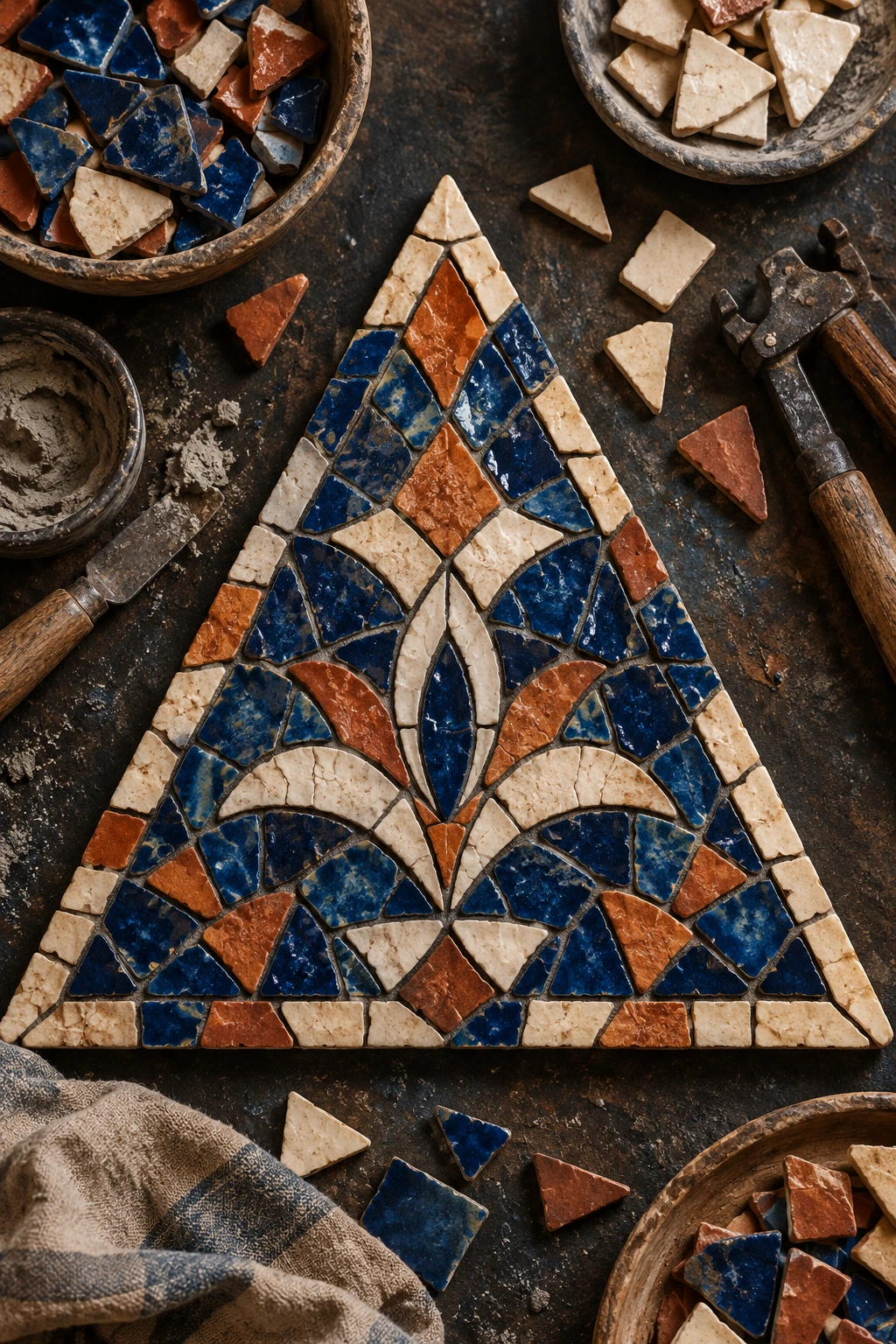
A mosaic maker has six numbered tokens and a triangular frame. The numbers will be covered once the glaze is applied, but the maker has recorded the totals along the three outside edges.
Two comparisons between positions remove the last ambiguity. Reconstruct the arrangement before the tokens disappear beneath the glaze.
Place the numbers 1, 2, 3, 4, 5, 6 exactly once in six positions:
- Top row: A.
- Middle row: B on the left, C on the right.
- Bottom row: D on the left, E in the center, F on the right.
The outside-edge totals are:
- Left edge: A + B + D = 11.
- Right edge: A + C + F = 9.
- Bottom edge: D + E + F = 11.
There are two further clues: B is greater than C, and A is less than D.
Which number belongs in each position? The labels describe fixed places, so a rotated or reflected triangle is a different candidate and must satisfy the same labeled clues.
You can draw three rows of empty boxes or simply make a six-column list. The equations, rather than the decorative triangular artwork, define which positions share an edge.
Hint 1 - reveal when you want a nudge
Add the three edge totals. The corner numbers A,D,F have been counted twice; the other numbers only once.
Hint 2 - reveal when you want a nudge
All six numbers total 21. The three edge totals sum 31, so A + D + F =10. Use that to limit the corners.
Reveal the solution and explanation
The arrangement is A = 1, B = 6, C = 3, D = 4, E = 2, F = 5.
Adding the edge equations gives 31. Since the numbers 1 through 6 total 21, the corners must total 10.
Choose distinct corners with that total. Once A, D, F are chosen, the other positions are forced: B = 11 − A − D, C = 9 − A − F, and E = 11 − D − F. Reject any repeated number or any value outside 1–6.
After also requiring B greater than C, only these three rows remain, listed as A,B,C,D,E,F:
- 1,6,3,4,2,5
- 3,6,1,2,4,5
- 5,4,1,2,6,3
The clue A less than D rejects the last two. The surviving edges check as 1 + 6 + 4 = 11, 1 + 3 + 5 = 9, and 4 + 2 + 5 = 11. Testing all permitted corner choices leaves exactly one answer.
Solve another: The Cabinet of Fifty Mysteries · Browse all 50 cases