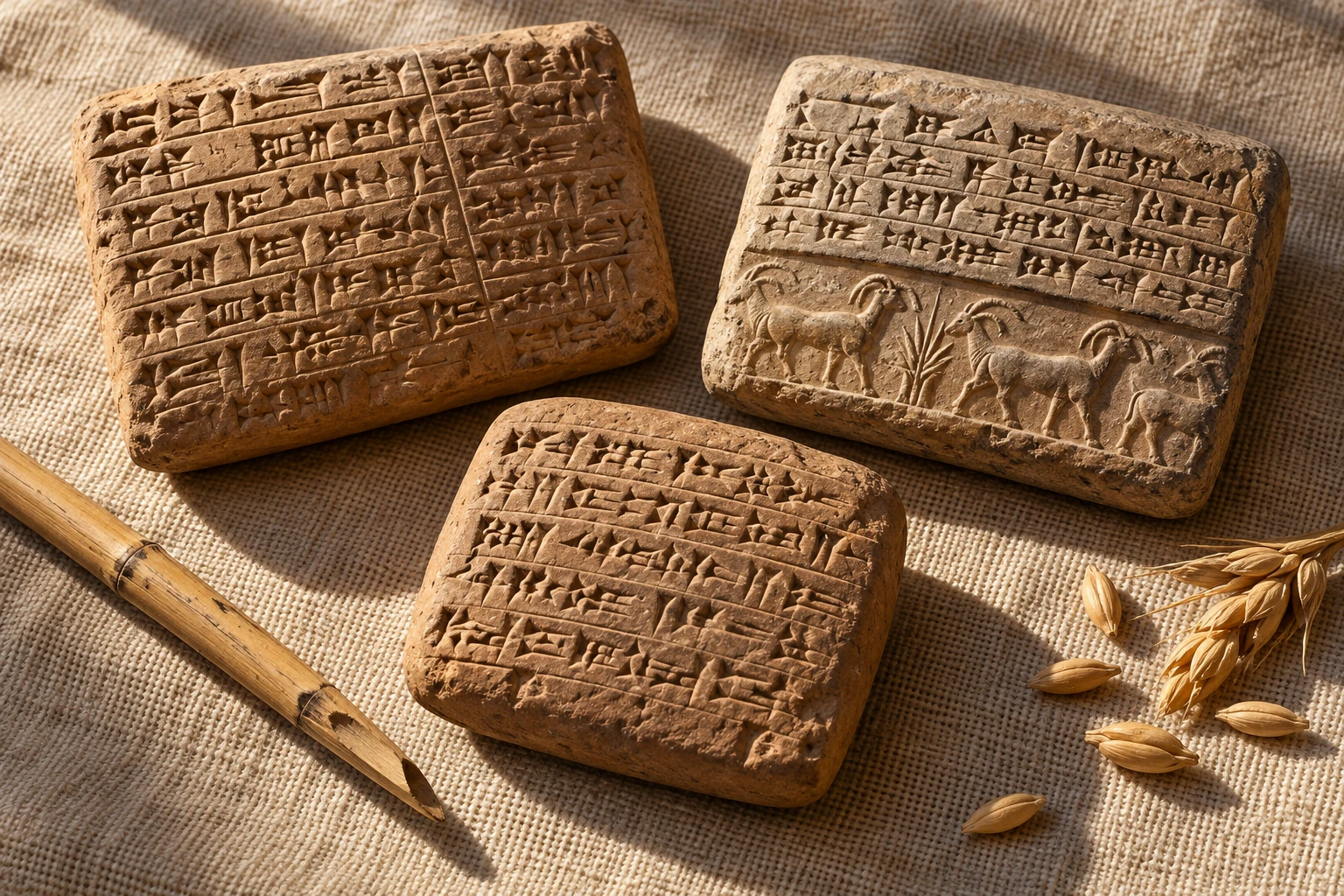
A palace can make an empire look like a procession of rulers. An accounting tablet can bring a different set of people into view: those receiving, storing, authorizing, carrying, and recording food. The Persepolis Fortification Archive opens that administrative world through small pieces of clay.
The tablets are not private diaries. Their power comes from repeated records made for practical work. An entry that looks mundane in isolation can become revealing when connected with other entries, dates, places, and seal impressions.
An archive with more than one language of evidence
The University of Chicago’s OCHRE project account describes tens of thousands of tablets and fragments excavated at Persepolis in 1933 and loaned for study in 1935. The digital environment connects languages, scripts, seal images, and the physical features of the objects rather than separating them into unrelated files.
The National Endowment for the Humanities’ project description identifies the archive with the Achaemenid Empire around 500 BCE and emphasizes texts in several languages alongside thousands of seal impressions. A clay tablet can therefore carry information in writing, image, and physical arrangement at once.
That combination matters for the reader. A transcription of the words is invaluable, but it is not the whole object. Where a seal was applied, whether it overlaps a surface, and how it relates to an entry can contribute to understanding the administrative act.
Food records reveal relationships
The introduction to Seals on the Persepolis Fortification Tablets characterizes the archive’s overarching content as procurement, storage, and disbursement of food commodities. It explains how these records broaden evidence for economic organization, religion, and the roles of women at different levels of society.
A ration entry does not give a complete personal life. It can identify a category of recipient or a transaction, while leaving the recipient’s own voice largely absent. The administrative visibility of a person is not the same as that person having control over the record.
For the same reason, the existence of food allocations should not be turned into a sweeping claim that everyone enjoyed equal conditions, that every worker had the same legal status, or that an ancient institution matched a modern employment system. Those are larger propositions requiring specific evidence.
A seal can connect entries that the text alone separates
The first seal catalog volume documents 312 seals with heroic-encounter imagery through 1,970 impressions. One engraved tool can leave traces on multiple records. Researchers can compare those impressions even when the original seal itself has not survived.
A familiar analogy is a recurring stamp on a set of paper forms. The shared mark may connect acts of authorization or administration. It does not mean all the forms record the same transaction. The pattern of use becomes meaningful when combined with the written entries.
The University of Chicago’s account of imaging research describes digital approaches to examining tablet surfaces and seal impressions. A shallow mark can change dramatically under different illumination. Technology assists the trained reading; it does not remove the need for language, comparison, and context.
Build a miniature archive from ordinary life
Here is a deliberately invented dataset to explore the principle. It is not a translation of a Persepolis tablet.
| Record | Recipient | Item | Authorization mark |
|---|---|---|---|
| A | Workshop group | Grain | Circle |
| B | Traveling group | Grain | Triangle |
| C | Workshop group | Oil | Circle |
| D | Traveling group | Oil | Square |