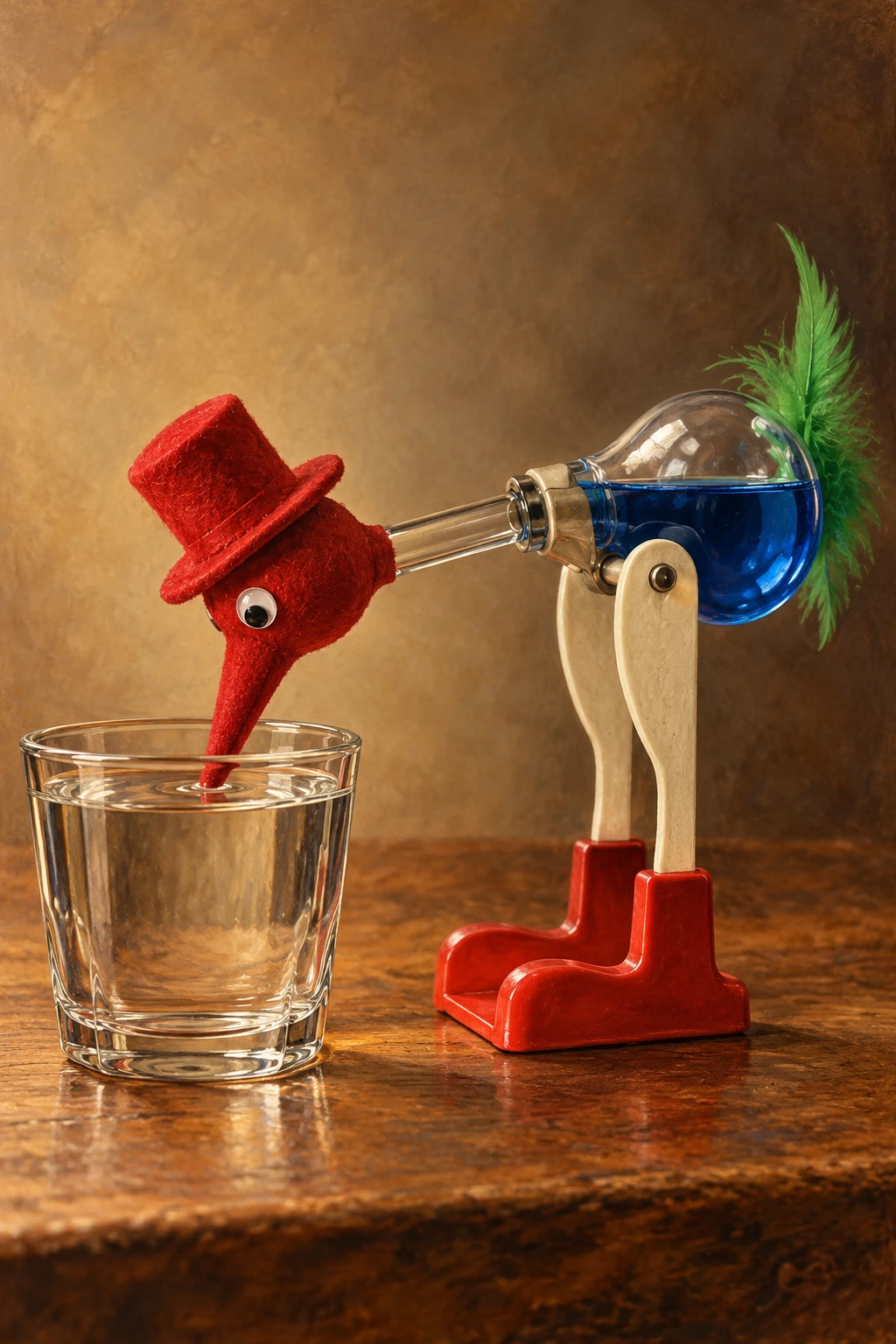
The toy lowers its red head to a glass of water, rises, waits and bows again. A drinking bird looks as though it has found a way to turn a quiet room into endless movement. It has found an energy source, but not an exception to thermodynamics. The visible motion depends on heat flowing through a temperature difference maintained by evaporation.
Its apparent simplicity is deceptive. One sealed fluid system, one wet surface and one pivot cooperate to create a repeating cycle. The water outside the bird and the colored working liquid inside it have different jobs. Confusing them makes the mechanism seem more magical than it is.
The wet head makes the cold side
The University of Colorado's demonstration account identifies the head as the cooled region and the lower body as the warmer region. Water evaporating from the head's covering removes heat. A temperature and vapor-pressure difference develops within the sealed device, helping drive working liquid upward through the connecting neck.
The outside water does not flow through the beak into the internal glass system. It refreshes the evaporating covering. The internal liquid is part of a sealed mechanism. The beak's “drink” therefore maintains a boundary condition rather than providing a digestive meal.
One useful way to describe the energy route is: room heat and evaporation sustain a temperature difference; that difference changes pressures; pressure shifts liquid; the shifted liquid changes balance; the bird tips. The moving liquid and the tipping body make the otherwise invisible thermal process legible.
The pivot turns a slow buildup into a reset
As working liquid rises, its distribution changes the toy's center of mass. Eventually the upright arrangement no longer remains balanced and the bird tilts. In the tipped position, the fluid-and-vapor connection permits the system to reset, liquid returns toward the lower bulb, and the body comes upright again.
The University of Iowa lists the bird as a relaxation oscillator. That name describes a recognizable pattern: a condition builds relatively slowly until a threshold produces a faster event and reset. The toy is therefore interesting as a clock-like cycle as well as a heat engine.
For a paper model, divide a cycle into four boxes: cooling and pressure difference; liquid rise; tipping; return. Draw an arrow from the last box back to the first. Then write the external requirement beside the loop: continued evaporation under suitable ambient conditions. A closed arrow on paper does not mean a physically isolated device.
A clear cover can stop a seemingly self-powered toy
Colorado's account describes covering the bird and water with a bell jar. Humidity increases and evaporation becomes less effective; the bobbing stops. Remove the cover and the process can resume. Simon Fraser University's demonstration likewise identifies cooling by evaporation, heat-engine behavior and the relaxation cycle.
This is a revealing intervention because it changes an environmental exchange without grabbing the bird's body. If the toy were a truly closed source of inexhaustible motion, changing the air around it should not remove its supply. Instead, the intervention exposes the dependency that the repeated bowing can make easy to overlook.
The role of humidity also explains why “room temperature” is not a sufficient description of its conditions. Evaporation depends on how the surrounding air can accept additional vapor. Two apparently comfortable rooms can offer different evaporative conditions even when their thermometer readings match.
Water is consumed, heat is transferred
The water that leaves the covering as vapor does not vanish from the accounting. It moves into the environment, carrying energy. Replenishing it keeps the cooling process available. Calling the toy “water powered” without explaining this route can suggest that liquid water is being burned or that its mass itself supplies unlimited energy.
A useful comparison is a wet cloth cooling as it dries. The temperature effect is familiar even without a moving mechanism. The bird adds pressure-sensitive fluid, shifting balance and a repeatable reset so that a thermal exchange produces a mechanical sequence you can watch.
| Visible event | Hidden question |
|---|---|
| The head covering stays damp | Can evaporation continue into the surrounding air? |
| Liquid rises in the neck | How have pressures and temperature changed? |
| The bird tips | Where is the mass relative to the pivot? |
| The bird returns upright | What reset makes the next buildup possible? |
The drinking bird succeeds because it is open to a useful difference in its surroundings. Its repeated motion makes a flow of energy look like a self-contained habit. Once the wet head, humid air and shifting fluid are included, the illusion of perpetual motion gives way to something better: a small machine that lets you see an environmental exchange become a rhythm.
Sources and a closer look: University of Colorado: evaporation and the drinking bird; University of Iowa: relaxation oscillator demonstration; Simon Fraser University: drinking-bird demonstration.
Explore art, experiments and other unexpected connections at Incoprea.