Showing posts with label Indonesia. Show all posts

Wednesday, October 14, 2026

Gamelan Tuning: Why an Ensemble Has Its Own Musical Voice

An interpretive gamelan arrangement includes bronze keys, kettle gongs, a hanging gong, drum and flute.
Generated illustration of a generalized gamelan arrangement. It is not a documented ensemble or a diagram of any particular set’s tuning.

The deep resonance of a gong, the clear attack of bronze keys and the movement of many overlapping parts can make a gamelan immediately recognizable. But “gamelan” does not name one instrument, one tuning or one uniform Indonesian musical style. It refers to ensembles and traditions whose details depend on place, purpose and history.

Central Javanese, Sundanese and Balinese practices differ, and there is variation within those broad descriptions. Understanding a particular performance begins with identifying the ensemble and the tradition in which its players are working.

Two tuning categories in a Javanese example

In Central Javanese gamelan, two important tuning categories are sléndro and pélog. Sléndro has five pitch positions per octave, with comparatively even spacing. Pélog has seven, with more conspicuously unequal intervals; particular pieces often emphasize selected groups of pitches.

Those descriptions are starting points. They do not mean every sléndro ensemble shares exactly the same frequencies, or that pélog is simply a Western scale with a different name. Individual gamelan sets can have distinct tunings that contribute to their character.

Central Javanese categoryIntroductory description
SléndroFive pitch positions, comparatively even spacing
PélogSeven pitch positions, unequal intervals and selected pitch groupings

A full ensemble may include separate instruments for the two tunings. Moving an instrument from one set into another is not automatically like swapping two identical piano keys. Its pitches and sound belong to relationships among the ensemble's components.

The music lives between the parts

Gamelan commonly includes metallophones and gongs, but other instruments and voices can be important. Depending on the ensemble, these can include drums, a wooden xylophone, a bowed rebab, plucked strings and a bamboo suling.

Different parts organize musical time in different ways. Some mark larger structural moments, while others articulate a melody or provide more elaborate patterns around it. The listener can move attention between a repeating cycle and the activity unfolding within it.

Learning also involves those relationships. Musician and scholar Sumarsam's introductory Javanese materials emphasize listening, observing and playing with others. Notation can assist learning, but knowing a written sequence does not by itself supply the full experience of how one part fits the ensemble.

The same caution applies to a diagram of a scale. Frequencies alone do not explain phrasing, timing, instrumental color, ensemble interaction or the context of a performance.

Hear a particular ensemble

The Smithsonian's Javanese gamelan concert resource identifies pieces and their tuning and modal settings. Its timed program lets a listener connect actual music with names such as sléndro and pélog, rather than treating them as abstract categories.

Other gamelan traditions need their own explanations. The brilliant interlocking textures of many Balinese ensembles, for example, should not be assumed to follow every detail of a Central Javanese introduction. Even within Bali, there are many ensemble types and purposes.

The useful discovery is that tuning can be part of an ensemble's identity. Musicians make a shared sound with instruments designed and learned in relation to one another. Listening to that collective voice reveals much more than asking which Western notes it resembles.

Sources and further reading: Sumarsam: Introduction to Javanese Gamelan; Smithsonian National Museum of Asian Art: Javanese concert resource; The Met: Sléndro saron panerus.

Explore more creative discoveries at Incoprea.

Titan Arum: A Giant Bloom That Makes Its Own Heat

Generated botanical illustration of a titan arum inflorescence with a cream spadix and maroon spathe.
The tall spike and surrounding spathe belong to an inflorescence made of many small flowers. Generated illustration.

At a botanical garden, a queue can form for a plant whose chief attraction is an appalling smell. The titan arum, Amorphophallus titanum, earns its corpse-flower nickname through odors associated with decay. The spectacle also includes a less obvious trick: it produces heat.

Native to Sumatra, this plant has an enormous flowering structure. What looks like one gigantic flower is an inflorescence, a collection of many smaller flowers working together. Understanding that distinction reveals a carefully arranged system beneath the drama.

A tower above tiny flowers

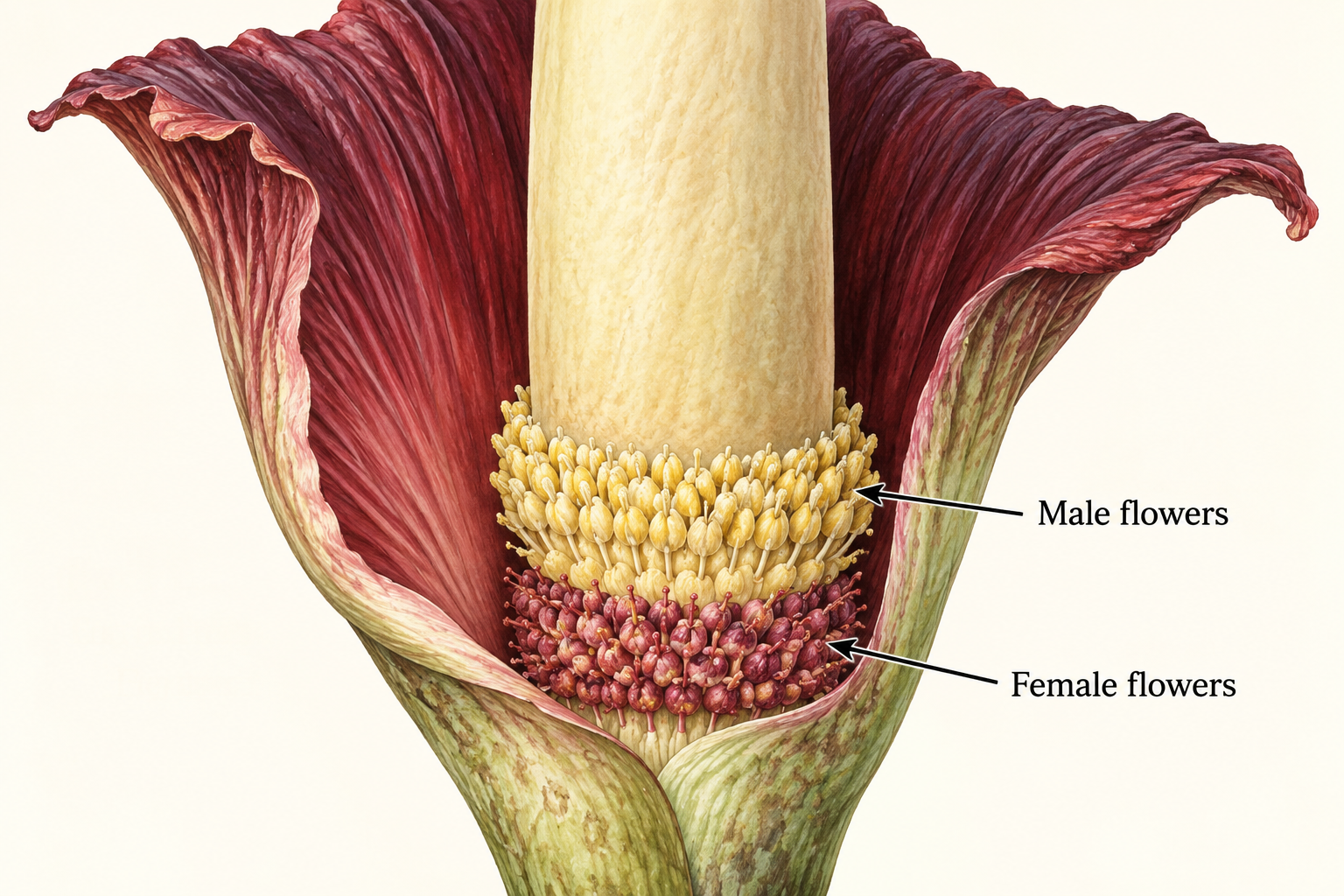
The central spike is the spadix. Around it stands a large modified leaf, the spathe, with a deep burgundy inner surface and paler green exterior. The individual male and female flowers occupy separate zones low on the flowering axis, rather than the visible tip.

The display attracts insects associated with decaying organic material. Odor, appearance and timing all matter. The female and male phases occur at different times, so a single flowering event is a changing biological process rather than a static ornament.

This also explains why a photograph can be deceptive. Two images of the same plant may show different stages, and the impressive upper structure hides much of the actual reproductive machinery.

Generated titan arum cutaway showing male flowers above the lower female flowers.
The actual flowers sit low on the axis, in separate zones. This cutaway simplifies their form and proportions. Generated illustration.

Heating the display

Researchers at the University of Bonn used thermal imaging to study titan arum flowering. They documented heating in the spadix during the female phase, and a later thermogenic phase involving the male flowers. The heat occurs in relation to the plant's flowering sequence.

Thermogenesis is metabolic heat production. It can help disperse volatile compounds and may have other roles in interactions with visiting insects. The observations establish where and when warming occurs; explanations of every benefit require further testing.

A thermal image is especially useful here because temperature is invisible in an ordinary photograph. Its colors represent measured heat according to a chosen scale. A bright red area is not a visibly glowing part of the plant.

The quiet years behind the event

The bloom depends on resources stored in an underground corm. During vegetative growth, a large, branching leaf captures light and supports the accumulation of reserves. The United States Botanic Garden describes a cycle of growth, storage, dormancy and eventual flowering.

Years can pass between impressive displays. A large bloom is costly, and conditions influence its development. Predicting a flowering date is therefore different from scheduling an annual garden show.

Watch: Kew's titan arum video introduces the plant and its cultivation behind the scenes.

The odor may bring people through the door, but the deeper interest is coordination: stored energy, reproductive timing and heat meet in one brief event. The ordinary-looking intervals are part of the same story, quietly preparing the next spectacular performance.

Sources: Kew: titan arum form and biology · University of Bonn researchers: titan arum thermogenesis · United States Botanic Garden: titan arum life cycle

Explore more creative curiosities at Incoprea.

Kecak: The Balinese Chorus With a Modern Performance History

Generated interpretive illustration of a kecak stage chorus. It is not a documentary image of a named troupe, venue or ritual. A circle of v...