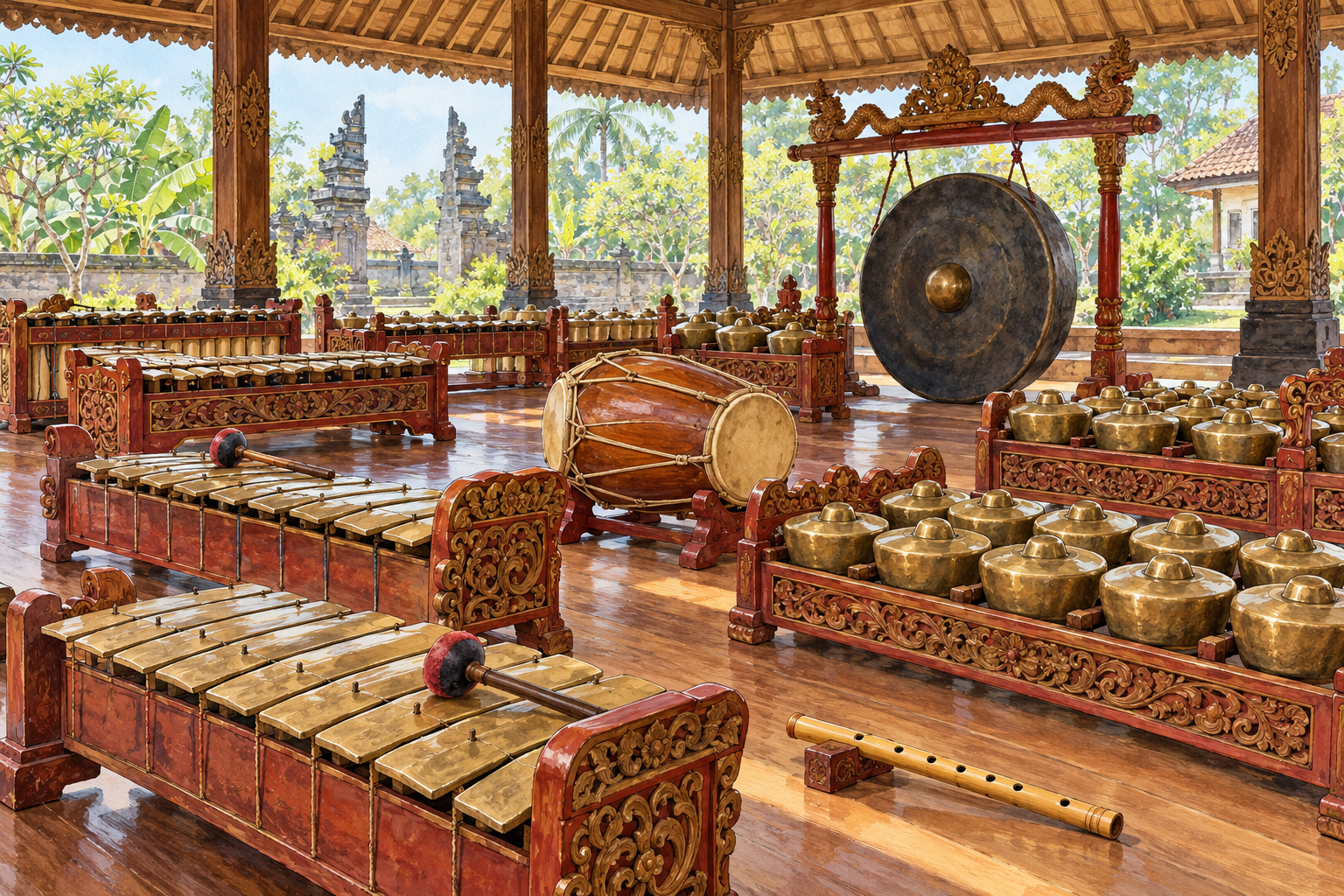
The deep resonance of a gong, the clear attack of bronze keys and the movement of many overlapping parts can make a gamelan immediately recognizable. But “gamelan” does not name one instrument, one tuning or one uniform Indonesian musical style. It refers to ensembles and traditions whose details depend on place, purpose and history.
Central Javanese, Sundanese and Balinese practices differ, and there is variation within those broad descriptions. Understanding a particular performance begins with identifying the ensemble and the tradition in which its players are working.
Two tuning categories in a Javanese example
In Central Javanese gamelan, two important tuning categories are sléndro and pélog. Sléndro has five pitch positions per octave, with comparatively even spacing. Pélog has seven, with more conspicuously unequal intervals; particular pieces often emphasize selected groups of pitches.
Those descriptions are starting points. They do not mean every sléndro ensemble shares exactly the same frequencies, or that pélog is simply a Western scale with a different name. Individual gamelan sets can have distinct tunings that contribute to their character.
| Central Javanese category | Introductory description |
|---|---|
| Sléndro | Five pitch positions, comparatively even spacing |
| Pélog | Seven pitch positions, unequal intervals and selected pitch groupings |
A full ensemble may include separate instruments for the two tunings. Moving an instrument from one set into another is not automatically like swapping two identical piano keys. Its pitches and sound belong to relationships among the ensemble's components.
The music lives between the parts
Gamelan commonly includes metallophones and gongs, but other instruments and voices can be important. Depending on the ensemble, these can include drums, a wooden xylophone, a bowed rebab, plucked strings and a bamboo suling.
Different parts organize musical time in different ways. Some mark larger structural moments, while others articulate a melody or provide more elaborate patterns around it. The listener can move attention between a repeating cycle and the activity unfolding within it.
Learning also involves those relationships. Musician and scholar Sumarsam's introductory Javanese materials emphasize listening, observing and playing with others. Notation can assist learning, but knowing a written sequence does not by itself supply the full experience of how one part fits the ensemble.
The same caution applies to a diagram of a scale. Frequencies alone do not explain phrasing, timing, instrumental color, ensemble interaction or the context of a performance.
Hear a particular ensemble
The Smithsonian's Javanese gamelan concert resource identifies pieces and their tuning and modal settings. Its timed program lets a listener connect actual music with names such as sléndro and pélog, rather than treating them as abstract categories.
Other gamelan traditions need their own explanations. The brilliant interlocking textures of many Balinese ensembles, for example, should not be assumed to follow every detail of a Central Javanese introduction. Even within Bali, there are many ensemble types and purposes.
The useful discovery is that tuning can be part of an ensemble's identity. Musicians make a shared sound with instruments designed and learned in relation to one another. Listening to that collective voice reveals much more than asking which Western notes it resembles.
Sources and further reading: Sumarsam: Introduction to Javanese Gamelan; Smithsonian National Museum of Asian Art: Javanese concert resource; The Met: Sléndro saron panerus.
Explore more creative discoveries at Incoprea.




