Showing posts with label Unsolved Questions. Show all posts

Wednesday, October 14, 2026

Roopkund Lake: The Discovery That Made a Mystery More Complicated

A group of remains found in one place invites a single story. The people travelled together, an event struck them and the scene stayed where it was. At Roopkund Lake in the Indian Himalayas, scientific analysis made that neat explanation much harder to sustain.

The 2019 study did not simply replace one dramatic story with another. It separated evidence about ancestry, time and diet, showing that the sampled individuals included different histories. The important discovery was a more complicated question, grounded in several methods rather than a more spectacular nickname for the lake.

Illustration of a small high Himalayan lake among rocky slopes, with a field notebook in the foreground.
A landscape inspired by the site's high-altitude setting, not a documentary view.

Shared location does not establish shared time

Roopkund lies more than five thousand metres above sea level. Human remains have been found around the lake, and the setting has been disturbed by rockslides and visitors moving material. These changes make it difficult to recover the original relationships among remains and associated objects.

A familiar archaeological problem sits behind the extraordinary view. Material can accumulate at one place through separate events. Later movement can bring those deposits together or scatter an earlier group. Proximity is an observation to explain, not an automatic date.

The lake's association with local traditions and a pilgrimage landscape is relevant to its human history. Connecting a particular story with particular individuals, however, requires evidence about those individuals and the events. A meaningful tradition is not a laboratory label that identifies every remain.

What the 2019 researchers compared

Éadaoin Harney, Ayushi Nayak and colleagues analysed genome-wide ancient DNA from thirty-eight individuals, alongside radiocarbon and stable-isotope evidence. Their results grouped the individuals into three ancestry-related clusters.

Twenty-three fell within the range of present-day South Asian variation, fourteen had eastern Mediterranean-related ancestry and one had Southeast Asian-related ancestry. These terms describe genetic relationships to comparison populations. They are not verified nationalities, languages or self-identifications.
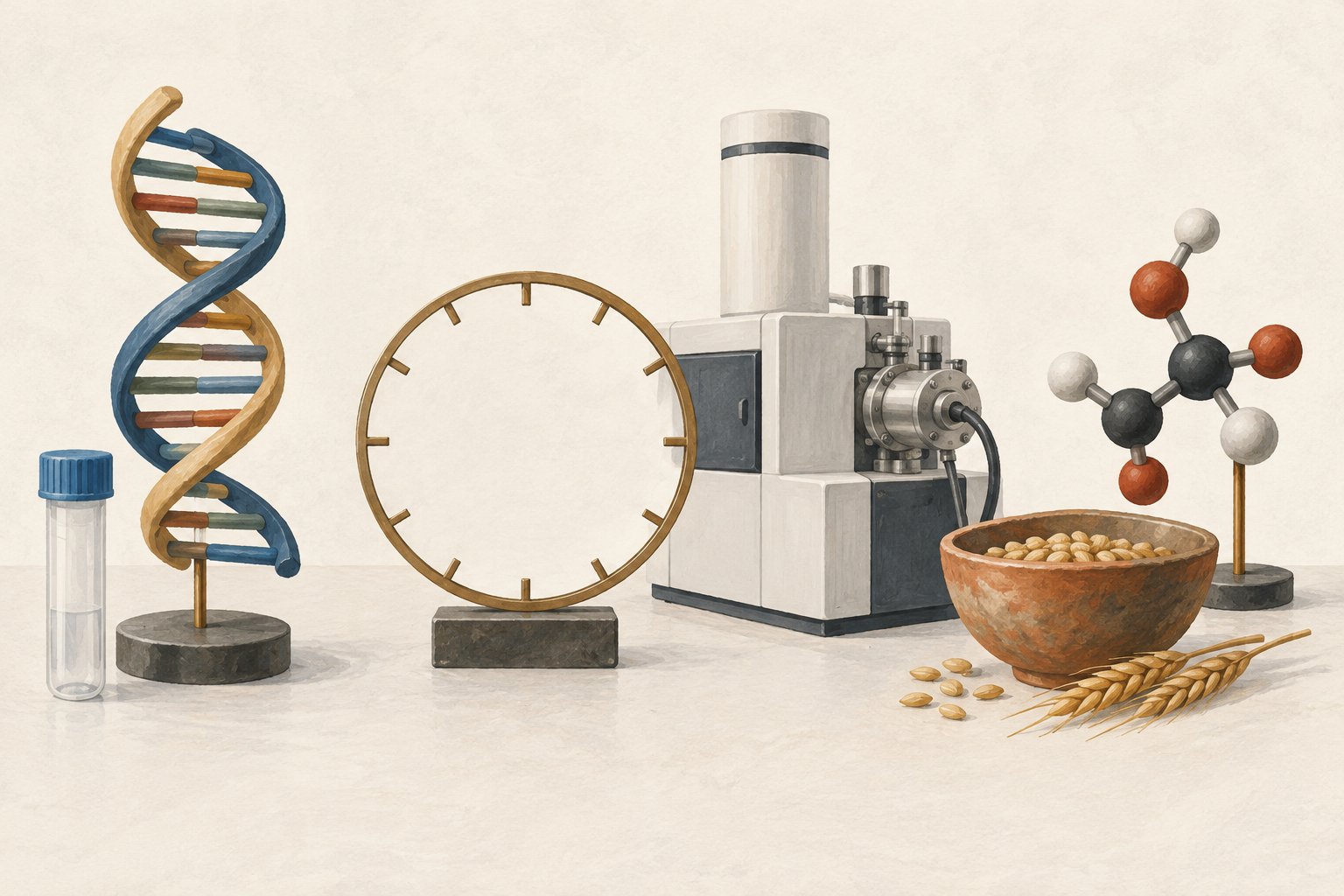
Illustration symbolizing genetic ancestry, radiocarbon dates and diet evidence.
Different laboratory methods answer different questions; the objects here symbolize those methods rather than the actual Roopkund samples.

The research-method illustration represents different analytical questions. It does not show the actual specimens or an authentic laboratory result. For those, the primary paper's figures and methods give the relevant detail.

The dates were decisive. The South Asian-related group centred around approximately 800 CE, with evidence for more than one depositional event. The other sampled individuals dated around 1800 CE. A separation of roughly a millennium cannot be explained as one travelling party killed in a single incident.

Three methods, three partial portraits

Ancient DNA supports comparison of inherited genetic relationships. Radiocarbon constrains the age of organic material. Stable isotopes can contribute evidence about diet and related life-history questions. Each method answers something useful; none supplies a complete biography alone.

It is especially important not to make ancestry do the work of geography too precisely. A genetic relationship to people in a broad region does not prove a person's birthplace. Nor does a dietary pattern identify a named meal, occupation or reason for visiting a high-altitude lake.

The methods become powerful together because one can challenge a story suggested by another. A seemingly shared location became a sequence of different dates. An assumption about one population became evidence for several genetic groupings. The research did not require every result to fit the opening expectation.

When an unexpected result deserves another look

Penn State's account follows the radiocarbon work from the laboratory's perspective. The initial results were sufficiently unexpected that researchers checked the records and examined more material. Repetition and comparison helped turn an apparent problem into a finding.

This is an engaging part of the investigation because it shows uncertainty being handled actively. An odd date can result from a mistaken association, a laboratory issue or a real complexity at the site. The next step is to test those possibilities, not simply choose the most exciting explanation.

The account also reminds us that a sample code carries limited context. A laboratory measurement has to return to the archaeological question before it becomes a historical interpretation. Accurate analysis and a trustworthy relationship to the sampled individual are both necessary.

Test three explanations against the evidence

Consider these broad proposals: everyone in the sample died together; different groups reached the site at different times; every individual in one ancestry cluster shared the same reason for being there. Which statements are supported, contradicted or left unresolved?

Compare your answers

The wide date separation contradicts a single event for all sampled individuals. Multiple times of deposition fit the findings. A shared ancestry relationship does not establish a common motive, so the third proposal needs further evidence. The study concerns its sample, not a complete census of every remain at the lake.

Now list the evidence a fuller account would need. Secure associations, more chronological context, historical records and careful study of the landscape could all matter. A laboratory can extract remarkable information from a sample, but cannot restore a context that has been casually moved or removed.

Read the figures without turning groups into characters

The open author-hosted paper provides a route around summaries. Begin with the figure legends. Identify which image concerns ancestry and which concerns dates before combining them into an account.

Pay attention to ranges and comparisons. A plotted estimate is not a birth certificate, and a cluster is not a speaking character whose motives can be supplied from imagination. The people behind the data lived individual lives, many details of which remain unrecovered.

Roopkund's lesson is consequently larger than a surprising genetic connection. A single place can contain several human journeys separated by centuries. Careful research can make those journeys more distinct while leaving their purposes and endings unresolved. That is meaningful progress, and a more respectful story than forcing everyone into one spectacular disaster.

Sources and further reading

Explore more art, stories and discoveries at Incoprea.

The Roman Dodecahedron: Twelve Faces, No Agreed Answer

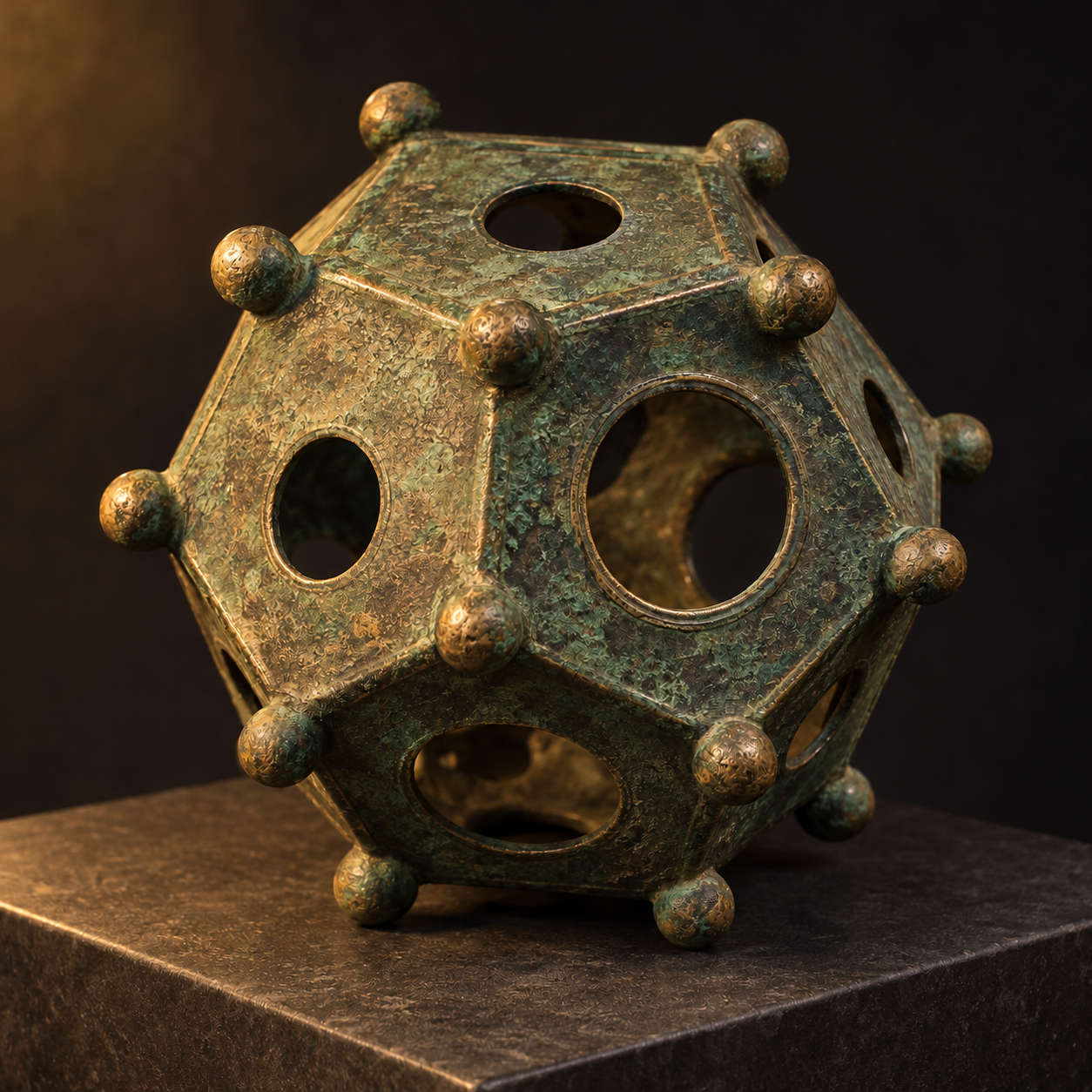
The object seems almost too deliberate to remain unexplained. Twelve pentagonal faces enclose a hollow space. Circular openings pierce the faces, and small knobs project from the corners. You can picture someone holding it, turning it, and knowing exactly what to do next. The missing part is that person’s knowledge.

Illustration of a patinated bronze Roman dodecahedron with round openings and corner knobs.
An interpretation of the Roman dodecahedron's distinctive form.

Roman dodecahedra are real copper-alloy artifacts, not a modern puzzle invented to frustrate archaeologists. Their recognizable form has outlived a securely established account of their use. That makes them a useful invitation to investigate: what can a measurement, a findspot, or a successful replica actually tell us?

One complete example comes with an excavation story

The Lincoln Museum account published in April 2024 describes a complete example found at Norton Disney in summer 2023. It places the object in the third or fourth century, gives its approximate height as eight centimetres, and records a mass of 245 grams.

The find emerged from a recorded excavation, not just an attractive object appearing without surroundings. The University of Nottingham Museum’s later exhibition account identifies the local archaeological group’s partnership with Allen Archaeology and places the site near a Roman villa and the Fosse Way. That exhibition ended in January 2026; its page remains a record of the investigation.

Location does not supply an automatic function. An object found near a road is not necessarily a road-measuring device, just as one found near a house is not necessarily a household tool. The setting gives researchers relationships to investigate, which become more informative when the deposits and associated material are carefully recorded.

Compare two actual records before choosing a theory

A second useful example is the British Museum’s Fishguard dodecahedron, registration 1924,0411.1. Its record gives an overall diameter of 127.71 millimetres and a mass of 553.20 grams. It also lists a range of aperture diameters, rather than treating every opening as identical.

Two objects, with the measurement labels retained
RecordReported sizeMass
Norton DisneyAbout 8 cm tall245 g
Fishguard, British Museum127.71 mm diameter553.20 g

Pause over the labels. Height and diameter are not automatically equivalent ways of measuring a knobbed object. The mass difference is clear, but a precise comparison of scale would require knowing how the dimensions were taken. Preserving the original labels makes the table more useful than silently placing both numbers in a column called “size.”

Now consider a proposed use. Does it depend on an object having one fixed weight, an easily held size, a particular arrangement of holes, or a consistent relationship between openings? Variation does not necessarily refute the idea. It does require the explanation to work with more than one convenient specimen.

A replica answers the question you build into it

Suppose someone makes a replica and uses it successfully for a craft task. You have learned that this replica can perform that task under those conditions. That can be a valuable experiment. It has not yet established that ancient makers designed the artifact for that purpose.

Look for the decisions the demonstration has added. Which dimensions were copied? Were worn or missing features reconstructed? What modern materials, tools, or motions were introduced? Does the proposed technique explain the inconvenient faces and knobs as well as the features the demonstrator uses?

An especially useful experiment makes a prediction before it begins. If a proposed use should create repeated contact at a particular edge, the next step is to inspect appropriate original surfaces for a matching pattern. If an interpretation depends on calibrated openings, compare their measurements across several objects. The proposal becomes more informative when it tells us what new evidence to seek.

“Ritual” also needs an argument

The Norton Disney account reports the excavators’ suggestion that the object may have been deliberately placed in a former pit. Religious or ritual significance has been considered. That is an interpretation of a deposit, not a surviving account of a ceremony.

Deliberate placement and practical use are also not simple opposites. An object can have a working life before being deposited for another reason. To understand its last setting, researchers need the relationships among the object, the pit, other finds, and the sequence in which material entered the ground.

For the same reason, calling something ritual should not mean that investigation stops. Repeated associations, distinctive placement, or comparisons with independently understood practices might strengthen a proposal. An elaborate imagined ceremony does not become evidence just because it explains the object’s strangeness.

Build a better museum label

Try writing a three-sentence label using the two records linked above. Give each sentence a different job.

  1. Describe: identify a feature someone can examine or a measurement supplied by the record.
  2. Locate: identify the particular object and what its record says about discovery or collection.
  3. Interpret: state one question or proposed explanation, making its status clear.

Then read your label again. Did “perhaps” quietly disappear from a theory? Did a photograph become evidence of a function you could not actually see? Did information about Norton Disney migrate into your description of Fishguard? Those small slips are how a neat story can become more certain than its source.

What would make the label more informative?

A good label lets a visitor distinguish an observed feature, a recorded fact, and an interpretation. It can be engaging without supplying a final function. A useful unanswered question also points toward evidence that could change the answer.

The care is visible even when the job is missing

The dodecahedron’s form encourages us to solve it quickly. Yet there is another pleasure in looking: someone made these repeated faces, varied openings, and projecting corners into one object. Its physical complexity survives even where its social meaning has become difficult to recover.

The mystery becomes richer when each new find adds a context and each measurement constrains an idea. A convincing answer will need to account for the surviving objects and their histories together. Until then, asking a sharper question is real progress.

Investigate two different kinds of ancient technology

Compare an object whose surviving parts constrain a working reconstruction in The Antikythera Mechanism: A Sky Made of Gears. Then test the distance between a demonstration and historical use in The Baghdad Battery: When a Name Gets Ahead of the Evidence.

Explore more art, ideas, and independent projects at Incoprea.

Famous Last Meals is now in paperback — stories, history and 25 recipes

Famous Last Meals: Stories, History, and Recipes is now available in paperback on Amazon. The illustrated collection brings together 23 his...
