Some artifacts acquire a nickname so vivid that it begins to sound like a conclusion. The Baghdad Battery is one of them. A small ceramic vessel associated with copper and iron has inspired claims about ancient electrical technology. The interesting question is not simply whether a similar arrangement can generate voltage. It is whether the ancient object was made and used for that purpose.
A pot, two metals and a persuasive resemblance
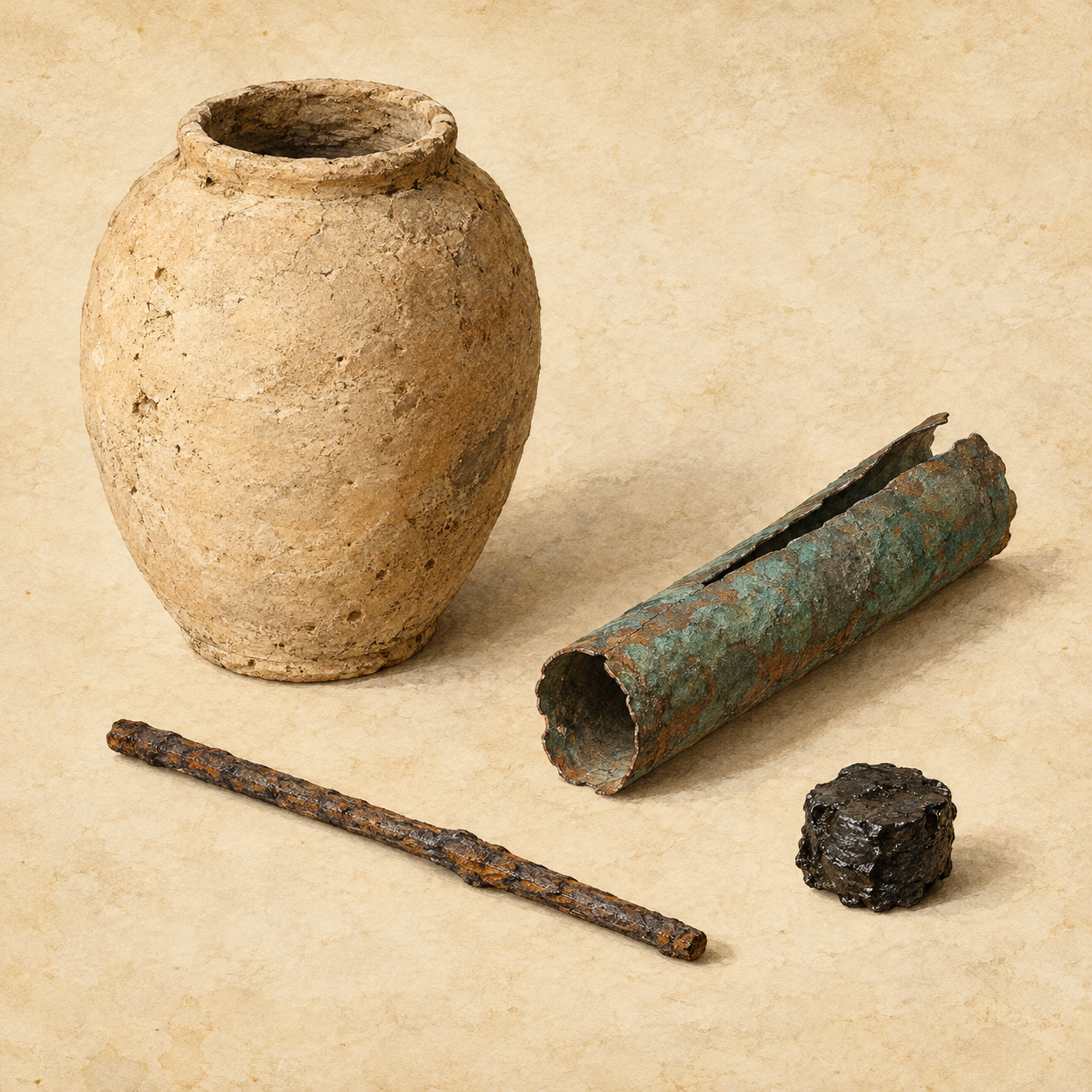
The object became famous after Wilhelm König described it in the 1930s. Published discussions describe a ceramic jar, a rolled copper cylinder, an iron rod and a bitumen or asphalt seal. That combination can remind a modern observer of a simple electrochemical cell.
Put different suitable metals into an electrolyte and chemical reactions can produce a potential difference. Experimental replicas have demonstrated versions of that principle. The physics is real. But a replica needs choices: what liquid to add, how to connect it, which dimensions and materials to use, and what result to measure.
Those choices can introduce information that has not been established for the archaeological object. A successful experiment therefore answers a narrow question about the replica. It does not, by itself, recover an ancient craftsperson's intention.
The missing context matters
Electrical interpretations have included electroplating and a proposed medical use. Paul Keyser's 1993 paper explored the latter possibility, while explicitly presenting it as a hypothesis that would require confirming evidence. That qualification matters as much as the memorable suggestion.
A historical interpretation also needs support from context. Were there connections, associated equipment, a workshop, a text or a product that independently points to electrical use? An explanation should account for the complete assemblage, not only the parts that look familiar to modern eyes.
In a 2012 interview, archaeologist Elizabeth Stone expressed strong skepticism about the battery interpretation. Other discussions compare related sealed metal-containing vessels with containers for organic material or texts. Those comparisons are worth investigating, but they should not become a new certainty merely because they sound more ordinary.
Possibility is a starting point
The fairest description is a disputed interpretation of an ancient object whose function has not been securely demonstrated. The word battery belongs in that discussion as a claim to examine, not a label that settles it.
This distinction travels well beyond archaeology. A shape can suggest a use. A laboratory demonstration can show that a use is feasible. Evidence from the original setting is needed to establish that people actually used it that way. Each step adds something different.
The jar remains fascinating without powering an imaginary ancient city. It reveals how quickly a compelling modern analogy can become a story about the past. Looking carefully at the gap between the object and the story gives us a better mystery, and a better way to investigate it.
Sources and further reading: D. E. Von Handorf: The Baghdad Battery—Myth or Reality?; Paul Keyser's 1993 hypothesis; Interview with archaeologist Elizabeth Stone.
Continue exploring unusual ideas at Incoprea.