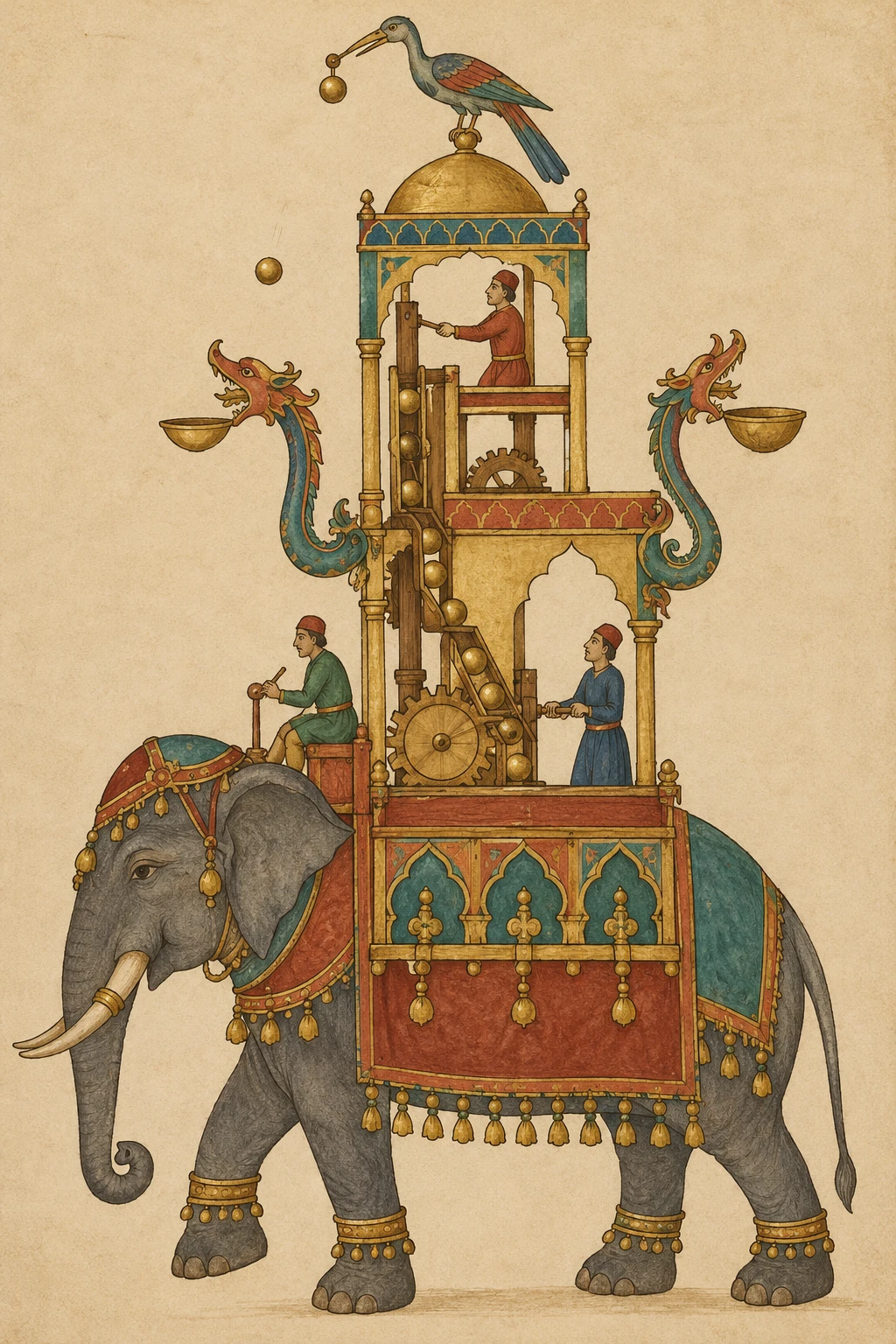
The half hour arrives as a small performance. A bird whistles. A ball enters a dragon’s mouth. A driver makes a gesture above an elephant. Time is not merely indicated; it is turned into an event that an audience can notice and remember.
Al-Jazari’s elephant clock is famous enough to appear in many simplified histories of invention. The most interesting way into it is to ask what survives, what is reconstructed, and how a measuring device becomes a public spectacle.
A drawing is an object with its own date
The Metropolitan Museum’s Elephant Clock folio comes from a copy of al-Jazari’s book dated 1315. The author lived in the twelfth and early thirteenth centuries; the surviving illustrated page is later. The museum identifies Farrukh ibn ‘Abd al-Latif as its calligrapher and describes the material as ink, opaque watercolor, and gold on paper.
That separation matters. A photographed manuscript page is not a photograph of a surviving medieval machine. It is evidence for a text and image transmitted through copying. Its beauty and technical content can be studied together, but its date should not be silently substituted for the date of the device’s conception.
A Met publication on Islamic painting places al-Jazari’s illustrated mechanical work in the courtly setting of the Artuqids at Diyarbakir and dates the treatise to 1206. It also points to the visual ways the clock presented time. The mechanism belonged to a larger culture of technical description and illustrated books, not to a solitary unexplained flash of genius.
Watch for the difference between timing and announcing
Every clock has to connect some changing process with a readable result. In this case, the familiar outward result is theatrical. The Met’s object account describes the bird, the ball, the dragon, and the driver acting every half hour. The Museum With No Frontiers record similarly treats the automaton as a way of making the passage of time entertaining.
Those visible actions should not be confused with the whole timing system. A performance needs something to trigger it, transmit motion, and prepare the next cycle. To understand a reconstruction, ask where those functions are located and which parts the maker has left visible for explanation.
A modern visitor may be drawn to the elephant as sculpture and miss the practical coordination: a result has to happen at an interval, several components have to act in sequence, and the device needs to be ready for another interval. The repeated cycle is an achievement different from producing one dramatic motion once.
Follow the water back to the spectacle
The 1001 Inventions animation shows a perforated bowl inside a concealed water tank. As water enters, the bowl sinks and pulls ropes. At the interval, a released ball begins a sequence through the upper figures. The dragon tips under its weight and helps raise the bowl again; further movement prepares another cycle.
This modern explanation makes an elegant relationship visible: the performance also contributes to resetting the timer. The ball is not merely a decorative surprise at the end of the measurement. Its movement performs work in the returning sequence.
Watch once while following only the bowl, then again while following only the ball. On a third viewing, look for the point where their two journeys connect. Breaking the animation into these paths makes the coordination easier to grasp than trying to follow every moving figure at once. It also gives the source’s reconstruction a specific, testable explanation to compare with the manuscript.
Replicas are arguments you can watch
The Museum of Science and Technology in Islam at KAUST explicitly identifies its Elephant Water Clock and Castle Clock as working replicas. That label is valuable. A replica can test an interpretation and reveal moving relationships that are difficult to grasp on a flat page. It does not become an original artifact because it works impressively.
A modern maker must make decisions about dimensions, materials, tolerances, and ambiguous details. Some may be well specified in the source; others may require inference. A good exhibit helps visitors understand those choices rather than hiding them behind the word “authentic.”
Working does not prove every historical claim. It can show that an arrangement is mechanically possible under the model’s conditions. Establishing that an earlier machine had exactly that arrangement is a different question, requiring the historical sources.
Make a sequence map while viewing
Use the Met’s digitized folio or a museum’s documented reconstruction film. On paper, write four headings: interval, signal, action, reset. Under each, record only what the source actually shows or explains.
| Function | Question to ask |
|---|---|
| Interval | What process determines when the event happens? |
| Signal | What makes the passage of time perceptible? |
| Action | Which visible parts move, and in what order? |
| Reset | How does the device become ready to do it again? |