Showing posts with label Evidence. Show all posts

Saturday, October 24, 2026

Two Flight Records Can Tell Different Parts of the Same Event

A numerical trace shows a change. A sound recording contains a warning and a conversation. Put them side by side and a sequence begins to emerge—but only if you know what each record actually measures and how their clocks relate.

Flight recorders are often introduced through the nickname “black box.” The more useful distinction is between two kinds of preserved evidence: sounds in the cockpit and recorded flight parameters. They can illuminate the same event without being interchangeable witnesses.
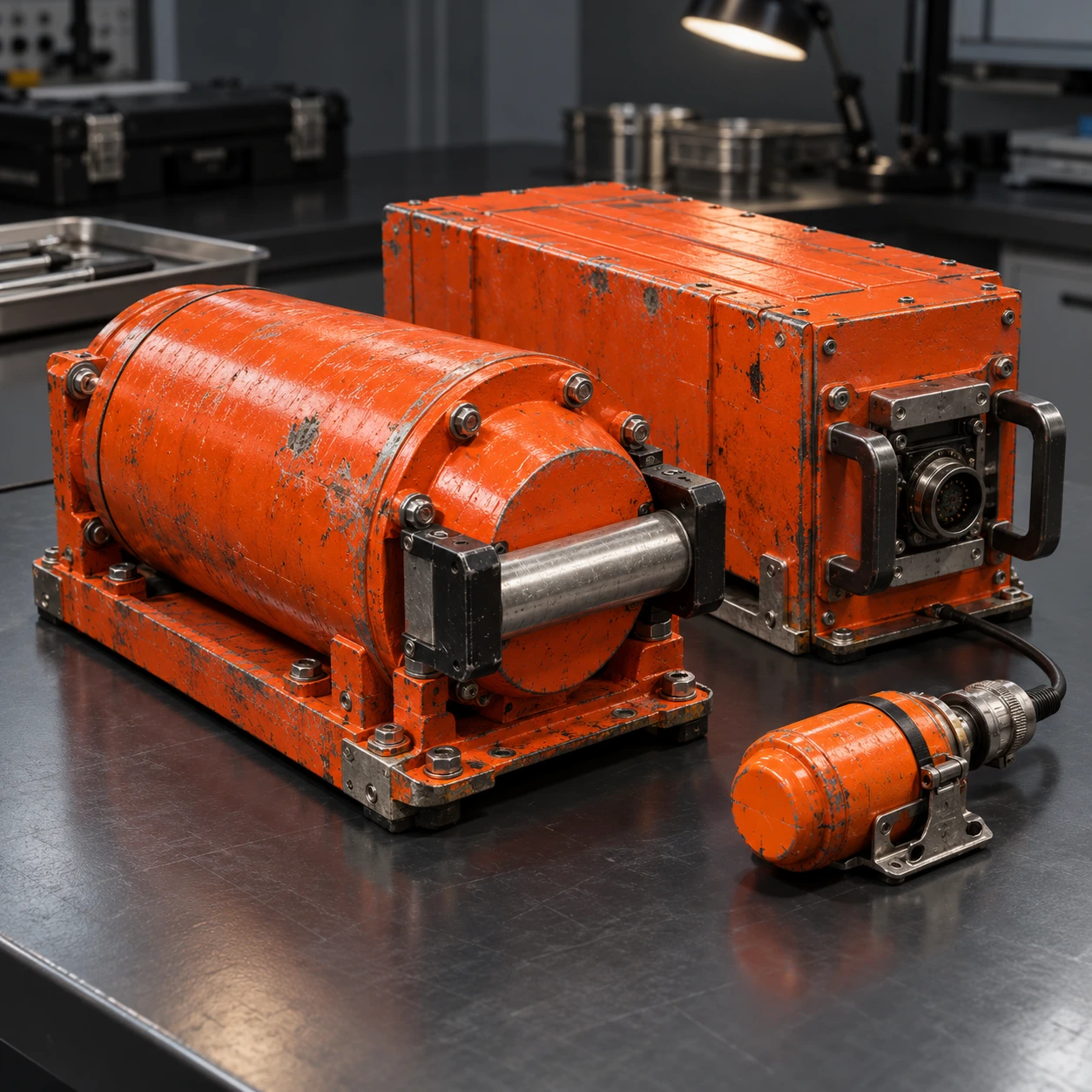
Two unbranded orange recorder housings sit beside a small locator beacon on a laboratory bench.
The important distinction is the evidence recorded. These generic interpretations do not identify a particular certified model.

Different channels answer different questions

The NTSB’s recorder explanation distinguishes cockpit voice recorders, which preserve cockpit audio and radio communications, from flight data recorders, which capture parameters such as airspeed, altitude and heading. Investigators use these alongside other evidence to reconstruct events.

A parameter is a recorded variable, not a complete movie of everything aboard. An audio channel is also selective. A sound may be clear, masked, absent or hard to identify. The label on a channel does not remove the work of interpreting its contents.

This gives a good habit for reading an investigation: separate an observation from its explanation. “This value changed” and “this change happened because of that action” are different claims. Establishing a sequence can support a causal analysis, but sequence alone does not finish one.

A clock problem you can solve on paper

Try a fictional workshop exercise, unrelated to a real flight. A sound recording timestamps a shared test chime at 12:00:05. A separate equipment log records that same known chime event at 12:00:02. Assume both clocks run steadily over this short exercise. The sound recorder is three seconds ahead.

The equipment log then records a switch changing at 12:00:04. On the sound recorder’s clock, that corresponds to 12:00:07. A spoken instruction at 12:00:06 therefore precedes the logged switch change by one second. Comparing the printed timestamps without correcting the offset would reverse the apparent order.

What assumptions made that answer possible?

We stipulated that the two chimes were the same event, that the clocks had a constant offset and that the recorded entries accurately represented the stated events. Remove any assumption and the conclusion needs reconsideration. A similar-looking sound at a different time would not automatically be a valid synchronization marker.

Write the offset as an explicit rule: equipment-log time plus three seconds equals sound-recording time. Apply the same rule to every compared entry. This little exercise demonstrates evidence alignment; it is not a description of the timing methods used in every aircraft investigation.

Protecting the memory is its own engineering task

The Australian Transport Safety Bureau’s recorder fact sheet describes crash-protected recording systems and their development. The protected memory and the equipment that records into it have to be considered together. Ordinary operation and the conditions following an accident are very different environments.
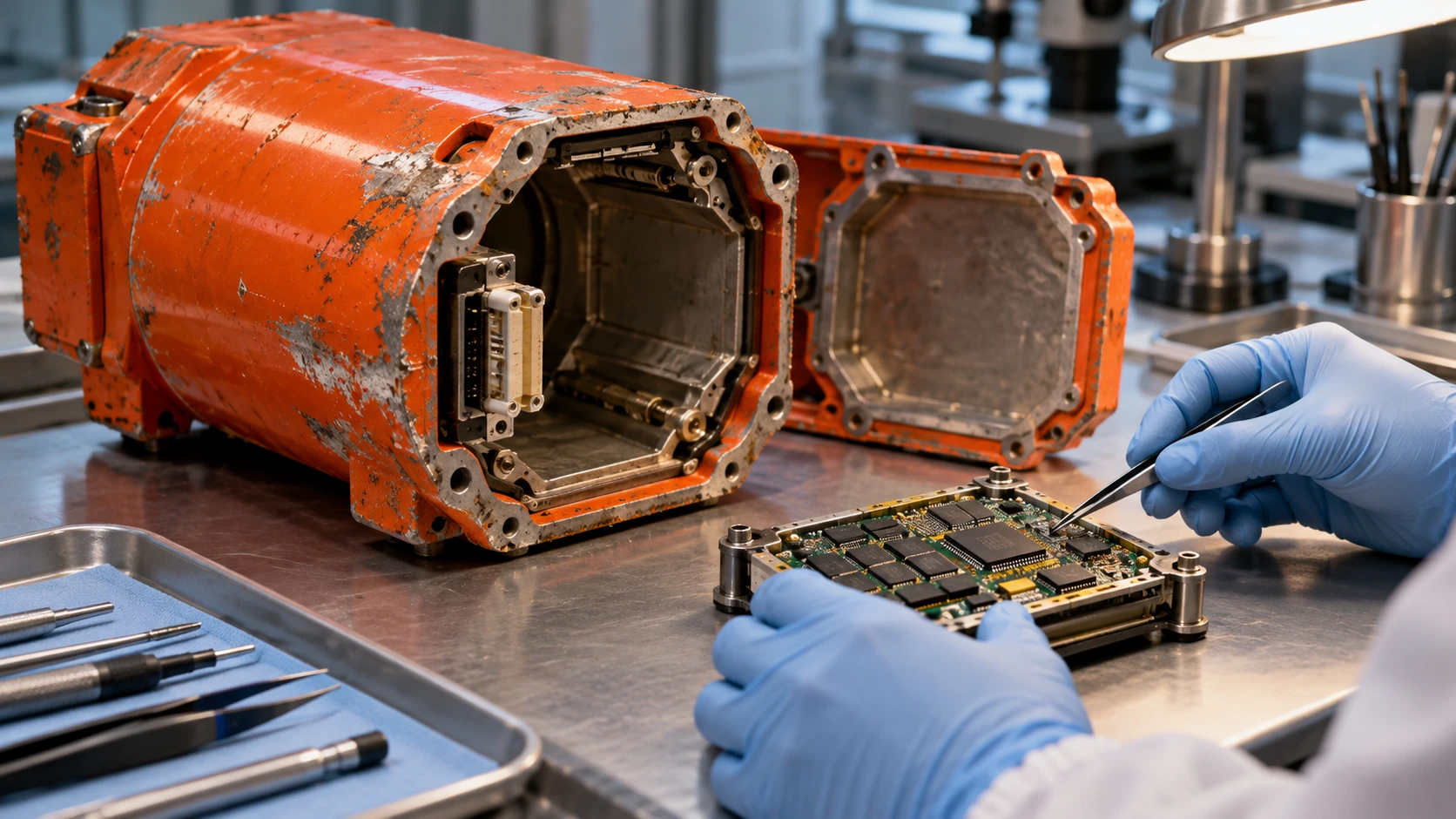
Gloved hands inspect a circuit board beside an open orange protective housing.
Finding the housing and recovering usable information are different stages. This is an interpretive laboratory scene, not a real investigation photograph.

The orange housings in these interpretations evoke the visibility of actual recorders, but the illustrations are not certified device schematics. A rugged shell suggests only one part of the problem. Connectors, memory, data formats, recording continuity and recovery procedures all affect whether usable evidence can be extracted.

ATSB also discusses units combining recording functions. “Two kinds of record” does not require every installation to contain two separate boxes of identical shape. Keeping the evidence distinction separate from packaging avoids learning the photograph instead of the function.

Recovery is not the last step

An NTSB laboratory update from 2019 shows a recorder engineer inspecting memory boards for damage and water intrusion. It is a small but revealing view of the work between finding equipment and obtaining an interpretable record.

Data recovery, decoding, synchronization and analysis are separate accomplishments. A successful readout does not mean every channel is complete or that the investigation’s conclusion is already known. Equally, visible damage to a housing does not by itself tell an observer whether the protected information can be recovered.

For a final reader exercise, make a two-column notebook while reading an official report. On the left, list recorded observations with their stated timing or uncertainty. On the right, list the investigators’ interpretations and the additional evidence connecting them. Mark any place where your own assumption has filled a gap.

The point of a recorder is not to provide an all-seeing narrator. It is to preserve particular observations well enough that careful people can bring them into relation with other observations. Two partial records, aligned and interpreted honestly, can make a much stronger account than either could alone.

Sources and further exploration: NTSB: cockpit voice and flight data recorders; ATSB: black box flight recorders; NTSB: recorder laboratory update,2019.

Explore all 50 new articles · Browse the complete illustrated collection

Explore more art, ideas, and independent projects at Incoprea.

Wednesday, October 14, 2026

Viking Sunstones: A Beautiful Optical Idea with an Evidence Gap

A transparent crystal that helps a sailor estimate the hidden Sun's position sounds like an object from a saga. The optical idea is real enough to test. Whether Viking navigators actually used such a procedure is a different historical question.

The proposed sunstone is most interesting at that junction. Light, crystals and human judgement can be investigated experimentally. Texts and objects can be examined for evidence of past practice. Bringing the results together is useful precisely because neither discipline can do all the work by itself.

Illustration of a clear calcite crystal doubling a dark line, with a cloudy sea and wooden vessel behind.
A visual interpretation of the optical hypothesis, not evidence of a recovered Viking tool.

The sky carries a pattern

Sunlight scattered by the atmosphere can become polarised: the light has a patterned orientation rather than every direction being represented equally. Under suitable conditions, that pattern relates to the Sun's position. A patch of sky can therefore carry information beyond its apparent brightness.

Certain crystals interact with polarisation in ways an observer can use. Transparent calcite, often called Iceland spar, is a prominent candidate in the sunstone hypothesis. Its double refraction also makes an image viewed through it appear doubled, a striking effect that is easier to recognise than the full navigation proposal.

Double refraction and a useful sky observation are connected through the crystal's optical properties, but they are not the same demonstration. Seeing a doubled word proves that a crystal changes the path of light. It does not establish that someone has located the Sun accurately.

From optical effect to navigational estimate

A proposed method has several stages. The observer must make a judgement about the light, relate that judgement to solar position and use that estimate within a navigation system. Each stage can introduce error. The interesting question is not simply whether a crystal has an effect, but how reliably a whole procedure performs.

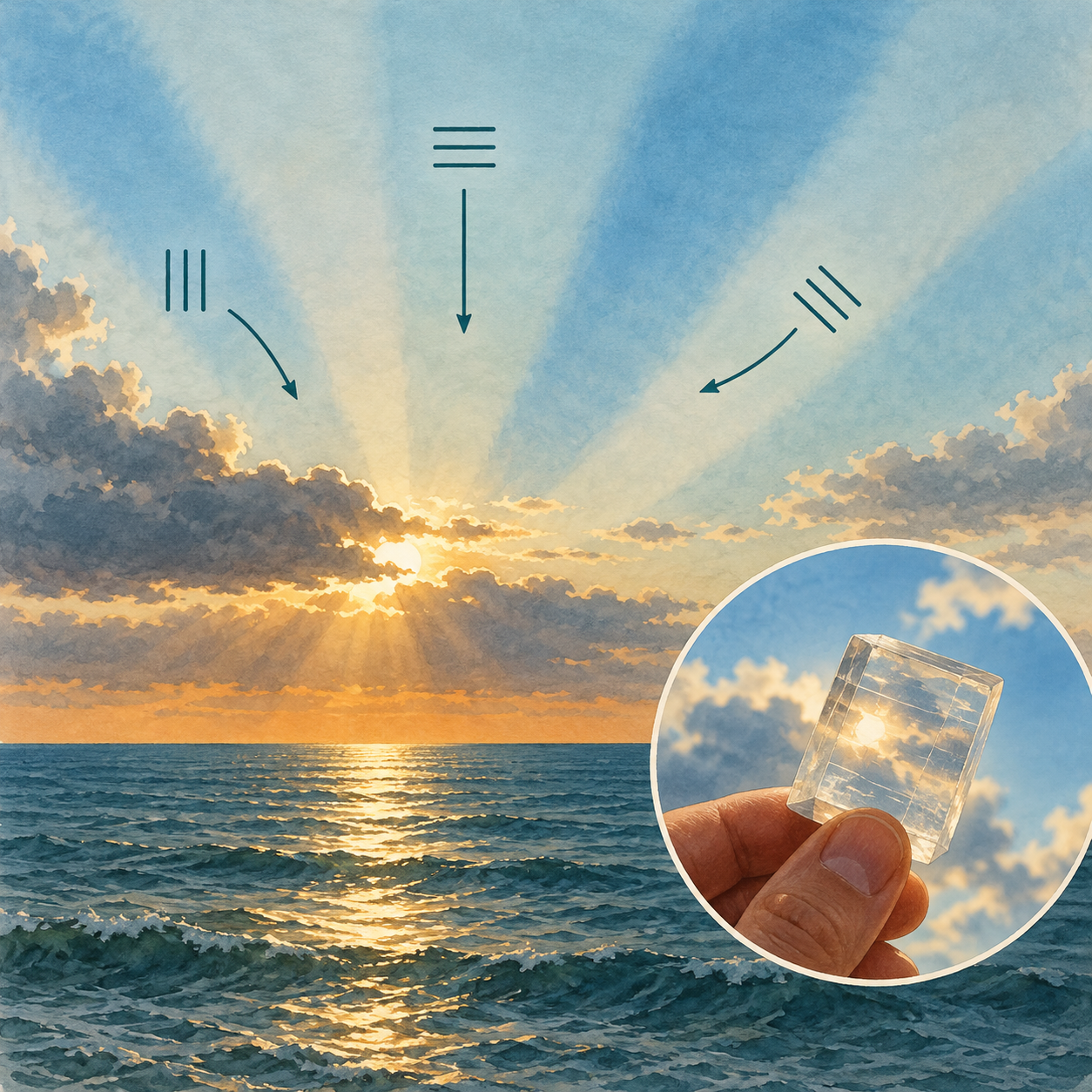
Conceptual illustration of polarized skylight and a transparent crystal.
Sky polarization is a physical effect. The symbols are conceptual and do not establish how Viking navigators worked.

The schematic sky illustration separates the general idea from a historical equipment claim. It does not show a verified Viking instrument or an observation with measured accuracy. For the experiments, turn to the published research and its stated conditions.

A 2017 study explicitly called the system hypothetical and examined accuracy under different solar elevations and sky conditions. Its authors discussed limitations when moving from experimental settings to an actual voyage. A rolling vessel, cold hands and variable visibility make a different observing platform from a controlled demonstration.

What a 2026 classroom study adds

An American Journal of Physics paper published in 2026 uses the speculative history as a context for undergraduate experiments. It combines a simplified sun compass with polarimetric sky observations. The historical uncertainty is stated in the title and abstract rather than hidden behind the activity.

Its student results found the polarisation approach most useful under partly cloudy conditions; a fully obscured sky made the signal difficult or impossible to observe in the activity. That is a useful correction to the romantic image of a crystal defeating any weather.

The result is about a particular exercise with particular observations. It should not be expanded into a claim that every proposed method has been tested under every Arctic condition. Equally, a successful exercise can teach real optics without proving a medieval practice.

A small evidence challenge

Imagine three new discoveries. First, an experiment shows that a crystal gives accurate estimates on a partly cloudy afternoon. Second, a medieval passage mentions a sunstone. Third, a crystal is found in an archaeological setting connected to seafaring. Which historical claim does each support?

The experiment supports feasibility under its tested conditions. The passage supports investigation of a term in its textual context. The find supports investigation of an object in its archaeological context. To argue for routine Viking navigation, the connections among those kinds of evidence must also be demonstrated.

Why does “could have” matter?

It marks a possibility established or explored by evidence. “Did” makes a claim about an event or practice. Replacing one with the other requires further support, not merely a more impressive modern demonstration.

Try the exercise with another technology you know. A method can be physically workable, historically available and still not have been the one used on a particular occasion. The distinction prevents experimental archaeology from being asked to prove more than its design can test.

Look at the experiment's conditions

Begin with the Royal Society introduction, then open the 2026 teaching study. Locate its account of sky conditions and compare the purpose of its classroom activity with the historical claim in the popular introduction.

For a deeper route, the 2017 paper and a later sensitivity study investigate how assumptions affect a modelled journey. Notice what is treated as an input: the frequency of observations, the date, conditions and decisions about sailing. A model's answer is conditional on its setup.

You do not need to carry out an outdoor Sun-finding exercise to appreciate the result. Comparing a figure's conditions and the authors' claims is already an active way to read the science. It also avoids mistaking a conceptual picture for an observing instruction.

The open history is part of the appeal

The sunstone does not have to become a solved Viking secret to remain compelling. It reveals a subtle structure in daylight and a clever interaction between a material and an observer. It also demonstrates how a good question can survive while its answer remains incomplete.

Keep the historical and optical questions beside one another. A crystal can do something remarkable with light. Establishing who used it, where and for what purpose asks for another kind of evidence. That combination makes the subject richer than either a dismissal or an announcement that a saga has finally been proved.

Sources and further reading

Explore more art, stories and discoveries at Incoprea.

The Baghdad Battery: When a Name Gets Ahead of the Evidence

Imagine a demonstration in which a replica jar makes a voltmeter register a signal. The audience has seen something real happen. Then the explanation makes a much larger leap: people in antiquity must have built the original object to produce electricity. The interesting investigation begins in the space between those two statements.

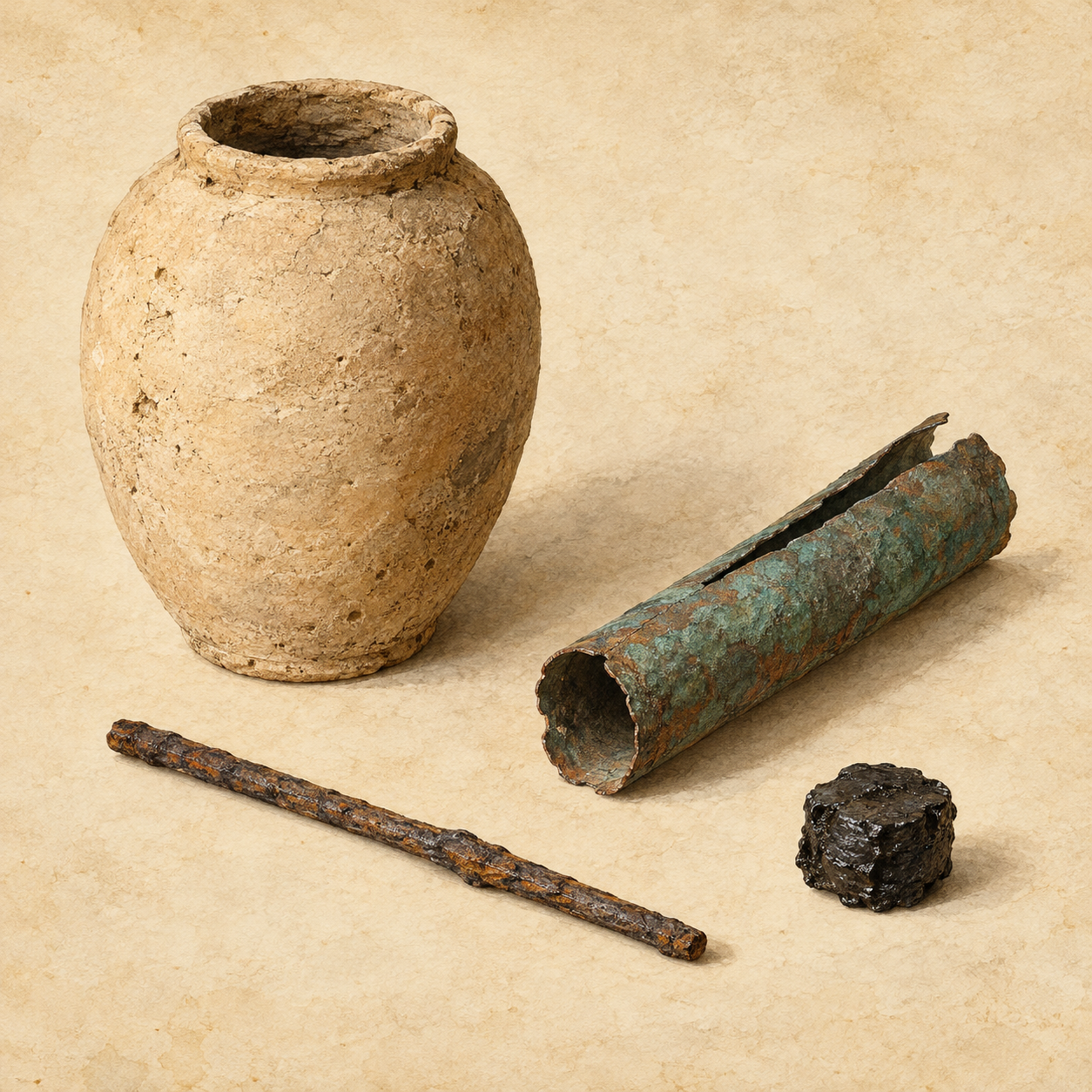
Illustration of a pottery jar and separate copper tube, iron rod and dark plug laid out for study.
A study inspired by the reported components, with no electrical use assumed.

The artifact commonly called the Baghdad Battery is a ceramic vessel associated with copper, iron, and a dark sealing material. Its nickname has become so familiar that it can sound like a settled identification. A more useful approach is to examine what was reported, what a reconstruction adds, and which historical purpose the evidence can support.

Start with the components, not their modern names

D. E. Von Handorf’s 2002 technical discussion revisits the vessel reports associated with Wilhelm König and the debate that followed. Published descriptions include a pottery container, a copper cylinder, an iron element, and asphalt-like material. Their arrangement suggested an electrochemical interpretation to modern observers.

Try describing those parts without using the words battery, electrode, or electrolyte. You still have a physical assemblage. Now restore the electrical vocabulary and notice how quickly each component acquires a role. That change in language is useful when explaining a hypothesis, but it should not silently convert the hypothesis into an observed ancient function.

Descriptions of several related vessels also need to remain separate. A component present in one reported example cannot automatically fill a gap in another. A reconstruction assembled from the most convenient details across several finds may test an ingenious design without representing any one documented original.

What would make the arrangement a cell?

The US Department of Energy’s explanation of batteries distinguishes electrodes, an electrolyte, and an external circuit. Chemical processes and movement of charge have to work together. A pot containing metals is not enough to specify all those conditions.

For a historical reconstruction, the liquid matters, as do the metal surfaces, their separation, and the connections used to draw current. If a demonstrator chooses those details, the choices belong in the experiment’s record. They may be reasonable, but they still need historical support before becoming a description of ancient use.

It also matters what the demonstration measures. A voltage reading is not a complete description of useful electrical performance. A proposed task may require current for a certain time under a particular load. Ask whether the result being displayed answers the same question as the historical claim being made.

Electrical proposals are not all the same proposal

Paul T. Keyser’s 1993 paper is instructive because it argues against electroplating while proposing a different electrical use: local pain relief. He discusses ancient use of electric fish and the cultural setting in which an electrical sensation might have been understood.

Those are arguments within a particular interpretation, not evidence that every proposed electrical function stands or falls together. One can reject electroplating and still propose another use. Equally, finding a weakness in one alternative does not establish the electrical interpretation by elimination.

At the beginning of his medical-purpose discussion, Keyser explicitly says the proposal must remain hypothetical until further confirming evidence appears. His conclusion nevertheless argues that such a purpose was possible and even likely. Reading both parts gives a more accurate account than either presenting his title as proof or dismissing the paper without considering its argument.

Ask what a proposed use should leave behind

A historical explanation becomes stronger when it predicts evidence beyond a working replica. An electroplating interpretation might prompt examination of relevant finished surfaces, workshop materials, and connections. A medical interpretation needs its own contextual support. A container interpretation likewise needs comparisons that explain the whole assemblage, not merely its resemblance to an ordinary jar.

Absence has to be handled carefully. A missing perishable connection does not prove a device never worked, but inventing that connection does not prove it did. The question is how many unsupported additions an explanation requires and whether independent evidence begins to support them.

This is a useful discipline because the most vivid part of an explanation can arrive last. We begin with modest materials, supply a plausible liquid and connections, obtain a modern result, then imagine a workshop or treatment. Each step may feel small. Together they can produce a historical scene whose crucial parts never came from the find.

Separate three claims in a demonstration

What has actually been established?
ClaimEvidence needed
This reconstruction produces an electrical effect.A documented experiment, with materials, connections, measurements, and conditions.
An ancient example could have operated similarly.A close match between the reconstruction’s necessary features and the surviving object or reliable record.
People made the object for that purpose.Historical or archaeological support for intention and use, beyond the modern experiment.

Choose a demonstration or written explanation and place its strongest evidence in one row. Then look at its conclusion. Has the argument moved to another row without supplying another kind of support? This simple check works even when you cannot assess every detail of the chemistry.

Does a successful first row make the last row likely?

It makes the proposed function physically more plausible under the tested conditions. It does not tell us how ancient people used the object. Many objects can perform tasks for which they were never designed; the intended task needs a historical argument of its own.

Read skepticism as carefully as enthusiasm

In a 2012 interview, archaeologist Elizabeth Stone expressed strong skepticism about the battery interpretation. She also made clear that she was recalling the object during a live conversation. Her response is evidence of her assessment in that interview, not a substitute for a published examination of every reported component.

That distinction protects the investigation on both sides. A confident demonstration is not enough to establish ancient use, and a confident dismissal does not by itself identify the original function. Detailed records, material analysis, carefully framed experiments, and comparisons each contribute something different.

The jar remains worth looking at because it exposes how a modern analogy can organize what we see. Once the label has supplied a complete machine in our imagination, it is surprisingly difficult to return to the actual components. Making that return gives us a better question: which parts of the story came from the object, and which came from us?

Keep investigating

Apply another test of proposed functions in The Roman Dodecahedron: Twelve Faces, No Agreed Answer. Then compare scientific explanation of a surviving material in The Lycurgus Cup: Roman Glass with Two Personalities.

Explore more art, ideas, and independent projects at Incoprea.

Famous Last Meals is now in paperback — stories, history and 25 recipes

Famous Last Meals: Stories, History, and Recipes is now available in paperback on Amazon. The illustrated collection brings together 23 his...