A transparent crystal that helps a sailor estimate the hidden Sun's position sounds like an object from a saga. The optical idea is real enough to test. Whether Viking navigators actually used such a procedure is a different historical question.
The proposed sunstone is most interesting at that junction. Light, crystals and human judgement can be investigated experimentally. Texts and objects can be examined for evidence of past practice. Bringing the results together is useful precisely because neither discipline can do all the work by itself.
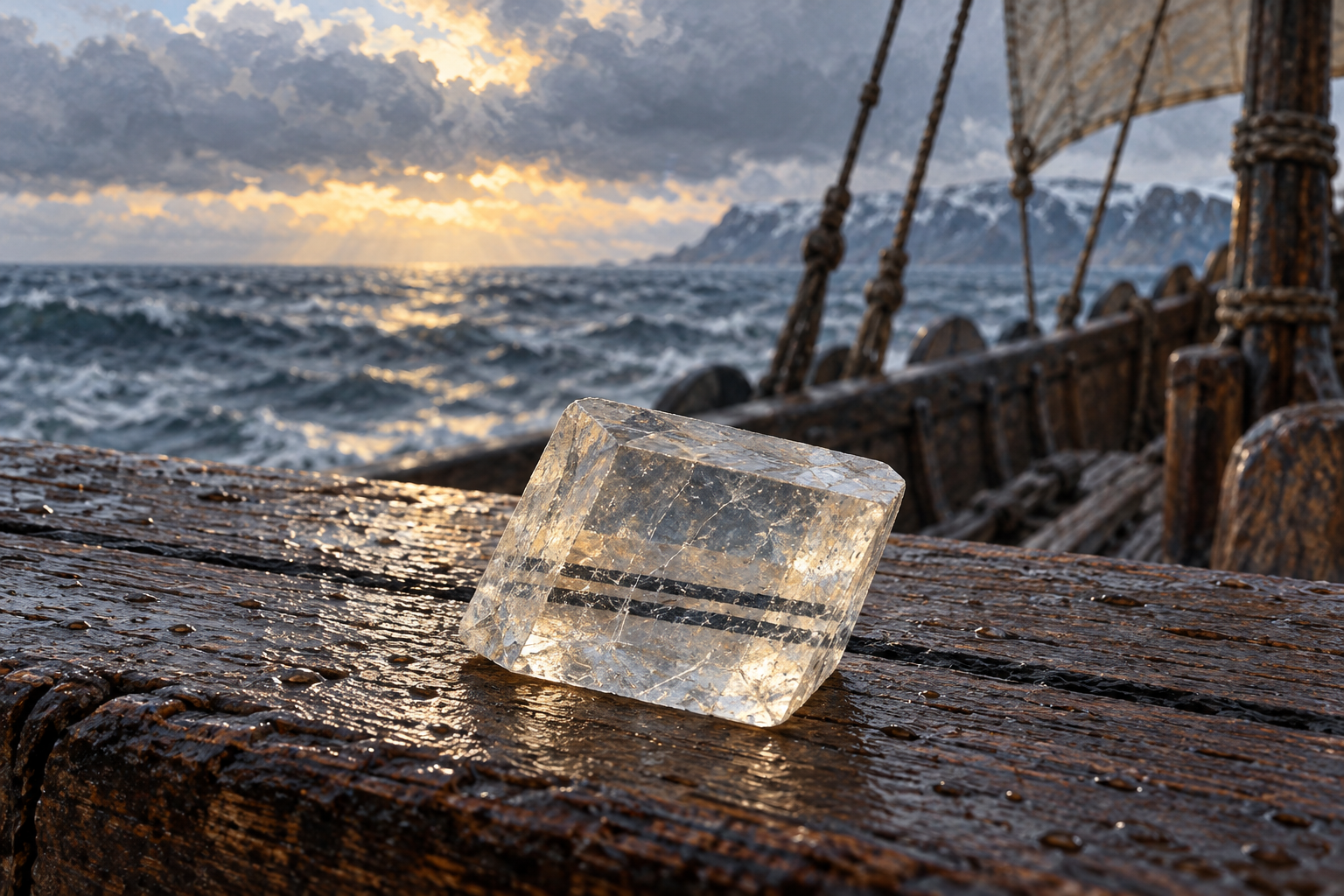
The sky carries a pattern
Sunlight scattered by the atmosphere can become polarised: the light has a patterned orientation rather than every direction being represented equally. Under suitable conditions, that pattern relates to the Sun's position. A patch of sky can therefore carry information beyond its apparent brightness.
Certain crystals interact with polarisation in ways an observer can use. Transparent calcite, often called Iceland spar, is a prominent candidate in the sunstone hypothesis. Its double refraction also makes an image viewed through it appear doubled, a striking effect that is easier to recognise than the full navigation proposal.
Double refraction and a useful sky observation are connected through the crystal's optical properties, but they are not the same demonstration. Seeing a doubled word proves that a crystal changes the path of light. It does not establish that someone has located the Sun accurately.
From optical effect to navigational estimate
A proposed method has several stages. The observer must make a judgement about the light, relate that judgement to solar position and use that estimate within a navigation system. Each stage can introduce error. The interesting question is not simply whether a crystal has an effect, but how reliably a whole procedure performs.
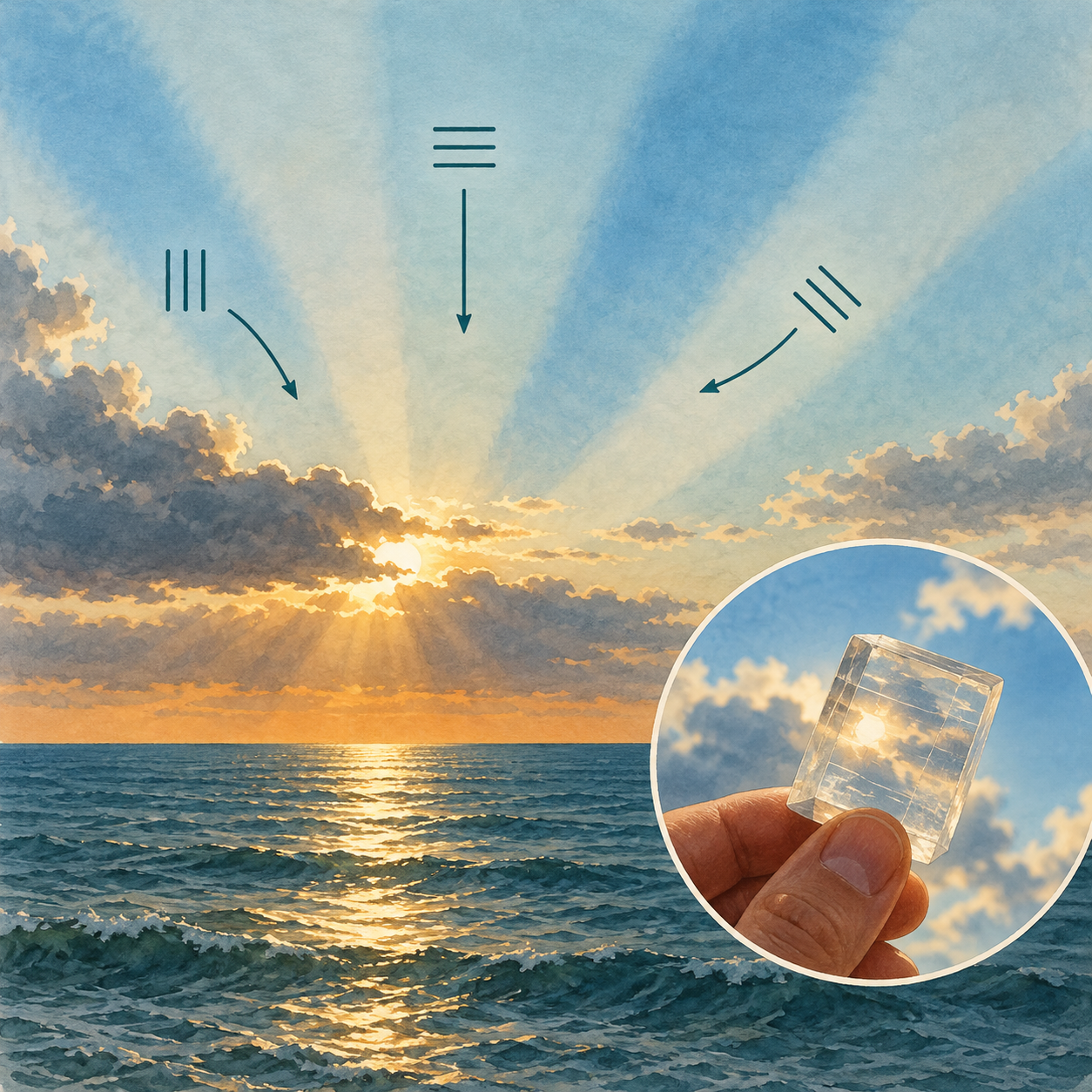
The schematic sky illustration separates the general idea from a historical equipment claim. It does not show a verified Viking instrument or an observation with measured accuracy. For the experiments, turn to the published research and its stated conditions.
A 2017 study explicitly called the system hypothetical and examined accuracy under different solar elevations and sky conditions. Its authors discussed limitations when moving from experimental settings to an actual voyage. A rolling vessel, cold hands and variable visibility make a different observing platform from a controlled demonstration.
What a 2026 classroom study adds
An American Journal of Physics paper published in 2026 uses the speculative history as a context for undergraduate experiments. It combines a simplified sun compass with polarimetric sky observations. The historical uncertainty is stated in the title and abstract rather than hidden behind the activity.
Its student results found the polarisation approach most useful under partly cloudy conditions; a fully obscured sky made the signal difficult or impossible to observe in the activity. That is a useful correction to the romantic image of a crystal defeating any weather.
The result is about a particular exercise with particular observations. It should not be expanded into a claim that every proposed method has been tested under every Arctic condition. Equally, a successful exercise can teach real optics without proving a medieval practice.
A small evidence challenge
Imagine three new discoveries. First, an experiment shows that a crystal gives accurate estimates on a partly cloudy afternoon. Second, a medieval passage mentions a sunstone. Third, a crystal is found in an archaeological setting connected to seafaring. Which historical claim does each support?
The experiment supports feasibility under its tested conditions. The passage supports investigation of a term in its textual context. The find supports investigation of an object in its archaeological context. To argue for routine Viking navigation, the connections among those kinds of evidence must also be demonstrated.
Why does “could have” matter?
It marks a possibility established or explored by evidence. “Did” makes a claim about an event or practice. Replacing one with the other requires further support, not merely a more impressive modern demonstration.
Try the exercise with another technology you know. A method can be physically workable, historically available and still not have been the one used on a particular occasion. The distinction prevents experimental archaeology from being asked to prove more than its design can test.
Look at the experiment's conditions
Begin with the Royal Society introduction, then open the 2026 teaching study. Locate its account of sky conditions and compare the purpose of its classroom activity with the historical claim in the popular introduction.
For a deeper route, the 2017 paper and a later sensitivity study investigate how assumptions affect a modelled journey. Notice what is treated as an input: the frequency of observations, the date, conditions and decisions about sailing. A model's answer is conditional on its setup.
You do not need to carry out an outdoor Sun-finding exercise to appreciate the result. Comparing a figure's conditions and the authors' claims is already an active way to read the science. It also avoids mistaking a conceptual picture for an observing instruction.
The open history is part of the appeal
The sunstone does not have to become a solved Viking secret to remain compelling. It reveals a subtle structure in daylight and a clever interaction between a material and an observer. It also demonstrates how a good question can survive while its answer remains incomplete.
Keep the historical and optical questions beside one another. A crystal can do something remarkable with light. Establishing who used it, where and for what purpose asks for another kind of evidence. That combination makes the subject richer than either a dismissal or an announcement that a saga has finally been proved.