Showing posts with label Conservation. Show all posts

Saturday, October 24, 2026

A Museum Can Treat an Insect Problem by Changing the Air

A carved wooden object sits inside a transparent enclosure. From outside, little seems to happen. There is no visible spray, no dramatic repair, and no freshly polished surface. The important work is occurring in the atmosphere around it—and in the records showing that atmosphere stayed within its intended conditions.
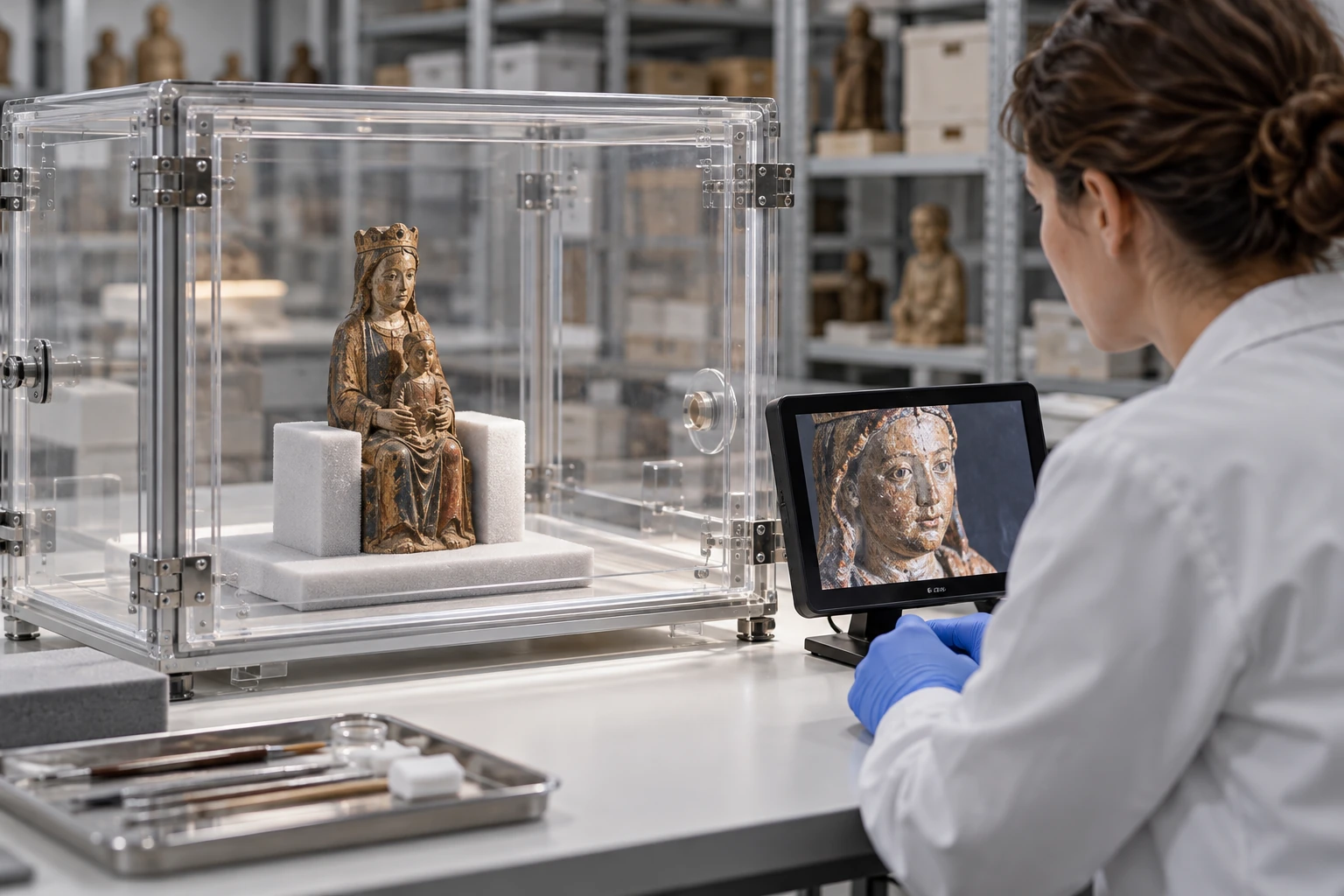
A wooden carving rests inside a clear conservation enclosure while a gloved hand checks a monitor.
In a professional treatment, the environment is controlled and recorded around the object. The scene is interpretive, not an operating guide.

Museum anoxia uses a very low-oxygen environment as one tool against insect infestation. Its appeal is easy to understand: treat the living threat while preserving the object that contains it. Its success depends on much more than putting something in a bag.

Start with the collection, not the enclosure

The Canadian Conservation Institute's pest guidance places treatment within a wider program of prevention, detection, identification, and response. A damaged hole alone does not reveal whether an insect is currently active. Records of fresh debris, traps, location, and the kind of organism help establish what problem exists.

Imagine receiving an old chair with small exit holes. One possible story is active infestation; another is historical damage that has been inactive for decades. The visible object can fit both stories. A careful institution collects additional evidence before choosing a response.

For a visitor's close-looking exercise, inspect only a museum label or published conservation account. Does it distinguish old damage from an identified active pest? Does it describe prevention after treatment? Those details show the reasoning that a before-and-after photograph cannot carry.

The environment has to stay changed

CCI's treatment comparison explains that low-oxygen treatment depends on conditions including temperature, duration, and insect tolerance. Enclosures can be compromised by small leaks or poor seals. Some object colorants also require consideration. The method is therefore a controlled conservation procedure, not a universal safe treatment for every material.

Separate three states: the environment you intend, the environment a sensor reports at one moment, and the environment the object actually experiences over the whole treatment. A single favorable reading cannot establish the third. The record across time is part of the evidence.

This is a professional conservation account, not a household pest-control recipe. Gas handling, low-oxygen environments, object compatibility, and verified efficacy require appropriate expertise and facilities. We can understand the decision process without providing an operating schedule.

An invisible process needs visible records

The Getty Conservation Institute's monograph brings together experiments, treatment experience, enclosure materials, and monitoring methods. Its detailed attention to containment and measurement is the substance of the procedure, rather than administrative decoration around it.

Consider a fictional log containing only two entries: “enclosure closed” and “object removed.” What questions remain? You cannot tell whether oxygen stayed low, whether temperature and humidity were suitable, whether a leak occurred, or what criterion defined completion. Adding a beautiful photograph does not fill those gaps.

Now imagine a log that preserves readings, interruptions, object description, pest identification, and the reason for the selected method. Even without seeing the treatment occur, another professional can assess what was done and what uncertainty remains. Documentation lets the invisible process become reviewable.

The object has an environment after treatment, too

The National Park Service's monitoring guidance emphasizes trap placement, inspection, and records as part of integrated pest management. A successful intervention does not prevent a new pest from arriving later. Building conditions, storage, housekeeping, and incoming objects remain part of the system.

Think of treatment as one bounded event inside a longer collection history. Before it, staff need evidence and a plan. During it, they need controlled conditions and records. After it, they need prevention and monitoring. The enclosure occupies only the middle of that sequence.

Read a conservation story in four questions

What was the evidence of a current problem? Why was this method compatible with the object? How were conditions and completion checked? What changed afterward to reduce recurrence? If a short exhibition label answers only one, treat the others as questions for the fuller project record.

When reading an example treatment record, look for a stated completion criterion before the results. A criterion chosen only after the event can be too easy to satisfy. Recording what would count as success in advance makes the later judgment clearer, especially when the most important conditions were invisible throughout the procedure.

The quiet enclosure becomes much more interesting once you know what to look for. Its visible stillness conceals an active experiment in environmental control. The conservator is not merely removing an insect. They are building a defensible chain of evidence that a vulnerable object passed through a treatment—and can return to a collection whose care continues.

Sources and further exploration: CCI: pests and preventive conservation; CCI: comparison of treatment methods; Getty: inert gases in museum pest control; NPS: insect monitoring with sticky traps.

Explore all 50 new articles · Browse the complete illustrated collection

Explore more art, ideas, and independent projects at Incoprea.

Friday, October 23, 2026

Djenné’s Great Mosque: A Building Renewed by Many Hands

A photograph can make Djenné's Great Mosque look like a finished object: powerful earthen walls, projecting timber, and towers rising above an open square. A more revealing image is one in which people are working on the surface. The building endures through organized care, renewed material, and knowledge passed between generations.

That does not mean maintenance is effortless, or that a celebrated annual event solves every problem. The mosque belongs to a living town. Its care connects skilled masons, residents, religious life, drainage, resources, and decisions about what kinds of change are appropriate.

A respectful interpretive view of the Great Mosque of Djenné in Mali, monumental earthen buttresses and projecting timber toron against a pale sky, open foreground with small covered baskets and mud plaster material at edge but no people, no named festival scene or present-day condition claim.
Projecting timber members are part of the architecture and its maintenance access. This interpretive view is not a condition survey or a record of one replastering day.

A continuing building, not a timeless scene

UNESCO's account dates the reconstruction of the Great Mosque to 1906–1907. It places the building within the Old Towns of Djenné World Heritage property, which also includes separate archaeological sites. The age of occupation in the wider area should not be confused with the construction date of the mosque standing today.

The distinction prevents an easy but misleading compression. A place can have a very long history while a prominent building has a much later form. Layers of rebuilding do not make the history less significant. They give it more than one date and more than one set of human decisions.

The same UNESCO account identifies the Barey corporation as a vehicle for transmitting building techniques. That makes knowledge part of the architectural story. Earth is a material; making it into a maintained sacred building requires learned practices and social organization.

Read for the work between the spectacular moments

The UNESCO record for an NHK film preserves its English narration about the town's earthen architecture and maintenance. The video file is currently marked unavailable, but the transcript can be read in two passes. First follow the descriptions of buildings. Then mark the actions performed by people. This separates an account of appearance from an account of continued work.

Ask what must happen before a surface can be renewed. Material must be prepared and moved; people need access to the wall; someone must know where attention is needed. A short narration can describe parts of that work, but it selects and compresses a much larger practice.

Do not turn this account into an eternal rule about every resident's role. A documentary narration describes practices under particular circumstances. Its closing language of continuity is itself worth examining: what does it emphasize, and which changes might fall outside its brief account? The record is not a current announcement inviting attendance at a festival.

Renewal needs judgment as well as repetition

The Aga Khan Trust for Culture's project account describes a 2006 study that identified structural risks despite regular maintenance. Accumulated material on the roof and walls had increased loads. Conservation beginning in late 2008 included roof rehabilitation, work on load-bearing walls, and collaboration with local masons.

This is a useful complication to the familiar celebration of annual replastering. Repetition preserves a practice, but a building's condition still needs assessment. More of a protective material is not automatically better in every location. A surface action can have consequences for the structure carrying it.

The lesson is about diagnosis rather than replacing local knowledge with a generic technical solution. The project describes working with the barey-ton and developing skills. Conservation requires conversation between the building's ongoing life, experienced makers, and evidence about particular problems.

Imagine being asked to judge a repair from one photograph taken after completion. A smoother surface might look reassuring. Yet the photograph alone would tell you little about loads, hidden damage, or the reason a material was added or removed. Appearance is one piece of a conservation assessment.

Beyond the walls: the city helps protect the mosque

The same project account extends beyond the building to public space, water management, and sanitation. This broader scale is essential. Water and waste do not respect the visual boundary between a monument and its surroundings. Caring for a square, a channel, or a route can contribute to the setting in which a landmark survives.

A dated source makes those everyday contributions more concrete. In its 2025 decision on Djenné, the World Heritage Committee acknowledged local civil society, including the youth association TAPAMA and the women's association Badenya de Dioboro. It described cleaning drainage channels and the mosque frontage after the Monday market. It also recorded continuing concerns about sanitation and conservation resources.

This is work that a dramatic architectural image can omit. A cleaned channel is less likely to become the cover picture than a tower. Yet the distinction between photogenic and necessary is a poor guide to what a living heritage place needs.

What does it mean for a building to remain itself?

For a structure whose surface is periodically renewed, survival cannot mean preserving every particle exactly where it was on one chosen day. It involves continuity in form, material practice, use, and the relationships that make care possible. That continuity can include debate and adaptation rather than automatic agreement.

It is equally misleading to say that constant renewal makes the material unimportant. Material choice is part of the knowledge being sustained. A repair can change texture, behavior, and appearance. The fact that maintenance is expected makes careful decisions more necessary, not less.

The most useful view of the Great Mosque therefore holds two images together: the striking architectural form and the people whose repeated work sustains it. The building is neither frozen outside history nor remade from nothing each year. It is a continuing achievement, dependent on attention, skilled judgment, and a town whose needs extend beyond the camera's frame.

Sources and further exploration

Explore all 80 new articles · Browse the complete illustrated collection

Continue exploring art, ideas, and unexpected connections at Incoprea.

A Wall Made From Burned Stone: The Craft in Maya Lime Plaster

A pale plaster surface can look like the least interesting part of an ancient building. Stone blocks and carved figures claim attention; the coating seems merely to cover them. But plaster is made, not found. It records a sequence of material transformations and choices that helped give a building its finished surface.

At Copán in present-day Honduras, a 2023 study brought some of those choices into unusually close focus. Its most useful lesson is not that one mysterious ingredient explains every surviving Maya wall. It is that combining archaeological materials, living craft knowledge, and controlled experiments can answer a carefully bounded question.

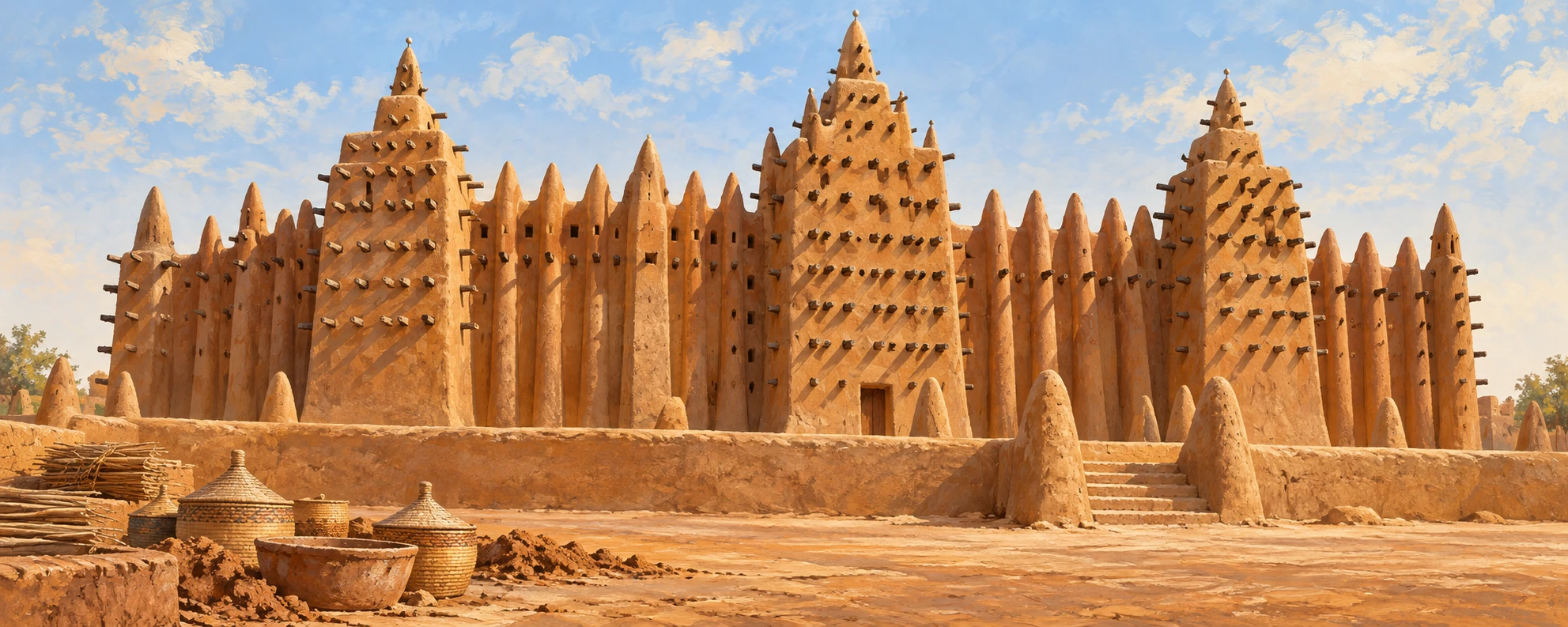
A horizontal close study of an imagined Maya lime-plaster wall edge: thick pale mineral plaster over rough masonry, a small area of muted red painted geometric surface, adjacent soft-focus bowl containing bark fragments as an explanatory separate ingredient cue.
A finished wall hides choices about lime, aggregates, water, and possible organic additions. This material study is not a sample from Copán.

First, separate the wall from its finish

UNESCO's account of Copán describes a major political, civil, and religious center with temples, terraces, plazas, and successive phases of construction. A coating belongs to this larger architectural setting. It may conceal masonry while also creating the surface people encountered, decorated, repaired, or built over.

“Made of stone” can therefore be an incomplete description. Ask which stone is structural, which material binds or covers it, and which surface was meant to be visible. A ruin presents the materials that survived and remained exposed. That is not automatically the same view its builders prepared for a finished monument.

The conceptual illustration brings a broken edge and a smooth surface together. Its bowl and decorative geometry are illustrative choices, not objects from a documented excavation. Use it to notice the difference between bulk material and finish, then turn to the study for the actual samples and their locations.

Stone changed into a binder

In the basic lime cycle, heating limestone releases carbon dioxide and produces quicklime. Reacting quicklime with water produces slaked lime. As an air-lime material hardens by carbonation, it takes up carbon dioxide and forms calcium carbonate again. These are chemical transformations, not simply grinding a white rock into smaller pieces.

The cycle is a helpful outline, but it is not a complete account of a historical plaster. A finished material also has a structure: pores, grains, interfaces, layers, and sometimes added substances. Those relationships help determine how it behaves. Knowing the names of ingredients is only a beginning.

Nor does a chemical cycle mean the final surface has returned to the original rock in every respect. A quarried stone and a newly formed binder may contain related minerals while differing in texture and arrangement. “Back to limestone” is memorable shorthand, but it can obscure the very features a materials researcher wants to examine.

The Copán experiment

Carlos Rodriguez-Navarro and colleagues analyzed plaster samples from Classic-period Copán structures. Some contained organic material within a calcite-rich binder. Following advice from Maya-descendant masons, the team prepared replicas with extracts from chukum and jiote bark. Compared with additive-free controls, the replicas helped demonstrate how incorporated organics could change crystal structures and improve toughness and weathering resistance.

The paper's author-hosted full text makes clear that the ancient samples were not all identical. That qualification matters. This is evidence for particular materials and a tested mechanism, not a license to assign one formula to every Maya city or every century.

Traditional knowledge was part of choosing what to test. Laboratory instruments did not conjure the practical use of tree extracts from nowhere. At the same time, a modern replica does not recreate every action in an ancient workshop. The relationship is strongest when both contributions are described precisely.

How to read a materials claim

A useful research question has more moving parts than “did the additive work?” What counts as working? Resistance to cracking, behavior while wet, long-term weathering, and ease of application are different properties. A material can improve in one respect without becoming universally superior.

Historic Environment Scotland's account of mortar analysis shows why complementary methods matter. A hand specimen, a microscope, and mineral identification provide different information. Observing texture is not the same operation as identifying minerals. A sample's location also matters because its function and exposure help explain its condition.

QuestionEvidence that helpsWhat it cannot do alone
What is present?Composition and mineral analysis.Reconstruct every workshop action.
How is it arranged?Microscopy and layers in a sample.Tell us every maker's intention.
Does a proposed change affect behavior?A comparison with a suitable control.Guarantee identical performance in every wall.
Where does the result apply?Sample context, test conditions, and replication.Turn a local result into a timeless universal recipe.

Keep the last column beside the first two. It does not weaken the research. It shows the boundary of each kind of evidence. The most convincing account is one in which the conclusion fits inside those boundaries.

Why a stronger material may be the wrong repair

Modern conservation introduces another question: what belongs next to an existing wall? Historic Environment Scotland's repair guidance emphasizes compatibility with existing materials, exposure, and aftercare. Strength by itself is an inadequate goal. An unsuitable repair can affect neighboring fabric and moisture movement.

This guidance concerns modern conservation practice, not a direct instruction from Copán's builders. Its relevance is the decision it forces us to articulate. Are we trying to reproduce a historical surface, protect old material, understand a mechanism, or design something new? Those aims overlap, but they are not interchangeable.

When a headline promises an ancient secret for modern buildings, try writing the missing specification. Which tested property matters? In what climate? On what substrate? For how long was it measured? You do not need to solve all those questions to see why the single word “better” is doing too much work.

The reward for this slower reading is considerable. A wall coating becomes evidence of learned practice, demanding material choices, and knowledge that can still inform research. Its endurance is interesting because it can be investigated, not because it has to remain mysterious.

Sources and further exploration

Explore all 80 new articles · Browse the complete illustrated collection

Continue exploring art, ideas, and unexpected connections at Incoprea.

The Sweet Track: A Neolithic Route Built Across Wet Ground

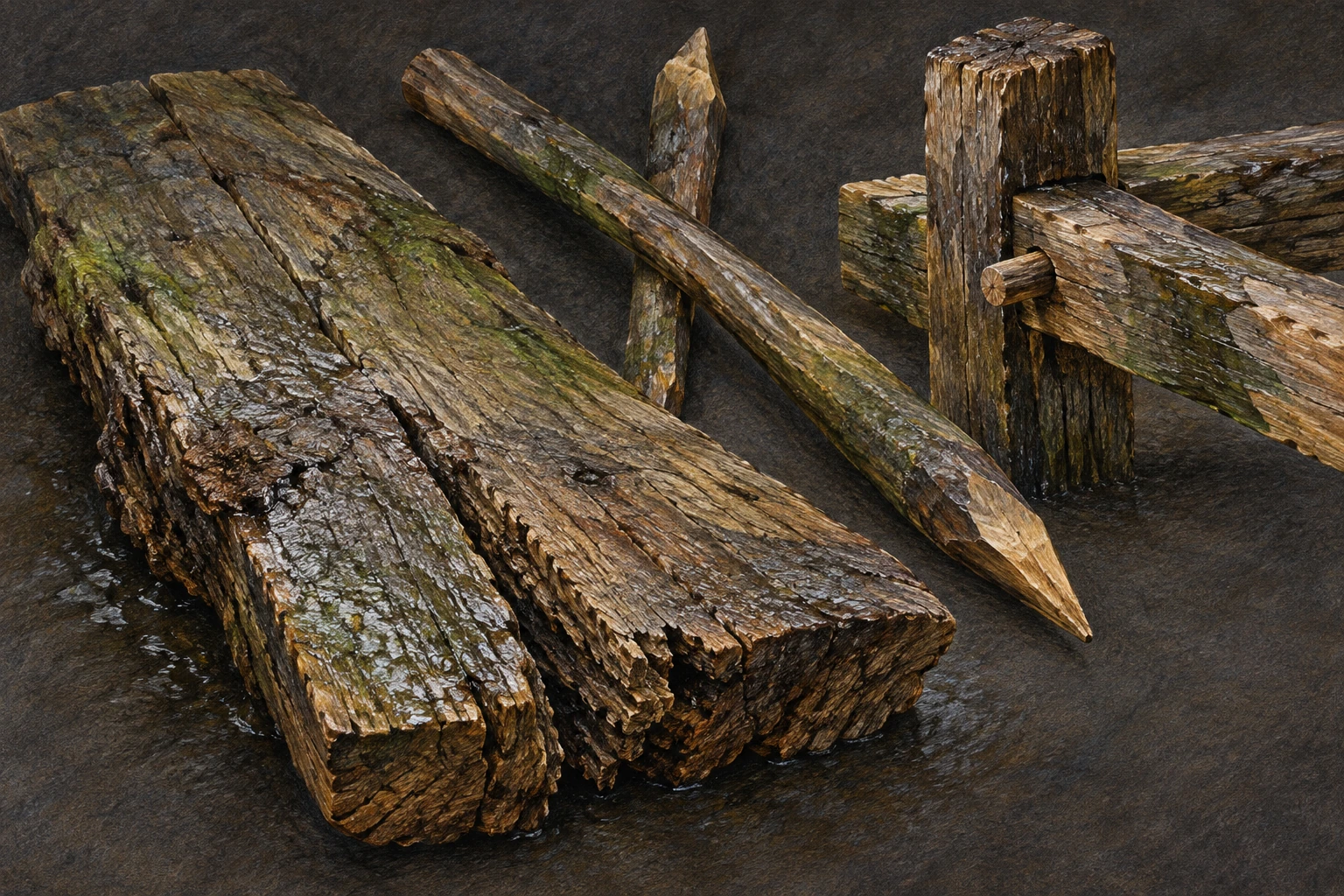
The most arresting fact about the Sweet Track is not simply its age. It is the unusual precision with which part of its making can be dated. Timbers from a route across the Somerset wetlands preserve a calendar written before the tree was cut. Yet that calendar cannot tell us the names of the people who walked there.

This is a useful place to separate three questions: what survives, what can be dated, and what the route meant. The answers do not have equal precision. A date can be extraordinarily specific while a purpose remains open to interpretation.

An interpretive Neolithic timber walkway across an English reed wetland: narrow straight planks elevated modestly above wet ground on simple crossed timber supports, birch and hazel-like marsh-edge vegetation, dawn mist and subdued ochre greens.
The narrow wooden route is a reconstruction concept. The excavated Sweet Track provides the evidence for the much more specific account in the text.

Evidence file 1: a way above the wet ground

The Sweet Track ran for almost two kilometers through wetland between the Polden Hills area and Westhay. Its surviving construction shows a raised wooden route rather than a strip of permanently dry ground. The Somerset Historic Environment Record describes longitudinal rails, supporting pegs, and walking planks. Crossed pegs and other supports helped hold the upper surface above the lower timbers.

That is a more interesting object than the vague phrase “prehistoric boardwalk” suggests. A board resting directly on mud and a board carried by a support system solve different problems. Construction details reveal how the makers dealt with the ground. They also give archaeologists features that can be compared between stretches of the route.

The illustration evokes a wooden crossing, but it is not a measured reconstruction. In particular, a scenic depiction can simplify plank orientation, joints, spacing, and the supporting structure. Use the archaeological description, rather than the picture's attractive regularity, to understand the excavated design.

Also notice that “wood” is not one uniform material. A support, a peg, and a walking surface ask different things of a piece of timber. The record's distinctions between components are therefore worth retaining in your notes. A reconstruction that turns every part into the same regular lumber makes the route easier to picture while discarding some of the choices preserved in the remains.

Evidence file 2: the last ring

According to Historic England's research account, tree-ring evidence places felling for the Sweet Track in the winter of 3807–3806 BCE or early spring 3806 BCE. Repairs indicate use for at least several years afterward. This is a date for trees being felled, tied to construction through the archaeological context. It is not a diary entry announcing an opening ceremony.

Think about what must survive for such precision to be possible. An isolated piece of wood does not automatically produce a year. Archaeologists need a recognizable pattern of rings that can be compared with a dated sequence. The relationship between the final surviving ring and the tree's outer edge affects how closely felling can be estimated.

This distinction is especially helpful when encountering headlines. “A 3806 BCE trackway” is a useful shorthand. “Everyone crossed it on a known day in 3806 BCE” adds information the evidence does not supply. Precision in one measurement should never spread automatically to every sentence around it.

Evidence file 3: a route with a predecessor

The scheduled monument record includes both the Sweet Track and the earlier Post Track. The latter has a felling date of 3838 BCE. So even here, the neat story of one extraordinary invention is too simple. People had already been building routes through this wet landscape.

Compare the questions an earlier route raises with the questions it answers. It establishes that the landscape had an earlier episode of route construction. It does not tell us, by itself, whether the later route replaced exactly the same kind of journey, served the same users, or had the same social importance.

A crossing could help movement between places. That functional statement leaves room for different reasons to move: tasks, exchanges, visits, ceremonies, or combinations. Objects found near a route may inform those possibilities, but a striking object is not a caption explaining the whole site.

A close arranged study of waterlogged wooden walkway components on neutral dark ground: one broad split oak-like plank, two slender crossed stakes and a pegged simple timber joint nearby.
The invented timber study draws attention to planks, stakes, and working marks. It is not a measured Sweet Track joint or an excavated assemblage.

Evidence file 4: preservation is an ongoing experiment

Wet conditions helped the timbers survive. Changing those conditions can change what remains for future study. A 2022 research report describes trials using four trenches and monitoring from March 2017 to November 2019. During that interval, the monitored conditions did not indicate a significant desiccation threat. A trial membrane offered little observable benefit under those conditions.

Read the time boundaries carefully. A result from a monitored interval is evidence about that interval and that setting. It is neither proof of permanent safety nor proof that a proposed intervention must always fail. Conservation research is useful precisely because it tests assumptions against the place being protected.

The buried timber and the public reconstruction also have different needs. A reconstruction can help visitors picture movement. The original deposits preserve information that no reconstruction can replace. Making the former more visible should not mean treating the latter as expendable once the main story has been told.

Open the observation sheet

The printable sheet below asks you to classify six statements as observation, dating result, interpretation, or unsupported embellishment. It includes an answer guide. You can use it without visiting the site or handling any archaeological material.

Sweet Track evidence sheet

Printable six-statement evidence classification worksheet with answer guide.

Open sweet track evidence sheet in its own window.

For a second visual account, the South West Heritage Trust's archaeology films page includes a Sweet Track digital reconstruction. Watch for the decisions every reconstruction has to make: water level, vegetation, completeness, and the spacing of structural parts. Which are being illustrated, and which could you verify from the excavation record?

Here is a useful test afterward. Write two short descriptions of the site. In the first, include only claims directly established by the surviving materials and their analysis. In the second, add a plausible account of a journey. Underline every addition in the second description. This shows how rapidly a modest set of facts can become a vivid narrative.

There is nothing wrong with imagining that journey as long as the boundary remains visible. The timbers deserve both kinds of attention: curiosity about the lives around them, and care with what their survival allows us to know. A route made for movement has become a remarkably precise, incomplete record of human decisions.

Sources and further exploration

Explore all 80 new articles · Browse the complete illustrated collection

Continue exploring art, ideas, and unexpected connections at Incoprea.

Thursday, October 22, 2026

Saving the Vasa Was the Beginning of a Much Longer Experiment

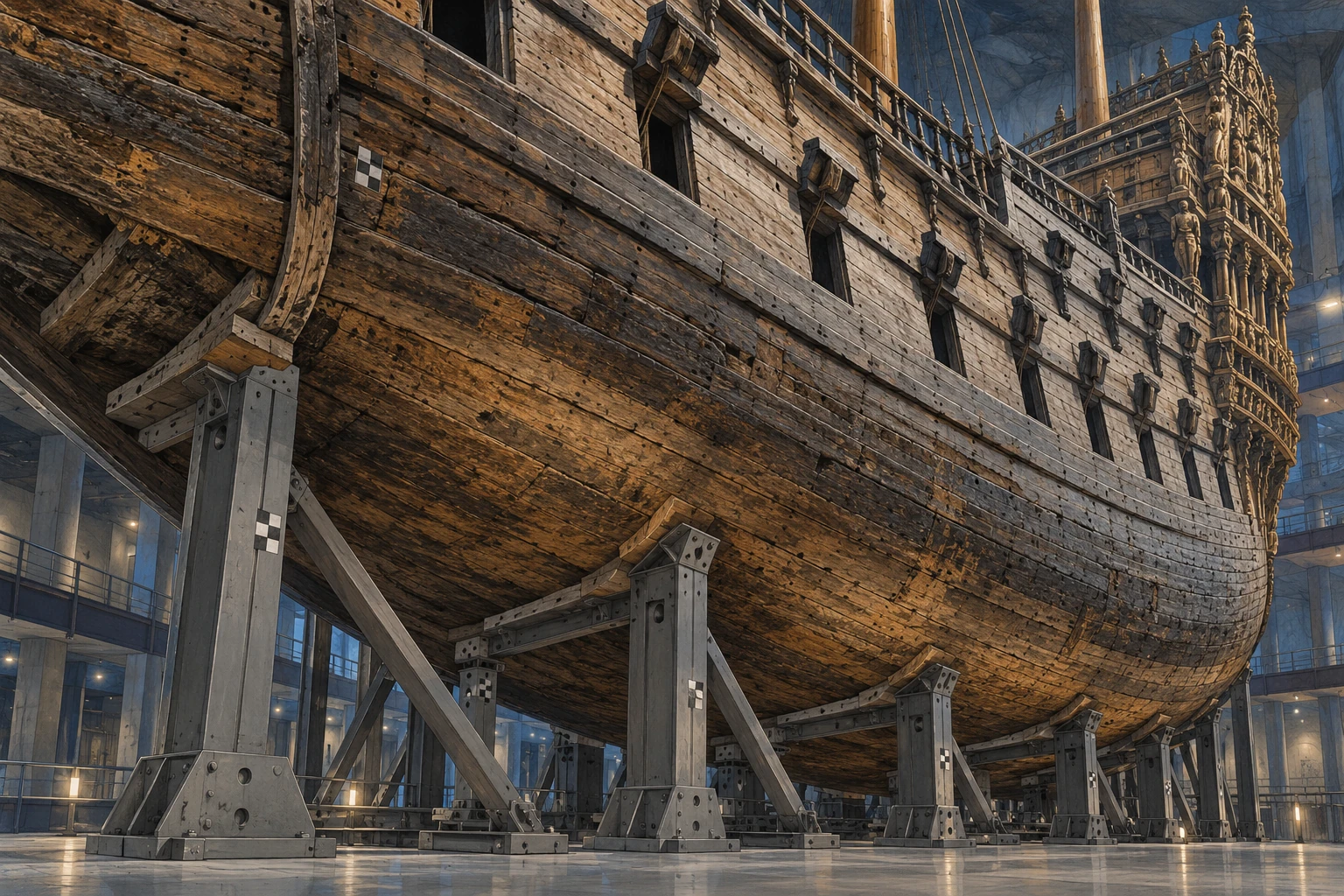
An illustrative preserved wooden ship hull indoors, viewed from below with modern steel cradle supports clearly visible.
Conceptual museum conservation scene, not a photograph or an exact model of Vasa’s current support system.

Raising a ship from the seabed looks like an ending. The vessel returns to daylight; the dramatic photographs are made; a lost object seems to have been rescued. For Vasa, raised in 1961, that moment began a much longer problem: how to preserve a heavy wooden structure whose material had changed underwater.

The ship in the museum is not merely waiting in a dry room. Its chemistry, moisture environment, weight, and support all matter. Conservation is an ongoing investigation into an object that must continue to carry itself—or be helped to do so.

Water can hold a weakened shape open

The Vasa Museum’s conservation history explains that waterlogged timber can look sound while its cells are weakened by decay. If the water leaves without suitable treatment, the wood can shrink and crack. Conservators chose polyethylene glycol, or PEG, to help replace water within the structure.

The scale changed the practical problem. Small objects can be treated in tanks; the ship required spraying. The museum records a spray treatment from 1962 to 1979, followed by nine years of slow air drying. A spectacular salvage became a project conducted over decades.

The key is to distinguish shape from strength. A form can remain recognizable while the material supporting it becomes fragile. Looking solid from a gallery balcony is not a measurement of what the wood can safely bear.

The first visible warning was only a surface clue

The museum’s account of ongoing preservation describes white and yellow surface deposits appearing after the museum opened in 1990. Sulfur and iron compounds with high acidity drew attention to reactions affecting the wood. Research then moved from the visible symptoms toward material conditions below the surface.

That sequence is a useful model of scientific care. A deposit is observed; its composition is investigated; possible causes are examined; measures are tested. The observation is not itself a complete diagnosis, and cleaning the visible spot would not necessarily resolve the underlying process.

The same museum account describes improvements to climate control and trials removing iron from smaller wooden objects that could tolerate retreatment. A treatment feasible for a small item is not automatically feasible for an enormous assembled hull. Scale, accessibility, and structural risk constrain the options.

A museum building becomes part of the treatment

Stable humidity and temperature can reduce damaging variation. The room is therefore part of the preservation system, alongside chemical treatment and physical support. It is easy to treat air conditioning as visitor comfort and miss its role in the life of the object.

The museum’s preservation timeline records successive investigations and revisions. This is not evidence that conservation “failed” because further work was needed. It shows that a very large, altered organic object requires new information and changing responses over time.

A useful question for any conserved artifact is what the current intervention is intended to do. Preventing rapid drying, reducing chemical change, limiting movement, and supporting weight are different aims. A single treatment may not satisfy all of them.

The support has to follow the ship’s needs

In a 22 January 2026 update, the Vasa Museum reported that half of the new external support construction was in place. It described replacing 17 external supports with 27 articulated cradles and adding internal support to help carry deck loads. The project was expected to finish in 2028. Those are the museum’s reported milestone and target, not a claim that all work is already complete.

The number of supports is less important than where and how forces enter the hull. A new structure must fit a historic form that cannot simply be rebuilt to suit an engineer’s convenience. The intervention is designed around the object’s altered material and geometry.

The thought is striking: steel made now helps preserve wood worked centuries ago. The modern support does not make the old ship less historically meaningful. It makes visible the care required for that history to remain physically available.

Measurement makes slow change perceptible

The museum’s deformation-monitoring page describes following changes in the ship’s shape. Repeated measurements allow a slow movement to become a dataset rather than an impression. A visitor’s memory of how a hull looked last year is not a sensitive structural instrument.

Imagine photographing the same doorway once a day while a house settles imperceptibly. One picture may show nothing alarming. A carefully aligned series can reveal movement. This analogy is about repeated observation, not a description of the museum’s full technical method.

The support’s visibility is part of an honest display. If a photograph crops the cradle away, it can make the ship appear to carry itself. Seek a wider image and locate where present-day structures meet the surviving hull. The achievement includes those carefully chosen points of contact.

The fastener has a history too

The hull’s joins contain several periods of engineering. The museum’s bolt-replacement account distinguishes the original corroded iron rivets, the mild-steel bolts inserted for the salvage, and the later specially designed corrosion-resistant bolts. It reports that replacing roughly five thousand older bolts took seven years and was completed in 2018. The altered fastener is part of the preservation history, not a seventeenth-century component that happened to survive unchanged.

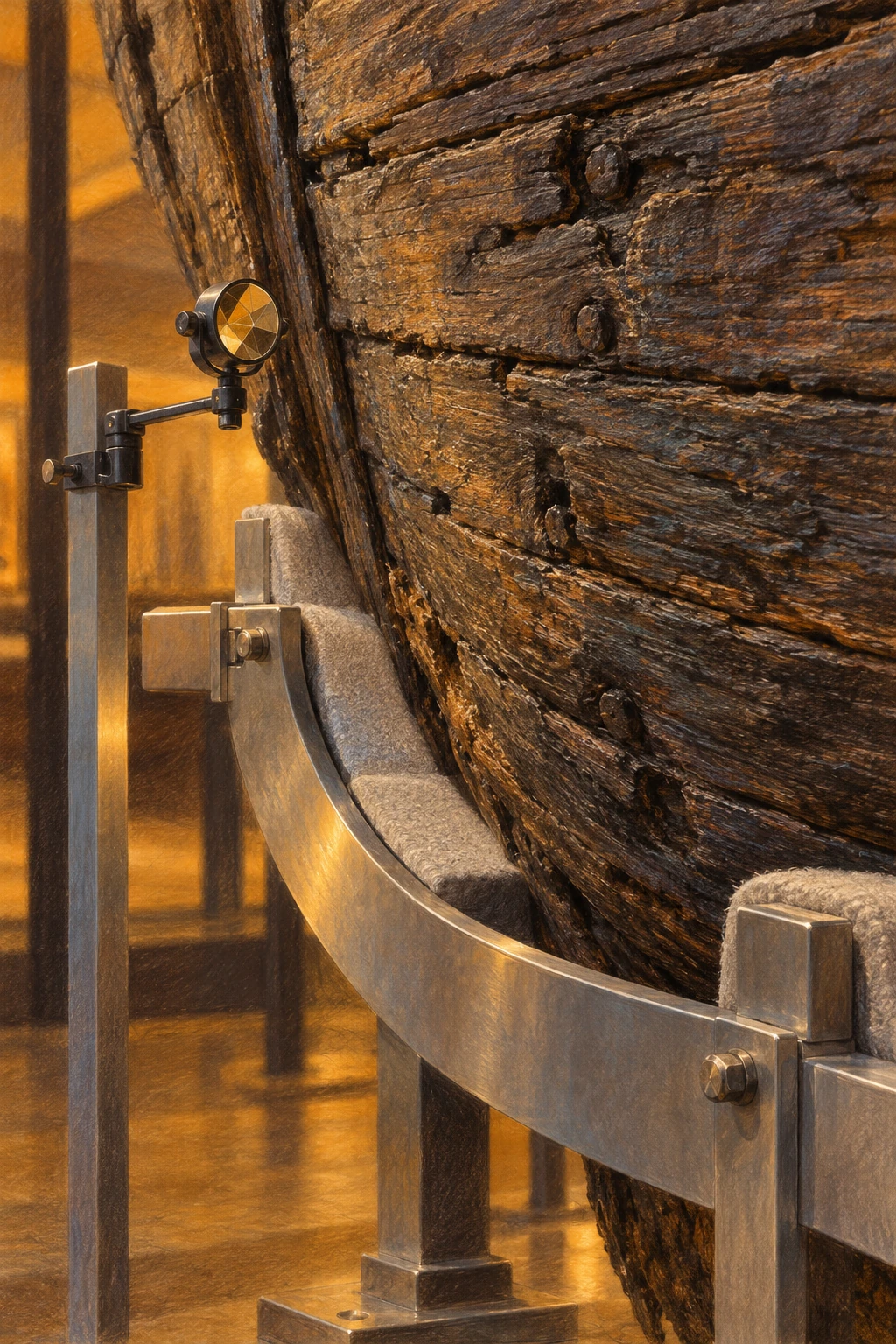
Historic timber rests against a padded modern steel support in a close material view.
Interpretive support study, not Vasa’s actual engineering arrangement.

The new design includes a compression spring that helps determine how tightly the connection is held. That detail is more informative than a general statement that “stronger steel saved the ship.” The problem involves applying force appropriately to vulnerable timber, as well as resisting corrosion. An engineering improvement is a relationship among materials, geometry, and the load being carried.

The museum’s 2012 documentation report adds a related caution about shape. Its three-dimensional survey recorded more than eighty thousand points and revealed significant asymmetry in the hull. Some irregularity belongs to construction; some later movement belongs to the ship’s long material history. A present-day outline cannot automatically tell us when every deviation arose.

Try a deliberately fictional monitoring exercise. A point on a paper sketch is recorded 2 millimetres farther left in a later survey. Before calling that “the ship moving,” ask whether the reference system, instrument setup, measurement uncertainty, and definition of the point stayed comparable. These are general questions about repeat measurement, not a description of an error in the museum’s survey.

Now separate three aims in your notes: holding two timbers together, carrying a span’s weight, and measuring change. A bolt, a cradle, and a survey target may all be visible near one another while performing different jobs. Their proximity does not make them interchangeable parts of one simple support.

For a viewing challenge, choose a wide institutional photograph and find one visible modern intervention. Describe its intended relationship to the old wood without guessing its precise capacity. Then check the museum’s account. “Carries,” “connects,” and “measures” are better starting verbs than the vague word “protects.”

Conservation becomes more interesting when we give its components separate names and dates. The timber can retain evidence of the shipbuilders while a carefully designed modern connection helps that evidence remain available. A replacement part does not erase the material history when the replacement itself is documented.

A paper support thought experiment

Place a thin strip of scrap paper between two small stacks of books, with a modest gap. Do not load it with anything. Notice its sag. Move the stacks closer together, then add a third support beneath the middle. The paper’s own weight has not changed, but the places where it is carried have.

The model is deliberately simple. A ship hull is a three-dimensional assembly with joints, different materials, and an uneven history of weakening. The paper cannot predict its behavior. It can help you ask a better gallery question: which spans and loads is each visible support intended to relieve?

When you next encounter a conserved ship, look at the cradle as well as the carving. Ask what is original material, what is conservation treatment, what is structural support, and what is being monitored. These are different parts of one continuing achievement.

Vasa’s preservation is a story of changing questions. The first was how to bring it up. Another was how to dry it without losing its shape. Today’s work includes how to reduce further change and carry a weakened structure safely. The ship survives because rescue became a long commitment to learning.

Sources and a closer look

Vasa Museum: conservation history; Vasa Museum: ongoing preservation; Vasa Museum: preservation timeline; Vasa Museum: support project milestone, 22 January 2026; Vasa Museum: deformation monitoring.

Find more art, ideas, and unexpected connections at Incoprea.

Pando: Where Does One Tree End?

Stand among the white trunks of an aspen grove and the ordinary counting rule seems obvious: one trunk, one tree. Pando, the large quaking-aspen clone in Utah, makes that rule inadequate. Many visible stems belong to a lineage that began from one seed and spread vegetatively. The forest-like scene asks us to distinguish a trunk from a genetic individual.

An autumn aspen grove with a schematic soil cutaway showing roots and young suckers.
Conceptual aspen cutaway; root connections are schematic, not a map or reconstruction of Pando.

The distinction is not mystical. A ramet is a module produced through clonal growth; a genet is the genetic individual originating from a seed or other founding reproductive event. Multiple ramets can belong to one genet. The terms help describe a plant whose body is assembled and renewed across space.

How can we know that the stems belong together?

The Western Aspen Alliance's genetics account describes DNA-fingerprinting work that confirmed Pando's clonal identity in 2008. It also notes other, smaller clones within the broader aspen stand. A grove's visual boundary and a clone's genetic boundary are not automatically the same line.

This is a good example of evidence changing an everyday category. Similar leaf shape or simultaneous autumn color can suggest a connection, but genetic markers can test whether sampled stems share clonal identity. Conversely, a genetically identified clone does not give us a photograph of every living root connection at every moment.

The US Forest Service account of quaking aspen explains how root suckering contributes to regeneration. New stems can arise from an existing root system. A stem can die while clonal growth continues elsewhere. The longevity of a lineage therefore need not mean that one ancient trunk or one unchanged piece of original tissue remains alive.

Which age are we asking about?

Counting rings in a trunk estimates the age of that stem. Estimating the time since the clone's founding seed requires a different method. Neither the number of stems nor the width of the grove supplies a direct clock unless assumptions about past growth are added.

A 2026 eLife reviewed preprint analyzed somatic mutations across more than 500 samples, including different tissues and neighboring clones. Its authors used phylogenetic analyses to estimate a clone age of roughly 12,000–37,000 years. Crucially, the accompanying editorial assessment judged evidence for several central conclusions, including age, incomplete because the genomic data were relatively low-coverage and sampled only part of the genome.

The right way to report that result is as a model-based estimate with explicit evidential limits. It is not a certified birthday. Older articles and earlier preprint versions can give different ranges; that movement is a reason to identify the version and method rather than selecting the most dramatic number.

One genotype can become several ecological neighborhoods

Sharing a clonal identity does not make every part of a grove experience the same conditions. A fence, a browsing route or a patch of dense young stems can create a different developmental history without creating a new founding genotype.

The 2022 Pando reassessment returned to 64 plots and followed a set of vital indicators. It described contrasting trajectories among management areas, including stronger regeneration in protected parts and continuing problems elsewhere. The account concerns the conditions measured then; it should not be read as a fresh 2026 census.

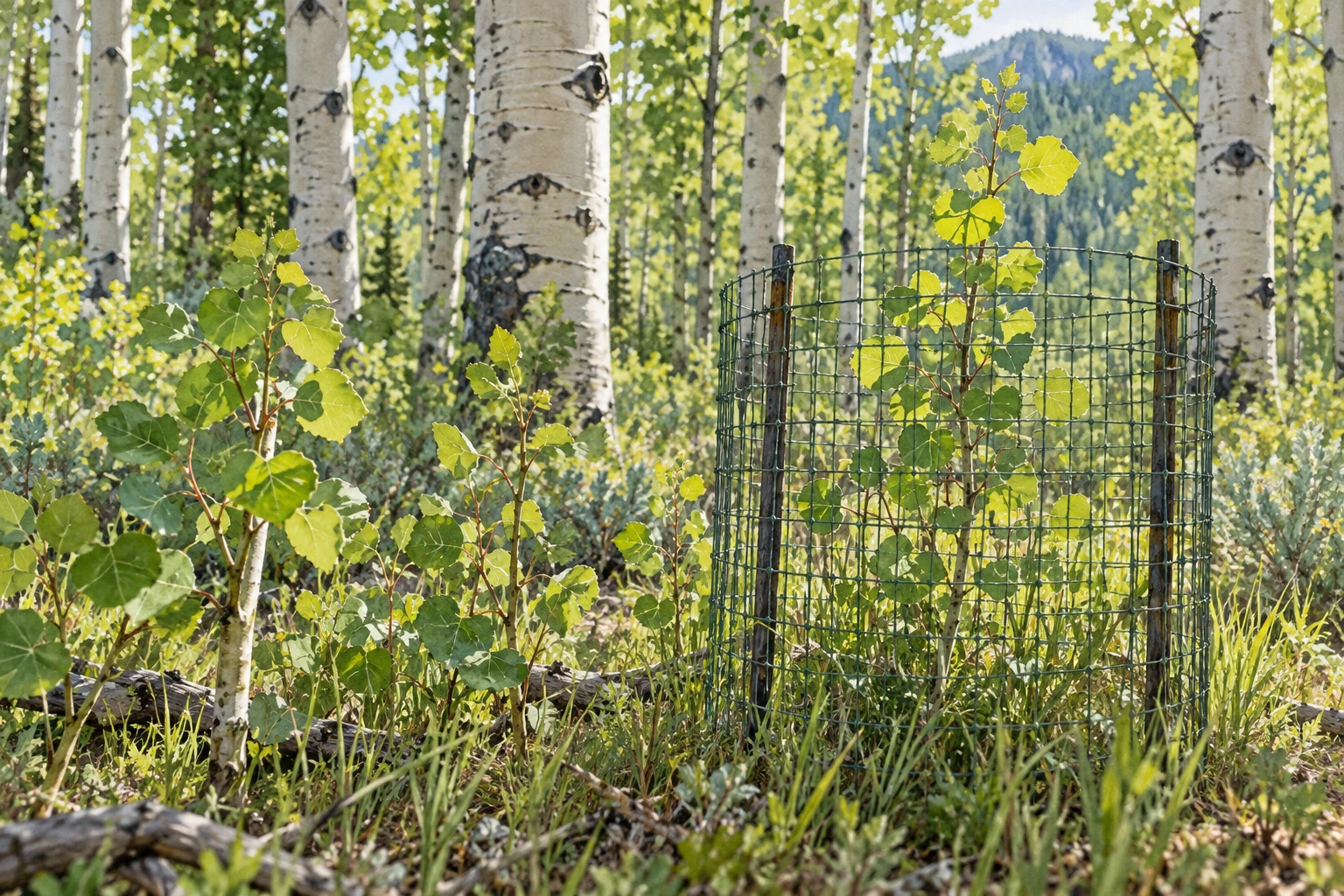
Young aspen suckers and a small sapling near a conservation fence beneath mature trunks
Genetic continuity still depends on successful stem replacement. This scene is not a monitored Pando plot.

The associated Utah State dataset and methods record explain why remeasurement matters. Repeatedly returning to defined plots can connect changes in mature stems, young stems and browsing. A new photograph from an attractive part of the grove cannot replace that comparison.

The study also distinguished regeneration from recruitment. Producing low suckers is not enough if they remain trapped in a vulnerable stage and fail to grow beyond browsing height. A count of new shoots can look encouraging while the transition needed for canopy replacement remains weak.

A small demographic check

Imagine a fictional stand with 100 mature stems. During one interval, ten die,50 low suckers appear and only two young stems reach the class needed to replace mature stems. Reporting “50 new shoots” alone sounds like rapid renewal. Recording the transitions shows a different balance:92 mature or replacement-class stems after the losses and gains, under these simplified rules.

What should be followed next?

The fate of those 50 suckers. How many survive, how many are repeatedly browsed and how many enter the next size class? The numbers are invented; the exercise explains why stages and transitions can matter more than a single total.

A clone can therefore persist genetically while its visible structure changes. Its conservation problem is not solved by confirming identity again, and its identity does not cease merely because management produces a patchwork of conditions.

When looking from an established path, let the smallest stems have as much attention as the canopy. Then return to the measured study for the population-level inference. The young shoot is an opportunity; successful passage through several stages is the process that makes that opportunity count.

The practical problem is the next generation of stems

Whatever the precise age, persistence depends on replacement. A 2018 study by Rogers and McAvoy examined 65 monitoring plots under different management regimes. It measured mature trees, regeneration, browsing, and signs of ungulate presence, and used historical aerial photographs to examine change. Successful recruitment of young stems was central to assessing condition.

The study linked mule-deer browsing with poor regeneration and found stronger recruitment under effective protective treatments. A fence that animals could penetrate did not provide the same protection as an effective barrier. That detail matters: the presence of a management structure on a map is not evidence that it achieved its ecological function.

A stand full of large trunks can therefore conceal a demographic problem. If old stems continue to die while few young stems escape browsing and reach maturity, the current canopy does not guarantee a future canopy. Looking only upward can miss the process that determines whether the clone persists.

The Friends of Pando–Forest Service partnership describes a framework for research, public education, and stewardship. Such work turns a record-breaking organism into a place with ongoing practical needs. The relevant conservation outcome is not preserving a headline about size; it is sustaining the living processes that replace tissue and maintain a functioning community.

If visiting an aspen grove, look for several sizes of stems, including young suckers and saplings, from established routes. Do not dig to expose connections or move through protected regeneration areas. The contrast between a mature canopy and the smallest stems can be more informative than another photograph of impressive trunks.

The generated cutaway above is schematic. Its roots explain the possibility of clonal growth; they are not a mapped reconstruction of Pando's underground body. The genetic and monitoring studies are the evidence.

Pando expands the meaning of a tree without erasing the usefulness of individual stems. Each trunk has a history; the lineage has another. Its future depends on renewal at the scale of small shoots. A very old organism can be sustained by tissue that is young, and an apparently full forest can need help making what comes next.

Follow the evidence: Utah State Western Aspen Alliance: genetic identity; US Forest Service: quaking-aspen biology; Rogers and McAvoy: regeneration and browsing at Pando; Pineau and colleagues: 2026 reviewed preprint and assessment; Friends of Pando: stewardship partnership with Forest Service.

More curious connections, art and independent projects at Incoprea.
Freshwater Mussels Begin Life by Borrowing a Fish

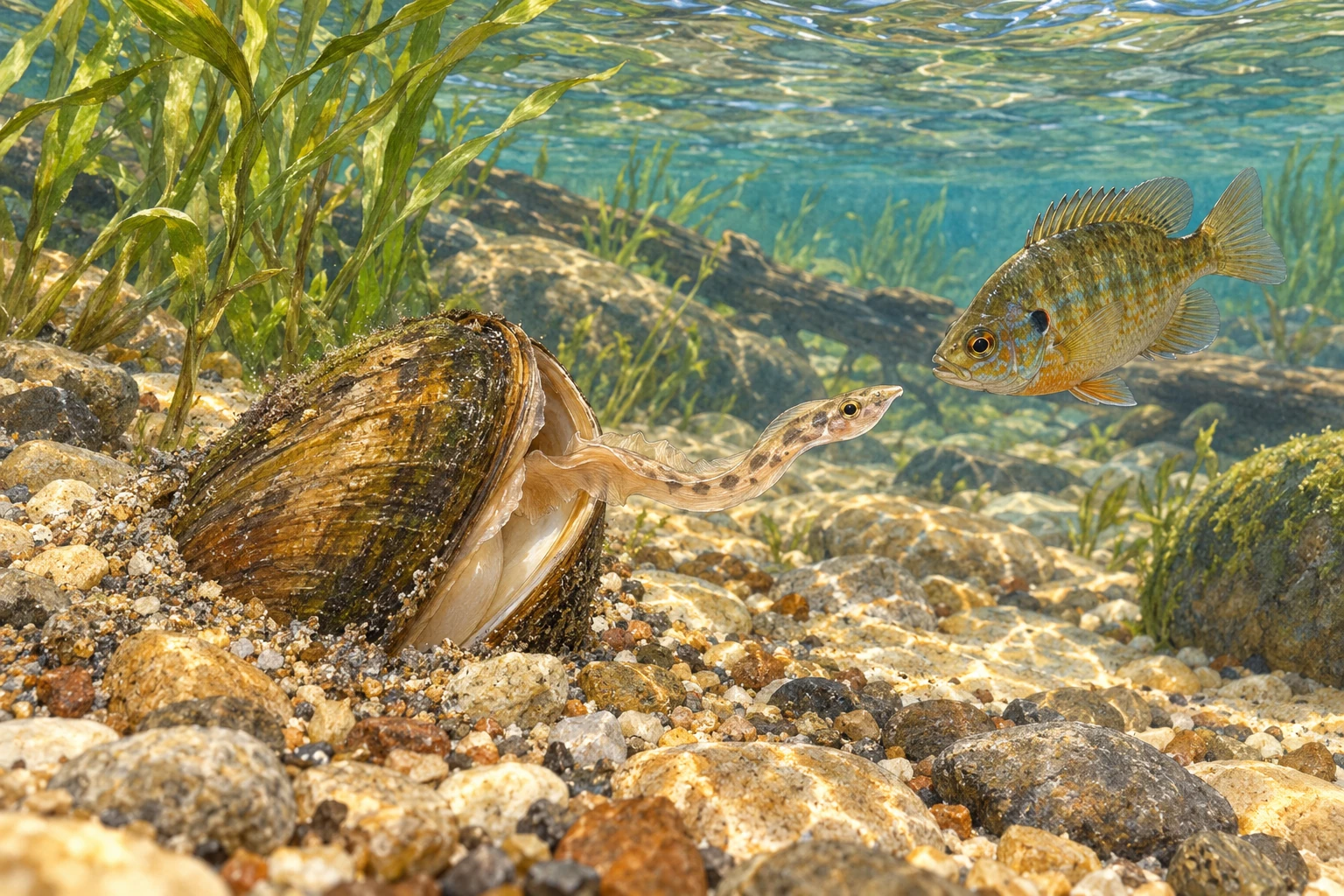
At the riverbed, a small fish-shaped movement appears beside a shell. A real fish approaches what looks like an opportunity to feed. The moving shape can be a mussel's mantle lure, part of a reproductive strategy whose next stage depends on contact with a suitable fish. The adult mussel's stationary life contains a mobile chapter.

Many native freshwater mussels in the unionid group produce larvae called glochidia. These larvae temporarily attach to a host fish and develop before leaving it as juveniles. That stage helps explain why conserving a mussel requires more than leaving adults undisturbed in apparently clean gravel. The life cycle connects the riverbed to animals moving through the water above it.

A partly buried freshwater mussel extends a fish-like mantle lure toward a small sunfish.
Conceptual host-attraction scene; no mussel or fish species, host compatibility, or larval scale can be inferred from it.

The host must be more than a passing ride

The USGS host-fish research program emphasizes specificity: larvae may complete their transformation on a particular host or a limited set of hosts. Finding glochidia attached to a fish does not necessarily prove that they will develop successfully there. Contact, attachment, and successful metamorphosis are distinct steps.

This is a subtle but consequential distinction. A fish might encounter larvae often because it occupies the right habitat, yet be physiologically unsuitable. Another fish might be an excellent host in a laboratory but rarely overlap with reproductive mussels in a river. A useful account combines compatibility with opportunity.

A USGS investigation in Texas joined field fish collection and laboratory recovery of larvae and juvenile mussels. Molecular identification can help connect the young stages with adult species that are hard to distinguish at such small sizes. An adult shell, a larva, and a fish carrying larvae are different parts of the evidence chain.

Not every mussel recruits its host in the same way

In a USGS public lecture with a full transcript, fisheries biologist Heather Galbraith explains a range of host-attraction strategies. Some mussels use mantle displays. Others release packages resembling food, and some make more direct contact with a fish. The fish-shaped lure is a striking example, not a universal organ on every freshwater mussel.

A lure does not need to fool a human observer perfectly. Its ecological effect depends on how a relevant fish responds in the water, under local light and movement conditions. An indistinct wriggle can be persuasive enough if it triggers investigation or a feeding strike. The resemblance is tested by the receiver's behavior, not by a photograph winning a human imitation contest.

That also explains why the details vary. A strategy involving one host's feeding behavior may be unsuitable for another. The mussel's reproductive timing, larval release, habitat, and display must fit the opportunities provided by its particular fish community.

A compatible host also has a history

A host-species list is useful, but the name of the fish need not describe every relevant property of an individual. Prior exposure can change the host's response. A fish capable of supporting a mussel's development may become less suitable after repeated encounters with its larvae.

A 2006 experiment with largemouth bass investigated resistance after previous glochidial infections. The researchers measured successful metamorphosis among attached larvae and examined antibody responses. Primed fish supported lower transformation success than previously unexposed controls at the tested intervals. This is evidence for a changing host condition, not simply a failure of larvae to find the right fish species.

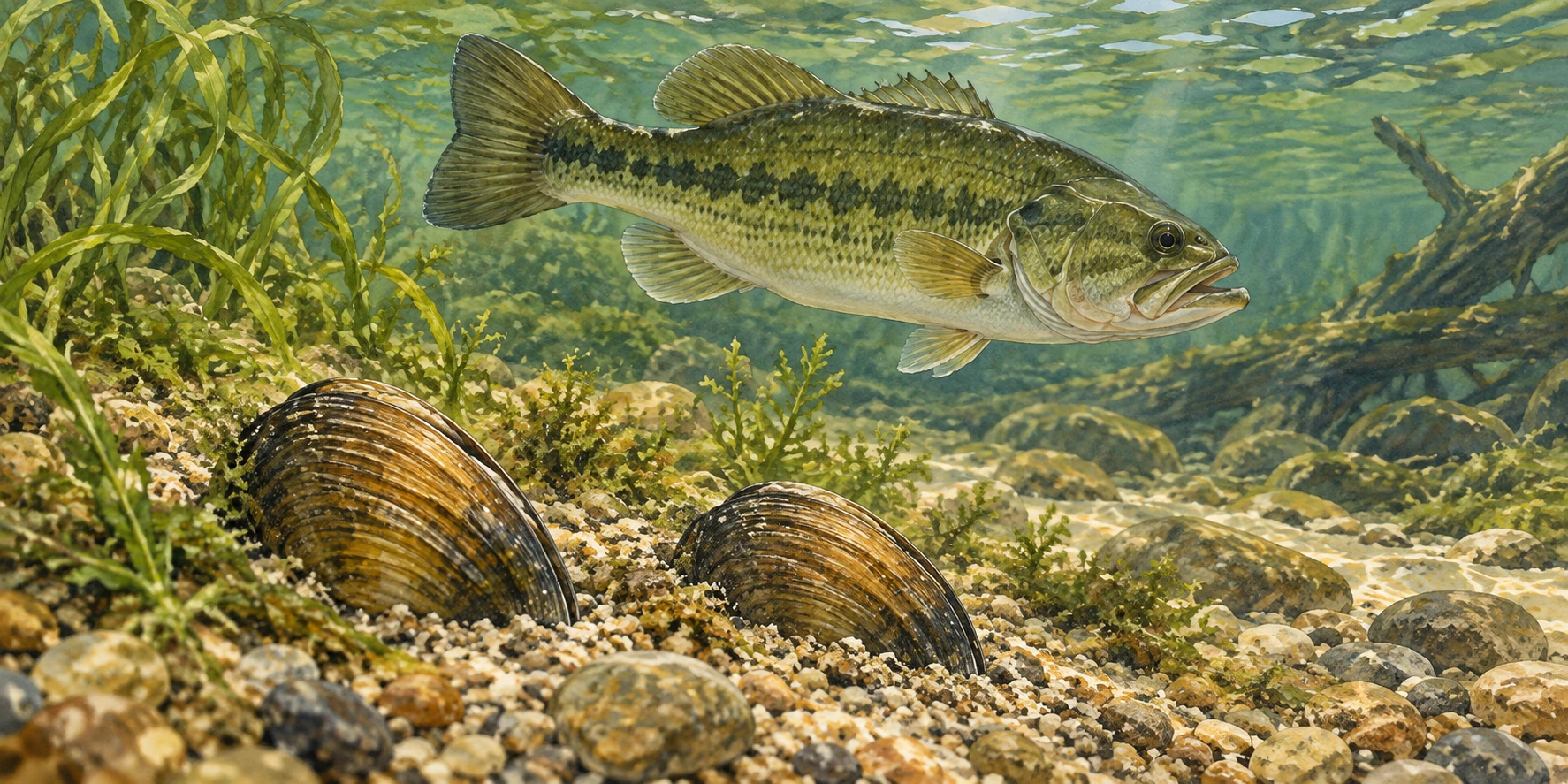
Largemouth bass passes above mussel shells in a gravel-bottomed river
A fish is a living developmental setting with its own history. This scene does not show infection or identify a current host relationship.

A related 2005 study tested whether acquired resistance extended to other mussel species. Some cross-resistance occurred, with evidence suggesting both specific and less specific components. The result should remain attached to the tested largemouth-bass/mussel comparisons. It does not establish one universal duration or immune response for every river fish.

Keep the denominator attached to the outcome

The worksheet has two fictional trials. Trial A begins with 30 attached larvae and yields 10 live juveniles. Trial B begins with 100 and yields 20. Trial A has a higher transformation proportion, about 33 percent rather than 20 percent. Trial B produces more juveniles overall.

Attachment is not transformation

A fictional two-trial ledger separates transformation percentage from juvenile yield and asks for appropriate controls.

Open this activity in its own window.

Both comparisons are correct. Neither identifies why the trials differ. Fish history, larval condition, species and recovery methods would need suitable controls before a cause could be assigned. “Better host” is too compressed unless the outcome and conditions are specified.

This is especially helpful when reading conservation propagation work. A successful attachment is an intermediate step. A percentage calculated from attached larvae asks a different question from the number of juveniles ultimately available. The two measures can rank trials differently without contradicting one another.

The moving fish in the illustration now carries another kind of history: its own previous biological encounters. The mussel's mobile chapter depends on an interaction with a living host, rather than a standard transport vehicle. Species compatibility opens the possibility; individual condition and the rest of the life cycle determine what follows.

The temporary association includes nutrition

Calling the fish merely a taxi can understate the relationship. A stable-isotope study investigated nutritional transfer during larval development. Changes in isotopic signatures supported a parasitic relationship rather than a completely passive ride. The host is part of the larva's developmental environment.

Parasitism does not automatically mean every natural attachment causes severe disease in a fish. The effects depend on species, exposure, and conditions. The important point is to identify the biological exchange accurately rather than making it sound either harmless by definition or catastrophic by definition.

Once young mussels leave the host, suitable habitat still matters. Successful transport cannot rescue a juvenile that lands in an unsuitable bed. Conversely, a good patch of substrate may fail to receive recruits if the appropriate host fish cannot reach it. A barrier's effect can therefore propagate through a life cycle without directly touching the adult mussels.

For conservation, that makes a practical difference. Restoring one species may require understanding another's movement, abundance, and compatibility. A hatchery can use host information to support propagation, while river restoration must also consider the conditions under which the whole sequence can occur naturally.

If you find a live mussel, observe it where it is and follow local rules rather than collecting or relocating it. The shell's identity and the river's host relationships are not obvious from appearance. The generated illustration shows a generic mantle-lure interaction, not a guide for identifying a particular species or choosing a fish host.

The adult seems anchored, but its offspring's history reaches into a moving animal. A river mussel's world includes a fish's senses, physiology, and route through the water. That hidden chapter is why a shell on the bottom can tell a larger story about whether a river remains connected.

Follow the evidence: USGS: life-history research and host-fish requirements; USGS: field and laboratory assessment of host relationships; USGS: stable-isotope evidence for larval parasitism; Heather Galbraith, USGS: audio lecture with transcript.

More curious connections, art and independent projects at Incoprea.
Wednesday, October 14, 2026

Herculaneum Scrolls: Reading a Library Without Opening Its Pages

A carbonised Herculaneum scroll can resemble a piece of charcoal, yet its interior may still contain pages of writing. The eruption of Vesuvius in 79 CE transformed papyrus into an object too fragile to open in the ordinary way. Physical access and intellectual access became painfully difficult to reconcile.

Virtual unwrapping changes that relationship. The scroll can stay closed while researchers scan it, identify its internal surfaces and construct flattened views. Reading is no longer dependent on pulling the original layers apart. But the journey from a scan to a philosophical argument still has several distinct stages.

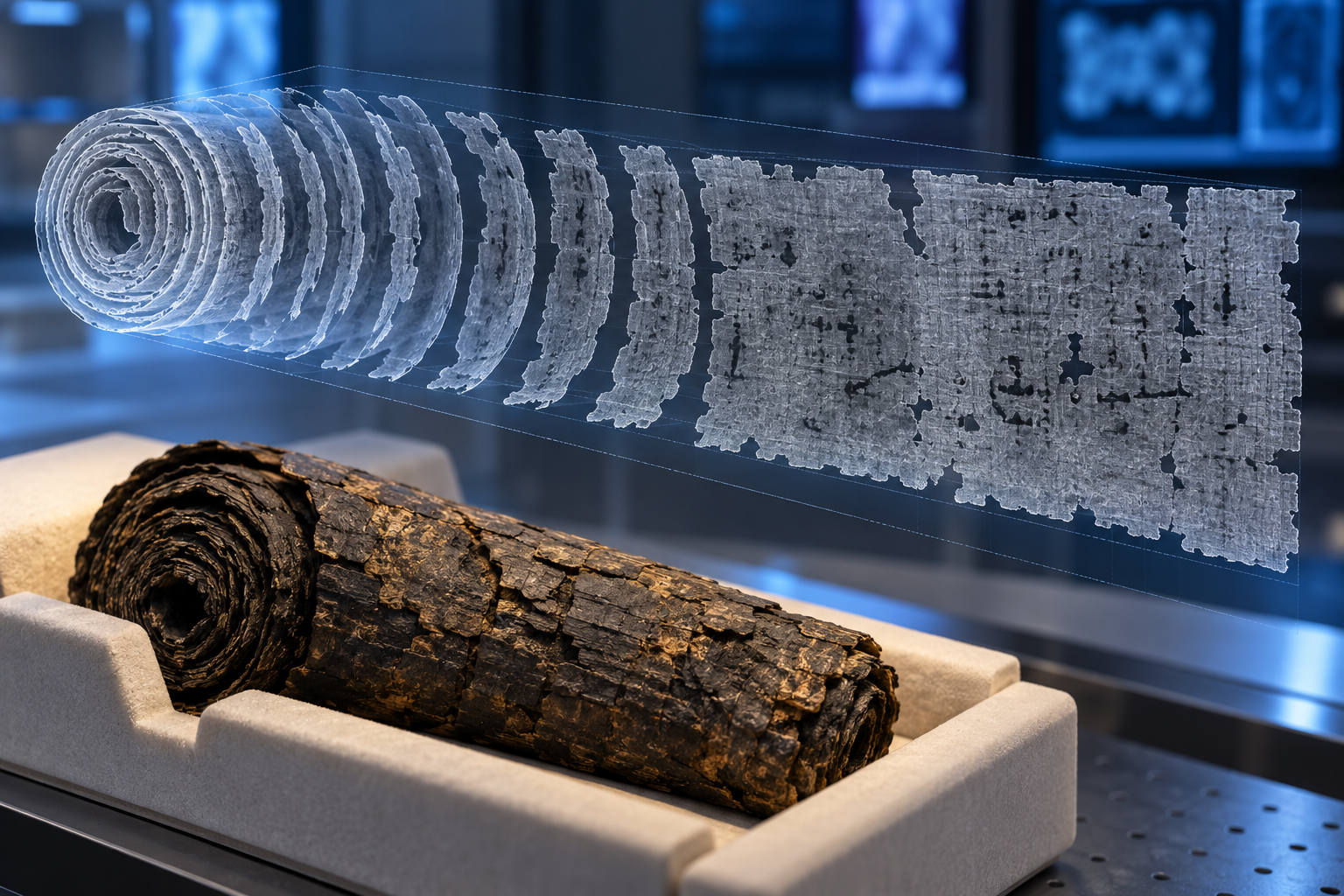
A conceptual carbonized scroll rests in a cradle beneath an abstract visualization of digital layers flattening.
Conceptual illustration of virtual unwrapping. The scroll, scan layers and marks are invented visual examples, not actual scan data or recovered text.

First find the page inside the object

X-ray computed tomography combines many projections into a three-dimensional representation. For a damaged roll, the result is not automatically a set of readable pages. Researchers first have to identify surfaces within a compressed and distorted volume.

That task is called segmentation. Think of following one crumpled sheet through a dense stack without accidentally crossing into a neighbouring sheet. Breaks, folds and close contacts complicate the route. An error can affect how marks relate to one another in the flattened view.

The EduceLab-Scrolls methodology makes verification central to this work. The aim is to preserve a traceable relationship between a recovered surface and the scan data. A compelling image is useful only if researchers can investigate how it was obtained.

Then distinguish the writing

The ink presents another difficulty. Carbon-based ink and carbonised papyrus can be hard to separate in X-ray data. Machine-learning methods can identify subtle evidence associated with writing, but they must remain connected to measured features.

A model producing a plausible ancient-looking sentence would not solve the problem. The task is to recover evidence of marks that were on the object. Language knowledge can help assess a reading, but cannot replace the material basis for the letters being proposed.

This is why a flattened image, a transcription and a translation should be distinguished. The first presents a recovered surface. The second identifies letters and gaps. The third interprets the words. Progress at one stage enables the next without making its judgements automatic.

Follow the change from a first image to sustained text

The Vesuvius Challenge began in 2023, helping accelerate work through shared data and collaborative problem-solving. In February 2025, the Bodleian Libraries announced an image of the interior of PHerc. 172, one of its Herculaneum scrolls. The announcement described both the technological achievement and the continuing work of reading.

A June 2026 University of Kentucky report documented a further scale of recovery. Researchers had virtually unwrapped the surviving portion of PHerc. 1667, yielding nearly one and a half metres of text across approximately twenty columns. It also reported more than seventy recovered columns from PHerc. 172.

The phrase surviving portion matters. Recovering all of a present fragment is not necessarily recovering an entire ancient book. A count of columns is meaningful when attached to a particular scroll and state of preservation, rather than used as a total for an imagined complete library.

What a title can change

The 2026 report included identified titles associated with Philodemus, including “On Gods, Book 8.” Other recovered material raised a possible Stoic attribution, with the scholars explicitly treating authorship as an open question. The source contains both firm identifications and proposals, and they should be read differently.

A title can connect a recovered passage with a work known incompletely or not otherwise surviving. A continuous stretch of text can reveal how an argument develops across columns. Those gains are different from the excitement of recognising one isolated word.

The new material therefore returns attention to scholarship: the ordering of claims, the meaning of terms, relationships with other writings and the reconstruction of damaged passages. Technical recovery opens a door; trained readers still have to work through what is behind it.

Watch a surface become legible

The University of Kentucky's June 2026 feature includes a film of the virtual unwrapping. Watch once for the geometry: volume, surface and flattened view. Then watch again for the distinction between seeing the surface and recognising its writing.

  1. Where does the presentation show the physical roll or scan volume?
  2. How is a particular internal surface selected and followed?
  3. When do marks appear in an image that a reader could begin to inspect?
  4. Which later steps—transcription, restoration and translation—are not settled by the animation alone?

This viewing task is more useful than imagining an invisible hand peeling the scroll open. The digital method creates a representation; the original remains physically closed. Its success depends on relating the representation back to the measured object.

Preservation and access can support one another

A digital surface can be shared and revisited without repeatedly handling the fragile original. Researchers can compare readings, improve algorithms and return to difficult areas. The stored scan also gives later methods something to reconsider.

Yet a scan does not eliminate conservation. The object remains the source of the evidence, and its condition matters for both present and future examination. Nor is a first successful reading a final edition. Better documentation can improve access while making disagreements more precise.

The Herculaneum scrolls change the meaning of a surviving library. These books had endured physically while remaining largely inaccessible as texts. Virtual unwrapping lets preservation and reading meet again, one documented surface and carefully examined passage at a time. The achievement is not simply that a machine sees through charcoal. It is that a community of researchers can recover evidence without sacrificing the pages it hopes to understand.

Sources and further reading

Explore more art, stories and discoveries at Incoprea.

Socotra's Dragon's Blood Trees: An Umbrella With a Future to Protect

A dragon's blood tree makes an arresting silhouette: a trunk and branching framework beneath a densely packed green umbrella. On Socotra, that umbrella is more than the outline of an extraordinary landscape. It is also a useful starting point for asking where a tree gets water, what its canopy changes beneath it, and why a woodland full of adults can still be in trouble.

Illustration of umbrella-shaped dragon's blood trees across a misty rocky plateau.
This interpretive Socotra-inspired landscape emphasizes crown shape and mist rather than a specific documented grove.

Dracaena cinnabari grows naturally on the Yemeni island of Socotra. Its familiar name refers to its red resin. Yet the most revealing features for understanding its future are the living crown above the ground and the much less conspicuous young plants near the ground. A sweeping photograph usually gives the first feature far more attention.

An umbrella can collect as well as shelter

Royal Botanic Garden Edinburgh describes tough leaves that retain water and intercept moisture from mist. Droplets can gather on the foliage and fall toward the soil. The canopy also shades the ground. These are connected effects: changing the amount of water arriving and changing the rate at which water is lost can both influence the conditions below a tree.

Picture two containers receiving the same small amount of water, with one exposed to strong sun and the other shaded. Their final contents need not match. Now imagine adding a surface that catches suspended droplets above one container. The comparison illustrates why a tree's water balance involves more than rainfall falling straight onto bare ground.

This is a thought experiment, not a measurement of dragon-tree water use. Real crowns, wind, soil and seasons complicate the outcome. Its value is to keep two questions separate: how much water enters the local system, and how much remains available afterward? A mist-catching canopy cannot manufacture moisture when the surrounding air supplies none.

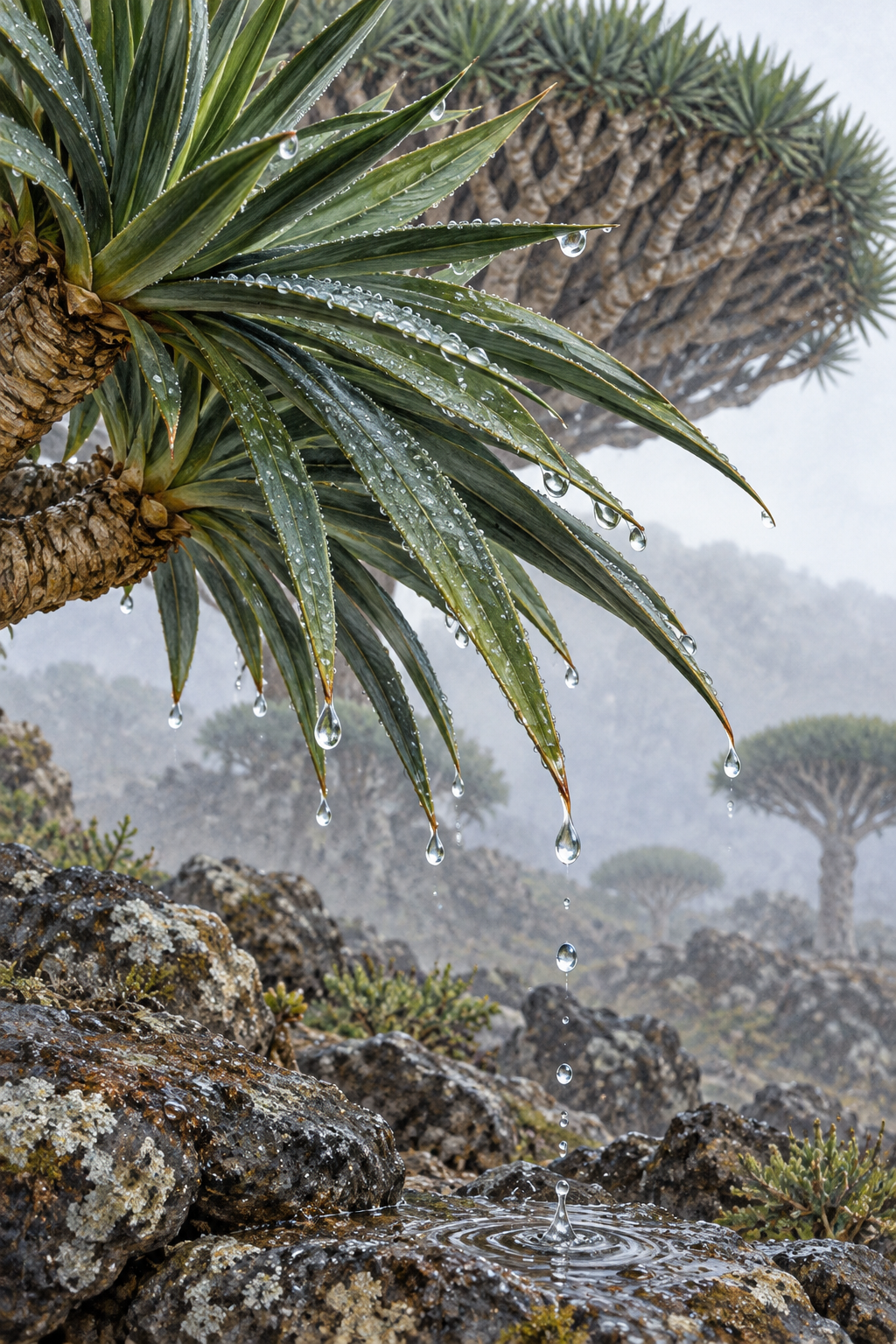
Close-up of water droplets on the narrow leaves of a dragon's blood tree.
Leaf surfaces can intercept mist, while the crown shades the ground. This close-up is conceptual, not a measured water balance.

The missing generation can be almost invisible

A long-lived adult can continue shaping a landscape while replacement is failing below it. Researchers studying Socotra have identified grazing pressure and environmental conditions as important constraints on regeneration. Young plants can be vulnerable even where established trees remain prominent. An apparently magnificent stand is therefore not enough to establish that a population is renewing itself.

For your next landscape photograph, try a three-stage audit. First look for reproductive adults. Then look for seedlings or small juveniles, remembering that these may be too small or too hidden for the image to reveal. Finally ask whether there is evidence that some young plants survive into larger stages. “Not visible” belongs in a different category from “absent.”

The stages suggest different conservation questions. Seeds must be produced and reach suitable sites. Germination must occur under suitable conditions. Seedlings must then survive dry periods, grazing and other hazards. Protecting one stage may be essential without automatically solving the next. A tree population persists through a sequence of successful transitions, rather than through adult survival alone.

What a nursery can teach

Ivana Hubalkova and colleagues followed seedlings from two Socotran source populations under controlled conditions in the Czech Republic. Their two-year study recorded growth repeatedly, including leaf development. The groups differed in aspects of leaf number and length, although their average final plant lengths were similar. Growth also varied seasonally despite the controlled setting.

The study makes the young tree less abstract. A seedling is a growing organism allocating resources over time, rather than simply a miniature umbrella waiting to expand. Comparing its leaves, survival and growth can help researchers understand early development. Those measurements are particularly valuable when field records of small plants are difficult to obtain consistently.

But a cultivated seedling has a different daily environment from one on Socotra. Controlled watering, protection and growing conditions change the challenges it faces. Successful germination in a pot answers an important propagation question. Establishment in a woodland asks an additional question about survival in the place where the tree ultimately needs to grow.

A fence turns a question into a comparison

A field study by Hana Habrova and Jindrich Pavlis followed vegetation inside and outside an exclosure on the Firmihin Plateau. Over five years, protection from grazing allowed substantial changes in woody vegetation. Outplanted dragon-tree seedlings performed relatively well, while seeds sown in the experiment did not germinate. The outcomes show why “just stop grazing” is an incomplete description of regeneration.

The protected plot helped test the influence of browsing. At the same time, the sowing result pointed toward the importance of suitable establishment conditions. The study's observations connected germination with protected, moist microsites. A fence changes access by animals; it does not guarantee that every seed receives the moisture and shelter it needs.

Imagine evaluating a conservation project using only the number of seeds distributed. That count would tell you something about effort but little about the future woodland. Following surviving seedlings through subsequent seasons supplies a different kind of information. The useful question becomes which stage is limiting recovery at a particular place, and whether the intervention addresses that stage.

A living landscape, with people in it

UNESCO describes Socotra through both its exceptional biodiversity and its indigenous inhabitants, language and cultural landscape. Livestock and other uses of land belong to people's livelihoods. Conservation decisions cannot be reduced to removing people from a picturesque scene. Local knowledge, practical grazing arrangements and long-term care of young trees matter alongside botanical measurements.

That perspective changes the umbrella's meaning. A mature crown can shelter a patch of ground, intercept moisture and draw our attention from far away. Its future depends on much smaller plants and sustained decisions around them. When you next see the iconic shape, look below it in your imagination: the most consequential part of the picture may be a generation that has not yet become conspicuous.

Explore more creative curiosity at Incoprea.

publications

New this week Two novels in six stories each, from The Night Shift . New — a novel in six documents Small Print A Novel in Six Do...