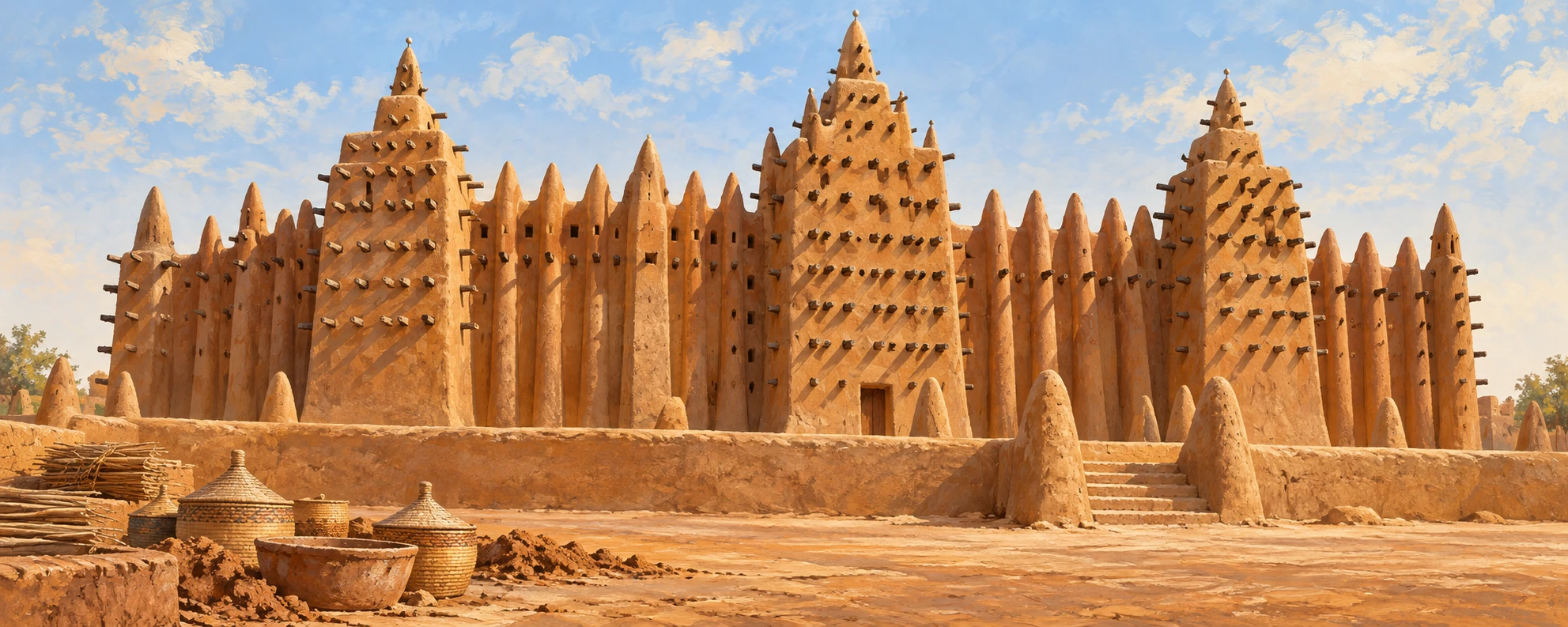
A photograph can make Djenné's Great Mosque look like a finished object: powerful earthen walls, projecting timber, and towers rising above an open square. A more revealing image is one in which people are working on the surface. The building endures through organized care, renewed material, and knowledge passed between generations.
That does not mean maintenance is effortless, or that a celebrated annual event solves every problem. The mosque belongs to a living town. Its care connects skilled masons, residents, religious life, drainage, resources, and decisions about what kinds of change are appropriate.
A continuing building, not a timeless scene
UNESCO's account dates the reconstruction of the Great Mosque to 1906–1907. It places the building within the Old Towns of Djenné World Heritage property, which also includes separate archaeological sites. The age of occupation in the wider area should not be confused with the construction date of the mosque standing today.
The distinction prevents an easy but misleading compression. A place can have a very long history while a prominent building has a much later form. Layers of rebuilding do not make the history less significant. They give it more than one date and more than one set of human decisions.
The same UNESCO account identifies the Barey corporation as a vehicle for transmitting building techniques. That makes knowledge part of the architectural story. Earth is a material; making it into a maintained sacred building requires learned practices and social organization.
Read for the work between the spectacular moments
The UNESCO record for an NHK film preserves its English narration about the town's earthen architecture and maintenance. The video file is currently marked unavailable, but the transcript can be read in two passes. First follow the descriptions of buildings. Then mark the actions performed by people. This separates an account of appearance from an account of continued work.
Ask what must happen before a surface can be renewed. Material must be prepared and moved; people need access to the wall; someone must know where attention is needed. A short narration can describe parts of that work, but it selects and compresses a much larger practice.
Do not turn this account into an eternal rule about every resident's role. A documentary narration describes practices under particular circumstances. Its closing language of continuity is itself worth examining: what does it emphasize, and which changes might fall outside its brief account? The record is not a current announcement inviting attendance at a festival.
Renewal needs judgment as well as repetition
The Aga Khan Trust for Culture's project account describes a 2006 study that identified structural risks despite regular maintenance. Accumulated material on the roof and walls had increased loads. Conservation beginning in late 2008 included roof rehabilitation, work on load-bearing walls, and collaboration with local masons.
This is a useful complication to the familiar celebration of annual replastering. Repetition preserves a practice, but a building's condition still needs assessment. More of a protective material is not automatically better in every location. A surface action can have consequences for the structure carrying it.
The lesson is about diagnosis rather than replacing local knowledge with a generic technical solution. The project describes working with the barey-ton and developing skills. Conservation requires conversation between the building's ongoing life, experienced makers, and evidence about particular problems.
Imagine being asked to judge a repair from one photograph taken after completion. A smoother surface might look reassuring. Yet the photograph alone would tell you little about loads, hidden damage, or the reason a material was added or removed. Appearance is one piece of a conservation assessment.
Beyond the walls: the city helps protect the mosque
The same project account extends beyond the building to public space, water management, and sanitation. This broader scale is essential. Water and waste do not respect the visual boundary between a monument and its surroundings. Caring for a square, a channel, or a route can contribute to the setting in which a landmark survives.
A dated source makes those everyday contributions more concrete. In its 2025 decision on Djenné, the World Heritage Committee acknowledged local civil society, including the youth association TAPAMA and the women's association Badenya de Dioboro. It described cleaning drainage channels and the mosque frontage after the Monday market. It also recorded continuing concerns about sanitation and conservation resources.
This is work that a dramatic architectural image can omit. A cleaned channel is less likely to become the cover picture than a tower. Yet the distinction between photogenic and necessary is a poor guide to what a living heritage place needs.
What does it mean for a building to remain itself?
For a structure whose surface is periodically renewed, survival cannot mean preserving every particle exactly where it was on one chosen day. It involves continuity in form, material practice, use, and the relationships that make care possible. That continuity can include debate and adaptation rather than automatic agreement.
It is equally misleading to say that constant renewal makes the material unimportant. Material choice is part of the knowledge being sustained. A repair can change texture, behavior, and appearance. The fact that maintenance is expected makes careful decisions more necessary, not less.
The most useful view of the Great Mosque therefore holds two images together: the striking architectural form and the people whose repeated work sustains it. The building is neither frozen outside history nor remade from nothing each year. It is a continuing achievement, dependent on attention, skilled judgment, and a town whose needs extend beyond the camera's frame.
Sources and further exploration
- UNESCO: Old Towns of Djenné
- Aga Khan Development Network: Earthen Architecture Programme, Mali
- UNESCO World Heritage Committee decision 47COM 7A.31,2025
- NHK World Heritage 100: Old Towns of Djenné, hosted by UNESCO
Explore all 80 new articles · Browse the complete illustrated collection
Continue exploring art, ideas, and unexpected connections at Incoprea.