Showing posts with label Manuscripts. Show all posts

Thursday, October 22, 2026

Purple Pages, Silver Words: The Material Life of a Luxury Manuscript

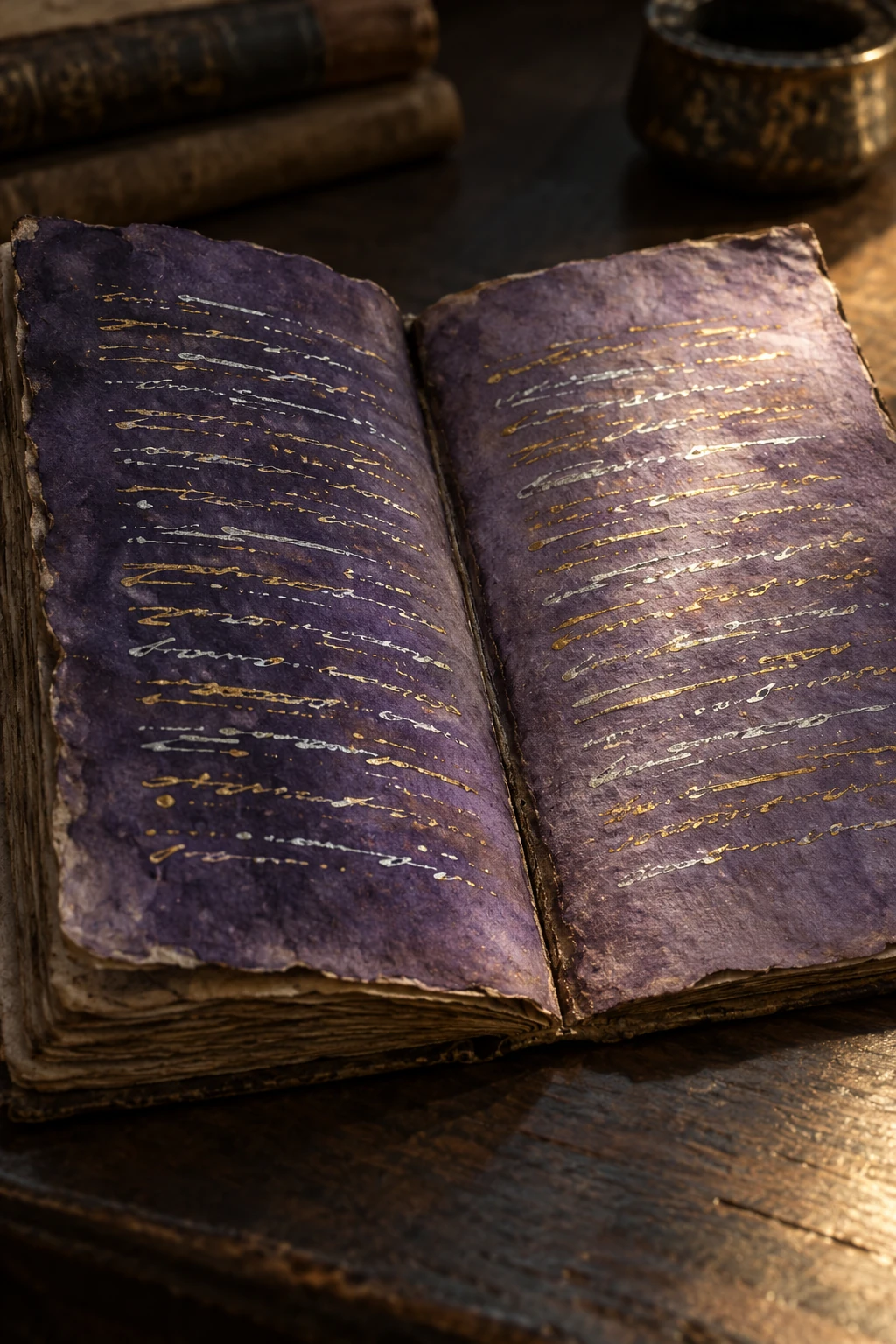
An illustrative purple parchment codex with abstract silver and gold pen strokes, softly lit on a dark desk.
Manuscript material study. The marks are non-readable illustrative strokes, not a facsimile or invented ancient text.

A page does not have to be white. In a luxury manuscript, the writing surface itself can be a deep purple, with letters in silver or gold. The book announces a material ambition before a reader identifies a single word.

Yet the color is a question, not an answer. Purple parchment does not automatically mean one particular dye. Metallic-looking writing does not explain itself from a photograph. A careful encounter with these books moves between appearance, catalog history, and material analysis.

Two books, several centuries apart

The Codex Argenteus at Uppsala University Library was written in Italy in the early sixth century in silver and gold ink on purple parchment. Its Gothic text is a major surviving source for that language. The book matters for what it says and for the unusually rich material form in which the words survive.

Compare it with the Golden Gospels of Henry VIII at the Morgan Library. Made in Trier around 980, it was copied by about sixteen scribes in gold on purple parchment. The Morgan identifies the coloring as orchil, a lichen-derived colorant. Its familiar title comes from an owner centuries after its manufacture. A book’s present name is not necessarily a description of who commissioned or made it.

Putting these manuscripts together does not make their materials, institutions, or circumstances identical. It reveals a recurring attraction to a richly colored page and luminous lettering, while leaving room for distinct choices in different workshops and periods.

What is the purple made of?

Because purple is associated with prestigious ancient dyes, it is easy to assume that every purple book used a rare shellfish colorant. Material evidence can complicate that assumption. A 2017 scientific-research conference abstract on Morgan manuscripts explicitly frames the question of whether costly traditional colorants or more readily available alternatives were used.

A spectroscopic study of the sixth-century Codex Rossanensis reported evidence for an elderberry-based lake among its purple materials. That result belongs to that studied manuscript. It is a reason to investigate, not a license to assign elderberry to every purple page in a museum case.

The useful lesson is about categories. “Purple” is a visual description. “Orchil” or “elderberry lake” is a material identification that needs a source and method. “Imperial” is a historical interpretation of use or symbolism. A single adjective should not silently perform all three jobs.

Metal letters change the act of looking

A bright letter can become dark when the viewing angle changes. A digital photograph freezes one combination of illumination, surface condition, and camera position. It can make a reflective mark seem like a flat patch of color. Without access to the actual book, the reader depends on careful photography and documentation to understand its surface.

The Library of Congress record for the Purple Gospel offers a digitized encounter with another manuscript written largely in gold and silver on purple-stained parchment. Such images are valuable because they permit repeated, close viewing. They still do not reproduce the weight, flexibility, reflectance, and scale of the physical leaves.

Try comparing two photographs of one manuscript page, if its holding institution provides them. Do apparent dark areas move? Does a line look interrupted in one image but continuous in another? Treat the variation as a question about the imaging and material surface before assuming damage or a change in the original text.

Read the page as a made object

A useful close-looking sequence starts at the margin and moves inward. First locate the edge of the leaf. Then find the text block. Notice how blank space, columns, line spacing, enlarged letters, and metallic emphasis organize the reader’s attention. Only after that should you ask what an individual word means.

This approach is useful even if you cannot read Gothic, Latin, or Greek. It gives you access to decisions about the physical page without pretending language does not matter. Layout can be observed; translation requires linguistic knowledge; identifying the materials may require scientific analysis. These routes complement one another.

Uppsala’s Codex Argenteus Online project also reminds us that a manuscript continues to acquire scholarly forms through editions and digitization. The ancient object and the modern tools for reading it have different histories.

When viewing a full opening, compare the left and right pages before enlarging a single letter. Does the color appear continuous across them? Are the text blocks balanced? A stain, different lighting, or a replacement image may interrupt that apparent unity. Noticing an interruption supplies a question for the catalog; it does not yet identify the cause.

Hear a modern encounter with an old page

The manuscript also has an afterlife in sound. Uppsala University’s listening page offers Sven Sandblom’s recital of a Gothic text and his modern choral setting of Atta unsar. The page identifies the singers as members of Chorus Ena, directed by Lena Westberg, and provides a score. These are contemporary performances associated with the manuscript’s language, not recordings of sixth-century readers or a recovered ancient melody.
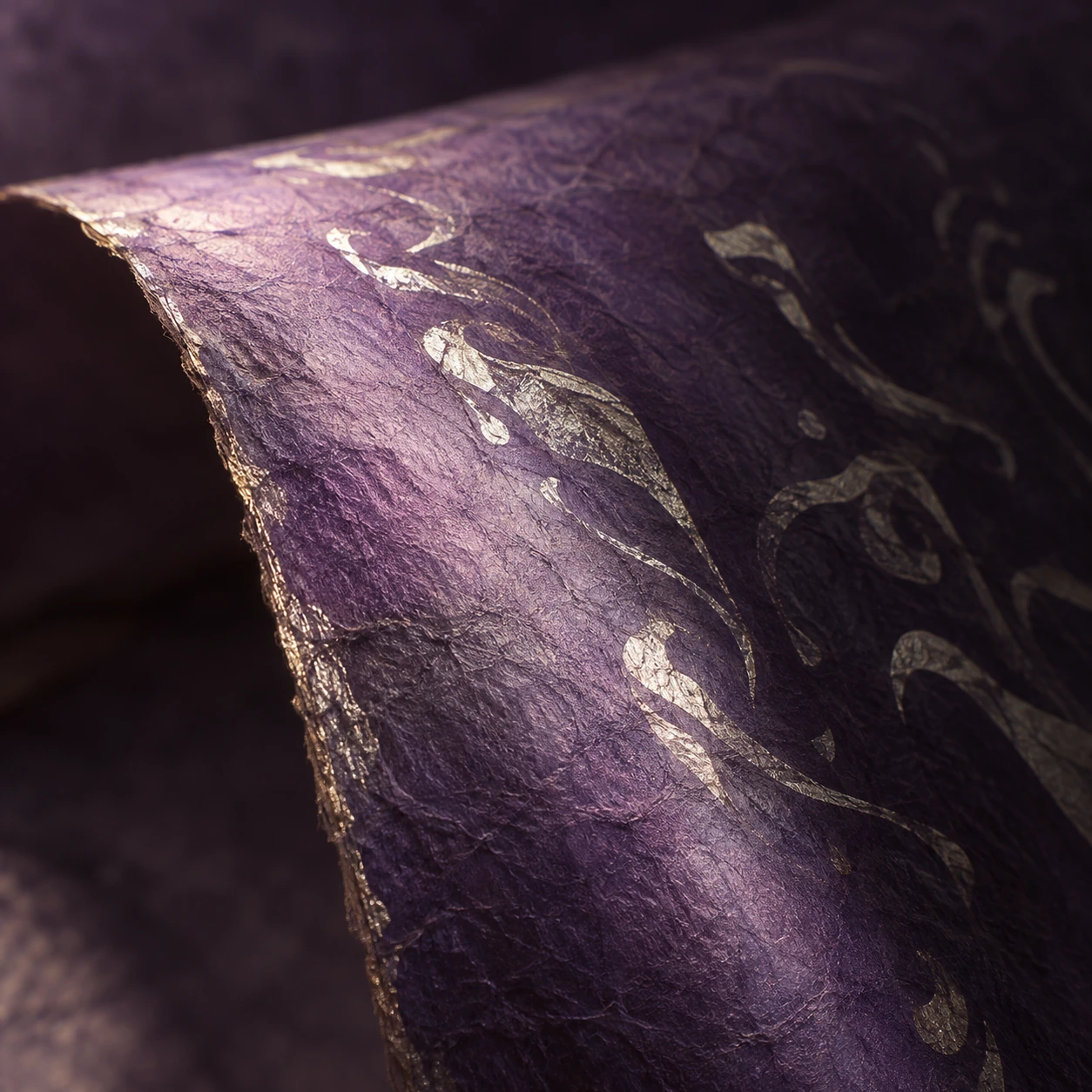
Reflective silver-like abstract strokes catch light on a curved purple parchment surface.
Material and light study. The strokes are not manuscript text.

For a short listening visit, start with the recital and concentrate only on where the speaker pauses. Then try the choral setting and notice where musical duration changes the apparent size of a phrase. You need not know Gothic to hear that speech and choral composition organize time differently. To understand the words, use the identified text and scholarly language resources rather than guessing meanings from familiar-sounding syllables.

If listening is inconvenient, the score gives a visual route into the comparison. Look for repeated passages, held notes, and the distribution of words across the staves. These observations concern the modern composition. They tell us about one later response to the manuscript, while leaving the original book’s performance history open.

Uppsala’s history of the codex offers another useful separation. Its familiar silver cover was supplied with Magnus Gabriel De la Gardie’s seventeenth-century donation; the purple manuscript leaves are much earlier. A lavish cover in a display photograph should therefore not be used as direct evidence for the binding under which the first readers encountered those leaves.

Make a three-line caption for an imagined exhibition: the first line dates the surviving manuscript; the second identifies the later cover; the third identifies a modern sound recording. All three belong to the history of people encountering the book. Their importance does not depend on pretending they happened together.

The exercise changes what “the manuscript” means in a museum visit. There is a surviving material object, a succession of later presentations, and a continuing field of responses in print, images, and music. Keeping those layers visible gives the old page more relationships, while preserving the particular evidence each relationship can provide.

A small experiment in attention

Use two sheets of ordinary colored paper, one pale and one dark. Write the same short original sentence on each with whatever light and dark pencils you already have. Do not use valuable materials or attempt historic dye recipes. The point is to compare reading, not reconstruct a manuscript workshop.

  1. View both pages from across a table. Which marks are legible first?
  2. Move closer and compare whether the background feels empty or visually active.
  3. Change the lighting direction. If a pencil has any sheen, notice how its appearance shifts.
  4. Leave a wide margin on one version and a narrow margin on another. Observe how the material and spacing work together.

The result is not evidence about medieval readers’ feelings. It is an exercise in noticing how a writing surface participates in the presentation of words. A color that looks sumptuous may also make an unusual demand on contrast and light.

The purple page is therefore more than a lavish container for a text. It is the outcome of decisions about skin, color, metal, labor, authority, and reading. The strongest museum question is wonderfully simple: which of those decisions can this particular book still help us understand?

Sources and a closer look

Uppsala University Library: Codex Argenteus; Morgan Library: Golden Gospels of Henry VIII; Scientific research abstract: Royal Purple and Burgundian Black; Codex Rossanensis spectroscopic study; Library of Congress: Purple Gospel; Uppsala: Codex Argenteus Online project.

Find more art, ideas, and unexpected connections at Incoprea.

Wednesday, October 14, 2026

Dunhuang's Library Cave: An Archive Larger Than Its Nickname

Start with a room, then imagine the scale of what came out of it. In 1900, Wang Yuanlu discovered a sealed chamber at the Mogao Caves near Dunhuang in northwestern China. The objects associated with that small space now support research across languages, religions, book forms and everyday activities.

“Library Cave” is a convenient name, but it can mislead if it suggests shelves of uniformly bound books. Cave 17 held manuscripts, printed documents, paintings, textiles and other materials. To explore it well, follow one object closely, then step back to consider the extraordinary range around it.

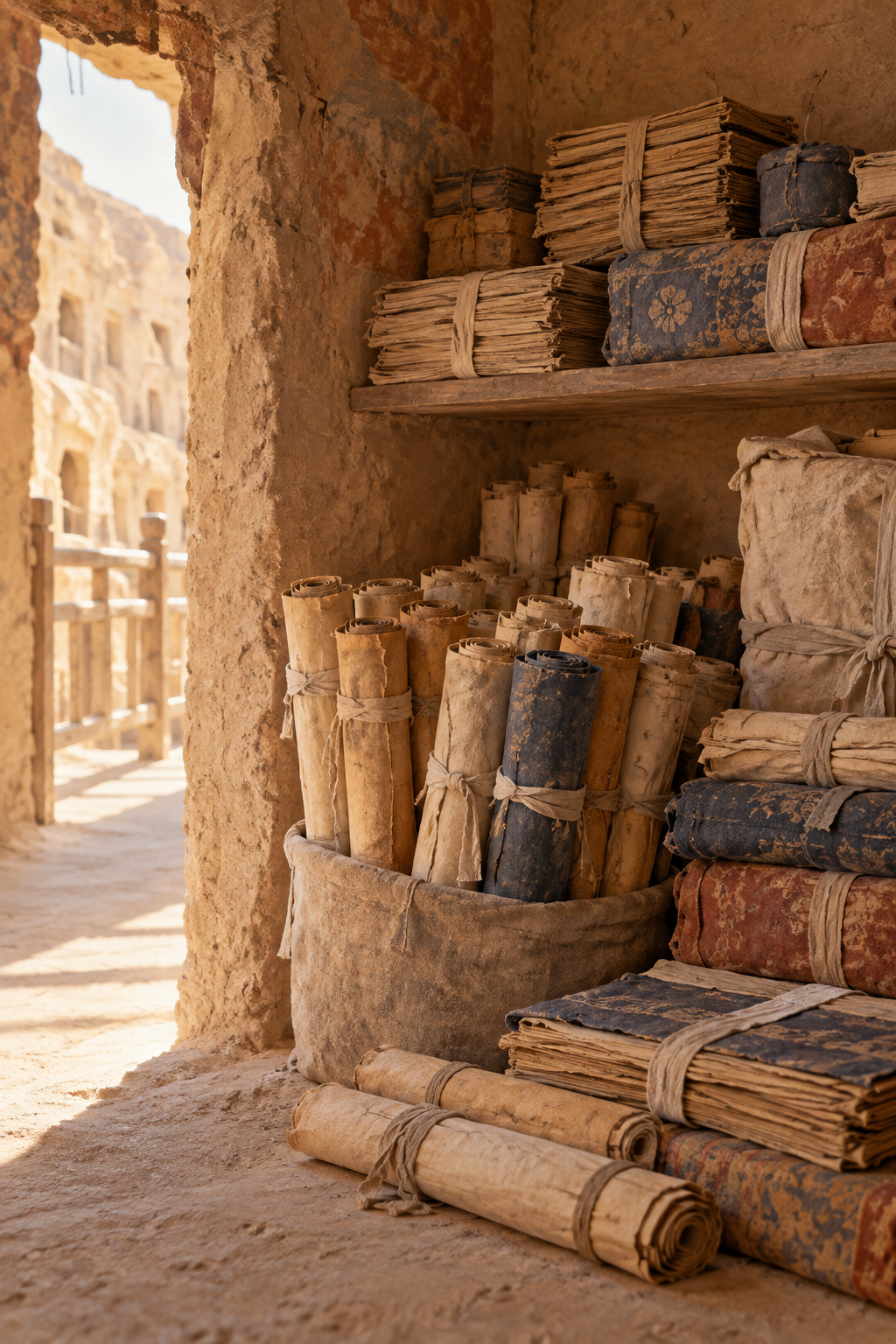
Illustration of imagined manuscript bundles in an earthen storage alcove.
This conceptual storage scene is not a reconstruction of Cave 17 as first found; the original arrangement is uncertain.

A collection of activities, not just titles

The International Dunhuang Programme introduces a collection in which Chinese and Tibetan materials stand alongside smaller groups in Khotanese, Turkic, Sanskrit and Sogdian. The presence of several languages reflects connections among people who did not all write, read or worship in the same way.

Buddhist texts form a major part of the archive, while legal, official and other practical records reveal further uses of writing. Scrolls, booklets, concertinas and loose-leaf forms ask different things of a reader's hands. The format of an object can tell us something before its language becomes accessible.

A scroll presents information by unrolling a length. A booklet allows pages to be turned. A folded format makes other kinds of opening and sequence possible. Thinking about those actions helps restore reading as an activity. A digitised rectangle is the surface of something that was handled.

Follow the Diamond Sutra beyond its famous date

Among the best-known objects is the printed Chinese Diamond Sutra dated to 868. IDP's introduction explains its importance as a Buddhist text and identifies this copy as the earliest dated printed book. The distinction is about a surviving, dated object; it does not mean printing began on that day.

The scroll offers more than a timeline landmark. Its opening illustration, extended text and concluding information invite different kinds of looking. IDP explains that seven printed sheets were joined into the scroll and describes the dedication associated with Wang Jie and his parents.

That dedication connects reproduction to religious intention. Printing was a way to make and circulate a meaningful text, not simply an early attempt to invent the modern publishing industry. Ask what the object was for before asking which later technology it resembles.

The date of the surviving copy is also distinct from the age of the teaching it transmits, the date of a translation and the later history of its storage. A single scroll can hold several chronological layers. Keeping them separate makes the object more informative rather than less impressive.

Discovery changed the archive

Wang Yuanlu had taken responsibility for restoration at the caves before finding the chamber. IDP's discovery account describes his custodianship and the acquisition of large groups of objects by visiting foreign scholars. Aurel Stein obtained materials in 1907; Paul Pelliot followed in 1908.

The subsequent dispersal is part of the history readers need. Present-day collections reflect decisions about selection, acquisition, transport and cataloguing as well as the activities of the people who originally made the objects. A library record is therefore also a record of how an item entered a modern institution.

Nor can a dramatic storage image recover an untouched arrangement at discovery. The contents were disturbed before later documentation. The illustration here suggests density and variety, but should not be used to infer the exact location of a bundle inside the chamber.

A three-object visit you can make online

Open the IDP manuscript introduction, then follow its collection links. Choose three objects for different reasons: one for its format, one for its language and one for its subject or use. They need not be famous.

Questions for a miniature reading room
Your objectBegin withThen consult
A striking formatHow would someone open or hold it?Dimensions and material description.
An unfamiliar scriptHow are lines and spaces arranged?Language identification and scholarly description.
A practical documentWhat action might the record support?Translation, date and provenance.

For each, write down one observation available from the image and one fact that depends on the catalogue. This small separation helps avoid treating a visual impression as a translation. It also shows why digital access works best when photographs and records stay connected.

If a scan contains several sheets or views, follow their order. A frontispiece alone can make a religious scroll seem like an independent picture. A fragment alone can conceal the scale of a larger work. Digital interfaces are useful tools, but the reader still has to reconstruct the relationship among parts.

The people behind the paper

The British Library's 2024–2025 exhibition “A Silk Road Oasis” used roles including scribes, printers, merchants and religious practitioners to explore Dunhuang. That approach remains useful after the exhibition's closing date. Documents are traces of people doing things, not simply specimens of scripts.

A copied teaching, a legal record and an image might have circulated within overlapping communities while serving very different purposes. Their differences make the archive rich. “Silk Roads” names a field of connections; the object gives those connections a particular material form.

By the end of a short digital visit, the chamber can seem larger than it did at the beginning. Its significance lies partly in celebrated treasures, but also in the ability to set unlike records beside one another. The best next question is often modest and specific: who needed this object, and what did its format allow them to do?

Sources and further reading

Explore more art, stories and discoveries at Incoprea.

The Derveni Papyrus: A Book Preserved in the Remains of a Fire

A book can survive because something went wrong. The Derveni papyrus is a particularly unsettling example: the roll was charred in a funerary setting, and the damaged remains preserved writing that would otherwise probably have disappeared in the Greek climate.

Its contents produce another surprise. This is a text about interpreting a text. An ancient commentator works through a poem attributed to Orpheus, arguing that its language carries an account of the world beneath its stories about gods. Modern readers encounter that interpretation through another layer of work: the reconstruction of a fragile, incomplete manuscript.

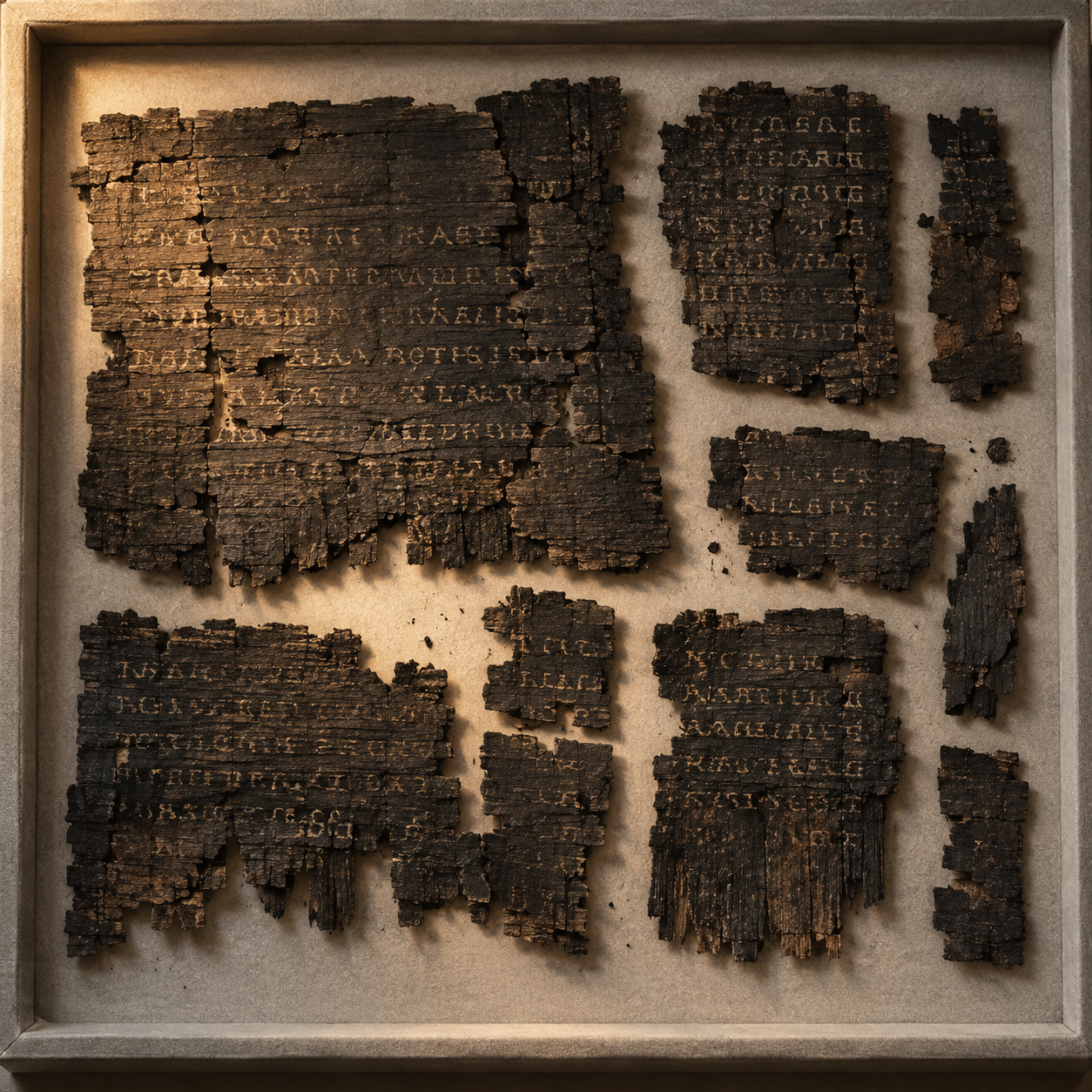
Illustration of imagined carbonized papyrus fragments laid out for conservation.
The invented fragments evoke carbonized papyrus; their marks are not a facsimile, a transcription or a proposed restoration.

What survived the pyre

The papyrus was found in 1962 at Derveni, near Thessaloniki, among remains associated with a funeral pyre. The Archaeological Museum of Thessaloniki dates the writing to roughly 340–320 BCE. The work being copied is considered older, so the surviving physical roll and the composition it transmits belong to different moments.

Only part of the roll remained. Specialists separated charred layers and joined fragments, recovering portions arranged into twenty-six columns. The lower areas had been lost. A display of ordered columns can make the result look surprisingly complete, but that orderly presentation is itself a major scholarly achievement.

Picture the work at two scales. A fragment may preserve a few strokes or letters. A reconstructed column needs those fragments to occupy defensible positions. The entire roll then requires a larger sequence. Moving from carbonised pieces to readable argument involves several kinds of comparison, not just improving the visibility of ink.

An ancient reader explaining another voice

The Center for Hellenic Studies describes religious instructions alongside allegorical commentary on a theogonic poem, a poem concerning the origins and relationships of gods. The commentator treats its language as something to be explained rather than merely repeated.

That distinction is the heart of the book's appeal. A summary would tell us what happens in a poem. Commentary asks why particular words are used, how they should be understood and what account lies behind them. The reader doing the explaining becomes a forceful presence of his own.

Classicist Jeffrey Rusten's study draws attention to the relationship between quotation and explanation, including how the physical width of a column could accommodate a verse. Format and argument meet: a book can visually organise the movement from an earlier line to a later reader's discussion of it.

A modern analogy might be a heavily annotated edition in which short extracts sit inside an extended interpretation. The analogy helps with structure, but should not determine the author's purpose. The Derveni text belongs to its own religious and intellectual environment, where categories such as philosophy, ritual and poetry overlapped differently.

Three speakers, three different questions

It helps to give each layer its own question. What does the poem say? What does the commentator claim it means? What can an editor recover from the surviving papyrus? Those questions are connected, but an answer at one layer cannot simply be substituted for an answer at another.

A commentator's explanation is evidence for an ancient act of interpretation. It is not automatic proof of an original poet's intention. Similarly, an editorial restoration can make excellent sense without being a surviving letter on the papyrus. Both distinctions allow us to appreciate the work more precisely.

The attribution to Orpheus also belongs to the text's cultural world. It should not be treated as a verified signature by a historically documented author. The identity of the commentator remains debated. Assigning a familiar name too confidently would close a question the material does not settle.

A reader's tour of a reconstructed column

The Center for Hellenic Studies' online text lets you see the visible machinery of an edition. You need not read Greek to notice column numbers, line numbers, brackets, dots and spaces. These marks turn uncertainty into something that can be discussed.

  1. Choose a short stretch where the printed text is relatively continuous. Notice how the line divisions are displayed.
  2. Find a nearby area with brackets or an extended gap. Compare the amount of surviving-looking text with the amount supplied or left open.
  3. Read the edition's conventions before deciding what an individual symbol means. Editors can distinguish several kinds of uncertainty.
  4. Return to an institutional photograph of the fragments. What work has the printed arrangement made easier to follow?

The exercise is about recognising the kind of object an edition is. A clean translation offers access to an argument; an edited text exposes some of the decisions that make that access possible. Read together, they provide a fuller experience than either can offer alone.

The CHS project page also lists its 2006 edition and a later treatment of the opening columns. Some older linked tools may depend on legacy hosting, but the project's introductions and text pages still show the collaborative character of the work. Disagreement about a passage can be a productive comparison of evidence.

Why the damage remains part of the story

UNESCO placed the Derveni papyrus on its Memory of the World register in 2015, recognising its significance for Greek religion and philosophy. The distinction celebrates a rare survivor, not a claim that every line has become certain.

Its unusual preservation also changes the way we imagine ancient books. The surviving collection of texts from any period depends on conditions of storage, destruction, copying and recovery. What happens to survive is not a neutral sample of everything people wrote.

The papyrus finally offers a meeting between readers. Someone in antiquity believed a difficult poem required close explanation. Modern specialists believe damaged remains deserve equally close attention. We can join that meeting by taking both the argument and the gaps seriously, allowing the book to be incomplete without making it silent.

Sources and further reading

Explore more art, stories and discoveries at Incoprea.

The Bakhshali Manuscript: A Tiny Dot and a Big Dating Lesson

Write 105, then remove the zero. The remaining 15 is not simply a shorter spelling of the same number. The empty position is doing work. A tiny mark can organise a number, and the Bakhshali manuscript preserves dot-shaped zeros within a much larger tradition of mathematical calculation.

The manuscript also supplies an unusually good lesson in dating evidence. Bark, ink and mathematical ideas each have a history. When a measurement changes the age assigned to one layer, it does not automatically date the other two. The more carefully those layers are separated, the more interesting the surviving book becomes.

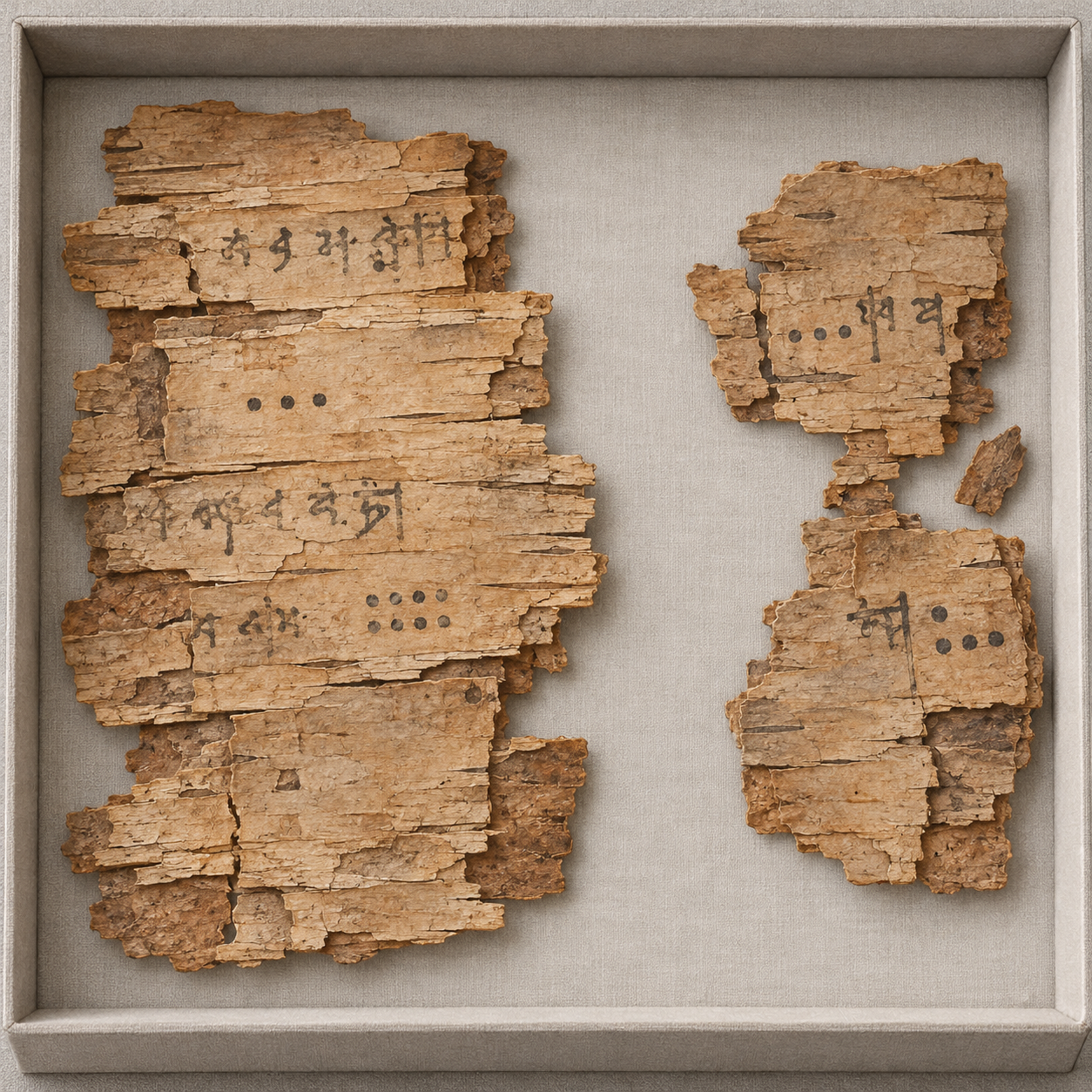
Illustration of imagined birch-bark mathematical manuscript fragments in a conservation tray.
These invented fragments evoke a fragile writing surface; the marks are not a facsimile or a readable mathematical text.

Begin with the mathematics

The manuscript was found in 1881 near Bakhshali in present-day Pakistan and is held at Oxford's Bodleian Libraries. Its surviving birch-bark folios preserve a Sanskrit mathematical work with regional linguistic features. The material is fragmentary, but rules and worked examples give researchers more than isolated numerical symbols.

A worked problem preserves a sequence: state a task, apply a method, obtain a result and sometimes check it. That sequence helps historians investigate what a notation actually does. A dot's appearance is a beginning, while its role inside a calculation supplies further evidence.

Think of a modern exercise in which a blank box stands for an unknown number. Its shape is not enough to tell us its function. The surrounding instruction might ask us to fill the box, add a quantity or compare results. Historical mathematical notation also needs to be read in context.

Three jobs for a small mark

A placeholder distinguishes positions in a numeral. Zero as a number can participate in arithmetic. A symbol can also stand for an unknown quantity. These ideas are related, but they are not identical, and a single visual form can be used within more than one procedure.

In their response to the 2017 dating announcement, historians Kim Plofker and colleagues challenged the description of the manuscript's zeros as merely placeholders. They considered large-number operations and a rule involving substitution for an unknown, arguing that the mathematical procedures complicate such a sharp division.

Their point is valuable even if you do not follow every Sanskrit term. To understand a mathematical symbol, examine the actions performed with it. A claim about the writer's concepts should be supported by the calculations, rather than deduced solely from whether the mark looks like a dot or a circle.

Try a modern comparison. In 105, the zero distinguishes the tens position. In 5 minus 5 equals 0, it is an arithmetic result. In “a number plus 5 equals 12,” an empty space might indicate the unknown 7. These are teaching examples, not transcriptions of Bakhshali problems.

Why the 2017 headline needed revision

Oxford's 2017 announcement drew attention to widely separated radiocarbon results from three pieces of bark, including an early date in the third or fourth century CE. The announcement connected that finding with the history of the zero symbol. Specialists questioned how the samples should be related to the writing and the manuscript as a whole.

A 2024 Oxford report provides later determinations for five folios and a new model. It places the start of the dated bark-formation phase within 799–892 CE and its end within 900–1102 CE, at the stated 95.4 percent probability level. These are modelled boundaries, not two precisely observed days of copying.

The report makes the central distinction explicit: radiocarbon concerns the formation of the bark. Ink must be applied after its writing surface exists, but it can be applied later. The composition of a mathematical rule can be older still, transmitted through copies that have not survived.

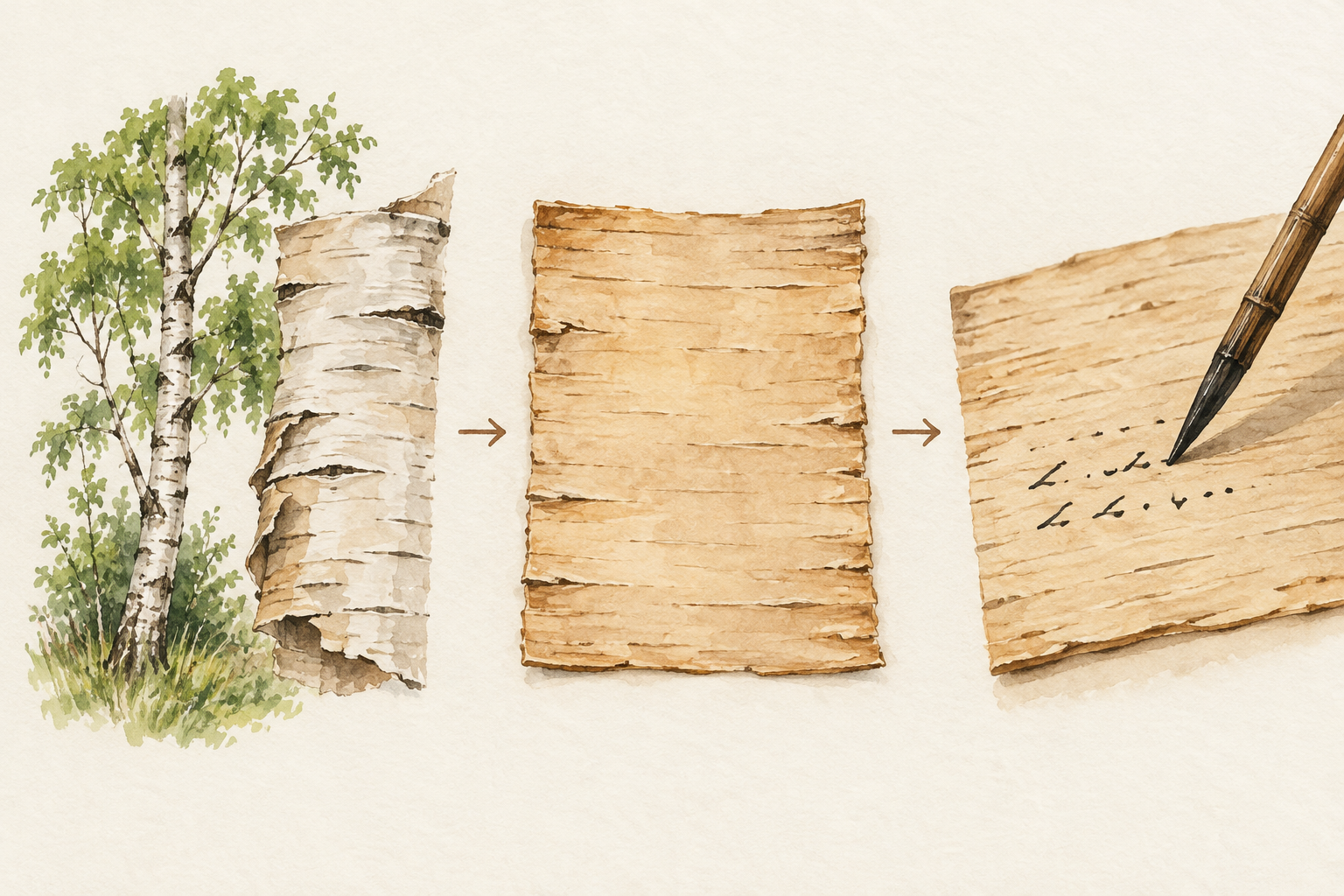
Conceptual sequence from a birch tree to a blank bark sheet and the act of writing.
The surface must exist before it can carry writing. This conceptual sequence does not document the manuscript's exact manufacture.

The layered illustration is a conceptual aid. It does not reproduce a measured folio or assign a time interval between bark formation and writing. That interval has to be investigated with evidence rather than supplied by the attractiveness of a sequence.

A dating exercise with three clocks

Imagine an old notebook copied from an even older textbook. A laboratory tests the paper. A handwriting specialist studies the script. A historian compares the problems with other books. Each investigator can be right while addressing a different date.

Which clock is being read?
EvidencePrimary question
Radiocarbon of barkWhen did this sampled organic material form?
Handwriting and physical structureWhen and how was the surviving copy written?
Comparison of mathematical worksHow were rules and ideas developed and transmitted?

Now test a headline: “The oldest piece of bark gives the invention date of zero.” Which links would have to be demonstrated? You would need a defensible relationship between the sample and the writing, and then between that particular copy and the first development of the idea. The short headline skips both.

That does not make material dating unhelpful. It makes its proper question more precise. Several independent kinds of evidence can strengthen a chronology, especially when a proposed interpretation explains how apparently conflicting results fit together.

Read the report as an argument

Open the 2024 Oxford report record and follow its document link. Look first for the folio identifiers, then for the discussion of modelling. Compare its language with the earlier announcement, keeping the publication dates in view.

The manuscript's value survives that comparison. It remains evidence of people teaching, calculating and checking through a sophisticated mathematical tradition. A later surviving copy can preserve earlier knowledge; an earlier surface cannot by itself establish when every idea was invented. The dot is small, but reading it well requires a generous view of the book around it.

Sources and further reading

Explore more art, stories and discoveries at Incoprea.

Timbuktu's Manuscripts: A City of Readers, Teachers and Scribes

Begin with three pages rather than a legend about a distant city. One has a diagram of the heavens. Another turns commercial obligations into verse. A third uses examples to teach arithmetic. The manuscripts associated with Timbuktu become more vivid when we ask what a reader was expected to do with a particular page.

Timbuktu, in Mali, was a place people travelled towards for learning, trade and religious study. Its handwritten books preserve an intellectual culture of teaching, copying and argument. Their value is not confined to age or rarity. They let us investigate scholarship as a set of activities carried out by people.

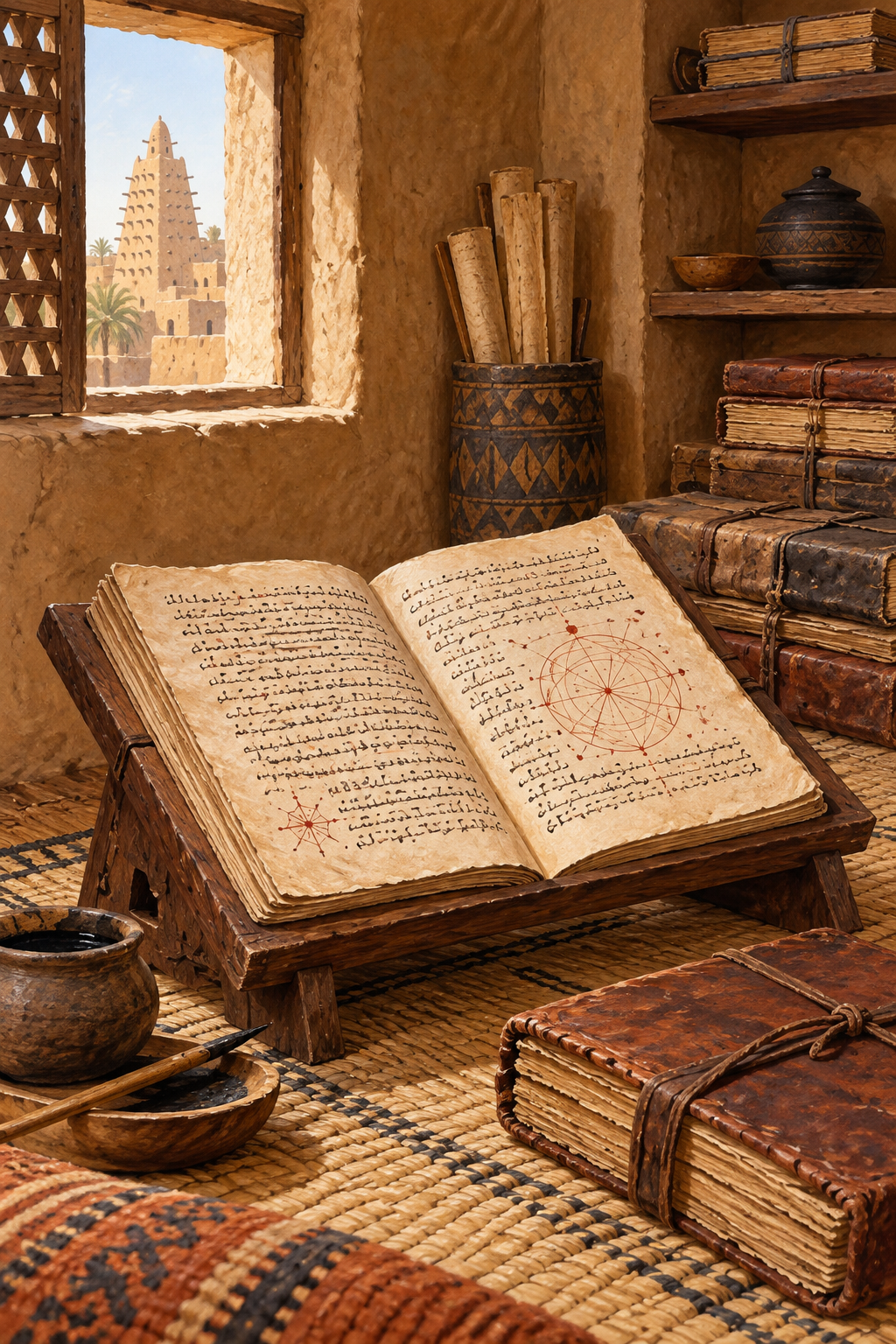
Illustration of an open manuscript, geometric diagram and leather-covered books in a Timbuktu-inspired study.
An imagined scholarly setting; the marks and diagram do not reproduce a specific manuscript.

Three objects with different jobs

The Library of Congress's online exhibition includes an astronomy work copied in 1733, with a diagram of the rotation of the heavens. Its description connects stellar motions with reckoning the seasons. A diagram organises relationships visually, giving the reader a different route into an explanation from continuous prose.

A second item presents laws of commerce in verse. The exhibition explains that verse supports memorisation of obligations in transactions. Here a form we may associate chiefly with poetry also serves instruction. Rhythm and verbal organisation can help a learner retain material needed beyond the page.

The arithmetic commentary by al-Rasmuki explains a work by al-Samlali through charts and worked problems. The exhibition places it within teaching in Timbuktu and North Africa. The example is concrete: a commentary can transmit a prior work while actively making its rules usable for another reader.

All three were loaned to the exhibition by the Mamma Haidara Commemorative Library. Keeping that custodial connection attached to them helps prevent the pages from becoming anonymous illustrations of an entire continent's scholarship.

Look for the teaching in the layout

A page is a set of decisions about attention. A diagram sets some relationships beside one another. A heading separates a new subject. A chart can make a procedure easier to follow. A copied page has to arrange those elements within the writing surface available.

Even if you do not read the script, you can begin by noticing differences in density, spacing and the placement of images or tables. Those observations do not translate the text, but they help you ask the catalogue a more precise question: how is this page helping someone learn?

Try comparing a dense page of explanation with a diagrammatic one. Which could be followed line by line? Which asks the eye to move around a field? Which parts might a teacher point to while explaining? These are questions about an object's use, rather than judgements about whose page looks more familiar.

Copying is intellectual work

Many surviving manuscripts are copies of works that existed earlier. That does not make them interchangeable duplicates. A copy requires materials, time and skilled decisions, and can later accumulate evidence of reading and ownership.

The University of Hamburg's project on scribes in the “Timbuktu archive” examines copying as a practice of preserving, transmitting and producing knowledge. It asks how professional scribes, students and scholars differed, and what material and decorative features can reveal about their work.

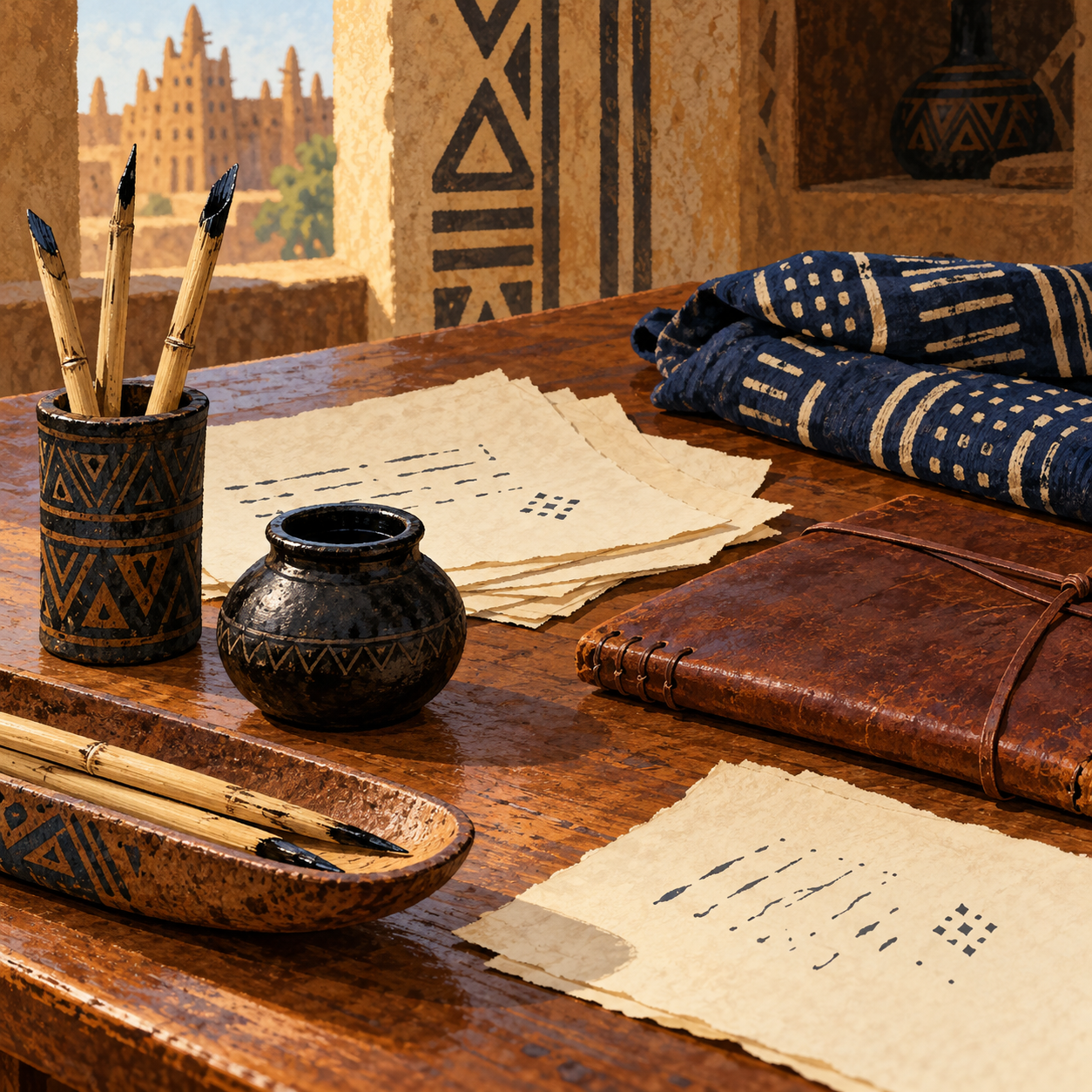
Illustration of reed pens, ink, writing sheets and book coverings.
Manuscripts also tell stories about materials and skilled copying. The tools and indistinct writing are imagined examples.

The writing-tool scene is an interpretation, not a reconstruction of one manuscript's production. The research questions direct us back to actual objects: the hand, paper, ink, structure and evidence of use. Each can contribute information that a transcription of the words alone would leave out.

The project also draws on testimony and practices of living scribes. A manuscript tradition contains knowledge carried by people as well as by pages. Understanding a tool or a copying convention may require conversation and observation alongside the examination of an old book.

Make a small digital seminar

Open the Library of Congress exhibition. Use its enlarged images to visit “Structure of the Heavens,” “Laws of Commerce in Verse” and “Arithmetic Primer.” You can inspect all three without needing to turn them into a single story.

  1. For the astronomy page, describe how the diagram occupies space and how it relates to the writing.
  2. For the verse text, read the exhibition's explanation of its purpose. What does the chosen form help a student do?
  3. For the arithmetic page, look for divisions or organised examples. What would you want a teacher or translation to clarify?

Finish by assigning each object a verb: compare, remember, calculate, explain, or another action supported by its description. “Treasure” tells us that a page is valued. A verb starts to explain why someone needed it.

Keep the copy date separate from the dates of the author and underlying work. A later manuscript can carry earlier learning, and an earlier author can be encountered through several later copies. The movement of a text through time is part of the history a collection preserves.

A city connected through books

The Library of Congress overview places Timbuktu within commercial and scholarly connections extending beyond the city. People came for knowledge as well as goods. A book could be copied, taught, owned and transported through those relationships.

The broad phrase “Timbuktu manuscripts” can consequently gather objects with different histories and connections to a wider region. A particular item still needs its own provenance. Knowing where it is kept today is a beginning; knowing where and how it was made, read and moved enriches the account.

This also changes what preservation means. Saving a page protects future possibilities for reading and research, including questions that have not yet been asked. Digital photographs widen access, while records of ownership, materials and interpretation keep the photographs meaningful.

Return to the three opening pages. They no longer stand chiefly for distance or a hidden archive. They show people organising the heavens, remembering obligations and working through numbers. Timbuktu becomes a place of intellectual labour, and the manuscript becomes an invitation to join the work of looking closely.

Sources and further reading

Explore more art, stories and discoveries at Incoprea.

Palimpsests: The Books Hidden Inside Other Books

Turn a manuscript page and the lines seem to run in two directions. One hand has written across the page you are holding. A fainter hand belongs to a book whose original shape has disappeared. The same piece of parchment has served different readers, and neither history can be understood by looking only at its darkest words.

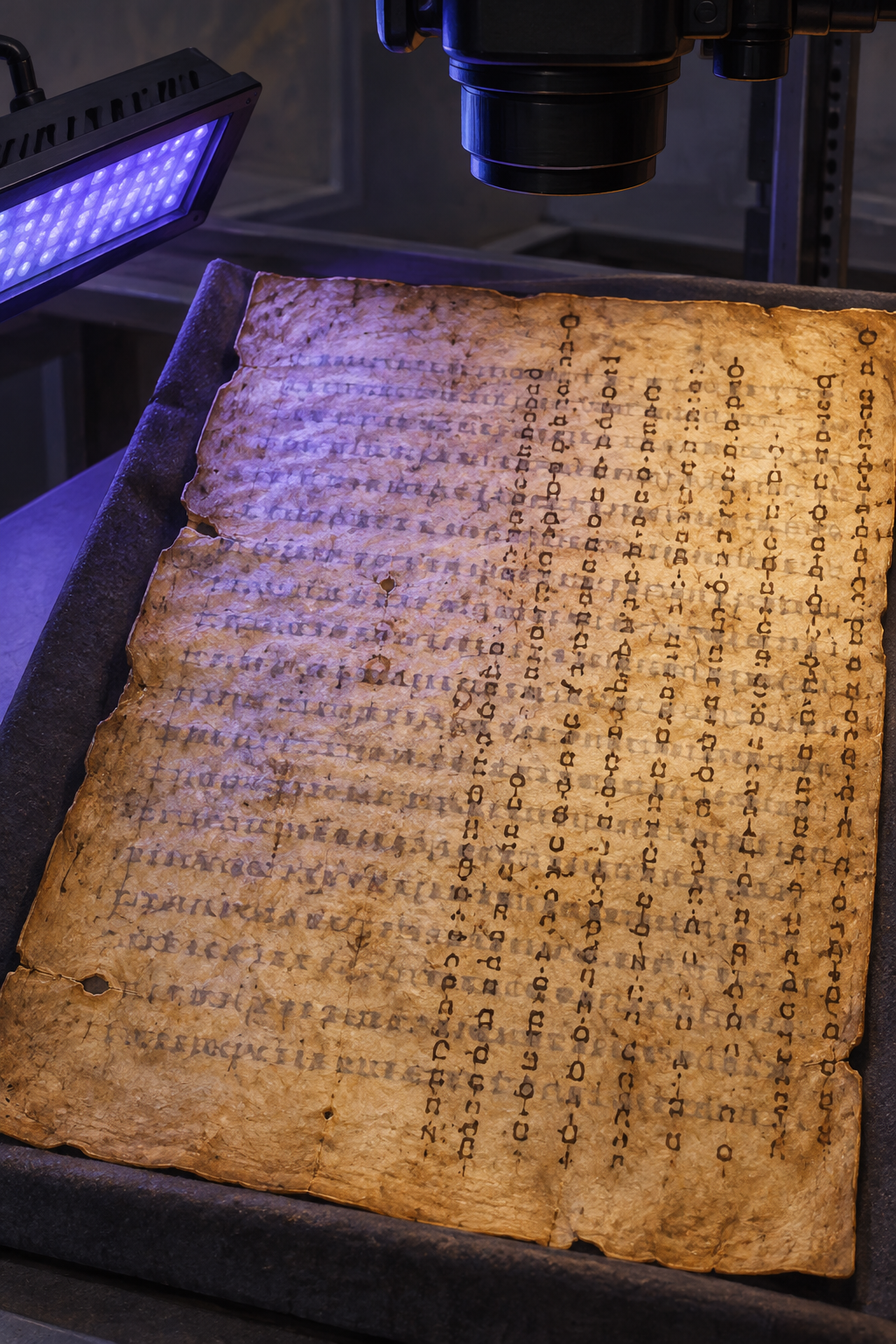
Overlapping manuscript layers on a parchment leaf beneath an imaging camera.
A conceptual conservation scene; the manuscript marks do not transcribe a real text.

A manuscript made from erased and reused writing material is called a palimpsest. The word can suggest a secret waiting for one magical camera. The actual investigation is more absorbing: a page has to be conserved, its material responses recorded, its old arrangement reconstructed, and its marks read by people who know what to look for.

The prayer book is real, too

The Archimedes Palimpsest Project’s account begins with a useful correction to the manuscript’s famous name. The object is a Greek prayer book completed in 1229. Its makers reused parchment from several earlier manuscripts, including a tenth-century copy containing works by Archimedes. These are medieval copies of ancient mathematical writing, not pages penned by Archimedes himself.

The reused material also carries works associated with the orator Hyperides and a commentary on Aristotle’s Categories. A single later binding gathered fragments of several earlier reading worlds. “The book underneath” is therefore not always one complete lost volume waiting to be restored.

The Walters Art Museum’s account describes leaves being cut, rotated, and refolded. Reusing parchment changed the orientation and order of writing as well as its visibility. A researcher needs to distinguish the later page sequence from the arrangement of the older leaves. That physical problem matters to the reading: adjoining marks on a photograph may have belonged to different pages in an earlier book.

It is tempting to cast the prayer-book makers as people who failed to recognize a treasure. A more useful question is what their material and devotional needs made possible at that moment. The prayers deserve study in their own right. Their survival and the survival of the undertext are now intertwined.

First preserve the page that carries the question

A conservation paper by the project team describes mold-damaged parchment, adhesive residues, and the work needed to prepare leaves for imaging. Some pages had also acquired modern painted images over the manuscript writing. The investigators were dealing with several kinds of interference, not one uniform layer of erasable ink.

This gives conservation a central role. A dramatic enhancement is of little use if the surviving source is damaged in obtaining it. The page holds information that a future technique or a different scholar may read more successfully. Caring for its material condition keeps those possibilities open.

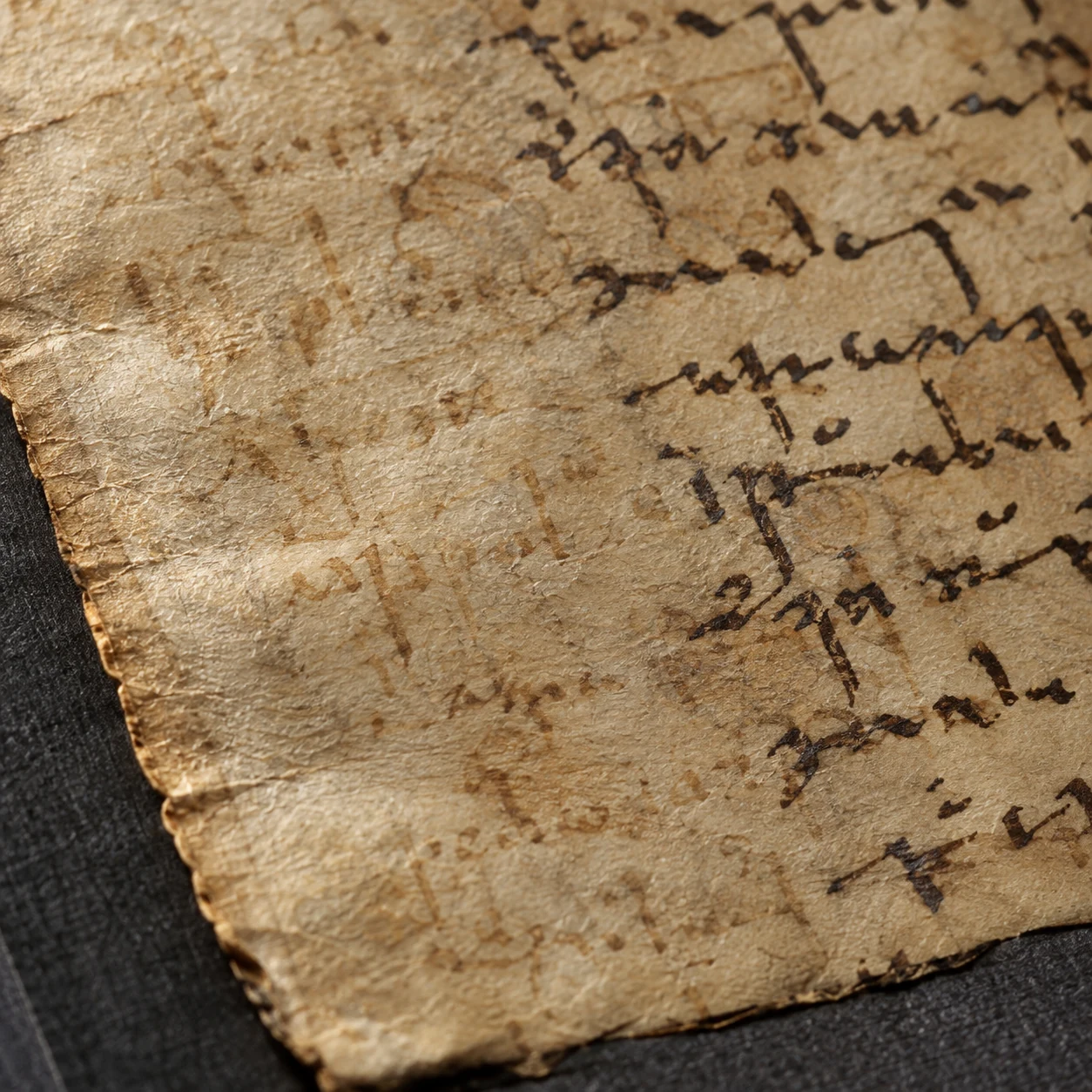
Close study of a parchment surface with darker abstract marks crossing faint traces in another direction.
A close-looking study of crossing traces on parchment. These marks do not transcribe a historical page.

Before trying to identify letters in a real image, notice ordinary physical clues: an edge, a hole, a stain, or a direction of writing. Such features can help you recognize the same place across different photographs. A convincing discovery begins with knowing exactly what surface you are comparing.

Twelve photographs still need an interpretation

In the project’s account of the August 2007 imaging session, each leaf was photographed at twelve wavelengths from ultraviolet through infrared. The capture system recorded whole leaves at a resolution the scholars judged sufficient for detailed reading. Yet the account stresses that the separate photographs did not immediately yield easily legible text.

Different materials respond differently to illumination. Comparing and combining those responses can make a weak trace stand out. A displayed color may therefore represent a useful contrast between recorded signals rather than the color a medieval reader would have seen.

The project’s discussion of early imaging experiments identifies another difficulty: photographs have to align accurately. Slight changes between images can confuse the tiny details of a character. Processing also produced unwanted features that hindered reading. Improving contrast and establishing what a mark means are connected tasks, but they are not the same task.

Think of a familiar example from a faded photograph. Increasing contrast may help you notice an outline; it does not establish who the person is. Reading a palimpsest similarly requires evidence about script, language, layout, and context after a mark becomes easier to see.

When light meets a layer it cannot read through

Some obscured pages required a different approach. SLAC’s account of the 2006 investigations describes X-ray fluorescence used to detect iron associated with ink. The researchers also examined signals from elements present in later paint. Mapping material signals helped distinguish text-related traces from interference.

The distinction matters because “use a stronger camera” does not describe every imaging problem. Visible-light photography, photographs made under selected illumination, and elemental mapping collect different kinds of information. Choosing among them depends on what is obscuring the writing and what physical evidence survives.

Compare a page without pretending to read Greek

The photographs accompanying Sorbonne University’s report on a rediscovered leaf offer a useful starting point. They show the two sides of a real object, including a later painted image. Open the photographs and choose one small area to examine before reading the full account. Understanding Greek is not required for this first exercise.

Four questions for a layered manuscript page
Look forRecord
The physical surfaceFind an edge, stain, or hole. Where does it interrupt the area available for writing?
DirectionCan you distinguish groups of traces running along different lines?
A later additionWhat does the painted side allow you to see, and what does it conceal?
A remaining uncertaintyWhat still cannot be identified from appearance alone?

Keep “I can see a curved trace” separate from “this is a particular letter.” The first is an observation you can point to. The second needs an argument that may draw on neighboring marks and specialist knowledge. Writing both statements separately makes the image more interesting, because it shows where seeing ends and interpretation begins.

A missing page can turn up in plain sight

The investigation is still changing. In a report published in March 2026, Sorbonne University described Victor Gysembergh’s identification of a missing leaf in the Blois Museum of Fine Arts. Recognizable writing and a later added image prompted investigation. Comparison with Johan Ludvig Heiberg’s photographs from 1906 confirmed the connection.

The rediscovered leaf contains material from On the Sphere and the Cylinder. Its identification illustrates a kind of research that a spectacular laboratory image can overshadow: examining catalogued objects, recognizing details, and testing a match against an older record. The university’s report also explains that further imaging would be needed to read writing hidden beneath the added painting.

A palimpsest’s wonder is not that technology supplies words where none survive. It is that surviving material can answer a better question when conservation, imaging, old photographs, and scholarly reading are brought together. Every visible trace has a location and a history. Recovering that history can be as satisfying as recovering the sentence.

Read another material clue

Compare a different way of reading concealed writing in Herculaneum Scrolls: Reading a Library Without Opening Its Pages. Then consider what a manuscript’s materials can establish in The Bakhshali Manuscript: A Tiny Dot and a Big Dating Lesson.

Explore more art, ideas, and independent projects at Incoprea.

Famous Last Meals is now in paperback — stories, history and 25 recipes

Famous Last Meals: Stories, History, and Recipes is now available in paperback on Amazon. The illustrated collection brings together 23 his...