A medieval message does not have to announce a battle or preserve a royal decree. It can ask for a payment, keep a record of an obligation or give someone an instruction. Scratched on a strip of birch bark, ordinary writing can bring the past close through tasks that still feel recognisable.
The documents excavated at Novgorod and other sites in medieval Rus' are valuable partly because many were used and discarded. They survived outside the long copying histories of prestigious books. Archaeology recovered a different register of written life: brief, practical and often dependent on knowledge shared by sender and recipient.
A surface that keeps the scratch
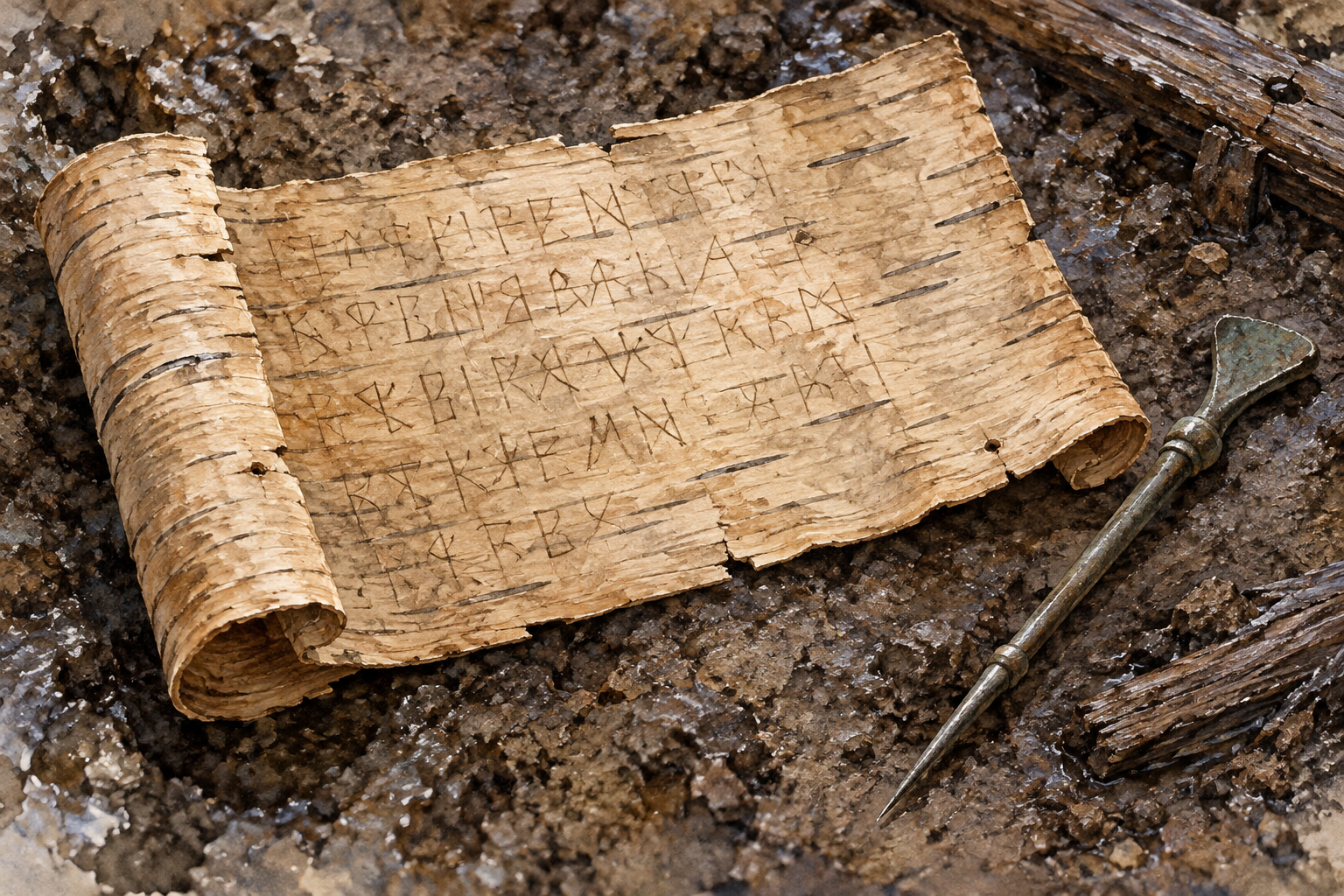
In this tradition, the writer generally incised the bark with a pointed stylus rather than applying ink. The University of Hamburg's writing-material guide contrasts that practice with bark manuscripts elsewhere, including South Asian ink-written examples. The material can be shared while the techniques and reading traditions differ.
A scratched text is part of the surface. Lighting, damage and the grain of the bark can affect what a photograph makes visible. An apparently small groove may belong to a letter, a surface feature or a later mark. Close examination has to establish the inscription before interpretation can proceed.
The shape of a fragment matters as well. Was the message written across the available strip? Does a broken edge interrupt a line? Can the surviving piece belong to a longer document? A neat modern transcription can conceal how much of the original writing surface is missing.
The first find was everyday business
The State Historical Museum records the first Novgorod birch-bark document's discovery on 26 July 1951 at the Nerevsky excavation. It identifies Nina Akulova as the finder. The fragment concerns income or obligations associated with landowners and settlements, including payments in money and produce.
That is an excellent beginning for an archive of daily life. A list of obligations makes relationships visible: people owe, collect, account and communicate. The document is modest in scale, but the activity it records belongs to a wider economy.
The museum also describes earlier discoveries of bark pieces and pointed tools whose function had not been fully recognised. A securely identified text changed the way related objects could be understood. Archaeological interpretation can advance when one find makes an existing collection of clues fit together differently.
A child learning to write
Onfim's drawings and exercises provide another unusually direct encounter. A museum record describes a bark fragment with a rider, a fallen opponent and the name Onfim, dated around 1240–1260. The suggestion that the rider is an imagined self-portrait is an interpretation, not something the drawing can prove alone.
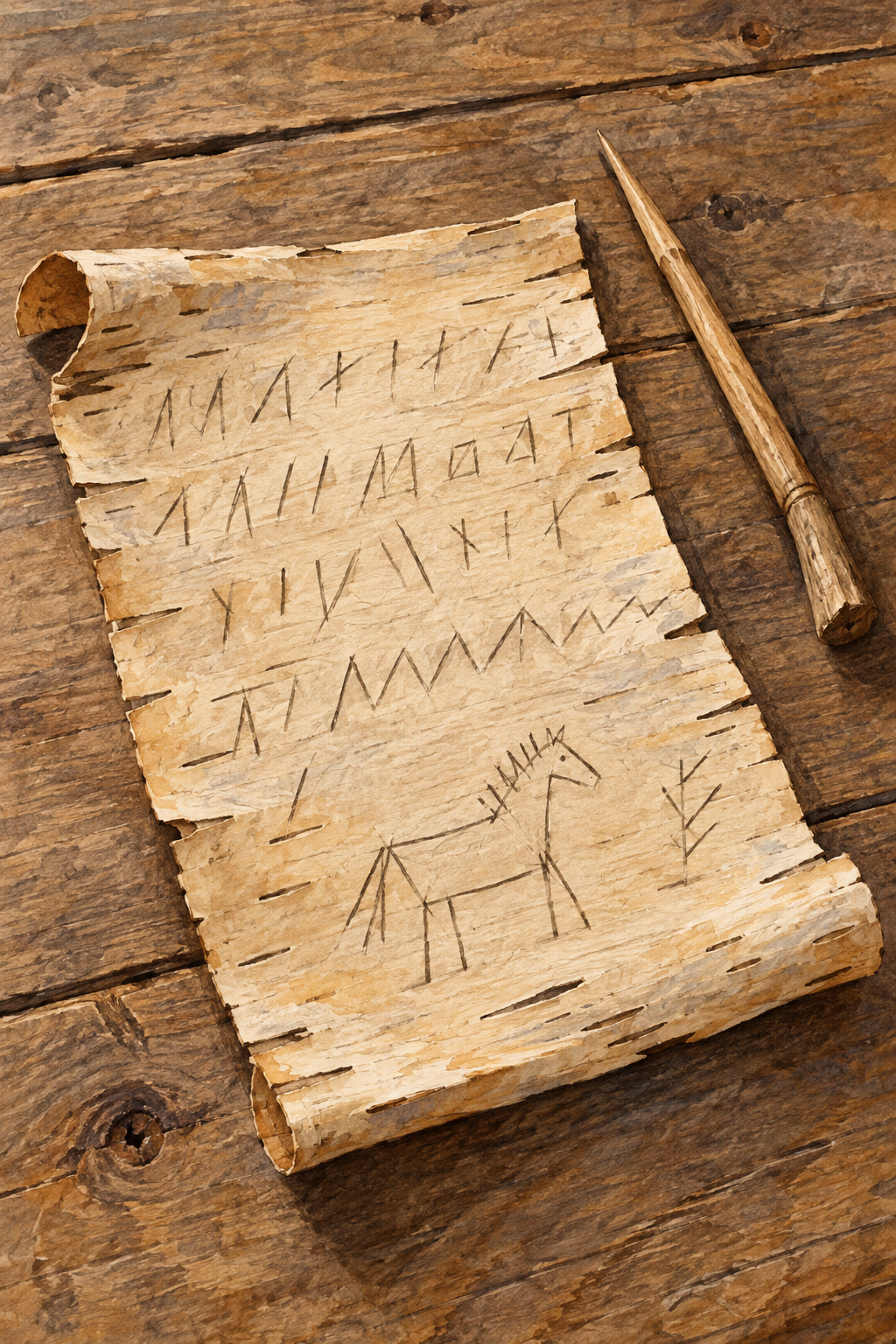
The lesson illustration here is invented; it is not a reproduction of Onfim's work. The actual object is available through the State Historical Museum's cultural-collections feature. Comparing the two keeps an appealing general idea separate from the marks of a particular child.
Scholarly accounts connect Onfim's surviving exercises with stages of learning: letters, syllables and copied religious material. Writing practice and drawing occur within the same small body of evidence. The result makes education visible as an activity rather than merely a skill someone possessed.
It is easy to invent a child's thoughts around a vivid picture. A better first question is how the drawing and writing occupy the surface. What has been repeated? Where does a name appear? Which observations support a discussion of practice, and which require a more imaginative biography?
Read a brief message for what it leaves out
Short practical communication relies on context. If you send someone “bring the other one tomorrow,” both of you may understand perfectly. A reader seven centuries later would need to identify the object, the day, the relationship and the reason. Brevity can be evidence of shared knowledge rather than careless composition.
The same principle matters for bark letters. A request may omit information its recipient already knew. A debt list may have been a memory aid or an instruction to another person. Its function has to be argued from wording, layout and context.
Try a small modern exercise. Write a two-sentence household instruction, then remove every detail that the intended recipient already knows. Now give it to an imagined future reader who lacks that context. List three questions they could no longer answer. The exercise reveals why an apparently plain ancient note can demand substantial scholarship.
A three-layer viewing visit
Open the museum feature on Onfim's bark fragment. Begin with the image, then read the object details and interpretation. Keep three layers separate:
- Surface: the fragment's outline, visible grooves, drawing and arrangement.
- Identification: date range, find context and the reading of a name.
- Interpretation: what the scene might represent and how it relates to learning.
Now return to the image. Which details became easier to notice after reading the record? Which claims still depend on specialist knowledge? A good catalogue can guide attention without making every interpretation directly visible on the surface.
For a deeper route, the University of Hamburg's study surveys the manuscript tradition, while Alexej Gippius's linguistic discussion considers writing and education. Compare how a museum object entry and a scholarly study organise the same kind of evidence for different readers.
Ordinary voices, uneven survival
The archive includes personal and business notes, educational exercises, religious texts and drawings. It widens the range of people and activities available for historical study. It does not establish that every resident wrote, or that every named sender personally scratched the words.
Preservation and excavation shape the sample. So do the decisions to discard a note, reuse a surface or leave a message in a particular place. Each surviving strip belongs to that chain of circumstances as well as to the conversation it once served.
The attraction lies in that meeting of scale and intimacy. A few scratched lines can reveal an obligation, an instruction or a learner's practice. The message needed doing in its own time. Its survival lets us investigate that need, and hear something beyond the grand public narratives that so often dominate the medieval past.