Showing posts with label Plants. Show all posts

Sunday, October 25, 2026

A Leaf Can Change Its Angle Without Growing a New Shape

Visit the same plant at midday and after dusk, and its leaves may seem to have rearranged themselves. In some legumes, pairs of leaflets spread during the day and fold into a different position at night. These repeated movements are called nyctinasty. The leaf need not grow a new bend each evening. A specialized joint changes its mechanics by redistributing ions and water.

A compound leaf in open daylight and folded night postures, with a conceptual enlargement of the pulvinus.
Day and night leaf postures, with a conceptual enlargement of the pulvinus joint.

Find the joint before explaining the motion

The joint is a pulvinus, a thickened region at a leaf or leaflet base. One well-studied example is the tropical legume Samanea saman, often called the rain tree. Its compound leaves contain repeated moving parts, giving researchers several levels at which to examine the behavior. The action is localized: a relatively small region changes the angle of a much larger leaf surface.

Inside the pulvinus, opposing groups of motor cells change volume and shape. Their water content influences turgor pressure, the pressure of the cell contents against the enclosing wall. Different changes on opposite sides alter the joint’s curvature. A 1974 study of potassium flux and movement connected rhythmic leaflet motion with changes in the distribution of potassium. The leaf’s daily rearrangement could therefore be investigated as a measurable transport process.

Think of two opposing cushions whose firmness can be adjusted. If one changes relative to the other, the structure between them changes position. This analogy captures the importance of asymmetry, but it is not a literal description of the tissue. Plant cells have walls, membranes, internal compartments, and regulated transport systems. Their behavior is more organized than simply filling and emptying two bags.

Water follows a controlled chemical difference

Motor cells accumulate or release ions, including potassium and chloride. Changes in solute distribution influence water movement and cell volume. The mechanism therefore links electrical properties of membranes, chemical concentration, and the visible angle of a leaflet. A leaf can move even though we do not see anything resembling an animal muscle pulling a tendon.

Researchers tested the membrane part directly with patch-clamp recordings from Samanea motor cells. They found potassium channels capable of carrying currents relevant to the ion losses associated with cell shrinkage. Channel-blocking treatments also affected movement in the experimental material. These are interventions and electrical measurements, a stronger basis for explanation than merely finding potassium in a plant that happens to fold.

Later work identified candidate channel genes and examined their expression through day–night and circadian cycles. The 2002 study illustrates both the promise and the limits of that approach. A rhythmic gene-expression pattern can identify a plausible component, but expression alone is not a full demonstration of a protein’s function. Explaining a moving leaf requires connecting molecular identity to transport and then to tissue behavior.

A daily clock meets the actual light

Nyctinasty is influenced by both environmental light and an internal circadian oscillator. In experiments, movements can continue rhythmically during prolonged darkness. That persistence helps distinguish an endogenous rhythm from a behavior driven only by each immediate sunset. The physiological analysis by Satter describes how light and the clock jointly affect ion transport in the moving organ.

This does not mean the plant ignores its surroundings. An internal rhythm and external signals can work together, adjusting a movement to actual conditions while maintaining a daily organization. “Clock-controlled” is not the same as “unchangeable.” To test their respective roles, researchers must control the lighting schedule rather than comparing two photographs taken under unspecified conditions.

A 2018 study of ion channels identified anion and potassium channels involved in Samanea leaf opening. It linked circadian regulation of one anion-channel component with the movement and used work in soybean to test a related role. This narrows the gap between a daily pattern visible across the room and a transport mechanism operating across cell membranes.

Make a record that can answer a question

A simple observation log
RecordWhy it helps
Same leaf, same viewpointMakes position changes easier to compare
Time and light conditionsSeparates the observation from an assumed sunset response
Watering or unusual disturbanceKeeps potentially relevant changes in the record

If you already care for a suitable plant, take ordinary photographs from the same place over several days without changing its normal care. Identify one leaflet and its base in each picture. Record what moved before proposing why. Two images can show a different posture; a sequence can show whether the change repeats. Neither by itself proves a circadian mechanism, because the light cycle repeats too.

The word “sleep” is an old descriptive name for this daily leaf movement. It gives us a memorable way to notice the pattern, but the mechanism must be established from the plant’s tissues and rhythms. Different plants also move for different reasons, so this account of legume pulvini should not be applied automatically to a flower opening, a stem growing toward light, or every rapid response to touch.

The hidden connection is between posture and transport. A large visible change can begin with ions moving across membranes, followed by water, pressure, and tissue curvature. The leaf’s outline stays familiar while its orientation changes. Watching it at two times of day brings an otherwise invisible control system into view: a plant keeping time by adjusting the water-filled mechanics of a small joint.

Sources and further exploration

Two more connections

Visit Incoprea

Inside a Ginkgo Ovule, the Last Journey Still Requires Swimming

A ginkgo beside a city pavement seems thoroughly at home on land. Its pollen travels through air, and its eventual seed is a substantial package. Yet one intimate step in reproduction still involves swimming. Inside an ovule, flagellated sperm move through a small fluid-filled space toward an egg. The tree combines long-distance delivery by wind with a final, protected aquatic journey.

Fan-shaped ginkgo leaves and paired ovules, with male pollen cones depicted on a separate branch below.
An illustrated comparison of ginkgo ovules and pollen cones, which usually develop on separate trees.

Keep three stages separate

Pollination, fertilization, and seed development are easy to collapse into one word, especially when all we see is a tree and its fallen seeds. Pollination brings pollen to a receptive ovule. Fertilization joins a sperm with an egg. The resulting embryo then develops within the seed. These events have different structures, timing, and requirements, so the swimming stage becomes clearer when we follow them in order.

Ginkgo typically bears pollen-producing and ovule-producing structures on separate trees. The pollen grain is part of the male gametophyte generation; it is not simply a loose sperm cell carried on the breeze. The female gametophyte develops inside the ovule and contains the egg-bearing structures called archegonia. A comparative review of ginkgo and cycads explains both the shared motile-sperm system and important differences between these living lineages.

  1. Airborne arrival: pollen reaches the ovule and is received through its opening.
  2. Internal development: the male gametophyte grows and the sperm develop.
  3. Short swim: released sperm move through internal fluid toward an egg.

This sequence is not a scale drawing. The wind-borne journey and the final swim occur at radically different distances and in different environments. Neither replaces the other. Saying that ginkgo uses swimming sperm does not imply that rainwater must carry sperm from one whole tree across the ground to another. The fluid for the final movement is inside the reproductive structure.

A pollen tube with a different job

After pollen arrives, it germinates and forms a pollen tube. In ginkgo, that tube helps anchor and nourish the developing male gametophyte within the ovule before releasing sperm. A study following development between pollination and fertilization observed this extended internal interval. The reproductive process is not an instantaneous consequence of pollen landing on an opening.

Many seed plants use non-motile sperm delivered by pollen tubes to the fertilization site. Ginkgo and cycads are the living seed-plant groups retaining motile sperm. In them, release into fluid and active swimming remain part of delivery. The distinction is sometimes described by the terms zooidogamy and siphonogamy, but the words matter less than the route: does the sperm complete part of the journey under its own power through a liquid medium?

The sperm’s motility apparatus is a real cellular structure. A 2006 investigation of ginkgo sperm examined its organization and associated proteins. Ginkgo sperm bear numerous flagella arranged along a specialized band. A microscopic image reveals a highly organized cell, not an imaginary miniature tadpole. Its propulsion depends on that cellular machinery, while successful reproduction also depends on its release and the condition of the surrounding tissues.

The liquid is part of the reproductive system

Water inside the ovule is not incidental leakage. A review of gymnosperm sexual fluids distinguishes fluids used during pollen capture from those present around fertilization. A pollination drop helps with the earlier arrival of pollen; fertilization fluid provides the later swimming medium. Similar appearance does not make these secretions one continuous puddle with one job. Their location, timing, and composition matter.

The fluid’s origin and guidance roles also require careful wording. Evidence from cycads cannot automatically be substituted for ginkgo, and the composition of transient internal secretions is difficult to study. A useful explanation can say that the chamber is fluid-filled when sperm are released without pretending every contribution to that fluid, or every signal affecting the sperm’s route, is completely resolved.

A study of ginkgo’s “tentpole” structure examined tissues near the archegonia during fertilization. The authors described cellular changes and proposed contributions to the environment in which sperm reach the egg. That work makes an important point: swimming is only one element. The shape of the chamber, the opening of a route, and changes in surrounding cells help make the short journey possible.

What the fallen “fruit” conceals

The fleshy covering of a ginkgo seed is often called a fruit in conversation, but botanically ginkgo is a gymnosperm. Its ovules are not enclosed inside a flower’s ovary, and the fleshy outer seed coat is not the fruit wall of a flowering plant. The terminology is useful here because it keeps us from placing the egg, pollen, and swimming chamber into the wrong set of structures.

Try sketching two maps of the same reproductive event. On the first, draw the two trees and the airborne path of pollen. On the second, enlarge only the ovule and show a pollen tube, fluid space, and egg-bearing structure. Mark where the scale changes. The exercise makes clear why the phrase “a land plant with swimming sperm” is accurate while still being incomplete without a location.

A ginkgo is not a surviving diagram of an unfinished transition to land. It is a living species with a particular combination of inherited and specialized features. Its protected internal swim shows that evolutionary change need not replace every earlier mechanism at once. The tree’s reproductive system can move a male gametophyte across dry air, support its development within an ovule, and preserve a liquid route for the final few moments.

Sources and further exploration

Two more connections

Visit Incoprea

The Pitcher Plant That Helps a Bat Find Its Bedroom

A carnivorous pitcher plant is an unlikely place to look for a bedroom. Its modified leaves are associated with trapping animals, yet in Borneo the elongated pitchers of Nepenthes hemsleyana can shelter Hardwicke’s woolly bats, Kerivoula hardwickii. The bat gains a roost and the plant gains nutrients from the bat’s droppings. There is an additional twist: the pitcher’s shape helps advertise the room through echoes.

A bat approaches a pitcher beside a cutaway revealing another bat roosting above the liquid.
A cutaway imagines a bat’s roost above the pitcher’s fluid; another bat approaches.

First establish the exchange

The initial 2011 report of the mutualism used an older plant name, Nepenthes rafflesiana variety elongata, for the plant later treated as N. hemsleyana. That naming history can make two descriptions seem like separate discoveries. The study found bats using aerial pitchers and provided evidence that the plants received nitrogen from their roosting guests. The ecological relationship is specific; it is not a reason to assume that any bat can safely sleep in any pitcher.

These elongated pitchers contain relatively little digestive fluid compared with more effective insect-trapping relatives, leaving usable space above the pool. The bat occupies that roosting space rather than being an item dropped into dinner. This is a useful correction to an overly broad story about carnivory. A structure associated with capturing prey can also supply a service to another animal when its form and the animal’s behavior fit together.

The exchange is also different from pollination. Here the bat is not visiting a flower to drink nectar while moving pollen. It is an insect-eating animal using a leaf-derived shelter. Its feces bring nutrients to the plant. A later nutrient experiment examined the benefits of this digestive arrangement. Thinking of it as an exchange of shelter for nutrient delivery makes the relationship intelligible without requiring either partner to understand a bargain.

A sign made from the receiver’s own signal

A small bat searching dense vegetation faces a recognition problem: many objects reflect sound. The relevant plant has an elongated, exposed inner back wall above the opening. In the 2015 acoustic study, researchers directed ultrasound at pitchers and measured returning echoes. The shape produced a strong, distinctive reflection over useful approach angles. A neighboring species without the same enlarged structure supplied a comparison.

Calling that wall a reflector is more precise than saying the plant “calls” the bat. The incoming sound is produced by the echolocating animal. The plant’s geometry changes what returns. A doorway sign ordinarily gives off or reflects light already present in the environment; this sign-like feature becomes informative when the searching animal actively illuminates the scene with sound. The pitcher can stand out without making its own audible advertisement.

Acoustic measurements alone would leave an important gap. An unusually strong echo might be interesting to a physicist while irrelevant to a bat. The researchers therefore altered the reflector and presented pitchers to the animals. Changes in the structure influenced how readily bats found or approached the pitchers. The combination of measured echoes and behavioral tests makes the explanation much stronger than a resemblance between a leaf and a dish-shaped antenna.

Even a successful approach does not necessarily equal final roost selection. The researchers’ Cell Press release explains the experimental changes and the distinction between attracting an animal and providing a suitable room. An enlarged reflector may be conspicuous while the altered pitcher still feels unfamiliar. Detection, identification, entry, and continued use are separate behaviors that can be tested separately.

The partnership has boundaries

A 2017 field and behavioral study investigated roost use at multiple sites and found that bats did not all follow one universal rule. Individuals used pitcher plants or furled leaves, and experience with a roost type mattered. This prevents an attractive headline from expanding into “the bat species depends exclusively on this plant everywhere.” A well-supported local association remains fascinating without becoming a total account of every individual’s life.

The evidence also does not imply a conscious invitation by the plant. Evolutionary explanations concern the consequences of traits over generations. A pitcher that is easier for a beneficial animal to locate may receive a different nutrient return from one that is hard to find. Establishing the exact historical route is a further problem. Present-day experiments show how a feature functions, while evolutionary history requires comparison and additional evidence.

For a thought experiment, redesign a room entrance for a visitor who cannot use your visual sign. What physical cue would the visitor already be sampling? Which part of the entrance would modify that cue? Then ask whether making the cue larger could make the room less usable. These questions capture the connection between communication and architecture: an effective signal must fit the receiver and remain attached to a useful service.

In the Bornean forest, the service is a small protected space inside a leaf, and the sign is an echo shaped by its wall. The plant and bat meet through a combination of chemistry, shelter, sound, and habit. The surprise is not simply that a carnivorous plant tolerates a guest. It is that the architecture of a trap can also help the right guest locate a home.

Sources and further exploration

Two more connections

Visit Incoprea

Thursday, October 22, 2026

Ants and Acacias: The Cost of a Living Defense

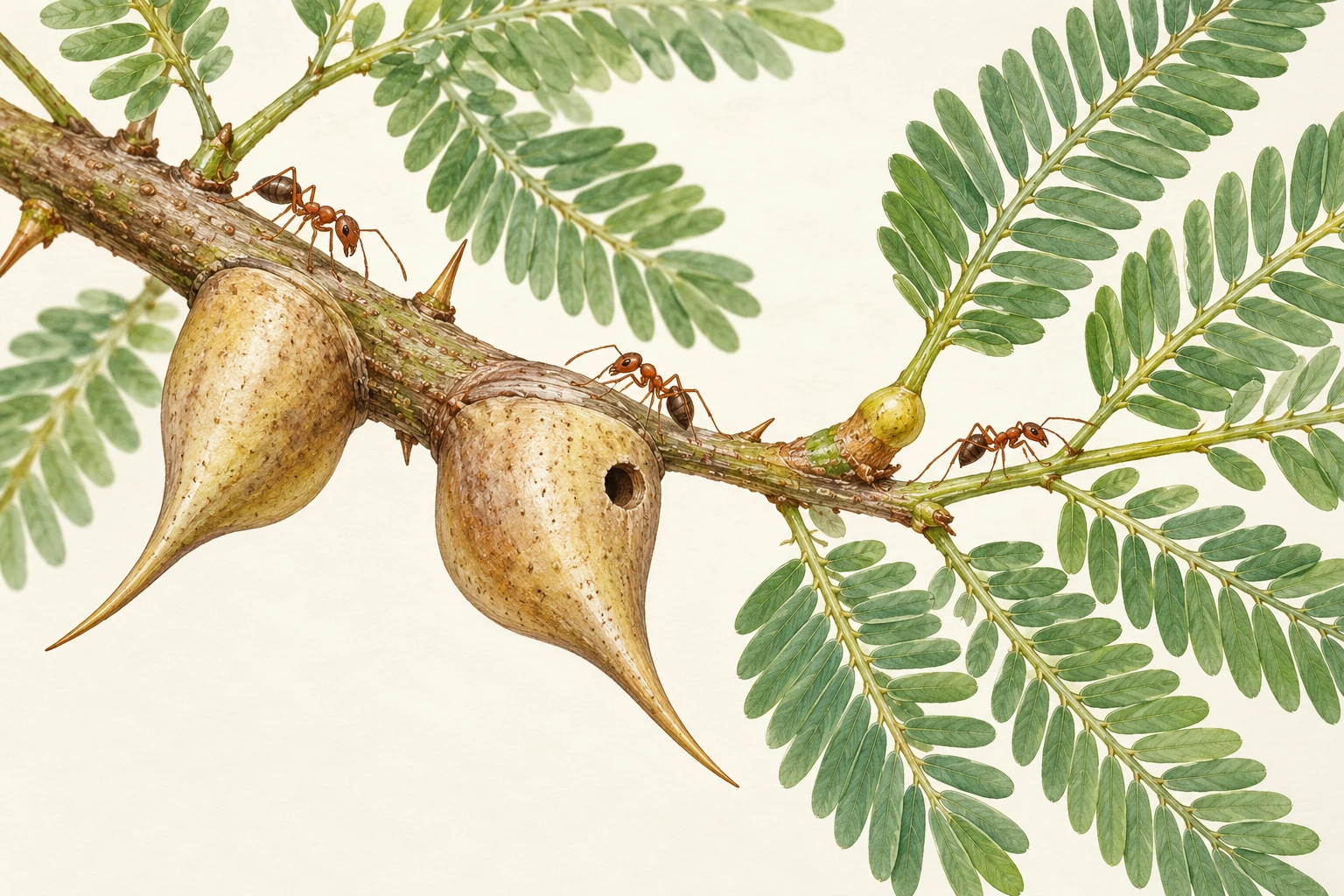
Small reddish ants patrol an acacia branch bearing swollen thorns and finely divided leaves.
Generic acacia–ant illustration; not a named specimen, species diagnosis, or representation of one study site.

A tree can grow its own thorns. It can also provide accommodation for animals that bite. In several acacia–ant partnerships, hollow thorns or other nesting spaces, nectar outside the flowers, and sometimes food bodies help sustain resident ants. The ants patrol the plant and can attack herbivores. The defense moves because the defenders are alive.

It is an elegant exchange, but calling it a perfect partnership would hide the main scientific questions. Food costs the plant resources. Ant species differ in their behavior. Other plants compete with the host, and flowers may need insect visitors that aggressive defenders could disturb. The value of the arrangement depends on circumstances.

Start with the terms of the exchange

The rewards must be distinguished. A nesting cavity is shelter. Extrafloral nectar is food produced outside a flower, so it need not function as a pollination reward. Food bodies are another investment. A study of short-term variation in acacia rewards examined how occupancy and herbivory relate to plant provisioning. The plant's contribution is a measurable biological allocation, not a free surplus with no consequences.

Likewise, an ant on a branch is not automatically a defender. Its behavior toward herbivores, its abundance, and its dependence on the host all matter. A visitor collecting nectar could provide a different service from a resident colony occupying the plant's shelter. Observing the insect is the beginning of the inference, not its end.

Different acacia systems should not be merged. Central American swollen-thorn acacias and East African whistling-thorn trees involve different plants and ant communities. Botanical names have also changed: the East African tree often studied as Acacia drepanolobium is now commonly placed in Vachellia. Following the species name across sources helps keep the evidence attached to the correct partnership.

A grass can change the relationship without attacking either partner

Field experiments in a Kenyan savanna tested a plausible prediction: grasses competing with acacia saplings for resources should make it harder to support Crematogaster mimosae, an aggressive defender that consumes substantial nectar. The lower-cost, less-protective ant Tetraponera penzigi does not consume that nectar and was expected to be less affected. Researchers manipulated grass presence and ant identity, then followed colony survival and sapling growth for 40 weeks.

The surprising result ran against the competition prediction. C. mimosae colonies survived better with grasses present. Grass-shaded soil held more moisture, and those saplings had more active nectaries; reduced water stress appeared to help the tree support its ants. Grass removal did not significantly change T. penzigi colony survival, and grass neighbors had no significant net effect on sapling growth. Neighboring vegetation can therefore facilitate an interaction as well as compete for resources. The observed result, rather than the attractive initial explanation, has to guide the story.

A comparative study of indirect plant resistance also distinguished induced nectar production from more continuous provisioning in obligate ant-associated acacias. Some defenses increase in response to damage; a resident defensive workforce may require ongoing support. Those are different allocation strategies, each with costs and conditions under which it can be useful.

A broken defense can change a lion's hunting ground

The effects of an ant–tree partnership can extend beyond the animals that eat the tree. If protected branches help maintain cover across a landscape, that cover becomes part of the setting in which other animals hunt and escape.

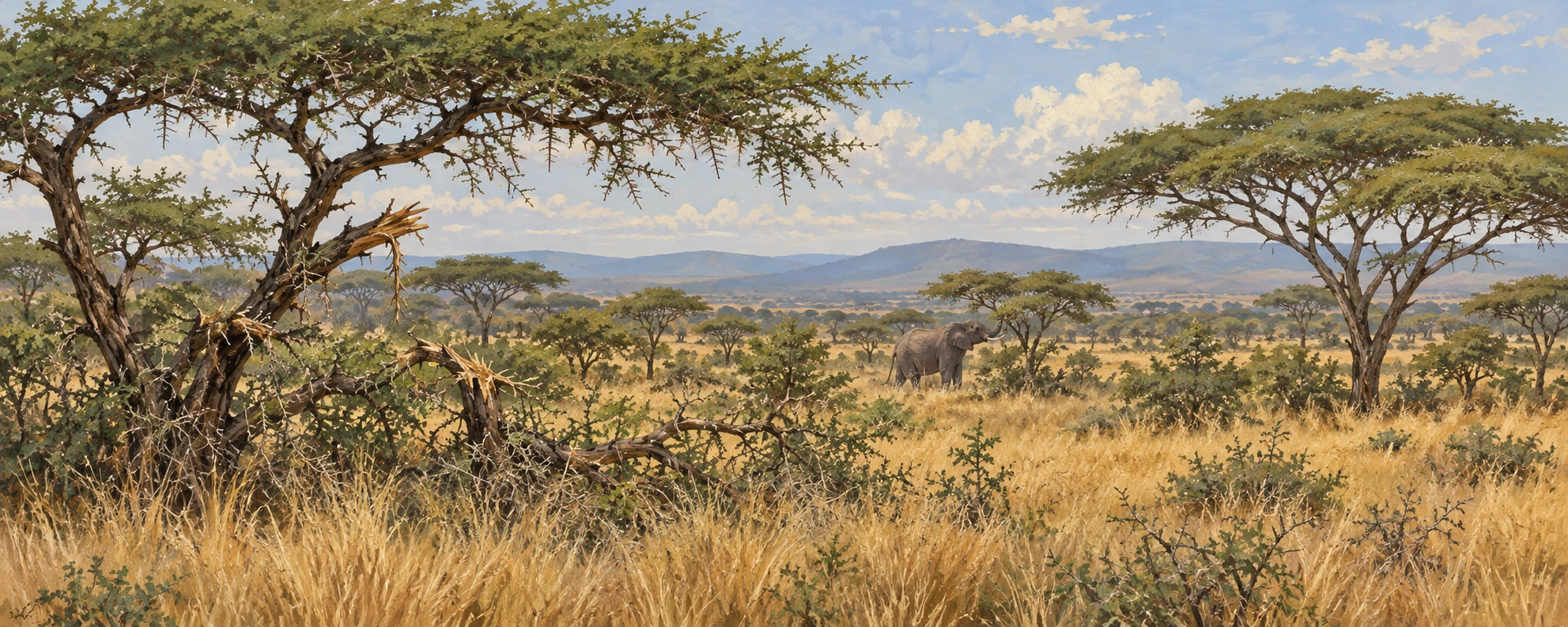
A 2024 study at Kenya's Ol Pejeta Conservancy traced such a chain after invasive big-headed ants, Pheidole megacephala, displaced native defensive ants. Whistling-thorn trees became more vulnerable to elephant browsing. More open vegetation then changed the opportunities available to ambush-hunting lions.

Whistling-thorn savanna with browsed branches and a distant elephant
Tree cover connects the ant defense to a larger landscape. This is an ecological interpretation, not a photograph of the study plots.

The researchers combined experiments, tracking and investigations of kills. Zebra kills were less likely in the more open, invaded areas. Lion numbers had not declined during the study's invasion history, with prey switching toward buffalo offered as a likely reason. This is a local, measured reorganization of interactions, rather than a prediction that invasive ants will remove lions from every savanna.

The University of Wyoming account explains how the team connected ant occupancy, tree damage, landscape visibility and predator behavior. Those links are the substantive discovery. A headline about ants defeating lions would conceal both the elephant's role and the lions' behavioral response.

Build the chain, then ask which arrow was measured

Write five items in a line: ant community, tree defense, browsing damage, cover, zebra hunting. Between each pair, write a verb. “Displaces,” “protects,” “opens” and “conceals” describe different processes. A row of nouns is much easier to mistake for a complete explanation than a row of testable relationships.

Why does stable lion abundance not settle the outcome?

A population count can remain similar while diet, hunting locations or effort change. Stability of one outcome does not establish that every interaction remained stable. The study distinguished reduced zebra predation from the subsequent question of lion population consequences.

Now imagine measuring only ant presence and lion numbers. An unchanged predator count could make the intervening changes disappear from the account. The lesson is to look for behavior and habitat structure as well as abundance.

The tree's living defense helps shape a place, not only the condition of one leaf. A small interaction on a thorn can have consequences that become visible only when the observer steps back far enough to include elephants, cover and a predator choosing its approach.

Benefits do not erase conflict

Research on different investment strategies considered the coexistence of mutualistic and more exploitative ant partners. A host that offers less reward may save resources, but can also alter the ant community it supports. The relationship is not classified adequately by saying “ants present” or “ants absent.” Which ants are present can be central.

There is another potential conflict at flowering. Aggressive guards could interfere with pollinators, yet the plant needs successful pollination as well as protection. A 1997 study examined how ant guarding and seed production interact. The broader lesson is to look for spatial or temporal ways in which a plant can accommodate two kinds of insect activity, rather than assuming all defense should be maximized everywhere.

That is a recurring evolutionary theme: the best amount of a trait is not always the largest amount. More nectar is costly. More aggression can have side effects. A flexible arrangement can be favored when circumstances change. None of those outcomes requires the plant to calculate a budget consciously; differential reproductive success can shape the allocation.

The generated branch illustration makes one part of the arrangement visible: swollen thorns, a possible entry hole, leaves, and patrolling ants. It is a generic conceptual view. A field identification or a claim about the resident species requires the photographs, descriptions, and local evidence in the research.

The compelling feature is not a tree hiring tiny soldiers. It is a defense assembled across species, with its success depending on the resource demands and behavior of both partners. A branch can support shelter, food, danger, and reproduction at once. Understanding how those uses fit together turns a charming mutualism into a much richer piece of ecology.

Follow the evidence: Short-term plasticity in acacia ant rewards; Palmer and colleagues: neighboring grasses alter a protection mutualism; Heil and colleagues: induced and constitutive indirect defenses; Divergent investment strategies and exploiter ants; How ant guards and acacia pollination can coexist.

More curious connections, art and independent projects at Incoprea.

Wednesday, October 14, 2026

Gympie-Gympie: Plant Defense at the Molecular Scale

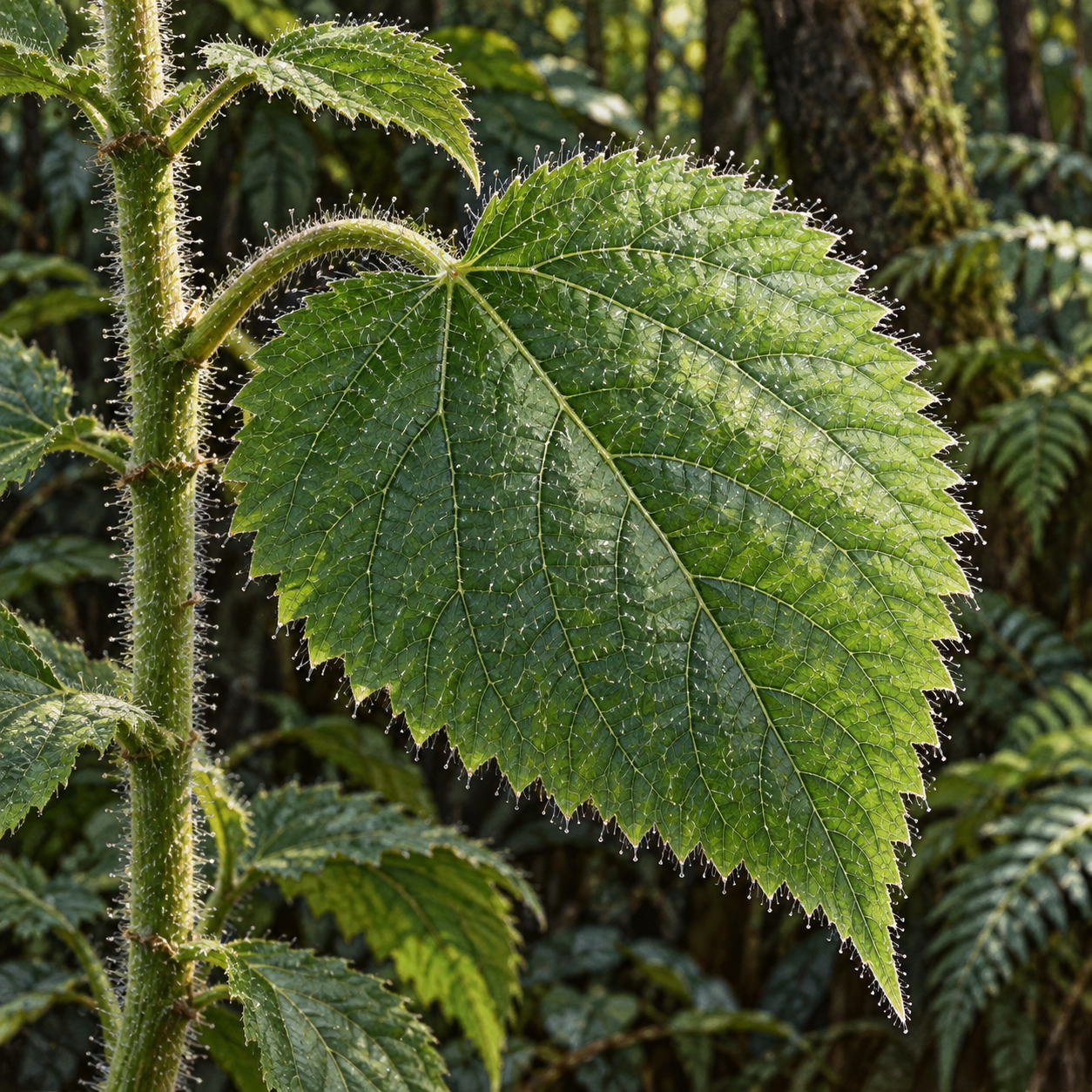
Illustration of a broad toothed stinging-tree leaf covered in fine hairs.
The leaf and its hairs are an artistic botanical view, not an identification guide or a microscopic measurement.

A broad, heart-shaped leaf can look soft because its surface is covered in fine hairs. In gympie-gympie, that impression is misleading. The hairs are part of a delivery system capable of causing intense and persistent pain. The interesting explanation begins when we separate the structure that delivers the sting from the molecules that act afterwards.

Dendrocnide moroides belongs to Australia’s stinging trees in the nettle family. It should be observed without touching. Its biology can be explored through photographs, research figures, and molecular evidence; a personal encounter with the sting adds nothing necessary to understanding it.

A leaf, a delivery structure, and a payload

The hairs are called trichomes. In these plants, they can introduce toxin-containing material when contact breaks the delicate tip. A microscope view therefore answers a structural question: how can a leaf surface deliver something beneath an animal’s skin?

It does not by itself answer the chemical question. A needle can explain entry while leaving the effect of its contents unexplained. Earlier investigations of familiar small molecules did not adequately account for the characteristic severity and persistence associated with these stinging trees. That gap encouraged a search for additional active components.

The common name can also conceal differences between species. Research on this toxin family includes both D. moroides and the giant stinging tree, D. excelsa. A finding obtained with a molecule from one species should keep that identity when used to explain the wider family.

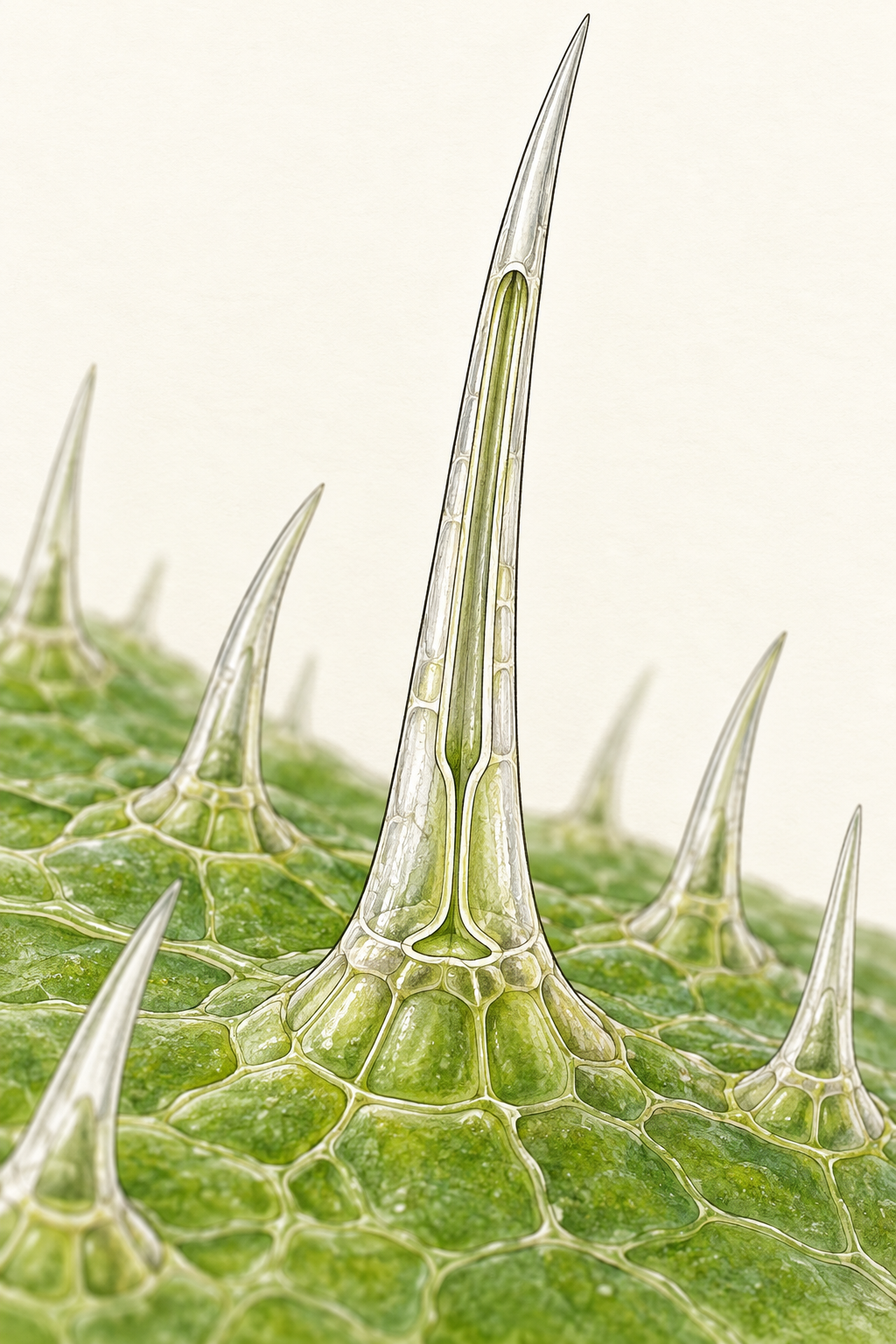
Enlarged schematic of a narrow hollow stinging hair on a leaf surface.
Delivery structures and the effects of their payload are separate research questions. This schematic simplifies hair anatomy and is not a micrograph.

What the 2020 discovery added

In 2020, researchers reported a family of small protein toxins called gympietides. The name draws on the Indigenous name for these stinging trees. The work combined chemical identification, structural analysis, and tests of biological activity. It offered a more specific explanation than describing the leaf as containing a powerful irritant.

A protein is a chain of amino acids that folds into a three-dimensional structure. The order of its components and its final shape are different properties. Gympietides were particularly interesting because their folded architecture resembled that of some animal toxins despite limited similarity in their amino-acid sequences.

The resemblance does not mean a plant acquired an identical vial of spider or cone-snail venom. It points to related structural solutions and effects reached in very different organisms. A useful comparison names what is similar: the fold, the target system, or the biological response. “The same venom” would erase those distinctions.

The 2020 experiments examined effects on voltage-gated sodium channels involved in sensory nerve signalling. These channels help control electrical activity by regulating ion movement across a cell membrane. Changing their behaviour can alter how readily a nerve cell produces or sustains signals.

A missing partner changes the result

A 2023 study revealed another important part of that explanation. The action of a studied gympietide, ExTxA, depended on a membrane-associated protein called TMEM233 in the experimental sodium-channel system. The toxin’s effect was therefore not explained by considering the channel in isolation.

This is a consequential discovery because researchers often simplify a system to investigate it. Simplification is useful, but it can remove a necessary participant. A cell expressing a channel may behave differently from a sensory neuron containing that channel and its relevant partners.

Imagine two test systems with the same named channel. One contains a required partner and the other does not. A different response to the toxin would not automatically mean that one channel was labelled incorrectly. It could reveal a dependency the simplified description had omitted.

Which observation answers which question?

Follow the mechanism across scales
EvidenceQuestion it addresses
Microscopy of a stinging hairHow is the material delivered?
Chemical identificationWhich molecules are present?
Structural analysisHow does a molecule fold?
Controlled cellular comparisonsWhich components are needed for an effect?

Choose one row and imagine trying to answer its question with evidence from another row alone. A photograph cannot identify every active molecule. A molecular structure cannot by itself establish the duration of a real-world sting. These methods become powerful when their findings connect, while each retains its own limits.

Then look back at the two illustrations. The broad leaf places the defence in its botanical setting. The enlarged hair draws attention to delivery. Neither picture is intended to replace microscopic measurements or the experiments that identified the active peptides.

The plant has a life beyond the dramatic nickname

Calling gympie-gympie a frightening plant can make its habitat and conservation disappear from the story. The NSW Government’s species profile treats D. moroides as an organism with a distribution, ecological setting, and threats. Those questions matter alongside what happens when a person touches a hair.

The NSW account places the species in lowland rainforest, particularly gaps and disturbed sites, and describes it as very rare in the southernmost part of its range. Listed threats include fragmentation, roadworks, weeds, and clearing by people concerned about the hairs. A strong defence against touch does not protect a plant against habitat loss. The same organism can be hazardous to handle and vulnerable to changes in its landscape.

There is also a limit to the medical promise of a toxin discovery. A well-characterized molecule can become a tool for understanding nerve function and a starting point for further research. That is a different claim from showing that a leaf, extract, or newly described molecule is a treatment. The mechanism is the finding here.

Gympie-gympie rewards attention across several scales: leaf shape, hair structure, folded peptide, and membrane proteins. Its dramatic sting brings those scales to our attention. The deeper story is how experiments connect them, revealing that an apparently simple leaf surface can depend on an intricate molecular relationship.

Explore more creative curiosity at Incoprea.

Ghost Pipes: Flowering Plants That Borrow Their Carbon

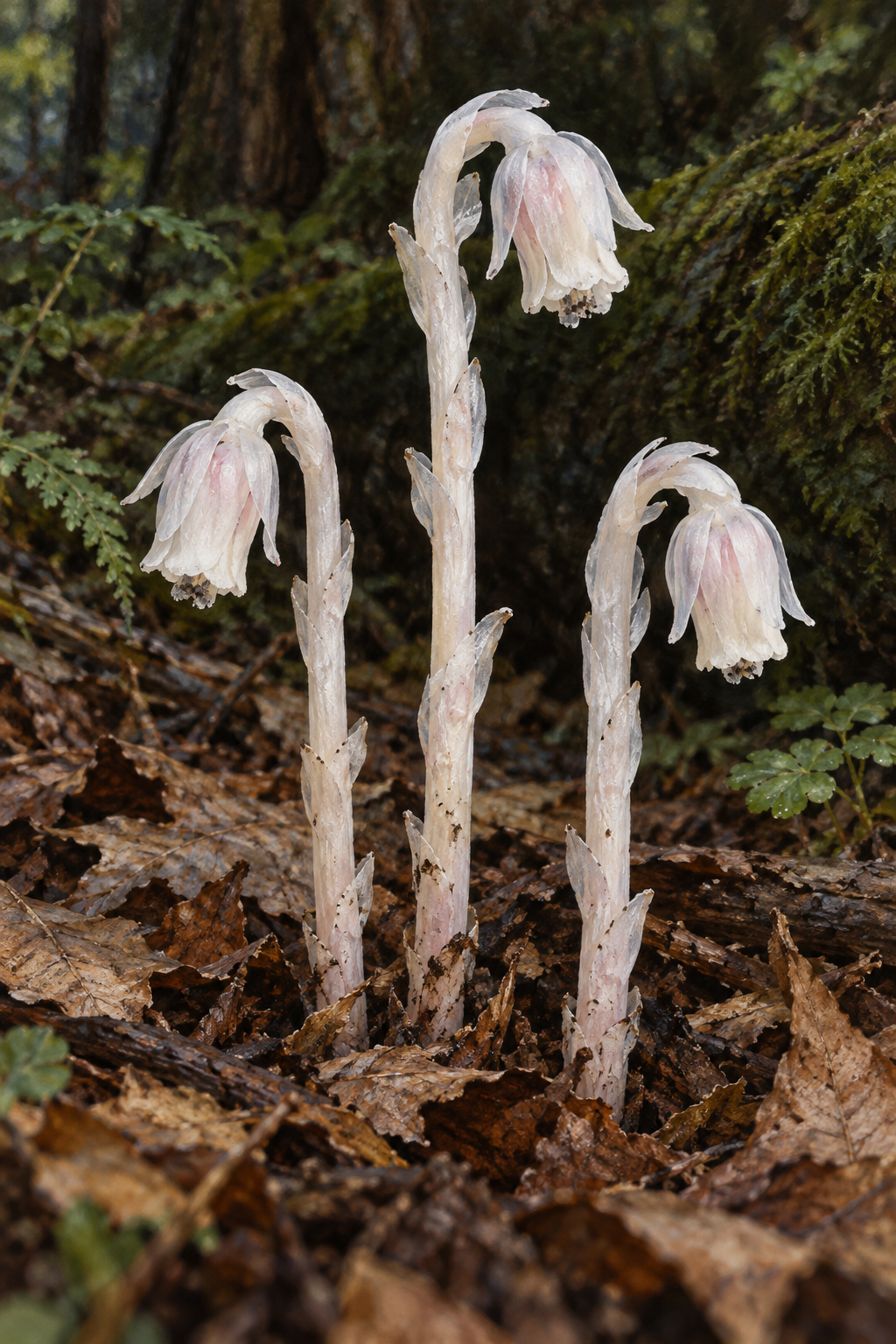
Illustration of ivory ghost-pipe stems, each bearing one nodding flower.
Scale-like leaves and nodding flowers belong to a plant whose carbon supply depends on fungi.

A cluster of pale stems appears through woodland leaves. Each bends near the top, carrying a small hanging flower. The colour is so unlike an ordinary green plant that your eye may put it in the mushroom category before you have properly looked. Ghost pipe asks you to reconsider two things at once: what makes an organism a plant, and where a plant’s carbon can come from.

Monotropa uniflora is a flowering plant in the heath family, Ericaceae. Its lack of chlorophyll prevents it from making its own food through the usual green-plant route. It instead obtains resources through fungi connected with trees. The pale flower is the conspicuous part of a relationship whose important connections are below the leaf litter.

Look for the flower before deciding what it is

North Carolina State’s plant account describes the small scale-like leaves and unusual pale stems of Monotropa. In ghost pipe, a flowering stem generally carries a single flower. These are useful features because whiteness alone is a poor classification tool. A mushroom and a ghost-pipe flower may share a colour while belonging to entirely different groups of organisms. Explore the university’s plant account.

A photograph that shows only a white stalk can preserve the initial confusion. A view of the flower, its attachment, and the scales on the stem gives you more information. You do not need to pull the plant apart to improve your observation. Changing your viewing angle can be more useful than taking a closer crop of the same feature.

The University of Texas makes the central distinction especially clear: this is a wildflower that depends on fungi, rather than a fungus itself. An organism’s relationship with another organism does not change which group it belongs to. The unusual nutritional strategy and the botanical identity answer different questions. See the species page and herbarium records.

Follow the carbon past the visible stem

The term for obtaining resources through fungi is mycoheterotrophy. In the ghost pipe’s case, the fungi are associated with photosynthetic trees. Carbon fixed by a tree can enter the fungal relationship and reach the nonphotosynthetic plant. Kew describes ghost pipe as parasitic on these fungi. The title’s “borrow” should therefore be read as an image of indirect dependence, not a claim that the plant repays a carbon loan. Read Kew’s species profile.

The absence of green tissue does not remove sunlight from the larger chain. A plant in deep shade can depend on carbon that another plant captured using light. This is a more precise explanation than saying ghost pipe simply lives without the sun. The immediate provider and the ultimate source are not always the same thing.

A simplified carbon pathway, not a map of one measured individual
ParticipantRole in the explanationWhat a casual photograph cannot establish
A photosynthetic treeFixes atmospheric carbon into organic compounds.Which particular tree supplies a particular ghost pipe.
An associated fungusConnects the tree relationship with the ghost pipe’s roots.Its identity from a nearby mushroom alone.
Ghost pipeObtains fungal-derived resources without its own photosynthesis.The quantity or timing of resource transfer.

This simplified pathway is useful because it distinguishes roles. It is not a claim that every tree, fungus, and pale flower in a patch is connected to every other one. The actual partners and transfers need evidence. A line drawn between organisms in an illustration would be a hypothesis unless the connection had been investigated.

DNA puts names to the hidden partners

In 2006, S. Yang and Donald Pfister studied ghost pipes at four sites in eastern Massachusetts. They sampled root-associated fungi and nearby fungal fruiting bodies, then used DNA sequences to investigate identity and diversity. All 56 sampled ghost-pipe fungal associates belonged to the Russulaceae, a family including Russula and Lactarius. They were not all the same fungal type. Read the Massachusetts study.

The result is both selective and diverse: a restricted family of partners, with variation inside it. That distinction matters. “Uses many fungi” and “uses any fungus” are not equivalent statements. Nor does a result from a set of Massachusetts sites become a complete inventory of every ghost pipe across its range.

The study also helps explain why the nearest mushroom is not automatically the answer to the partnership question. A fruiting body is a visible fungal structure. The fungus associated with a plant root must be identified from the root association itself and compared with other samples. Proximity can suggest a question; a DNA comparison can test an identity.

Identity is not the same measurement as nutrition

Researchers can investigate carbon sources as well as fungal identity. A 2009 study of a different mycoheterotrophic plant, the orchid Gastrodia confusa, included Monotropa uniflora as a comparison. Its authors combined fungal identification with carbon and nitrogen stable-isotope measurements. The two plants showed different isotope patterns consistent with different fungal relationships. Read the comparative study.

The comparison prevents another shortcut: all pale, fungus-dependent plants do not necessarily obtain resources through the same ecological route. Stable isotopes are naturally occurring forms of an element with different masses. Their relative abundance can help researchers examine sources and processing, when suitable reference samples and biological context are available. A result is interpreted through those comparisons; the method is not a direct photograph of a sugar molecule travelling between two organisms.

Make a record without uncovering the roots

If you find ghost pipe on a woodland walk, record what is visible. Photograph the cluster from the path, including one view of the flower and one of its setting. Note the date, whether the flowers are nodding or more upright, the colour of the exposed stems, and the general canopy. Keep “observed” and “inferred” as separate parts of the note.

If you can return later, compare the same small area without assuming every stem belongs to one individual. Have the flowers changed position? Are seed capsules visible? Which stems remain? A missing aboveground stem is not, by itself, evidence that the entire perennial plant has died. Your record concerns the visible structures at the times you visited.

Leave the surrounding leaf litter and roots in place. The Missouri Department of Conservation notes that ghost pipe rarely survives transplantation because of its complicated fungal requirements. Its field account also describes flowers becoming upright as seeds mature and the exposed structures darkening. These changes give you a useful subject for repeat photographs without removing the plant. Read the conservation field guide.

A small flower reveals a larger dependence

Ghost pipe changes the scale of a woodland observation. At first it is an unusual white object. Then it becomes a flower with recognisable structures. Finally, it points toward a carbon pathway and a set of selective relationships that cannot all be seen from aboveground.

The interesting answer is not simply that a plant found a way to avoid being green. It is that a different way of living brings different dependencies. The pale stem draws attention to itself; the evidence asks us to look beyond it, to the fungi, trees, and conditions that help make its brief appearance possible.

Explore more creative curiosities at Incoprea.

Strangler Figs: A Tree That Can Begin Above the Ground

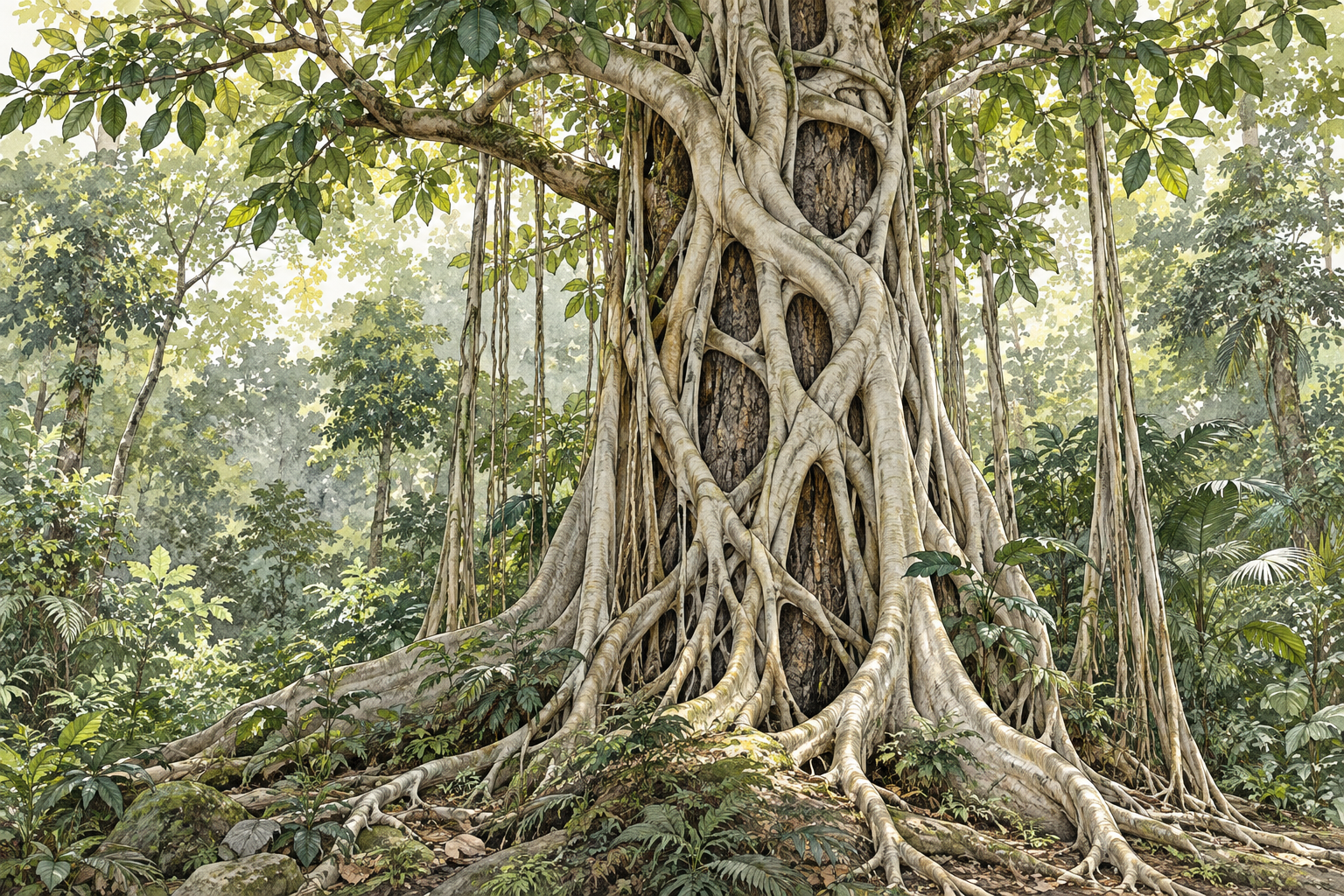
Illustration of a fig's pale interlacing roots around a darker host-tree trunk.
The contrasting structures help show how a fig can surround its support tree. This is an interpretive scene, not a documented specimen.

Look at the trunk in the illustration and try to decide where one tree ends and the other begins. The lighter framework appears to wrap around a darker central support. That puzzle is a useful entrance to the story of strangler figs: a tree can begin high in another tree, send roots downwards, and eventually become a substantial structure of its own.

“Strangler fig” describes a growth habit found in several fig species. It does not name a single species with one timetable and one inevitable outcome. Following the stages of a particular tree is more rewarding than treating every enclosing lattice as the same dramatic event.

A seed begins with an unusual address

Many seeds arrive in places where they will never establish. A fig seed deposited by an animal in a suitable fork or crevice may instead find an elevated foothold. The young plant can begin as an epiphyte, growing on another plant rather than germinating directly in the ground below it.

The Florida Museum describes this canopy-starting route for Ficus aurea. It also notes that the species can grow from buried seeds. A characteristic life history is not an exclusive rule. Even a well-known strangler can have more than one starting point.

An elevated position changes access to light, but it does not remove the need for water and nutrients. The seedling must establish and maintain itself at the place where the seed landed. It has gained a location, not a guarantee of success.

This is also why the word “parasite” should be used carefully. A plant growing on another plant is not necessarily extracting food directly from the host’s tissues. An epiphyte can use physical support while making its own organic food through photosynthesis. Harm can develop later through competition and surrounding growth without that being the original feeding relationship.

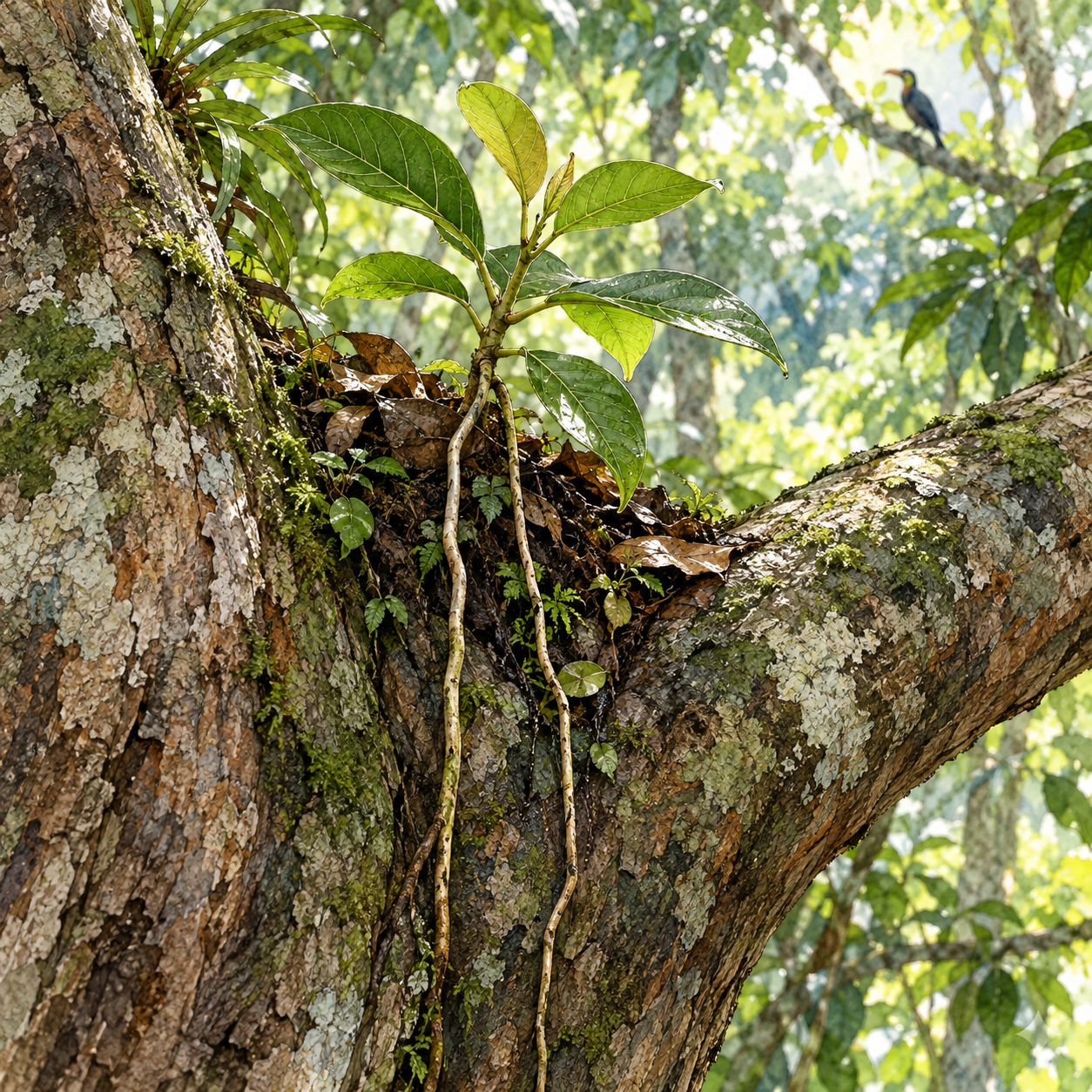
Illustration of a young fig established in a tree fork with slender descending aerial roots.
An early canopy foothold looks very different from a mature enclosing lattice. The scene is an imagined example.

The first long journey is a root’s journey

Descending aerial roots connect the elevated plant with the soil. As they reach the ground and thicken, the balance changes: the fig develops a more extensive resource supply and a supporting framework. University of Florida’s account of F. aurea describes this transition from a vine-like early form to a self-supporting tree.

What looks like a single mature trunk can therefore record a history of many roots. Some remain narrow and hanging; others have reached soil and become substantial supports. A lattice makes that history visible in a way an ordinary smooth trunk rarely does.

The original host may eventually die while the fig remains. But a hollow central space in a mature framework is not enough to reconstruct every detail of the host’s death. Competition for resources, shading, structural enclosure, and other events can matter. A vivid name should not stand in for observations of the particular relationship.

Read the roots in three directions

Use the photographs on the University of Florida page, or an accessible labelled specimen in a botanical collection. Begin at a visible hanging root and follow it downward. Can you see whether it reaches soil? If the lower end disappears behind vegetation or outside the picture, record that part as unknown.

Next follow a thick support upwards. Does it connect to a spreading fig branch or remain obscured? Finally, inspect the central trunk or opening. Distinguish the original support where it is clearly visible from the enclosing framework. Bark colour may help in a particular image, but colour alone does not identify every piece of a living structure.

Compare the young-seedling illustration with the mature view. The thin descending roots and thick framework are stages of a process, not different inventions. A photograph freezes one stage. Observing another stage helps explain how the first one could change without pretending that you watched decades pass.

A fig is also a meeting place for animals

The roots draw attention, but the fruits connect the tree with a much wider community. Smithsonian Gardens emphasizes the importance of figs as food for tropical animals. A tree competing strongly with one host can simultaneously provide resources for many fruit-eaters. Ecology does not require each species to fit a single role as either helper or harm-doer.

Singapore’s NParks profile of Ficus drupacea gives a concrete example. It describes an aerial-rooted strangler whose fruits are eaten and dispersed by birds and small mammals. The same tree’s reproductive biology also involves fig wasps. Dispersal and pollination are two different animal relationships, with different participants and consequences.

That distinction closes the circle without making it too neat. A pollinator contributes to reproduction. A fruit-eater may move seeds. A suitable tree fork can provide the next starting place. Each link has conditions; eating a fruit does not guarantee that a seed reaches a successful canopy site.

The name covers a changing relationship

Consider how the roles alter through time. Early on, another tree supplies a place to establish. Later, the fig’s roots reach the ground and its branches spread. The two plants may then compete while remaining physically interwoven. Eventually, the fig may survive independently. A single word, “strangling,” compresses those different stages into one action.

The comparison with other plants helps make the story precise. A ghost pipe’s fungal dependence concerns nutrition. A strangler fig’s epiphytic beginning concerns location and support. A mangrove seedling’s early development concerns another set of establishment conditions. Unusual starting points do not imply identical biological strategies.

The most interesting view of a mature strangler fig is therefore both structural and historical. Its framework shows routes from canopy to soil, while its fruits connect it with animals moving through the landscape. Looking closely reveals more than one tree surrounding another. It reveals a life history built from changing relationships.

Explore more creative curiosity at Incoprea.

The Walking Palm: Remarkable Roots, With the Story Kept Straight

At the foot of a walking palm, the forest seems to have left a piece of scaffolding exposed. Slanting roots descend from the trunk into the ground, enclosing a space that looks surprisingly empty. Before asking whether the tree can walk, pause over a question you can actually see: how does a tall living column stand on this arrangement?

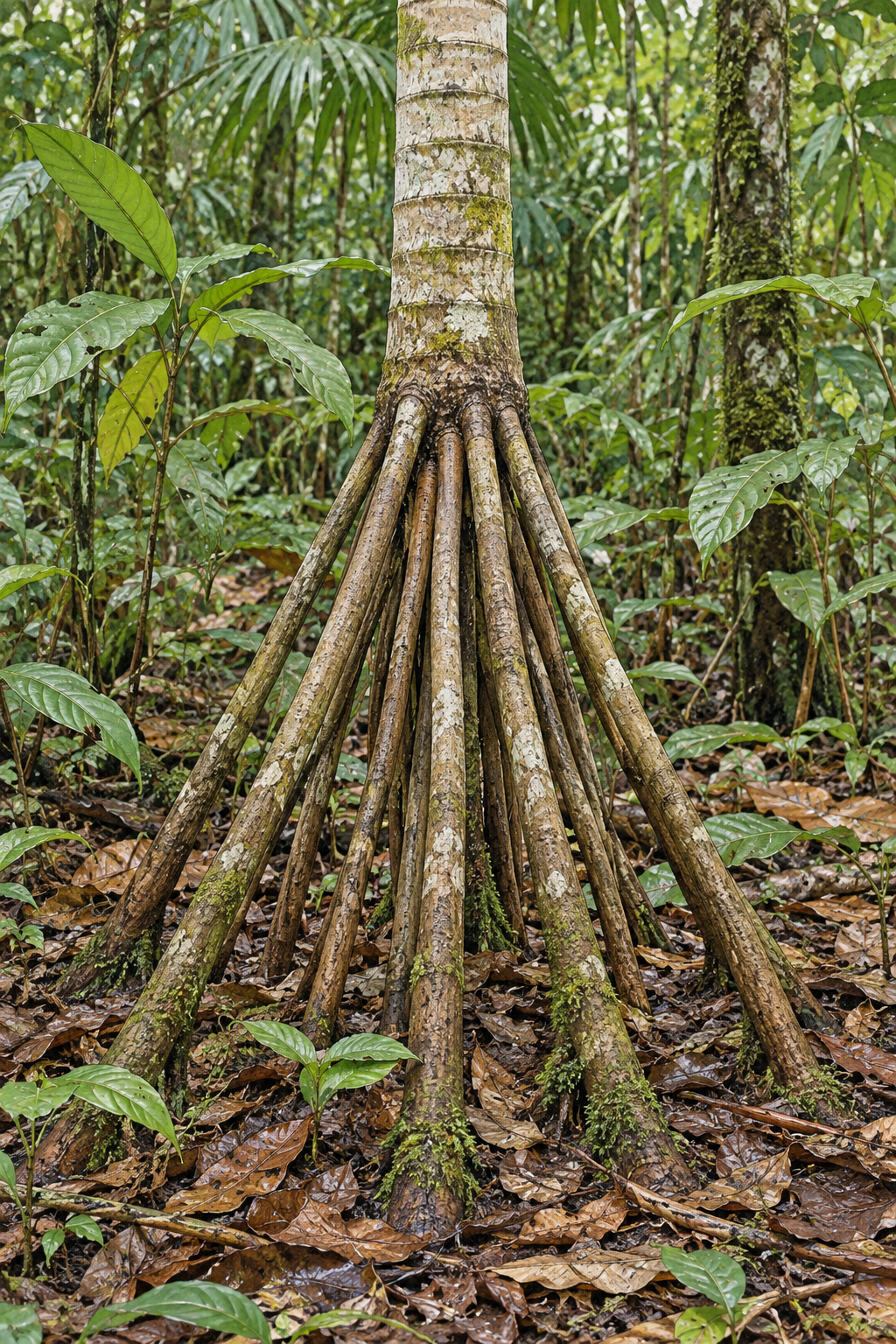
Illustration of an upright palm supported by rooted stilt roots in rainforest leaf litter.
The cone of stilt roots is striking on its own. All roots shown are anchored; the illustration depicts no walking motion.

Socratea exorrhiza is a tropical American palm with stilt roots. Its silhouette invites an explanation, and several have been proposed: support, rapid upward growth, recovery after damage, and advantages in difficult ground. Those possibilities concern different parts of a plant's life. Treating them as one spectacular trick makes the roots harder to understand.

Read the structure from the ground upward

Start with the places where roots enter the soil. Then follow them upward to their junctions with the stem. The visible structure has both height and spread. A wide footprint and a high attachment are different features, even when they appear together. Looking only at the most dramatic root can hide the geometry of the whole support system.

This is a useful way to look at unfamiliar organisms: separate a description from an explanation. “Several roots attach above ground” describes a structure. “They evolved to cope with steep slopes” proposes a function. The second statement needs comparisons that the first does not. A convincing photograph can establish the appearance without settling the proposed reason for it.

For a quiet observation exercise, use a documented photograph with a clear ground line. Identify the highest visible root attachment, the widest visible pair of ground contacts, and anything obscured by vegetation. Do not measure biological proportions from the illustration here. Its purpose is to make the form easier to notice; an actual specimen photograph supplies the observational evidence.

A slope is an appealing explanation. Does it fit?

In a 2005 study, Gerardo Avalos and colleagues measured 31 Iriartea palms and 36 Socratea palms at two Costa Rican sites. They compared root-cone dimensions with palm size and ground slope. Larger palms had larger, taller cones. In that sample, palm size explained the architecture better than slope did.

The comparison matters because a single palm on a hillside cannot tell us which feature explains its roots. A large tree might have a large cone because it is large, because the ground slopes, or because those circumstances coincide. Measuring many trees allows those explanations to be compared rather than selected by visual appeal.

Notice what this finding leaves open. Roots still provide support on sloping ground. The result challenges a simple prediction that slope alone should determine the cone's shape. A structure can function on a hillside without having an architecture chiefly determined by the hillside. That distinction turns an attractive just-so story into a question researchers can investigate.

Growing upward without making everything thicker

Gregory Goldsmith and Rakan Zahawi investigated 80 Socratea trees at two tropical sites. They likewise found no clear differences in several root-cone characteristics between their flat and sloping locations. They did find relationships between the architecture of the stilts and allocation to vertical growth.

Their interpretation was that stilt roots can help a palm gain height while maintaining stability, without simultaneously investing as much in a thicker stem and underground support. That is a growth strategy, rather than a claim that roots remove all mechanical constraints. In a forest, reaching light is useful, but the construction supporting that height has a cost.

Imagine two possible budgets for a growing plant. One spends heavily on broadening a column before extending it; another builds additional supports around a relatively slender column. Neither imaginary budget is a literal account of every palm. The comparison simply makes the research question tangible: how is material divided among height, leaves, stem and roots?

What the famous name compresses

The 2024 Smithsonian chapter by Cecilia Williamson and Helene Muller-Landau revisits the walking story. An often-cited 1980 account concerned seedlings and saplings that had fallen and then rerooted and resprouted. The replacement upright growth could stand away from the original rooting point. Recovery following a fall is a real and interesting change in position.

That account does not establish a mature upright palm deliberately advancing across the forest by growing roots on one side and abandoning the other. The Smithsonian authors describe claims of that mature walking as unsubstantiated. Keeping the life stage in the story preserves the observed biology instead of asking it to support a larger claim.

What would a convincing record look like?

Try designing an observation before choosing its outcome. You would need a fixed reference outside the palm, a consistently defined point on its trunk, dates, repeated measurements and photographs from reproducible positions. You would also record leaning, damage, soil movement and replacement growth. A changing shadow or a new root would not by itself establish displacement of the trunk.

This thought exercise requires no marking, digging or interference with a tree. It is about making the word “move” precise. Does it mean the stem leaned, a fallen juvenile produced a new upright shoot, or the same mature stem shifted horizontally? Each possibility asks for a different record and suggests a different biological process.

There are also questions beyond the nickname. The Smithsonian review reports a steep decline in this palm's abundance on Barro Colorado Island over recent decades and calls for further investigation. A palm can be visually familiar while its population changes remain poorly understood. Its exposed roots offer an entrance into a much larger story about growth, survival and the value of returning to the same forest over time.

Explore more creative curiosity at Incoprea.

Socotra's Dragon's Blood Trees: An Umbrella With a Future to Protect

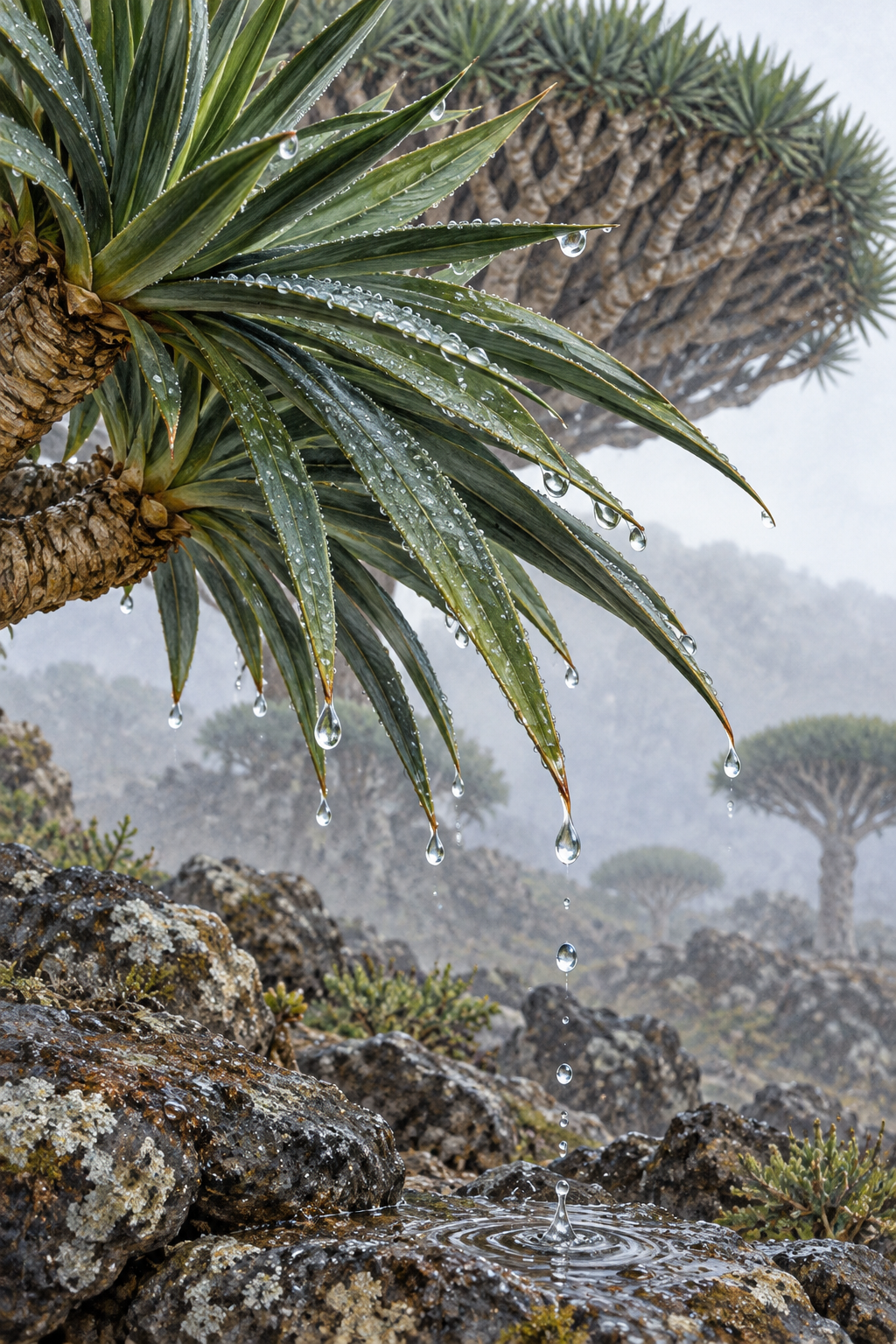
A dragon's blood tree makes an arresting silhouette: a trunk and branching framework beneath a densely packed green umbrella. On Socotra, that umbrella is more than the outline of an extraordinary landscape. It is also a useful starting point for asking where a tree gets water, what its canopy changes beneath it, and why a woodland full of adults can still be in trouble.

Illustration of umbrella-shaped dragon's blood trees across a misty rocky plateau.
This interpretive Socotra-inspired landscape emphasizes crown shape and mist rather than a specific documented grove.

Dracaena cinnabari grows naturally on the Yemeni island of Socotra. Its familiar name refers to its red resin. Yet the most revealing features for understanding its future are the living crown above the ground and the much less conspicuous young plants near the ground. A sweeping photograph usually gives the first feature far more attention.

An umbrella can collect as well as shelter

Royal Botanic Garden Edinburgh describes tough leaves that retain water and intercept moisture from mist. Droplets can gather on the foliage and fall toward the soil. The canopy also shades the ground. These are connected effects: changing the amount of water arriving and changing the rate at which water is lost can both influence the conditions below a tree.

Picture two containers receiving the same small amount of water, with one exposed to strong sun and the other shaded. Their final contents need not match. Now imagine adding a surface that catches suspended droplets above one container. The comparison illustrates why a tree's water balance involves more than rainfall falling straight onto bare ground.

This is a thought experiment, not a measurement of dragon-tree water use. Real crowns, wind, soil and seasons complicate the outcome. Its value is to keep two questions separate: how much water enters the local system, and how much remains available afterward? A mist-catching canopy cannot manufacture moisture when the surrounding air supplies none.

Close-up of water droplets on the narrow leaves of a dragon's blood tree.
Leaf surfaces can intercept mist, while the crown shades the ground. This close-up is conceptual, not a measured water balance.

The missing generation can be almost invisible

A long-lived adult can continue shaping a landscape while replacement is failing below it. Researchers studying Socotra have identified grazing pressure and environmental conditions as important constraints on regeneration. Young plants can be vulnerable even where established trees remain prominent. An apparently magnificent stand is therefore not enough to establish that a population is renewing itself.

For your next landscape photograph, try a three-stage audit. First look for reproductive adults. Then look for seedlings or small juveniles, remembering that these may be too small or too hidden for the image to reveal. Finally ask whether there is evidence that some young plants survive into larger stages. “Not visible” belongs in a different category from “absent.”

The stages suggest different conservation questions. Seeds must be produced and reach suitable sites. Germination must occur under suitable conditions. Seedlings must then survive dry periods, grazing and other hazards. Protecting one stage may be essential without automatically solving the next. A tree population persists through a sequence of successful transitions, rather than through adult survival alone.

What a nursery can teach

Ivana Hubalkova and colleagues followed seedlings from two Socotran source populations under controlled conditions in the Czech Republic. Their two-year study recorded growth repeatedly, including leaf development. The groups differed in aspects of leaf number and length, although their average final plant lengths were similar. Growth also varied seasonally despite the controlled setting.

The study makes the young tree less abstract. A seedling is a growing organism allocating resources over time, rather than simply a miniature umbrella waiting to expand. Comparing its leaves, survival and growth can help researchers understand early development. Those measurements are particularly valuable when field records of small plants are difficult to obtain consistently.

But a cultivated seedling has a different daily environment from one on Socotra. Controlled watering, protection and growing conditions change the challenges it faces. Successful germination in a pot answers an important propagation question. Establishment in a woodland asks an additional question about survival in the place where the tree ultimately needs to grow.

A fence turns a question into a comparison

A field study by Hana Habrova and Jindrich Pavlis followed vegetation inside and outside an exclosure on the Firmihin Plateau. Over five years, protection from grazing allowed substantial changes in woody vegetation. Outplanted dragon-tree seedlings performed relatively well, while seeds sown in the experiment did not germinate. The outcomes show why “just stop grazing” is an incomplete description of regeneration.

The protected plot helped test the influence of browsing. At the same time, the sowing result pointed toward the importance of suitable establishment conditions. The study's observations connected germination with protected, moist microsites. A fence changes access by animals; it does not guarantee that every seed receives the moisture and shelter it needs.

Imagine evaluating a conservation project using only the number of seeds distributed. That count would tell you something about effort but little about the future woodland. Following surviving seedlings through subsequent seasons supplies a different kind of information. The useful question becomes which stage is limiting recovery at a particular place, and whether the intervention addresses that stage.

A living landscape, with people in it

UNESCO describes Socotra through both its exceptional biodiversity and its indigenous inhabitants, language and cultural landscape. Livestock and other uses of land belong to people's livelihoods. Conservation decisions cannot be reduced to removing people from a picturesque scene. Local knowledge, practical grazing arrangements and long-term care of young trees matter alongside botanical measurements.

That perspective changes the umbrella's meaning. A mature crown can shelter a patch of ground, intercept moisture and draw our attention from far away. Its future depends on much smaller plants and sustained decisions around them. When you next see the iconic shape, look below it in your imagination: the most consequential part of the picture may be a generation that has not yet become conspicuous.

Explore more creative curiosity at Incoprea.

Lithops: The Pebbles That Have Windows

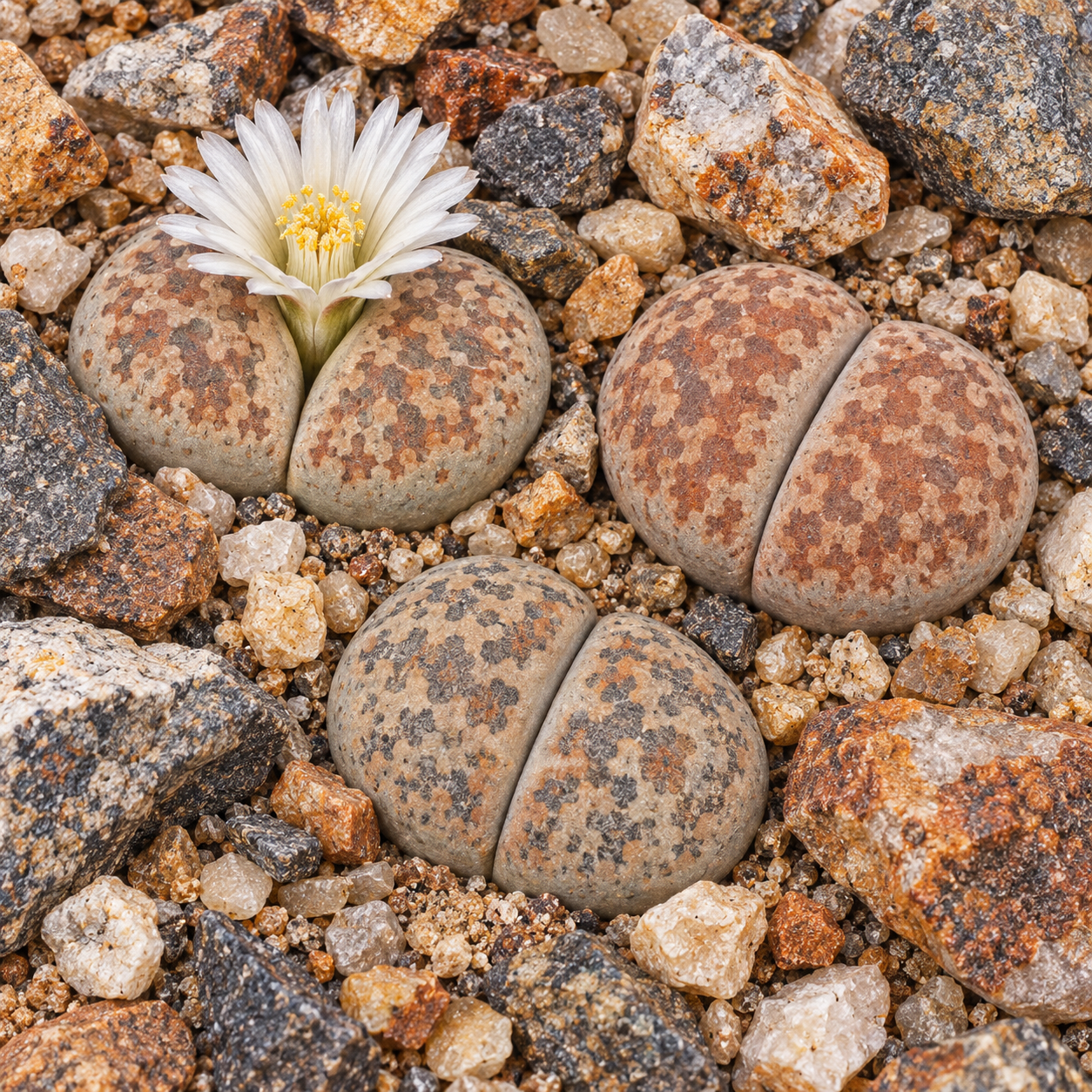
Look at a gravelly patch of ground and decide where the plants are. You probably search for stems, leaves held above the surface, or a clear patch of green. A Lithops plant defeats those expectations. Its exposed top can resemble another pebble, while much of the living body sits below the level your eyes are searching.

Illustration of low paired Lithops leaves blending with gravel, with one white flower.
Paired fleshy leaves can resemble surrounding stones, while a flower makes the living plant easier to recognize.

The resemblance is the beginning of the story, rather than the whole adaptation. These southern African succulents also face a physical problem: keeping a low profile and storing water can leave much of their photosynthetic tissue shaded underground. Their translucent leaf windows help light reach the interior. Letting light in, however, also changes the heat entering a small water-filled body.

Two leaves make an unexpectedly substantial plant

A typical body consists of a pair of thick leaves joined at the base, with a fissure between their upper faces. The part that looks like a stone is therefore living leaf tissue. A compact form stores water while exposing relatively little surface. It is quite different from a thin garden leaf spreading into the air.

Science and Plants for Schools highlights the combination of spongy water-storage tissue, reduced surface area and translucency. Think of it as several demands sharing one structure. The leaves must retain water, receive useful light and remain functional under demanding conditions. Their shape is interesting because those jobs can pull in different directions.

Try a visual search using the habitat photographs in the University of Wisconsin Extension article. Look first without enlarging the picture, then zoom in. Which cue finally reveals a plant: a fissure, a rounded edge, a repeated pattern, or a difference in texture? Compare that cue with a nearby stone rather than relying on greenness alone.

This is a perception exercise, not a test of whether every animal sees the same way you do. A photograph also freezes the lighting and hides scale. Still, noticing which features mislead your search makes “camouflage” more concrete. The plant is not simply brown; its visible form is difficult to separate from a particular background.

A leaf window is an entrance, not a free supply of energy

Light entering at the top can penetrate to photosynthetic tissue within the leaf. That arrangement lets a partly buried plant use sunlight without spreading a broad sheet above the ground. Yet the interior does not become uniformly illuminated. Light is absorbed and scattered along the way, so different regions experience different conditions.

In a 2013 study of Lithops aucampiae, Katie Field and colleagues found differences in pigments and light-related physiology between upper and lower leaf regions. The buried portions showed features suited to dimmer conditions, while exposed regions had adaptations to stronger light. One leaf can contain contrasting light environments, with corresponding differences in how its tissues use and manage incoming energy.

The researchers also described CAM, a mode of photosynthesis in which carbon dioxide can be taken up at night and stored for later use. Separating that uptake from daytime light use can reduce water loss. Leaf shape, light handling and the timing of gas exchange therefore work together; the window alone cannot explain the plant's way of living.

How would you test a window?

Craig E. Martin, Emily Brandmeyer and R. D. Ross investigated leaf windows experimentally. Plants with windows covered by reflective tape had lower leaf temperatures than plants whose windows were covered with transparent tape. The result draws attention to the heat associated with incoming radiation, alongside the potential benefit of light reaching deeper tissue.

Why use transparent tape as well? Before reading on, think of a possible problem with comparing a taped plant only with an untouched one. Covering a surface can change more than its illumination. A comparison in which both groups receive tape helps separate the intended change in light entry from effects associated with covering the surface.

You do not need to tape or cut a plant to explore the reasoning. Write down the proposed cause, the measured outcome and the comparison group. Then ask what remained different between the treatments. This habit is useful whenever an appealing anatomical feature is assigned a function: the design of the comparison determines how confidently the explanation can be assessed.

The same study compared window sizes with habitat conditions. Its results were consistent with smaller windows in brighter, drier settings and larger windows in cloudier, wetter ones. This supports a tradeoff rather than a universal “bigger is better” rule. Useful light and unwanted heating arrive together, and the balance can differ among habitats.

The pebble changes, even when it seems still

A living stone also makes more sense when viewed across time. As a new leaf pair develops, the old pair is reabsorbed and eventually dries to a papery remnant. A plant may divide into more than one pair. What looks like a static ornament can therefore reveal a sequence of resource transfer, growth and replacement.

The Wisconsin Extension photographs show this transition clearly, along with flowers emerging between the leaves. Rather than assigning every plant an identical calendar, follow the sequence: old leaves, developing replacement, flower and fruit. Species and growing conditions matter. A single snapshot cannot identify every stage, and a shrinking old leaf is not the same observation as a plant simply running out of water.

Even seed release responds to conditions. The fruiting capsule opens when moistened, allowing rain to help disperse seeds, then closes again as it dries. The miniature landscape thus contains more movement than its stony appearance suggests. Water is stored, light is admitted selectively, leaves are replaced, and a dry capsule waits for an appropriate change outside.

Explore more creative curiosity at Incoprea.

publications

New this week Two novels in six stories each, from The Night Shift . New — a novel in six documents Small Print A Novel in Six Do...