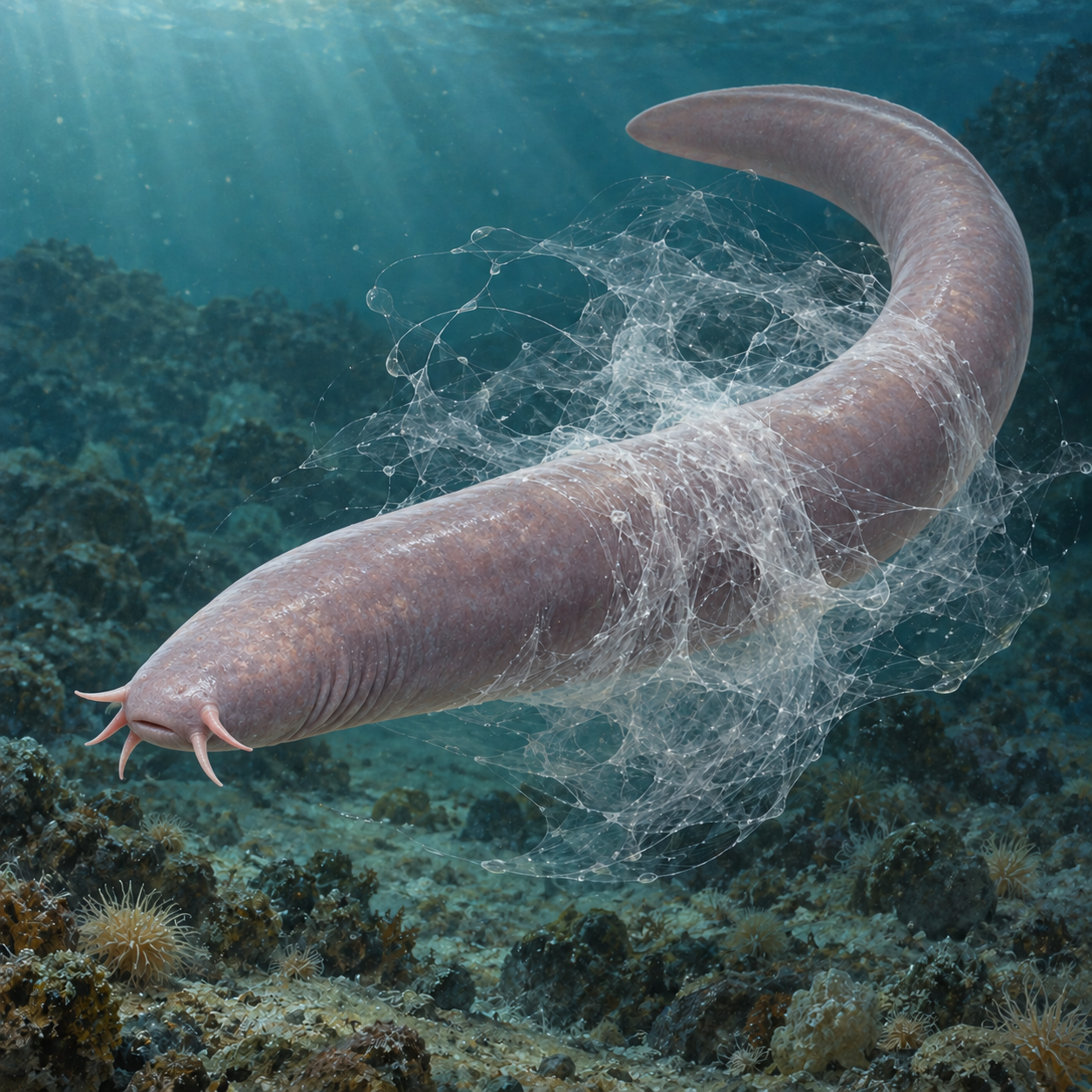
Slime has a poor public image. It suggests something shapeless and unpleasant, useful mainly for a dramatic reaction. Hagfish slime deserves a better description. It is an extraordinary material assembled from mucus, protein threads and surrounding seawater, and it can help an unassuming marine animal survive an attack.
The ocean supplies most of the volume
Hagfish release material from specialized glands when threatened. Once deployed, it rapidly forms a soft, highly dilute fibrous network. That network can clog the gills of a fish predator, making an attack difficult to continue.
The material is more than ordinary mucus. Very fine protein threads give it mechanical coherence. Rather than carrying a large finished mass around inside the body, a hagfish stores concentrated components that interact with the water already around it.
A review of slime biomechanics stresses that the material does not behave simply like a superabsorbent substance soaking up seawater. Its network impedes and entrains water. The distinction is subtle, but it matters when trying to explain how a small release becomes such a large defensive structure.
A long thread in a tiny package
The threads are stored in intricately coiled bundles called skeins. Unpacking them fast enough is an engineering problem in miniature. The bundle must stay organized inside the gland, yet release its hidden length during deployment.
Research on Pacific hagfish has examined chemicals that help keep skeins from unraveling prematurely. A 2019 study found that certain methylamines inhibited unraveling in laboratory tests, supporting the idea that the chemical environment within the gland contributes to stabilizing the packaged threads.
Then the situation changes. Released material encounters seawater and flow, and the deployed fibers contribute to the expanding network. Storage and deployment are two parts of the same adaptation. A strong fiber that remains forever in its bundle would offer little protection.
Inspiration without instant products
Researchers are interested in both the fibers and the way they deploy. A 2025 study reported synthetic skeins designed to reproduce aspects of fluid-driven unraveling. Its focus included fiber coiling, adhesives, flow and the stiffness needed for a soft network.
That is a concrete step toward understanding design principles, rather than proof that all the properties of biological slime have been reproduced. An engineered demonstration and a finished commercial material are different achievements. The organism still combines production, packaging and deployment in a remarkably compact system.
Hagfish slime asks an inventive question: what if a material could be stored small, then build a much larger structure by recruiting the environment? The animal's answer arrives in a fraction of a second. The human effort to understand and adapt it takes longer, and is all the more interesting for the details.
Sources and further reading: Review of hagfish slime physiology and biomechanics; Research on skein stabilization; 2025 study of synthetic deployable fibers.
Explore more unexpected ideas at Incoprea.