Showing posts with label Ancient History. Show all posts

Thursday, October 22, 2026

Flowers Inside Glass: How Ancient Mosaic Vessels Were Put Together

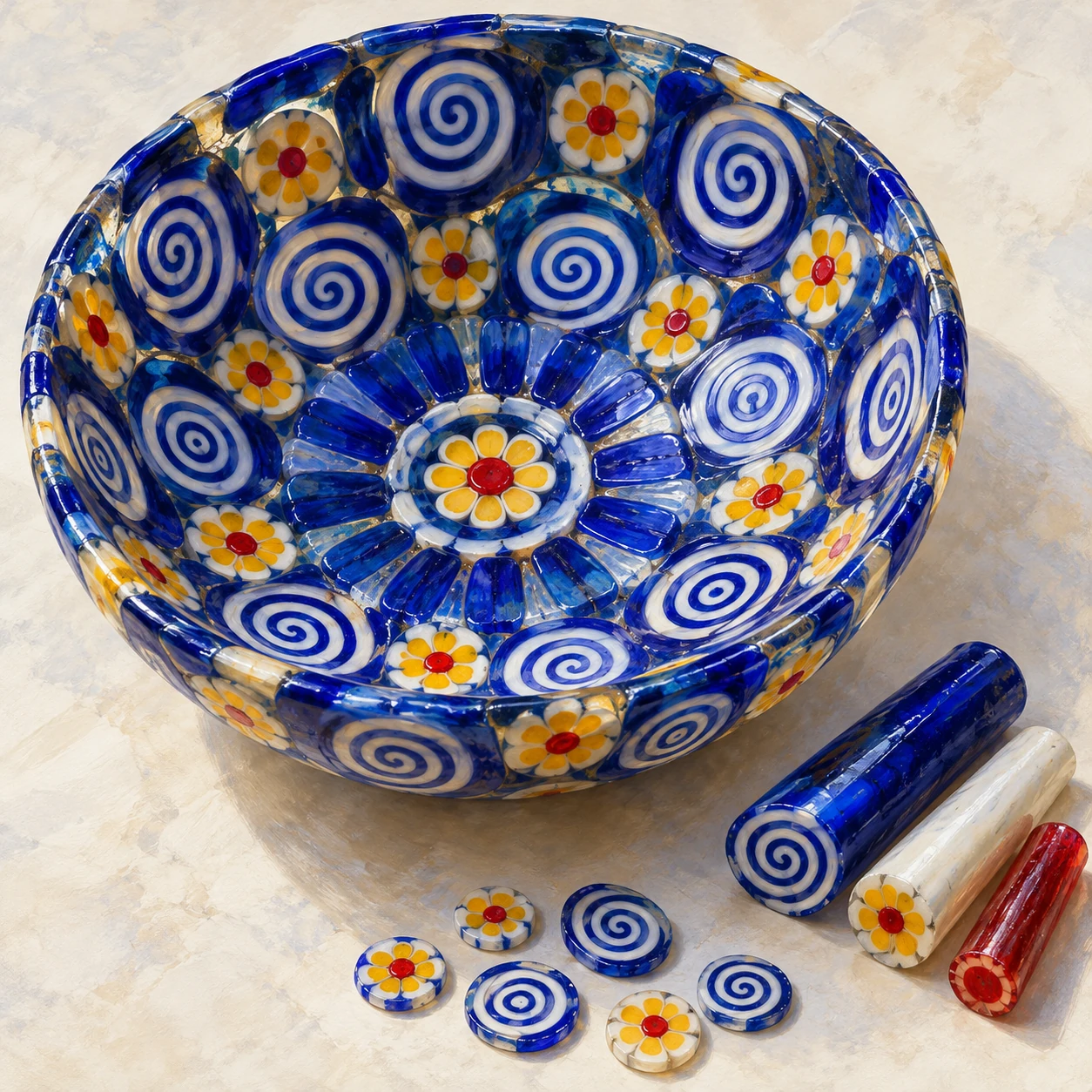
An original blue mosaic-glass bowl with white spirals and flower-like cane patterns beside short cane pieces and slices.
Conceptual glassmaking study with an original pattern. It is not a museum artifact or a measured process diagram.

A flower seems to repeat inside the wall of a glass bowl. It is not painted on the surface. The pattern can run through a slice of a colored cane, and many slices can be fused into the vessel. The image begins along a rod, becomes a cross-section, and finally enters a curved surface.

Ancient mosaic glass turns that sequence into something you can still read. Its delight is not only the color. It is the way a small pattern can survive being assembled, heated, stretched, cut, rearranged, and shaped.

A pattern has a length before it has a surface

The Corning Museum of Glass’s account of early techniques describes mosaic glass made by arranging small cut pieces or lengths of canes and fusing them into vessels or inlays. This belongs to a range of ancient approaches, rather than a single unchanging recipe for every patterned object.

Corning’s explanation of mosaic glass and glass mosaic offers a helpful distinction. Bundled colored rods can be fused and drawn out so that their internal pattern becomes smaller. Cross-sections then carry that pattern. In a glass mosaic made with separate pieces set in a binder, by contrast, the pieces need not become one fused glass body.

The terminology can be confusing because both results look like collections of small colored units. Ask how the units are joined. Heat-fused glass and pieces held by cement are different constructions even when both involve a mosaic-like visual logic.

One museum bowl makes the process concrete

The Walters Art Museum’s small patella, object 47.185, is dated to the first century BCE–first century CE. Its description identifies red, blue, and white glass discs fused and shaped over a form. Instead of imagining a painter placing each colored dot on a finished bowl, imagine pattern-bearing material being assembled before the final curved shape emerges.

The Smithsonian’s mosaic glass bowl is likewise cataloged through its making terms: slumped, polished, and applied mosaic glass. Technical vocabulary becomes useful when it prompts a question about the surface. Which parts of the appearance belong to fused units, which to shaping, and which to finishing?

A whole vessel can conceal the work particularly well. In a photograph of a fragment, an exposed edge may help show that color occupies the material, rather than merely sitting on top. The inference should still be checked against the catalog. A colorful broken edge alone is not a complete laboratory identification.

Why drawing out a pattern is such a clever move

Consider the design problem in ordinary paper. If you need a hundred tiny identical flowers, drawing each at final size is demanding. If you can make one larger cross-sectional pattern that continues along a length, every slice inherits a version of it. The practical glass process involves heat and the behavior of different glasses; the conceptual economy is repetition through a structured material.

This does not make the final bowl automatic. The arrangement of slices, control of heat, shaping, and surface finishing introduce further decisions and possible failures. “It is just sliced rods” is as incomplete as saying a woven picture is just threads.

Corning’s Roman glass gallery places mosaic vessels alongside the later possibilities of glassblowing. New techniques changed production and forms, while older approaches could continue. A technological history need not be a simple race in which one method instantly replaces everything before it.

A cold model you can safely make

Use soft modeling material in three colors, or rolled strips of paper if that is what you have. Keep the design your own: a dot inside a ring, a simple spiral, or a few stripes.

  1. Build a thick short bundle with a visible pattern at its end.
  2. If using soft material, gently lengthen it while trying to keep the internal arrangement. Observe where the pattern distorts. With paper, simply make a second smaller bundle to compare scale.
  3. Use the repeated ends or drawn copies to arrange a circular “bowl surface” on paper.
  4. Rotate several units. Notice when repetition becomes a new larger pattern.

This is a room-temperature model, not a glassmaking procedure. No heating or cutting glass is involved. It shows only the relationship between a cross-sectional pattern and a surface assembled from repeated units.

To make the exercise more revealing, impose a limit of three colors and six units. Fewer choices force attention onto orientation and placement. A small variation can make the overall arrangement feel orderly, flowing, or deliberately uneven.

There is a useful difference between repeating a unit and repeating its placement. Identical slices can make a varied surface when rotated or separated by other pieces. Conversely, different units can be organized into a regular rhythm. In your paper arrangement, change only orientation, then only spacing. The two results help you see why a vessel’s larger composition cannot be explained by the cane design alone.

Not every repeated unit is a little disc

The flower slice is a helpful entrance to mosaic glass, but it should not become the only construction we imagine. Corning’s Lace Mosaic Bowl, 66.1.217, uses spirally twisted canes laid side by side and sagged in a mold. Its catalog describes fifty-seven canes and an added rim arrangement. Instead of a surface made entirely from flower-like cross-sections, this vessel lets lengths of patterned material help form the bowl.
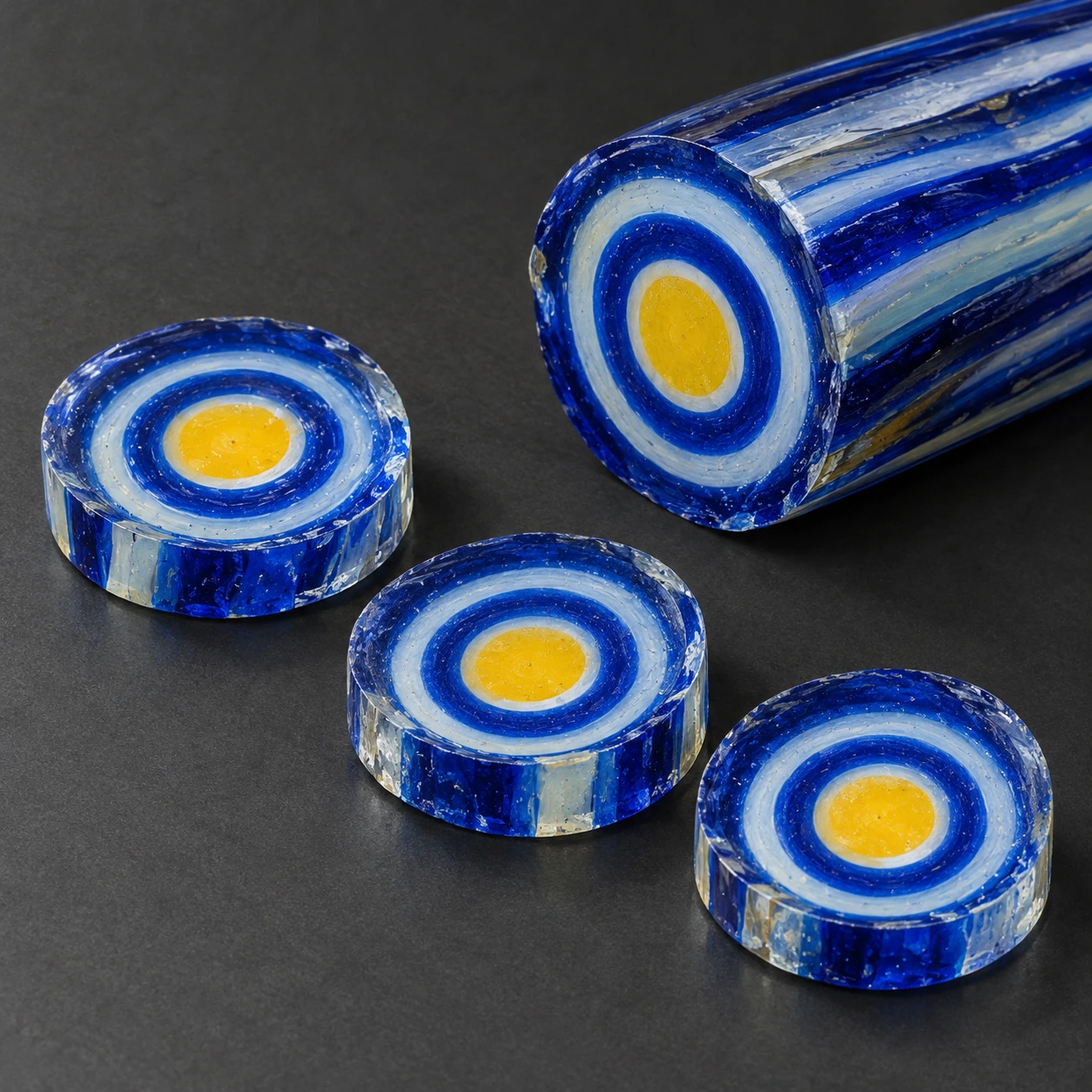
Patterned blue and yellow glass cane beside three matching cross-sectional slices.
Conceptual cane study with an original pattern, not excavated pieces.

A second Corning object, Bowl with Ribs, 55.1.78, is cataloged as mold-pressed mosaic glass with polishing and a rim rounded by grinding. The museum also records substantial weathering. Those descriptions make several stages visible: preparing patterned material, bringing it into a vessel form, finishing surfaces, and the later alteration that affects what we can see now.

Compare the two records using three verbs: assemble, shape, finish. Put each cataloged action under the appropriate heading. If an action could affect more than one stage, note the ambiguity rather than forcing it into one box. “Polished” concerns a worked surface; it does not, on its own, explain how the patterned glass first became a bowl.

For a room-temperature thought experiment, arrange six pencils side by side and look at their lengthwise stripes. Then compare that view with their exposed ends. The same bundle has different patterns depending on which surface you inspect. Nothing here models hot glass behavior, and no cutting is needed. The point is to notice the distinction between a repeated length and a repeated cross-section.

Now return to a museum photograph and choose a patch of decoration. Ask whether its visible structure looks like a slice, a longer strip, a twisted length, or a feature you cannot confidently classify from that image. Check the institution’s description before assigning a process. Appearance can generate a hypothesis; the technical record can support or revise it.

The exercise also helps explain why an exposed edge or a weathered patch can be informative without becoming a perfect window into manufacture. Later alteration may reveal, obscure, or distort the very feature you want to read. A process account is strongest when it brings the whole form, the local surface, and the museum’s technical observations together.

The result is a wider vocabulary for enjoying patterned glass. Repetition can travel along a cane, across a slice, around a rim, and through a shaped vessel. Following those different directions reveals more ingenuity than treating every colorful bowl as one version of the same recipe.

Read the bowl in both directions

When you return to a museum image, read from the center outward, then reverse direction. Do units keep the same scale? Are they aligned with the rim, or do they seem to move independently? Where does a pattern stretch or disappear around the curve? These questions let the vessel disclose its making without pretending that every visible variation has an obvious cause.

Also read the object’s date separately from its later collecting history. A modern label such as “millefiori” may help describe a pattern to today’s viewer, but it should not be treated as the ancient maker’s own vocabulary.

The bowl’s achievement is a chain of transformations held in one surface. Once you see the little flower as a slice of a longer structure, a decorative object becomes a compact lesson in how people design not only images, but materials capable of carrying images through the work of making.

Sources and a closer look

Corning Museum of Glass: origins of glassmaking; Corning: mosaic glass versus glass mosaic; Walters Art Museum: patella 47.185; Smithsonian: mosaic glass bowl; Corning: glass of the Romans.

Find more art, ideas, and unexpected connections at Incoprea.

Wednesday, October 14, 2026

Herculaneum Scrolls: Reading a Library Without Opening Its Pages

A carbonised Herculaneum scroll can resemble a piece of charcoal, yet its interior may still contain pages of writing. The eruption of Vesuvius in 79 CE transformed papyrus into an object too fragile to open in the ordinary way. Physical access and intellectual access became painfully difficult to reconcile.

Virtual unwrapping changes that relationship. The scroll can stay closed while researchers scan it, identify its internal surfaces and construct flattened views. Reading is no longer dependent on pulling the original layers apart. But the journey from a scan to a philosophical argument still has several distinct stages.

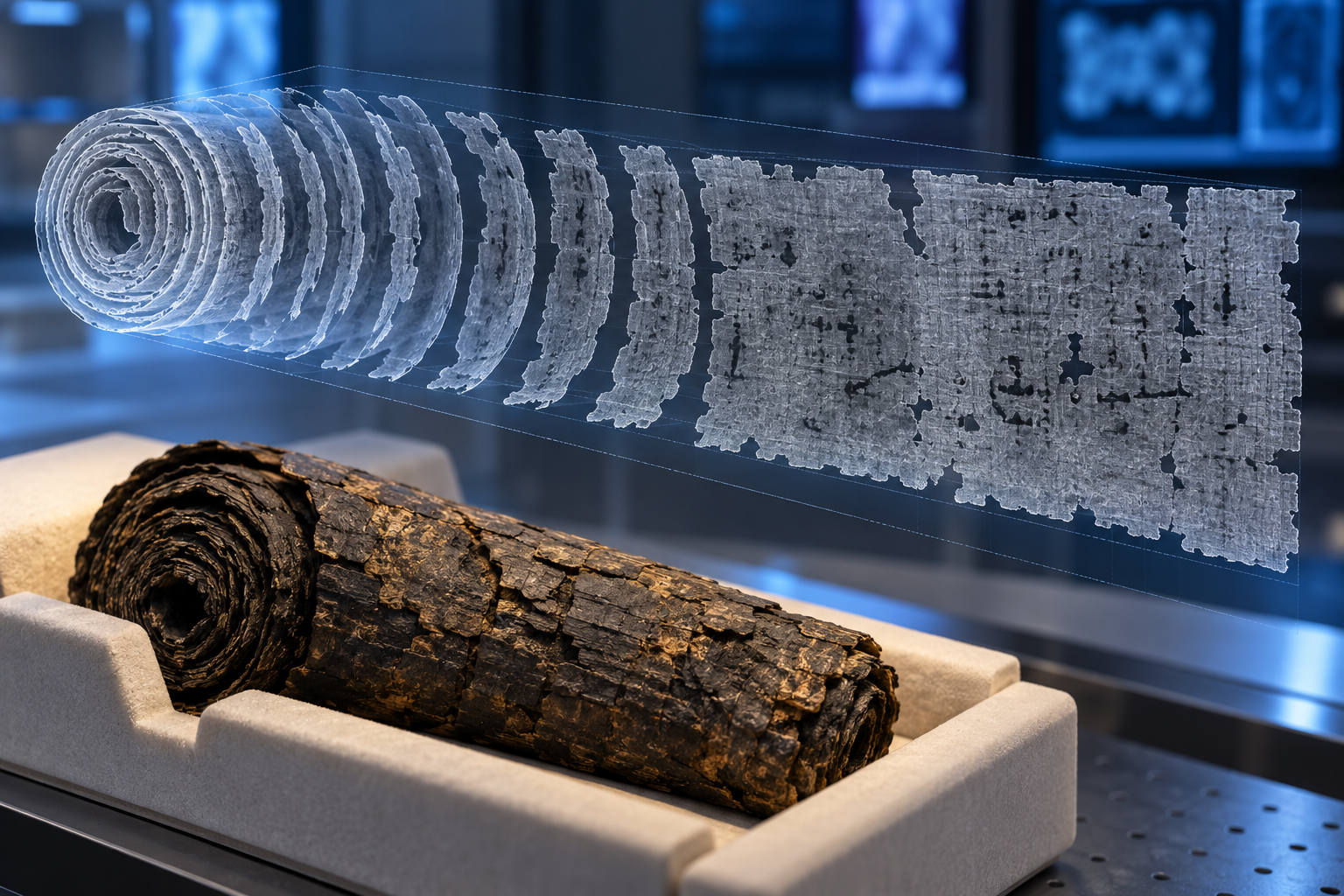
A conceptual carbonized scroll rests in a cradle beneath an abstract visualization of digital layers flattening.
Conceptual illustration of virtual unwrapping. The scroll, scan layers and marks are invented visual examples, not actual scan data or recovered text.

First find the page inside the object

X-ray computed tomography combines many projections into a three-dimensional representation. For a damaged roll, the result is not automatically a set of readable pages. Researchers first have to identify surfaces within a compressed and distorted volume.

That task is called segmentation. Think of following one crumpled sheet through a dense stack without accidentally crossing into a neighbouring sheet. Breaks, folds and close contacts complicate the route. An error can affect how marks relate to one another in the flattened view.

The EduceLab-Scrolls methodology makes verification central to this work. The aim is to preserve a traceable relationship between a recovered surface and the scan data. A compelling image is useful only if researchers can investigate how it was obtained.

Then distinguish the writing

The ink presents another difficulty. Carbon-based ink and carbonised papyrus can be hard to separate in X-ray data. Machine-learning methods can identify subtle evidence associated with writing, but they must remain connected to measured features.

A model producing a plausible ancient-looking sentence would not solve the problem. The task is to recover evidence of marks that were on the object. Language knowledge can help assess a reading, but cannot replace the material basis for the letters being proposed.

This is why a flattened image, a transcription and a translation should be distinguished. The first presents a recovered surface. The second identifies letters and gaps. The third interprets the words. Progress at one stage enables the next without making its judgements automatic.

Follow the change from a first image to sustained text

The Vesuvius Challenge began in 2023, helping accelerate work through shared data and collaborative problem-solving. In February 2025, the Bodleian Libraries announced an image of the interior of PHerc. 172, one of its Herculaneum scrolls. The announcement described both the technological achievement and the continuing work of reading.

A June 2026 University of Kentucky report documented a further scale of recovery. Researchers had virtually unwrapped the surviving portion of PHerc. 1667, yielding nearly one and a half metres of text across approximately twenty columns. It also reported more than seventy recovered columns from PHerc. 172.

The phrase surviving portion matters. Recovering all of a present fragment is not necessarily recovering an entire ancient book. A count of columns is meaningful when attached to a particular scroll and state of preservation, rather than used as a total for an imagined complete library.

What a title can change

The 2026 report included identified titles associated with Philodemus, including “On Gods, Book 8.” Other recovered material raised a possible Stoic attribution, with the scholars explicitly treating authorship as an open question. The source contains both firm identifications and proposals, and they should be read differently.

A title can connect a recovered passage with a work known incompletely or not otherwise surviving. A continuous stretch of text can reveal how an argument develops across columns. Those gains are different from the excitement of recognising one isolated word.

The new material therefore returns attention to scholarship: the ordering of claims, the meaning of terms, relationships with other writings and the reconstruction of damaged passages. Technical recovery opens a door; trained readers still have to work through what is behind it.

Watch a surface become legible

The University of Kentucky's June 2026 feature includes a film of the virtual unwrapping. Watch once for the geometry: volume, surface and flattened view. Then watch again for the distinction between seeing the surface and recognising its writing.

  1. Where does the presentation show the physical roll or scan volume?
  2. How is a particular internal surface selected and followed?
  3. When do marks appear in an image that a reader could begin to inspect?
  4. Which later steps—transcription, restoration and translation—are not settled by the animation alone?

This viewing task is more useful than imagining an invisible hand peeling the scroll open. The digital method creates a representation; the original remains physically closed. Its success depends on relating the representation back to the measured object.

Preservation and access can support one another

A digital surface can be shared and revisited without repeatedly handling the fragile original. Researchers can compare readings, improve algorithms and return to difficult areas. The stored scan also gives later methods something to reconsider.

Yet a scan does not eliminate conservation. The object remains the source of the evidence, and its condition matters for both present and future examination. Nor is a first successful reading a final edition. Better documentation can improve access while making disagreements more precise.

The Herculaneum scrolls change the meaning of a surviving library. These books had endured physically while remaining largely inaccessible as texts. Virtual unwrapping lets preservation and reading meet again, one documented surface and carefully examined passage at a time. The achievement is not simply that a machine sees through charcoal. It is that a community of researchers can recover evidence without sacrificing the pages it hopes to understand.

Sources and further reading

Explore more art, stories and discoveries at Incoprea.

Ugaritic: An Alphabet Written With Cuneiform Wedges

A tablet covered in wedges can make us expect a writing system with hundreds of signs. At Ugarit, some of those wedges do a different job. A compact set of signs records the local language alphabetically, while other scribes in the same city use the older, more elaborate traditions of Akkadian cuneiform.

The surprise is a useful one: a writing tool does not dictate a single way of representing speech. Pressing a stylus into clay can serve several languages and several systems. Once those distinctions are visible, an ancient tablet becomes more than an example of something called cuneiform.

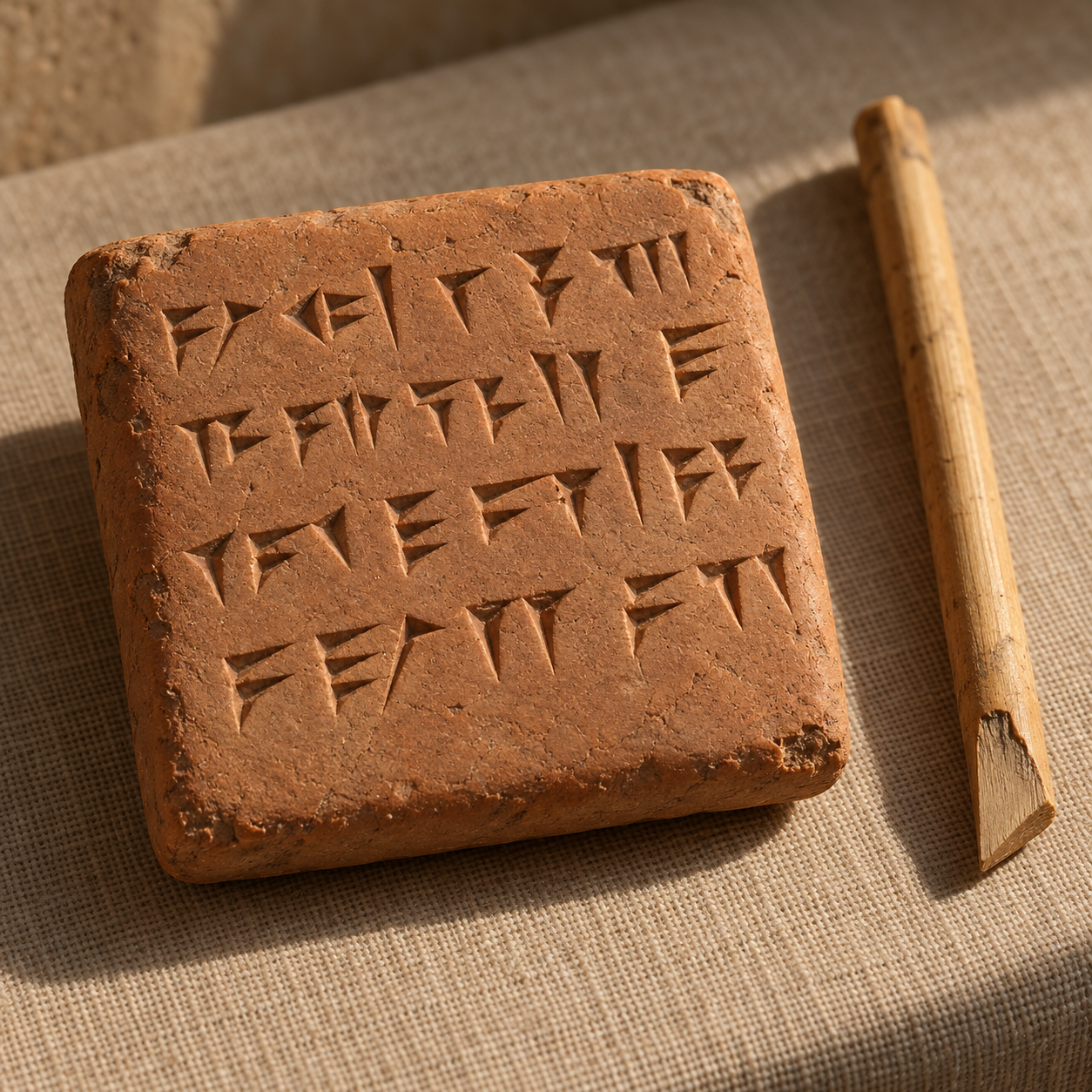
An interpretive clay tablet with wedge-shaped marks rests beside a stylus.
Illustration inspired by alphabetic cuneiform. The marks are illustrative, not a transcription, authentic inscription or readable Ugaritic message.

Three questions hidden in one label

Ask separately about the material, the script and the language. Clay is the writing surface. Cuneiform describes the wedge-shaped impressions. Ugaritic is both the name given to the local language and, in a related use, to its alphabetic writing. These labels answer different questions.

The distinction is familiar in modern life. English and Spanish can use the same letter shapes without becoming the same language. A language can also be written in different scripts. The Ugaritic case adds a further possibility: a similar-looking technique can support systems organised at different levels of sound.

Ugarit, at modern Ras Shamra on Syria's Mediterranean coast, belonged to a multilingual Late Bronze Age world. Its documents include administration, correspondence, legal material, literature and scribal exercises. The city is valuable for studying what writing did in practice: record, communicate, teach and preserve texts within a particular society.

What the thirty signs represent

The standard long Ugaritic alphabet has thirty signs. Specialists often call it an abjad, or a chiefly consonantal alphabet. This wording avoids suggesting that vowels are represented in the same regular way as in English. Three signs associated with the glottal stop introduce additional vowel-related distinctions, so the simple slogan “no vowels” also needs care.

By contrast, the Akkadian cuneiform tradition combines signs with syllabic and word-sign functions. The difference lies in what a sign represents, not in whether its wedges look horizontal or vertical. Similar materials and tools can conceal very different relationships between mark and speech.

Mnamon, the scholarly guide maintained by Scuola Normale Superiore, also describes rarer alphabetic forms at Ugarit: a shorter set and an alphabet with another ordering tradition. The thirty-sign system is the central reference point, but it should not erase all variation. Even a letter list has a history.

A school exercise that became evidence

An abecedary is a sequence of letters in order. The French Ministry of Culture's account identifies tablet RS 12.033 as the first complete Ugaritic abecedary discovered, found during Royal Palace excavations in 1948. Other examples have supplied comparisons. Their repeated sequences helped confirm which marks belonged to the alphabet and how they were ordered.

The small educational object thus works at two scales. For an ancient learner, an ordered sequence could support practice and recall. For modern researchers, comparison across sequences can help distinguish a letter from a damaged shape or a variant. Repetition makes the tablet informative without turning it into a bilingual dictionary.

The ministry's discussion places such exercises within scribal learning and notes examples from palace and private archives. An alphabet was teachable, but a short inventory by itself does not establish how many people could read. Access to teaching, the uses of texts and the organisation of a community matter too.

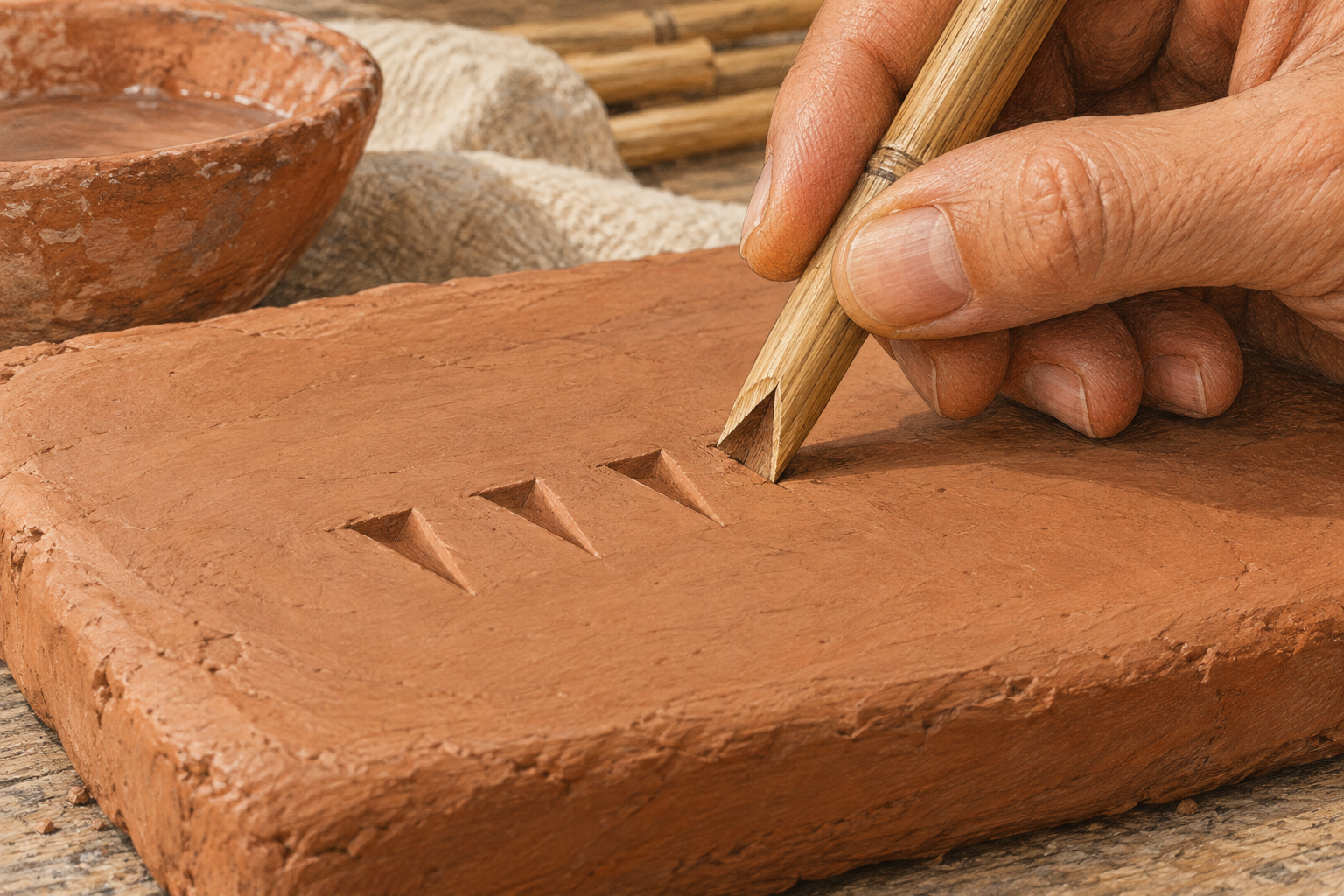
A hand presses a shaped stylus into clay beside a few wedge impressions.
Explanatory illustration of making wedge impressions in clay. The marks do not form an authentic inscription, and the hand and tool are interpretive.

A wedge is made by an action. Angle, pressure and spacing turn a tool into an impression. In an authentic tablet, those features may help a specialist recognise a sign or a hand. The explanatory image above isolates that physical process; its marks are not a passage to translate.

Look at an alphabet without pretending to read it

Open the Ministry of Culture's RS 12.033 feature. The page is in French, but the named tablet and discussion provide a precise starting point. Use the catalogue identifier when following links: an incomplete abecedary is not interchangeable with this complete example.

Begin with three observations. Notice the division into lines. Choose one cluster and count the impressions you can actually distinguish. Then look for a cluster elsewhere whose arrangement differs. Do this before consulting a sign chart, so that a modern label does not decide in advance what you think you see.

Keep the evidence layers separate
LayerWhat it can establish
PhotographVisible impressions, damage, spacing and layout.
Sign identificationWhich impressions form a letter and which variants count together.
Ordered comparisonWhere a letter belongs in an attested sequence.
Language analysisSound values, grammatical relationships and meanings in texts.

The steps build on one another. A photograph does not supply pronunciation by itself. Equally, the inability to pronounce a sign does not prevent a careful observation about its position. That is a useful antidote to the idea that an unread ancient object offers only mystery.

An important alphabet without a race for first place

The alphabet has a complicated early history. Penn Museum's discussion of that history emphasises scattered evidence, changing interpretations and the difficulty of tracing continuity. Giving Ugarit the title “the first alphabet” would flatten that wider story and obscure what makes its evidence distinctive.

Its achievement is interesting on its own terms. Alphabetic writing was adapted to a clay-and-stylus environment and used alongside other established systems. An abecedary lets us see the organisation being taught, while other documents show writing doing work beyond the classroom.

Return to the opening tablet and the wedges look different. Their shape no longer tells you the entire story. The better questions are what the signs encode, which language a writer chose, who learned to make them, and what the finished object was expected to accomplish.

Sources and further reading

Explore more art, stories and discoveries at Incoprea.

Famous Last Meals is now in paperback — stories, history and 25 recipes

Famous Last Meals: Stories, History, and Recipes is now available in paperback on Amazon. The illustrated collection brings together 23 his...